Teisco
Spectrum 5
Five colored buttons, stereo out, and a Japanese badge nobody took seriously. Mark Knopfler ended up with three.
1966. Teisco’s new catalog lands in American shops with a flagship that looks like a surfboard and wires like a radio. The copy promises features “which no other guitar in the world can match.” Most of America isn’t ready to believe that about a guitar from Japan.
- Introduced
- 1966
- Type
- Solidbody electric
- Class
- Production
Have a photograph of this guitar? Send a picture
The short version
1946
Teisco begins
Atsuwo Kaneko and Doryu Matsuda start the company in Japan.
1966
The Spectrum 5
Teisco’s new top of the line. Three split pickups, five colored switches, stereo.
1967
Kawai buys Teisco
Production of the Spectrum 5 moves to Kawai’s factory in Hamamatsu.
1969
Name dropped
Kawai stops putting Teisco on export guitars. Spectrum 5s trickle on into the early ’70s.
1990
On a magazine cover
Eddie Van Halen poses with a red Spectrum 5 as Guitar World’s Player of the Decade.
2004
Knopfler finds one
A sunburst Spectrum 5 from a Pennsylvania shop goes on Shangri-La.
2007
Radiogram buttons
A red one records “True Love Will Never Fade.”
Side A
A1
Made in Japan, 1966
In 1966 “made in Japan” still carried a stigma in America, no matter how well the guitar was made. Teisco already filled the department-store racks. Nobody was looking to it for a flagship.
So Teisco built a guitar that couldn’t be mistaken for a cheap one. The Spectrum 5 was the top of the line, and the catalog wasn’t shy about it: it “has unique features which no other guitar in the world can match.”
That’s a big thing to say. It took the rest of the world a long time to agree.
A2
Five buttons and two jacks
Start with the pickups. There are three, but each one is split in two and staggered, so the catalog had to explain that you were looking at “what appears to be six pick-ups.” Under the strings sit five little colored switches, like the buttons on a hi-fi.
Teisco sold those switches as a “spectrum of sound,” five tone colors you could use alone or together. Others treat each one as a preset: bass cut, out of phase, single-coil, humbucker, and a hotter humbucker. Depends who you ask how they’re meant to work, and honestly, you’ll figure out your favorite in about ten minutes.
Then there are two output jacks. Run it in stereo and the bass strings go to one amp and the treble strings go to the other. In 1966 that was pure space-age showing off. It still is.
The body is an offset double-cut with a carved edge borrowed from Mosrite. The catalog promised seven coats of hand-rubbed lacquer, and metallic blue is the color you see most. The vibrato is its own design: the bridge rides along with the tailpiece, so the strings don’t saw back and forth across the saddles when you use the arm.
A3
Kawai takes over
It wasn’t cheap. One 1967 catalog listed it at $375, which kept it off a lot of counters, and a mail-order book the same year had it for $199.98. The paperwork doesn’t agree, and I’m not going to pick.
In 1967 Kawai bought Teisco and moved production to its factory in Hamamatsu. By 1969 the Teisco name was gone from export guitars. Spectrum 5s kept coming out of the factory into the early 1970s, and by then the price had fallen into the mid-$100s.
Kawai reissued it in Japan in the early 1990s, and they got it right. One writer called them “perfect reissues,” and they’re about as hard to find as the originals.
One warning if you go shopping. The Spectrum 4 looks like a close cousin, but it has four pickups, an ordinary vibrato, and no stereo. The colored buttons and the two jacks are what make it a 5.
Flip the record · By the numbers
5
Colored switches, each a different color of sound. That’s the “spectrum.”
6
Pickup coils, in three staggered split pickups. The catalog admits it looks like six pickups.
7
Coats of hand-rubbed lacquer, according to the 1966 catalog.
$375
One 1967 catalog price. A mail-order book the same year had it at $199.98.
Side B
B1
“Get a proper guitar”
Andy Fairweather Low saw Ry Cooder with one on television and asked the Who’s guitar tech, Alan Rogan, to find him one in America. He used it briefly with Eric Clapton in the early 1990s, until, after a show at the Albert Hall, Clapton told him: “Put it away and get a proper guitar.”
He did, at least on Clapton’s stage. But he still brings one out for Christmas shows with Gary Brooker. He runs it in mono. His verdict: “Bits of LEGO.”
Eddie Van Halen held a red Spectrum 5 on the cover of Guitar World in February 1990. That’s a photo, not his first guitar. His first was a four-pickup Teisco from a department store, and people mix them up constantly.
B2
An old Japanese thing
In January 2004 Mark Knopfler bought a sunburst Spectrum 5 at a shop in Coatesville, Pennsylvania. Weeks later, in Malibu, he played it alongside a nylon-string guitar on “Postcards From Paraguay.” Then he kept going. A candy-apple red one recorded “True Love Will Never Fade” at his own studio in London. An ivory one he found in Nashville played the part in the video.
On BBC Radio 2 in 2007, Johnnie Walker asked about the “fancy guitar with a row of coloured buttons.” Knopfler said:
Yeah with the radiogram buttons on it… yeah that’s an old Japanese thing.
In 1966, “Japanese” was the word the Spectrum 5 had to live down. By 2007 it was just how Mark Knopfler described the guitar he’d made his record on.
Put this on
You’ve read about it. Now hear it. Here’s what this guitar sounds like, and what to listen for.
Postcards From Paraguay
Knopfler’s sunburst Spectrum 5, paired with a nylon-string Ramirez. He’d bought the Teisco only weeks before the sessions.
Find it on YouTube (opens in a new tab)True Love Will Never Fade
Recorded on a candy-apple red Spectrum 5. (The ivory one in the video is a different Spectrum 5, used for the cameras.)
Find it on YouTube (opens in a new tab)Trash Man
Ray’s solo on this B-side uses the Spectrum 5’s stereo split, so the inversions jump from one amp to the other.
Find it on YouTube (opens in a new tab)
The cast
The people, and the specific guitars, that made the legend.
2004
Mark Knopfler
Sunburst, red, and ivory Spectrum 5s
The sunburst on Shangri-La, the red on “True Love Will Never Fade,” the ivory for the video.
early 1990s
Andy Fairweather Low
Two Spectrum 5s
Played one briefly with Eric Clapton. Still brings one out for Christmas shows with Gary Brooker.
’66 or ’67
Brian Ray
A candy-colored Spectrum 5
His guess at the year. Used the stereo outputs on “Trash Man.”
Ry Cooder
A Spectrum 5, on TV
Fairweather Low saw him with one on television and went looking for his own.
1990
Eddie Van Halen
A red Spectrum 5, for a cover
The Guitar World Player of the Decade cover. His first guitar was a different, four-pickup Teisco.
Nils Lofgren
Spectrum 5
Photographed with one. That’s as far as the paper trail goes.
Liner notes
Specs, construction, rarity, value, and every source we used.
Three staggered split pickups, five colored switches, and a stereo/mono pair of jacks — Teisco’s Spectrum 5, not a Spectrum 4.
- Body
- Offset double-cut; Mosrite-inspired German carve. Catalog / Vintage Guitar / Guitar Player: mahogany. RetroFret’s 1967: hardwood. Mix flagged.
- Neck
- Bolt-on; 4×2 headstock. Catalog / Vintage Guitar / Guitar Player: five-ply ebony, unique to the 5. Premier Guitar and RetroFret 1967: maple. Mix flagged.
- Fingerboard
- Catalog / Guitar Player: ebony, Kay-influenced “parachute” / club markers, 22 frets plus a zero fret. RetroFret 1967 and many surviving examples: rosewood. Mix flagged.
- Scale
- RetroFret 1967: 24½" (622 mm). 1992 Kawai reissue (RetroFret): 24¾" (629 mm). Mix flagged.
- Pickups
- Three staggered split single-coils (six coils). 1966 catalog: “what appears to be six pick-ups… three split pick-ups to produce stereo.”
- Hardware
- Integral bridge/vibrato; the bridge moves with the tail. Chrome cover. 4×2 tuners.
- Electronics
- Five colored self-canceling switches; volume and tone; stereo/mono switch; two output jacks. Catalog: a volume per channel.
- Finish
- Seven coats of hand-rubbed lacquer (1966 catalog). Metallic blue typical (Premier Guitar). Red, sunburst, and ivory exist.
- Nut
- RetroFret 1967: 1 9/16" (40 mm). 1992 reissue: 1 11/16" (43 mm). Mix flagged.
Open the full research fileConstruction details, the complete player record, production numbers, dated value estimates, and sources
Classic living example = 1966–69 Teisco Spectrum 5 (Japan; Teisco Del Rey on U.S. badges). No current Teisco guitar SKU this pass: teisco.com is BandLab pedals (fetched 18 September 2026). Spectrum 4 is four pickups, mono, ordinary Japanese vibrato (Vintage Guitar). Spectrum 22 is the two-pickup sibling. Spectrum bass is a bass. Eastwood Spectrum 5 Pro is another factory; the product page did not serve this pass. 2015 Ikebe and early-1990s Kawai reissues are closed runs, not this table. Mixed inch/mm flagged on RetroFret’s 1967: overall 41" (104.1 cm), lower bout 14¾" (37.5 cm), depth 1⅜" (3.5 cm), scale 24½" (622 mm), nut 1 9/16" (40 mm); Christie's body length 17¼" (43.5 cm). Do not average 24½" / 24¾".
Construction
The job was a Japanese solidbody that could sit on a counter next to a Strat without copying one. Teisco already filled the department-store racks. This one was the deluxe.
Vintage Guitar (Michael Wright): debuting circa 1966, a few years only, top of the line. The 1966 Teisco Del Rey catalog is in that piece: the Spectrum 5 “has unique features which no other guitar in the world can match.” Premier Guitar (Wizard of Odd, 12 September 2022): around late 1966; $375 in the 1967 Bennett Brothers (Blue Book) catalog. guitar-list cites Alden’s 1967 mail-order book at $199.98. Keep both period lists. 1960s money, not 2026 street. This plate starts in 1966.
Who built it is split. Wikipedia: Atsuwo Kaneko and Doryu Matsuda, 1946; Teisco Co. 1964; Kawai bought the brand in 1967 and dropped Teisco on export guitars in 1969 (1977 in Japan). Premier Guitar: one of the first designs Kawai built after the purchase, production moved to Hamamatsu. Wright’s 1966 catalog sits before that sale. Keep 1966 and Kawai. Christie's dates surviving examples circa 1966–1969. Premier Guitar has the factory still building them into the early 1970s, retail down into the mid-$100s. Keep the range.
The Spectrum series shared the silhouette. Wright: mahogany, German-carve edge, seven-layer lacquer, Kay-influenced inlays. The 5 is the one with staggered split pickups, stereo/mono, and the five-ply ebony neck. Four-and-two tuners show up on other Teiscos; the plastic headstock faceplate is the tasteful bit. Some heads are natural, some match the body.
The name is the switches. Catalog, via Wright and Guitar Player (Terry Carleton, 13 January 2022): five tonal colors, a “spectrum of sound,” alone or in combination; two jacks for stereo — bass strings one channel, trebles the other. Guitar Magazine Japan (25 August 2020) treats each colored switch as a preset: low-cut, out-of-phase, single-coil, humbucker, high-power humbucker. Keep both. Volume and tone on the guard. A stereo/mono slide. The 1966 catalog: a volume per channel.
The vibrato is its own assembly. Wright and Carleton: the bridge is integral and moves with the tail, two strips of tensile metal, so the strings do not saw the saddles. Premier Guitar: the chrome cover is as scarce as the guitar. RetroFret’s 1967, serial 256041: top-loaded bridge and vibrato as one unit, height and intonation on screws, maple neck, rosewood board, “mushroom” inlays. Catalog ebony versus maple/rosewood in the wild is the wood split. Do not pick a winner.
Not a Spectrum 4. Wright: four pickups, typical Japanese vibrato, mono only. David Lindley plays that one. Off this plate. Not a Spectrum 22. Two pickups, same German-carve family, other switches. Not Eddie Van Halen’s first guitar. That is a four-pickup Teisco Del Rey, usually filed as a WG-4L, bought at a department store. Other object.
Jack Westheimer’s Teisco Del Rey badge is on U.S. examples from about 1964 (Wright, Part II). Some UK/W.M.I. lists recatalog the 5 as Eliter (Teisco Twangers). Same guitar, other name.
Early 1990s. Kawai reissued the 5 in Japan. Guitar Player: “perfect reissues,” as hard to find as originals. RetroFret’s 1992: maple/rosewood, 24¾" (629 mm), nut 1 11/16" (43 mm). Acrylic-body examples exist as later objects. 2015 Ikebe original: maple/rosewood, 648 mm scale, Tune-o-matic, simplified slides, list ¥185,000 before tax (Digimart). Eastwood Spectrum 5 Pro: six-in-line headstock because of trademarks, Jaguar-ish tremolo, Fender-leaning pickups (Carleton). Other factories on this outline.
Classic vs current: 1966 Spectrum 5 — German-carve mahogany, three split pickups, five colored switches, stereo/mono — against no new Teisco guitar you can order in 2026. BandLab revived the name for pedals.
Players
Do not hang a Spectrum 4, a Spectrum 22, or a four-pickup Del Rey on this plate. Do not recruit Hound Dog Taylor’s Sears Teiscos or James Iha’s K-2L.
Mark Knopfler. The documented Spectrum 5 player. Christie's, 31 January 2024. Sunburst serial 194135, bought January 2004 at Neal’s Guitars in Coatesville, Pennsylvania; with a Ramirez on “Postcards From Paraguay” (Shangri-La, Shangri-La, Malibu, February–March 2004). Guy Fletcher photographed him with it outside the studio. Realised £32,760. A candy-apple red recorded “True Love Will Never Fade” (Kill to Get Crimson, 2007) at British Grove; Christie's story, £37,800. Ivory serial 220872, bought July 2006 at Sound Stage Studio, Nashville, is the official video guitar (British Grove, January 2007), not the tracking guitar; oneverybootleg compiling the sale: £30,240. BBC Radio 2, 16 September 2007, Johnnie Walker on the “fancy guitar with a row of coloured buttons”: Knopfler — “Yeah with the radiogram buttons on it… yeah that’s an old Japanese thing.” Celebrity lots. Not-comps.
Brian Ray. Guitar.com (4 April 2019): a candy-colored Spectrum 5 in the collection, “I think it’s a ’66 or ’67.” Split pickups, colored toggles, two jacks. Solo on the B-side “Trash Man” (with Steve Conte, Wicked Cool). He used the stereo split so inversions jumped amp to amp. Named guitar, named side. Which year inside ’66/’67 is his guess.
Andy Fairweather Low. MusicRadar (Jonathan Horsley, 31 January 2025), from a Guitarist YouTube sit-down: two Spectrum Vs. He saw Ry Cooder on television with one, asked Who tech Alan Rogan to find him one in the U.S. Used it briefly with Eric Clapton in the early 1990s; after the Albert Hall, Clapton: “Put it away and get a proper guitar.” Still plays one at Christmas shows with Gary Brooker. He runs it in mono. “Bits of LEGO.”
Eddie Van Halen. The February 1990 Guitar World cover — Player of the Decade — shows him with a red Spectrum 5 (MusicRadar; Eastwood’s captioned photo). That is a photograph of this model. It is not the first guitar. Do not mash them.
Also known to play stays short. Wright: photographs of Nils Lofgren with one. MusicRadar via Fairweather Low: Ry Cooder on TV. Wikipedia: Jim Reid of the Jesus and Mary Chain used a Spectrum 5 — Wikipedia’s claim, no session log here. None invented.
Rarity
You cannot buy a new Spectrum 5 from Teisco. The original run ended with the catalog. Kawai’s 1990s reissues, Ikebe’s 2015, and Eastwood’s Pro are other factories on this silhouette. They are not a 1966 5.
Teisco did not publish Spectrum 5 unit totals. None invented. Serial plates date a guitar. They don’t count a year. That is why a first-year census is unknown, not the chapter.
Wright: in 1966, “made in Japan” still carried a stigma in the U.S. no matter how well the guitar was made. Premier Guitar: the $375 Bennett Brothers list kept it off most counters, which is why originals are thin on the ground. Completeness is the scarce end: original vibrato cover, un-rewound splits, five working colored switches, Del Rey badge on the plate. Carleton has never seen a vintage white; Christie's still catalogued an ivory. Blue is the color Premier Guitar calls more common. Knopfler’s 194135, the True Love red, and 220872 are unique objects. They are not a vintage Spectrum 5.
Value
Informal estimate, 18 September 2026. Not an appraisal.
Ask vs sold labeled. Celebrity lots are not-comps. No invented medians or factory counts. Period $375 (Bennett Brothers 1967, Premier Guitar) and $199.98 (Alden’s 1967, guitar-list) are 1960s money, not 2026 street.
New street. None under Teisco this pass. teisco.com is pedals. Eastwood Spectrum 5 Pro product page unavailable (fetched 18 September 2026). Historical, not a 2026 cart: Guitar Player, January 2022, Eastwood “around $1,500”; Digimart Ikebe 2015 list ¥185,000 (tax exclusive).
Used modern. 1990s Kawai reissues trade used. Guitar Player 2022: about half the vintage asks of that moment. Named ask, not a 2026 hammer: RetroFret 1992 candy-apple reissue $2,500. Ikebe 2015 limiteds are a later object. Don’t invent a midpoint.
Vintage / collectible. Reverb Price Guide on Spectrum 5 (1966 Metallic Red, Good to Mint; product-page snippet this pass): $1,139–$2,223, based on 20 orders. Named solds on that same guide, not a series average: 11 December 2025 Excellent $2,350; 4 June 2025 Excellent $2,499.99; 10 April 2025 Excellent $1,750; 17 March 2025 Good $1,342. Guitar Player, January 2022: ’60s examples “fetching up to $5,000” — a 2022 ceiling, not a 2026 median. Do not average the Reverb band with that ceiling. Knopfler’s Christie's results (£32,760 / £37,800 / £30,240, 31 January 2024) are celebrity. Not a vintage Spectrum 5.
See also
- mosrite-ventures — the Bakersfield German-carve reverse Strat this Tokyo deluxe borrowed from
- fender-jaguar — Fender’s own stereo/split-coil offset; short scale, not this
- fender-jazzmaster — the offset silhouette this wavy double-cut is not
Sources
- Vintage Guitar, Michael Wright, Spectrum 5 — circa 1966 debut; 1966 Teisco Del Rey catalog quote; mahogany, German carve, seven-layer lacquer, Kay inlays; staggered stereo pickups and five-ply ebony unique to the 5; integral vibrato; Nils Lofgren photographs; Lindley on Spectrum 4
- Vintage Guitar, Michael Wright, Teisco Guitars, Part II — Teisco Co. 1964; Teisco Del Rey via Jack Westheimer circa 1964
- Premier Guitar, Wizard of Odd, Teisco Spectrum (12 September 2022) — late 1966; Bennett Brothers / Blue Book 1967 $375; Kawai / Hamamatsu claim; catalog ebony vs maple/rosewood example; split pickups, two jacks; tremolo cover; early-1970s continuation, mid-$100s; blue more common than red/white
- Guitar Player, Terry Carleton, Cool, Quirky and Collectible: the Teisco Spectrum 5 (13 January 2022) — catalog five tones / self-canceling switches; stereo split; integral vibrato; 22 frets, zero fret, five-ply ebony neck and board; one-piece mahogany; seven coats; 1990s Kawai reissues; Ikebe 2015; Eastwood ~$1,500; ’60s up to $5,000
- Guitar.com, Rare Guitars: Brian Ray’s vintage Teisco Spectrum 5 (4 April 2019) — ’66 or ’67; stereo split; “Trash Man”
- Christie's, Teisco Spectrum 5, serial 194135 — circa 1966–1969; sunburst; Neal’s January 2004; “Postcards From Paraguay”; body 17¼" (43.5 cm); realised £32,760 (31 January 2024)
- Christie's, The Mark Knopfler Guitar Collection — a Spectrum 5 realised £37,800, 31 January 2024
- Christie's, Teisco Spectrum 5, serial 220872 — ivory; Sound Stage Studio July 2006; True Love Will Never Fade video, not the tracking guitar; Johnnie Walker 16 September 2007 quote
- oneverybootleg, Mark Knopfler and his guitars — Teisco — compiling Christie's: 194135 £32,760; True Love red £37,800; ivory 220872 £30,240
- MusicRadar, Jonathan Horsley, Andy Fairweather Low on the Teisco Spectrum V (31 January 2025) — two Spectrum Vs; Cooder on TV; Alan Rogan; Clapton Albert Hall; Brooker Christmas shows; EVH Guitar World cover
- Wikipedia, Teisco — 1946 Kaneko/Matsuda; 1964 Teisco Co.; Kawai 1967; guitar brand 1969 export / 1977 Japan; Del Rey after 1964; Jim Reid Spectrum 5; BandLab pedals 2018
- Reverb Price Guide, Teisco Spectrum 5 — 1966 Metallic Red Good-to-Mint $1,139–$2,223 (20 orders, product-page snippet this pass); named solds Dec 2025 $2,350 / Jun 2025 $2,499.99 / Apr 2025 $1,750 / Mar 2025 $1,342; dedicated widget page bot-blocked this pass
- RetroFret, Teisco Spectrum 5 (1967), serial 256041 — candy apple red; maple/rosewood; 41" / 14¾" / 1⅜"; scale 24½" (622 mm); nut 1 9/16" (40 mm)
- RetroFret, Teisco Spectrum 5 reissue (1992) — 40½" / 13" / 1½"; scale 24¾" (629 mm); nut 1 11/16" (43 mm); ask $2,500
- Eastwood, Original Teisco Spectrum 5 vs. Eastwood Reissue (7 May 2018) — 1966 catalog quote; 6-in-line headstock; EVH photo caption; Cooder/EVH as celebrity users
- Digimart, Teisco IKEBE ORIGINAL Spectrum 5 (28 April 2015) — 1966 original; 1990s reissue; Ikebe 2015 ¥185,000; mahogany (alder on Tobacco Burst); maple/rosewood; 648 mm; 42 mm nut
- Guitar Magazine Japan, Teisco Del Rey Spectrum 5 (25 August 2020) — 1966–67 Del Rey export; German carve; six split coils; five switch presets
- guitar-list, Teisco Spectrum 5 — 1966 catalog block quote; length 41"; Alden’s 1967 $199.98
- Teisco Twangers timeline — Spectrum 5 in 1966; W.M.I. Eliter badge
- teisco.com — BandLab pedals, no guitar cart (fetched 18 September 2026)
- Reverb News, Carly Smith, BandLab announces Teisco and Harmony guitar reboots (14 December 2017) — brand reboot; living Teisco is not this guitar
Keep digging
Guitars this one gets compared to, confused with, or descended from.
- Send a picture
Mosrite
Ventures
1963
Semie Moseley offered Nokie Edwards the guitar free. He paid $200, and the Ventures dropped their Jazzmasters.
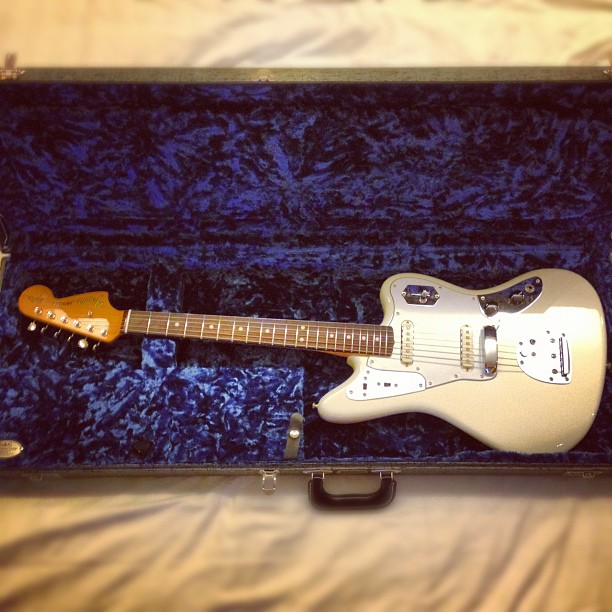
Fender Jaguar Johnny Marr signature. Photo by ToGa Wanderings. Licensed under CC BY 2.0. Via Wikimedia Commons. Fender
Jaguar
1962
It was the top of Fender’s catalog in 1962. By the late ’70s it was a pawn-shop guitar, and somebody’s only one.
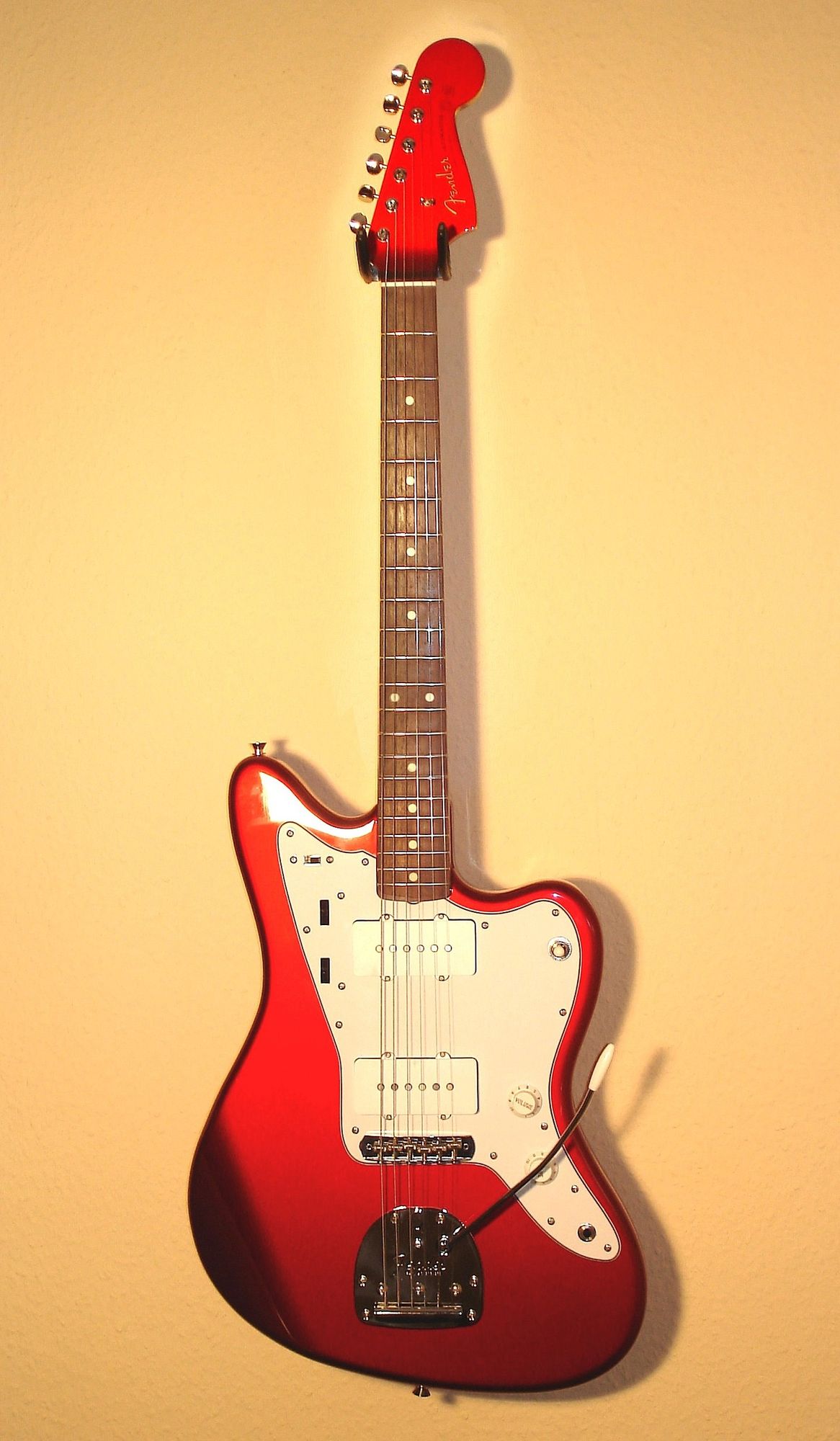
Photo: Dirk-X / Wikimedia Commons / CC BY-SA 4.0 Fender
Jazzmaster
1958
Fender built it for jazz players. Jazz players said no thanks. Surfers, punks, and noise bands said yes.