Ibanez
Iceman
Ibanez drew this one itself in 1975. When the lawyers made the copies go away, it got to stay.
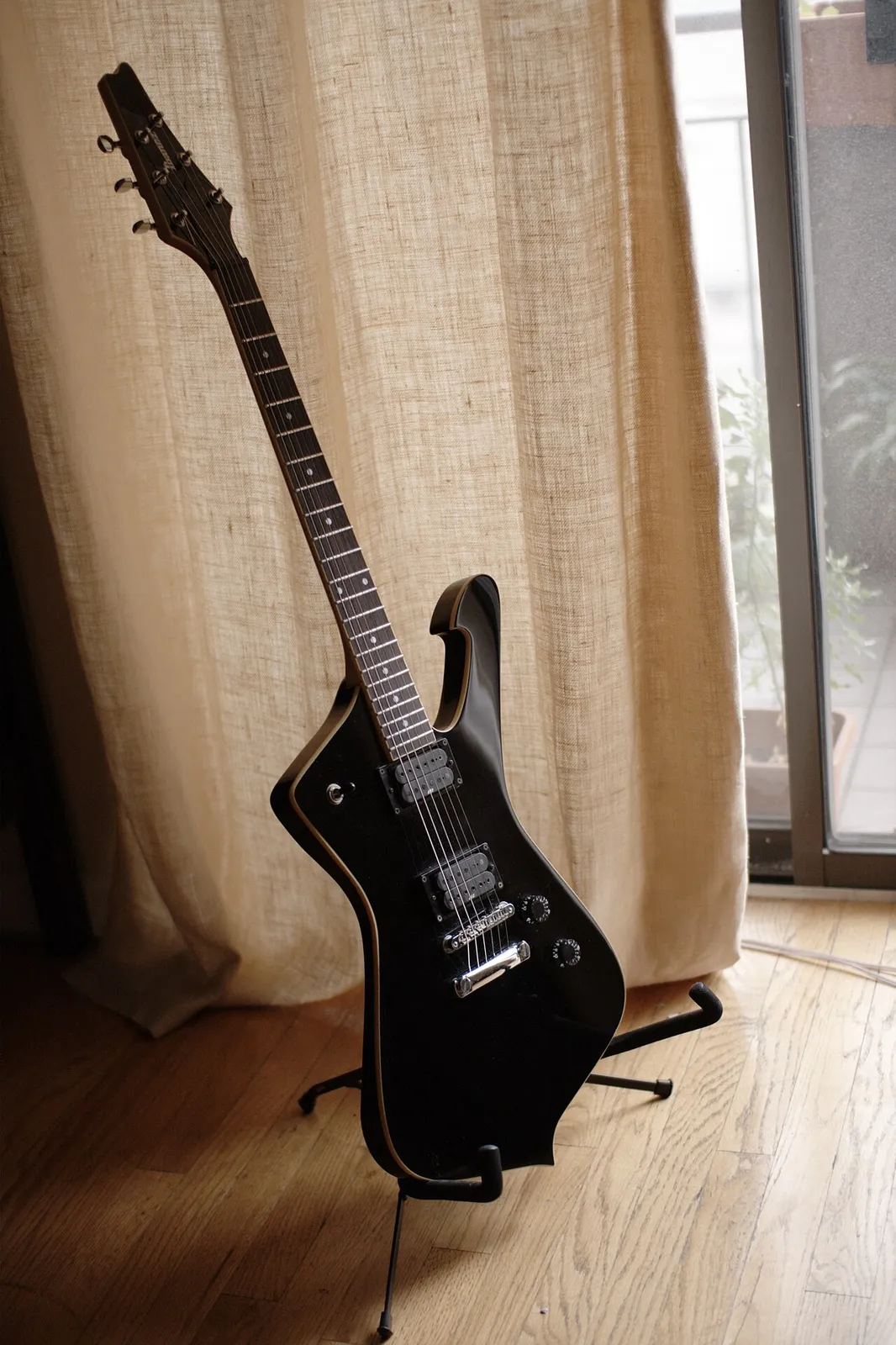
Nagoya, 1975. Ibanez is selling copies of American guitars. Meanwhile a designer named Fritz Katoh draws something that isn’t a copy of anything: a hooked horn, a pointed base, a long headstock. It goes into the catalog as model 2663. Nobody calls it the Iceman yet.
- Introduced
- 1975
- Type
- Solidbody electric
- Class
- Production
The short version
1975
Model 2663
A new Artist-series solidbody, first called the Flash, built at FujiGen.
1977
Book of Dreams
Steve Miller plays a triple-coil 2663 onstage and on the record.
1977
Gibson sues
The copy era starts to end. The case settles in February 1978.
1978
It gets a name
The catalog calls it the Iceman. Paul Stanley’s PS10 arrives the same year.
1982
Iceman II
Six tuners in a line instead of three a side. Some sources say 1983.
1992
Back in the catalog
After a break, the Iceman returns and stays.
2023
The IC420
Today’s standard Iceman, made in China, goes into production.
Side A
A1
The one that wasn’t a copy
In 1975 Ibanez was busy selling other people’s shapes. The Destroyer was an Explorer. The Rocket Roll was a Flying V. Those shapes belonged to somebody else.
The 2663 was different. Fritz Katoh designed the body in Nagoya, and it doesn’t look like a copy of anything, though you can see a little family resemblance if you squint. Picture a Firebird somebody gave a curved, pointed base, and then a hooked horn that looks borrowed from a Rickenbacker. A long three-a-side headstock on top. It was first called the Flash. It wasn’t the Iceman yet.
That doesn’t sound like much, a company drawing its own guitar. It turned out to matter more than anything else in that catalog.
A2
Three ways to buy a Flash
The 2663 came three ways. The plain one had two Super 70 humbuckers. Another had a single triple-coil pickup at the bridge and a four-way selector. The third had a triple-coil that slid, so you could move it along the strings.
The rest was proper guitar-building. A set neck, 22 frets, a 24¾-inch scale, and a stop tailpiece with a stylized cover over the bridge. As for the body wood, the records say mahogany, and people who’ve studied the early ones have also seen solid ash. Maybe both are right.
The triple-coil is the one to know about. One pickup, three coils, and a four-way switch that changed how those coils were combined, so each position had its own voice. It’s several guitars in one, and it’s the version that found a famous owner.
A3
Steve Miller’s number four
Steve Miller found a triple-coil 2663 in a shop. The pickup is what got him. He took it onstage and onto Book of Dreams in 1977, the first Western player on the shape.
His favorite was setting number four on that switch, all three coils in parallel. That’s a bright, shiny sound, and you can hear it on “Jet Airliner” and “Swingtown.” If you only know the Iceman as a metal guitar, those two songs are a nice surprise. The shape looks mean. On Miller’s records it sparkles.
In 1978 his guitar became a catalog model, the IC210.
Flip the record · By the numbers
3
Versions of the 2663 in 1975, from two humbuckers to a sliding triple-coil.
#4
Steve Miller’s favorite switch setting. All three coils in parallel, bright and clear.
$545
List price of the set-neck IC200 Iceman in 1978. One catalog that year says $535.
1,526
Paul Stanley PS10s built from 1978 to 1981.
Side B
B1
Paul Stanley wants one in black
Ibanez approached Paul Stanley in Japan. It was 1976 or 1977, depending who you ask. He took the shape and specified his own: black, maple on mahogany, fancy binding, mirror-chrome hardware. It went into the 1978 catalog as the PS10, and you can see it on the inner sleeve of Kiss’s Alive II.
The PS10 was expensive. The man who named the Iceman remembered that they sold a pile of plain black Icemans. From 1978 to 1981 they built 1,526 PS10s. Stanley later said the PS10 and the catalog Iceman weren’t built the same way, so don’t assume one is the other with a different badge.
B2
The lawyers leave, the name arrives
In 1977 Gibson sued Ibanez’s American distributor. The case settled in February 1978. The Gibson-like names and the Gibson-style headstock went, and so did the straight copies.
The 2663 didn’t. It never looked like a Gibson in the first place. So in 1978, while the copies were leaving, it got a proper name. Jeff Hasselberger called it the Iceman, and the set-neck IC200 listed at $545. The shape carried on, went six-in-a-line on the Iceman II around 1982, left the catalog, and came back in 1992.
It’s been there ever since. Jay Yuenger of White Zombie got a signature model in the ’90s. Daron Malakian of System of a Down got a limited run of 300 in 2004. Sam Totman of DragonForce got his own after that. Paul Gilbert liked the outline enough to flip it over; his Fireman is this body upside down, which is its own kind of compliment.
The standard one you can buy today, the IC420, is made in China, has okoume where the old ones had mahogany or ash, and still has the hooked horn Katoh drew in Nagoya.
The Destroyer, the famous copy from the same year, isn’t a guitar you can order from Ibanez anymore. The Iceman is. The shape Ibanez had to give back was the one it borrowed. The one it drew itself, it kept.
Put this on
You’ve read about it. Now hear it. Here’s what this guitar sounds like, and what to listen for.
Jet Airliner
From Book of Dreams, cut with Miller’s triple-coil 2663. He liked the bright number-four setting, all three coils in parallel.
Find it on YouTube (opens in a new tab)Swingtown
Same album, same guitar, same favorite setting. Clean, shiny, and not remotely what the shape looks like it should sound like.
Find it on YouTube (opens in a new tab)
The cast
The people, and the specific guitars, that made the legend.
1975
Fritz Katoh
Designer
Drew the body in Nagoya. The shape hasn’t needed much help since.
1978
Jeff Hasselberger
The name
Gave the 2663 the name Iceman when it finally got one.
1977
Steve Miller
A triple-coil 2663
Found one in a shop and liked the triple-coil pickup. It became the IC210 Steve Miller model in 1978.
1978
Paul Stanley
PS10
Kiss’s frontman specified his own black, mirror-trimmed version. Came back to Ibanez in 2016.
2004
Daron Malakian
DMM1
System of a Down’s guitarist got a limited run of 300, on the later ICX outline, with artwork by his father, Vartan.
Liner notes
Specs, construction, rarity, value, and every source we used.
Ibanez’s 1975 angular original — Artist 2663, named Iceman in 1978 — not a Destroyer, not a JEM, not an RG550.
- Body
- Okoume, Iceman shape, ivory binding
- Neck
- Set-in 3-piece okoume, Iceman profile
- Fingerboard
- Bound jatoba, acrylic & abalone parallelogram, 22 medium. Mix flagged.
- Scale
- 24.75" (628 mm). Mix flagged.
- Pickups
- Super 80 humbuckers, flying-finger covers, ceramic
- Hardware
- Gibraltar Performer, Quik Change III, gold
- Electronics
- Two volumes, two tones, 3-way
- Finish
- Antique Blue Metallic, Gold, Coral Green Metallic (2026); Antique Autumn Burst. Gloss polyurethane (Sweetwater)
- Nut
- Ivory plastic, 43 mm. Mix flagged.
Open the full research fileConstruction details, the complete player record, production numbers, dated value estimates, and sources
Current production typical = IC420 (China Standard; ibanez.com USA, fetched 3 September 2026). Classic living example is FujiGen 2663 (1975–77), then IC200 (1978–80). Mix flagged. Destroyer, JEM, and RG550 stay on their plates. PS10 is Paul Stanley’s signature on this silhouette, not a second slug. Fireman is Gilbert’s flipped body. Iceman bass is not this guitar. No Gibson SKU.
Construction
The job was an original Ibanez could own. By 1975 Hoshino was still selling American shapes from FujiGen — Destroyer took the Explorer, Rocket Roll the V — and Gibson was already moving on the dove-wing head. Tony Bacon (Reverb News, 29 June 2023): in 1975 a new solid arrived as model 2663, first called The Flash. Ibanez wiki: Artist series, FujiGen, 1975. The Iceman name was not on it yet. Jeff Hasselberger, to Vintage Guitar (Pete Prown, July 2011): Fritz Katoh designed the body in Nagoya; Hasselberger added the name.
What they built is not a Destroyer. Destroyer is the Explorer-shape from the same year. This one is an angular original: hooked lower horn, pointed base, long 3+3 head. Bacon: as if someone had given a Firebird a curved, pointed base and a Rickenbacker-like hooked horn. Guitar World (Chris Gill): completely new, unlike the double-cut Artist or the Strat-inspired Musician. Do not file it as a Gibson. Different company, different factory, different headstock, different name.
Three 2663s shipped as Artist. Wiki and Bacon: 2663, two Super 70s; 2663TC (2663-3P), one triple-coil at the bridge, four-way selector; 2663SL, a sliding triple-coil. Mahogany body with cream binding on the wiki 2663 table; Jim Donahue’s archived Ibanez Vintage page also has original Iceman bodies as solid ash or solid mahogany. Keep both. Set neck. Wiki specs: 3-piece rock maple; the same page’s lede says 3-ply mahogany. Keep both. Ebonized rosewood, pearloid parallelograms, 22 frets, 628 mm / 24¾", Tune-o-matic and stop with the stylized ashtray cover, face-mounted jack, Smooth Tuner, bone nut. Brown Sunburst. Greco’s Japan-market twin is the Mirage. It is not this slug.
1977: Gibson sued Elger. Bacon: settled February 1978; Elger stopped using Gibson-like names and the trademarked head. Gill: copies gone by 1978. By then the 2663 already had its own shape. Wiki: 2663 discontinued after 1977, replaced for 1978 by IC200. That is when the catalog says Iceman. Hasselberger named it. Gill: the Artist 2663s become IC200 (two humbuckers) and IC210 (triple-coil, Steve Miller). IC100 bolt-on, IC300 ash/korina, IC400 maple-on-mahogany, and PS10 sit in that first named wave. Super 80 flying-finger pair on the set-neck IC200; Gibraltar and Quik-Change. Period list, Ibanez wiki 1978 catalogs: IC200 US$545 / $535. That is 1978 money.
It is not a JEM. It is not an RG550. Those are 1987 superstrats — monkey grip and claw on one, Wizard/Edge/HSH mass sibling on the other. Twelve years later, different job.
1982/83: Wikipedia and the Ibanez Vintage page: Iceman II, six-in-line instead of 3+3. Wiki portal: original run 1975–1982, then 1992–2026. Later ICX, ICT, Iron Label, and the September 2026 seven-string multi-scale ICMS721 are catalog cousins, not a second encyclopedia object. Paul Gilbert’s Fireman is this body flipped; stay off this plate.
The table above is the living IC420. China Standard from late 2023 (Ibanez wiki). Okoume body and 3-piece set neck, bound jatoba, Super 80s, Gibraltar Performer and Quik Change III, gold, gig bag. Factory scale 628 mm / 24.75", nut 43 mm, radius 305 mm. Mix flagged. IC420FM adds a flame maple top. Classic vs current: FujiGen mahogany or ash, Super 70 then Super 80, stop or Gibraltar — against a Chinese okoume Standard you can order in 2026.
Players
Do not recruit Destroyer, JEM, or RG550 users. Eddie’s Shark is Destroyer. Vai is JEM. Gilbert’s PGM/RG stays on RG550; his Fireman is the flipped body, not this guitar.
Steve Miller. Gill: first Western player on the future Iceman, a 2663TC onstage and on Book of Dreams (1977). Favored the bright #4 setting — all three coils in parallel — on “Jet Airliner,” “Swingtown,” and others. Hasselberger: he found one in a shop; the triple-coil is what drew him. In 1978 that guitar became the IC210 Steve Miller model.
Paul Stanley (Kiss). Ibanez approached him in Japan — Vintage Ibanez site 1976, Wikipedia March 1977, Gill 1977. Keep the span. He took the 2663 shape and specified the PS10: black, maple on mahogany, deluxe binding, chrome/mirror hardware, V2s. Wiki: first catalog 1978, FujiGen, through 1981. Also called IC1000 in early ads. Alive II (1977) inner sleeve is the live shot. Hasselberger: the production PS10 was expensive; they sold a pile of black Icemans. The cracked-mirror / mirror-ball PS10 is a custom object. Stanley later told interviewers the PS10 and the catalog Iceman were different constructions. Washburn years are not this factory. He returned to Ibanez in 2016 (Wikipedia).
Jay Yuenger (White Zombie). Gill: ICJ100WZ, 1994–99. Wikipedia: introduced 1996. Keep both.
Daron Malakian (System of a Down). Gill: DMM1, 2004. Wikipedia: ICX-shape limited run, graphic by Vartan Malakian, 300 built. ICX is a later outline on this name, not the 1975 2663.
Sam Totman (DragonForce). Gill: STM1 / STM2 / STM3, 2008–2019. Wikipedia STM: 2008–2010. Keep both. Neck-through with a trem is not the stop-tail IC200.
Rarity
You can buy a new IC420. China Standard, regular catalog, not scarce. IC420FM and the 2026 IC420MFM limited are trims on that cart. Factory does not publish IC420 totals. None invented.
The original FujiGen run is finite because the first series ended, not because Ibanez numbered it like a JEM777 LNG. 2663 (1975–77) factory totals are unpublished. Jim Donahue, via Mark Hartman’s Vintage Ibanez production table (archived 2020): 1978 IC200 277, IC210 68, PS10 313; 1979 IC200 212, PS10 674; 1980 IC200 66, PS10 268; 1981 PS10 271. Axeology independently: 1,526 PS10 for 1978–81. That is a PS10 census, not a 2663 count and not an Iceman-wide total. Serials on these years are month letter plus year digits. They date a guitar. They don’t count a year.
What is actually thinner: first-year 2663 / Flash; the triple-coil 2663TC / IC210; IC300 ash; the 1,526 PS10s against later reissue PS models; Yuenger and Malakian signatures. Stanley’s cracked-mirror guitar is a unique object. It is not a vintage Iceman.
Value
Informal estimate, 3 September 2026. Not an appraisal.
Ask vs sold labeled. Celebrity lots are not-comps. No invented medians. Period list IC200 $545 / $535 and PS10 $875 / $795 (Ibanez wiki 1978 catalogs) are 1970s money, not 2026 street.
New street. Living typical is IC420. Sweetwater Antique Blue Metallic $759.95 (from $899.99), backordered, estimated October 2026. Guitar Center / Klarna snapshot $759.95. Musician’s Friend list $899.99. Ibanez wiki 2025 SMAP $749.99 / $829.99. Do not pick one as “the” 2026 street. Working: about $750–$900. IC420FM Violin Sunburst, Sweetwater $999.99. PS60 is a later cheap Paul Stanley SKU, not this table.
Used modern. Later ICX / IC520 / ICT sit below original FujiGen money. Reverb Price Guide did not print a clean IC420 used band this pass. Don’t invent a midpoint.
Vintage / collectible. Reverb Price Guide on IC200 (1978–80), Australia page, Good to Mint: A$2,176–A$3,694 on 5 orders (estimate based on US sales). Named solds on that tape: A$4,212.36 (1 January 2026, Good); A$2,557.51 (1 August 2025, Good); A$3,460.16 (29 May 2025, Very Good); A$3,144.23 (8 January 2025, Very Good). Named asks this pass, not hammers: 1978 IC200 $2,900 (from $5,400); 1978 sunburst $4,225 (Chicago; DiMarzios, not stock). A 1975 2663 listing ended at $4,499.95 — modified Jackson bridge pickup, ended ask, not a sold. Kahler-routed examples are not stock IC200s.
Stanley’s cracked-mirror PS10 is a unique object. Malakian’s DMM1 is an ICX signature. Neither is a street 2663.
See also
- ibanez-destroyer — 1975 Explorer-shape; not this angular original
- ibanez-jem — 1987 monkey-grip superstrat; not this guitar
- ibanez-rg550 — 1987 mass sibling of the JEM; not this guitar
Sources
- Ibanez IC420 (USA) — current IC420 spec; 628 mm / 24.75"; 43 mm nut; 305 mmR; Super 80; Gibraltar Performer / Quik Change III
- Ibanez wiki, IC420 — China Standard late 2023–2026; okoume; 22 medium; 2025 SMAP $749.99 / $829.99
- Ibanez wiki, 2663 — 1975–77 FujiGen Artist; Flash / Iceman Std; Super 70; 628 mm / 24¾"; discontinued after 1977
- Ibanez wiki, Portal: Iceman series — 1975–1982, 1992–2026; IC420 2023–2026
- Ibanez wiki, 1975 catalogs — 2663 / 2663-3P / 2663-SL in the 1975 guitar & bass catalog
- Ibanez wiki, 1978 catalogs — Iceman named; IC200 US$545 / $535; PS10 US$875 / $795
- Ibanez wiki, PS10 (1978–1981) — FujiGen PS10 / IC1000; maple on mahogany; 1978–81
- Reverb News, Tony Bacon, Ibanez’s earliest original electric guitar designs — 1975 2663 / Flash; three versions; Katoh; Greco; Gibson suit 1977 / closed February 1978
- Guitar World, Chris Gill, How Ibanez flipped the script with the Iceman — Artist before Iceman name 1978; Miller 2663TC / Book of Dreams; Stanley 1977 / PS-10; Yuenger 1994–99; Malakian DMM1 2004; Totman 2008–2019; Gilbert Fireman
- Guitar World, Chris Gill, 50 years of Ibanez in the USA — 2663 angular Artist, renamed Iceman; copies gone by 1978; PS10 basis
- Vintage Guitar, Pete Prown, Vintage Visionary (July 2011) — Hasselberger: Katoh designed Iceman, Hasselberger named it; Miller triple-coil; Stanley PS10 vs black Iceman volume; cracked-mirror custom
- Vintage Guitar, Ward Meeker, Classics: Ibanez IC200 Iceman — 1978 catalog IC200
- Sweetwater, IC420 Antique Blue Metallic — $759.95 from $899.99; gloss polyurethane; Super 80; okoume
- Sweetwater, IC420FM Violin Sunburst — $999.99
- Reverb, Ibanez IC200 Iceman 1978–1980 — 1978–80 set-neck IC200; 24.75"
- Reverb Australia, IC200 price guide — A$2,176–A$3,694 / 5 orders; named 2024–26 solds
- Ibanez Vintage, Iceman Series (Jim Donahue, archived 2003) — Iceman name 1978; ash or mahogany; Super 80 / triple-coil; Iceman II 6-in-line 1982
- Vintage Ibanez, Iceman production 1978–82 (Donahue figures, archived 2020) — IC200 277 / 212 / 66; PS10 313 / 674 / 268 / 271
- Axeology, Paul Stanley Ibanez signatures — PS10 1978–81; 1,526 built; early IC-1000 name
- Axeology, Paul Stanley PS10 — 2663TC as the guitar Stanley saw; Alive II; PS10 vs catalog Iceman
- Vintage Ibanez, Paul Stanley models — 1976 Japan approach; PS10 1978 catalog; ~$695 1978 retail
- Wikipedia, Ibanez Iceman — 1975 Artist 2663; Iceman name 1978; Greco Mirage; 1975–82/83; PS10; DMM1 300 / ICX; STM 2008–10; Fireman
- Guitar World, Paul Stanley on trading Gibsons for Ibanez — Japan / Hoshino; PS10
- Wikipedia, Ibanez DMM1 — 2004 Malakian ICX signature
Keep digging
Guitars this one gets compared to, confused with, or descended from.
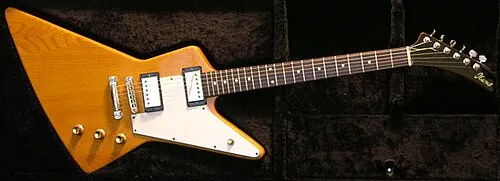
Photo: TheDestroyerGuy / Wikimedia Commons / Public domain Ibanez
Destroyer
1975
Ibanez copied the Explorer, right up until Gibson sued. Eddie Van Halen got a sound out of it nobody could copy.
Ibanez Jem 7VWH vertical. Photo by Rachmaninoff; upright derivative by GreyCat. Licensed under CC BY-SA 4.0. Via Wikimedia Commons. Ibanez
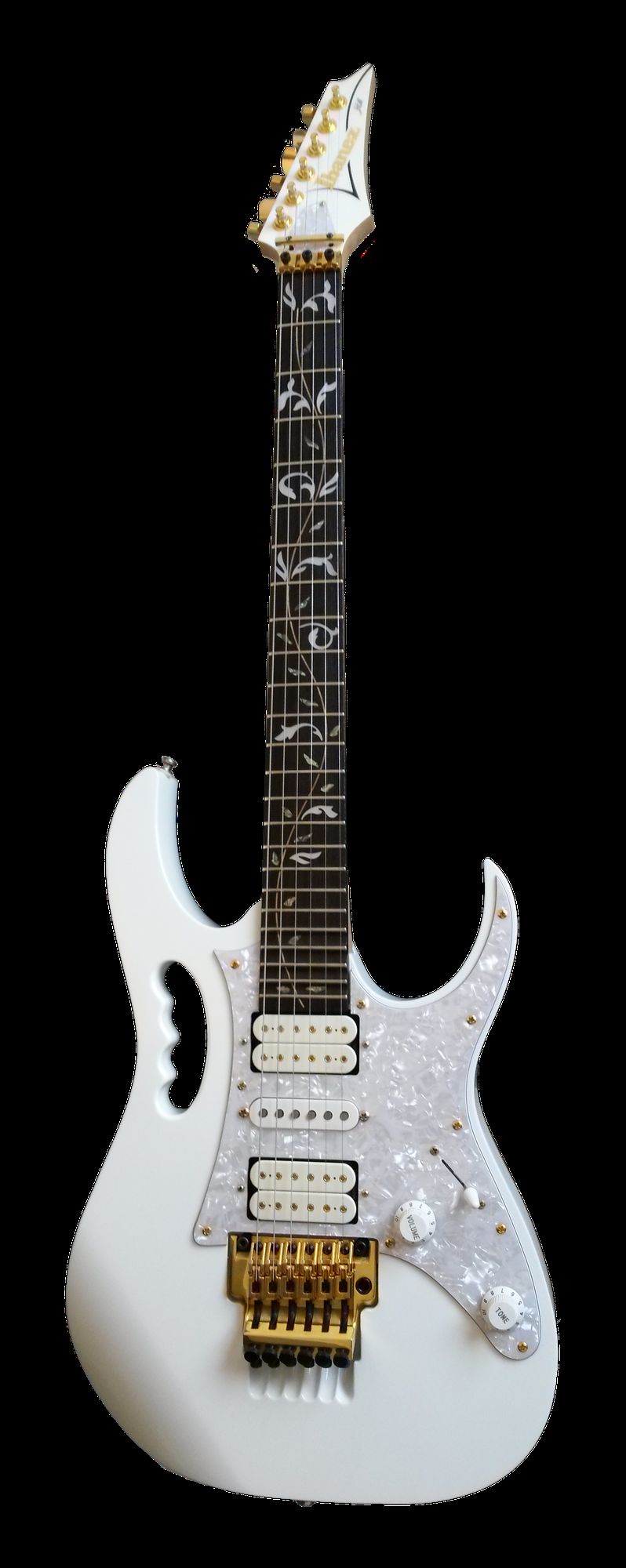
JEM
1987
Steve Vai wanted a handle through the body and a finish that matched his curtains. Ibanez put it in the catalog.
- Send a picture
Ibanez
RG550
1987
Nobody’s name on it. Just a thin neck, 24 frets, and a locking trem, and it keeps coming back.