James Tyler
Studio Elite
Built in a North Hollywood shop with no sign, for the session players whose names were in the small print.
North Hollywood, the 1980s. There’s a repair shop on Lankershim with no sign out front. The motto, if you can call it that, is “Either You Know Or You Don’t.” The people who know are the guitarists and bassists who play on everybody else’s records.
- Introduced
- 1987
- Type
- Solidbody electric
- Class
- Production
Have a photograph of this guitar? Send a picture
The short version
1972
A garage
James Tyler starts out doing repairs.
1978
Norman’s
Tyler works at Norman’s Rare Guitars.
1982
The circuit
A lead/rhythm circuit with a midboost preamp, in the shop before the guitar has a name.
1987
The Studio Elite
The first production model debuts with its hockey-paddle headstock.
1988
“Puffy”
Steve Lukather’s Studio Elite is built, just in time for Toto’s next record.
1998
The HD
A back-to-basics sister drops the lead/rhythm circuit. The original stays in the book.
2024
Goodbye
James Tyler dies at 72. His daughter Sarah and the shop keep building.
Side A
A1
The shop with no sign
A lot of the guitar you’ve heard on the radio was played by people whose names you’ve never looked up. In Los Angeles in the 1980s, those people had a repair guy, and his shop didn’t even have a sign.
James Tyler started fixing guitars in a garage in 1972. By 1978 he was at Norman’s Rare Guitars, by 1980 he had his own shop, and through the ’80s he was on Lankershim in North Hollywood, with nothing out front to tell you so. Either you knew or you didn’t.
Neil Stubenhaus knew. So did Dean Parks, Dann Huff, Michael Landau, Buzz Feiten, Steve Watson, and Abe Laboriel. If you owned records in the ’80s, you own their playing. Tyler was building for that room.
A2
A guitar you could take to any date
Here’s the problem with being a session guitarist. You walk in at ten, and by lunch somebody wants a clean funk part, then a fat lead, then something that sounds like a Les Paul. You can bring six guitars, or you can bring one that does all of it.
Tyler had the answer before he had the guitar. In 1982 he worked out a lead/rhythm circuit with a midboost preamp. Load one up with every option and each pickup gets its own little three-way toggle. Up is series, loudest, and no hum. Middle is split. Down is parallel. So pickups that look like plain single-coils are hiding a second coil, and the midboost, which pushes the middle of the sound forward so a solo jumps out of a mix, sits on a button you can kill.
That’s not a gimmick. That’s a guy saving his clients a trip back to the car.
A3
A hockey paddle on the end
In 1987 it all went into one production guitar, the Studio Elite. It shows up at the Los Angeles Guitar Show or at NAMM, depending who you ask. At a glance it’s a hot-rodded Strat: double-cut, pickguard, 25½-inch scale, two singles and a humbucker slanted across the body.
Then you get to the headstock. It’s shaped like a hockey paddle, on purpose, so the guitar’s silhouette wouldn’t step on Fender’s trademark. It isn’t pretty, and it tells you what you’re looking at from across a stage. The heel is contoured, the treble cutaway is deeper, and in 1988 it got its own pickguard shape too. San Fernando Valley, not Fullerton.
Flip the record · By the numbers
1972
The year Tyler started fixing guitars in a garage.
3
Positions on each pickup’s mini-toggle, on a fully loaded one. Series, split, parallel.
8th
Official Studio Elite, the one known as Steve Lukather’s “Puffy.”
25½″
Scale length. Fender length, on a guitar that very much isn’t a Fender.
Side B
B1
Puffy
Also in 1988, Tyler built the eighth official Studio Elite, for Steve Lukather. Lukather had ordered it during the sessions for Toto’s The Seventh One. It arrived in time for him to play the rhythm and the solo on “Stop Loving You” and the song and solo on “A Thousand Years,” and then it went out on the tour that followed. It’s known as Puffy, and the original has the name at the 12th fret.
Lukather doesn’t play Tylers now, and the company says so. But for one record and one tour, a guitar built for the players in the small print got the starring role.
Later, the line split. In 1991 Tyler made Michael Landau a finish called Psychedelic Vomit. The way the story gets told:
…unfortunately, the world took it seriously.
Burning Water followed for Landau, and in 1998 the Studio Elite HD took the lead/rhythm circuit out for players who wanted it simpler. Those are other guitars. The Studio Elite kept the switches.
B2
Positions four and five
Wayne Krantz is the kind of player this guitar makes sense for. When he ran through his gear in 2012, the Studio Elite was on the list, and so were positions 4 and 5 on its switch. He put black tape over the headstock because he didn’t like Tyler’s graphic. The rest of the guitar he kept.
When his black Studio Elite later came up for sale, it was billed as the guitar from Krantz Carlock Lefebvre and Good Piranha / Bad Piranha, plus a lot of touring.
B3
Still no sign out front
James Tyler retired in 2022 and died on 29 August 2024, at 72. His daughter Sarah and the shop’s general manager, Rich Renken, kept it going. In 2024 they brought out a 1987 anniversary model, Sarah’s idea, with the old circuit.
You can still order a Studio Elite, made to order, alder by default, with the switches that were there before it had a name. Most people who hear one will never know it. They’ll hear a great guitar part on a record and never look at the credits. That was always the deal. Either you know or you don’t.
Put this on
You’ve read about it. Now hear it. Here’s what this guitar sounds like, and what to listen for.
Stop Loving You
Steve Lukather ordered Puffy during the sessions for The Seventh One. He played the rhythm and the solo here on it.
Find it on YouTube (opens in a new tab)A Thousand Years
Same album, same guitar. Lukather used Puffy for the song and the solo.
Find it on YouTube (opens in a new tab)
The cast
The people, and the specific guitars, that made the legend.
1987
James Tyler
Builder
Went from garage repairs to the shop with no sign, and built the Studio Elite for the players who came through it.
1988
Steve Lukather
“Puffy”
The eighth official Studio Elite, ordered during the sessions for Toto’s The Seventh One and taken on the tour after. He doesn’t play Tylers today.
2012
Wayne Krantz
Black Studio Elite
His gear list names pickup positions 4 and 5. Taped over the headstock graphic because he didn’t like it.
1980s
Michael Landau
A shop regular
One of the session players the guitar was built around. His named finishes, Psychedelic Vomit and Burning Water, are other Tylers.
1982
David Williams
Not this one
His “Billie Jean” Tyler came from the shop years, five years before the Studio Elite existed.
2024
Sarah Tyler
Keeper of the shop
James’s daughter. The 1987 anniversary model was her idea, and she kept the shop going after he died.
Liner notes
Specs, construction, rarity, value, and every source we used.
A hockey-paddle headstock, a slanted HSS, and the lead/rhythm midboost L.A. sessions actually used — Tyler’s Studio Elite, not a Fender Stratocaster.
- Body
- Solid alder; double-cut, contoured heel, deeper treble cutaway, pickguard. Optional: swamp ash or mahogany, hollow, bent maple top, rear rout, binding. Factory default alder.
- Neck
- Quartersawn maple. Factory: Standard 59, .845" at 1st / .975" at 12th. Optional: mahogany or birdseye; Standard 64 (.825" / .950", formerly Thin 59), Fat, X-Thin, Vee. Mix flagged.
- Fingerboard
- Maple, Indian rosewood, pau ferro, or macassar ebony; compound 10"–12" (254–305 mm); 22 wide/tall nickel-silver frets .110" × .055" (2.8 mm × 1.45 mm). Mix flagged.
- Scale
- 25½" (647 mm). Factory general spec. Mix flagged.
- Pickups
- Slanted SSH: Tyler true single-coils and a Tyler humbucker. Optional: two noise-cancelling with Tyler humbucker.
- Hardware
- 2-post or 6-screw tremolo with bent steel Tyler saddles; locking Hipshot; chrome. Optional: Floyd, Hipshot hardtail, black or gold.
- Electronics
- 5-way, master volume, master tone, midboost preamp with bypass. Lead/rhythm circuit. Optional: add neck+bridge, humbucker split, series/split/parallel.
- Finish
- Solid, candy, transparent, burst, Jimburst, Shmear, and named specials. Finish system unpublished on the Studio Elite page this pass.
- Nut
- 1 5/8" (41.3 mm). Factory general spec. Neck card also prints 41.33 mm. Material unpublished on the Studio Elite page. Mix flagged.
Open the full research fileConstruction details, the complete player record, production numbers, dated value estimates, and sources
Current typical = USA Studio Elite (tylerguitars.com/studio-elite2; neck/spec card guitar-neck-specifications-and-bridges; fetched 18 September 2026). Factory prints inches and millimetres; mix flagged, not averaged. Studio Elite HD (1998) drops the lead/rhythm circuit — sister, not this table. HD-P, Burning Water / Burning Water 2K, Studio Elite 1987, Studio Elite 1978 / 1982, and James Tyler Guitars Japan (2016 NAMM) are other cards. Not a Fender Stratocaster (fender-stratocaster). Standalone — not a Strat family card.
Construction
The job was a Superstrat an L.A. session could pick up and play. Contoured heel. Deeper treble cut. A pickguard that is not Fender’s. A lead/rhythm circuit and a midboost already in the shop before the model had a name. San Fernando, not Fullerton. Not a Fender Stratocaster. Not a Charvel So-Cal (charvel-so-cal). Not a Suhr Classic S (suhr-classic-s). Not Tom Anderson’s Classic (tom-anderson-classic), even though Tyler had Anderson cut pieces first.
Factory About: custom work and repairs from the early 1970s. Timeline: garage repair 1972; Norman’s Rare Guitars 1978; own shop in Los Angeles / Reseda 1980 (Guitar World, Matt Parker, 2 September 2024). North Hollywood on Lankershim in the 1980s, no sign, “Either You Know Or You Don’t.” Schecter and Kubicki parts, then custom pieces at Tom Anderson’s shop. Neil Stubenhaus, Dean Parks, Dann Huff, Michael Landau, Buzz Feiten, Steve Watson, Abe Laboriel. That is the room this guitar was built for.
1982: lead/rhythm circuit with a Demeter midboost preamp (factory timeline). The circuit is not a marketing extra. Factory neck/spec page: each pickup gets a three-way mini-toggle — series up (loudest, no 60-cycle hum), split in the middle, parallel down. Hidden second coils on pickups that look like singles. Midboost on a button you can kill. That wiring is why a session guitarist could cover a date without swapping instruments.
1987. Factory: headstock and Studio Elite debuted at the Los Angeles Guitar Show. Guitar World’s obituary puts the same debut at NAMM. Keep both. Wikipedia, citing Fuzz (September 2007) and Guitar Buyer (January 2006): first production model, a hot-rodded Stratocaster, woodwork by hand, “hockey paddle” headstock so the silhouette would not step on Fender’s trademark. Guitarist (Simon Bradley, November 1996) is Wikipedia’s trademark source. This plate starts in 1987.
1988. Factory: the distinct Studio Elite pickguard, and Steve Lukather’s “Puffy” is built. White pearl guard is the live default. Slanted SSH of Tyler true singles and a humbucker. 2-post or 6-screw tremolo with bent steel Tyler saddles. Locking Hipshot. Chrome.
What you get now is still that guitar, made to order. The millimetre card is the factory general spec above. Alder is the live body default. Early anniversary copy (Wild West on the 1987 35th; Distinctive Guitar, 6 March 2024) puts those first Tylers on Mamywo (jelutong). Do not flatten Mamywo onto the live alder card. Dealer G2TS bridges sit on current serials. Factory still prints 2-post or 6-screw.
Then the instrument split. 1991: Psychedelic Vomit for Landau, “unfortunately, the world took it seriously” (Guitar Buyer, January 2006, via Wikipedia). Ultimate Weapon the same year on the factory timeline; Wikipedia dates it 1993. Keep both — different plate. 1993: first Burning Water, again for Landau; standard from 1994. 1998: Shmear, and Studio Elite HD by taking the lead/rhythm circuit off and going more retro (factory timeline; Mixdown, 12 July 2023). HD keeps the midboost. It is not this guitar. 2005: James Tyler Electric pickups. Wikipedia, citing Guitarist (February 2007 / December 2005): Fadal CNC, optional hollow; earlier pickups from Duncan, DiMarzio, Fralin, Anderson, Suhr. 2011: larger San Fernando Valley shop. 2016: Japan line at Winter NAMM — mid-priced, other factory.
James Tyler died 29 August 2024, interstitial lung disease, age 72 (Guitar World; daughters Sarah and Jessica). He had retired in 2022; Sarah Tyler and GM Rich Renken kept the shop. Wikipedia: the company continues. A new USA Studio Elite is still this slug.
Not this guitar. HD and HD-P drop or simplify the circuit. Burning Water / 2K are finish-locked siblings. Classic is 1992, discontinued 2008. Ultimate Weapon is the other outline. Japan is the 2016 line. Studio Elite 1978 and 1982 are 2023 throwbacks. The 1987 35th (NAMM 2024, Sarah Tyler’s idea per Wild West) is a commemorative Mamywo with the old circuit — limited object, not the living alder table. A Fender Stratocaster is a Fender.
Players
Do not hang a Fender Stratocaster, a Burning Water, an Ultimate Weapon, or David Williams’s pre-1987 Tyler on this plate. Thriller is 1982. The Studio Elite is 1987. Factory timeline puts Williams’s “Billie Jean” guitar in the shop years, not on this model.
Steve Lukather — “Puffy,” 1988. Factory timeline: built that year. James Tyler Guitars Instagram (11 October 2022): the eighth official Studio Elite; delivered in time for Toto’s The Seventh One; “Stop Loving You” and “1000 Years”; the tour that followed. Company disclaimer on that post: he does not use or endorse James Tyler Guitars today. Lukather’s own discography note: ordered during those sessions, rhythm and solo on “Stop Loving You,” song and solo on “A Thousand Years,” and a Guitar World piece circa 1987–1988. Nico-nico’s 2025 replica copy: metallic Jim Burst, Floyd, pearl-button tuners, “Puffy” at the 12th on the original. Named object. Not a current endorsement.
Wayne Krantz. Premier Guitar (27 June 2012), gear list: James Tyler Studio Elite. Positions 4 and 5. Black tape on the headstock because he did not like Tyler’s graphic. Wikipedia photograph: Chicago, 2012. 30th Street Guitars / Reverb: the black Studio Elite he used on Krantz Carlock Lefebvre (2009) and Good Piranha / Bad Piranha (2014), plus touring. Named guitar. Ask $10,000 on that listing is a celebrity lot, not a street tape.
Also known to play stays short. Landau, Huff, Parks, Feiten are factory clients from the shop years. Landau’s named finishes are Psychedelic Vomit and Burning Water — other cards. Wikipedia’s artist list is Tyler, not pinned Studio Elites. None invented.
Rarity
You can order a new Studio Elite. Current production is made-to-order, not rare as a model. Tyler does not publish Studio Elite unit totals. None invented. Ishibashi dealer copy on a 2007 (“only a few hundred… each year”) is not a factory table. Skip it.
Serials on cards this pass (24306, 26169, 07110, #255) date a guitar. They don’t count a year.
What is actually thinner: 1987–88 first-run examples; Puffy as the eighth official; Mamywo bodies the 1987 anniversary copy treats as the early recipe; Krantz’s black touring guitar as one object. The 2018 Burning Water 25th was a limited run of 75 — that is Burning Water, not this census. Japan Elites are another factory on the silhouette.
Value
Informal estimate, 18 September 2026. Not an appraisal.
Ask vs sold labeled. Celebrity lots are not-comps. No invented medians or factory counts. Reverb Price Guide widget on a Studio Elite product page was not available this pass. Flag: thin sold-comp access.
New street. Made-to-order; options move the ticket. Named cards this pass: Reverb, 2024 serial 24306, Transparent White, full lead/rhythm and midboost, $7,450 (listing marked sold). Eddie’s Guitars, Barn Find, $6,899.00 (out of stock). CR Guitars 2026 Charcoal Frost, serial 26169, 6.2 lb hollow mamywo — sold, dollar unpublished. Reverb Tuckerburst custom serial 25645, $10,844.27 — options upcharge, labeled adjacent. Do not average those asks into a MAP. Japan HD (Reverb, BBQ Black, $3,099.99, sold) is the other factory. Not this table.
Used modern. Named asks and ended listings, not a midpoint: 2023 Black and Blue Shmear, Excellent, $7,000; 2025 Fire & Ice Shmear, Mint, $7,099 (from $8,200); 2024 Burning Water finish, Excellent, $6,676.89 (ended); 2009 Shoreline Gold, Excellent, $5,500; Sweetwater Gear Exchange 2024 “Full Option,” $7,030 (was $7,400). HD rows are other cards. Do not fold them in.
Vintage / collectible. Early 1987–88 Studio Elites trade as used Studio Elites, not a separate SKU. Ishibashi 2007 Jim Burst serial 07110, Good, ask $8,752.73. Serial #255, Very Good, ended $5,124.86. Puffy is one guitar. Krantz’s black Studio Elite at $10,000 (30th Street / Reverb, ended) is a celebrity lot. Not a comp.
See also
- fender-stratocaster — the 25.5" pickguard bolt-on this San Fernando guitar is not
- tom-anderson-classic — Anderson cut Tyler parts first; different pickguard S
- charvel-so-cal — the production Superstrat this session guitar is not
Sources
- James Tyler, Studio Elite — 1987 first available; contours and treble cutaway; lead/rhythm and midboost; live alder / SSH / Hipshot / 2-post or 6-screw spec (fetched 18 September 2026)
- James Tyler, History and Timeline — 1972 garage; 1978 Norman’s; 1980 shop; 1982 Demeter midboost / lead-rhythm; 1987 L.A. Guitar Show debut; 1988 pickguard and Lukather “Puffy”; 1991 Vomit and Ultimate Weapon; 1993 Burning Water; 1998 Shmear and Studio Elite HD; 2005 pickups; 2011 San Fernando shop; 2016 Japan NAMM
- James Tyler, Guitar & neck specs, and bridges — 25½" / 647 mm; 1 5/8" / 41.3 mm (neck card 41.33 mm); 10–12" / 254–305 mm; 22 frets; Studio Elite wide/tall .110" × .055" / 2.8 mm × 1.45 mm; Standard 59 / 64; lead/rhythm mini-toggle description. Mix flagged
- James Tyler, Studio Elite HD — HD as “back to basics”; same outline, not this circuit
- James Tyler, Burning Water 2K — 2000 sibling; fixed spec
- James Tyler, Finishes — solid / candy / transparent / burst / Jimburst / Shmear on Studio Elite series
- Wikipedia, James Tyler Guitars — 1972; 1987 first production model; hockey-paddle headstock vs Fender trademark (Guitarist, Nov. 1996); Guitarist “50 guitars to play before you die”; Ultimate Weapon 1993 vs factory 1991; Vomit 1991 / Burning Water 1993 / Shmear 1998; CNC and in-house pickups (Guitarist 2005–07); Japan 2014–16; died 29 August 2024; company continues. Lead only
- Guitar World, Matt Parker, 2 September 2024 — death 29 August 2024, age 72, interstitial lung disease; Norman’s 1978; Reseda 1980; NAMM wording on the Studio Elite debut; retired 2022; Sarah Tyler and Rich Renken; Williams/Billie Jean as a Tyler guitar, not this model
- James Tyler Guitars Instagram, 11 October 2022 — Puffy as 8th official Studio Elite; The Seventh One; “Stop Loving You” / “1000 Years”; tour; current non-endorsement
- Steve Lukather, *The Seventh One* — ordered for those sessions; “Stop Loving You”; “A Thousand Years”; world tour; Guitar World circa 1987–1988
- Premier Guitar, Wayne Krantz, 27 June 2012 — named Studio Elite; positions 4 and 5; taped headstock
- 30th Street Guitars / Reverb, Krantz Studio Elite — Krantz Carlock Lefebvre and Good Piranha / Bad Piranha; ask $10,000; celebrity lot
- Mixdown, In Focus: James Tyler Guitars, 12 July 2023 — 1987 L.A. Guitar Show; HD drops lead/rhythm; USA and Japan
- guitarguitar, The Complete Guide to Tyler Guitars, 9 April 2024 — 1987 Studio Elite; distinctive pickguard; HSS typical
- Wild West, Studio Elite 1987 35th Anniversary — NAMM 2024 announcement; Sarah Tyler; Mamywo / jelutong early recipe; 1987 as official birth year
- Distinctive Guitar, Studio Elite 1987 35th, 6 March 2024 — Mamywo; lead/rhythm and midboost throwback
- CR Guitars, 2026 Studio Elite serial 26169 — current USA card; 25½"; 1-5/8"; lead/rhythm; hollow mamywo; sold, no dollar
- Reverb, Studio Elite serial 24306 — 2024; $7,450; sold listing
- Eddie’s Guitars, Studio Elite Barn Find — new street $6,899.00; out of stock
- Sweetwater Gear Exchange, 2024 Studio Elite — used $7,030 (was $7,400); full-option vs HD
- Reverb, used Studio Elite listings — named used asks this pass; no Price Guide widget isolated
- Nico-nico Guitars, Studio Elite 1988 “Puffy” replica — replica spec; The Seventh One association
Keep digging
Guitars this one gets compared to, confused with, or descended from.

Photo: Lightburst / Wikimedia Commons / CC BY-SA 4.0 Fender
Stratocaster
1954
The guitar most people mean when they say “electric guitar.” Designed by a man who didn’t play one.
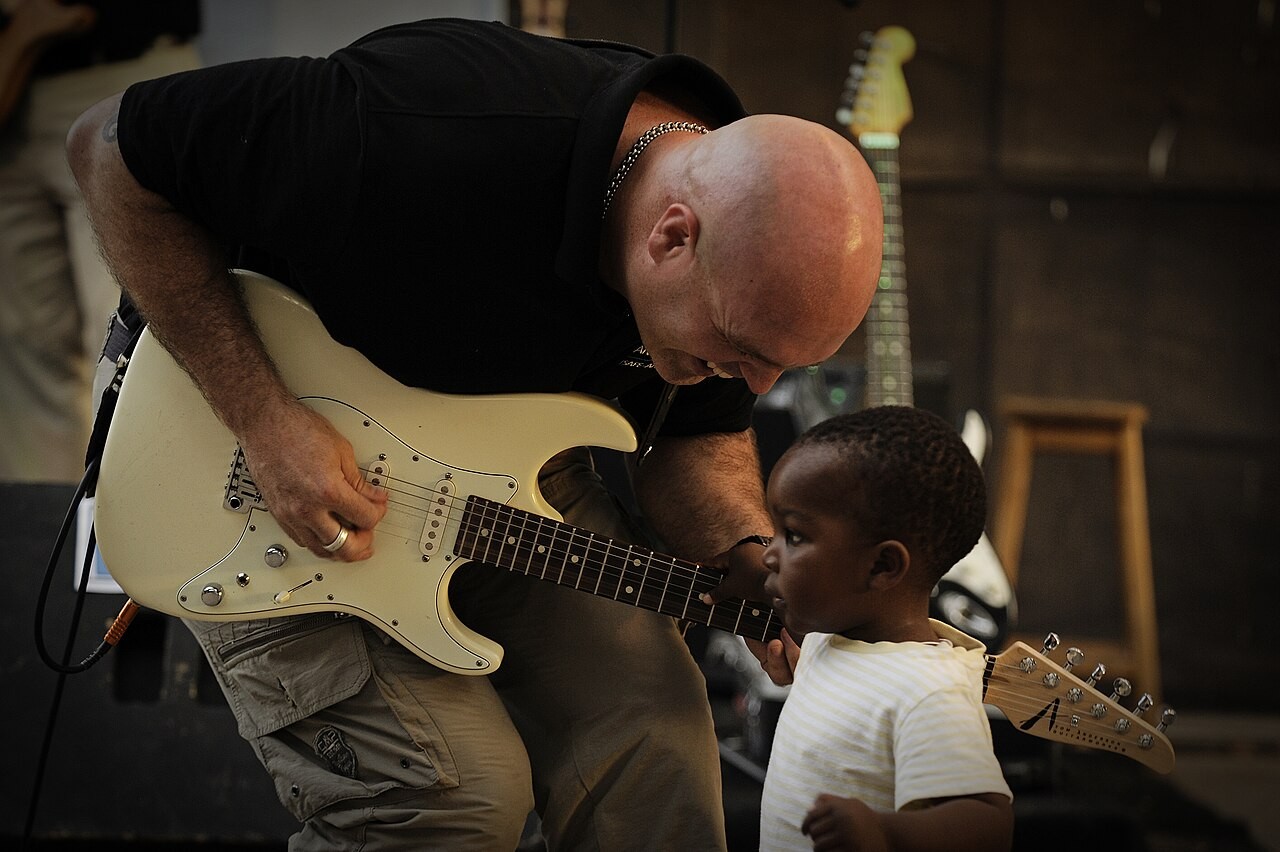
Photo: Staff Sgt. Ryan Crane / U.S. Air Force / Public domain Tom Anderson
Classic
1991
Tom Anderson grew up on vintage guitars and wanted them a little better. Forty years later, he’s still at it.
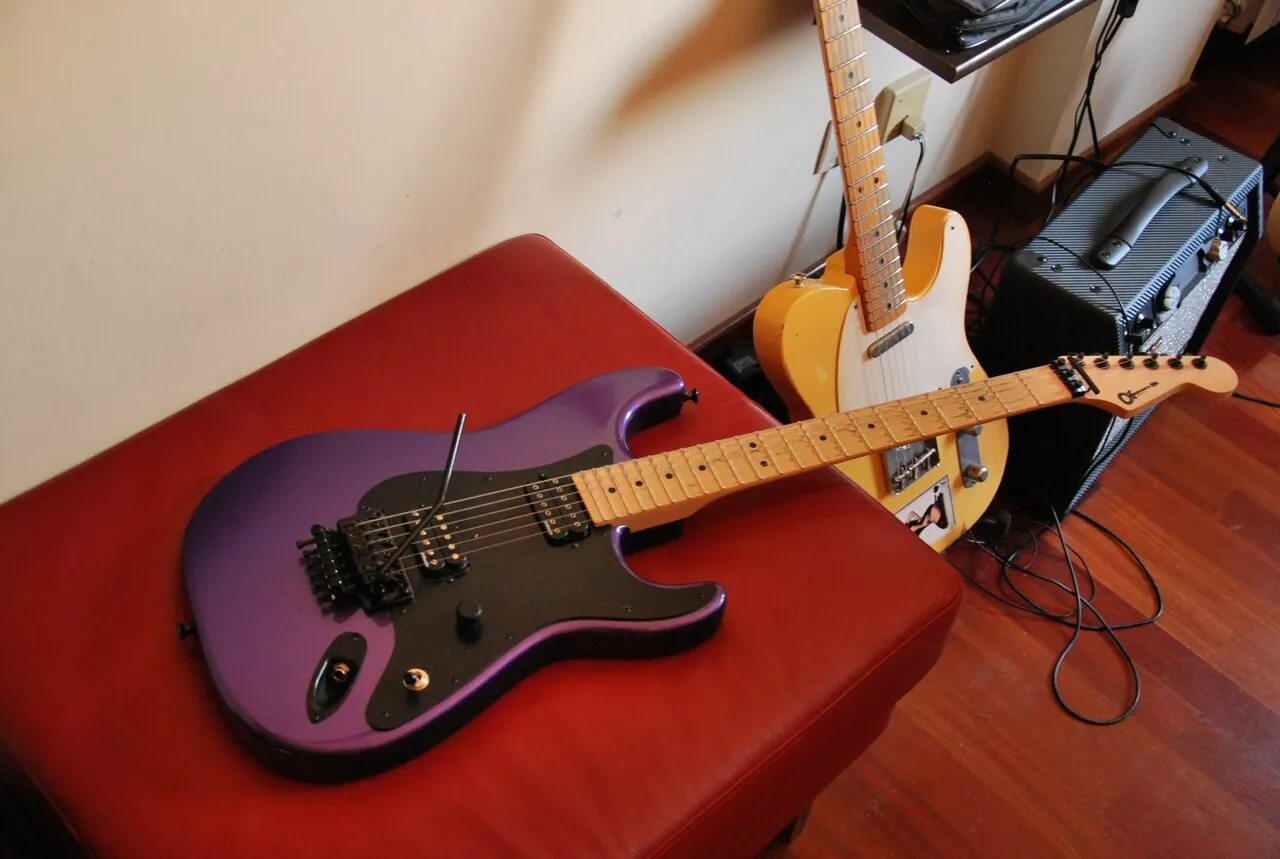
Photo: Freebird from Madrid, Spain / Wikimedia Commons / CC BY-SA 2.0 Charvel
So-Cal
2008
Charvel went through its old work orders, found what players asked for most, and put a pickguard on it.