Kramer
450
The patent said aluminum necks were Travis Bean’s. So Gary Kramer put wood in his.
In 1976 a new company in Neptune, New Jersey, shipped a guitar with a metal neck, walnut set into the back of it, and a headstock split like a tuning fork. Most of those choices were an argument with the guitar its designer had just walked away from.
- Introduced
- 1976
- Type
- Solidbody electric
- Class
- Production
Have a photograph of this guitar? Send a picture
The short version
1975
The patent
Travis Bean’s aluminum-neck patent issues in October. Gary Kramer and Dennis Berardi form BK International the same year.
1976
Neptune
The first brochure shows two guitars and two basses, the 450G among them. The first production batch goes out in November.
1977
Shorter horns
A 450 Deluxe appears with slightly shorter horns. Underneath, still the 1976 guitar.
1978
Laminate
The body is described as a walnut-and-maple laminate. DiMarzio-loaded Kramers arrive in 1978 or 1979, a different line.
1979
The last 450s
The 450G stops in 1979 or 1980, depending who you ask.
1981
Wood
Kramer starts moving to wooden necks, and the company that made the 450 becomes the company that made the Baretta.
Side A
A1
The shop he walked out of
Picture Travis Bean’s shop in Sun Valley, putting a machined aluminum billet straight through a koa body. Players said those guitars were heavy, and that the metal drank the heat right out of your hand.
Gary Kramer had been in that shop. How he left depends who’s telling it. In his own account he was a partner, not a sales rep, and the unofficial versions get it wrong. Other histories call him a sales rep. Keep both.
Then there’s the patent. It issued in October 1975, and Kramer says Bean had filed it in his own name, not the partnership’s. He also remembers coming in one Monday to find a drum studio built on the production floor, egg cartons on the walls, orders running late. He was gone in 1975, or 1976. The dates don’t agree either.
A2
Named after a Mercedes
The patent covered an aluminum neck. Kramer’s answer was to put wood in his.
In 1975 he and Dennis Berardi formed BK International, which started out making cases. The first guitar got a name off a car lot: the 450 G, for the Mercedes 450 SL. Phil Petillo built the prototype from Kramer’s drawings on the porch of Berardi’s beach house in Manasquan.
Then came the money. Henry Vaccaro wrote a check for $35,000, and he owned a building at 1111 Green Grove Road in Neptune, so that’s where the shop went. Peter LaPlaca came over from Norlin. At the Chicago NAMM show, a booth with a 20-foot spinning neck took orders.
The patent covered an aluminum neck. Kramer’s answer was to put wood in his.
A3
A metal bar in a wooden neck
Turn a 450 over and you see the trick. The neck is aluminum, bolted on, with walnut or maple set into the back in epoxy. From behind, it looks like a metal bar running through a wooden neck. Your thumb sits on wood.
That did three jobs. It got around the patent, on Kramer’s telling. It cut weight. And it made the neck feel less cold, which was the complaint about the Bean in the first place.
Then there’s the headstock, split down the middle like a tuning fork. That was so nobody would mistake it for a Bean, and to lose a little more weight. The board is Ebonol, the bowling-ball stuff. There’s a zero fret. The body is wood, like the Bean’s, but here the pickups and bridge sit in the wood, not on the aluminum.
Flip the record · By the numbers
$545
A 450G on the 1976 introduction list. Cases extra.
$35,000
Henry Vaccaro’s check, and the start of the Neptune shop.
20 ft
The spinning neck on the Kramer booth at the Chicago NAMM show.
4:1
Roughly how the aluminum basses ended up outselling the guitars.
Side B
B1
The humbucker one
The first brochure, in 1976, had four instruments: the 350G and 450G guitars and the 350B and 450B basses. The 450G was the one with two humbuckers, chrome covers etched Kramer, two volumes, two tones, a 3-way, a 25-inch scale, 22 frets, and Schaller tuners. It listed at $545. The first production batch went out in November.
The Deluxe body was American black walnut with maple running through it, finished natural. Early boards had block inlays, later ones aluminum dots. In 1977 there was a Deluxe with slightly shorter horns. By 1978 the body was a walnut-and-maple laminate.
It isn’t a featherweight. One that’s been on a dealer’s scale came in at ten pounds and an ounce, another at about eleven. Light was relative.
B2
The workaround stays
The 450G ran until 1979 or 1980, depending who you ask. The company kept making aluminum necks for a few years after that, and started going to wood in 1981. The basses were what sold. By the early 1980s they were outselling the guitars about four to one.
Kramer himself was gone within about a year of the launch. He says he was sent west to do artist relations, and the break came months later, over pay, not on bad terms. Berardi and LaPlaca kept the name. In the 1980s it went on a very different guitar: the wooden-necked Baretta and the superstrat years. Gibson bought the brand out of bankruptcy in 1997.
There’s no 450 on Kramer’s list today. But pick one up and run your hand down the back of the neck. It’s cool where the metal shows and warm where the walnut is. That’s the workaround, right under your thumb.
The cast
The people, and the specific guitars, that made the legend.
1975
Gary Kramer
Designer of the 450G
Left Travis Bean, in 1975 or 1976, and named the guitar after a Mercedes. Gone from his own company within about a year.
1975
Phil Petillo
The 450 prototype
Built it from Kramer’s drawings on the porch of a beach house in Manasquan.
1975
Dennis Berardi
BK International
Kramer’s partner, first in cases, then guitars. He and Peter LaPlaca kept the name after Kramer left.
Jim Root
450G Deluxe
Of Slipknot. A dealer sold a 450G Deluxe described as from his collection. No record or stage is attached to it.
Liner notes
Specs, construction, rarity, value, and every source we used.
Wood set into a bolt-on aluminum neck, and a tuning-fork head — Kramer’s 450, not a Travis Bean, and not the Baretta.
- Body
- Slightly offset double-cut. Blue Book: select American black walnut with a maple center strip. Natural.
- Neck
- Bolt-on aluminum, wood inserts in the back (walnut or maple, set in epoxy). Two bolts under an oval plate (vintagekramer.com); a former employee there says three hex bolts. Mix flagged.
- Fingerboard
- Ebonol, 22 frets. Blue Book: pearl blocks early, aluminum dots later. vintagekramer.com: square blocks on the earlier 450s. Mix flagged.
- Scale
- 25" (Blue Book; vintagekramer.com). No millimetres in the named sources.
- Pickups
- Two humbuckers, chrome covers etched Kramer, height set from the back (Blue Book; vintagekramer.com).
- Hardware
- Schaller M-6, three-a-side; adjustable bridge. vintagekramer.com: a combo bridge/tailpiece.
- Electronics
- Two volumes, two tones, 3-way
- Finish
- Clear natural on the wood. Later aluminum necks on the line were painted.
- Nut
- Factory width unpublished. Zero fret (Wikipedia; Terry Boling). vintagekramer.com: a “zero nut.”
Open the full research fileConstruction details, the complete player record, production numbers, dated value estimates, and sources
Classic living example = 1976–79 Neptune 450G Deluxe (Blue Book’s years). No current 450 SKU this pass. Gibson’s Kramer page, fetched 19 October 2026, is wood-neck Pacers, Barettas, and a 50th-anniversary line. Factory inches only. No millimetre figure in the named sources; none invented. Neck-bolt count mix-flagged. Dealer nut widths on single guitars do not agree; the only one printed below is Eastside’s 1.659". Do not average, and do not convert. 450B is the bass. 350G is the single-coil. 650G is the Artist. DMZ is the DiMarzio line. No Gibson SKU.
Construction
The job was an aluminum neck you could leave on a shoulder. Travis Bean had already put a machined billet through a koa body in Sun Valley (travis-bean-tb1000). Players said it was heavy, and the metal drank the heat out of a hand. Gary Kramer had been in that shop. What he built next was not that guitar.
How he left is not one story. His own account (garykramerguitar.com; mirrored on travisbeanguitars.com): he was a partner for several years, not a sales rep, and the unofficial versions have it wrong. Bean filed and secured the patent in his own name, not the partnership. USPTO 3,915,049 issued 28 October 1975. Kramer says one change got around it: wood in place of some of the aluminum, which would also lighten the neck and warm it. He also says he came in one Monday to a drum studio on the production floor, egg cartons on the walls, orders late. Michael Wright (Vintage Guitar, June 2018), reporting Kramer: that patent discovery “precipitated Kramer’s exit and the formation of Kramer guitars in ’76.” Tony Bacon (Reverb News, 19 May 2022) has him gone in 1975. Justin Beckner (Guitar.com, 29 August 2023) is “certain” the exit was 1976, and treats the patent name and the drumming as Kramer’s account. Ellen Angelico (Premier Guitar, 19 August 2024): dissolved in 1975; the inserts were for weight and a neck that felt less cold; the tuning-fork head was so nobody would mistake it for a Bean, and to cut more weight. Terry Boling’s compile on vintagekramer.com dates the exit October 1975 and calls him a sales rep. Boling’s own note says that writeup is not guaranteed. Keep partner against sales rep. Keep 1975 and 1976.
The name is a car. Kramer: in 1975 he and Dennis Berardi formed BK International, at first for Calzone cases, and named the first guitar the 450 G after the Mercedes 450 SL. Phil Petillo built the prototype from Kramer’s drawings on the porch of Berardi’s beach house in Manasquan. Kramer says those prototype pickups were his own design. Henry Vaccaro’s check was $35,000. Vaccaro owned 1111 Green Grove Road, Neptune, New Jersey, and they moved the shop there. Peter LaPlaca came from Norlin. A Chicago NAMM booth with a 20-foot spinning neck took orders. Kramer does not date the show. Adam Moore’s Premier Guitar question (14 November 2008) calls 1975 the “release.” That is the interviewer’s year for the name. The catalog year is the next one.
1976. Angelico: the first product brochure, 350G, 450G, 350B, 450B. Bacon: launched that year, 450G listing $545, 350G $425, the basses $465 and $595. vintagekramer.com’s aluminum-neck page: first production batch November 1976. Boling: company established June 1976, guitars out the door in November, retail “in the neighborhood of $425–$595,” cases extra. This plate starts in 1976. The 1975 object is a prototype with a Mercedes name, not the catalog guitar.
What they shipped is a bolt-on aluminum neck with wood fills down the back, walnut or maple set in epoxy (Gibson’s history; Wikipedia), so the hand is not on a bare billet. From the back it looks like a metal bar in a wooden neck (Bacon). Ebonol for the board, the bowling-ball stuff. The head is a split fork — Blue Book’s words; Angelico says tuning fork; Gibson’s history says pitchfork. Same shape. Not Bean’s T. The body is wood, a slightly offset double-cut. Pickups and bridge sit in the wood, not on an aluminum receiver. That is the argument with Sun Valley.
The 450 is the humbucker guitar: two chrome covers etched Kramer, four knobs, a 3-way, 25", 22 frets, Schaller M-6s. Blue Book’s 450G “Deluxe” is black walnut with a maple center strip, natural, 1976–79, pearl blocks early and aluminum dots later. vintagekramer.com: two maple strips, square blocks on the earlier boards, and in 1977 a 450 Deluxe with slightly shorter horns. Boling: 1977 was still the 1976 guitar; by 1978 the body was a walnut-and-maple laminate. Moseley (Vintage Guitar, January 2013, a bass article): the ’78 catalog says “select American black walnut and maple,” and “for the first time” calls the pickups single-coil. That sentence sits beside the 450B. Blue Book and vintagekramer.com print two humbuckers on the guitar. Keep Moseley’s reading. Do not turn the 450G into a single-coil.
vintagekramer.com puts the machining at Kaiser Aluminum, East Avenue, Erie, Pennsylvania, and the joint at two bolts under an oval plate. Steve Z, quoted there, says three hex bolts, and that the oval plates were obsolete by the headless Dukes. Keep two and three. Early bodies on the line ran to koa, bubinga, afromosia, shedua, and swietenia (Wikipedia; Boling). Moseley ties the “tropical imported” line, and about 10 pounds, to the 450B. The guitar in the books is walnut with maple through it. Pickup origin on production guitars is unpublished. Mighty Mite is vintagekramer.com’s rumor. Kramer’s claim is the prototypes. Neither is a winding spec.
Not the 450B. Same number, four strings, 33 3/4" scale, 1 5/8" nut, 20 frets (Moseley). Not the 350G. Two single-coils; Blue Book’s 1976 catalog 350G has no center strip. Not the 250G (1977, maple, a black guard) or the 650G Artist (bird’s-eye center, mother-of-pearl crowns). Not a DMZ. DiMarzio, from 1978 (Moseley) or 1979 (vintagekramer.com). Not the Gene Simmons Axe. Not a Baretta (kramer-baretta). That is the 1983 banana-headstock, bolt-on maple, one humbucker. Eddie Van Halen’s Kramer years are that later, wooden guitar. Not a Travis Bean. No Gibson SKU.
The 450 did not last as long as “aluminum Kramer.” Blue Book stops the 450G at 1979. Boling: dropped from the 1980 line, with the 650. vintagekramer.com: the 450s lasted until 1980. Reverb’s product years print 1976–1980. Keep 1979 and 1980 for this model. DMZ, XL, and the headless Duke are later aluminum, not this slug. Gibson’s history runs the alumi-neck era roughly to 1982. Bacon: aluminum models gone by 1985. Beckner and Angelico: wooden necks in 1981. Those are the company. Boling: Kramer himself left within a year. His 2008 interview: he was sent west as artist relations, and the break over pay came months later. He says it was not a bad-terms exit. Berardi and LaPlaca kept the name. Gibson bought the brand out of bankruptcy in 1997 (Wikipedia).
Classic vs current: a 1976 Neptune 450G — fork head, Ebonol, two covered humbuckers, walnut and maple, $545 on Bacon’s introduction list — against nothing you can order. The 2026 Kramer cart is a different factory’s wood-neck guitars.
Players
Do not hang a Travis Bean player here. Garcia, Richards, Wood, and Perry are on the TB1000 plate. Wyman’s Bean is a bass. Do not hang Eddie Van Halen, Richie Sambora, or Vivian Campbell here. Those Kramers are wooden 1980s guitars, and the Baretta plate already refuses that mash. The Gene Simmons Axe is a different model. vintagekramer.com’s endorsee list (Elliot Easton, Mick Mars, the rest) is a company list. None of it is pinned to a 450G.
Jim Root (Slipknot). The one sourced 450G. Wild West Guitars sold a 450G Deluxe it described as from his collection: “owned by Jim Root.” A dealer provenance line and a short video. No album, no stage, no serial in the listing. Sold out, price unpublished. That object is not a street 450.
Also known to play stays empty. Moseley credits the 1976 launch with “big-name endorsers” and does not name a 450 guitar. None invented.
Rarity
You cannot buy a new 450. Neptune’s aluminum run is over, and Gibson’s Kramer does not put this model back on the cart.
Kramer did not publish a 450G total. None invented. Gibson’s history page says basses and guitars were produced about 4:1. Angelico says that by the early 1980s the basses were outselling the guitars four to one. Beckner repeats the ratio and treats the reason as a guess. A ratio is not a census. Serials and pot codes date one instrument. They don’t count a year.
What is actually thinner: first-batch 1976 guitars, the longer-horn bodies vintagekramer.com puts before the 1977 Deluxe, block-inlay boards against the later dots, and any early exotic-wood body that is actually a 450G and not a 450B. Root’s collection guitar, if the dealer line holds, is one object. It is not a vintage 450.
Value
Informal estimate, 19 October 2026. Not an appraisal.
Ask vs sold labeled. A collection guitar is not a comp. No invented medians or factory counts. Bacon’s $545 (1976 introduction) and Boling’s line-wide neighborhood $425–$595, cases extra, are 1970s money, not 2026 street. Angelico’s $499 is a 350B, a different instrument.
New street. None. Kramer’s live pages this pass are other models. Premier Guitar (25 June 2026) prices a 50th-anniversary 84 at $1,199 street. Gibson’s Kramer home, fetched 19 October 2026, lists that anniversary 84 at $999 and a 50th-anniversary Baretta at $999. Different guitars. Do not use those carts for a 450.
Used modern. There is no modern 450 to make a used-modern band.
Vintage / collectible. Reverb’s Price Guide on 450G Standard Natural (1976–1980), this pass, prints $868–$1,949 from 65 orders, Good to Mint. The newest named sale on that same table is 8 December 2025. The band is not a 19 October 2026 median. Named solds on it, not a midpoint: 8 December 2025 Good $1,400; 7 June 2025 Very Good $1,500; 14 November 2024 Very Good $1,425; 19 May 2024 Excellent $1,800 and, the same day, Very Good $1,000. Do not average those.
Named 2026 hammer, one guitar: Gardiner Houlgate, 10 March 2026, a late-1970s 450G in black, £700 (estimate £700–1,000), weight listed 4.66 kg. Kilograms against U.S. dealer pounds: mix flagged. Do not convert. Named asks this pass, not hammers: Killer Vintage’s 1977 natural $1,995; Eastside Music Supply’s 1976, sold out, had been $3,285; a Tucson listing posted 15 February 2026 and updated 28 March 2026, $2,800. One Eastside guitar weighed about 11 lb and measured a 1.659" nut. Killer Vintage’s 1977: 10 lb 1 oz. Those are single instruments. Not a factory weight, and not a price.
See also
- travis-bean-tb1000 — the Sun Valley through-neck this bolt-on was built against; wood inserts and a fork head are the split
- kramer-baretta — 1983 banana-headstock superstrat; maple neck, one humbucker, not this aluminum 450
- veleno — earlier all-aluminum guitar; carved metal body, not a wood-insert neck in walnut
Sources
- Gary Kramer, “The Official Kramer Story” — partner, not a sales rep; Bean’s patent in his own name; wood inserts to get around it, and for weight and warmth; 1975 BK International; 450 G named for the Mercedes 450 SL; Petillo prototype; prototype pickups his design; Vaccaro $35,000; 1111 Green Grove Road, Neptune; Chicago NAMM undated. Mirrored at travisbeanguitars.com
- Reverb News, Tony Bacon, 19 May 2022 — left in 1975; 1976 launch; 450G $545, 350G $425, 350B $465, 450B $595; wood inserts for weight and cold; tuning-fork head; aluminum models gone by 1985
- Vintage Guitar, Michael Wright, The Travis Bean TB1000S Standard (June 2018) — patent in Bean’s name precipitated the exit; Kramer guitars formed in 1976
- USPTO 3,915,049 — Travis Bean patent, issued 28 October 1975
- Premier Guitar, Ellen Angelico, 19 August 2024 — partnership dissolved 1975; 1976 brochure with 350G, 450G, 350B, 450B; inserts for weight and feel; fork head so it would not be mistaken for a Bean; 350B at $499; basses outselling guitars four to one by the early 1980s; wood necks in 1981
- Guitar.com, Justin Beckner, 29 August 2023 — left in 1976, “certain”; patent-name and drumming accounts are Kramer’s; inserts for weight and a traditional feel; 1976–81 resemblance; wood necks late 1981
- Vintage Guitar, Willie G. Moseley, Kramer Aluminum-Neck Basses (January 2013) — 1976 entry; two guitars and two basses; 450B specs; 1977 Deluxe brochure; ’78 catalog “select American black walnut and maple”; single-coil sentence in that bass article; tropical woods and ~10 lb on the 450B
- Blue Book of Guitar Values, Kramer 250/350/450/650 — 450G Deluxe 1976–79; walnut and maple strip; 22-fret Ebonol; pearl blocks then dots; 25" scale; two humbuckers; Schaller M-6; 350G 1976 catalog with no center strip
- vintagekramer.com, Aluminum Neck Guitars — November 1976 first batch; 25" scale; Kaiser plant, Erie; two bolts; Petillo center-touch frets; zero nut; square blocks; 1977 shorter-horn Deluxe; 450s until 1980; Mighty Mite rumor; Steve Z on three hex bolts
- vintagekramer.com, company story (Terry Boling) — Boling’s caveat that the compile is not guaranteed; October 1975 exit; June 1976 / November 1976; $425–$595 neighborhood; 450 humbuckers; 1978 laminate; 450 dropped for 1980. Sales-rep framing conflicts with Kramer’s own account
- Gibson, Kramer History — introduced 1976; inserts in epoxy, walnut or maple; alumi-neck roughly until 1982; bass-to-guitar ratio about 4:1
- Wikipedia, Kramer Guitars — early history disputed; 1975 BK International and Petillo prototypes; 1976 tuning-fork necks, Ebonol, zero fret, aluminum dots; Gibson 1997
- Premier Guitar, Adam Moore, 14 November 2008 — interviewer’s “release of the 450 G in 1975”; Kramer on leaving over compensation, not a bad-terms exit
- Wild West Guitars, Jim Root collection 450G Deluxe — “owned by Jim Root”; sold out; price unpublished
- Reverb Price Guide, Kramer 450G Standard Natural — $868–$1,949, 65 orders; named solds through 8 December 2025
- Gardiner Houlgate, 10 March 2026 — late-1970s 450G, black, 4.66 kg; estimate £700–1,000; hammer £700
- Killer Vintage, 1977 450G — ask $1,995; 10 lb 1 oz; one guitar
- Eastside Music Supply, 1976 450G — sold-out ask $3,285; ~11 lb; 1.659" nut; 14" radius; CTS 33rd week of 1976; one guitar
- Craigslist Tucson, 450G ask, posted 15 February 2026 — ask $2,800; updated 28 March 2026; not a hammer
- Premier Guitar, 25 June 2026 — 50th-anniversary 84 street $1,199; not a 450
- Kramer at Gibson, fetched 19 October 2026 — no 450; anniversary 84 $999; anniversary Baretta $999
Keep digging
Guitars this one gets compared to, confused with, or descended from.
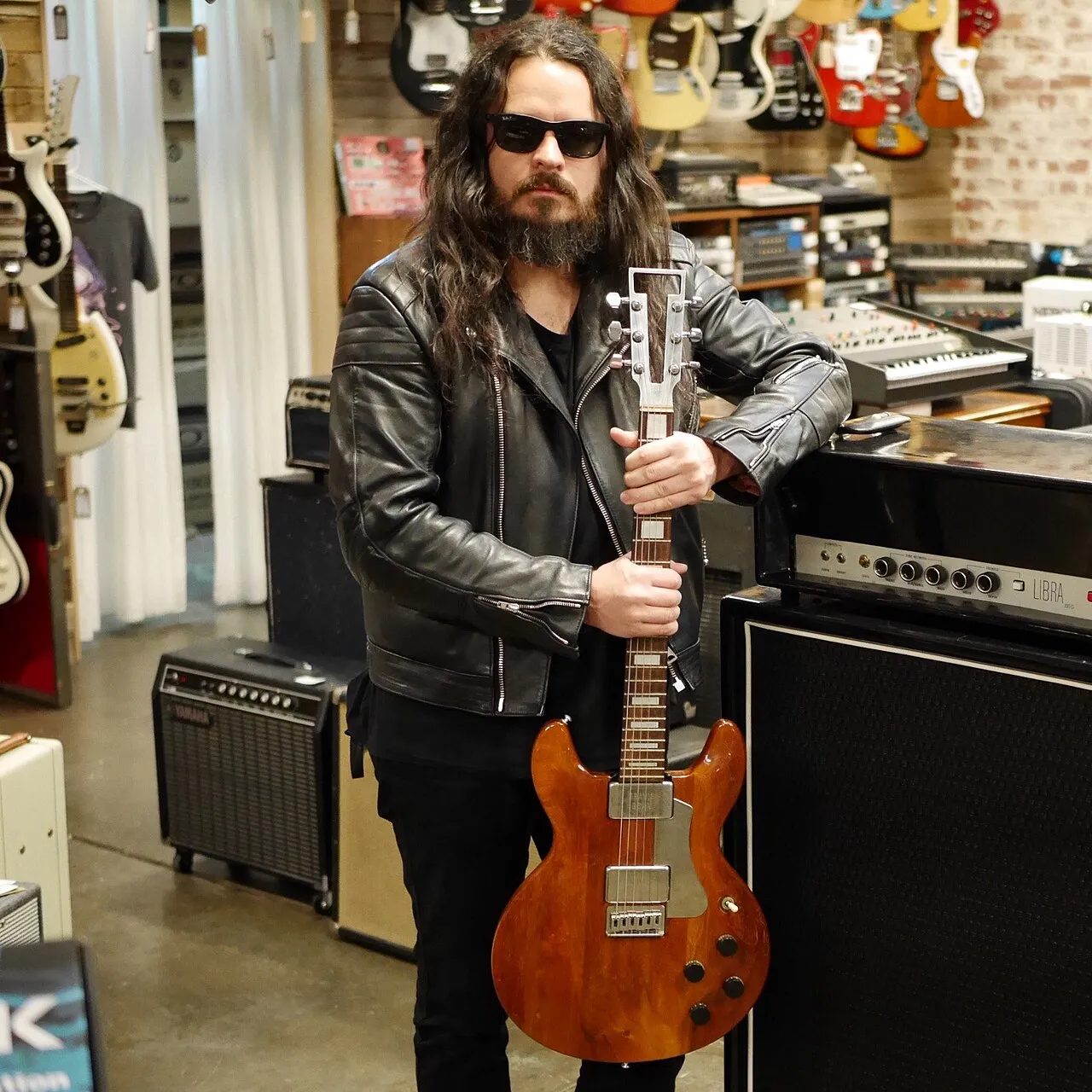
Photo: Somalley / Wikimedia Commons / CC BY-SA 4.0 Travis Bean
TB1000
1974
A motocross racer watched a repairman fight wooden necks all day. So he made one out of aluminum.
- Send a picture
Kramer
Baretta
1983
One humbucker, a bolt-on neck, a banana headstock. Kramer’s 1983 superstrat kept the loud part.
- Send a picture
Veleno
Veleno
1970
A rocket-parts machinist built an aluminum guitar, hid it in a closet, and waited to be asked twice.