Veleno
Veleno
A rocket-parts machinist built an aluminum guitar, hid it in a closet, and waited to be asked twice.
St. Petersburg, Florida, the late 1960s. John Veleno spends his days machining aluminum boxes for rocket electronics and his evenings teaching guitar at home. His aluminum supplier keeps asking the obvious question: why don’t you make one?
- Introduced
- 1970
- Type
- Solidbody electric
- Class
- Production
Have a photograph of this guitar? Send a picture
The short version
1963
Florida
Veleno moves to St. Petersburg and goes to work machining aluminum for rocket electronics.
1966
The closet guitar
The first aluminum guitar, built for himself somewhere between 1965 and 1967. Local players laugh.
1970
Asked again
The supplier asks again, and Veleno starts walking into soundchecks with a case. The first guitars follow, around 1970 or 1972.
1974
Two strokes
An aneurysm in April, a second stroke in June. He keeps building.
1977
The last Originals
Production winds down in 1976 or 1977, with somewhere between 143 and 200 made.
1993
In Utero
Kurt Cobain plays Steve Albini’s Veleno, restrung left-handed, at the Nirvana sessions.
2023
The family reissue
The Veleno family launches the Next Generation Legacy, still all aluminum.
Side A
A1
Boxes for the moon
John Veleno was not a luthier. He was a machinist who taught guitar on the side. In 1963 he moved to St. Petersburg, Florida, and went to work at a shop that made aluminum boxes for rocket electronics coming out of Cape Canaveral, including the lunar module. The job was taking a 35-pound block of metal and carving it down to a ribbed box that weighed a pound and a half to three pounds.
He still taught lessons at home. The town only let him put up a one-foot sign, so he machined a mailbox shaped like a guitar and stood it at the curb. That’s the kind of guy we’re dealing with.
His aluminum supplier took one look at all this and asked the obvious question. Why not make a guitar?
A2
The closet years
So he did, somewhere around 1966. The dates depend on who you ask, anywhere from 1965 to 1967, and he built it for himself. The idea was a guitar that would never warp, cut from the metal he already worked with every day.
The local players laughed at it. The guitar went in a closet.
That’s where most of these stories end. A clever guy builds a clever thing, the room shrugs, and the thing stays in the closet for good. It took the supplier asking a second time, around 1970, before Veleno took it out again.
A3
Polishing it at soundcheck
The sales plan came from some costume makers: walk into a big band’s soundcheck with a case, open it, and start polishing an aluminum guitar. Somebody will ask.
The James Gang didn’t buy. Jorge Santana, Carlos’s younger brother, played it for the first three songs and handed Veleno about a dozen notes. One was to lose the six-in-a-row headstock. Back home, his kids around the kitchen table turned the new 3+3 head into a V, and he set a ruby in it, his first wife’s birthstone.
Then Marc Bolan saw one shining at a T. Rex soundcheck and bought two, one for himself and one as a gift for Eric Clapton, “who Veleno had never heard of.” Ace Frehley had one early. So did Gregg Allman, Johnny Winter, and Martin Barre, and Cher bought one for Sonny Bono. An Original cost $600.
It was a sales plan with exactly one step: be the shiniest thing in the room.
Flip the record · By the numbers
17
Pounds of raw aluminum carved down to a body of about a pound and a half.
$600
What an Original cost in the 1970s.
0
Truss rods. The neck is solid aluminum, with nothing to adjust.
<200
Originals made, in Veleno’s own words. Other counts start as low as 143.
Side B
B1
Seventeen pounds of metal
What he built is called the Veleno Original. The body is two carved halves of aluminum, hollow inside, screwed together. He started from about 17 pounds of raw metal and cut each body down to a pound and a half, like the rocket boxes. The first four or five were cast, and after that they were carved. The finished guitar weighs somewhere around eight or nine pounds. Chrome plating is the look everyone pictures.
The neck is aluminum too, cast in most tellings, bolted on, with no truss rod. With no rod to make room for, he gave it a Gibson-style radius on a Fender-style back. It’s a little heavy up there, and three strap-button positions never quite fixed the balance. Pickups were whatever humbuckers he could get: DeArmonds on the first few, then Gibsons when they turned up, Guilds when they didn’t.
People mix it up with a Travis Bean. Don’t. Bean’s guitar came in 1974 and put an aluminum neck through a wooden body. The Veleno is metal all the way through, and it got there before Bean did. Bean and Kramer both went for aluminum necks later in the ’70s, “possibly influenced” by Veleno. Influence isn’t family.
B2
He kept building
In April 1974, Veleno had an aneurysm. In June, a second stroke. He kept building anyway, and he didn’t stop until the late ’70s, 1976 or 1977 in most tellings. How many Originals he made depends on who’s counting, anywhere from 143 to around 200. Veleno himself said “less than 200.” Afterward he became a wedding photographer. He died in 2018, at 84.
B3
The one at the Nirvana sessions
In 1993, Steve Albini was producing Nirvana’s In Utero, and he had a Veleno of his own. Here he is on it:
…a Veleno guitar I had brought from Chicago and re-strung lefty.
Kurt Cobain played it on “Very Ape.” Albini later sold it, and it went to the Grammy Museum in Cleveland. Veleno Originals have been shown at the Rock and Roll Hall of Fame and in Dangerous Curves at Boston’s Museum of Fine Arts. In 2023 the family started building a new Veleno, still all aluminum.
All of it goes back to a closet in St. Petersburg, and an aluminum supplier who wouldn’t stop asking.
Put this on
You’ve read about it. Now hear it. Here’s what this guitar sounds like, and what to listen for.
Very Ape
Cobain on Steve Albini’s Veleno, restrung for a lefty, at the In Utero sessions. This is the song that guitar is credited on.
Find it on YouTube (opens in a new tab)
The cast
The people, and the specific guitars, that made the legend.
1970s
Marc Bolan
An Original
The first sale. He watched Veleno polish one at a T. Rex soundcheck and bought two.
1970s
Eric Clapton
A gift from Bolan
The second of Bolan’s two. Veleno had never heard of him.
1970–71
Jorge Santana
The test drive
Carlos’s younger brother. Played it for three songs, then gave Veleno about a dozen notes, including the one that led to the V headstock.
1975
Ace Frehley
An early Original
One of the first Original owners, photographed with it in 1975 and onstage with it in Philadelphia in 1976.
1993
Steve Albini
The In Utero Veleno
Brought it from Chicago to the Nirvana sessions. He later sold it, and it went to the Grammy Museum in Cleveland.
1993
Kurt Cobain
Albini’s, restrung lefty
Played it on “Very Ape.”
Liner notes
Specs, construction, rarity, value, and every source we used.
Two carved aluminum halves, a bolt-on aluminum neck, and a ruby in the V — Veleno’s Original, not a Travis Bean.
- Body
- Two carved 6061 aluminum halves, hollow; equal double-cut, Strat-into-slab-Tele outline (Wright). Early 7075 tarnished. First four or five cast. No welds, no bends.
- Neck
- Bolt-on, cast Almag 35; no truss rod. Chrome or black. Three strap-button positions. Mix flagged: Guitar.com also prints carved necks.
- Fingerboard
- Aluminum, integral. First few 21 frets, then 22. Chrome or black; white or black dots, 1–2 pattern, three at the octave. veleno.net / Music Zoo original: 11" radius. Family Legacy: 12" (304.8 mm). Mix flagged.
- Scale
- Unpublished on Wright / Bacon. Family Legacy: 25" (635 mm). Music Zoo 2024 Legacy measured 25.1". Mix flagged. Do not treat the reissue as a 1970s factory drawing.
- Pickups
- Two humbuckers. First few DeArmond; then Gibson when he could get them, Guild when he could not; DiMarzio between #25 and #50 (Wright).
- Hardware
- House bridge, Gibson Tune-o-matic, or Guild (he preferred Guild). Clear plexiglass guard after the switch from casting. 3+3 on the V head.
- Electronics
- Mix flagged. Wright 2002 typical: two volume, two tone, two 3-way mini-toggles (off in the middle, coil-tap up), phase mini-toggle. Wright 2006 on serial 90: 3-way, one coil-tap mini, one phase, one volume, one tone.
- Finish
- Chrome plate typical. Gold plate, polished aluminum, anodized blue / red / green / gold, ebony, “super finish” black offered. Few of the colors were actually built.
- Nut
- Unpublished on Wright / Bacon. Family Legacy: 1.625" (41.28 mm). Mix flagged.
Open the full research fileConstruction details, the complete player record, production numbers, dated value estimates, and sources
Classic living example = 1970s St. Petersburg Veleno Original. No current typical SKU from John Veleno. Family Next Generation Legacy reissues (2023–) are later objects, not this table. Traveler is the short-scale. Ankh is Rundgren’s shape. The bass is a bass. Not a Travis Bean (travis-bean-tb1000): that is an aluminum through-neck into wood, 1974. This is all aluminum, bolt-on, Florida, earlier. No Gibson SKU. Mixed inch/mm flagged on family millimetres; no millimetres invented for the 1970s guitar.
Construction
The job was a guitar that would not warp, cut from the metal he already knew. John Veleno was a machinist, a guitar teacher, not a shop luthier. Born 1934. Massachusetts combo around 1958; teaching 1961–62 (Michael Wright, Vintage Guitar, 10 April 2002). St. Petersburg, Florida, 1963. Universal Machine Company: aluminum boxes for rocket electronics out of Cape Canaveral, including the lunar module (Wright; Ward Meeker, Vintage Guitar, 5 September 2018). A 35-pound billet cut down to a ribbed box of a pound and a half to three.
He still taught at home. Ordinance: a one-foot sign. He machined a guitar-shaped mailbox for the curb. His aluminum supplier asked why not make a guitar. Wright: first one 1966, finished 1967. Meeker: 1965–66, for himself. Keep both. Local players laughed. The guitar went in a closet.
Around 1970 the supplier asked again. Costume makers pointed him at soundchecks: walk in with a case, polish the aluminum guitar. James Gang first. No sale. Jorge Santana next, 1970 or 1971 — Wright has Carlos’s brother; Meeker has cousin. Keep both. Jorge played it on the first three songs, then gave Veleno about a dozen notes. One of them: dump the six-in-line bird head for 3+3. The kids around the kitchen table made it a V. The corundum ruby is the first wife’s birthstone.
This plate starts in 1970. Blue Book: idea 1967, production 1970, late 1970 through 1975 (maybe 1976), citing Wright. Bacon (Reverb News, 15 November 2018): around 1970. Guitar.com: Original run 1970–77. Family: 1970–78. Wikipedia, citing Wright, prints first guitars 1972. Keep 1970 and 1972. Prototype stays 1966–67.
What he built is called the Veleno Original. Wright: equal double-cut, Strat crossed with a slab Tele; some slimmer like a Les Paul Junior, some chunkier like a Tele. Two billets. Wright: 17 pounds of raw aluminum reduced to a pound and a half, finished guitar 8½ pounds. Guitar.com: bodies to about 2½ pounds, overall around 8. veleno.net: 8¼. Music Zoo’s authenticated original: 9 lb 2 oz. Keep the spread. First four or five bodies cast; then carved. Meeker: four more cast, then a TruTrace; numbers 7 through 16 on rented CNC before he bought the machine. Backs come off for the harness. Cast Originals had no guard; carved ones got clear plexiglass. Early 7075 tarnished. 6061, chrome-plated, is the guitar people mean.
Necks are why this is not a Bean. Cast Almag 35, three at a time at a local foundry, bolt-on, no truss rod. Wright: Gibson radius, Fender back, because he did not have to leave room for a rod. Guitar.com prints Strat-profile necks carved from Almag 35. Keep both. A little heavy. Three strap buttons never quite fixed the balance. Frets glued in, meant to be replaceable. 21, then 22.
Not a Travis Bean. Bean’s TB1000 is a Reynolds 6061-T6 through-neck into koa, Sun Valley, 1974 (travis-bean-tb1000). Bacon: Bean and Kramer took a taste for aluminum necks later in the ’70s, “possibly influenced” by Veleno. Influence is not a family. This guitar is all metal. That one is a metal pan in wood. Wandré had aluminum necks in the late ’50s. Rickenbacker’s A-22 was a cast lap steel in 1932. No Gibson SKU.
Pickups follow what he could buy. DeArmond on the first few. Gibson covers when they showed up; Guild when they did not — Wright: he did not much like Guild’s treble. Larry DiMarzio between #25 and #50. One gold-plated Original with three DiMarzios is in Tony Bacon and Paul Day, The Ultimate Guitar Book (1991). House, Gibson, or Guild bridges; he liked how the Guild adjusted. $600.
Not the Traveler. Short-scale, after B.B. King wanted something for a plane. Bacon: just over 27"; veleno.net 27¼" × 8½", 24 frets, first string open to G. Wright: about 10, plus about 20 his son later assembled. Not the Ankh. Rundgren’s Egyptian outline. Meeker: three in ’77. Blue Book: two, 1977. Family: two guitars and a bass, 1976; veleno.net learned of a 1985 warehouse fire in 2001. Keep the split. Guitar Player, October 1977, has Rundgren and an Ankh on the cover. Not the bass.
April 1974: aneurysm. June: a second stroke (Meeker). He kept building. End dates and counts live in Rarity. Serials are hand-engraved consecutive numbers on a little plate. Meeker: last guitar a custom three-pickup Original. Bacon: he became a wedding photographer.
2003: Wright, he announced the Original and the Ankh again. Family: six Ankh bodies with Chris, five later finished with James Little at Aluminati. Next Generation Legacy, 2023: still aluminum, Lollar Imperial humbuckers, Sperzel, brass Tune-o-matic, 22 stainless, hollow-core neck, list $8,599. Music Zoo’s 2024 Chrome measured 25.1", 12" radius, 23 frets, 9 lb 4 oz. Later object.
Classic vs current: 1970s St. Petersburg Original — two carved 6061 halves, Almag 35 bolt-on, ruby in the V, house/Gibson/Guild humbuckers, $600 — against a family Legacy you can inquire about, and against nothing you can order from John Veleno.
Players
Do not hang a Travis Bean on this plate. Do not recruit the Traveler or the Ankh as if they were this guitar. Do not flatten every laundry-list owner into a session log.
Marc Bolan (T. Rex). The first sale. Wright: he polished the guitar at a T. Rex soundcheck; Bolan bought one for himself and one as a gift for Eric Clapton, “who Veleno had never heard of.” Meeker the same two. Which T. Rex night is unpublished here. Clapton’s is the gift. No named studio log on this plate.
Ace Frehley (Kiss). Wright lists him among the first Original owners. Axeology: serial #5 in Guitar Stories (Vintage Guitar reprint); Christopher Makos photos 26 July 1975; onstage 24 March 1976, Philadelphia. Guitar Stories has Veleno’s records selling #5 to Lou Reed. The Evening Independent (St. Petersburg, 24 February 1973) has Reed selling his to a member of Blood, Sweat & Tears. Keep both. Do not invent how Ace bought it.
Todd Rundgren. The Ankh is his shape, Guitar Player October 1977. The three-DiMarzio gold Original in Bacon/Day is this silhouette with an extra pickup, not a second slug. Do not collapse Ankh into Original.
Steve Albini, then Kurt Cobain. Albini’s guitar. Guitar.com (Crystal Koe, 18 August 2023), Albini to Louder: Cobain used “a Veleno guitar I had brought from Chicago and re-strung lefty” at the In Utero sessions. Reverb News (Beckner, 20 April 2023) and Guitar.com (Beckner, 2022) put that object on “Very Ape.” Other In Utero song-to-guitar credits stay unpublished here. MusicRadar (15 April 2024): Albini later sold it; Grammy Museum, Cleveland. Celebrity object, not a street Original.
Also known to play stays last and short. Wright 2006, first Original owners: Gregg Allman, Sonny Bono, Johnny Winter, Pete Haycock, Alvin Lee, Ronnie Montrose, Martin Barre, Dave Peverett, Mark Farner. Meeker adds Dan Ferguson (#9); Cher bought #10 for Bono; Ray Monette, Jeff Lynne. A Veleno is on The Cars’ Panorama cover (veleno.net). Family site and Guitar.com laundry-list Lennon and Gilmour — no named sessions here. None invented.
Rarity
You cannot buy a new 1970s Original from John Veleno. That shop was a living room in St. Petersburg. Family Legacy reissues are a different factory on the silhouette.
He did not publish a year-by-year ledger. None invented. Attributed totals, not a census: Meeker 143 Originals; Bacon around 185; Wright at most 195; Guitar.com 195–200; family around 200; Veleno himself “less than 200” (Axeology). Blue Book’s 185 splits 10 Travelers, one bass, two Ankhs. Keep the spread. Consecutive plates date a guitar. They don’t count a year. That is why a first-year census is unknown, not the chapter.
What is actually thinner: the first four or five cast bodies; 21-fret boards; gold plate; the few colored anodized Wright says almost never left the house; the Traveler; the Ankh; the one bass; the three-pickup gold Original. Meeker: Chris used leftover parts for a dozen or so extra Originals and 10 more Travelers — leftover-part guitars, not John’s run. Bolan’s pair, Ace’s #5, Albini’s In Utero guitar, Rundgren’s Ankh on the Guitar Player cover are unique objects. They are not a vintage Veleno.
Meeker: displayed at the Rock and Roll Hall of Fame. veleno.net: Boston MFA Dangerous Curves, through 25 February 2001. Exhibition objects.
Value
Informal estimate, 11 September 2026. Not an appraisal.
Ask vs sold labeled. Celebrity lots are not-comps. No invented medians or factory counts. Period $600 (Wright; Guitar.com) is 1970s money, not 2026 street.
New street. Family Next Generation Legacy list $8,599 (velenoguitars.com, fetched 11 September 2026; sold out on that page this pass). Music Zoo’s 2024 Chrome Legacy ended at $8,599. That is a reissue cart, not a 1970s Original.
Used modern. There is no modern John Veleno production to make a used-modern band. Legacy reissues live on their own tape. Tribute copies (Reverb, “not an original Veleno,” $2,999, listed six years ago) are other people’s aluminum. Not this table.
Vintage / collectible. Wright (August 2006 issue): Originals had “recently traded” $10,000–$12,000 — dated, not a 2026 median. Guitar.com (2022): typically $20,000–$30,000. Guitar Gavel (12 May 2022): a Nashville ask $29,500. Named older asks, not hammers: Rumble Seat 1975 €26,412.94 (listed four years ago, ended); 1973 serial #9 $35,000 (same era, ended); 1976 #138 $19,999.99 (listed seven years ago, ended); Music Zoo authenticated Original $15,999 (listed four years ago, ended). Flag: thin sold-comp access. Do not average those asks. Reverb Price Guide widget was not a clean band this pass.
Rumble Seat 2003/2023 Ankh #5 of 6, $35,199, is a later Ankh, not this table. Albini’s sold guitar at the Grammy Museum is one object. Not a comp.
See also
- travis-bean-tb1000 — aluminum through-neck into koa, 1974 Sun Valley; not an all-aluminum Veleno
- ampeg-dan-armstrong — another late-’60s materials experiment, Lucite, not aluminum
- rickenbacker-a-22 — earlier aluminum, a 1932 cast lap steel, not a Spanish-neck Original
Sources
- Vintage Guitar, Michael Wright, Veleno Guitars: Shiny Metal (Rare) Birds (10 April 2002) — 1934 / 1956 / 1958 / 1961–62 / 1963; mailbox; prototype 1966–67; ~1970 Cheshire Cat / James Gang / Jorge Santana 1970 or 1971; V head and ruby; Original construction; Almag 35; 21 then 22 frets; 17 lb to 1½ lb, 8½ lb guitar; cast then carved; 7075 then 6061 chrome; DeArmond / Gibson / Guild / DiMarzio #25–#50; $600; two vol / two tone / coil-tap / phase
- Vintage Guitar, Michael Wright, Veleno Original (originally August 2006) — 1966–67 first guitar; 1970 costume makers; Bolan first sale, one for Clapton; quit 1976 or ’77, at most 195; serial plate; Traveler ~10 plus son’s ~20; one bass; Ankh pair for Rundgren, Guitar Player cover; 2003 revival plans; 2006 trade $10,000–$12,000; serial 90 electronics; first Original owners list
- Vintage Guitar, Ward Meeker, John Veleno, Noted Guitar Builder, Passes (5 September 2018) — died 10 September, 84; 1965–66 first guitar; cast then TruTrace; Jorge Santana (cousin); Bolan / Clapton; Ferguson #9, Cher #10 for Bono; April / June 1974 strokes; 143 Originals; Traveler after B.B. King; three Ankhs ’77; last three-pickup Original; Chris leftover dozen Originals and 10 Travelers; Rock Hall
- Guitar.com, Justin Beckner, The untold story of Veleno Guitars (2 May 2022) — 1966–67; 6061 17 lb to ~2½ lb, ~8 lb overall; two-piece hollow, screws at bridge and neck; Almag 35 bolt-on, no truss rod; 21 then 22; Original run 1970–77, 195–200; $600; Bolan / Clapton / Albini; Cobain Very Ape; 2022 street $20,000–$30,000
- Reverb News, Tony Bacon, 6 Guitars That Tried to Predict the Future—and Failed (15 November 2018) — building around 1970; hollow aluminum, cast necks, carved bodies; Original; no truss rod; Traveler just over 27", 24 frets; stopped 1977, around 185; wedding photographer; Bean / Kramer later, possibly influenced
- Reverb News, Justin Beckner, 6 Obscure Guitars That Made Iconic Albums (20 April 2023) — Original run 1970–77, 195–200; Albini’s guitar; Cobain Very Ape at Pachyderm
- Guitar.com, Crystal Koe, Steve Albini on Cobain’s setup (18 August 2023) — Albini to Louder: Veleno brought from Chicago, re-strung lefty
- MusicRadar, Albini on In Utero (15 April 2024) — Albini sold the Veleno; Grammy Museum, Cleveland
- Blue Book of Guitar Values, VELENO — idea 1967, production 1970; late 1970 through 1975 (maybe 1976), citing Wright; ~185: 10 travel, one bass, two Ankhs 1977; 2003 reintroduction
- Veleno Guitars (manufacturer) — ~200, 1970–1978; Legacy list $8,599; Legacy spec 25" (635 mm) / 12" (304.8 mm) / 1.625" (41.28 mm) / 22 stainless / Lollar Imperial; Ankh six bodies, Rundgren 1976
- veleno.net, history — Original ~8¼ lb, ~195; Traveler 27¼" × 8½", 24 frets, ~10; 11" radius; Ankh / bass for Rundgren; 1985 fire learned 2001; Panorama cover; Boston MFA through 25 February 2001; Guitar Player October 1977
- Axeology, Ace Frehley Veleno Original — #5; 26 July 1975 Makos; 24 March 1976 Philadelphia; Veleno “less than 200”; Guitar Stories Reed #5 vs Evening Independent 24 February 1973 Reed sale
- Wikipedia, Veleno Guitars — prototype 1967; first guitars 1972, citing Wright; Original 1970–77 / 2023; hollow, bolt-on, no truss rod
- The Music Zoo, 2024 Original Legacy Chrome — 25.1" / 12" / 23 stainless / Lollar Imperial / 9 lb 4 oz; ask $8,599 sold
- The Music Zoo, Veleno Original Aluminum Guitar (Reverb) — authenticated 2008; 11" radius; 9 lb 2 oz; aftermarket DiMarzio; ask $15,999 ended
- Rumble Seat Music, 1975 Veleno Original (Reverb) — ask €26,412.94 ended
- Brad’s Shop, 1973 Original #9 (Reverb) — ask $35,000 ended
- Huber Breese, 1976 Original #138 (Reverb) — ask $19,999.99 ended; Guild pickups; COA
- Guitar Gavel, No Wood? No Problem (12 May 2022) — $600 period; Nashville ask $29,500; less than 200
- Rumble Seat Music, 2003/2023 Ankh #5 of 6 (Reverb) — ask $35,199; later Ankh, not this table
- Reverb, Veleno Tribute Aluminum Guitar — “not an original Veleno”; ask $2,999; listed six years ago; other people’s aluminum
Keep digging
Guitars this one gets compared to, confused with, or descended from.
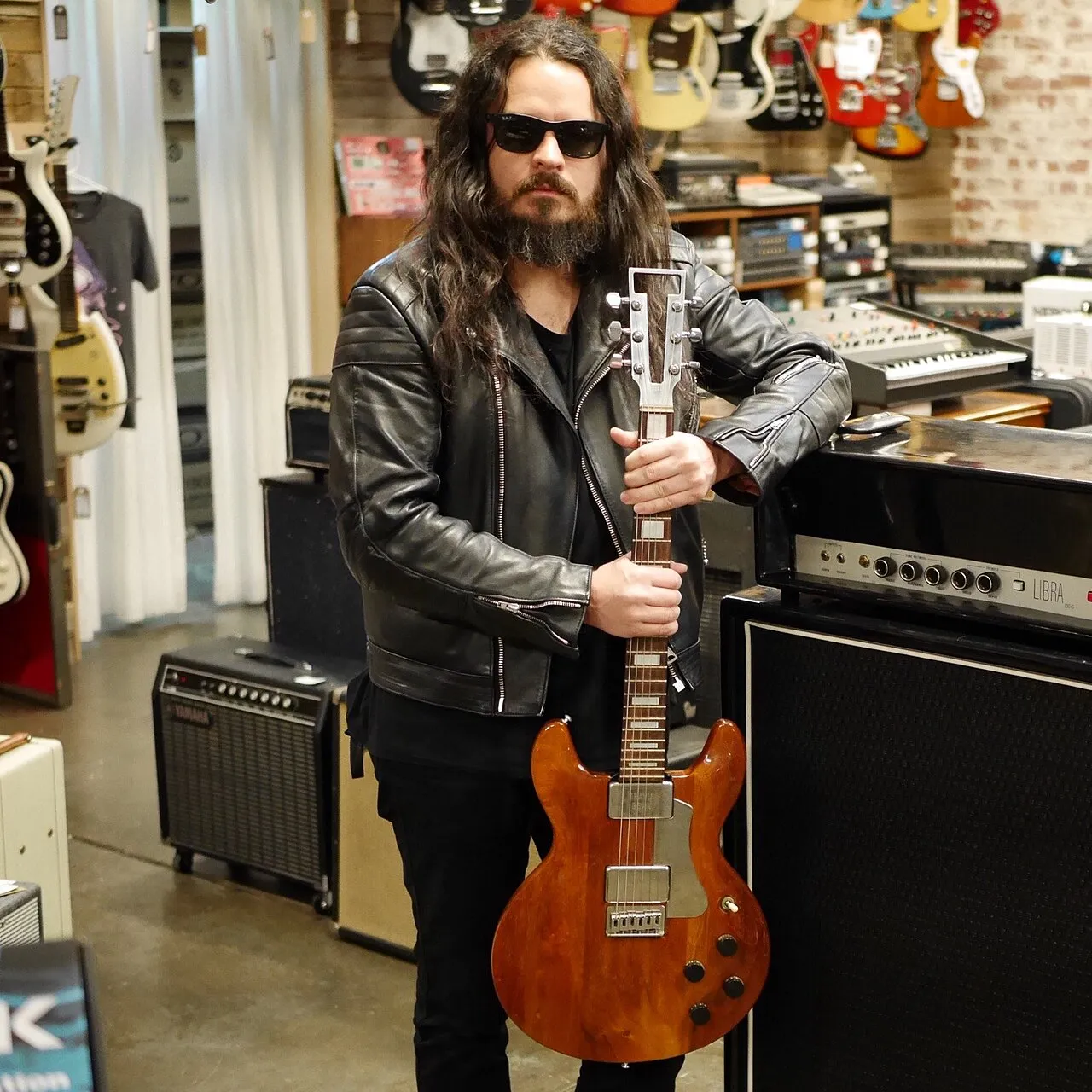
Photo: Somalley / Wikimedia Commons / CC BY-SA 4.0 Travis Bean
TB1000
1974
A motocross racer watched a repairman fight wooden necks all day. So he made one out of aluminum.
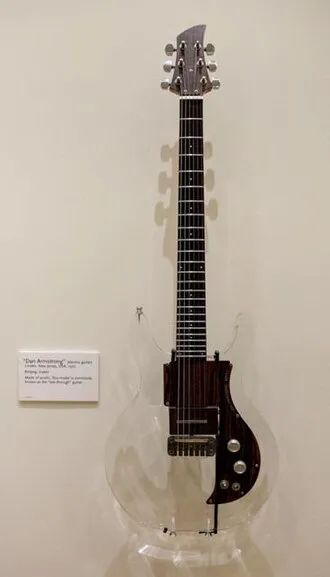
Photo: Frank Kovalchek / Wikimedia Commons / CC BY 2.0 Ampeg
Dan Armstrong
1969
A repairman who spent his days inside other people’s guitars designed one you could see straight through.
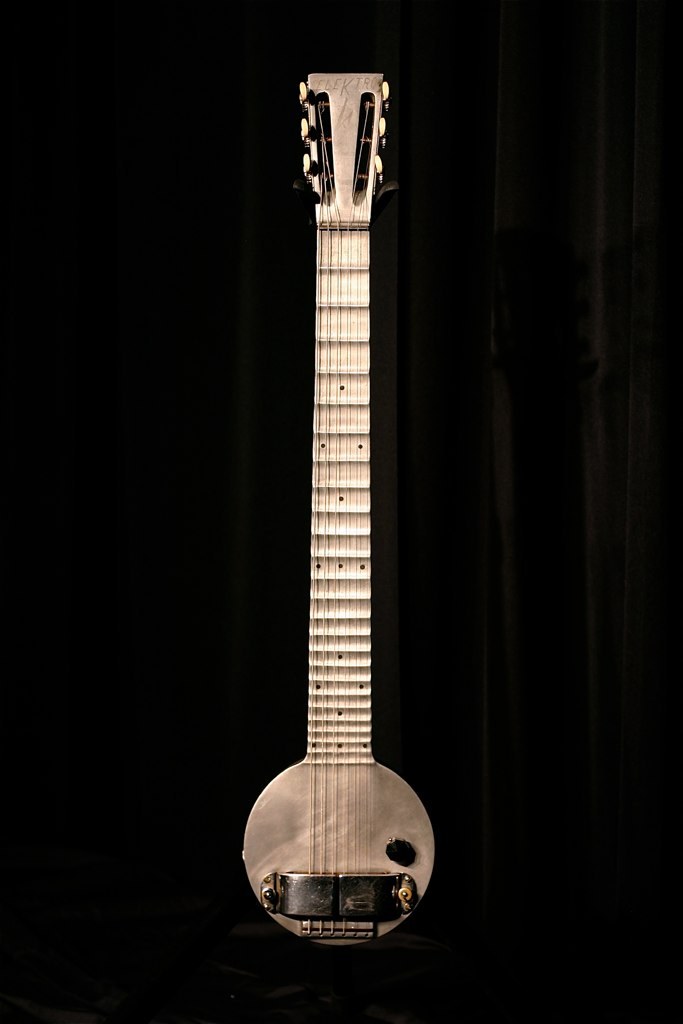
Photo: Museum of Making Music / Wikimedia Commons / CC BY 3.0 Rickenbacker
A-22 Frying Pan
1932
The first electric guitar you could buy looked like a frying pan. The patent office didn’t believe it worked.