Kustom
K200
A Kansas woodshop carved a guitar to sell next to the amp. Everyone remembers the amp.
Kustom made its name with tuck-and-roll amplifiers out of Chanute, Kansas. For about two years at the end of the sixties, the same company sold a carved semi-hollow guitar beside them. It wasn’t padded, it wasn’t a Rickenbacker, and it shares a number with an amp.
- Introduced
- 1968
- Type
- Semi-hollow electric
- Class
- Closed run
Have a photograph of this guitar? Send a picture
The short version
1964–65
Tuck and roll
Bud Ross starts Kustom in Chanute. The year depends who you ask.
1966
The one that got away
Ross takes a guitar design to the new factory in Neodesha. By his account, it comes out wearing a Wurlitzer logo.
1967
The woodshop
Doyle Reading leaves Neodesha, and in one account he and Ross set up a guitar shop in Chanute with Wes Valorie.
1968
The K200 debuts
The carved semi-hollow goes out through Kustom amp dealers in the summer.
1969
Done
Production ends late in the year, all of it in Kansas.
Side A
A1
The amp came first
If you know the name Kustom, you probably picture the amp. Tuck-and-roll vinyl, out of Chanute, Kansas.
The idea started with a wrecked Fender Bassman a friend brought to Bud Ross. Ross re-covered it in tuck-and-roll, and other amps followed. Whether the company dates from 1964 or 1965 depends on which account you open.
The amps sold. A dealer with a wall of them could use a guitar to hand you with one. So Ross set out to build one.
A2
The one that got away
The first try didn’t end up wearing his name.
In 1966, Ross and some local players worked up a design, and the new factory in Neodesha agreed to build it for Kustom. Ross never heard back. Then he saw guitars with something like his idea on them, and a Wurlitzer logo. He felt taken, and he started over.
That’s his side. Put a Kustom next to one of those guitars and they don’t match, and the man who wrote up both factories calls coincidence the likelier answer. Keep both.
A3
Two woodshop teachers
The second try was homegrown.
Doyle Reading had been a woodshop teacher and had worked at the Neodesha factory. In 1967 he left, came to Chanute, and set up a guitar shop with Ross. Wes Valorie, another woodshop teacher, was hired. In the fullest telling, the three of them, mostly the two teachers, drew a guitar “completely different from the Wurlitzer model.”
Reading told it a little differently, years later, in an email. Ross had come to him in 1966, and his ties ended in the summer of 1967, after which Ross hired Valorie. When he left, he wrote:
We could not meet the demand.
So the dates don’t agree, and neither does who was in the room. Ross, in his own email, was clear about the where: they “were only made at 210 west main Chanute, Kansas 66720.”
Flip the record · By the numbers
2,000–3,000
Made in 1968 and ’69, by Bud Ross’s estimate. He said it might be very generous.
4
Pieces of wood carved to make one body, two for the front and two for the back, in the fullest account.
A–D
The versions. A has the Bigsby, B a trapeze, C a smaller headstock, D is the bass.
Side B
B1
Carved, not padded
The K200 debuted in the summer of 1968. It was not covered in vinyl. The vinyl was the amp.
It was a symmetrical double-cut semi-hollow, carved. In the fullest account, two pieces of wood were glued and hollowed for the front, two more for the back, then the halves glued together. It had one cat’s-eye soundhole, a zero fret, and a skinny bolt-on maple neck. Reading knew Roy Clark, and Ross said that “had a big influence on the small neck.”
That’s why people misfile it. The cat’s-eye and the knobs look like a Rickenbacker. The thin neck and the zero fret could pass for a Mosrite. It’s neither. These guitars hail from Kansas.
The pickups were DeArmonds in big chrome covers. The price guides call the ones on the top model humbuckers. The pickup people say Kustom’s was the DeArmond Model 2000, the single-coil Gretsch called the Dynasonic. A cover that size will start that argument on its own.
The top version, the A, got a Bigsby. The B got a trapeze tail. The C was an A with a smaller headstock. The D was a bass. They came in black, blue, natural, red, sunburst, zebra, and a green-to-purple wineburst that listings call watermelon.
B2
Right number, wrong Kustom
Kustom sold the K200 through its amp dealers until late 1969. Then it stopped.
How many? Ross guessed two to three thousand over the two years, and added that “those numbers may be very generous,” because it was a small shop. Reading said he didn’t know why the guitars failed. No reissue has turned up. Kustom today sells amplifiers.
The amps did fine. John Fogerty played a Rickenbacker through a hundred-watt Kustom K200A-4 on “Green River.”
So if someone tells you they’ve heard a K200 on a Creedence record, they’re right, in a way. It was the one with the tuck-and-roll.
The cast
The people, and the specific guitars, that made the legend.
1968
Bud Ross
Founder of Kustom
Re-covered a wrecked Fender Bassman in tuck-and-roll and built a company on the idea. Then he wanted a guitar to go with it.
1967
Doyle Reading
Designer
A woodshop teacher who had worked at the Neodesha factory. His name is spelled Reeding in some accounts.
1967
Wes Valorie
Designer and builder
Another woodshop teacher, hired for the Chanute shop. Whether he worked beside Reading or came in after him depends who’s telling it.
1968
Roy Clark
The small neck
Had input on the design and later endorsed Kustom amps. No record ties him to playing a K200.
1969
John Fogerty
A Rickenbacker, through a Kustom K200A-4 amp
The famous Kustom on a Creedence record is the amplifier. He isn’t tied to the K200 guitar.
Liner notes
Specs, construction, rarity, value, and every source we used.
A cat’s-eye semi-hollow carved in Chanute — Kustom’s K200 guitar, not the tuck-and-roll amp that wears the same number.
- Body
- Symmetrical double-cut semi-hollow, one cat’s-eye hole. Blue Book, citing Wright: a two-piece carved top glued to a two-piece carved back. Wright’s 2010 column says the bodies were “carved out of two pieces.” Don’t merge those counts. Species is not on the Blue Book line. The K200A in that column is natural ash. Carter’s one 1967/68 natural is ash. Other listings say maple. Don’t pick.
- Neck
- Bolt-on two-piece maple on the Blue Book K200 A, zero fret. Guitar Stories, as transcribed: thin, with a curved truss rod. Carter’s one natural: an ash neck, a “C,” 0.778"–0.917" deep. One guitar.
- Fingerboard
- Bound rosewood, 22 frets, multiple dot inlays (Blue Book, K200 A). The B is double-dot. Carter’s CITES field on that natural says not Brazilian. A shop’s “Brazilian” is that shop. Don’t merge.
- Scale
- Blue Book, K200 A: 24.75". One Reverb natural prints 24.5" (622 mm). Bernunzio’s sold guitar prints 25". Lovies’ one wineburst prints 24.75". Mix flagged on 622 mm. Do not average. Do not invent millimetres for 24.75" or 25".
- Pickups
- Blue Book: two DeArmond “humbuckers” on the K200 A; two DeArmond single-coils on the K200 B. musicpickups and MusicRadar: Kustom’s unit is a chrome DeArmond Model 2000 (the Dynasonic), a single-coil, with a trapezoidal opening. Keep both descriptions.
- Hardware
- K200 A: adjustable bridge, Bigsby, three-per-side tuners, long black or white pickguard (Blue Book). K200 B: non-vibrato trapeze. No Bigsby on a B.
- Electronics
- Two volumes, two tones, three-way (Blue Book). Passive.
- Finish
- Blue Book: Black, Black Ash, Blue, Natural, Red, Sunburst, White Ash, Wineburst, Zebra. Wright (2010) also says greenburst. Lacquer. Not Naugahyde. “Watermelon” is a collector name for the green-to-purple burst, not a second factory color.
- Nut
- Blue Book: chrome-plated. Empire’s serial 2191: aluminum, about 1 9/16". One Reverb natural: 1 5/8" (41 mm). Lovies: 1 11/16". Mix flagged on 41 mm. Do not average. Do not invent millimetres for 1 9/16" or 1 11/16".
Open the full research fileConstruction details, the complete player record, production numbers, dated value estimates, and sources
Classic living example = a 1968–69 Chanute K200 A, the Bigsby guitar in the table. K200 B is the trapeze, double-dot, single-coil sister. K200 C is the A with a smaller unwinged headstock, a white guard, and plainer tuners. K200 D is the bass: 21 frets, a 2-per-side winged headstock, a bass bridge, two four-pole DeArmond single-coils. Not this table. No K200 guitar on the current Kustom amp site this pass, and no reissue found. Standalone. No Gibson SKUs.
One Reverb natural also prints overall length 38 3/4" (98.4 cm), lower bout 15" (38.1 cm), rim 1 1/2" (3.8 cm). Mix flagged: 38.75" is 98.425 cm, and 1.5" is 3.81 cm. Both are rounded on that page. 15" is 38.1 cm. One guitar. Not a factory sheet. musicpickups measures one early K200 pair at 4" × 1 11/16" (101.6 × 43 mm). 4" is 101.6 mm. 1 11/16" is 42.86 mm, not 43. Mix flagged.
Construction
Kustom already had the amp. Tuck-and-roll Naugahyde, solid-state, Chanute. The K200 guitar was what a dealer could hand you beside it. Wright (1 March 2010): they went out through Kustom amp dealers. The guitar is not padded. The vinyl is the amplifier. This is a carved semi-hollow with one cat’s-eye hole, a zero fret, and a neck thin enough that people file it under Mosrite.
The company year is already split, and it is not this guitar’s year. Kustom’s own article (Kane Tolinski, 13 December 2025): Charles “Bud” Ross founded Kustom Electronics in 1964. Premier Guitar (9 January 2013) prints “Bob Ross” and 1965. Premier’s Bob is not a second founder. Blue Book: Ross with Fred Berry, amps at the summer 1965 NAMM show. Wright (2010): the idea around 1965, after a friend brought him a trashed Fender Bassman and he re-covered it in tuck-and-roll. Other amps followed. Keep 1964 and 1965.
The guitar that missed is the 1966 one, and it is not a K200. Guitar Stories, Volume 1 — Wright’s interview with Ross, page 157 as typed onto VintageKustom.com on 22 December 2003 — says Ross and some local players had a design, the new factory in Neodesha agreed to build it for the Kustom name, and the guitars went out wearing Wurlitzer instead. Vintage Guitar’s Holman piece, same writer: Ross never heard back, then saw something that looked like his idea with a Wurlitzer logo, felt taken, and started over. That article also gives Doyle Reading the design credit for both the Wurlitzers and the later Kustoms, and says a coincidence is the likelier reading. A Kustom and a Holman in the hand do not match. The Wurlitzer Cougar, Wildcat, and Gemini are Neodesha solidbodies. Off this plate.
Who cut the K200 is Chanute. When they started does not agree, so it stays split.
Blue Book, citing that book: in 1967 Doyle Reeding approached Ross. Vintage Guitar and the emails below spell him Reading. The page-157 transcription: he had been a woodshop teacher, left the Neodesha factory, moved to Chanute in the fall of 1967, and he and Ross set up the guitar shop. Wesley Valorie, another woodshop teacher, was hired. The three — mostly Reeding and Valorie — designed a guitar “completely different from the Wurlitzer model.” It debuted in the summer of 1968. Wright’s 2010 column: the guitars “hit the street in 1968.” Vintage Guitar: they began making them in 1968. Blue Book’s manufacture line is 1967 through late 1969. The 1967 date is the shop in that same story, not a catalog cover opened here. YAML introduced is the summer-1968 debut.
Reading’s account, printed in a 4 February 2026 Reddit post as an email the writer says arrived about ten years earlier, starts sooner and stops sooner. Bud contacted him in 1966. They started the Kustom guitar. In the summer of 1967 his ties ended, and Bud hired Wes Vallier, a Chanute schools woodshop teacher. When Reading left, “we could not meet the demand.” He does not know why the guitars failed. Bud’s email in the same post: they “were only made at 210 west main Chanute, Kansas 66720.” Doyle helped design them, knew Roy Clark, and that “had a big influence on the small neck.” Doyle had trouble running the factory. Bud let him go, he went back to teaching, and then Bud hired Wes Valorie. Jack Valorie “run the wood shop making speaker cabinets.” Cabinets. Not these bodies. Keep fall 1967 (the book) against summer 1967 (Reading’s email). Keep “the three designed it” against “Wes came in after Doyle left.”
The carve, when the book is specific, is four pieces: two glued and hollowed for a front, two for a back, then glued (page-157 transcription). Blue Book: two-piece carved top to a two-piece carved back, “similar to the Microfrets design.” A method. Not a claim that Micro-Frets built them. Wright’s 2010 “two pieces” is the short sentence. Don’t average two and four. Shops that weigh one: Empire’s wineburst serial 2191, single-coils and double horizontal dots, 6 lb 11 oz; one Reverb wineburst, 6 lb 12 oz; Carter’s natural, 6.6 lb. Don’t average. The 1966 date on the CTS pots in that Empire guitar is a part. Not a launch.
Blue Book’s A is the table: 22-fret bound rosewood, multiple dots, zero fret, chrome nut, Bigsby, the pickups it calls humbuckers, 24.75". The B is double-dot, a trapeze, and single-coils. The C keeps the A and changes the headstock, the guard, and the tuners. The D is the bass. Wright (2010): the better guitars got DeArmond humbuckers, the lower models single-coils, and the pictured top A is natural ash. musicpickups counts seven Kustom pickup variants. The K200A cover it describes is a Model 2000 with the opening cut trapezoid. MusicRadar’s word for a Model 2000 is single-coil. A large chrome cover is why a listing says humbucker. Don’t settle it from the ad.
Not a Rickenbacker, and not a Mosrite neck on a Kansas body. Wright: the cat’s-eye and the knobs look like a Rick, the skinny two-piece maple and the zero fret could pass for a Mosrite, and these guitars “hail from Kansas.” Bob Shade (mosriteforum, 8 September 2014) describes a later deal, from the years Semie Moseley did not own the Mosrite name: Ross fronted $15,000, few pieces came back, and the one Shade owned had a Mosrite bridge, a stop tail, tiny frets, and micro dots, plus DeArmonds. A different neck, and a different contract. It does not move the 1968 Chanute carve.
No 1968 list price was on a catalog page opened here. A Reverb listing for a 1 June 1971 Kustom price sheet is described by the seller as still naming K200A guitars. The figures on that sheet were not read. Don’t invent them, and don’t make 1971 a second factory year. There is no living K200 guitar. The Kustom site this pass is amplifiers.
Players
The famous Kustom is the amp. Don’t hang it on this guitar.
Guitar Player (Dave Hunter, 29 September 2023): Conway Twitty, Johnny Cash, John Fogerty, Leon Russell, the Grateful Dead, and most of the Jackson 5 used the tuck-and-roll amps, and Sheryl Crow and Mike Campbell later. Those are backlines. Premier Guitar (2 November 2015) prints Fogerty’s circa-1968 guitars as a Rickenbacker 325, a Gibson ES-175, and a ’68 Les Paul Custom. The Kustom on that card is a 100-watt K200A-4 amplifier and a 2×15 cab. “Green River,” in that piece, is the Rickenbacker through the K200A-4. “Midnight Special,” in the same piece, is the Les Paul Custom, tuned down a whole step, into a Fender Vibrolux. Guitar World (his 2023 remarks, quoted 29 September 2025): the K200A-4’s blend of vibrato and tremolo is on “Born on the Bayou” and “Midnight Special,” and “the Rick with the Kustom amp.” Keep the Midnight Special split. Amp against Vibrolux. Neither sentence is a K200 guitar.
Roy Clark is a neck, and an amp endorser, not a pinned K200 on a record. Blue Book, from Wright: he had input on the design and later endorsed the amps. Bud’s email, as that Reddit post prints it: Doyle knew Clark, “and that had a big influence on the small neck.” No side opened here credits Clark with playing this model.
No other player is tied to a named K200 guitar by a source opened for this plate. Also-known stays empty on purpose.
Rarity
You cannot order a new one. No reissue turned up, and the Kustom pages opened this pass are the amp line. What exists is the Chanute run.
Kustom published no K200 guitar total. Wright (2010), reporting Ross: between 2,000 and 3,000 from 1968 to ’69, and “those numbers may be very generous,” because it was a small shop. Blue Book repeats 2,000–3,000 “during the two years,” all in Kansas, and dates manufacture 1967–late 1969, without the generous clause. Keep the estimate and the caveat. It is not a ledger. Reading’s email says they could not meet demand when he left. That is his 1967, not a count. Serials on these guitars are not a published year-by-year census. A pot code dates a pot.
What is actually thin: a clean K200 A that still has the Bigsby, the multiple-dot board, and the DeArmonds it left with; a K200 C you can tell from an A by the smaller headstock; wineburst, the green-to-purple finish listings call watermelon. The B, with the trapeze and the single-coils, is the same short run and a different guitar. The D is the bass. Shade’s later Mosrite-necked piece is one object from another deal. Empire’s 2191 is one wineburst. Not a price for the model.
Value
Informal estimate, 23 October 2026. Not an appraisal.
Ask is not sold. A K200 bass is not this guitar. A tuck-and-roll K200A-4 amp is not a comp, including Fogerty’s. No celebrity guitar lot turned up. No invented median, and no 1968 catalog dollar. The 1 June 1971 price sheet is a seller’s description. The prices on it were not read.
New street. None. No K200 guitar for sale from Kustom this pass.
Used modern. No reissue market to price.
Vintage / collectible. No Reverb Price Guide band isolated on the K200 guitar this pass. Flag: thin sold-comp access. Asks, not hammers. Carter Vintage, one 1967/68 natural: tag was $2,200, now $1,900. Musician’s Friend, a used black: $1,799.99. Guitar Hangar, a natural in excellent: $1,699.99. On Reverb’s Kustom electric index, fetched this pass: a fair 1960s ask at $1,458; a modified 1968 K200A sunburst at $1,475; a K200 A wineburst at $3,000; a deluxe cherry cut to $3,182.50 and a deluxe cherry sunburst cut to $3,206.25. Don’t average the fair ask with the deluxe asks. An ended natural shown at $1,700, and a wineburst page listed about nine years ago at $1,499.99, are ended asks. Not hammers. Bernunzio’s natural is marked sold, and the page opened does not print the price. K200 bass asks on that same day’s bass index ($2,495 to $3,450) are the other instrument.
What moves a result, when a shop will say: A, B, or C; a Bigsby that was stock against a trapeze; Model 2000s still in it against a swap; wineburst against a plain natural; ash or maple, as that guitar is; a chrome nut against an aluminum one a shop measured. One serial is not the model.
See also
- rickenbacker-330-360 — the cat’s-eye double-cut people file a K200 under; Santa Ana, not Chanute, and not this bolt-on
- mosrite-ventures — the thin zero-fret neck the K200 gets mistaken for; a German-carve solidbody, not this semi-hollow
- micro-frets-spacetone — Blue Book’s comparison for the carved two-piece top and back; a Maryland guitar, and not the builder of these bodies
Sources
- Michael Wright, “Tuck & Roll,” myrareguitars.com, 1 March 2010 — Ross and Fred Berry, idea around 1965; 1966 design lost to Holman-Woodell / Wurlitzer; 1967 with Doyle Reeding and Wesley Valorie; carved bodies, cat’s-eye; street in 1968; natural-ash K200A; humbuckers on the better guitars, single-coils below; Ross’s 2,000–3,000 for 1968–69 “may be very generous”; sold through amp dealers
- Blue Book, Kustom electric guitars — four models, Kansas, 1967–late 1969; Reeding, Valorie, Roy Clark’s design input and later amp endorsement; two-piece top to two-piece back, “similar to the Microfrets design”; 2,000–3,000, citing Wright, Guitar Stories, Volume One. K200 A / B / C / D spec lines, including 24.75" on the A
- VintageKustom.com, ET, 22 December 2003, transcribing *Guitar Stories* Vol. 1, p. 157 — Wright’s interview with Ross: 1966 Neodesha approach; fall 1967 move; summer 1968 debut; four-piece semi-hollow; DeArmonds; Bigsby; Clark; “hail from Kansas.” A typed copy, not the book in hand
- Vintage Guitar, “Holman Guitars” — Reading left Holman in 1967; Kustom guitars begun 1968; Reading credited with the Wurlitzers and the Kustoms; Ross’s expropriation story, with coincidence called likelier; a Kustom and a Holman do not match in the hand. Points the guitar story at Guitar Stories, Volume 1
- Kustom, Kane Tolinski, 13 December 2025 — Charles “Bud” Ross, Kustom Electronics, 1964; tuck-and-roll amps. The living site this pass is amplifiers
- Premier Guitar, “Kustom K-100,” 9 January 2013 — prints “Bob Ross” and a 1965 founding. Not a second person
- Reddit, r/VintageGuitars, 4 February 2026 — owner’s paste of emails he dates about ten years earlier. Reading: 1966 start, ties ended summer 1967, Wes Vallier, demand unmet. Bud: only at 210 West Main, Chanute, Kansas 66720; Clark and the small neck; Wes Valorie after Doyle; Jack Valorie on speaker cabinets
- musicpickups.com, Kustom — seven pickup variants; K200A cover is a Model 2000 with a trapezoidal opening; one early pair measured 4" × 1 11/16" (101.6 × 43 mm). Mix flagged
- musicpickups.com, Model 2000 — Kustom, Martin, and Standel specified cosmetic changes to the 2000; Kustom’s opening is trapezoidal; chrome, black coil formers, neck and bridge heights
- MusicRadar, “DeArmond Model 2000,” 30 August 2019 — Model 2000 is a single-coil; Gretsch’s Dynasonic name
- Bob Shade, mosriteforum, 8 September 2014 — later Semie deal, $15,000 fronted, few guitars; Shade’s example had a Mosrite bridge, stop tail, tiny frets, micro dots. Not the 1968 Chanute neck
- Guitar Player, Dave Hunter, 29 September 2023 — Cash, Fogerty, Russell, the Dead, the Jackson 5, Twitty, and later Crow and Campbell, on the tuck-and-roll amps
- Premier Guitar, “John Fogerty: That Old Travelin’ Bone,” 2 November 2015 — circa-1968 guitars: 325, ES-175, ’68 Les Paul Custom. Amp: 100-watt K200A-4 and a 2×15. “Green River” through the Kustom; “Midnight Special” on the Les Paul into a Vibrolux
- Guitar World, 29 September 2025, quoting Fogerty’s 2023 remarks — K200A-4 amp; vibrato-tremolo on “Born on the Bayou” and “Midnight Special”; “the Rick with the Kustom amp”
- Carter Vintage, K-200 1967/68 natural — one guitar: ash body, ash neck, rosewood, not Brazilian, 24.75", nut 1.591", 6.6 lb, radius 9.5". Ask was $2,200, now $1,900
- Empire / Gbase, 1968 K200 wineburst, serial 2191 — single-coils, double horizontal dots, aluminum nut about 1 9/16", 6 lb 11 oz, CTS pots dated 1966
- Reverb, 1968 K200 natural, dimensions — one guitar: 38 3/4" (98.4 cm), 15" (38.1 cm), 1 1/2" (3.8 cm), 24.5" (622 mm), nut 1 5/8" (41 mm). Mix flagged. Ended ask $1,700
- Bernunzio, Kustom K200, item 19188 — sold; scale printed 25"; nut 1 9/16"; serial 1155; replacement tuners. Price not on the page
- Lovies, 1968 wineburst — one listing: scale 24.75", nut 1 11/16". The “Tune-O-Matic style” bridge is that listing, not the Blue Book line
- Guitar Hangar, K200 natural — ask $1,699.99; that page prints 24.5" and a 1 5/8" nut
- Musician’s Friend, used black K200 — used ask $1,799.99
- Reverb, Kustom electric guitars — October 2026 asks, including fair $1,458, modified K200A sunburst $1,475, K200 A wineburst $3,000, deluxe cherry $3,182.50, deluxe cherry sunburst $3,206.25. Not a price guide
- Reverb, Kustom bass guitars — K200 bass asks from $2,495 to $3,450 on that fetch. Not this guitar
- Reverb, 1 June 1971 Kustom price list — seller says the sheet includes K200A guitars. Figures not read. Not a 1971 production date
- Reverb, 1968 wineburst, ended — one guitar at 6 lb 12 oz; ended ask $1,499.99, listed about nine years ago. Not a 2026 hammer
Keep digging
Guitars this one gets compared to, confused with, or descended from.
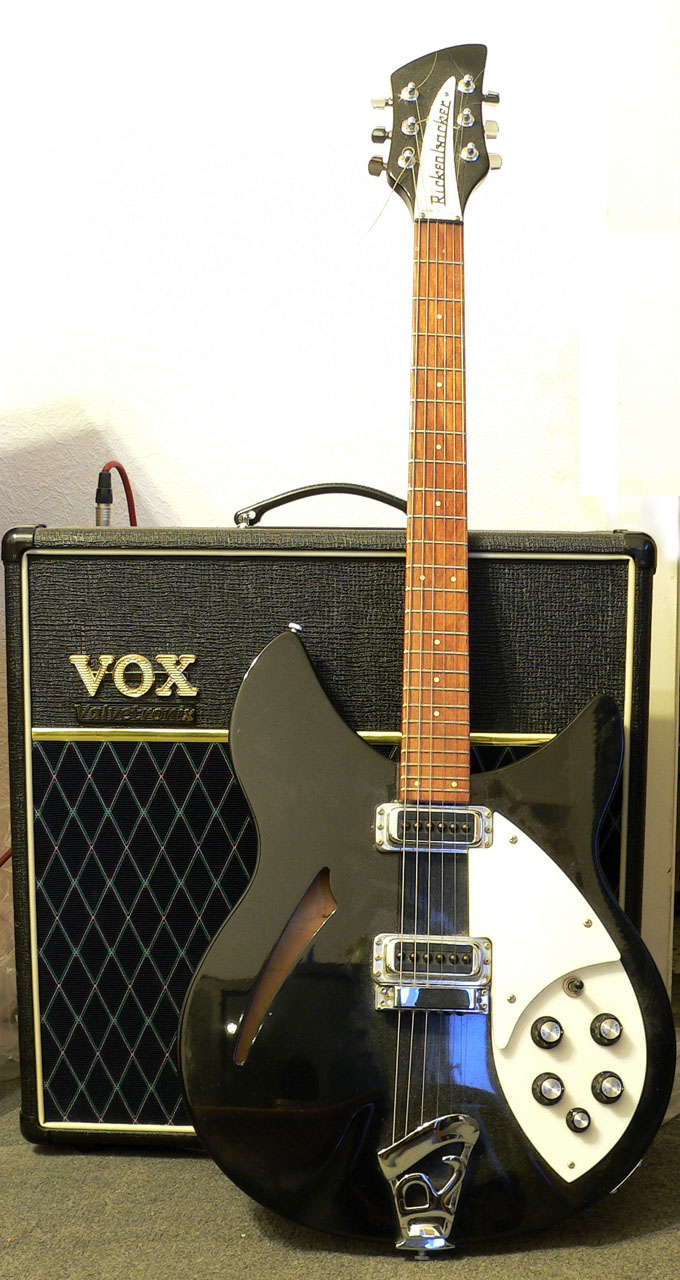
Rickenbacker 330JG. Licensed under CC BY-SA 3.0. Via Wikimedia Commons. Rickenbacker
330 / 360
1958
Same body, same neck, same pickups. The 360 got the binding. The 330 got Paul Weller’s, with “I AM NOBODY” on it.
- Send a picture
Mosrite
Ventures
1963
Semie Moseley offered Nokie Edwards the guitar free. He paid $200, and the Ventures dropped their Jazzmasters.
- Send a picture
Micro-Frets
Spacetone
1969
A Maryland guitar you intonate at the nut, with a bar that dips whole chords in tune. Some even broadcast FM.