Fender
Starcaster
Fender built it for 335 players. They walked right past it. Twenty years later, Radiohead didn’t.
The early 1970s, Fender R&D. The Coronado is gone, CBS has a pile of its leftover parts, and Gene Fields has the job of using them up. What he ended up with has a fin on the headstock, five knobs, and almost nobody who wanted it at the time.
- Introduced
- 1976
- Type
- Semi-hollow electric
- Class
- Production
The short version
1961
Fields joins R&D
Later come the Mustang Bass, the Bronco, and the Marauder that never shipped.
1966
The fin
The headstock shape turns up on the Marauder, by most accounts.
1972
The Coronado is gone
CBS wants the leftover stock used up. The scrap-parts prototypes don’t work.
1975
Prototypes
The earliest dated guitars. Production is 1976.
1976
The Starcaster
Fender’s first new electric model in three years.
1980
Off the price list
Cut in the fall of 1980. Some accounts run it to 1982.
2013
The body comes back
A Modern Player, with four knobs and no string-through. Squiers follow by 2019.
2024
One pickup
Tom DeLonge’s signature. The outline, not the circuit.
Side A
A1
Use up the Coronado parts
The Coronado was gone by 1972. It had been Fender’s try at a hollow guitar for the 335 crowd, and it left behind a pile of parts. In the early 1970s CBS wanted that stock used up, and gave the job to Gene Fields.
Fields had been in Fender R&D since 1961. He’d done the Mustang Bass and the Bronco, and a guitar called the Marauder that never shipped. Now he was building prototypes out of leftovers, and they looked like it. The historian Tony Bacon’s verdict: “too obviously outings for scrap components.”
So CBS had him start over. Some tellings treat the scrap-parts story as closer to rumor than record. Either way, the guitar that shipped was drawn from scratch.
It was built to catch a player who wanted a 335. That player never came.
A2
First heard in 1976
Fender called it the company’s first new electric model in three years. At least one guitar is dated 1975, and there were prototypes that year; production was 1976. A 1977 ad went big: “The Hard-Charging Sharp-Toothed Starcaster.”
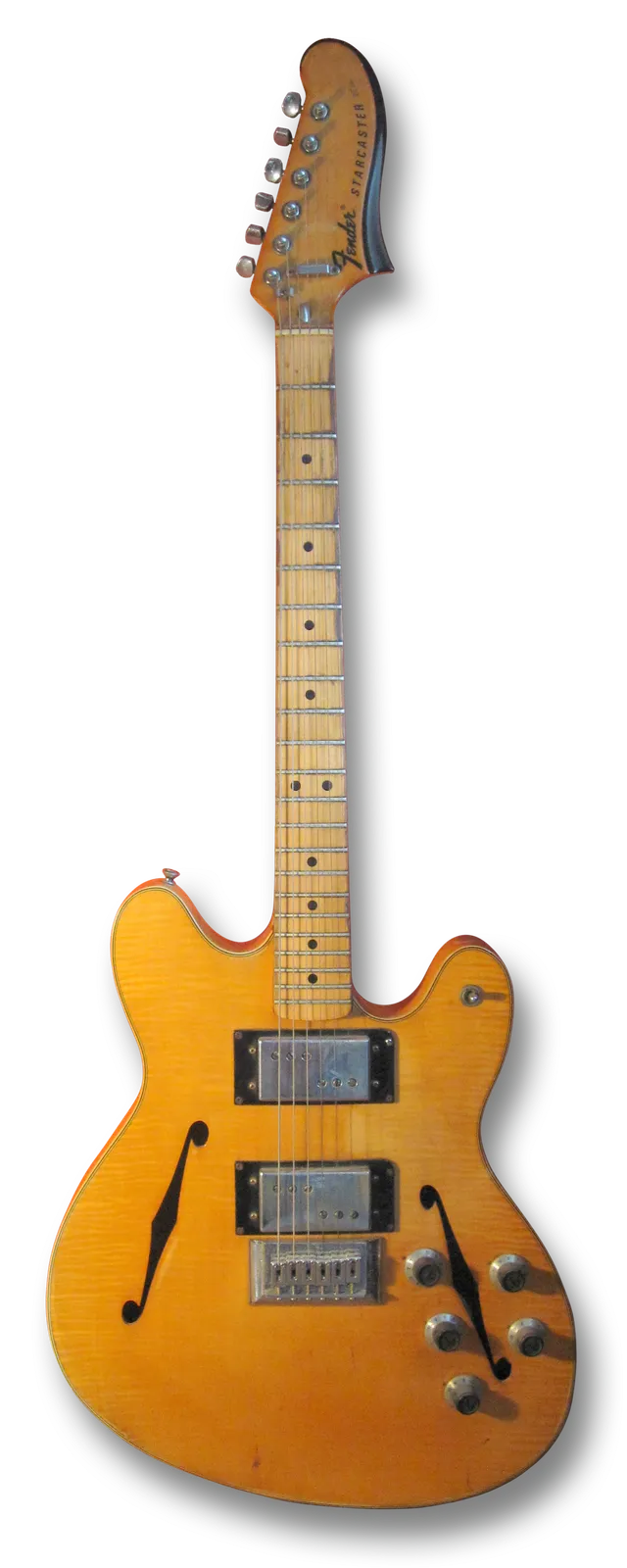
What they shipped was a Gibson idea in Fender clothes. A semi-hollow maple body with two f-holes and binding front and back, and a block down the middle, which the Coronado never had. Fender says the block is maple. At least one 1976 guitar has a poplar frame instead. Keep both.
The rest is pure mid-’70s Fender. An offset waist. A bolt-on maple neck, three bolts, with the Micro-Tilt adjuster and the bullet truss rod. Twenty-two frets on a maple board. A 25.5-inch scale, against the 335’s 24.75. It came with flatwound strings and a hardshell case.
A3
The fin and the five knobs
Look at the headstock first. It’s wide, six tuners in a row, with a dark-painted fin on the far side. Fields had drawn it for the 1966 Marauder, by most accounts. Another remembers it on a one-off Lucite guitar instead. Either way, it isn’t a Strat headstock, and it isn’t the big CBS one.
The pickups were Seth Lover’s Wide Range humbuckers, the ones with threaded CuNiFe pole pieces under chrome covers. The Telecaster Thinline, Custom, and Deluxe already had them. The Starcaster was the only other Fender that got them.
Then the knobs. Volume and tone for each pickup, plus a master volume, five skirted knobs in all, with the toggle on the lower horn. The strings go through the body to a hardtail. No tremolo.
A 335 buyer looked at a bolt-on neck with five knobs and a fin, and kept walking.
Flip the record · By the numbers
3 years
Since Fender’s last new electric model, when the Starcaster arrived in 1976.
5
Knobs. A volume and tone for each pickup, plus a master.
25.5"
The scale. The 335 it was chasing is 24.75".
2
Wide Range humbuckers. The only Fender outside the Telecaster line to get them.
Side B
B1
It still failed to excite players
Bacon again, and this time generous: “It was a much better instrument than some of the previous (Fender) hollow-body models, but still failed to excite players.” By then the talk was that a good Fender was one made before CBS. And the 335 buyer still wanted a set neck.
Hardly anyone famous picked one up. Fender can name one notable exception from the original run: Leo Nocentelli of the Meters. The Starcaster came off the price list in the fall of 1980. Some accounts keep it going to 1982.
Then the name went wandering. In the early 2000s “Starcaster by Fender” was a budget line of Strat-shaped guitars. Different body, same word.
B2
A cello bow on a Fender
Radiohead’s Jonny Greenwood mostly plays a Telecaster Plus. That’s the guitar on “Paranoid Android.” But on “Street Spirit (Fade Out)” and “Pyramid Song” he plays a Starcaster, sometimes with a cello bow. Fender connects it to OK Computer, Kid A, and Amnesiac, and to live versions of “The Tourist,” “Street Spirit,” “Optimistic,” and the bowed “Pyramid Song.”
Find a live “Pyramid Song” where he’s bowing it. That’s the Starcaster doing a job nobody designed it for.
After that it turns up in videos: Dave Keuning in the Killers’ “For Reasons Unknown” and “Human,” Jamie Cook in Arctic Monkeys’ “Crying Lightning.” Fender brought the body back in 2013 as a Modern Player, with four knobs, no string-through, and no bullet. Squier had Starcasters by 2019. Tom DeLonge got a signature in 2024 with one pickup and one knob. The outline, not the circuit.
(Trey Anastasio’s guitar looks like one. It’s a custom Languedoc, designed after the Starcaster.)
In 1976 the players it was built for walked right past it. It had to wait for someone who’d reach for a cello bow.
Put this on
You’ve read about it. Now hear it. Here’s what this guitar sounds like, and what to listen for.
Pyramid Song
Jonny Greenwood on a Starcaster, sometimes played with a cello bow. Live, the bowed version is the one Fender points to.
Find it on YouTube (opens in a new tab)Street Spirit (Fade Out)
One of the two songs tied to Greenwood’s Starcaster rather than his Telecaster Plus. Fender lists it among the songs he plays it on live.
Find it on YouTube (opens in a new tab)Crying Lightning
Watch Jamie Cook in the video. That clip is his sourced Starcaster.
Watch it on YouTube (opens in a new tab)For Reasons Unknown
Dave Keuning plays one in this video, and in “Human.” That’s where the record ends, so that’s where the card does.
Watch it on YouTube (opens in a new tab)
The cast
The people, and the specific guitars, that made the legend.
2001
Jonny Greenwood
Starcaster, alongside his Telecaster Plus
Radiohead. “Street Spirit” and “Pyramid Song,” sometimes with a cello bow; Fender adds OK Computer, Kid A, and Amnesiac. “Paranoid Android” is the Tele Plus.
Leo Nocentelli
Starcaster
The Meters. Fender’s one notable exception to the rule that famous hands skipped it in the original run. No Meters track is pinned to it.
1978
Randy Bachman
A natural, and a black 1977
By the account that came with the black one, the natural recorded Survivor (1978), and the black guitar is on Heavy Blues (2015).
2009
Jamie Cook
Starcaster
Arctic Monkeys. Plays one in the “Crying Lightning” video.
Dave Keuning
Starcaster
The Killers. In the “For Reasons Unknown” and “Human” videos. Don’t hand him all of Sam’s Town.
1976
Gene Fields
Designer
In Fender R&D from 1961. Handed a scrap-parts job, and drew a new guitar instead.
Liner notes
Specs, construction, rarity, value, and every source we used.
Offset semi-hollow, a maple stick through the middle, five knobs, and Gene Fields’s fin headstock — Fender’s 1976 oddball, not a 335, not a Coronado, and not a Tele.
- Body
- Offset double-cut semi-hollow. Arched laminated maple top, maple back and sides, bound front and back, two f-holes. Center block: Fender says maple; one Chicago Music Exchange 1976 card says a poplar frame. Crave’s example: unbound f-holes.
- Neck
- Bolt-on hard-rock maple. Three-bolt, Micro-Tilt, bullet truss rod.
- Fingerboard
- Maple, black dots, 22 nickel-silver medium-jumbo frets. Fender: 10" radius. One CME 1976 sheet: 9.50". One dealer sheet: 7.25". Do not average.
- Scale
- 25.5" (Premier Guitar; Wikipedia). Crave measured 25½" (647 mm). A shop card prints 25.5" (648 mm). Mix flagged.
- Pickups
- Two chrome-covered Seth Lover Wide Range humbuckers; threaded CuNiFe pole pieces (True Vintage Guitar)
- Hardware
- String-through six-saddle hardtail. Fender names Grover Rotomatic tuners; shop cards often say Fender-branded enclosed machines. Chrome. Three-ply black guard.
- Electronics
- Volume and tone per pickup, plus a master volume. Five skirted knobs. 3-way toggle on the lower horn.
- Finish
- Fender’s thick-skin gloss: Blonde, White, Black, Natural, Walnut, Antigua, Wine, Tobacco Sunburst. Premier’s 2012 list omits Antigua and Wine.
- Nut
- Measured 1 5/8" (Crave, CME, Colemans, Cream City). Imperial prints 1.65". Crave’s parentheses: 41.2 mm. ATB: 41.8 mm and no inch. Mix flagged.
Open the full research fileConstruction details, the complete player record, production numbers, dated value estimates, and sources
Classic living example = 1976–80 U.S. Starcaster (center block, two Wide Range humbuckers, five knobs, string-through, fin headstock, 3-bolt). Not a current SKU. Modern Player (China; Fender 2013, Reverb’s bucket 2014–2017) drops the master volume, the bullet, and the 3-bolt. Squier Classic Vibe is the nearest new silhouette and is still not this table. Tom DeLonge Starcaster (2024) is one bridge humbucker. Early-2000s Starcaster by Fender is a budget Strat-shaped line. The bass is not this guitar. Mix flagged in the scale and nut rows, and again on current pages that print 25.5" (648 mm), 1.650" (42 mm), 9.5" (241 mm), 12" (305 mm). Do not average 647 with 648, or 10" with 9.50" or 7.25". No period list price located this pass.
Construction
The job was a humbucker semi Fender could hang next to a 335 and still have it read as a Fender. Offset waist. A block through the middle. Bolt-on maple. Five knobs. A headstock with a painted fin. Not a Strat with f-holes. Not a Tele. Not a Jazzmaster.
CBS had already tried a hollow Fender. The Coronado — fully hollow, no center block — was gone by 1972 (Fender). In the early 1970s CBS wanted the leftover Coronado stock used up and gave the job to Gene Fields, in R&D since 1961 (Mustang Bass, Bronco, the aborted Marauder). Tony Bacon, quoted by Fender: early prototypes were “too obviously outings for scrap components.” CBS then had him design a new instrument. Crave’s telling is the same story labeled allegation: the scrap idea proved fruitless, and the guitar was drawn from scratch.
Fender dates the arrival 1976, “the company’s first new electric model in three years,” and the exit as a price-list cut in the fall of 1980. Vintage Guitar and Bass’s transcription of the 1977 ad says it was first heard “in 1976.” Wikipedia says that same ad dates first creation to 1975. Crave’s card is a 1975 Fullerton guitar. Leadmusic: a prototype in 1975, production really in 1976. Keep 1975 and 1976. This plate starts in 1976.
The ending splits the same way. Premier Guitar in 2012, and Fretboard Journal, stop at 1980, with Fender. Wikipedia, and Premier’s 2020 column, run it 1976–1982. Reverb’s product bucket is 1976–1979 — a shop category, not a price list. Prefer the fall 1980 cut. Do not bury 1982.
What shipped is still a Fender, which is why the 335 player walked past it. Offset double-cut, laminated maple, two f-holes, binding front and back, and a center block the Coronado never had (Fender: maple; CME’s one 1976 card: a poplar frame — keep both). Bolt-on, three bolts, Micro-Tilt, bullet, maple board, 22 frets, Fender’s 10" radius. Scale 25.5" against a 335’s 24.75" is the contrast Premier Guitar draws.
The headstock is the other half of why it is not a Strat. Six-on-a-side, dark-painted fin opposite the tuners (Fender). Fields drew it for the 1966 Marauder that did not ship (Fender; Wikipedia). Fretboard Journal remembers the shape on a one-off Lucite custom instead. Keep both. Wide. Not the CBS Strat headstock. Wikipedia’s later Deluxe Affinity, on a “CBS style” headstock, is a different Squier.
The coils are Seth Lover’s Wide Range humbuckers, chrome covers, threaded CuNiFe poles (Fender; True Vintage Guitar). Premier, 2012: the only non-Telecaster to get them. They were already on the Thinline, the Custom, and the Deluxe. Same family. Not those guitars. Five skirted knobs — volume and tone each, plus a master — and the toggle on the lower horn (Fender). Strings through the body to a six-saddle hardtail, not a tremolo (Wikipedia; Premier, 2020). Fender names Grover Rotomatic tuners; shop cards say Fender-branded enclosed machines. Keep both. Thick-skin gloss, and Fender says it left with stainless flatwounds and a hardshell case.
Bacon, via Fender: “It was a much better instrument than some of the previous (Fender) hollow-body models, but still failed to excite players.” By then, Fender’s own account, the talk was that a good Fender predated CBS. The 335 buyer still wanted a set neck.
Not a Telecaster Thinline. A Tele slab, one f-hole, two knobs (fender-telecaster-thinline). Not a Coronado (fender-coronado). Not a Jazzmaster, Jaguar, or Strat. The waist is offset. That is a Fender habit, not a membership. Not an ES-335 (gibson-es-335).
The name then went walking. Early-2000s Starcaster by Fender was a cheap line of Strat-shaped guitars, Jazz-shaped basses, and drums (Fender; Wikipedia). A few 1970s bass prototypes never cataloged; Fender built a bass on the idea in 2013 and, Wikipedia says, dropped it by 2016. Not this six-string.
2013. The body came back as a Modern Player (Fender). Reverb says Fender “heard the calling in 2012” and files China guitars as 2014–2017. Fender’s return keeps two f-holes and two Wide Range humbuckers, moves the radius to 9.5", deletes the master volume, and fits an Adjusto-Matic with a stop tail. Wikipedia: no string-through, no bullet, no three-bolt, bound f-holes. zzounds: alder center block, nut 1.650" (42 mm), scale 25.5" (648 mm). Mix flagged. “Wide Range” there is not a CuNiFe claim.
Squier took the outline once the Fender badge left. Wikipedia: by 2019, Classic Vibe, Affinity, and Contemporary. Classic Vibe follows the 2013 layout — four knobs, stop tail, Fender-designed Wide Range pickups (Fender). No source here calls those coils CuNiFe. Contemporary Active has no f-holes and active ceramics (Fender). Wikipedia says Contemporary ended in 2024; Fender’s collection, checked this pass, still tiles it, and tiles an Affinity Deluxe on what Wikipedia calls a CBS-style headstock. Keep both. Prices for those, and for Tom DeLonge’s one-pickup signature (Seymour Duncan SH-5, one volume, rosewood, 12" radius, stop tail), are in Value. Same outline. Not this table.
Players
Do not hang a 335, a Coronado, or a Thinline on this plate. Do not move Wide Range Tele players over because the pickup matches. Do not recruit the bass.
Leo Nocentelli — the 1970s name Fender has. Fender: hard to find a Starcaster in famous hands in the original run; “Leo Nocentelli of the Meters is a notable exception.” No Meters side is pinned to this guitar here.
Jonny Greenwood — the softer Radiohead guitar, not the Tele Plus. Wikipedia: his main electric is a Telecaster Plus. On “Street Spirit (Fade Out)” and “Pyramid Song” he plays a Starcaster, sometimes with a cello bow. Fender’s history is wider — OK Computer (1997), Kid A (2000), Amnesiac (2001), plus live “The Tourist,” “Street Spirit,” “Optimistic,” and the bowed “Pyramid Song.” Keep both. “Paranoid Android” is the Tele Plus.
Randy Bachman — a natural on Survivor (1978); a black 1977 later. Julien’s, from his collection, serial S7 09092: the natural recorded Survivor; this black guitar and a customized black Starcaster are on Heavy Blues (2015). Named objects. Not a Guess Who or BTO guitar.
Dave Keuning — two videos. Premier Guitar: “For Reasons Unknown” and “Human.” Fender lists him and names no track. Do not give him the whole of Sam’s Town.
Jamie Cook — “Crying Lightning.” Premier Guitar: the video. That clip is the sourced use.
Tom DeLonge — the outline, from 2022, and not this circuit. Wikipedia and Fender: back with Blink-182 he went to one Seymour Duncan SH-5 and one volume. Artist Series announced April 2024. A current Fender. Not the five-knob guitar.
Trey Anastasio does not play this guitar. Premier Guitar, and Reverb’s Modern Player blurb: a custom Languedoc designed after the Starcaster. Outline only.
Also known to play stays short. Fender’s list, no tracks here: Martin Gore, Jesse Tobias, Chris Walla, Sammy James Jr., Steve Mazur. Wikipedia’s unsourced names are not a census.
Rarity
You can buy a new guitar with Starcaster on the headstock. It will be a Squier, or DeLonge’s one-pickup signature if a dealer still has one. It will not be a U.S. guitar from the original run. That run ended with the price list. The Modern Player is a 2010s China semi, and it is out of the line.
Fender did not publish unit totals. None invented. Serials date a guitar. They do not count a year. That is why a first-year census is unknown. Wikipedia calls the original “very rare,” then — citation-needed — says they bring less than other semis of the period because nobody famous played them then. Dealer talk. Not a factory figure.
What is actually thinner: CuNiFe Wide Ranges still under the chrome; the fin unmolested; a color a shop calls rare, with no census behind it. Natural and sunburst are what turn up. Greenwood’s Starcaster and Bachman’s black 1977 are unique objects. They are not a vintage Starcaster. A “Starcaster by Fender” starter pack is another word on another body.
Value
Informal estimate, 29 September 2026. Not an appraisal.
Ask ≠ sold. Do not average. Do not paste Strat, Tele, Thinline, or ES-335 bands onto this fin-headstock semi. No 1970s list price was located this pass. None invented. Artist lots sit outside these ranges: Julien’s sold Bachman’s 1977 for US$4,480 (11 bids, 29 May 2024, estimate $4,000–$6,000). One object. Not a comp.
New street. No U.S. five-knob Starcaster. Fender’s own pages disagree this week, so they stay apart. Classic Vibe oembed: sunburst and natural $449.99 (marked in stock), walnut $429.99 (out of stock). The sunburst product page also rendered sold out at $449.99. The collection tile prints Classic Vibe $529.99. Sweetwater’s new tag: $529.99. Amazon, 26 September 2026, via eDealinfo: $399.95. Do not midpoint those. Affinity Deluxe $499.99 and Contemporary Active $459.99 are other Squiers. DeLonge’s list is $1,349.99, colors sold out on the product page — one pickup, not this table.
Used modern. Reverb’s Modern Player widget did not redraw on a direct fetch. The indexed guide still prints Good–Mint $739–$1,089 (557 orders), with late-2025 solds on that index at $900–$1,000. One live ask: a Very Good natural at $900, neck strip refinished. Not clean, and not vintage. Sweetwater’s Gear Exchange suggestion for a used Classic Vibe natural is $276–$408. A pricing tool, not an order count. No USD Reverb band for the Classic Vibe was isolated this pass. Don’t fold a cheaper Affinity guide into it.
Vintage / collectible. Reverb’s 1976–79 dollar widget was empty. Flag: no order-counted band. Named asks, not hammers: Nationwide’s 1976 sunburst $5,750; Imperial’s 1976 natural flame $6,795 (same figure on Vintage Guitar and Bass’s affiliate strip); Miami Vintage’s played 1976 sunburst on Reverb $7,500. A sold-out white ask of $11,995 is a ceiling tag, not a median. Do not average them, and do not average them with Bachman’s hammer.
See also
- fender-coronado — the fully hollow CBS bolt-on this center-block guitar followed, and is not
- fender-telecaster-thinline — the other 1970s Fender with Wide Range humbuckers; a Tele slab, one f-hole, two knobs
- gibson-es-335 — the set-neck, 24.75" semi this 25.5" bolt-on was built to chase
Sources
- Fender, The Starcaster: Explore One of Fender’s Strangest Creations (Jeff Owens) — 1976; first new electric in three years; price-list cut fall 1980; Fields; Bacon on scrap prototypes and on the guitar still failing to excite players; maple center block; offset waist; fin headstock from the 1966 Marauder; 10" radius; 22 medium-jumbo frets; bullet and Micro-Tilt; two Wide Range humbuckers; five knobs; toggle on the lower horn; Grover Rotomatic; six-saddle bridge; flatwounds; case; finish list including Antigua and Wine; Nocentelli; Greenwood’s albums and live songs; 2013 reissue at 9.5" without master volume; Starcaster-by-Fender trap; 2013 bass
- Wikipedia, Fender Starcaster — 1976–1982, and a 1977-ad claim of 1975 the VG&B transcription does not match; 3-bolt; 25.5"; string-through; Marauder-prototype headstock; Modern Player lacks master volume, string-through, bullet, and 3-bolt, and has bound f-holes; Squier from 2019; Contemporary “discontinued” 2024; DeLonge SH-5, April 2024; “very rare” is citation-needed
- Wikipedia, Jonny Greenwood — Telecaster Plus is the main guitar; Starcaster on “Street Spirit (Fade Out)” and “Pyramid Song,” sometimes with a cello bow
- Vintage Guitar and Bass, 1977 ad “The Hard-Charging Sharp-Toothed Starcaster” — transcription says first heard in 1976; no price in the copy
- Premier Guitar, 1976 Fender Starcaster (10 January 2012) — 1976–1980; all-maple; offset; bolt-on; 25.5" vs 24.75"; five controls; only non-Tele with Wide Range; that page’s colors omit Antigua and Wine; Keuning’s two videos; Cook, “Crying Lightning”; Anastasio’s Languedoc is not a Starcaster
- Premier Guitar, No-Brainer Mods (14 April 2020) — “only six years (1976–1982)”; string-through hardtail. The Wide Range names in that column (Ranaldo, Gallagher, Kapranos) are pickup players, not this plate
- Fretboard Journal, Catch of the Day: 1977 Fender Starcaster (December 2014) — offset waist without being a Jazzmaster; 3-bolt; string-through; headstock remembered on a Lucite one-off; dropped 1980. Its Coronado end-date of 1970 is not followed
- True Vintage Guitar, 1976 Fender Starcaster — CuNiFe threaded poles; center block; 3-bolt; fin from the Marauder prototype
- CRAVE Guitars, 1975 Fender Starcaster — card dated 1975, Fullerton; unbound f-holes; 10" radius; nut 1 5/8" (41.2 mm); scale 25½" (647 mm); scrap-parts story as allegation
- Chicago Music Exchange, 1976 Starcaster natural — poplar center frame on this guitar; radius 9.50"; nut 1-5/8"; scale 25 1/2"
- Colemans Music, 1976 natural blonde — nut 1 5/8" on this guitar
- Cream City Music, 1976 black — nut 1 5/8"; scale 25 1/2"; string-through; original Wide Range
- Leadmusic, 1976 Starcaster — dealer: prototype 1975, production 1976 through 1980
- Julien’s Auctions, Randy Bachman 1977 Starcaster (29 May 2024) — serial S7 09092; natural on Survivor (1978); this black guitar and a customized black on Heavy Blues (2015); hammer US$4,480. Not a model comp
- Fender, Tom DeLonge Starcaster — list $1,349.99; colors sold out this pass; SH-5; treble bleed; 25.5" (648 mm); 12" (305 mm); nut 1.650" (42 mm). Mix flagged
- Fender, Classic Vibe Starcaster — 9.5" (241 mm); nut 1.650" (42 mm); 25.5" (648 mm); four knobs; stop tail; oembed $449.99 / $429.99. Mix flagged
- Fender, Starcaster collection — this pass: Classic Vibe $529.99, Affinity Deluxe $499.99, Contemporary Active $459.99, DeLonge $1,349.99. Do not average with the oembed
- Fender, Contemporary Active Starcaster — no f-holes; active ceramic humbuckers
- zzounds, Modern Player Starcaster — alder center block; 9.5" (241 mm); nut 1.650" (42 mm); 25.5" (648 mm). Mix flagged
- Reverb, Fender Starcaster (1976–1979) — marketplace years 1976–1979; string-through; 25.5"; dollar widget empty; Miami Vintage 1976 ask $7,500
- Reverb, Modern Player Starcaster — China; years filed 2014–2017; widget did not redraw; indexed Good–Mint $739–$1,089 (557 orders); one Very Good ask $900
- Sweetwater Gear Exchange, used Classic Vibe Starcaster natural — suggested used $276–$408; new tag $529.99
- eDealinfo, Amazon Classic Vibe sale (26 September 2026) — $399.95 that day
- Imperial Vintage, 1976 natural flame — ask $6,795; nut 1.65"
- Nationwide Guitars via Gbase, 1976 sunburst — listed $5,750
- Classic Guitars and Amps, 1976 white — sold-out ask $11,995; a ceiling, not a median
- Reverb listing, 1976 walnut — the 7.25" radius sheet and the 25.5" (648 mm) print. One card. Not averaged
- ATB Guitars, 1977 wine — nut 41.8 mm and no inch. Mix flagged
Keep digging
Guitars this one gets compared to, confused with, or descended from.
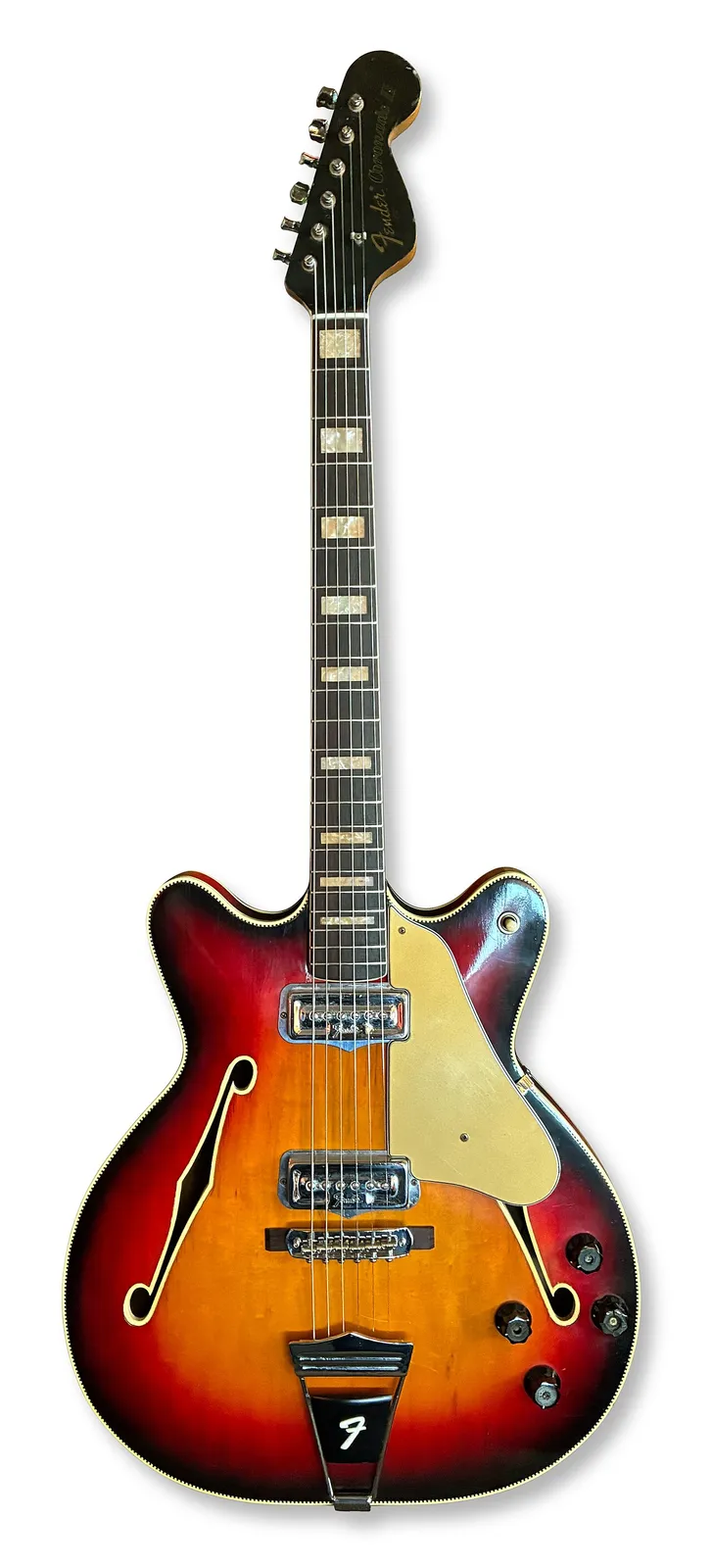
Photo: Auge=mit / Wikimedia Commons / CC BY-SA 4.0 Fender
Coronado
1966
Fender built it to stand next to a 335. It became the guitar nobody else at the gig has.
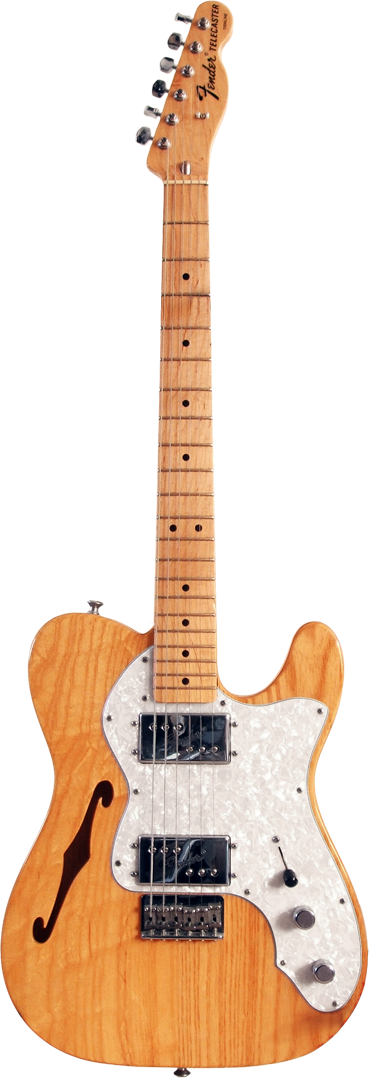
A Fender '72 Telecaster Thinline electric guitar. Photo by Matt Eason. Licensed under CC BY 3.0. Via Wikimedia Commons. Fender
Telecaster Thinline
1968
Fender hollowed out the Telecaster to take the weight off your shoulder. Tab Benoit has carried his since 1992.

Photograph of a vintage 1960 Gibson ES-335TD. Photo by Lightburst. Licensed under CC BY-SA 4.0. Via Wikimedia Commons. Gibson
ES-335
1958
Larry Carlton played three 335s off a shop wall, unplugged, paid $850 for one, and became Mr. 335.