Fender
Telecaster
Thinline
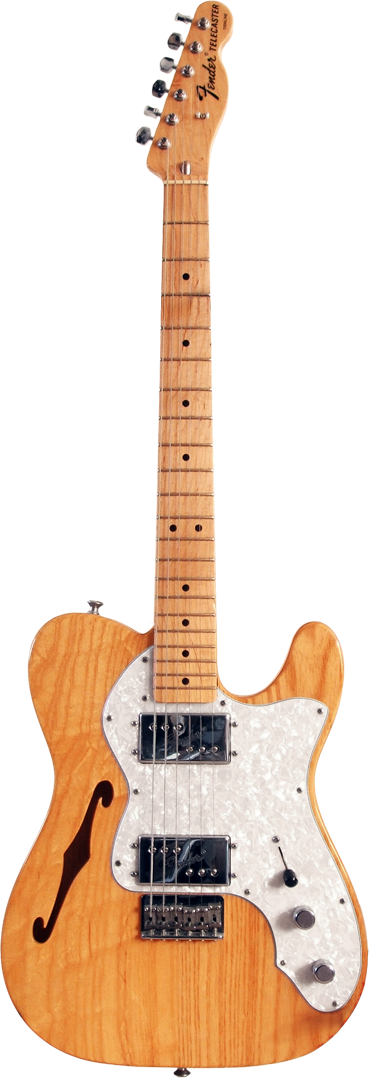
Fender hollowed out the Telecaster to take the weight off your shoulder. Tab Benoit has carried his since 1992.
Fullerton, 1968. The lumber coming into the Fender plant isn’t what it used to be. Light ash is scarce, heavy ash is everywhere, and a Telecaster made of the heavy stuff is a lot to hang on somebody’s shoulder for a four-hour gig. Two men in the factory take a router to the problem.
- Introduced
- 1968
- Type
- Semi-hollow electric
- Class
- Production
The short version
1968
The Thinline arrives
July. A hollowed Tele with one f-hole, in natural ash or natural mahogany, at $319.50.
1968
Sunburst
A three-tone sunburst joins the options in October.
1971
Curtis/Live!
Curtis Mayfield is on the cover of his live album with a Thinline.
1972
Two humbuckers
Seth Lover’s Wide Range pickups replace the single-coils. Fender says the redesign started late in 1971.
1979
The original run ends
At the end of the year, by most counts. One says 1980.
1987
The Custom Shop’s first artist job
Elliot Easton gets a foam-green left-handed Thinline.
1992
Tab Benoit buys a ’72
It becomes his road guitar, and stays that way.
Side A
A1
The ash got heavy
A Telecaster is a plank. That’s the whole idea, and it’s fine when the plank is light. By the late ’60s, the light ash was getting hard to find. Heavy ash wasn’t. And a heavy Tele is a guitar you feel in your back the next morning.
Fender’s first fix was sneaky. Somebody started routing hidden cavities into Tele bodies, under the pickguard where nobody would see. A few of those got out. Collectors call them Smuggler’s Teles, which is the best name anybody at Fender ever didn’t come up with.
There were prototypes, too, with spruce tops and no f-hole at all. They never made production. The fix that did was honest about it. In July 1968 Fender introduced the Telecaster Thinline, a Tele built from the start to be lighter on the person holding it.
A2
Half a Telecaster
Roger Rossmeisl and Virgilio “Babe” Simoni worked it out. They took a Tele-shaped blank, routed the hollows out from the back, and glued a thin back on to close it up. Then they cut one f-hole on the lower bass side, so it looked the part. How many cavities are in there depends on who you ask. What matters is the result: about half the weight of a solid Telecaster.
It sounds like what it is. There’s air inside, so the notes have a little more bloom and a little less snap than a solid Tele. It’s still a Telecaster, with two Tele pickups, three saddles, and one volume, one tone, and a three-way switch. The first ones came in natural ash or natural mahogany, with a long pearloid pickguard. Sunburst arrived that October.
It listed at $319.50. The case was $57.50 more. Early ones often just say “Telecaster” on the headstock. The “Telecaster Thinline” decal didn’t turn up until 1971.
In 1968 and ’69 the new Thinline gets associated with country players like Buck Owens and Conway Twitty. Don’t get carried away, though. Owens’s hits with Don Rich were cut on a solid Tele.
A3
Same name, new voice
Early in the ’70s, the Thinline turned into a different guitar under the same name. Fender puts the redesign in late 1971, with the first full year in 1972. Out went the single-coils. In went a pair of Seth Lover’s new Wide Range humbuckers, big chrome pickups with a much fatter, rounder sound. The magnets inside were CuNiFe, an alloy of copper, nickel, and iron, and Fender’s current American 1972 reissue went back to it. The bridge became a six-saddle hardtail.
The Thinline was where those pickups made their debut. Fender put one in the neck of the Telecaster Custom later in 1972 and two on the Deluxe in 1973. The Thinline had them first.
Black became an option, and by the middle of the decade you could get Walnut Brown. The mahogany version quietly left the price list in 1973.
Two guitars under one name: a hollow Tele with bright little pickups, and a hollow Tele with big fat ones.
Flip the record · By the numbers
½
Roughly the weight of a Thinline compared with a solid Telecaster.
1
F-hole, on the lower bass side.
$319.50
List price in 1968. The case was another $57.50.
2
Wide Range humbuckers from the early ’70s. The Thinline got them first, before the Custom or the Deluxe.
Side B
B1
Curtis
With the Impressions, Curtis Mayfield played a Stratocaster. “People Get Ready” is that guitar, not this one.
When he went solo, he switched. Through the ’70s he was mostly playing Telecaster Thinlines through a Fender Twin Reverb, and in 1971 he put one on the cover of Curtis/Live! Mayfield’s playing had a lot of space in it: soft, clean chords that floated over the band instead of shoving it. A light guitar with some air inside suits that about as well as anything could.
B2
Still on the road
The original run ended in 1979, or 1980 if you ask one source. Fender Japan started making Thinlines again in 1986, and Fender still makes both chapters today: a Mexican ’60s version with the single-coils and an American 1972 version with the humbuckers.
In 1987 Elliot Easton of the Cars got a foam-green, left-handed Thinline, the first official artist job for Fender’s new Custom Shop.
And in 1992 Tab Benoit bought a 1972 Thinline, the humbucker kind. It became his road guitar. It still is. Fender hollowed this thing out so it would be easier to carry. More than thirty years later, Benoit is still carrying the same one.
The cast
The people, and the specific guitars, that made the legend.
1968
Roger Rossmeisl & Babe Simoni
Designers
Routed the hollows from the back of a Tele blank and glued on a thin back. That’s the whole trick.
1971
Curtis Mayfield
1970s Thinlines
His solo-years guitar, through a Twin Reverb. His Impressions work, “People Get Ready” included, is a Stratocaster story.
1992
Tab Benoit
1972 Thinline
Bought it in 1992. It’s been his road guitar ever since.
1987
Elliot Easton
Foam-green left-handed Custom Shop Thinline
The first official artist job for Fender’s Custom Shop. A workshop guitar, not a Fullerton original.
1994
Thom Yorke
A modified f-hole Tele
On Fender’s Thinline list, and on stage at the Astoria with one. Jonny Greenwood’s guitar is a different Tele entirely.
Liner notes
Specs, construction, rarity, value, and every source we used.
Weight-relief Tele with one f-hole — two chapters of one model, not the 1972 Custom, not the Deluxe, not the 1959–72 bound Custom, not a solid Tele, and not a Player II chambered Tele.
- Body
- Semi-hollow Tele slab; rear-routed, glued thin back; one f-hole, lower bass bout. Launch natural mahogany or natural ash; ash later majority.
- Neck
- Bolt-on maple. 1968–late 1971: 4-bolt. Late 1971+: 3-bolt Micro-Tilt, bullet. Maple-cap 1968; one-piece maple (skunk stripe) from 1969.
- Fingerboard
- Maple (maple-cap 1968); rosewood optional 1969 (rare). 21 frets.
- Scale
- 25 1/2"
- Pickups
- 1968–late 1971: two Tele single-coils. Late 1971–1979: two Seth Lover CuNiFe Wide Range humbuckers.
- Hardware
- 1968–late 1971: 3-saddle Tele, elongated pearloid guard. Late 1971+: 6-saddle Strat-style hardtail; guard reshaped around both humbuckers.
- Electronics
- Master volume, master tone, 3-way blade (both chapters)
- Finish
- 1968 natural ash or mahogany; 3-tone sunburst from Oct 1968; custom colors; black from late 1971; Walnut Brown / Mocha from 1974.
Open the full research fileConstruction details, the complete player record, production numbers, dated value estimates, and sources
Vintage Fullerton 1968–79. Current American Vintage II 1972 Telecaster Thinline (USA) is a chapter-2 recreation (CuNiFe pair, 3-bolt). Current Vintera II ’60s Telecaster Thinline (Mexico) is a chapter-1 stand-in (two Tele SCs, 4-bolt, 3-saddle). No 2026 SKU named “Player Telecaster Thinline.”
Construction
July 1968 (Fender; Vintage Guitar April 2018; Guitar World / Rod Brakes). Wikipedia’s lead dates introduction 1969 — an error against factory and specialist-magazine dates. Original run to the end of 1979 (VG; GW; Fender). ggjaguar.com says discontinued 1980. Attribute both; prefer end of 1979.
Light ash was scarce; heavier ash was plentiful. CBS first hid cavities under the pickguard — the few that escaped are Smuggler’s Teles, not Thinlines. Roger Rossmeisl and Virgilio “Babe” Simoni routed the bouts from the rear of a Tele-shaped blank and glued a thin back on. About half the weight of a solid Tele. Cavity count is not settled: ggjaguar “wings” versus an Alston-family three-cavity claim. 1967–early 1968 spruce-top / no-f-hole prototypes are not production Thinline.
Two chapters of one model. Early headstocks often just “Telecaster”; 1971 adds a “Telecaster Thinline” decal. Wikipedia and ggjaguar date the humbucker change 1972; Fender AVII: reimagined late ’71, first full production year 1972. Attribute both; do not pick a switch day. Controls stay vol + tone + 3-way blade — not the Custom/Deluxe four-knob toggle. Vintage Guitar’s “three pole pieces per coil” is thinner than the usual WRHB look; cite CuNiFe, do not invent a pole count.
The Wide Range debuted as a pair on the Thinline, then Custom mid-1972 (one WRHB), then Deluxe 1973 (two WRHB + Strat headstock). Wikipedia’s “based on the Deluxe” inverts the order; do not follow.
Launch woods were natural mahogany or natural ash (Groovy Naturals); ash is the documented later majority. Wikipedia’s mahogany-then-swamp-ash split oversimplifies. Alder on original Fullerton is unconfirmed. Mahogany omitted from the price list 1973 (GW). Nut: measured 1969 1 5/8" (ggjaguar); AVII 1.650" — do not merge. Radius 7.25" is reissue/era inference, not a 1968 catalog number.
Reissues are not Fullerton 1968–79: Japan TN-69/TN-72 from 1986; U.S. ’90s; Mexico Classic ’69/’72; Classic Player Thinline Deluxe (2009 hybrid); Modern Player P-90; JA-90; Squier; Custom Shop relics. Vintera ’70s leftovers use Alnico / re-voiced WRHB, not CuNiFe.
Players
Curtis Mayfield — 1970s Thinlines; Curtis/Live! cover, 1971. Vintage Guitar (October 2025): solo-decade “mostly playing Telecaster Thinlines through a Twin Reverb.” Premier Guitar: the cover shows a Thinline; period video also shows ’70s Strats. Impressions-era Mayfield is a Stratocaster story — “People Get Ready” is not this guitar.
Tab Benoit — 1972 WRHB Thinline, bought 1992, still the road guitar (Vintage Guitar; Premier Guitar; Guitar World).
Elliot Easton — foam-green left-handed Custom Shop Thinline, 1987. Fender: first official Custom Shop artist job. Workshop, not Fullerton.
Thom Yorke is on Fender’s list; Live at the Astoria (1994) shows a modified f-hole Tele. Jonny Greenwood is Tele Plus. Do not make The Bends or “Creep” a Thinline record. VG’s 1990s UK clause lumps Radiohead and Franz Ferdinand across Thinline, Deluxe, and Custom — not a Thinline band. Kapranos is Deluxe.
Jonny Buckland and Jim Adkins sit on Fender’s list. Adkins’s JA-90 is soapbar, set-neck, not 68/71 spec. Vintage Guitar identifies the 1968/69 Thinline with Buck Owens and Conway Twitty — association only; Owens/Rich hits are a standard Tele. Frisell’s magazine identity is modified solid Teles. Cropper, Dragon, Micawber, Strummer stay on the Telecaster page; Richards’s factory Custom on the Custom plate.
Rarity
Official shipping totals are unknown (VG, April 2018). Serials date era, not counts. Chapter 1 is short versus chapter 2; VG: clean first-version rare — dealer language, not a census. Original CuNiFe on chapter 2 is the scarcity that moves money.
Value
Informal estimate, 25 August 2026. Not an appraisal.
Ask ≠ sold. Do not average. Do not paste Joe’s blonde standard Tele bands onto an f-hole guitar. Guitar Value Guide year-rows are standard Tele — labeled guide, not sold. AxeDB ~$2,900 is mixed late-CBS Tele median, not Thinline-only. Artist lots (Mayfield / Benoit / Easton) sit outside these ranges.
New / reissue. Vintera II ’60s new street $1,200–$1,300 (ask/street, new). Used Reverb $599–$832 (sold estimate, not vintage). AVII 1972 new $2,600–$2,800 (ask/street). Mixed AVII used AxeDB $1,525–$1,675 (not vintage). Mexico Classic ’72 used sold neighborhood ~$550–$850 (not vintage). Custom Shop relics ~$4,000–$6,000+ ask — not vintage.
Chapter 2 vintage. Reverb 1972–78 WRHB Good–Mint $2,448–$4,874 (181 orders); 2026 sold cluster ~$2,700–$4,900, $6,000 Excellent outlier. Working ask for honest original-finish original-WRHB 1970s ~$4,500–$8,000. Clean 1972–75 CuNiFe dealer ~$5,000–$8,000 ask; mixed solds sit below — do not average. Replaced WRHB −20–30% on Custom sibling logic.
Chapter 1 vintage. No numeric Reverb band; public solds thin; almost every dollar is an ask. Working ask honest/played ~$7,000–$12,000; cleanest visible dealer neighborhood ~$10,000–$17,000 ask (Norman’s 1969 Natural $16,900 ask is not all-original). 1969 factory-black $27,495 ask is a color-object ceiling, not a median.
1968 list $319.50 + optional $57.50 case is history, not a current value.
See also
- fender-telecaster — solid two-single-coil plank; Cropper / Dragon / Micawber / Strummer live there
- fender-telecaster-custom — 1972 solid HS; WRHB debuted as a pair here first