Martin
D-45
Pearl takes time. When the war took Martin’s time away, the D-45 stopped, and it waited 26 years to come back.
Chicago, March 1933. An order goes to Martin for Gene Autry: the big dreadnought body, in the fanciest trim the factory has, with his name inlaid down the fingerboard. Nobody has built one before. Someone in Nazareth is going to be cutting pearl for a while.
- Introduced
- 1933
- Type
- Flat-top steel-string acoustic
- Class
- Production
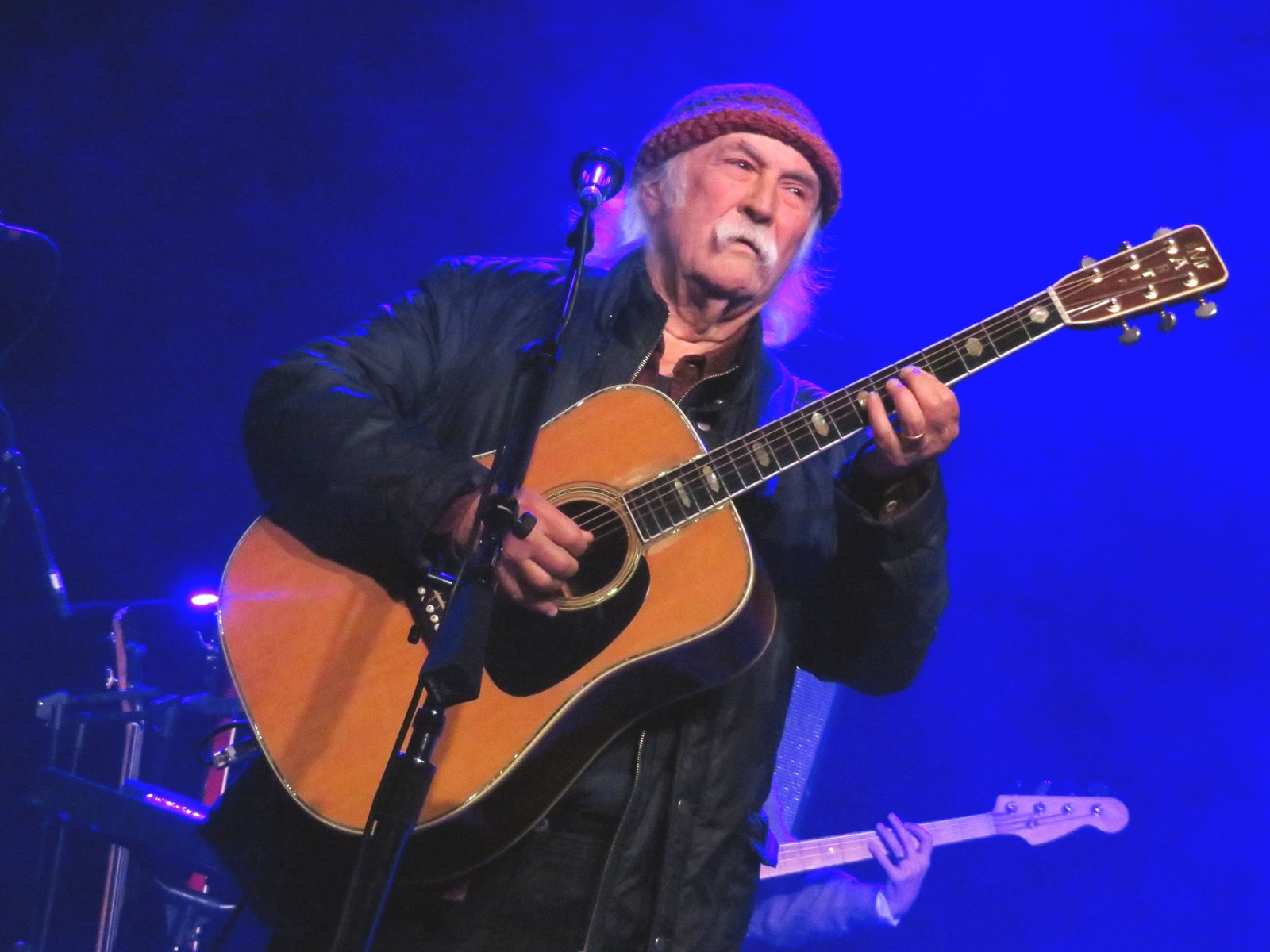
The short version
1933
Autry’s order
A custom Style 45 dreadnought, ordered 23 March. The first D-45.
1934
The second one
Jackie “Kid” Moore gets the next one, also twelve-fret, also with his name in the board.
1938
Into the catalog
The D-45 makes the catalog. Nine built that year.
1942
Stopped
Martin suspends pearl-bordered guitars. The original run ends at 91.
1968
Longworth
Martin hires inlay craftsman Mike Longworth, and the D-45 returns at a reported $1,200.
1969
Manny’s
Jimi Hendrix buys a new 1968 D-45 in New York.
1970
Indian rosewood
Indian rosewood replaces Brazilian on the D-45.
Side A
A1
Gene Autry’s name in pearl
On 23 March 1933 an order reached Martin through Chicago Musical Instruments, for Gene Autry. He wanted the big dreadnought body in Style 45, the top of Martin’s line, with his name inlaid in the fingerboard and a torch on the headstock. Martin started on it four days later. The invoice was $200, plus $10 for extra pearl.
That extra ten dollars is the whole guitar in a nutshell. Style 45 means abalone around the top, the back, the sides, the soundhole, and the endpiece. Every inch of it is somebody at a bench cutting shell and setting it into a channel, one piece at a time. You can’t rush that, and you can’t fake it cheaply. Not then, anyway.
Some production tables don’t start the D-45 until 1934, but Autry’s order is dated, and Martin counts it as the first. It’s a twelve-fret with a slotted head, and it lives at the Autry Museum of the American West now. The second D-45 went to Jackie “Kid” Moore in 1934. Also twelve frets, also his name in the board.
A2
Ninety-one of them
Martin’s own number is 91 pre-war D-45s over nine years. Add up the year-by-year counts and you get 92. Nobody has settled which one is off.
Either way, it was barely a trickle. None in 1935, nine in 1938, and never more than a couple dozen a year. Meanwhile Martin built 148 D-28s in 1937 alone. All of them had scalloped braces, and the recipe was Adirondack spruce, top-grade Brazilian rosewood, and solid pearl, not the laminated kind.
Do they sound better than a pre-war D-28, or are they just prettier? Most of the experts say it’s the ornament and the best wood, not a different build inside. A few swear they have overtones of their own. You’ll have to find one to decide, and good luck with that.
A few of the pre-war owners: Toby Stroud and Ken MacKenzie in Martin’s own promotional photos, Vince Gill, Stephen Stills. One went from Hank Williams Jr. to Johnny Cash to Marty Stuart. Somewhere along the way it got a 3/8-inch hole for a volume control, and the hole was later covered with an engraved abalone plaque. Even the repair got pearl.
A3
When the pearl stopped
In 1942 Martin stopped making pearl-bordered guitars. Martin puts it down to the war: efficiency, and the sheer hours the pearl work took. That was it. The D-45 went away, and it stayed away for twenty-six years.
Every piece of shell on a D-45 is somebody’s afternoon. In 1942 there weren’t any afternoons to spare.
Flip the record · By the numbers
91
Pre-war D-45s, 1933 to 1942. Add up the year-by-year counts and you get 92.
$200
Gene Autry’s invoice for the first one, plus $10 for extra pearl.
229
Brazilian rosewood D-45s from 1968–69. Or 230, depending who’s counting.
$1,200
The D-45’s reported 1968 list price, then the most expensive flat-top made in the U.S.
Side B
B1
Longworth comes back to the bench
In 1968 Martin hired Mike Longworth, an inlay craftsman, to bring the Style 45 dreadnought back. Prototypes first, then regular production that July. It reportedly listed at $1,200, the most expensive flat-top built in the country at the time.
The first reissues used Brazilian rosewood, about 230 of them across 1968 and 1969, and German spruce on top instead of the old Adirondack. Indian rosewood took over in 1970. The bracing followed the sturdier, heavier-braced D-28s of the day until scalloped braces came back somewhere in the mid-to-late ’80s.
B2
Hendrix walks into Manny’s
The reissue found a new crowd. Crosby, Stills, Nash & Young each bought one when the model came back, and Stephen Stills put D-45s on stage in the CSNY years. Jimi Hendrix bought a new one at Manny’s in New York in 1969. It’s in the Museum of Pop Culture in Seattle now.
Neil Young played a 1968 or ’69 reissue. His tech, Larry Cragg, later scalloped its braces, which is the kind of thing you do to a guitar you’re actually using. Plenty of people will tell you which famous Neil Young songs it’s on. None of that has been nailed down.
The 91 are mostly private or behind glass now. The D-45 you can buy today is a Standard with Indian rosewood and hexagon inlays. Later D-45s often use laminated pearl, not the solid shell of the originals, which is its own small compromise with the clock. But look at the edges. Someone still had to sit there and put every piece of it in.
The cast
The people, and the specific guitars, that made the legend.
1933
Gene Autry
1933 D-45
The first one. Twelve frets, slotted head, name in the board, torch on the headstock. Now at the Autry Museum of the American West.
1934
Jackie “Kid” Moore
1934 D-45
The second one, also twelve-fret, with his name in the board.
1968
Mike Longworth
Inlay craftsman
Hired by Martin to bring Style 45 dreadnoughts back after 26 years.
1968
Crosby, Stills, Nash & Young
New reissue D-45s
Each bought one when the model came back. Stills put them on stage and also owns pre-war examples.
1969
Jimi Hendrix
1968 D-45
Bought new at Manny’s in New York. Now at the Museum of Pop Culture in Seattle.
Neil Young
1968/69 reissue D-45
One of his main acoustics. Larry Cragg later scalloped its braces. It can’t be pre-war.
Liner notes
Specs, construction, rarity, value, and every source we used.
Style 45 pearl on a current Standard dreadnought — the 91 pre-war originals are a different guitar, and they are not this SKU.
- Body
- Square-shoulder D-14 fret dreadnought; solid Sitka spruce top with aging toner; solid East Indian rosewood back and sides; abalone with multi-stripe on top, back, sides, rosette, and endpiece; antique white binding
- Neck
- Genuine mahogany, gloss, dark mahogany color; GE Modified Low Oval, High-Performance Taper; dovetail joint
- Fingerboard
- Bound ebony, Style 45 hexagon abalone inlays, 20 frets, 14th-fret joint
- Scale
- 25.4"
- Pickups
- None on the current Standard
- Hardware
- Ebony GE Modern Belly bridge, drop-in saddle, 2 5/32" spacing; bone pins with abalone dots; compensated bone saddle; gold open-gear tuners with butterbean knobs; faux-tortoise pickguard; bound headstock, East Indian rosewood headplate, Block Inlay Golden Era logo
- Electronics
- None
- Finish
- Gloss body and neck; aging toner on top
- Nut
- 1 3/4"; 12th fret 2 1/8"
Open the full research fileConstruction details, the complete player record, production numbers, dated value estimates, and sources
SKU 10Y25D45. Current Standard only. Pre-war D-45 (1933–42) is not a current SKU — see Collectible. Guitar Center catalog language claims "more than 900 different pieces of abalone"; that is retailer copy, not a counted factory spec.
Construction
Martin's flagship Style 45 dreadnought. First year is 1933 — a custom order for Gene Autry, serial 53177 — not a 1931 catalog dreadnought. guitarhq.com's production-years table listing "1934–1942" is catalog/regular-production framing; it conflicts with the documented 1933 Autry guitar (Martin, Vintage Guitar, Premier Guitar). Use 1933, and keep the table's 1934 start as the competing frame. Premier Guitar's headline says "1932 and 1942"; body text is 1933. Use 1933.
The model was suspended 1942–1968. What you can buy new is a post-1968 Standard (plus Authentics, Modern Deluxe, limited/signature versions). The original 91 (Martin factory blog, 23 Jul 2025 — not the Premier Guitar yearly sum of 92 as a picked total) are in the Collectible sidebar. Current series is 1968–present, not a continuation of the 91. Do not treat them as this guitar.
Current Standard (2025 refresh): Sitka spruce, GE-scalloped forward-shifted X-brace (5/16" spruce), East Indian rosewood, gloss, aging toner. Hide glue is not listed on the current Standard spec. Neck is genuine mahogany — Martin says so here, unlike the D-28's "Select Hardwood." Bound ebony board with hexagon abalone. Gold open-gear butterbeans. No factory electronics. Optional/modern systems exist on other SKUs.
1968 reintroduction: Martin hired inlay craftsman Mike Longworth to restore Style 45 dreadnoughts (Premier Guitar; Johnston/Boak as quoted on UMGF). 1968 list price $1,200, then the most expensive U.S. flat-top (Wikipedia/secondary; Longworth-era reporting). Early reissues used Brazilian rosewood. Longworth: 229 Brazilian D-45s (Premier Guitar; UMGF quoting Longworth). guitarhq.com says 230 — one-guitar conflict. Prototypes #232933 and #236913; regular production July 1968 (Longworth via UMGF). Tops: Longworth says production models had German spruce, prototypes Sitka; German spec later dropped. Not Adirondack on the 1968 reissue. Early reissues used a "boxed" abalone endpiece to distinguish them from pre-war examples.
Indian rosewood: guitarhq.com first D-45 with Indian serial 256366 (1970). Style 28 Brazilian regular production had already ended at 254497 (late 1969).
1968–85 structure followed contemporary D-28s — non-scalloped, heavier plates — until scalloped bracing returns on the D-45. guitarhq.com Style 45: "1988 to present: scalloped bracing." UMGF buyers' guide: scalloped + maple plate 1986. Another line says 1985. Dates 1985 vs 1986 vs 1988 conflict slightly. Don't pick.
Later production often uses laminated pearl (Ablam); pre-war used solid shell (Martin archives / Jason Ahner). Authentics advertise solid pearl. Separate SKUs include D-45 Modern Deluxe (European red spruce VTS, among other differences), D-45 Authentic 1936 / 1942 recreations, and signatures (Autry, Stills, Longworth, and others). Authentics are new guitars, not the 91.
Players
1968 Longworth revival. Martin hired Mike Longworth to restore Style 45 dreadnoughts. The current series is 1968–present, not a continuation of the original 91.
Crosby, Stills, Nash & Young each bought a D-45 when the model was reintroduced (Martin / Jason Ahner, 23 July 2025). Company-archives voice for the production guitar, not the pre-war set. How the four were ordered is forum lore and is not used here.
Jimi Hendrix bought a new reissue D-45. Martin: now at the Museum of Pop Culture, Seattle. MoPOP object 1996.503.1.1 as indexed: 1968 D-45, purchased 1969 at Manny’s, New York. Ownership is museum-stated; a performance photograph is not.
Neil Young: associated with D-45 as a principal acoustic (Martin marketing). Guitar.com citing tech Larry Cragg: he bought a 1968/69 reissue; braces later scalloped by Cragg. Martin discontinued the model 1942–68, so that guitar cannot be pre-war. Song-level claims such as “Old Man” on Harvest appear in tertiary roundups and are not independently verified in the artist brief. Young’s better-documented named Martin in this research set is the D-28 “Hank.”
Stephen Stills: associated with putting D-45s on stage in the CSNY era (Gruhn in Premier Guitar). He also owns pre-war examples — those belong in the Collectible sidebar, not as current-production credits.
Pre-war owners — Autry, Kid Moore, the Hank Jr.–Cash–Stuart guitar, Vince Gill per Martin — are in the sidebar.
Rarity
Current Standard: regular production, expensive but not rare. No annual count from Martin.com. Current series is 1968–present, not a continuation of the 91.
1968–69 Brazilian reissues: 229 (Longworth: 67 in 1968, 162 in 1969) or 230 (guitarhq.com). Finite and collected, but not in the same universe as the original 91.
1970–present Indian rosewood: common relative to Brazilian and to pre-war.
Value
Informal estimate, 25 August 2026. Not an appraisal.
New street. About $9,750–$10,000. Martin.com $9,999.99. C&M Music Center 2025 Standard $9,749.99 (was $9,999.99). Guitar Center Platinum $9,799. Guitar Chalk (22 August 2026) $9,699.
Used modern. Reverb product D-45 1968–1992 (mixed Brazilian/Indian, mostly later Indian): estimated $4,987–$11,083 on 54 orders. Solds: $9,000 (11 Oct 2025); $7,325 (31 Dec 2025); $5,995 (7 Jan 2026); $8,500 (15 Jan 2026); $8,750 (27 Apr 2026); $12,255 (29 May 2026). Mostly $6,000–$12,000. Aftermarket electronics and refinishes pull solds down. UMGF buyers' guide: used entry $5–6k with play wear; mint closer to new.
1968–69 Brazilian reissue (not pre-war). Longworth: 229. Older UMGF thread: working band $12,000–$15,000, high-end ’68 around $20,000 — older than 2024, opinion, not a sold tape. Vintage Guitar Price Guide 2002 (quoted in-thread): $20,000–$24,000 then. Joe’s Vintage Guitars, July 2026 dealer guide: $35,000–$55,000 for 1968–69. 2024–26 solds specifically labeled 1968/69 Brazilian were not isolated. A Reverb ask of ~$140k (UMGF mockery) is not a market. Carter 1986 custom Brazilian D-45 asking $26,000 (2026 listing). Authentic D-45S 1936 list $59,999.
Pre-war originals are not this SKU. See Collectible.
See also
- martin-d-28 — the Style 28 dreadnought this was always the dressed-up sibling of
- gibson-j-45 — Gibson's production round-shoulder, the other working-guitar camp
Sources
Current production
- https://www.martinguitar.com/10Y25D45.html
- https://www.guitarcenter.com/Martin/D-45-Standard-Dreadnought-Acoustic-Guitar-Natural-1500000451726.gc
- https://candmmusic.com/products/martin-d-45-standard-series-acoustic-guitar-natural-aging-toner-2025-get-plekd-317
- https://www.guitarchalk.com/martin-d-45-vs-d-28/
- https://reverb.com/p/martin-d-45-1968-1992
- https://umgf.com/martin-d-45-buyers-guide-t227644.html
Pre-war / reissue history
https://guitar.com/features/artist-rigs/the-guitar-gear-used-by-neil-young-on-his-harvest-album/
https://umgf.com/1939-martin-d-45-acoustic-guitar-serial-73130-at-h-t236402-s40.html
https://en.wikipedia.org/wiki/List_of_original_(pre-war)_Martin_D-45s
https://doerrvaluations.co.uk/2026/03/25/inside-the-jim-irsay-auction/
https://www.joesvintageguitarsaz.com/martin-d-28-d-18-d-45-dreadnought-value-guide/
https://cartervintage.com/shop/martin-d-45-custom-brazilian-1986-natural/2qOtvAOcEZYS60FdUhVvuk7jPep
https://collections.theautry.org/mwebcgi/mweb.exe?request=record;id=M510017;type=101
https://www.groundguitar.com/jimi-hendrix-gear/jimi-hendrixs-1968-martin-d-45/
https://onemanz.com/guitar/reviews/acoustic-guitars/martin/authentic-series/d-45s-authentic-1936/
https://mopop.emuseum.com/objects/37239/martin-d45-acoustic-guitar-formerly-owned-by-jimi-hendrix — Hendrix 1968 D-45; object 1996.503.1.1 (direct fetch 403; indexed 25 Aug 2026)
https://umgf.com/gene-autry-and-the-1st-d-45-t211266.html — Autry / first D-45 (quoting Gruhn)
https://umgf.com/mike-longworth-and-the-reintroduction-of-the-d-45-t86724.html — Longworth 1968 revival (quoting Johnston & Boak)
https://www.martinguitar.com/blog-categories/tips-tutorials/blog-042623-martin-dreadnought-buying-guide.html — Martin dreadnought buying guide (26 Apr 2023)
Keep digging
Guitars this one gets compared to, confused with, or descended from.
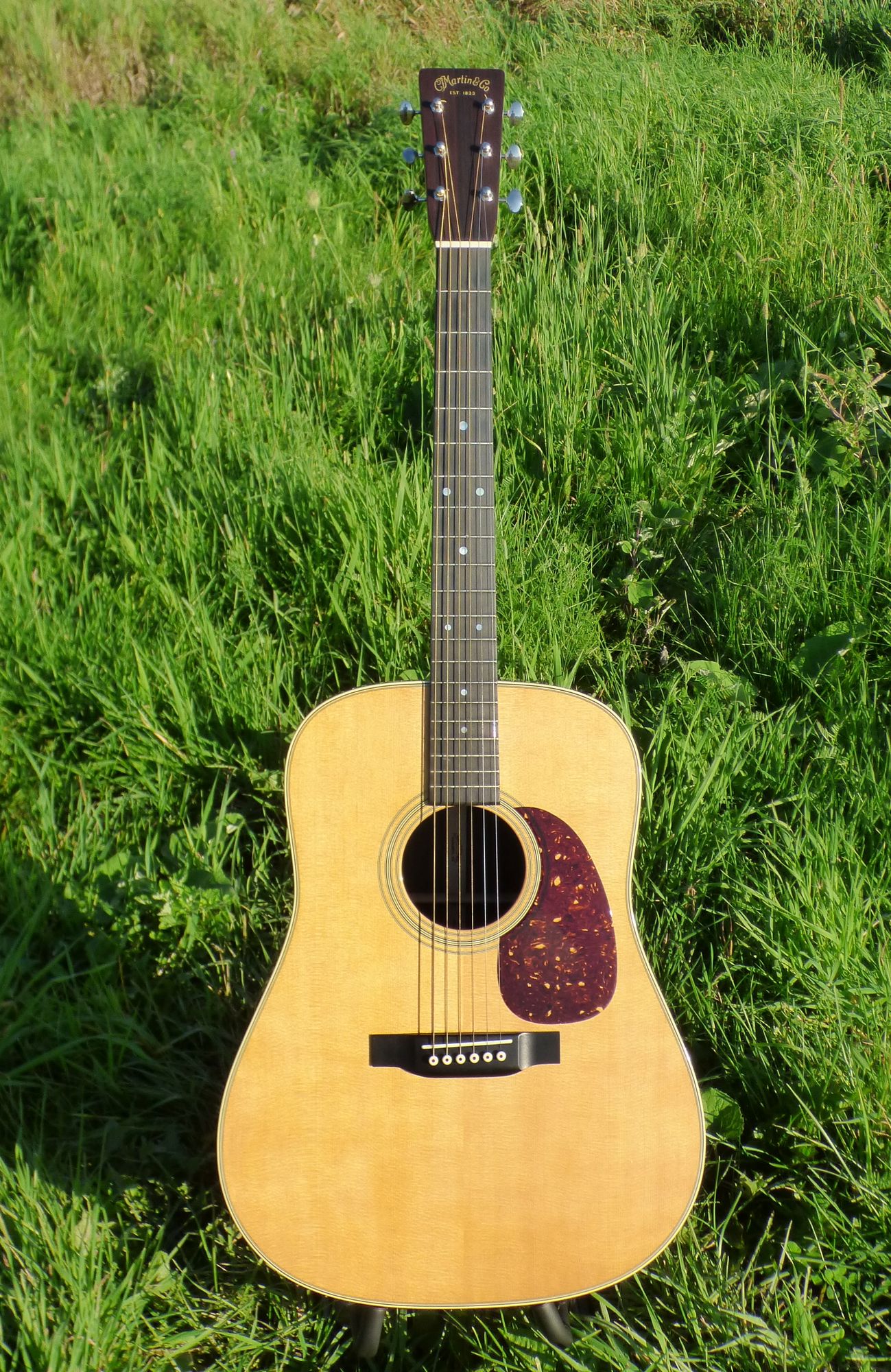
Martin D-28 Acoustic Guitar. Photo by Niranjan Arminius. Licensed under CC BY-SA 4.0. Via Wikimedia Commons. Martin
D-28
1931
You’ve heard a D-28 your whole life. It just never asked for the credit.
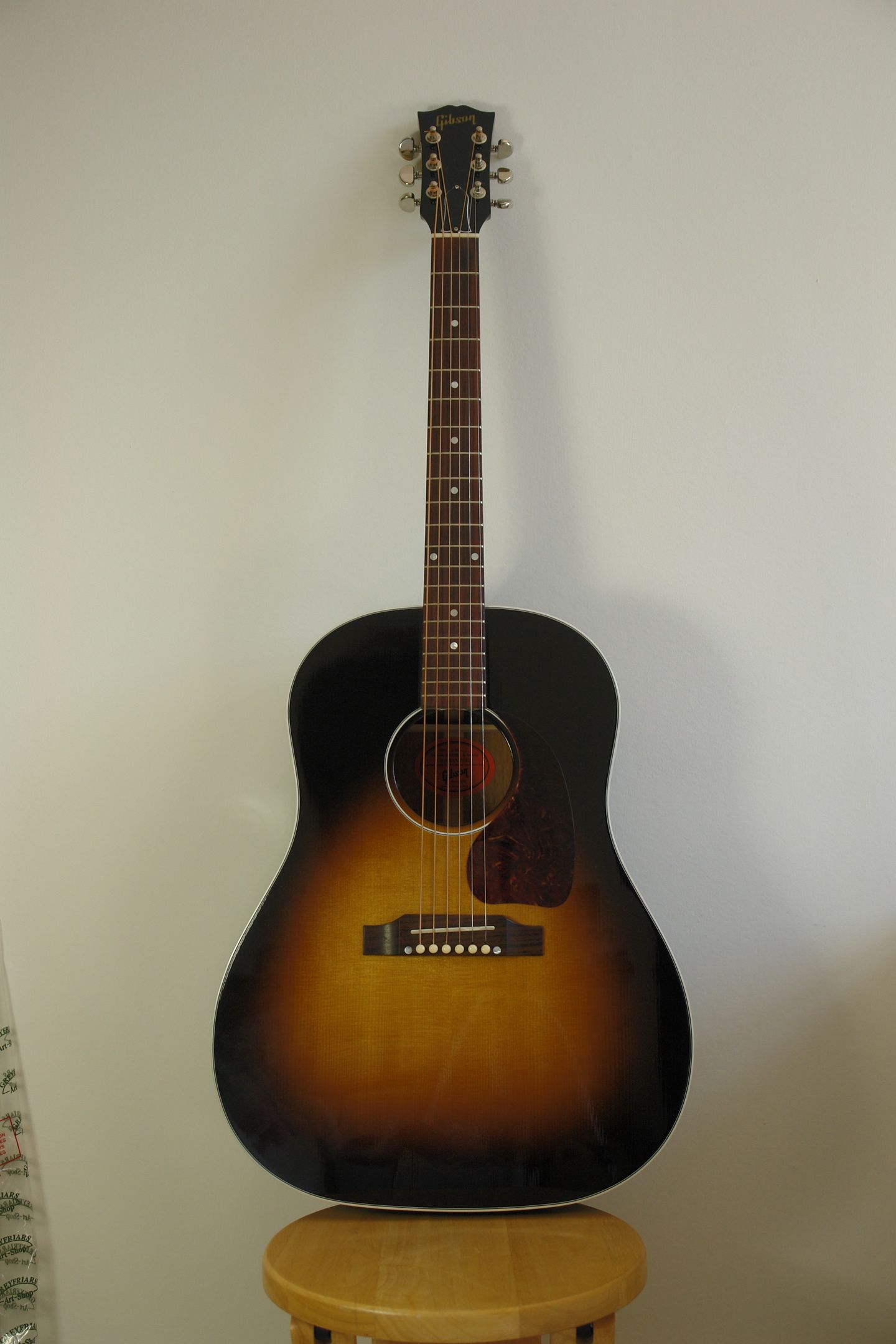
Gibson J-45. Photo by Jim Hutcheson. Licensed under CC BY 2.0. Via Wikimedia Commons. Gibson
J-45
1942
Born in 1942 out of whatever wood a wartime factory could find. Gibson calls it its best-selling acoustic ever.