Moog
Moog Guitar
A guitar whose pickups push back on the strings: a note that never dies, or one that never rings.
In 2008 Moog put its name on a guitar for the first time. It wasn't a synthesizer and it wasn't MIDI. Paul Vo's pickups fed energy back into the strings or pulled it out, and the string stayed the thing you heard.
- Introduced
- 2008
- Type
- Solidbody electric
- Class
- Closed run
Have a photograph of this guitar? Send a picture
The short version
2006
Vo brings the idea
Paul Vo brings his sustain idea to Moog in Asheville. Bob Moog and Mike Adams had already talked about a Moog guitar.
2008
Nashville
A showcase at 3rd and Lindsley on 20 June, Kenny Vaughn and Fareed Haque with Garaj Mahal, tickets $10. The press conference is the next morning.
2008
The Collector Edition
The Paul Vo Collector Edition, built for Moog by Zion, signed, with a certificate, lists at $6,495.
2009
The E1
The production guitar arrives in August, in alder with chrome hardware, with the same electronics, at $3,495.
2010
Reed's raffle
Lou Reed gives his Moog Guitar to a raffle. Two hundred tickets.
2011
Paul Simon
The solo on "Getting Ready for Christmas Day" is played on a Moog guitar, for the sustain.
2014
No longer available
A late Collector was still being finished in 2012. By July 2014 a customer is told "Sorry No Longer Available."
Side A
A1
Feedback, on purpose
Paul Vo told people the spark was Hendrix, and an amplifier feeding back.
Every guitar player knows the moment. You hold a note near the amp and it stops dying. It blooms, it sustains, it does something nobody fretted. Usually it's an accident, and usually it's loud. Vo wanted it on a knob.
He brought the idea to Moog in Asheville in 2006. Bob Moog and Mike Adams had talked about a Moog guitar, but by the time it launched, the press release was calling him the late Bob Moog. Moog's name had been inside Gibsons before, on circuitry in the 1970s RD Artist. This was the first guitar with the Moog name on it, and it did something the RD never did.
A2
Pickups that talk back
Vo's rule was that the string stays the source. A Minimoog, he said, connects a player to electrons. This had to connect the player to a vibrating string. So: not a synthesizer, not MIDI, not an effect bolted on after the note.
The two pickups listen and push at once. They read the string and feed magnetic energy back into it, or take energy out. Somebody guessed there were magnets in the frets. No, said Moog's Chris Stack. Nothing special in the neck.
There are three modes. Full Sustain is every string, every fret, ringing as long as you like, even open strings. Controlled Sustain keeps the notes you pick hard enough and damps the rest. Mute pulls the energy back off the string. One reviewer heard a banjo in it. Another heard something closer to a sitar with the buzz taken out. Take your pick; they were both listening to the same switch.
A harmonic knob slides the drive between the neck and bridge pickups. There's a piezo in the saddles, and a filter toggle that runs all the way to a Moog ladder filter, its cutoff swept with your foot.
A3
Six thousand dollars and a pedal
The first one was the Paul Vo Collector Edition, at $6,495 in June 2008. A boutique double-cut, built for Moog by Zion, in ash or mahogany under a figured maple top, depending which spec sheet you read. A set maple neck, ebony board, 22 frets, a Wilkinson tremolo, gold hardware, a tweed case with a bay for the pedal. Each one signed, with a certificate.
That pedal matters more than anything on the guitar. The sustain power comes from it, through a five-pin lead. The 9-volt battery inside only runs the piezo. An ordinary guitar cable won't run it. No pedal, no sustain.
It went public in Nashville: a showcase at 3rd and Lindsley on 20 June 2008, Kenny Vaughn and Fareed Haque with Garaj Mahal, ten dollars at the door, and a press conference the next morning. By September, orders had passed $1.3 million.
Lou Reed had already made up his mind:
"As soon as it's ready, I want it. The day you can sell it, I would buy it from you."
Flip the record · By the numbers
3
Modes. Full Sustain, Controlled Sustain, and Mute.
$6,495
The 2008 list price of the signed Paul Vo Collector Edition.
$3,495
The production E1 at launch, August 2009.
Side B
B1
Waiting for a song
The famous names came fast. Trent Reznor, Joe Walsh, and Hans Zimmer's studio ordered. Others said nice things. But in November 2009, a year and a half in, a critic could still point out there wasn't a Moog Guitar song yet.
In August 2009 Moog brought out the E1, the production model: alder body, chrome hardware, same pickups and electronics, $3,495. A later E1-M added a 13-pin synth jack, the one time the guitar got close to the synth world it had been built to stay out of.
The records came later. On Paul Simon's So Beautiful or So What, in 2011, Simon made quite a bit of use of it, as Andy Smith told it. The solo on "Getting Ready for Christmas Day" was played on a Moog guitar for the sustain. "Love & Blessings" credits it too. On Brian Eno's Lux, in 2012, the Moog Guitar is Leo Abrahams's, though the credit calls it a guitar synthesizer.
Kaki King played one at the Asheville factory on her Junior tour. The organ-like part on her later record came from Vo's next idea, in a different guitar altogether.
B2
The string, not the chip
Vo kept going without the guitar. In 2013 he put the Vo-96 on Kickstarter, his "inventor's version," a system you could fit into other instruments.
The Moog Guitar itself just stopped. In August 2012 one of the last Collector Editions was still being finished, to ship in an E1 case because the tweed ones were gone. By July 2014 a customer asking for one was told "Sorry No Longer Available." Moog's website doesn't mention it now, and the current service list names it among products with no spare parts.
So if you find one, look for the pedal first. Without it you have a heavy, handsome double-cut with a lot of knobs. With it, you can hold a chord until the room gets tired, and every second of it is still the string.
Put this on
You’ve read about it. Now hear it. Here’s what this guitar sounds like, and what to listen for.
Getting Ready for Christmas Day
The solo was played on a Moog guitar, chosen for the sustain. Listen for how long it hangs.
Find it on YouTube (opens in a new tab)Love & Blessings
The album credits this one to acoustic, nylon, and Moog guitar.
Find it on YouTube (opens in a new tab)Lux
Leo Abrahams, not Eno, is credited on Moog Guitar. The credit calls it a guitar synthesizer. It isn't one.
Find it on YouTube (opens in a new tab)Kaki King at the Moog factory
Moog's own film of King playing one at the Asheville factory, on the Junior tour.
Watch it on YouTube (opens in a new tab)
The cast
The people, and the specific guitars, that made the legend.
2008
Paul Vo
Designed the Moog Guitar and its sustain system
Brought the idea to Moog in 2006. The source had to stay the string, he said. Not synthesis, not MIDI.
2011
Paul Simon
A Moog guitar on So Beautiful or So What
Made quite a bit of use of it on the album, Andy Smith said. Two tracks are pinned.
2012
Leo Abrahams
Moog Guitar on Brian Eno's Lux
The credited player. The guitar is his on that record, not Eno's.
2008
Lou Reed
An early Moog Guitar
Wanted one before it was ready. Later gave his to a raffle.
2010
Kaki King
A Moog Guitar at the Asheville factory
Played one on a factory visit during the Junior tour. Her later Vo-96 organ sounds came from a different device in a Takamine.
2008
Fareed Haque
Moog Guitar at the Nashville showcase
Played the 20 June premiere with Garaj Mahal, alongside Kenny Vaughn.
Liner notes
Specs, construction, rarity, value, and every source we used.
The pickups feed the strings, or starve them — Moog’s guitar, not a Gibson RD and not a synthesizer.
- Body
- Double-cut solid. June 2008 press: mahogany, AAAAA maple top. Premier’s hands-on and Sound on Sound: swamp ash or mahogany, flame or quilt, arm chamfer, tummy cut. Do not pick one wood.
- Neck
- Set maple. Sound on Sound: C-section. Premier: headstock 7°, no string tree. MusicRadar’s prototype: 20.8 mm at the first fret, 23 mm at the 12th. Mix flagged. Do not invent inches for those depths.
- Fingerboard
- Ebony, 22 frets, jumbo. Premier and Sound on Sound: 12" radius. MusicRadar’s prototype: 305 mm. One abalone marker at the 12th (SoS). Mix flagged. Do not treat 305 mm as a second radius.
- Scale
- 25.5" (SoS) / 25½" (Premier). No millimetres printed. Do not invent them.
- Pickups
- Two custom Moog pickups. Designer to Sound on Sound: magnetic energy back into the strings, a separate transducer per string. Piezo saddles, blended or alone.
- Hardware
- Gold Wilkinson fulcrum tremolo. Gold Sperzel locking tuners. Nut width unpublished.
- Electronics
- Five knobs: Vo Power, piezo blend, harmonic balance, master volume, tone/filter. Mode: Full Sustain, Controlled Sustain, Mute. Filter toggle: tone, articulated, ladder. Five-way. The 2008 manual prints Piezo, Bridge, Out of Phase, In Phase, Neck. Sustain power comes from the mains pedal on a five-pin lead. The 9V is the piezo preamp only. CV in, 0–5 V. A normal cable does not run it.
- Finish
- Transparent over the maple. SoS sample: rich brown. Sweetwater’s Collector page: Emerald, mahogany, quilt. SoS: numerous others. No full chart verified.
- Nut
- Width not in the reviews or the E1 sheet used here.
Open the full research fileConstruction details, the complete player record, production numbers, dated value estimates, and sources
Classic living example = the 2008 Paul Vo Collector Edition, signed, certificate, built for Moog by Zion. SoS sample about 8 lb. The E1 (19 August 2009) is the production guitar: alder, chrome, fixed or tremolo, about 7 lb, same electronics — not this table. E1-M adds a 13-pin jack. The lap steel and the Vo-96 are other objects. Not the Gibson RD Artist (gibson-rd-artist). Standalone. No Gibson SKUs. Mixed inch/mm flagged on 20.8 mm, 23 mm, and 305 mm. Do not invent millimetres for 12", 25.5", or 25½". Do not average 8 lb with 7 lb.
Construction
The job was a guitar you could feed or quiet at the string, without making it a synthesizer. Bob Moog and Mike Adams had talked about a Moog guitar. The launch copy already calls him the late Bob Moog. The instrument waited on Paul Vo.
Wikipedia, quoting his licensing page: his legal name is Paul Ierymenko, and he took “Paul Vo” at Moog in Asheville because the shorter name was easier. The Bob Moog Foundation (30 March 2010): he brought the idea in 2006, and the guitar was released in 2008. On camera, 24 June 2008, he told Gearwire he had been with Moog for three years. Keep 2006 and “three years.” This plate starts at the 2008 launch.
He told Premier the spark was Hendrix and amplifier feedback. He told Gearwire the source had to stay the string: a Minimoog bridges the player to electrons; this had to bridge the player to a vibrating string. Not synthesis. Not MIDI. Not an effect after the fact. Chris Stack, to Wired (10 June 2008): the pickups listen and control at once. A commenter had put magnets in the frets. Stack said no. Nothing special in the neck.
Three modes. Full Sustain: Moog’s word is infinite, every string, every fret, any volume. Sound on Sound (Paul White, March 2009): continuous sustain even on open strings. Controlled Sustain: the notes you mean, the rest damped. White heard a picking threshold. The 2008 manual: played strings cross an amplitude threshold. Mute: energy comes back off the string. Wired glosses a banjo-type sound. MusicRadar’s Dave Burrluck (1 September 2008) heard a buzz-less sitar more than a banjo. Keep both. Harmonic blend moves that energy between neck and bridge pickups. The filter toggle is ordinary tone, an articulated filter (White: one per string), or the ladder, cutoff on the pedal. A NAMM 2010 demo says six filters.
Under the circuit, a boutique double-cut. Burrluck: Vo with Dale Brown of Zion, Zion building the guitar. Premier’s hands-on (10 September 2008): ash or mahogany, AAAAA flame or quilt, set maple, ebony, 22 frets, 12", 25½", 7° headstock, Wilkinson, Sperzels. The June press said mahogany and did not mention ash. White: you get ash or mahogany unless you ask. Keep both. Gold on the Collector. A tweed case with a bay for the pedal. Moog strings in 9–46, 10–52, or 11–52 on White’s sample. Ordinary strings work in a pinch. The manual wants high steel content, insulated at the bridge.
Burrluck’s guitar was a prototype. Those millimetre neck figures are that guitar. Moog told him the pickups were too hot and would be tamed. Do not file 20.8 mm as the catalog neck.
Sonicstate, 6 June 2008: Collector Edition on the site at $6,495. MusicRadar the same day: $6,495 / £4,000. Burrluck’s header is £3,999 / $6,495. Wired rounds $6,500 and was told they were not built yet, shipping in September. Each one signed, with a certificate calling it the first ever Moog Guitar. That is the edition’s line, not one instrument. Sweetwater, 16 September 2008: shipping to five continents, orders past $1.3 million. Dollars. Do not divide by $6,495.
The public start is Nashville. Showcase 20 June 2008, 3rd and Lindsley, Kenny Vaughn and Fareed Haque with Garaj Mahal, tickets $10. Press conference 21 June, 10:30 a.m., booth 2030. Premier’s hands-on says an offshore version was already being discussed. Discussed is not a guitar. Wikipedia says non-custom-shop Moog Guitars were Korean, citing Popular Science and the Guardian. The Guardian column (16 November 2009) does not say Korea. Premier’s E1 review (Pat Smith, 11 March 2010) calls that sample USA-made. Zion built the Collector. Keep the USA review. Do not promote the Wikipedia country.
The E1 is the production model. Moog’s press, via Premier, 19 August 2009: same electronics and pickups, alder, chrome, fixed or tremolo, Butterscotch, Candy Red, or Black, $3,495. The headline says new modes. The body describes the same three. zZounds’ fixed-bridge sheet: set neck, about 7 lb, ebony, 22 frets, 25½", 7°, Graph Tech piezos, ships 10–52, piezo on a quarter-inch jack and a 9V, pedal on 120/240 V. MusicRadar (Trevor Curwen, 1 April 2010): the neck is painted to look like a bolt-on. It is still set. That review’s price is £2,899 / $4,395. Smith prints MSRP $3,649. Keep all three dollar figures. Do not average them.
E1-M is the alder guitar plus a synth jack. Sweetwater: “13-pin” in the title, “MIDI output” in the copy. A NAMM 2010 demo says “13 pin midi” in one breath, and says the sustain still reaches the synth side. Vanceg, on vguitarforums, says the magnetic pickups are not on the 13-pin; a mono piezo mix is. Keep both. The 13-pin does not rewrite 2008.
The lap steel is Wes Lambe’s. A Moog-forum owner (26 August 2011) says they are handmade by Lambe and cost more than an E1. No dollar there. Premier filmed lap steels and custom guitars at NAMM, 31 January 2012. No spec invented. Not this table.
Vo then sold the idea without the guitar. 2013: the Vo-96 on Kickstarter, his “inventor’s version.” Wikipedia, quoting him: nearly 100 systems, $1,000 kit to a $4,800 Lambe acoustic. The Wond and the EMPick are handhelds. A Takamine with a Vo-96 in the soundhole is not a Moog Guitar.
Not a Gibson RD (gibson-rd-artist). Burrluck opens on it: the 1970s RD Artist was Moog and Gibson, and this guitar is a different thing. Wired: some Gibsons carried Bob Moog’s circuitry; this is the first guitar with the Moog name. The RD compresses and expands. It does not drive the strings. Not a Fernandes Sustainer, a Sustainiac, or an E-Bow. Those add energy. They do not, in these reviews, damp every idle string, and an E-Bow is one string in the hand. Not a guitar synthesizer. The Guardian: not a MIDI guitar, not a trigger for samples. The E1-M is the later exception.
Players
Do not hang an RD, a Vo-96, an E-Bow, or a lap steel on this plate. The Guardian, 16 November 2009, said there was not a Moog Guitar song yet.
Paul Simon — So Beautiful or So What (2011). Two credits, not every track. Andy Smith, to Sound on Sound (October 2011): Simon “made quite a bit of use of the relatively new Moog guitar.” On “Getting Ready for Christmas Day,” the solo “was played on a Moog guitar,” for the sustain. The sermon, Edie Brickell, and the foot stomps are the rest of that session. The vinyl (Hear Music HRM-32837-01) credits “Love & Blessings” to acoustic, nylon, and Moog. Do not spread it further.
Leo Abrahams — Eno’s Lux (2012). Abrahams, not Eno. Warp WARPCD231: “Guitar Synthesizer [Moog Guitar] – Leo Abrahams.” The role says synthesizer. The bracket says Moog Guitar. Do not put the guitar in Eno’s hands, and do not turn the instrument into a synth because a credit did.
Lou Reed — a quote, an order, a raffle. Not a Velvet Underground side. Wired: “As soon as it’s ready, I want it. The day you can sell it, I would buy it from you.” Sweetwater lists him as an early adopter. The Foundation: he gave his guitar to a raffle, 200 tickets, 9–29 March 2010, winner Robert Cranfield of Illinois. No hammer. Not a comp.
June 2008. Premier and Wired: Reed, Vernon Reid, Fareed Haque, and Andre Cholmondeley on the demo film. The 20 June showcase is Vaughn and Haque with Garaj Mahal. A stage, not a record.
Kaki King — the factory, not her albums. Moog’s film (6 May 2010) and Synthtopia: on the Junior tour she played one at the Asheville factory, the description says for the first time. Guitar Player (8 February 2021): the organ-like part on Modern Yesterdays is a Takamine with a Vo-96. She separates that device from the Moog Guitar. Do not merge them.
Also known, short. Sweetwater, 16 September 2008, orders: Trent Reznor, James Valentine, Joe Don Rooney, Joe Walsh, Hans Zimmer Studios, Chris Stein. The Guardian: Santiago, Reed, Daft Punk, and Reznor had “confirmed their appreciation,” and it points at a Phil Keaggy doodle with no title. Appreciation is not a track. A Reverb listing of Collector #18 says Rooney owned it, and says that is not a price effect. That is the seller.
Rarity
You cannot order one. moogmusic.com, fetched 23 October 2026, does not mention a guitar, and /moogguitar is a 404. inMusic’s service list (quoted by Matrixsynth, 9 November 2025; page modified 26 September 2025) names the Moog Guitar among products with no spare parts. An RMA is still offered. A finished repair is not promised. That is service, not a last year of manufacture.
No factory total this pass. None invented. Sweetwater’s Collector page says only 330 available in the U.S. A retailer line, not a world census. Sellers repeat it. Serials do not audit it. A listing says #18. Forum sellers have offered #188 and #191. The $1.3 million backlog is money. An August 2012 forum post still had a late Collector B-stock being finished, in an E1 case because the tweed ones were gone. Premier was filming lap steels at NAMM that January. A customer in July 2014 was told “Sorry No Longer Available.” Keep 2012 and 2014. Do not pick an end year.
What is thinner: a Collector with pedal, five-pin lead, certificate, and tweed case. Without the pedal the sustain is dead, and the guitar is a heavy double-cut. An E1 is the alder one, same trap. An E1-M is the 13-pin alder. A lap steel is Lambe’s. A Vo-96 is a kit in another guitar. Reed’s raffle guitar is one object.
Value
Informal estimate, 23 October 2026. Not an appraisal.
Asks are not sold prices. An E1 is not a Collector. No Reverb Price Guide sold band this pass. Flag: thin sold-comp access. Do not invent a median. Do not average the asks.
New street. None. Collector list $6,495 (June 2008); MusicRadar also prints £4,000, and Burrluck’s header £3,999. Wired’s $6,500 is the dollar rounded. E1 launch $3,495 (19 August 2009). Smith’s MSRP $3,649. Curwen’s review $4,395 / £2,899. Those are 2008–2010 lists, not a 2026 cart.
Used. Named asks, not hammers. E1-M black $7,999.97. Collectors: emerald $5,000 (from $5,555.55); sunburst $5,495; flamed $5,250; red quilt $5,999.99; natural-flame #18 $5,995. A deep-blue listing calls itself both an E-1 and a Collector, ash and quilt, “serial #2”: ask $6,145.31 (from $6,828.12). Do not file that one as a clean Collector. A working pedal is the difference between a guitar and a parts guitar. No sold price for that split.
Not a comps tape. Reed’s guitar moved by raffle, 200 tickets, no hammer in the Foundation note. The #18 Rooney line is the seller’s, and the seller says it is not a price effect.
See also
- gibson-rd-artist — Gibson’s 1977 maple solid with a Moog compression and expansion board. Not this brand, and not energy through the pickups
- vox-guitar-organ — the other closed-run solid built around a circuit. Six organ generators, 1966. Not this sustain
- parker-fly — piezo plus magnetic on a carbon-glass solid. A review heard the Moog headstock echo a Fly. Not this system
Sources
- Sonicstate, Moog Guitar (6 June 2008) — Collector on sale; mahogany, AAAAA top, ebony; $6,495; Reed and Reid on the film
- MusicRadar, Ben Rogerson (6 June 2008) — premiere 20 June; NAMM 21 June; $6,495 / £4,000; Wilkinson; Mike Adams
- Premier Guitar, Summer NAMM debut (6 June 2008) — Vaughn and Haque, $10; press conference 21 June, booth 2030; signed Collector; late Bob Moog
- Wired, Eliot Van Buskirk (10 June 2008) — ship September; Stack on pickups vs frets; Reed’s quote; $6500 rounding; first Moog-name guitar, against Gibson circuits Bob Moog designed
- MusicRadar, Chris Vinnicombe (16 September 2008) — orders past $1.3 million; Reed, Stein, Valentine, Reznor, Walsh. The Bellamy insider tip is not used
- Sweetwater InSync (16 September 2008) — five continents; $1.3 million; Reed, Reznor, Valentine, Rooney, Walsh, Hans Zimmer Studios, Stein, Haque; $6,495
- MusicRadar, Dave Burrluck, prototype (1 September 2008) — not the RD; Zion and Dale Brown; 20.8 mm / 23 mm; 305 mm; £3999 / $6495; mute closer to sitar than banjo. Mix flagged
- Premier Guitar, hands-on (10 September 2008) — Zion; ash or mahogany; 22 frets; 12"; 25½"; 7°; Wilkinson; Sperzel; offshore version only “being discussed”
- Sound on Sound, Paul White (March 2009) — about 8 lb; ash or mahogany; 12" radius; 25.5"; piezo on 9V; pedal powers the sustain; per-string drive; string sets; CV 0–5 V
- Moog Paul Vo manual, 2008, via All-Guides — five-way order Piezo / Bridge / Out of Phase / In Phase / Neck; Controlled Sustain amplitude threshold; strings high steel, insulated at the bridge
- Premier Guitar, E1 launch (19 August 2009) — production E1; alder; chrome; fixed or tremolo; $3,495; TEC nomination among the awards
- zZounds, E1 fixed-bridge sheet — set neck; about 7 lb; 25½"; 22 frets; 7°; Graph Tech; 10-52; 9V piezo; pedal 120/240 V. No longer sold
- MusicRadar, Trevor Curwen, E1 (1 April 2010) — £2899 / $4395; neck painted to look bolt-on; still a fixed neck
- Premier Guitar, Pat Smith, E1 (11 March 2010) — USA-made; alder; 25.5"; ebony; MSRP $3649
- The Guardian, David McNamee (16 November 2009) — not a synth; appreciation list; “there aren’t any yet”; Keaggy doodle. No Korea sentence
- Bob Moog Foundation (30 March 2010) — idea 2006, release 2008; Reed’s raffle; Cranfield
- Gearwire, Paul Vo (24 June 2008) — three years with Moog; not synth, not MIDI; the string is the source
- Sweetwater, E1-M — 13-pin and “MIDI output”; alder; 7 lb; 25½"
- NAMM 2010 Moog Guitar with MIDI demo — “13 pin midi”; six filters; sustain on the synth side
- Sound on Sound, Tingen, *So Beautiful or So What* (October 2011) — Smith on Simon’s Moog guitar; solo on “Getting Ready for Christmas Day”
- Discogs, Simon, HRM-32837-01 (2011) — “Love & Blessings”: acoustic, nylon, and Moog
- Discogs, Eno, *Lux*, WARPCD231 (2012) — Leo Abrahams, Moog Guitar
- Moog Music, Kaki King (6 May 2010) — factory visit, Junior tour
- Synthtopia (10 May 2010) — same visit
- Guitar Player, Jimmy Leslie (8 February 2021) — Vo-96 in a Takamine, distinguished from the Moog Guitar
- Premier Guitar, NAMM 2012 — lap steel and custom guitars still demoed
- Moog forum, lap steel (26 August 2011) — Wes Lambe; no price in the post
- Wikipedia, Moog Guitar — Ierymenko / “Paul Vo”; Korean claim not in the Guardian this pass; Vo-96 nearly 100, $1,000–$4,800, citing Vo
- Matrixsynth, inMusic service notice (9 November 2025) — no spares; page modified 26 September 2025; RMA not a guaranteed repair
- moogmusic.com — no guitar on the homepage;
/moogguitar404 (23 October 2026) - Sweetwater, Collector Edition emerald — “only 330 available in the U.S.” Not a world total
- vguitarforums, vanceg on the E1-M 13-pin — magnetic pickups not on the 13-pin; mono piezo mix on the normal channel. A player’s report, not a manual
- Moog forum, Collector #188 for sale (7 December 2010) — seller’s scarlet #188. Not a census
- Moog forum, Collector #191 (18 October 2015) — seller: number 191, year 2009
- Moog forum, case thread (18 August 2012) — one of the last Collector B-stocks; tweed case gone; ships in an E1 case
- Mod Wiggler (23 July 2014) — a customer told “Sorry No Longer Available.” Not a press release
- Reverb asks, this pass — Collector asks $5,000 / $5,495 / $5,250 / $5,999.99 / $5,995 (#18, seller’s Rooney note); “serial #2” ask $6,145.31 calls itself both E-1 and Collector; E1-M $7,999.97. Asks, not solds
Keep digging
Guitars this one gets compared to, confused with, or descended from.
- Send a picture
Gibson
RD Artist
1977
Gibson put a Moog inside it, then blamed the outside. The outside is the part that lasted.
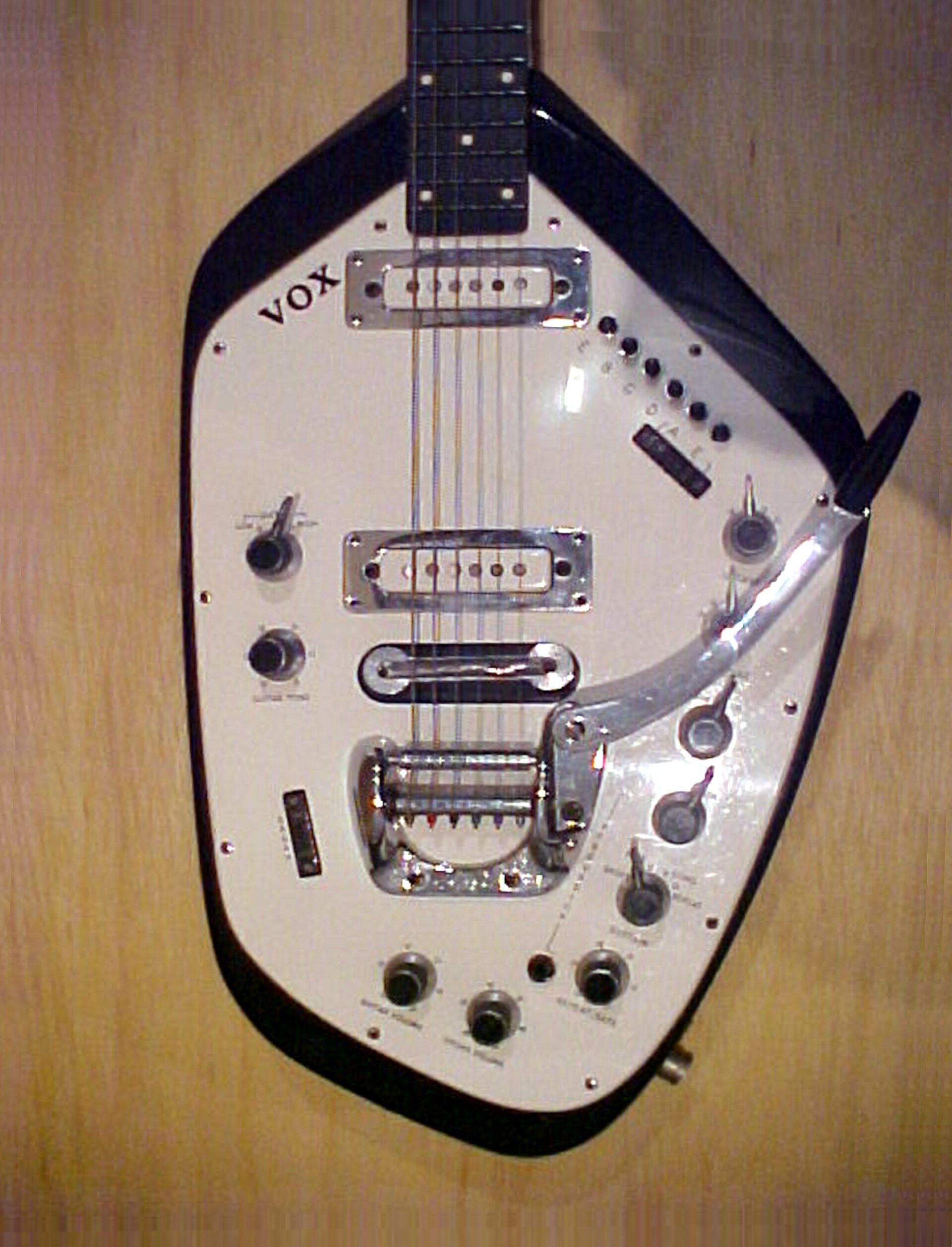
Photo: Sbz5809 / Wikimedia Commons / CC BY-SA 4.0 Vox
Guitar Organ
1966
An organ inside a guitar. It worked, sometimes. John Lennon kept the first one anyway.
- Send a picture
Parker
Fly
1993
Ken Parker built it like a lobster: wood on the inside, and all the strength in a skin thinner than the paint.