Vox
Guitar Organ
An organ inside a guitar. It worked, sometimes. John Lennon kept the first one anyway.
Vox already made the Continental organ. Dick Denney's idea was to put that organ under a guitarist's fingers, one tone generator per string, wired through the frets. It was heavy, it was temperamental, and the people who tried it had trouble letting go.
- Introduced
- 1966
- Type
- Solidbody electric
- Class
- Closed run
The short version
1964
The race
Vox, Watkins, and Burns all chase a guitar organ. A Vox prototype is built, and the instrument appears in a UK catalogue index.
1965
The drawings
Vox revises the Continental organ circuit so it covers the Guitar Organ too.
1966
Release
The V251 goes on sale, first to market. A January page in Beat Instrumental shows it.
1967
On television
Dick Denney demonstrates one on I’ve Got a Secret, with Steve Allen.
1978
Gilmour buys one
David Gilmour, who had wanted to try one, buys a 1967 V251 in England.
Side A
A1
Christmas at the Odeon
Dick Denney took the first one to the Beatles himself. He told it this way:
I took the first one up to John Lennon and Paul McCartney, to the Hammersmith Odeon in London during their Christmas show. When they first saw it they were in awe, but they couldn't suss it out. It was too much trouble to run. But I think they liked it, because John kept it.
That's Denney's version. George Harrison remembered it happening at Abbey Road. The guitar itself is dated 1964; another account puts the sample in 1965. Keep both, and keep the part everyone agrees on. Lennon kept it.
A2
An organ that frets
Vox already sold the Continental organ. Denney's idea was to put that organ inside a guitar.
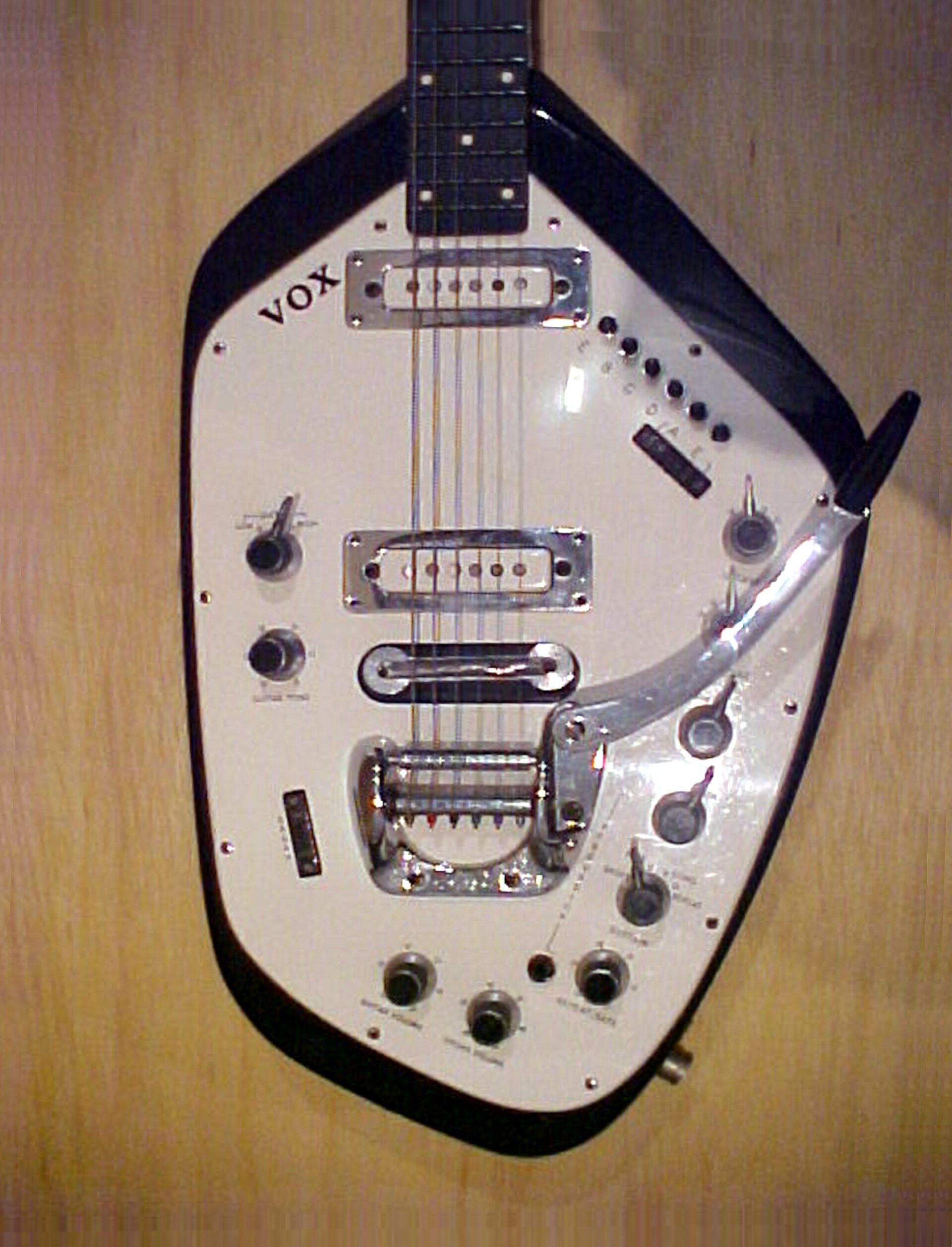
He took six of the Continental's tone generators, one for each string, and fitted them into a body shaped like the five-sided Vox Phantom. Then he turned the fingerboard into a switchboard. The strings are grounded. Each of the twenty-one frets is split into six contacts. Press a string down onto its contact and that string's generator sounds. Behind each string sits a ladder of twenty-one resistors that sets the pitch: more resistance, lower note.
A mode switch picks guitar, organ, or both. In organ mode you don't even have to pick. Hold the chord down and it plays.
The organ needs its own power. A separate mains supply sits on the floor and feeds the guitar up a multi-pin cable, which also carries the guitar and organ signals back down. You were tethered to a box.
A3
"Normal guitar techniques"
Vox's line was that you could play full organ chords
using only normal guitar techniques.
You couldn't, quite. It was heavy and cumbersome, the neck was steel on at least some of them, and the circuit boxes sat outside the body. The neck was wider at the nut than at the body, so a string you bent would slip off its divided fret. There were two pickups for the guitar side, a volume, a tone, and a three-way switch. Then all the organ controls on top.
On the organ side the voices were organ and flute, with percussion, sustain, and octave. One opened-up guitar has filter boards marked Organ, Flute, and Reed. The circuits were built roughly on the Continental's voice boards, so what came out was that organ, following your left hand.
Flip the record · By the numbers
6
Organ tone generators in the body, one for each string.
21
Frets, each split into six contacts. A resistor ladder per string sets the pitch.
$995
U.S. list at introduction, case included.
70 or 400
How many were made, depending who you ask. Another account says it never entered full production.
Side B
B1
Built in a hurry
Vox wasn't the only one chasing this. In 1964 it was racing Watkins and Burns. Burns finished the earliest prototype, and Lennon tried that one too. Vox was first to market, in 1966.
Then it paid for the speed. Denney was away when the first production run was wired, and engineers in a hurry copied his prototype to do it. The guitar's reputation followed. It worked in the right hands and proved unreliable in the field. Many players found it unreliable and hard to use, and it died quickly. In America it listed at $995 with the case.
Denney took one onto I've Got a Secret with Steve Allen in 1967. That's a television demonstration, not a tour.
Nobody agrees on how many were made, either. Around 70, say some. About 400, say others. One account says it never got into full production at all.
B2
Lennon kept it
Tom Jennings, who ran Vox, went on television and said he hoped that within a few months the Beatles would be spreading it all over the world. Vox told reporters Lennon was practicing, and that the next Beatles album would use it.
It didn't. No Beatles record has it. Lennon kept the guitar and never recorded with it, and later it went to Mal and Lily Evans. It's white, with a maple Phantom body and neck, a rosewood board with diamond inlays, fewer buttons than the production model, and the word Phantom still on the headstock.
B3
Gilmour wanted to try one
In 1978, David Gilmour bought a 1967 Guitar Organ in England. He had wanted to try one. He kept it for home and studio, with its power supply, its cables, and a case stenciled VOX ORGAN GUITAR.
No Pink Floyd track is pinned to it.
It was too much trouble to run. John kept it anyway.
The cast
The people, and the specific guitars, that made the legend.
1966
Dick Denney
Designer
Put Vox Continental tone generators into a Phantom-shaped body, and demonstrated it on American television in 1967.
1964
John Lennon
The prototype, white, with Phantom on the headstock
Given the first one by Denney. Kept it and never recorded with it. It later passed to Mal and Lily Evans.
1965
Tom Jennings
Vox’s boss, selling it
Told a television audience he hoped the Beatles would be spreading it all over the world within a few months.
1978
David Gilmour
1967 V251, a production guitar
Had wanted to try one, bought this one in England, and kept it for home and studio. No Pink Floyd track is pinned to it.
Liner notes
Specs, construction, rarity, value, and every source we used.
Six organ generators in a Phantom-shaped body — Vox’s Guitar Organ, not the Phantom, and not the teardrop.
- Body
- Five-sided Phantom solidbody, cavity for six organ tone generators. God’s Own on serial 73038: mahogany. Lennon’s prototype, not this table: maple (Sotheby’s).
- Neck
- Petersen and Denney, The Vox Story: steel, with the circuit boxes outside the guitar. God’s Own 73038: aluminium. GuitarPoint, on another 1966 example: steel. Prototype: maple. Mix flagged. God’s Own calls that neck grey; Roseberys calls 73038 a black neck. Do not average.
- Fingerboard
- 21 frets, each divided into six contacts (Vox Showroom; God’s Own 73038). God’s Own: ebony. Sotheby’s prototype: polyester-finished rosewood, diamond inlays. Gardiner Houlgate’s 2025 lot: composite. Mix flagged.
- Scale
- 25.5" on God’s Own 73038, overall 41.5" on that same guitar. No millimetres in a named source this pass. Do not convert.
- Pickups
- Two single-coils (Wikipedia; Roseberys on 73038). God’s Own: Vox V2. Not the Phantom VI’s three.
- Hardware
- Bigsby-style tremolo. Wikipedia: fixed-intonation bridge. God’s Own 73038: free-floating bridge. Prototype: nickel contour bridge and a chrome tremolo engraved “Hank Marvin.” Remote mains power supply and a multi-conductor cable ship with the instrument.
- Electronics
- Guitar: volume, tone, 3-way (Wikipedia). Organ: six generators, one per string; twenty-one resistors per string, higher resistance for a lower pitch (Vox Showroom). Separate guitar and organ outputs. Classic Keys: organ or flute, plus percussion, sustain, and octave. Jon at blackguitars.com, on one opened 1967: coarse and fine pitch pots per string, and filter boards marked Organ, Flute, Reed.
- Finish
- White and black both appear on named examples. No factory color card this pass.
- Nut
- No width in a named source this pass. Wikipedia’s GuitarOrgan section: wider at the nut than at the body, so a bend slips off the divided fret.
Open the full research fileConstruction details, the complete player record, production numbers, dated value estimates, and sources
Classic living example = 1966–67 V251 Guitar Organ (JMI, Dartford). No current Vox SKU this pass. Not the Phantom VI (vox-phantom): same five sides, no organ. Not the teardrop Mark III / Mark VI (vox-mark-iii). Lennon’s 1964 prototype wears fewer controls and a Phantom script on the headstock. It is still this instrument’s prototype, not a Phantom VI. Bob Murrell’s Waco GuitOrgan is another maker. Standalone. No Gibson SKUs. No source fetched this pass prints inches and millimetres together. Do not convert 25.5" or 41.5". Do not average steel / aluminium / maple, or ebony / rosewood / composite.
Construction
The job was to put a Continental under a guitarist’s hands. Vox already sold the organ. Dick Denney put six of its tone generators in a Phantom-shaped body, one generator to a string, so a fretted chord could speak as an organ.
Not a Phantom. Five sides, a bolt-on, a Hank Marvin tremolo: that shell is vox-phantom. The Phantom VI is three single-coils and a rotary selector. No divided frets. No power supply on the floor. Not a Mark III. The lute is vox-mark-iii. Brian Jones’s white two-pickup teardrop lives there. This plate is the organ, even when a headstock still says Phantom.
The years do not collapse. Vintage Guitar and Bass’s index of the 1964 UK Precision in Sound catalogue lists a Guitar Organ among the guitars. It is not in that site’s 1963 list, and it is not in the 1965 U.S. King of the Beat list printed there. Sotheby’s dates a prototype 1964. Classic Keys (Alan Lenhoff and David Robertson, 2019, p. 170): developed by 1965 at the latest, released 1966, roughly on Continental voice boards. The Vox AC30 research site: during 1965 drawing OS/063 was adjusted so the Continental circuit also covered the Guitar Organ and the Electric Accordion. The August 1965 date in that caption is the accordion’s. It is not a guitar ship date. Zero to 180, writing up Peter Stuart Kohman (Vintage Guitar, October 2013), reproduces a January 1966 Beat Instrumental page beside the instrument. Dave Hunter’s Vintage Guitar caption (16 February 2010) calls the photographed one a 1966 Guitar-organ: Phantom mechanics, Continental oscillators. Christie’s dates David Gilmour’s serial 73011 to 1967, Dartford. This plate starts in 1966, the release Classic Keys calls the introduction. Keep 1964, 1965, 1966, and 1967.
How a note happens is the fret. The strings are grounded. Each of twenty-one frets has six contacts. Press a string onto its contact and that string’s generator sounds. Showroom: a ladder of twenty-one resistors per string sets the pitch; more resistance, lower note. Showroom’s “if each resistor were 100 ohms” is a hypothetical. It is not a factory value. None used here. A remote supply makes the voltages and comes up a multi-pin cable. Classic Keys: the box turns mains AC into the DC the organ wants. Wikipedia’s Vox page: four conductors — power, guitar out, organ out, common — and the supply has an amp output for each.
Petersen and Denney, The Vox Story (1993), pp. 31–34, via Wikipedia: a switch for guitar only, organ only, or both. Organ only means you hold the strings down and get the tone without picking. The same pages: heavy, cumbersome, a steel neck, circuit boxes outside the body. The selector inventory — fret, brass plectrum, or open-string buttons; octave, effect, percussion, flute — is Wikipedia’s GuitarOrgan section, and that inventory has no footnote of its own. Classic Keys is shorter: organ or flute, percussion, sustain, octave. blackguitars.com’s opened 1967 labels the filters Organ, Flute, and Reed. Keep all three. Do not invent a voice the sources do not name.
Vox’s own line, in Classic Keys, was that it could produce full organ chords “using only normal guitar techniques.” God’s Own Guitars, pointing at a 1967 sales catalogue unearthed by Vintage Guitar and Bass, does not buy that sentence. The neck fights you. Wikipedia: wider at the nut than at the body, and a bend walks off the divided fret. Two pickups, not three. A volume, a tone, a 3-way, and then the organ.
It did not stay reliable. Petersen and Denney: the first production run was wired from Denney’s prototype while he was away, by engineers in a hurry, and the guitar got the reputation that followed. Kohman, via Zero to 180: it worked in the right hands and proved unreliable in the field. Classic Keys: many players found it unreliable and hard to use, and the product died quickly. Denney demonstrated a V251 on Steve Allen’s I’ve Got a Secret in 1967 (Zero to 180, citing Kohman). A television demonstration is not a tour.
Not Bob Murrell’s GuitOrgan. Billboard, 19 August 1967, via the Wikipedia Guitorgan page: Murrell Electronics, Waco, Texas, a guitar with a modified fretboard, a solid-state tone generator using Baldwin parts, and a foot expression pedal. Later Musiconics boxes, Japanese semi-hollow bodies, MIDI. Different maker. Off this plate. Sotheby’s catalogue note: in 1964 Vox was racing Watkins and Burns London; Burns finished the earliest prototype, and Lennon tried that one; Vox was first to market with the V251. The Burns object is not this guitar.
No Italian Eko line for the V251 shows up in the sources above. Christie’s files Gilmour’s as Jennings, Dartford. The current Vox European-history page tells the Phantom and the teardrop and does not mention this guitar. No Gibson SKUs.
Classic vs current: a 1966–67 Dartford V251 — Phantom outline, two coils, divided frets, six generators, a supply on a cable — against no new Guitar Organ.
Players
Do not recruit Phantom players. Ian Curtis’s Special is the trap, below. Do not recruit Mark VI players. Jones’s teardrop is the other slug. Do not put Ray Manzarek’s Continental, or Lennon’s Continental, on this fretboard. Those are keyboards.
John Lennon. The guitar this plate can name, and it is the prototype, not a catalog V251. Sotheby’s, 24 June 2014: white polyester, maple Phantom body and neck, 21-fret rosewood board with diamond inlays, two single-pole pickups, nickel contour bridge, chrome tremolo engraved “Hank Marvin,” Phantom script on the headstock. The catalogue note: fewer buttons than the production model. The power supply was not in the lot.
Who handed it over, and when, stays split. Dick Denney, quoted by Andy Babiuk in Beatles Gear and reprinted in the Sotheby’s note (the catalogue spells the surname Denny): “I took the first one up to John Lennon and Paul McCartney, to the Hammersmith Odeon in London during their Christmas show. When they first saw it they were in awe, but they couldn’t suss it out. It was too much trouble to run. But I think they liked it, because John kept it.” Denney’s place is the Odeon. George Harrison remembered Abbey Road. Sotheby’s dates the object 1964. Classic Keys dates the sample 1965: Vox told reporters Lennon was practicing and that the next Beatles album would use it. Tom Jennings, on television, via that book: “We hope that with in a few months, they’re going to be spreading it all over the world.” They did not. Lennon kept it and did not record with it. Provenance at Sotheby’s: John Lennon, then Mal and Lily Evans. McCartney was in the room. He is not a second player. No Beatles title sits on this guitar.
David Gilmour. A production V251, not Lennon’s. Christie’s, The David Gilmour Guitar Collection, 20 June 2019, lot 16: Jennings, Dartford, 1967, serial 73011, power supply, cables, case stenciled VOX ORGAN GUITAR and STOCK NO. DG1116, plus a facsimile of the Vox service guide. The specialist note: he had wanted to try one, bought this in England in 1978, and kept it for home and studio. No Pink Floyd title is pinned to it here.
Ian Curtis. Wikipedia’s Vox page: he is sometimes believed to have used a GuitarOrgan. He owned two white Phantom VI Specials (Wikipedia, citing Alan Hempsall, Extro, Vol. 2 No. 5, 1980). The documented Special, serial 76634, is on vox-phantom. Off this plate.
Also claimed, and not a credit. GuitarPoint and an ended Reverb listing say the second guitar went to Brian Jones. No serial, no photograph, no session in a named book this pass. Do not list him.
Rarity
You cannot buy a new V251. The run is closed. JMI does not publish a Guitar Organ total. None invented.
What the pages say instead does not agree, so none of it is a census. Wikipedia’s Continental article: the Guitar Organ never entered full production. Roseberys and GuitarPoint: about 400. blackguitars.com: around 70. The Music Locker: “I’ve read that only 70” were produced and sold, and that count is written to include Lennon. Surviving V251s with serials in the 73000s, cases, and power supplies are production guitars. They are not a factory tally. A serial dates one guitar. It does not count a year.
What is actually thinner: an organ section that still tracks the guitar (Gardiner Houlgate’s December 2025 lot was only partly working), the original supply and cable still in the case, and a complete divided neck. Lennon’s prototype is one object. It is not a vintage V251. Gilmour’s 73011 is one named production guitar. It is not the price of the others.
Value
Informal estimate, 22 October 2026. Not an appraisal.
Ask vs sold labeled. Celebrity lots are not comps. No invented medians or factory counts. No clean Reverb Price Guide band isolated this pass.
Classic Keys: U.S. list at introduction $995, case included. That is 1960s money, not 2026 street. No U.K. list isolated this pass.
New street. None. No Guitar Organ on a current Vox cart.
Used modern. No reissue. Nothing to price between new and the 1960s guitar.
Vintage / collectible. Named auction results, not a midpoint. Gardiner Houlgate, 2 December 2025: hammer £1,500 (estimate £1,500–£2,000); guitar output low, organ only partly working. Omega, 29 November 2022, serial 73014: hammer £2,400; untested, with the input box. Roseberys, 5 October 2019, serial 73038: price realised £1,820 including premium (estimate £1,000–£1,500), with the original supply. Do not average those.
Named shop sold-tags, not auction hammers: The Music Locker marked two black 1966s sold at the listed £4,995 and £3,495. Named asks, not hammers: AxeShop / Gbase lists a black 1966 with module, cables, and case at $14,995. An older Reverb ask, Rivington, ended at $4,999 (listing about nine years before this pass). Do not average an ask with a hammer, or a shop tag with either.
Lennon’s prototype, Sotheby’s New York, 24 June 2014: $305,000 (estimate $250,000–$350,000). Classic Keys, citing Beatles Gear, reports an earlier auction by the roadie’s widow at £10,000. That figure is not the 2014 result. Gilmour’s 73011, Christie’s, 20 June 2019: price realised $87,500. Both are provenance. Neither is a comp for a V251 without a name on it.
See also
- vox-phantom — the five-sided guitar this body copies; three coils, no organ
- vox-mark-iii — the teardrop; not this circuit, and not Jones’s prototype moved here by the outline
- line-6-variax — a later guitar that calls up other instruments from the strings; modeling, not fret contacts, and not a Continental
Sources
- VOX Guitars European History — current factory history names the Phantom and the 1964 teardrop; no Guitar Organ on that page (fetched 22 October 2026)
- The Vox Showroom, V251 Guitar Organ — Denney; Continental circuitry in a Phantom; six generators; six contacts per fret; twenty-one resistors per string; resistance sets pitch; remote supply; guitar, organ, or both. The 100-ohm ladder is the page’s hypothetical
- Vintage Guitar, Dave Hunter, 50 Years of Vox (16 February 2010) — 1966 Guitar-organ caption: Phantom mechanics, Continental oscillators, Denney
- Wikipedia, Vox (company), GuitarOrgan — 1966 introduction citing Classic Keys p. 170; Petersen and Denney, The Vox Story (1993), pp. 31–34: mode switch, steel neck, external boxes, prototype used as the production wiring template; unfootnoted control inventory; Curtis belief vs two Phantom VI Specials, citing Hempsall, Extro 1980; Lennon did not record with it
- Wikipedia, Guitorgan — quotes Classic Keys p. 170: developed by 1965, released 1966, six generators, resistor ladder, remote supply, organ/flute plus percussion, sustain, octave, Vox’s “normal guitar techniques” claim, U.S. list $995 with case, 1965 Beatles sample, Jennings television line, no Beatles session, Beatles Gear auction at £10,000; Murrell via Billboard, 19 August 1967
- Wikipedia, Vox Continental — 1966; Phantom body; fret contacts; Lennon given a sample, never recorded; “never entered full production”
- Sotheby’s, Rock & Roll History, 24 June 2014, lot 9 — prototype 1964; maple; rosewood; two single-pole pickups; Hank Marvin tremolo; Phantom script; fewer controls than production; Denney via Babiuk, Hammersmith Christmas show vs Harrison’s Abbey Road; Lennon to Mal and Lily Evans; sold $305,000, estimate $250,000–$350,000; Burns earlier prototype
- Christie’s, David Gilmour Guitar Collection, 20 June 2019, lot 16 — Jennings, Dartford, 1967; serial 73011; supply, cables, case; bought in England 1978 for home and studio; price realised $87,500
- Vintage Guitar and Bass, Vox catalogs — Guitar Organ named in the 1964 UK Precision in Sound index; absent from the 1963 index and from the 1965 U.S. King of the Beat list on that page
- Vox AC30 site, Continental early years — OS/063 revised during 1965 for the Continental, the Guitar Organ, and the Electric Accordion; accordion release August 1965
- Zero to 180, Dick Denney’s Guitar Organ (27 April 2015) — Kohman, Vintage Guitar October 2013: worked in the right hands, unreliable in the field; January 1966 Beat Instrumental; Denney on I’ve Got a Secret, 1967
- God’s Own Guitars, 1966 V251 serial 73038 — mahogany; aluminium neck; ebony; 21 frets, six sensors; V2; 25.5" scale; 41.5" overall; doubts the 1967 catalogue’s “normal guitar playing techniques”
- Roseberys, 5 October 2019, serial 73038 — white, black neck; two single-coils; six generators; price realised £1,820 including premium; dealer note “approximately 400”
- Omega Auctions, 29 November 2022, serial 73014 — hammer £2,400; untested; input box and case
- Gardiner Houlgate, 2 December 2025, lot 267 — black; composite board; hammer £1,500; organ partly working; supply, metal pick, and cables in the case
- blackguitars.com, 1967 V251 — six generator boards; twelve pitch pots; filters marked Organ, Flute, Reed; “around 70”
- The Music Locker, 1966 V251, £4,995 — sold tag £4,995; “I’ve read that only 70,” written to include Lennon
- The Music Locker, 1966 V251, £3,495 — sold tag £3,495; same “only 70” line
- GuitarPoint, 1966 V251 — sold, price unpublished; steel neck; dealer line “only 400”; Lennon then Jones, no serial
- AxeShop / Gbase, 1966 black V251 — ask $14,995; module, cables, case
- Reverb, Rivington 1966 listing — ended ask $4,999; dealer copy “about 400” and a second guitar to Brian Jones
Keep digging
Guitars this one gets compared to, confused with, or descended from.
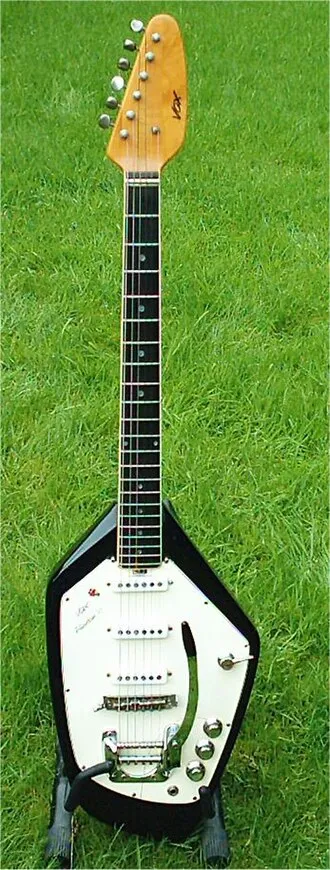
Photo: LittleRoughRhinestone / Wikimedia Commons / Public domain Vox
Phantom
1962
No Fenders in Britain, so Vox built a Strat in a five-sided coat you could spot from the back of the hall.
- Send a picture
Vox
Mark III
1963
Vox built Brian Jones a white teardrop, then sold everyone else a different guitar. The reissues chose his.
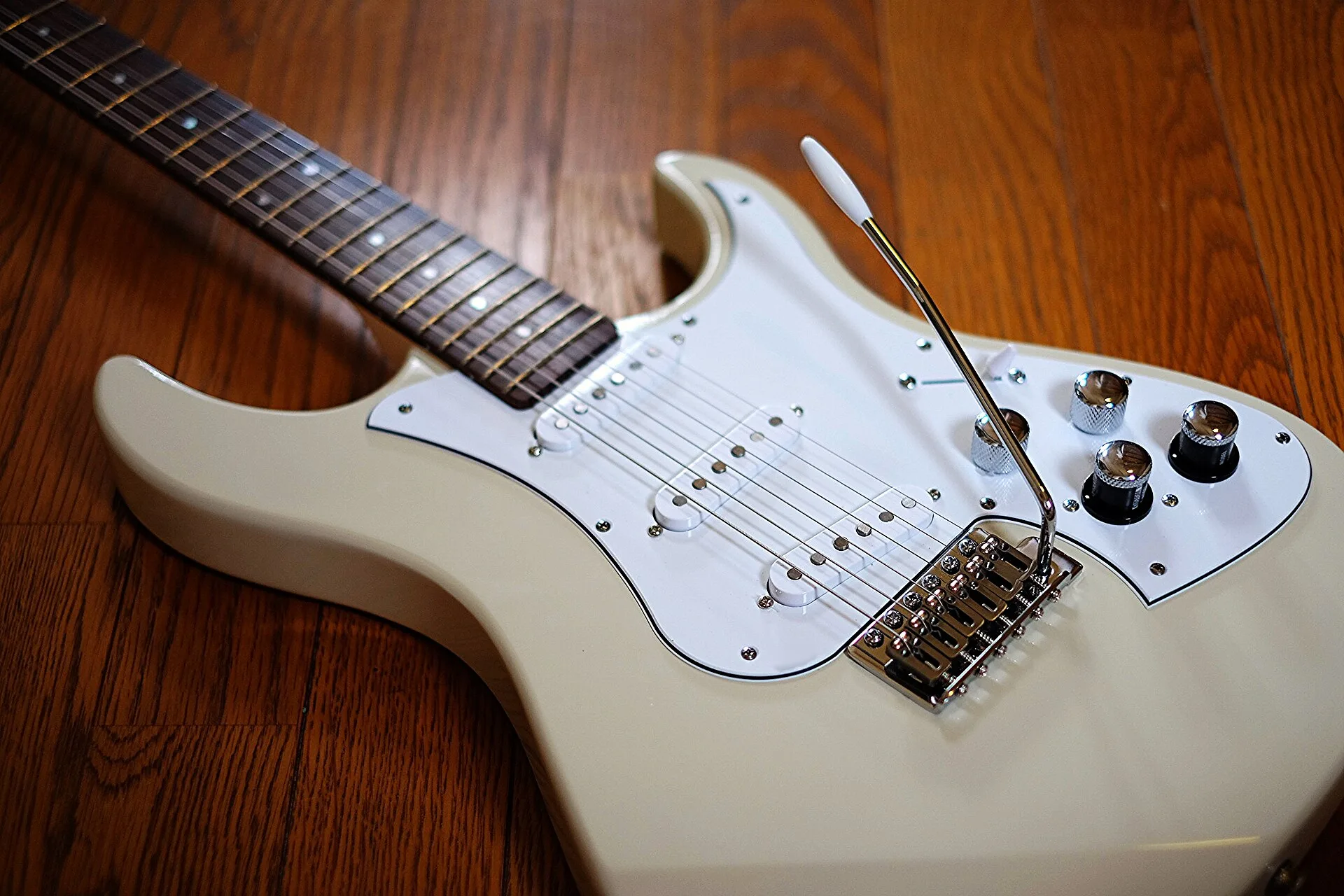
Photo: Shunichi kouroki / Wikimedia Commons / CC BY 2.0 Line 6
Variax
2002
One knob, and a plain solidbody is a 12-string, a sitar, or a banjo. It was built to be the rest of the gig bag.