Gibson
RD Artist
Gibson put a Moog inside it, then blamed the outside. The outside is the part that lasted.
Summer NAMM, Atlanta, June 1977. Gibson unveils a maple guitar with a battery, a long scale, and a circuit board designed with Bob Moog. People talked. They talked more about the guitar synthesizers.
- Introduced
- 1977
- Type
- Solidbody electric
- Class
- Production
Have a photograph of this guitar? Send a picture
The short version
1975
The work starts
One telling dates development to here, two years before anybody saw it.
1977
Atlanta
The RD line is unveiled at Summer NAMM in June. One longtime writer has the Artist introduced in 1978. Keep both.
1978
The peak
The Artist lists at $859, and the best year on the ledger is mostly Artists.
1979
Blame the body
The scale shortens, and the Moog circuit moves onto a Les Paul and an ES.
1981
The last hundred
Dealers hear of a run of 100 curly-maple-top Artists. The RD ends in 1981 or 1982, depending who you ask.
2018
Fortieth
An anniversary RD Artist in mahogany, with modern active pickups and no Moog board.
2025
Custom Shop
The first Custom Shop RD. Mahogany, long scale, passive.
Side A
A1
The talk of the show, almost
Atlanta, June 1977. Summer NAMM. Gibson has a new outline on the stand, three guitars and two basses wearing it, and at the top of the line sits the RD Artist: solid maple, gold hardware, and a circuit board the length of the body hidden under a cover on the back.
One magazine reported that the RD series created substantial talk at the show. The guitar synthesizers got more.
That’s the RD Artist in one trade show. Interesting, ahead of something, and not quite what everybody came to look at. Gibson would spend the next few years deciding the problem was the way it looked.
When it actually arrived depends who you ask. Gibson says 1977. One longtime writer has the RDs developed in ’77 and the Artist introduced in ’78. The work goes back to 1975. Keep all three.
A2
A steel player’s swell, without the pedal
Norlin owned Gibson. Norlin also owned Moog Music. So Bruce Bolen, Gibson’s product development director, could do what nobody else at a guitar company could: sit down with Bob Moog and Roger Cox and design a circuit. Alembic and B.C. Rich had already put batteries in guitars. This was Gibson’s first.
Bolen knew the sound he was after. A pedal steel player gets a note to bloom by rolling a volume pedal after the pick. He wanted that without the pedal:
“The reduction of the initial attack and the swell of the note after the initial attack had been made.”
Moog built a compression circuit for it, and then an expansion circuit Bolen called “unlike any other that had been designed to date.” Compression lives on the neck pickup: the catalog said it “compresses” each note into a long sustaining signal. Expansion lives on the bridge, “a very fast, explosive response with a rapid decay.” So the neck swells and sings, and the bridge snaps.
Then there’s the bright switch, for both pickups. One reviewer in 1978 measured it at about 8 dB up at 4 kHz. Bolen, later, put it better: “You had enough highs there to slice cheese.”
A3
Plug in, and it’s on
The rest of the guitar is Gibson thinking hard about being modern. A 9-volt battery, and no off switch: plug in and the circuit is on. The volume knobs sit at normal in the middle, so you can roll down to cut or up to boost. Bass and treble are numbered from −5 to +5 with zero at the center.
The scale was 25½ inches, Gibson’s first extra-long six-string, against the 24¾ on nearly everything else it made. That gives you a tighter, brighter string. Maple body, set maple neck, ebony board, pearl blocks, gold everywhere, and on the headstock Chuck Burge’s “flying f-hole,” an f with wings and a lightning bolt.
On the first ones, a single three-way trick switch picked bright or the Moog effects, never both. In January 1978 the Artist listed at $859. A Les Paul Standard was $749.
One writer called the RDs “a bit like ungainly reverse Firebirds.” He wasn’t the only one who thought so.
Flip the record · By the numbers
25½"
Gibson’s first extra-long-scale six-string, against the usual 24¾. It went back to 24¾ in 1979.
$859
The Artist’s list price in January 1978. A Les Paul Standard was $749.
+8 dB
What the bright switch added at 4 kHz, on one reviewer’s bench in 1978.
2,340
RD Artists shipped 1977–79 on one ledger. Another count says 2,600 by the end in 1982.
Side B
B1
Blame the body
1978 was the peak, and it was mostly Artists. Then the shops stopped moving them, and Gibson decided the shape was the reason.
So in 1979 the Moog circuit went looking for a better-looking home. Tim Shaw in R&D split the big board into two smaller ones, and it went into a Les Paul Artist at $1,299 and an ES Artist at $1,399. Shaw remembered the reputation:
“Somebody once said that with one of those Artists, you were a flick of a switch away from total disaster.”
The RD itself changed too. From June 1979 the Artist went to 24¾ inches, with a fine-tune tailpiece and two mini-toggles, so bright and the Moog effects could finally run together. The long-scale original stayed as a custom order at the same price. The Standard and the Custom were gone. Only the Artist made it past 1979, known by the end simply as the RD.
The end is a smear. In March 1981 dealers heard about one last run of 100 curly-maple-top Artists. Some count the RD finished in 1981, others in 1982. Keep both.
B2
The spare at Knebworth
The RD Artist never had a single famous owner. It had appearances.
Knebworth, 11 August 1979. Led Zeppelin’s night has guitar and PA trouble, cutting songs short, and Jimmy Page has a ’77 RD Artist out as the spare for “Misty Mountain Hop.” A backup, for one song, on a night that needed one.
Dave Grohl had a phase. “I had an RD phase. I was really into RDs for a while,” he said, and then remembered seeing one in a store and thinking it weighed 40 pounds. The RD in his 1996 photos is a Standard, though, dots not blocks. His engineer thinks a Standard is what went on “Everlong.” Grohl couldn’t remember. Either way, not this one.
Ghost’s Nameless Ghouls got RDs straight from Gibson, then put in Seymour Duncans with a coil-split, changed the necks and tuners, and painted them. The outline went onstage. The Moog board didn’t.
B3
The part that lasted
That’s been the pattern ever since. Plenty of original owners pulled the electronics out of their Artists. The reissues kept the shape and dropped the circuit: a 2014 Artist with modern active pickups, a 40th Anniversary in 2018 that one magazine described as “minus the original’s befuddling electronics.” In 2025 Gibson’s Custom Shop made its first RD. Mahogany, the long 25½-inch scale, passive pickups.
Gibson blamed the body and moved the brains to a Les Paul. Nearly fifty years later, the brains are the part nobody reissued, and the body is in the Custom Shop.
Put this on
You’ve read about it. Now hear it. Here’s what this guitar sounds like, and what to listen for.
Misty Mountain Hop (Knebworth, 11 August 1979)
Page had a ’77 RD Artist out as the spare for this one, on a night when guitar and PA trouble cut the song short. A live backup, not the studio track.
Find it on YouTube (opens in a new tab)
The cast
The people, and the specific guitars, that made the legend.
1977
Bruce Bolen
The RD Artist circuit
Gibson’s product development director. He wanted a steel player’s swell without a pedal, and took the idea to Bob Moog.
1979
Jimmy Page
’77 RD Artist
The spare for “Misty Mountain Hop” at Knebworth on 11 August 1979.
1996
Dave Grohl
RDs, including an RD Standard
Had “an RD phase.” The one in his 1996 photos is a Standard, and that’s the model his engineer thinks went on “Everlong.” Not the Moog Artist.
2013
Nameless Ghoul (Ghost)
Gibson-supplied RDs, modified
Seymour Duncans with a coil-split, a different neck, new tuners, a custom color. The outline onstage, without the Moog board.
Liner notes
Specs, construction, rarity, value, and every source we used.
Maple, 25½ inches, and a Moog board in the back — Gibson’s RD Artist, not a Firebird and not a Les Paul.
- Body
- Solid maple, offset double-cut; a softened reverse-Firebird outline with a conventional Gibson headstock. Contoured.
- Neck
- Set laminated maple. Bound headstock with Chuck Burge’s pearl “flying f-hole” (an f-shaped hole with wings and a lightning bolt). Neck bound from 1979.
- Fingerboard
- Ebony, pearl blocks, 22 frets. Vintage Guitar: most early boards unbound.
- Scale
- 25½" (RD-77, 1977–79). 24¾" from the RD-79 (1979–81). CRAVE, on a 1981: 24¾" (629 mm). Mix flagged. Do not average.
- Pickups
- Two gold-plated Series VI humbuckers. Wikipedia, one measured pair: 3.95K and 3.62K. Low-output on purpose.
- Hardware
- Gold. Schaller tuners; Tune-o-matic. RD-77: stopbar. RD-79 / CMT: TP-6 fine-tune tailpiece. Nickel and gold speed knobs on the 1981 CMT.
- Electronics
- Active, 9V. Two volumes, master bass, master treble (−5 / 0 / +5). 3-way pickup toggle. RD-77: one 3-way “trick switch” (expansion/compression, neutral, bright). RD-79: two mini-toggles so bright and expansion/compression can run together. No separate passive-off switch. The jack is the battery switch.
- Finish
- Antique Sunburst, Ebony, Natural, Fireburst. Fireburst drops off the RD-79 list. CMT: Antique Sunburst, Antique Cherryburst.
- Nut
- Catalog 1 11/16". CRAVE 1981: 1 11/16" (42 mm). Mix flagged.
Open the full research fileConstruction details, the complete player record, production numbers, dated value estimates, and sources
Classic living example = 1977–79 RD Artist (RD-77): maple, 25½", Series VI, the three-way Moog trick switch. Not a Firebird (gibson-firebird). Not an L-6S (gibson-l-6s). Not a Grabber or Ripper. RD Standard is passive, same outline. RD Custom is active bright-mode only, maple board, dots, nickel, no flying-f. RD Artist bass is the four-string, context only. The living 2026 cart is the Gibson Custom RD Custom (Ebony, CSRDCEBGH1): mahogany, 25.5 in / 647.7 mm, 490R / 498T, passive, gold, $5,799 — not this table. Mixed inch/mm flagged on CRAVE’s 24¾" (629 mm) / 42 mm and Gibson’s 647.7 mm / 25.5 in. Do not average the two scales, or treat 629 mm as a different guitar.
Construction
The job was a Gibson that could sit next to a synthesizer without becoming one. Alembic and B.C. Rich had already put batteries in guitars. Norlin owned Gibson and Moog Music. Bruce Bolen, product development director, talked the circuit through with Bob Moog and Roger Cox. Bolen, in the 1978 Gibson magazine, via FlyGuitars: start with the musical purpose, take it to an outside review board of players, then “Bob, Roger Cox and our entire design team we collaborated on the design of the instrument and the internal electronics.” What he wanted, he told vintageguitarandbass.com the same year, was a steel-player swell without a volume pedal: “the reduction of the initial attack and the swell of the note after the initial attack had been made.” Moog designed a compression circuit for that, and an expansion circuit “unlike any other that had been designed to date.”
Development starts earlier than the catalog. CRAVE dates work to 1975; FlyGuitars’s bass timeline takes the same year from that Bolen interview. This plate starts at the launch. Imperial Vintage (Ryan Gabrinetti, 3 December 2022): June 1977, Summer NAMM, Atlanta. FlyGuitars: 11–14 June 1977. Guitar Player, September 1977, via the same timeline: the RD series “creates substantial talk” at that show; guitar synthesizers got more of it. Gibson’s current Custom page: “Initially released in 1977.” Vintage Guitar (Michael Wright, January 2004) has the RDs “developed in ’77” and the Artist “introduced in ’78.” Keep 1977, 1978, and 1975. Do not pick one silently.
Not a Firebird. Not an Explorer. Not an L-6S. Not a Grabber. Wright: “a bit like ungainly reverse Firebirds.” Gibson Custom 2025 copy: “inspiration from both the Explorer™ and Firebird™ designs.” The headstock is a regular Gibson, not a reverse bird. Scale at launch is 25½", which vintageguitarandbass.com calls Gibson’s first extra-long-scale six-string, against the usual 24¾". Maple slab, set laminated maple neck, 22 frets — not the L-6S’s 24-fret rotary (gibson-l-6s), not a carved Les Paul (gibson-les-paul-standard). The 1981–82 Firebird II is maple, set-neck, and active. It is not this body. The Grabber and Ripper (gibson-grabber) are the other 1970s Norlin basses.
Five instruments on the outline. Three six-strings: Standard (passive, two volumes, two tones), Custom (active preamp, bright switch, no expansion/compression; maple board, dots, nickel; Natural and Walnut), Artist (the full Moog board, ebony blocks, gold, flying-f). Two basses: Artist and Standard, 34½" (Wright) / 34⅜" (FlyGuitars tech table). Mix flagged on the bass, and it is not this table. Wikipedia’s “Custom Artist” is the Custom. Prefer Custom.
The Moog board is the point. A 9V cell, a PCB the length of the body under a rear cover, two pots on the board, two off it. Jack in, battery on. Sound International (Dave Blake, May 1978): 150 to 200 hours intermittent; a dying cell warns by power loss. Four knobs: volume per pickup, master bass, master treble, each tone numbered 0 in the center and ±1 to 5. Wright: each volume is “maximum ‘normal’ volume in the middle” — roll down to cut, up to boost. Blake: tones between −5 and 0 “acting like any normal guitar with passive electronics”; above zero, boost. Wikipedia: the Artist “did not have a passive mode.” Keep both. Compression is the neck pickup: catalog, via Tony Bacon (Reverb News, 13 February 2019), “reduces fundamental attack and ‘compresses’ each note into a long sustaining signal.” Expansion is the bridge: “a very fast, explosive response with a rapid decay.” Bright is both pickups. Blake measured about +8 dB at 4 kHz. An expander-sensitivity trim lives under a hole (later a rubber plug) in the back plate; a decay-time trim is under the board. RD-77: one three-way trick switch, so bright or expansion/compression, not both. RD-79: two mini-toggles, so both at once. Bolen to Bacon: “you had enough highs there to slice cheese.”
January 1978 zone-1 list (vintageguitarandbass.com; Bacon): Artist $859, Custom $759, Standard $699. Les Paul Custom $949, Les Paul Standard $749. Historical list, not 2026 street. The Artist steps $919 (January 1979), $999 (June 1979), $1,099 (January 1980). Last price-list line: 1/7/80 for the Artist; Custom and Standard last appear 1/6/79. Burge cut the flying-f. Wright: sales copy claimed the outline was drawn to balance the long scale.
Then the scale shortened. From June 1979, vintageguitarandbass.com: the newer Artist is 24¾", TP-6, two mini-toggles, neck bound; the original 25½" RD-77 stays as a custom order at the same price, now with the RD-79 switches. Bacon: “RD 77, as the original, and the RD 79.” Premier Guitar (Chris Kies, 18 October 2011), on a 1979 maple-body Artist: 24.75" scale, “3-piece mahogany neck”; “RD Customs offered a 25.5" scale length.” Factory sheets and CRAVE’s 1981 still say laminated maple. Keep Premier’s one guitar. Do not make Custom-versus-Artist a second scale rule.
The shape took the blame. Bacon: Gibson thought the “wonky Firebird-Explorer body” was why shops didn’t move them, so in 1979 the Moog circuit moved onto a Les Paul and an ES. Tim Shaw in R&D split the big RD board onto two smaller ones. Les Paul Artist listed $1,299, ES Artist $1,399, against a 1979 Les Paul Standard at $799. Shaw, later: “Somebody once said that with one of those Artists, you were a flick of a switch away from total disaster.” Those two are not this guitar. The RD Artist bass (FlyGuitars: 2,640 shipped 1977–79) is not this guitar either.
The stop is a smear. Wright: only the Artist survived 1979, “making it to ’82, by which time it was known simply as the RD.” Wikipedia infobox: 1977–82. CRAVE: discontinued c. 1981. vintageguitarandbass.com: March 1981, dealers were told of a limited run of 100 RD CMT (curly maple top) Artists for April delivery — slab, bound, no contours, nickel, no pearl, Gibson decal, Antique Sunburst or Antique Cherryburst. The 1 April 1981 price list names no RD. FlyGuitars’s bass CMT is the same month, “probably numbering 100 or so.” Keep 1981 and 1982.
Reissues wear the outline and drop the Moog board. 2007: Wikipedia, 48th Guitar of the Week, Silverburst Standard, 400 guitars, Dirty Fingers, mahogany, 24¾". Premier Guitar prints that GOTW as the RD Standard bass, same 400. Keep both. 2009 Japan / 2011 US Exclusive Standard: Burstbucker Pro. 2014 120th RD Artist: Alpine White, mahogany, rosewood with a 12th-fret banner, GEM active humbuckers (Alnico II, 42 AWG), flying-f, TP-6. Ishibashi (5 October 2014): 24¾"; a Fat Bottom used listing prints 25.5". Keep both. No 2014 US list located this pass; Audiofanzine’s public price $2,299 is that site’s figure, not a Gibson sheet. 2018 40th Anniversary: mahogany, 24.75", torrefied granadillo, GEM actives, SKU DSRDAH18VSGH1. 2025: Gibson Custom RD Custom joins the core lineup — first Custom Shop RD, first 25.5" solidbody core model Gibson Custom has offered — 490R / 498T, $5,799 (gibson.com, 6 October 2026). Mahogany. Passive. Classic against current: the 1977 RD-77 — maple, 25½", Series VI, Moog compression and expansion — against a Custom Shop guitar you can order tomorrow that is not that circuit.
Players
Do not hang a Firebird, an L-6S, a Les Paul Artist, or an RD bass on this plate as if they were this guitar. Do not move Nevermind onto a six-string. Do not flatten Grohl’s Standard into an Artist.
Jimmy Page — Knebworth, 1979, a backup. Premier Guitar: a ’77 RD Artist on “Misty Mountain Hop” at Knebworth. Led Zeppelin’s own 11 August 1979 show page: guitar and PA trouble “truncated Over The Hills And Far Away and Misty Mountain Hop.” The RD is the spare for that song, not a session log for the studio “Misty Mountain Hop.”
Dave Grohl — an RD phase, and a Standard in the picture. Ground Guitar quotes him from a Them Crooked Vultures interview: “I had an RD phase. I was really into RDs for a while. [Krist Novoselic] had RD and Grabber basses. But I think what happened was that I saw one in a store and I thought, Wow this thing weighs 40 pounds!” The same page IDs the guitar in the 15 June 1996 Tibetan Freedom Concert shot as an RD Standard (dots, not blocks). Engineer Bradley Cook, on The Colour and the Shape: “It was probably the RD Standard” for “Everlong.” Grohl couldn’t remember. Guitar World (Matt Owen, 12 March 2025): “as the story goes, used one to track Everlong.” vintageguitarandbass.com lists him on Artist and Custom. Keep the phase. Do not pin “Everlong” on the Moog Artist.
Nameless Ghoul (Ghost) — Gibson-supplied RDs, then modified. Total Guitar “Me And My Guitar” (31 December 2013), via Blabbermouth: Gibson “gave us a couple of each”; “a fuckin’ heavy guitar”; Seymour Duncan pickups with a coil-split, a ’60s-style neck, changed tuners, a custom color. Equipboard: Fire Ghoul’s RD with Duncans and a tap; Omega Ghoul on a black RD Standard, same treatment. Studio writing, in that Equipboard interview, is an SG. Live silhouette. Not a stock Moog board.
Also known, short. vintageguitarandbass.com: Alan Kendall (Bee Gees), Rob Dean (Japan). No songs pinned here. Wikipedia’s Niclas Engelin is not repeated as fact.
Bass context, not this table. Krist Novoselic toured Gibson RD Artist basses around 1991 (novoselic.com); the 2011 signature is an RD Standard-shaped bass with Seymour Duncan Hot Stacks, not Moog. Premier Guitar names Adam Clayton with an RD Artist on the Achtung Baby sessions, 1990–91 — Clayton is a bassist. Do not move that onto six strings. FlyGuitars’s Entwistle “spiderbass” RD-77 prototype is a bass. Steve Howe’s Artist is an ES Artist. None of those are this guitar.
Rarity
You can buy a new RD tomorrow. It is a Gibson Custom RD Custom: mahogany, passive 490R / 498T. It is not a 1977 Moog Artist. The 2014 GEM and 2018 40th are gone. Eastwood’s RD Artist is another factory on the silhouette.
The count in hand is vintageguitarandbass.com’s ledger, 1977–79 only. RD-77 and RD-79 six-strings ran into the early 1980s with no cells. The site flags that it is unclear whether 1979 Artist figures include leftover RD-77s, and that a 1977 RD-77 row is unexplained. Premier Guitar: the Artist “died in 1982 with a total of just 2,600 units manufactured.” guitar-list: “around 2350” in the longer-scale pre-1979 window. Do not average them. The printed cells:
| 1977 | 1978 | 1979 | total | |
|---|---|---|---|---|
| RD Artist | 674 | 1,314 | 352 | 2,340 |
| RD-77 | 7 | — | 114 | 121 |
| RD Custom | 698 | 352 | 327 | 1,377 |
| RD Standard | 582 | 429 | 254 | 1,265 |
Peak year is 1978, and it is mostly Artists. Adding Artist and RD-77 through 1979 is 2,461, before the uncounted 1980–81 stragglers and the March 1981 CMT 100. Premier’s 2,600 can be that neighborhood plus the closeout. Serials date a guitar. They don’t count a year. That is why a 1980–82 addendum is unknown, not the chapter.
What is actually thinner: first-year 25½" Artists with the three-way trick switch and the Moog board still in and working — CRAVE notes many buyers stripped the electronics. Fireburst. A real CMT from the 100. Page’s Knebworth spare and Ghost’s painted stage RDs are unique objects. They are not a vintage RD Artist.
Value
Informal estimate, 6 October 2026. Not an appraisal.
Asking prices are not sold prices. Celebrity lots are not-comps. A Custom is not an Artist. A Standard is not either. The 2025 Custom Shop RD Custom is not 1977 Moog money. Period $859 (January 1978) and $1,099 (January 1980) are 1970s money, not 2026 street. Reverb Price Guide dollar widgets on the 1977–1982 Artist product page did not render a band this pass. Flag: thin sold-comp access. Don’t invent a median.
New street. Gibson Custom RD Custom Ebony $5,799 (gibson.com, CSRDCEBGH1, 6 October 2026). Mahogany, 490R / 498T, 25.5". Not this table. No current Gibson USA RD Artist SKU.
Used modern. 2007 GOTW, 2009–11 Standard, 2014 GEM Artist, and 2018 40th trade used. Named ask, not a hammer: 2018 40th Vintage Sunburst $2,850. Historical, not a cart: Audiofanzine 2014 public price $2,299. Don’t invent a midpoint from the dead lists.
Vintage / collectible. Named asks, not hammers: 1978 Fireburst $4,000; 1978 Fireburst $3,495; 1978 sunburst $3,200; 1977 Fireburst $3,229.99 (from $4,250); 1979 tobacco sunburst $3,995. Do not average them. A working original Moog board is the split; a stripped Artist is a different guitar. Bernie Marsden’s 1977, listed this pass at $31,474.68, is one object with a name on it. Not a comp.
See also
- Firebird — reverse-body Gibson, 1963, mini-humbuckers, neck-through. Not this maple Moog offset
- L-6S — the other 1970s maple Gibson solid. 24 frets, six-way rotary, 24¾". Not an RD
- Les Paul Standard — the carved mahogany Gibson the RD was priced against; the Les Paul Artist later took the Moog board. Not this body
Sources
- vintageguitarandbass.com, Gibson RD — unveiled 1977; three guitars, two basses; first Gibson extra-long scale 25½"; first actives; Moog expansion/compression; Bolen 1978 steel-player quote; Grohl / Page / Kendall / Dean lists
- vintageguitarandbass.com, RD Artist — RD-77 / RD-79 / CMT spec split; 25½" then 24¾"; 1 11/16"; Series VI; flying-f by Chuck Burge; March 1981 CMT 100; custom-order RD-77 after June 1979
- vintageguitarandbass.com, RD shipping and pricing — 1977–79 cells; Artist 2,340 / RD-77 121 / Custom 1,377 / Standard 1,265; January 1978 $859 / $759 / $699; steps to $1,099 January 1980; last lists 1/7/80 and 1/6/79; 1979 Artist vs RD-77 caveat
- vintageguitarandbass.com, RD Artist controls — RD-77 three-way vs RD-79 two minis; expander sensitivity and decay trims
- vintageguitarandbass.com, RD Custom — 1977–79; active bright only, no expansion/compression; maple dots; nickel; Natural and Walnut; 25½"
- Vintage Guitar, Michael Wright, 1978 Gibson RD Artist (January 2004) — developed ’77, Artist introduced ’78; maple body and set maple neck; 25½" first long scale; gold; Natural, Fireburst, Ebony; Series VI; trick switch; basses 34½"; Artist to ’82 as “the RD”
- Premier Guitar, Chris Kies, 1979 Gibson RD Artist (18 October 2011) — 1977 launch; Standard / Artist / Custom plus two basses; Page ’77 Artist, Knebworth “Misty Mountain Hop” 1979; Clayton Achtung Baby 1990–91; one 1979: maple body, 3-piece mahogany neck, 24.75", TP-6; Customs 25.5" on that page; 2,600 manufactured to 1982; 2007 GOTW as Standard bass, 400 Silverburst
- Reverb News, Tony Bacon, When Gibson Put Moog Preamps In Guitars (13 February 2019) — 1977 RD first actives; catalog “dynamic, rather like a piano”; $699 / $759 / $859; trick switch vs Custom two-way; 25½"; 1979 RD 77 / RD 79; Bolen “slice cheese”; Les Paul Artist $1,299 / ES Artist $1,399 vs LP Standard $799; Shaw two-board redesign and “flick of a switch”
- Sound International, Dave Blake, Gibson RD Artist (May 1978) — Bolen and Moog; 25½"; 1 11/16"; unbound ebony; Series VI; jack as battery switch; 150–200 hours; bright +8 dB at 4 kHz; compression neck / expansion bridge; trim-pot
- Imperial Vintage, Ryan Gabrinetti, A Vintage Moog Guitar? (3 December 2022) — June 1977 Summer NAMM; Bolen; 25½" later shortened (page prints “24"”); “There is no energy shortage”; one ’77 Custom nearly 11 lb
- CRAVE Guitars, 1981 Gibson RD Artist — developed 1975, launched 1977; 25½" at intro; CMT about 100; discontinued c. 1981; boards stripped; one 1981: maple 3-piece, 24¾" (629 mm), nut 1 11/16" (42 mm), 9 lb (4 kg), TP-6. Mix flagged
- Wikipedia, Gibson RD — launched 1977; 25½" then 24¾" in 1979; maple; Moog compression/expansion; “Custom Artist” naming; no passive mode; 3.95K / 3.62K one pair; 2007 GOTW 400 Silverburst guitars; 2009–11 Standard; 2011 Novoselic bass; 2014 Artist; 2025 Custom. Citation-thin on players
- FlyGuitars, RD series basses — two basses 1977–early 1981; a little over 3,600; maple; Artist Moog board shared with the six-string
- FlyGuitars, RD bass shipping — Artist bass 2,640 (1977–79); Standard 916; six RD-77 show/prototype basses
- FlyGuitars, RD Artist bass timeline — Bolen 1975/1978 quotes; NAMM 11–14 June 1977 Atlanta; Guitar Player Sept 1977; Entwistle bass prototype; patent 256367 filed 26 May 1978, granted 12 August 1980; April 1981 list empty
- FlyGuitars, RD Artist bass tech — bass body 19 9/16" × 14 5/8" × 1 5/8"; scale 34⅜"; schematic shared with the guitar; board pots 1 1/8" shafts on the six-string
- Gibson Custom RD Custom, Ebony — core lineup 2025; first Custom Shop RD; first 25.5" solidbody core Custom; mahogany; 490R / 498T; 647.7 mm / 25.5 in; nut 42.85 mm / 1.69 in; $5,799; CSRDCEBGH1; fetched 6 October 2026
- Guitar World, Matt Owen, Gibson RD launch (12 March 2025) — 1977; 25.5"; $5,799; Grohl “as the story goes” on Everlong; Ghost; Novoselic bass
- Guitar.com, Gibson RD Custom (12 March 2025) — $5,799; rear tummy cut; 25.5"
- Guitar Interactive, 2014 RD Artist (15 August 2014) — 120th; Alpine White; mahogany; rosewood; GEM Alnico II / 42 AWG; flying-f; TP-6; locking Grover
- Gibson legacy, 2014 RD Artist specifications — mahogany body and neck; rosewood; 1.695" Tektoid; flying-f; TP-6
- Ishibashi, 2014 Limited Run RD Artist (5 October 2014) — original maple 25½"; 2014 mahogany 24¾"; ¥213,840 street. Scale disagrees with one used listing
- Fat Bottom Guitars, 2014 RD Artist Alpine White — used ask $3,244; prints 25.5"; 9 lb 2.7 oz
- Audiofanzine, RD Artist 2014 — public price $2,299
- Gibson legacy, RD Artist 40th Anniversary 2018 — mahogany; 24.75"; granadillo; GEM actives; trapezoids
- MusicRadar, NAMM 2018 RD (21 December 2017) — 40th Anniversary; GEM; “minus the original’s befuddling electronics”
- guitar-list, Gibson RD Artist — 1977–82 and 2014; ~2,350 longer-scale pre-1979
- Led Zeppelin, Knebworth 11 August 1979 — guitar/PA trouble truncated “Over The Hills And Far Away” and “Misty Mountain Hop”
- Ground Guitar, Dave Grohl’s RD Standard — Grohl “RD phase” quote; 15 June 1996 Standard ID; Bradley Cook “probably the RD Standard” on “Everlong”
- Blabbermouth / Total Guitar, Nameless Ghoul (31 December 2013) — Gibson-supplied RD; Duncans; coil-split
- Equipboard, Nameless Ghoul — Fire Ghoul RD with Duncans; Omega Ghoul RD Standard; studio SG
- novoselic.com, Krist’s Equipment — two RD Artist basses toured circa ’91; RD Standard later. Bass, not this table
- Vintage Guitar, Krist Novoselic Signature RD Bass (4 October 2011) — maple; Duncan STK-J2; 2011. Bass
- Reverb, Gibson RD Artist 1977–1982 — years 1977–1982; maple; set neck; Price Guide widget did not render a dollar band this pass; featured asks $4,000 / $3,495 / $3,200 / $3,229.99
- Reverb marketplace, Gibson RD listings — named 1979 ask $3,995; Marsden 1977 ask $31,474.68 (not-a-comp); 2018 40th ask $2,850
- gibson.com product search, 6 October 2026 — Custom RD Custom current; no Gibson USA RD Artist SKU
Keep digging
Guitars this one gets compared to, confused with, or descended from.
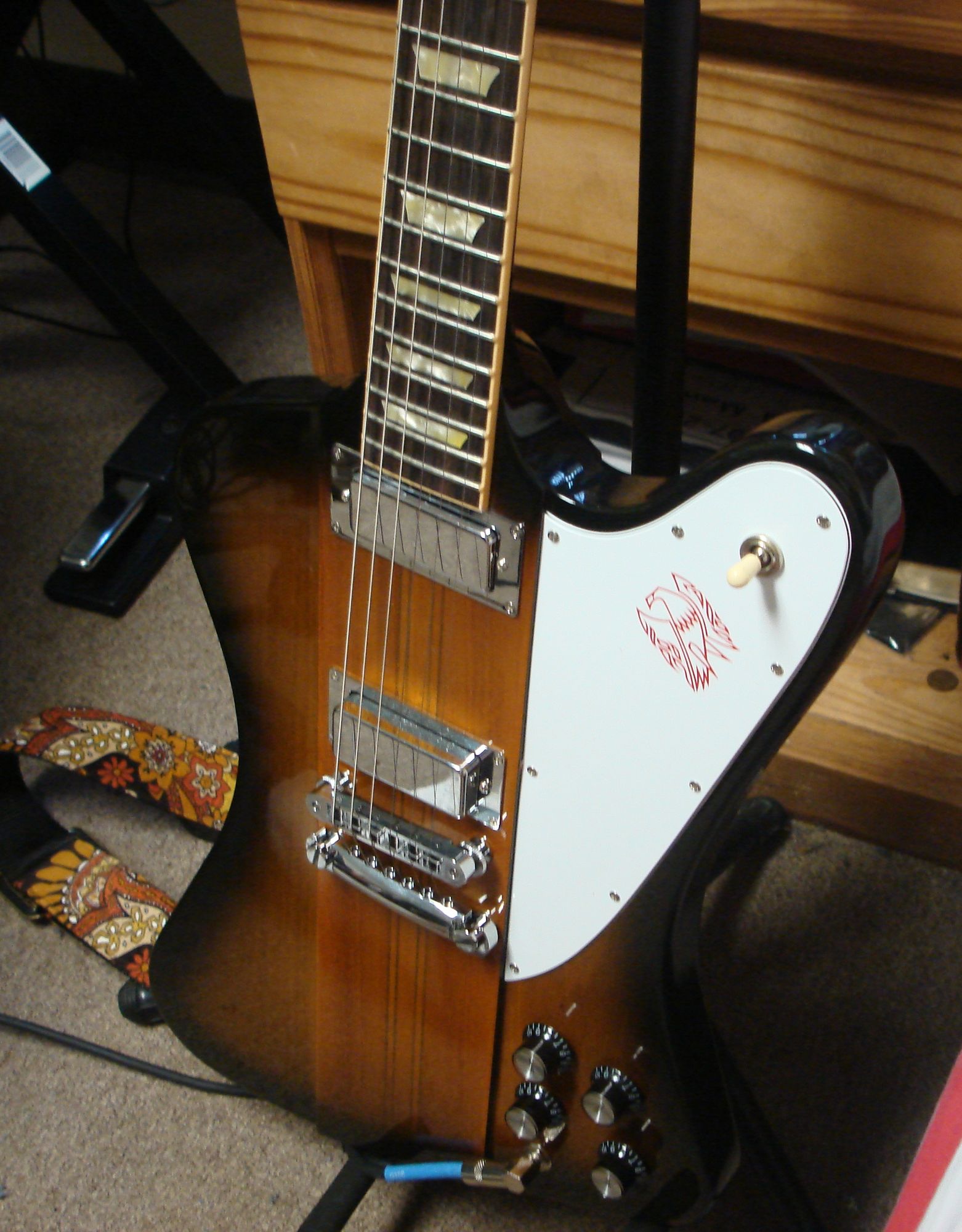
Gibson Firebird V. Photo by Jones629. Public domain (PD-self). Via Wikimedia Commons. Gibson
Firebird
1963
Gibson fixed the Firebird in 1965. Players have been hunting for the unfixed one ever since.
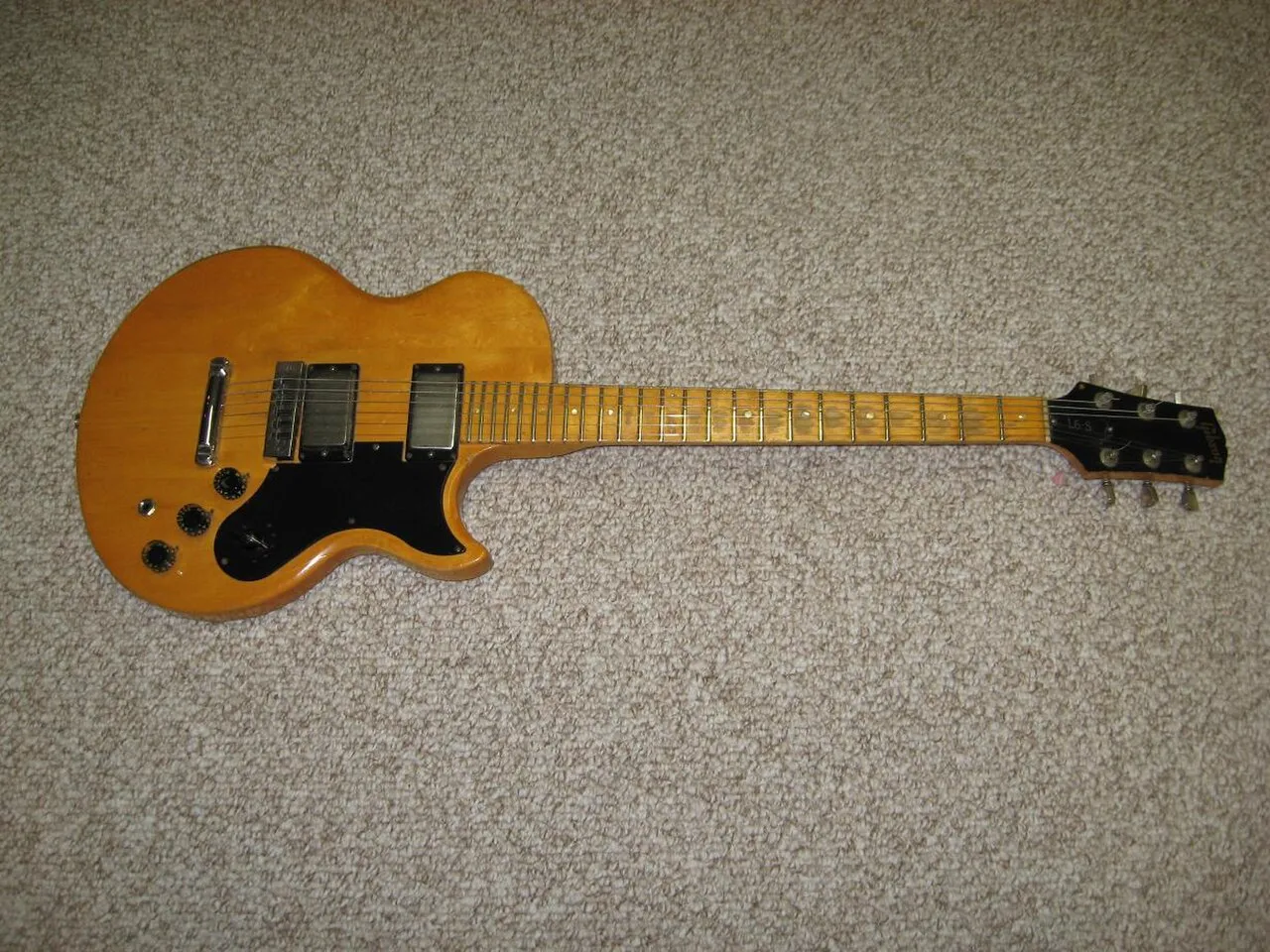
Photo: Glamafez / Wikimedia Commons / Public domain Gibson
L-6S
1973
Bill Lawrence drew a guitar with nine sounds. The budget cut it to six. Santana called it his rainbow.

2006 Gibson Les Paul Standard (SN 000660573). Photo by wetwebwork. Licensed under CC BY-SA 2.0. Via Wikimedia Commons. Gibson
Les Paul Standard
1952
Gibson made about 1,500 sunburst Les Pauls, decided nobody wanted them, and stopped. Then the British blues boom happened.