 Guitaripedia
Mosrite
Joe Maphis double-neck
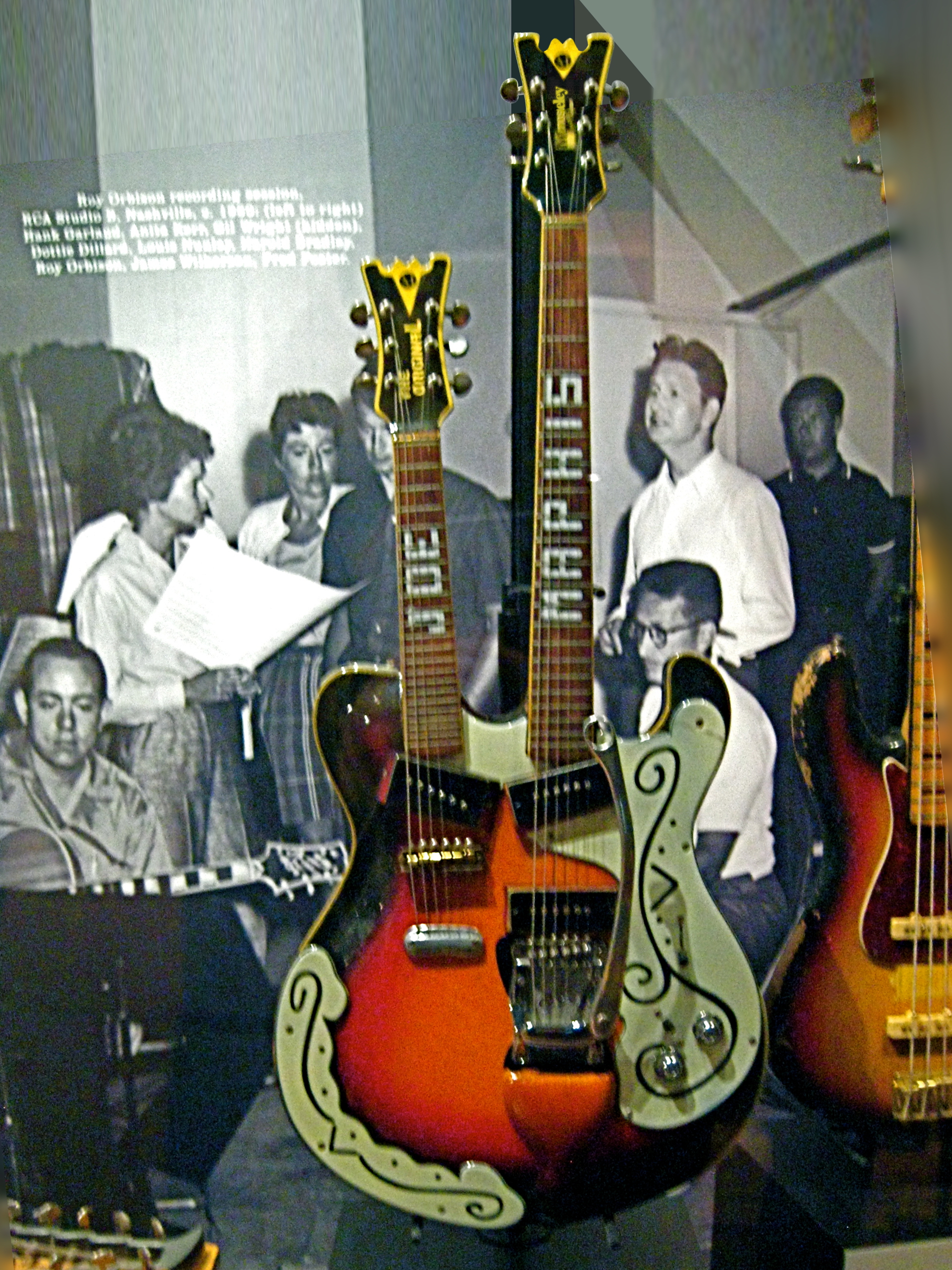
Build me a fancy doubleneck, Joe Maphis told a teenager, and it'll be my main guitar. It was.
A standard six on the bottom, a little six tuned an octave up on top, Joe's name inlaid down the necks, and a body somebody called gaudy. Semie Moseley built it for Joe Maphis in 1954 or 1955, before Mosrite had a shop. It's not the Ventures model, and not the six-and-twelve Mosrite sold in the '60s.
- Introduced
- 1954
- Type
- Solidbody electric
- Class
- Closed run
The short version
c.1954
Three necks in a garage
Semie Moseley builds a triple-neck at home and brings it to one of Joe Maphis's shows.
1954–55
Joe's doubleneck
Semie builds him the fancy doubleneck he asked for. Accounts split on the year.
c.1955–56
Collins gets one too
A year after Joe's, Semie builds Larry Collins his own.
1957
Fire on the Strings
Columbia puts out Joe's album, and the reviews remember the doubleneck.
1965
The catalog version
Mosrite sells a six-and-twelve double-neck under Joe's name for $689. A different guitar.
1972
To Nashville
Joe gives the original to the Country Music Hall of Fame, and Semie builds him a replacement.
1986
In memory of Joe
Joe dies on 27 June. A six-and-octave-six doubleneck carries Semie's pencil note dating it that year.
Side A
A1
Three necks and a promise
A garage in 1954. Semie Moseley is a teenager doing fancy inlay for Paul Bigsby in Downey, and building guitars at home on the side. He has made a triple-neck: a standard guitar on the longest neck, one an octave higher in the middle, and a short eight-string mandolin.
He takes it to one of Joe Maphis's shows.
Joe is already the fast picker on Town Hall Party in Los Angeles. He looks at the triple-neck and makes the kid a deal. Build me a fancy doubleneck, he says, and it'll be my main guitar.
A2
A tiny guitar that didn't exist
Semie had a funny reason for that octave neck. He'd heard Les Paul on the radio and assumed Paul was playing a tiny guitar. He wasn't. He was running a tape machine fast. Semie built the tiny guitar anyway.
So Joe's doubleneck is not a twelve-string. The bottom neck is an ordinary six. The top is six strings on a mandolin-length neck, tuned like a guitar, an octave up. You get guitar shapes under your fingers with a mandolin's sparkle coming out. For a picker as quick as Maphis, that was the point. Same licks, twice as bright.
The body is the big, ornate kind Mosrite people call "full gingerbread." Only a handful of Semie's 1950s customs got it; most were plain solidbodies. One writer calls the guitar "gaudy," and it is. Joe's name is inlaid down the necks, a habit Semie picked up from Bigsby, who'd done the same for Merle Travis.
A3
Every Saturday night
When exactly Joe got it depends on who you ask. One account has Semie presenting it later in 1954, and Joe playing it on television every Saturday night that year. Others say 1955. Semie was born in 1935 and built it at nineteen, which covers both.
Either way, it came before Mosrite had a real shop. The company either started in 1954 with the Reverend Ray Boatright, or took his money and the name Mosrite of California in 1956. The doubleneck is older than the business that made Semie famous.
Joe kept his promise. It was the guitar he played on Town Hall Party. A year later Semie built Larry Collins, Joe's protégé, a doubleneck of his own, and Tex Ritter would bring them out together:
"On the doubleneck guitars, here's the long and the short of it — Joe Maphis and Larry Collins."
Two players, two guitars. Collins still has his Mosrite twin-necks, three of them.
Flip the record · By the numbers
19
Semie Moseley's age when he built Joe's doubleneck
2
Doublenecks made specially for Joe, the Nashville original and its 1972 replacement
1 octave
How far above the bottom neck the short top neck is tuned
$689
The 1965 list price of the later six-and-twelve, case $60 extra
Side B
B1
Fire on the strings
In 1957 Columbia put out Fire on the Strings. People reviewing it decades later still picture Joe "with his trademark double-neck guitar, complete with his name inscribed on the fret board." Nobody has a studio sheet that names it on any one take, and there's banjo on that record too. But that's the guitar people mean when they say Joe Maphis.
He was on Ricky Nelson's early sides before James Burton, and "Dim Lights, Thick Smoke (And Loud, Loud Music)" is his song. The guitar on those isn't named.
Semie, meanwhile, kept updating the star guitars. Joe's original wears 1960s pickups and hardware now. The ones it left the shop with have never been published.
B2
The catalog guitar is somebody else
By the '60s Mosrite was a real factory, and Joe's name went on catalog guitars. In 1962 came the first Joe Maphis models, single-necks, and one of those shapes turned into the Ventures guitar. In 1965 there was a solidbody double-neck for $689, case $60 extra.
That one has a twelve on top. Jimi Hendrix bought a six-and-twelve at Manny's in New York, and Rory Gallagher owned one too. It's a fine guitar. It isn't Joe's. Joe's top neck is an octave six.
B3
Nashville and Bakersfield
In 1972 Joe gave the original to the Country Music Hall of Fame in Nashville. Semie built him a replacement: humbuckers, black pickguards, a push-button for rhythm to lead, supposedly about half the weight. That's the guitar on the 1970s Hee Haw clips, and it's at the Kern County Museum in Bakersfield now. Those are the only two made specially for him.
Joe died on 27 June 1986.
There's a doubleneck from Semie's shop with the old layout, a six and an octave six, the top neck 14¾ inches. Semie's pencil note says it was made in memory of Joe, 1986. The dealer who sold it reads the pots as early 1990, so the date has an argument attached, like everything else about this guitar.
Semie built Joe's first one at nineteen, before he had a company. After Joe was gone, he built the octave neck one more time.
Put this on
You’ve read about it. Now hear it. Here’s what this guitar sounds like, and what to listen for.
Fire on the Strings
The reviews of this Columbia album hear him "with his trademark double-neck guitar." No session sheet pins it to a single track, and some of the record is banjo, so listen for the high, mandolin-quick lines of the short neck.
Find it on YouTube (opens in a new tab)
The cast
The people, and the specific guitars, that made the legend.
1954
Joe Maphis
The 1954–55 octave-neck doubleneck
The "King of the Strings." Played it every Saturday night on Town Hall Party, then gave it to the Country Music Hall of Fame in 1972.
1954
Semie Moseley
Builder
Doing inlay at Paul Bigsby's, building guitars at home, and nineteen when he made Joe's doubleneck.
c.1955–56
Larry Collins
His own Mosrite doubleneck
Joe's protégé, the other half of "the long and the short of it." His guitar, not Joe's.
Tex Ritter
Host
Introduced the pair on Town Hall Party with the line people still quote.
Liner notes
Specs, construction, rarity, value, and every source we used.
Standard six on the bottom, an octave six on top — the doubleneck Joe Maphis told Semie Moseley would be his main guitar.
- Body
- Large custom, the ornate “full gingerbread” body (Deke Dickerson, Vintage Guitar). Wood, width, and depth unpublished.
- Neck
- Two. Bottom: standard six-string. Top: six-string “octave neck,” mandolin scale, tuned like a guitar (Dickerson).
- Fingerboard
- Joe’s name inlaid on the necks of the Hall of Fame guitar (Cumberland Times-News, 6 April 2016). Wood unpublished.
- Scale
- No inch figure for either neck. Dickerson calls the top neck mandolin scale.
- Pickups
- The Hall of Fame guitar now carries 1960s pickups (Dickerson, 15 December 2008). The originals are unpublished.
- Hardware
- Same account: 1960s hardware now. The tailpiece it left with is unpublished.
- Electronics
- Unpublished
- Finish
- Robert Price, The Bakersfield Californian: “gaudy.” Chemistry unpublished.
- Nut
- Unpublished
Open the full research fileConstruction details, the complete player record, production numbers, dated value estimates, and sources
Specs are for Joe Maphis’s original doubleneck, the Country Music Hall of Fame guitar; no current model carries the name, and the 1960s six-and-twelve is a different instrument.
Construction
The job was a main guitar he could play on television. Joe Maphis was already the fast picker on Town Hall Party in Los Angeles. Semie Moseley was doing fancy inlay for Paul Bigsby in Downey, and building guitars at home while he was still at Rickenbacker. Guitar.com and Wikipedia: Rickenbacker fired him when he said he was making his own. The German carve on the later Mosrites that have it is the chamfer he learned from Roger Rossmeisl there. That carve is not a Bigsby vibrato, and no source describes a Bigsby vibrato on this 1950s guitar.
Robert Price, in The Bakersfield Californian: in 1954 Semie built a triple-neck in his garage. Longest neck a standard guitar, middle neck an octave higher, shortest an eight-string mandolin. Later that year he presented a double-neck to Maphis. Price calls what Joe played “a gaudy, 1954-vintage custom-built double-neck.” Deke Dickerson, Vintage Guitar: Moseley brought the triple-neck to one of Joe’s shows, and Maphis said if Semie built him a fancy doubleneck, it would be his main guitar. By 1954 he was playing it on television every Saturday night. A photo caption in that same article dates the first triple-neck circa 1955. Premier Guitar, 17 December 2009, dates the doubleneck to 1955: one standard neck, and a shorter neck for mandolin-like passages. Worthpoint’s listing of a Mosrite ad it dates to 1968 quotes the caption. The guitar Joe is holding is the original, built 13 years earlier. The 1954 date is Price, and Dickerson’s television sentence. The 1955 date is Premier, and the ad.
The company year is a separate split. Dickerson: Mosrite formed in 1954 with the Reverend Ray Boatright. Price, Guitar.com (Justin Beckner, 27 June 2023), and Wikipedia put Boatright’s investment, and the name Mosrite of California, in 1956. Bonhams’s 2024 footnote also says founded in 1954, and that Semie built Joe’s doubleneck at 19. Semie was born in 1935 (Price; Wikipedia gives 13 June 1935), so nineteen runs from June 1954 into June 1955. The guitar is earlier than the Bakersfield shop either way. Price and Wikipedia put the move to Oildale in 1959.
What he built is not a twelve-string. Dickerson: a standard six on the bottom, and on top a six tuned an octave higher, which Moseley called an octave neck. Mandolin scale, tuned like a guitar. Moseley later said he had heard Les Paul on the radio and assumed a tiny guitar, not a tape machine run fast. The Cumberland Times-News, 6 April 2016, on the Hall of Fame guitar: Joe’s name is inlaid on the necks. Guitar.com: inlaying the player’s name is the habit Bigsby had used for Merle Travis.
Joe’s Gibson Super 400 is a different guitar. Dickerson: still at Bigsby’s bench, Semie definitely worked on that Super 400, and on a Gibson ES-125 for Larry Collins. Both men played Town Hall Party. The Super 400 is the hollow guitar he already had. This doubleneck is the one he said would be the main instrument. Grady Martin’s Bigsby, 1952, is a six under a five-string mandolin neck. Merle Travis’s Bigsby is a single neck.
Dickerson: only a handful of the 1950s customs were the large “full gingerbread” bodies, like Joe’s. Most were plain solidbodies, using pickups and hardware from the single-neck guitars. Wood, an inch figure for either scale, and the original pickups have not been published. On the Mosrite forum, 15 December 2008, Dickerson: Semie kept updating the star guitars, so Joe’s and Collins’s doublenecks now wear 1960s pickups and hardware. In 1972 Joe gave the original to the Country Music Hall of Fame. The Cumberland paper, from correspondence with a curator, had it off display in April 2016 and due back. The second doubleneck, built after the gift, is at the Kern County Museum in Bakersfield. Dickerson: 1972 Semie, humbuckers, black pickguards, truss-rod covers, a push-button for rhythm to lead, supposedly about half the weight, and the guitar on the 1970s Hee Haw clips, through a Barcus-Berry. Not the Nashville instrument.
The catalog guitar is later, and the top neck is a twelve. Wikipedia: in 1962, on Panama Lane, Semie produced the first Joe Maphis model guitars, and one of those shapes became the Ventures model. Joe later had a model like a Combo without the f-hole. That 1962 single-neck is not this doubleneck. The Ventures model of 1963 is not this doubleneck.
Willie G. Moseley, Vintage Guitar, on the 1968 catalog: the signature series is semi-hollow. Selected spruce top, no f-holes, walnut back, German carve, catalog depth 1 1/2 inches. Mark I six-string, Mark X short-scale bass, Mark XII twelve-string. Beside them, a solidbody double-neck, the Mark XVIII, a twelve and a six on one body. Natural and sunburst on the semi-hollows. Two-tone and solid colors on the Mark XVIII. The guitar Willie actually photographs, serial M0004, says Model II on the headstock. He notes there was no Model II in that catalog. One potentiometer reads February 1966. The owners said it came from Joe in Hawaii, and they had no papers. An experimental six-string. Not the doubleneck, and not the Hall of Fame guitar.
A 1965 Mosrite promotion, quoted by Gear Music and by guitar-list, calls the new double-neck a solidbody, six and twelve, two slender speed necks: $689, case $60, metallic pearl white or metallic blue $30 more. Blue Book agrees on the $30 and dates the Mark XVIII to 1965–69. Twelve over six, Moseley vibrato and three-on-a-side tuners on the six, adjustable bridge and six-on-a-side on the twelve, depth 1.25 inches, natural or transparent sunburst, bass neck optional. Blue Book’s series note calls Joe Maphis models semi-hollow, a carved walnut back glued to a spruce top. Willie and the 1965 copy call the doubleneck a solidbody.
Depth and scale disagree once a guitar is measured. Blue Book’s 1.25 inches is the Mark XVIII figure. Fretted Americana’s 1965, serial 2J359, is just over 1 3/4 inches deep, both necks 24 3/4 inches, six-string nut just under 1 5/8 inches, twelve-string nut 1 11/16 inches, 11.90 pounds, German carve, three-piece maple, zero fret and 22 speed frets. Semie modified it in 1975 for Lou Martin. One measured guitar, not a factory sheet. The dealer reads its Centralab pots as July 1966. Los Angeles Modern Auctions’ 1967, serial 2J175, is bolt-on maple necks and a Moseley vibrato. Blue Book’s 24.5 inch scale is the semi-hollow Mark I. No millimetre figure is published for any of them.
Blue Book’s JM 65, 1966–67, is a mandolin neck and a six-string. Not the octave neck, and not the twelve.
Joe died 27 June 1986 (Wikipedia). Fretted Americana’s 1986 guitar, prototype number 001, is a six plus an octave six again. The dealer quotes Semie’s pencil: made in memory of Joe, 1986. Scales 24 1/2 inches and 14 3/4 inches. That 14 3/4 is the only published inch figure for an octave neck he built, and the guitar is not the 1954 one. The dealer reads the pots as early 1990. Blue Book lists a Model VII reissue of the Mark XVIII for 1990 and 1992–94, black, sunburst, or white. Guitar.com, 27 June 2023: the Mosrite site had been offline since 2020, and the Las Vegas shop was not listing new instruments. No current model carries the name.
Players
The Nashville guitar is Joe’s. Collins has his own. Hendrix used a later six-and-twelve. Gallagher owned one. The Kern County guitar is the one Joe used after 1972.
Joe Maphis. Otis Wilson Maphis, 12 May 1921, Suffolk, Virginia, to 27 June 1986 (Wikipedia). “King of the Strings.” Premier: studio and live, and the famous doubleneck is at the Country Music Hall of Fame. Dickerson: Town Hall Party, every Saturday night, by 1954. Vintage Guitar’s profile “Rose Lee Talks About Joe Maphis” gives Tex Ritter’s introduction: “On the doubleneck guitars, here’s the long and the short of it — Joe Maphis and Larry Collins.” Two players. Two guitars.
Fire on the Strings, Columbia CL 1005, 1957 (Discogs). AllMusic’s review of the album puts him there “with his trademark double-neck guitar, complete with his name inscribed on the fret board.” Ken Burke, Country Standard Time, on the 2001 compilation of that LP, remembers the doubleneck Mosrite and, in the same piece, banjo workouts on the record. The doubleneck is the guitar those reviews mean. The banjo tracks are not it. No studio sheet names it on one take of “Fire on the Strings” or “Flying Fingers.”
Wikipedia credits him on Ricky Nelson’s “Stood Up,” “Waitin’ in School,” and “Be-Bop Baby,” before James Burton. The guitar is not named. “Dim Lights, Thick Smoke (And Loud, Loud Music)” is his honky-tonk song (Wikipedia). The instrument on that one is not named either. The 1970s Hee Haw clips are the Kern County doubleneck (Dickerson).
Larry Collins. A year after Joe’s, Semie built Collins his own (Dickerson). Collins Kids, and Joe’s protégé. Premier: the rock and roll licks went onto the doubleneck Moseley was glad to build. Wikipedia, on Semie: Collins still owns his three Mosrite twin-necks. His, not the Nashville guitar.
Jimi Hendrix. A 1960s six-and-twelve. Ground Guitar, citing the Museum of Pop Culture: bought at Manny’s in New York, used on “Spanish Castle Magic,” Axis: Bold as Love (1967). Fretted Americana prints the serial as 2J158, white, since faded to cream, nearly the same as their 2J359. The Mosrite forum’s list now reads 2J158. An earlier note on that thread could not settle the last digit from the photographs. Not the octave-neck original.
Rory Gallagher. Bonhams: circa 1968, cream, six and twelve, four pickups, two volumes and tones, three switches, tremolo on the six, maple necks, Brazilian rosewood with small dots, Kluson Deluxe, 42 inches (107 cm) overall. Bought in London in the 1980s. Sold 17 October 2024 for £14,080 including premium. Daniel Gallagher told Guitar.com, 9 December 2019, that Rory liked Joe Maphis, that the guitar was a looks-cool piece, and that he had found no sign Rory played it. Bonhams calls it a limited-edition reissue of the early design. Dickerson’s necks say a twelve on top is not that design.
Also known to play: Leroy “Sugarfoot” Bonner of the Ohio Players, “his double-necked Joe Maphis model” (Wikipedia). No song is named. The production name, not the 1954 guitar.
Rarity
You cannot buy Joe’s guitar. The Country Music Hall of Fame has had the original since 1972. The replacement is at the Kern County Museum. The Cumberland Times-News called those the only two made specially for him. Collins’s three are other guitars. Dickerson’s handful of gingerbread bodies is as close as anyone has come to a count, and it is not a shop book. No total has been published.
The Mark XVIII was a catalog model from 1965 to 1969 (Blue Book), one item in a factory building everything else. Price’s “perhaps 50,000,” and about 1,000 guitars a month in 1968 with 107 employees, are the whole company. Wikipedia’s peak is around 600 a month. Guitar.com repeats the 1,000 and the 107. None of them counts doublenecks. No Mark XVIII total has been published. A bass neck, and the mandolin-neck JM 65, are other guitars. The Model VII reissue is 1990 and 1992–94. Guitar.com, on 27 June 2023, found the brand’s site offline since 2020. No current model carries the name.
Value
Informal estimate, 28 October 2026. Not an appraisal.
The Hall of Fame guitar has no comparable sale. Neither does the Kern County guitar. No price Semie charged Joe in the 1950s has been published in the sources below. The figures after this are the later six-and-twelve, unless a sentence says otherwise. Celebrity lots are not comps.
New street. None. No current model carries the name.
Used modern. Blue Book’s Model VII (1990, 1992–94) is the later factory doubleneck under this name. No 2024–26 sold prices for it turned up. Fretted Americana lists the 1986 octave-neck tribute as sold and prints no price.
Vintage / collectible. The 1965 promotion: $689, case $60, metallic pearl white or metallic blue $30 more. That is 1965 money, for the six-and-twelve.
Los Angeles Modern Auctions, 5 June 2026: 1967 Mark XVIII, ink blue, serial 2J175, twelve over six, bolt-on maple, Moseley vibrato, original case. Estimate $1,000–1,500. Result $3,072. The same sale’s 1962 Joe Maphis Model, a single-neck, brought $7,040. That is the shape Wikipedia ties to the Ventures model. Not a comp for the doubleneck.
Reverb’s price guide for a 1966 Mark XVIII sunburst: 12 October 2026, Very Good, $2,856. The same table lists 5 January 2021, Very Good, $3,800. One recent sale is not a median. Asks, not sold, on Reverb listings current with this estimate: Race Hill Music, a 1966–67 pearl-white Mark XVIII, $3,450, down from $5,000; a 1966 sunburst six-and-twelve at $9,384.89.
Rory Gallagher’s circa-1968, £14,080 including premium at Bonhams on 17 October 2024, is one collection guitar. Daniel Gallagher’s account is that it was not a working instrument. Not a comp for the Nashville guitar, and not a guide to an ordinary Mark XVIII.
See also
- mosrite-ventures — the 1963 German-carve model. The 1962 single-neck Joe Maphis shape points at that guitar, not at this doubleneck
- bigsby-merle-travis — the Downey shop where Semie did the inlay. Merle’s guitar, and Joe’s Bigsby-dressed Super 400, are other instruments
- gibson-eds-1275 — the six-and-twelve people picture with Jimmy Page. This original is an octave neck over a standard six, not that Gibson
Sources
- The Bakersfield Californian, Robert Price, “The Mosrite Guitar” (archived) — 1954 triple-neck; double-neck presented later that year; “gaudy, 1954-vintage”; company with Boatright in 1956; Oildale 1959; born 1935, died August 1992; “perhaps 50,000”; about 1,000 a month and 107 employees in 1968
- Vintage Guitar, Deke Dickerson, “Doublenecks, Triplenecks…” — Boatright in 1954; Bigsby inlay, Joe’s Super 400, Collins’s ES-125; triple-neck caption circa 1955; on television every Saturday by 1954; Collins a year later; octave neck, mandolin scale, Les Paul tape; a handful of full-gingerbread bodies
- Mosrite forum, Deke Dickerson, 15–16 December 2008 — 1960s pickups and hardware on Joe’s and Collins’s; original to the Country Music Hall of Fame in 1972; Kern County guitar is the 1972 replacement, the Hee Haw guitar
- Premier Guitar, “Those Daring Young Men…,” 17 December 2009 — built in 1955; shorter neck; King of the Strings; died 1986; Hall of Fame; Collins’s doubleneck
- Vintage Guitar, Willie G. Moseley, “Mosrite Joe Maphis” — 1968 catalog, semi-hollow, 1 1/2 inch depth, Mark I / X / XII; Mark XVIII solidbody; serial M0004, “Model II,” pot February 1966
- Vintage Guitar, Rose Lee on Joe Maphis — Tex Ritter, “the long and the short of it”
- Wikipedia, Mosrite — 1954 triple-neck; double-neck for Maphis; company by 1956; Oildale 1959; Panama Lane 1962 and the Ventures shape; Combo-like Joe Maphis model without the f-hole; around 600 a month in 1968; Sugarfoot Bonner
- Wikipedia, Semie Moseley — born 13 June 1935; Collins still owns three twin-necks
- Wikipedia, Joe Maphis — 12 May 1921–27 June 1986; Town Hall Party; “Dim Lights, Thick Smoke”; Ricky Nelson sides, guitar not named
- Guitar.com, Justin Beckner, 27 June 2023 — Bigsby and Rossmeisl; name inlay; company 1956; about 1,000 a month and 107 employees; site offline since 2020
- Cumberland Times-News, 6 April 2016, via NewspaperArchive — built in 1954; name inlaid on the necks; two made for him; 1970s guitar at the Kern County Museum; off display in April 2016
- Worthpoint, Mosrite ad listing dated 1968 — original, built 13 years earlier
- Blue Book, Joe Maphis series — Mark I 24.5 inches, 1.5 inch depth, 1965–69; Mark XVIII 1.25 inches, 1965–69; Model VII 1990, 1992–94; JM 65 mandolin/six, 1966–67
- Blue Book, Mark XVIII — optional bass neck; metallic finishes, $30 extra on the 1960s list
- Gear Music, quoting the 1965 promotion — solidbody six-and-twelve; $689; case $60; metallic $30
- guitar-list, the same 1965 promotion — $689, case $60, metallic $30
- Fretted Americana, 1965, serial 2J359 — 11.90 lb; 24 3/4 inches; nuts; depth just over 1 3/4 inches; Lou Martin, 1975; Hendrix as 2J158
- Fretted Americana, 1986 octave-neck tribute — pencil note, 1986; 24 1/2 and 14 3/4 inches; pots read as early 1990; sold, no price
- Ground Guitar, Hendrix’s Mosrite — Museum of Pop Culture: Manny’s; “Spanish Castle Magic”; 1967
- Mosrite forum, serial list — 2J158; an earlier note left the last digit uncertain
- Bonhams, lot 49, 17 October 2024 — circa 1968; 42 inches (107 cm); London, 1980s; £14,080 including premium; company 1954, Semie at 19
- Guitar.com, Josh Gardner, 9 December 2019 — Daniel Gallagher: no reference to Rory playing it
- Los Angeles Modern Auctions, 5 June 2026, lot 182 — 1967, 2J175, result $3,072; 1962 single-neck Joe Maphis, result $7,040
- Reverb price guide, 1966 Mark XVIII sunburst — 12 October 2026, Very Good, $2,856; 5 January 2021, Very Good, $3,800
- Reverb, Race Hill Music, pearl white — ask $3,450, from $5,000
- Reverb, 1966 sunburst 6/12 — ask $9,384.89
- AllMusic, *Fire on the Strings* — trademark double-neck, name on the fretboard
- Country Standard Time, Ken Burke — doubleneck Mosrite; banjo pieces on the same set
- Discogs, Columbia CL 1005 — released 1957
Keep digging
Guitars this one gets compared to, confused with, or descended from.
- Send a picture
Mosrite
Ventures
1963
Semie Moseley offered Nokie Edwards the guitar free. He paid $200, and the Ventures dropped their Jazzmasters.
- Send a picture
Bigsby
Merle Travis
1948
Merle Travis asked a friend for one guitar that would ring like a steel. He got exactly one.
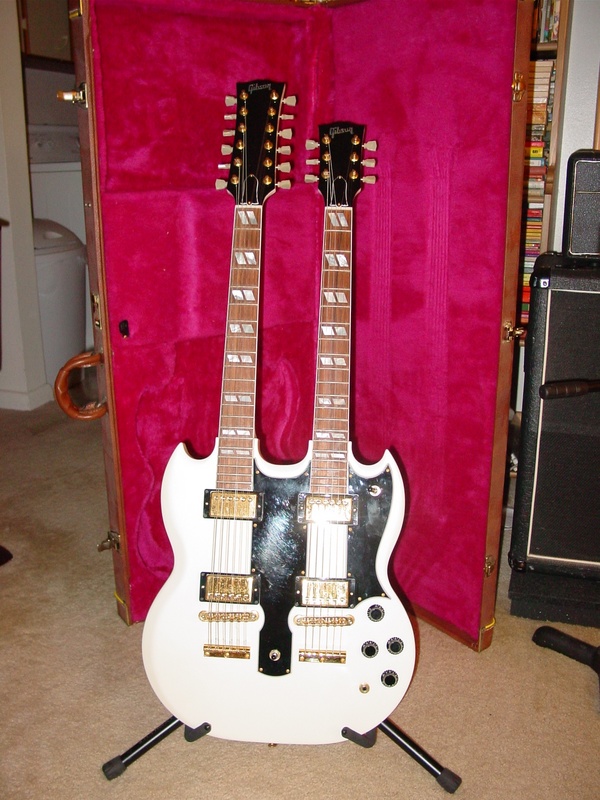
Gibson EDS-1275. Photo by T. Wesley. Public domain. Via Wikimedia Commons. Gibson
EDS-1275
1958
Jimmy Page had no way to play “Stairway to Heaven” live. So he ordered a guitar Gibson had stopped selling.