Resonet
Futurama
Britain couldn't buy a Stratocaster, so George Harrison and Jimmy Page started on this.
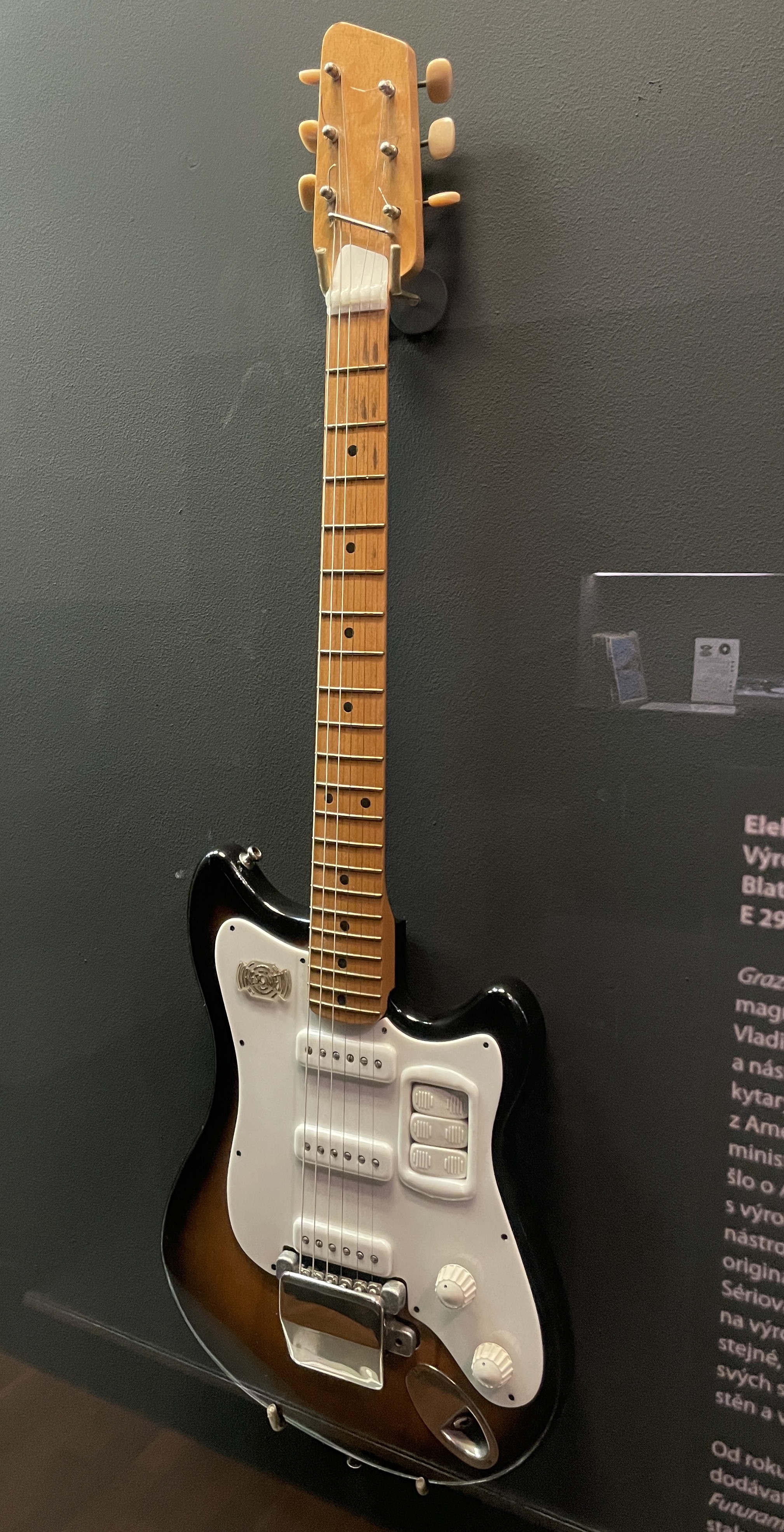
Three pickups, three rocker switches, and a spring under every string. Resonet built it in Blatná, Czechoslovakia, and called it the Grazioso. Selmer London imported it and sold it as the Futurama. It's not a Höfner, and it's nothing to do with Henri Selmer's jazz guitars from France.
- Introduced
- 1955
- Type
- Solidbody electric
- Class
- Production
The short version
1947
A pickup patent
Resonet is founded around a pickup patent. The state takes the company over two years later.
1955
The Strat on the bench
Development of a solid starts after a Stratocaster is brought in and studied. Production begins late in the year.
1957–59
Futurama
Selmer London starts importing the Grazioso and gives it a name a British shop can sell.
1959
Hessy's, Liverpool
On 20 November George Harrison signs for a "Futurama Gtr & Case," with his mother as guarantor.
1959
Blatná stops
In one account, a management change ends Grazioso production, and Selmer's book moves to the Futurama III from another Czech factory.
1961
Hamburg, 22 June
The Beatles record with Bert Kaempfert, including "Cry for a Shadow."
1961
The Gretsch
Back from Hamburg in July, Harrison gets a Duo Jet, and the Futurama is effectively retired.
1962
Brand closed
The Resonet name itself is shut down. The Futurama badge goes to Hagstrom guitars from Sweden in 1963.
Side A
A1
Everything fell off the wall
Hessy's, Liverpool, 20 November 1959. George Harrison already has an electric, a Höfner Club 40. What he wants is a Fender Stratocaster, and in Britain in 1959 he can't have one.
What's on the wall instead is a sunburst solid with three pickups and a white pickguard covering most of the top. Paul McCartney has come along. Harrison told the story in Anthology:
"Paul plugged it into the amp but he couldn't get any sound out of it, so he turned the sound right up. The guitar had three rocker switches, and I just hit one and there was an almighty 'boom' through the amplifier, and all the other guitars fell off the wall."
He signed the hire-purchase papers that day. The receipt says "Futurama Gtr & Case," with his mother as guarantor. The guitar itself dates from around 1958. One magazine later put the purchase in 1958, but the receipt says November 1959.
A2
The Strat in the workshop
The guitar came from Blatná, in Czechoslovakia, and the name on the pickguard was Resonet.
Resonet had a rough decade before that. It was founded in 1947 around a pickup patent, bought in 1948, and taken over by the state in 1949; the owner went to prison, and the firm was wound up in 1952. In 1953 a guitarist called Josef Růžička, who was running a state furniture works, picked up the brand. The cooperative in Blatná got going in 1954, and its first electric was a lap steel.
Then, in 1955, somebody brought in a Stratocaster, and they studied it. The solid they built has the same outline idea: a contoured double-cut, three single-coils, a tremolo. Production started late that year. At home it was called the Grazioso.
It isn't a copy, though. The engineer Vladimír Vlček gave each pickup its own rocker switch, so you got seven combinations where the Strat of those years gave you three. The tremolo had a saddle and a spring for every string. The jack sat on the top like a Strat's, but the head was three-a-side, and the body was beech or maple.
A3
A name for the counter
Selmer London already imported Höfners. Somewhere around 1957 to 1959, depending who you ask, it started bringing in the Czech solid too. Grazioso and Resonet weren't names that would sell in a British shop, so after a short spell the catalogue called it the Futurama. It was 55 guineas.
So the badge is Selmer's, and the guitar is Resonet's. Early ones still said Grazioso on the head, with Resonet on the guard. Harrison's has Resonet on the guard and nothing on the head. Both are the same guitar.
It went to Expo 58 in Brussels, where Resonet instruments took gold medals. Whether the Grazioso itself was one of the winners depends on which list you read.
It didn't last long in this form. In 1959, in one account that its own author says may not be totally reliable, Grazioso production stopped when the management changed, and the people behind it moved to another factory. Selmer's Futurama III came from there, with a darker board and the jack moved to the rim. Then in 1963 the Futurama name went onto Swedish Hagstroms. Same badge, different guitars.
Flip the record · By the numbers
55 gns
Selmer's price in Britain, about £57.75. Harrison paid it off in installments.
7
Pickup combinations from the three rocker switches. A Strat of the time had three.
324+
Beatles performances Harrison played it on, by one historian's count
3
Pickups, single-coils, each with its own switch
Side B
B1
Three hundred shows
Harrison played it at the Cavern, at the audition that got the band its 1960 Scotland tour backing Johnny Gentle, and through the Hamburg residencies, as the group went from Quarrymen to Silver Beetles to Beatles. One historian counts more than 324 performances.
On 22 June 1961, in Hamburg, the band recorded with Bert Kaempfert, Pete Best on drums. The Futurama is the tone on "Cry for a Shadow." Harrison said later they made it up on the spot while Lennon had "this new little Rickenbacker" with a wobble bar. That was Lennon's guitar.
A month later Harrison came home from Hamburg and bought a secondhand black Gretsch Duo Jet, and the Futurama was effectively retired. A 1964 magazine has him using it at the Cavern until the last Hamburg trip in 1962, so the retirement depends on who's telling it.
That 1964 magazine gave it away in a competition. Harrison's line: "I hope that whoever wins has as much fun with it as I did. It's a great guitar." The winner didn't play, took cash instead, and the editor kept the guitar.
B2
The reality of it
A teenage Jimmy Page had one too, at fourteen or fifteen, "1958, or probably 1959." His came after a Höfner his dad bought.
"That's the first one, the Grazioso," he told an interviewer in 2014. "It looked and felt like an electric guitar, even though it wasn't a Fender." He didn't trust the tremolo arm: "you'd think this arm would break." There's a photo of him on his knees with it, around 1960, playing with Neil Christian & the Crusaders. Then came a Strat, an orange Gretsch, and the Les Paul Custom.
When a documentary captioned a Strat as his first electric, Page wasn't having it. He didn't know whose Strat that was.
"The reality of it is, that Grazioso was the first electric guitar." He'd seen the pictures of Harrison with one in Liverpool. "That guitar was as good as you were going to get around that point of time."
Put this on
You’ve read about it. Now hear it. Here’s what this guitar sounds like, and what to listen for.
Cry for a Shadow
The Harrison–Lennon instrumental from the June 1961 Hamburg session, later on Anthology 1. The Futurama is the tone on the take. The new Rickenbacker Harrison remembered from that day was Lennon's, not this.
Find it on YouTube (opens in a new tab)Ain't She Sweet
From the same Hamburg session. The 1964 magazine competition that gave this guitar away named it as one of its recordings.
Find it on YouTube (opens in a new tab)
The cast
The people, and the specific guitars, that made the legend.
1959
George Harrison
c.1958 Futurama, serial 1126
Bought at Hessy's on hire purchase when he wanted a Strat and couldn't have one. His main Beatles guitar until the Gretsch in 1961.
1959
Paul McCartney
The same Futurama, on the shop wall
Went with Harrison to buy it and plugged it in first, with the volume all the way up.
1958–59
Jimmy Page
A Grazioso with "Grazioso" still on the head
His first electric, at fourteen or fifteen, after a Höfner his dad bought.
Brian Coan
A c.1958 Grazioso
Remembers buying his at Cranes in Liverpool, after Harrison had moved on to a Gretsch.
Liner notes
Specs, construction, rarity, value, and every source we used.
Three rocker switches, a spring on every string, and the solid a British kid could buy while a Stratocaster was still an import problem — Resonet’s Grazioso, under Selmer’s Futurama name.
- Body
- Solid double-cut, contoured. Russell: beech or maple. On Harrison’s 1126, Bonhams and the Beatles Story: contoured two-piece maple, two-tone sunburst. One Reverb consignment guesses birch or maple.
- Neck
- One-piece maple with a rosewood skunk stripe on 1126 (Bonhams; Beatles Story). That same consignment calls its neck bolt-on, maple or birch, a chunky D, .901" at the 1st and 1.02" at the 12th. Russell does not print the joint.
- Fingerboard
- Early UK guitars: natural maple, or sometimes beech. Black dots on 1126. Russell: some later Blatná boards are rosewood. No fret count on the Bonhams card or in Russell.
- Scale
- One measured late-1950s example, the Reverb consignment: 25 1/2". Not a factory figure. 1126 is 38½ in (97.8 cm) long. That is the guitar, not the scale.
- Pickups
- Three single-coils
- Hardware
- Six-saddle tremolo. Russell: each saddle adjusts, a rear spring works on each string, and this version is a two-post unit. Double-sided head, three-on-a-plate tuners. Jack on the top, the way a Strat wears one.
- Electronics
- Master volume, one tone, three rocker switches (Bonhams on 1126; Harrison, in Anthology). Russell: seven combinations.
- Finish
- Sunburst is the export. Czechoslovakia also had red and black. Russell: an original purple, spotted in Ostrava.
- Nut
- Plastic, 1.598" on that one measured guitar. Not a factory width.
Open the full research fileConstruction details, the complete player record, production numbers, dated value estimates, and sources
The spec above is a late-1950s Blatná Resonet Grazioso, the guitar Selmer London sold as the Futurama. Maple or beech board, top jack, three-a-side head, a white guard over most of the top. Resonet sells nothing today. A Jolana Grazioso II is a later Hořovice guitar. Futurama II, III, Duo, the Hagström De Luxe, and the Coronado are later names on other instruments. Not a Höfner. Not a Selmer Modèle Jazz (the Selmer Maccaferri), which is a different guitar. 1126’s length is 38½ in (97.8 cm). The measured consignment weighs 8 lb 11.5 oz. One guitar.
Construction
The job was a Strat you could get. Britain could not import the American one. Czechoslovakia built a solid that did the same three jobs: a contoured double-cut, three single-coils, and a tremolo with a saddle and a spring for every string.
The name is older than the guitar. Gregg Miner, reading Jiří Janků: Ferdinand Machálek founded Resonet in 1947 around a pickup patent. Ladislav Kořán bought it in 1948, with his brother-in-law Vladimír Vlček running the lab. A piano prototype was shown that year. A finished piano existed in 1949, and the state took the company. Kořán went to prison. The firm was liquidated in 1952. In 1953 Josef Růžička, a guitarist running a state furniture works, picked the brand up. Miner: the Dřevokov cooperative in Blatná was officially founded in 1954. The first electric off that line was the Akord lap steel, 1954. Not this guitar. The Arioso is a Hawaiian. The Arco is a bass. Russell’s Resonet Electric Bass is a solid upright. None of them is the Grazioso.
This guitar starts in 1955. Russell: Resonet had been producing the Grazioso since late 1955. Miner: development of the first solid began in 1955, after a Stratocaster was brought in and studied. Vlček’s rocker switch and a patented lever tremolo are the parts he names. The 1955 date is that production start, not a claim that the UK word Futurama existed yet, and not a claim that the Akord was this model. Russell gives late 1955 for production. Miner gives 1955 for the start of development, after the Strat they took apart.
What you get is the early one. A big white guard. Three single-coils, each with a piano switch, seven combinations where a Strat of those years had three. Top jack. Double-sided head, three-on-a-plate tuners. Body beech or maple (Russell). 1126 is the guitar Bonhams and the Beatles Story measured: two-piece maple, two-tone sunburst, one-piece maple neck, rosewood skunk stripe, black dots, six-saddle bridge, 38½ in (97.8 cm) long. The Reverb consignment is a different object: 25 1/2" scale, plastic nut 1.598", 8 lb 11.5 oz, and a seller’s bolt-on. Fret count was not on either card.
The names are the trap. At home it is the Grazioso. Resonet is the trade name on the guard. Selmer London already imported Höfner. Russell: in 1958/59 they started bringing this solid in, and after a short spell the catalogue name became Futurama, because Grazioso and Resonet were not words a British counter wanted. His gallery says the first Czech solids arrived from about 1957/58. Guitar-list, citing him, says around 1958, and Futurama by 1959. He prints pages from the 1959 Selmer catalogue. Sources differ: 1957/58 in his gallery, 1958/59 on his main page. The price he prints is 55 guineas. Julien’s converts that to £57.75, and about $160 then. Historical list, not 2026 street.
Early UK headstocks still said Grazioso, with Resonet on the upper bout of the guard. Harrison’s 1126 has Resonet on the guard and no name on the head (Russell; Bonhams). The Reverb News printing of Bacon’s Page interview: most guards still say Resonet, and some heads, Page’s included, still say Grazioso. A blank head and a Grazioso head are both this guitar. Futurama is Selmer’s catalogue word, not a second factory.
Expo is its own split. Miner: the Grazioso, the Arioso, and the Arco took gold medals at Expo 58 in Brussels. Wikipedia’s Jolana page awards the Arioso and the Arco in that sentence and does not put the Grazioso in the clause. A later Jolana shop line puts all three on the gold. The guitar was in the world by 1958. That is not the same sentence as “launched in 1958.”
Then the instrument left Blatná, and the name did not. Russell, and he flags the whole account as maybe not totally reliable: in 1959 the original Futurama was replaced in Selmer’s book by the Futurama III, built by ČSHN (Czechoslovak Musical Instruments) at Hradec Králové, because Grazioso production at Resonet/Dřevotvar stopped when the management changed. Růžička, production manager Josef Rika, and Vlček — Russell prints “Vlek” — moved. In Czechoslovakia the III began as a Neoton Star, then Jolana. Russell’s guess is Růžička’s daughter’s name. Wikipedia: Neoton opened in 1959, the first Jolana guitar in 1960. Dark stained-beech board, jack on the rim, tremolo no longer the two-post unit. The Futurama II is the two-pickup Jolana Star, 25 guineas against the III’s 45. Around late 1960 the III’s head went six-on-a-side. By 1962–63 the Star V had a pointed head and a smaller guard. In May 1963 Selmer put the Futurama name on Hagstrom guitars from Sweden, the De Luxe and then the Coronado. The old II hung on as the Futurama Duo until about 1965. Miner: the Resonet brand itself was shut in 1962, and production moved. This Blatná solid stopped in 1959, in Russell’s account; the brand stopped in 1962, in Miner’s. A Futurama III is not a Grazioso. A Hagstrom is not a Grazioso.
Not this guitar. The Höfner Club 40 Harrison already owned. A Fender Stratocaster. Selmer’s Modèle Jazz (the Selmer Maccaferri), which is Henri Selmer in Mantes, not Selmer London the importer. Spanish Wikipedia has Delicia building these under Höfner’s eye. Wrong factory, wrong decade.
Classic against current: the Blatná Grazioso — three singles, rockers, top jack, three-a-side, beech or maple — against nothing Resonet sells. Jolana’s later Grazioso II is alder, a head the maker dates to 1960, and not these pickups. Alexim, fetched 27 October 2026, lists a Jolana II Grazioso at 37,000 Kč, on request, with a Seymour Duncan HSS set. Music City’s ended pages print the scale as 648 mm on one Grazioso and 628 mm on a Grazioso II GT. Both are later Jolana guitars. Neither number is a 1958 Blatná scale.
Players
George Harrison — serial 1126, not his first electric. The first electric is the Höfner Club 40, serial 244. He still had it. This is the solid he bought when he wanted a Strat and could not have one.
Beatles Story, and the hire-purchase Babiuk showed Julien’s: 20 November 1959, Hessy’s, Liverpool, with Paul. The receipt says “Futurama Gtr & Case,” serial 1126, Mrs E. Harrison as guarantor. Julien’s dates the guitar c. 1958. That is the build, not the day he signed. Guitar Player’s October 2024 preview says he bought it in 1958. The receipt says November 1959.
Harrison, Anthology, as the Beatles Story prints it: “Paul came with me when I bought the Futurama. It was on the wall with all the other guitars, and Paul plugged it into the amp but he couldn’t get any sound out of it, so he turned the sound right up. The guitar had three rocker switches, and I just hit one and there was an almighty ‘boom’ through the amplifier, and all the other guitars fell off the wall.”
Babiuk, via Julien’s: played on over 324 Beatles performances, and the guitar he used on the first official Polydor recordings. One of the two guitars he used most with the band. Beatles Story: Cavern shows, the Larry Parnes audition at the Wyvern that led to the 1960 Scotland tour with Johnny Gentle, and the Hamburg residencies, through the name changes from the Quarrymen to the Silver Beetles to the Beatles. The June 1961 session is Friedrich-Ebert-Halle, Hamburg, 22 June, Bert Kaempfert, Pete Best still on the drum stool. Julien’s: the Futurama is the tone on “Cry for a Shadow,” later on Anthology 1. The Beat Instrumental competition copy, quoted by Julien’s, adds “Ain’t She Sweet.” Guitar Player’s preview also puts “My Bonnie” on this guitar, same sessions. Harrison, to Guitar Player in 1987: they made “Cry for a Shadow” up on the spot while Lennon had “this new little Rickenbacker” with a wobble bar. That sentence is the writing, and it is Lennon’s guitar. It does not move 1126 off the record Julien’s names, and it does not put a Ricky in Harrison’s hands for the take.
He put it down when the Gretsch arrived. Beatles Story: July 1961, back from the Top Ten residency, a black Duo Jet, and the Futurama effectively retired. Guitar Player (2024): a secondhand 1957 Duo Jet that month, and it became the main guitar. The October 1964 Beat Instrumental competition says this is the instrument he used at the Cavern “right up to the Beatles’ last visit to Hamburg in 1962.” Sources differ: July 1961 in the Beatles Story, 1962 in the magazine. His line in the magazine: “I hope that whoever wins has as much fun with it as I did. It’s a great guitar.”
The winner did not take it. Beatles Story: A.J. Thompson of Seaford, East Sussex, and he did not play. The Daily Beatle, reading Bonhams, prints Saltdean. Cash either way. Editor Sean O’Mahony kept the guitar. A relative consigned it to Bonhams. 12 June 2019, estimate £200,000–£300,000. Kleine Zeitung: high bid £190,000, reserve £200,000, unsold. Guitar Player: Phil Hylander of Seven Decades bought it off the block. Julien’s, Played, Worn & Torn II, 20 November 2024: estimate $600,000–$800,000, sold $1,270,000, buyer’s premium 27% plus an online fee on top. One object. Not a comparable sale. The Club 40’s $430,000 is the other guitar.
Jimmy Page — the Grazioso, and he will not let a Strat take the sentence. Tony Bacon, the 2014 interview printed in MusicRadar: first electric. The picture is him at 14 or 15, “1958, or probably 1959.” The Hofner before it, his dad bought. “That’s the first one, the Grazioso. It looked and felt like an electric guitar, even though it wasn’t a Fender.” He had recordings of himself on it, and he did not trust the arm: “you’d think this arm would break.” The Reverb News printing of that interview notes that Page’s head still said Grazioso. A later photograph Bacon dates probably 1960, Neil Christian & the Crusaders, Page on his knees with it. Then, in his own order, a Strat, an orange Chet Atkins Gretsch, and the Les Paul Custom. The sessions he describes are the Danelectro and that Custom.
It Might Get Loud captioned a Strat as “Jimmy Page’s first electric guitar.” Page, same interview: nothing to do with him, he doesn’t know whose Strat it is. “The reality of it is, that Grazioso was the first electric guitar.” And: pictures of Harrison with one in Liverpool. “That guitar was as good as you were going to get around that point of time.”
Not Syd Barrett’s Futurama, and not a proven Clapton. Ground Guitar files the Mottoes guitar as a Selmer Futurama III, about £25, early 1960s, no photograph, and says Roger Waters is the reason they call it a III rather than a II. The Futurama named on the Harmony Sovereign page is that later badge. It is not 1126, and it is not a Blatná Grazioso on the evidence Ground Guitar gives. Wikipedia’s Jolana page lists Eric Clapton among Grazioso users. No receipt, serial, or interview has turned up. Where’s Eric puts a double-cutaway Kay in his hands with the Roosters, and a Futurama III on the amplifier, not on the guitar.
Also known to play: no one else is confirmed. Russell’s page links a Clapton picture and a Marsden gallery. Brian Coan, on a c. 1958 Grazioso in that gallery, remembers buying his at Cranes in Liverpool after Marsden and Harrison had both moved on to Gretsch. A memory of a part-exchange. Not a Marsden serial.
Rarity
You cannot buy a new Grazioso from Blatná. For a few years it was the solid on the British counter. Russell’s line, hedged, is that the Futurama III / Grazioso was the solid most in use before Fender and Gibson actually showed up. Then the name moved to Hradec and to Sweden, and this version stopped.
Nobody published a Grazioso total. Serials on named guitars — 1126, gallery 1143 and 1206, a c. 1959 example at 492 — date a guitar. They do not count a year, and a lower number sitting next to a later date is a reason not to subtract them. Miner’s 1962 brand shutdown is not a census either.
What is actually thinner: a maple or beech board, the jack still on the top, the head still three-a-side, Resonet still on the guard, Grazioso still on the head if it left that way. A dark-board, rim-jack guitar is the III. A pointed head is later still. A red Hagstrom with a King’s Neck is a 1963 catalogue trick. Russell’s purple Ostrava guitar is one sighting. 1126 is one object. Page’s Grazioso is not the same object. A Grazioso photographed at the Czech Museum of Music in Prague in 2023 is another guitar. No card was read off that wall.
Value
Informal estimate, 27 October 2026. Not an appraisal.
Ask prices below are not sales unless marked sold. Celebrity lots are not comparable sales. A Futurama III, a Hagstrom De Luxe, a Jolana reissue, and a copy are different guitars. Period money: 55 guineas (Russell). Julien’s prints £57.75, and about $160 then. Just Collecting: 44 payments to clear 55 guineas on Harrison’s agreement. Guitar.com rounds the same purchase to £58. The II at 25 guineas and the III at 45 are the next guitars, not a price cut on this one.
New street. None under Resonet Grazioso or Selmer Futurama. Alexim’s 37,000 Kč, on request, fetched 27 October 2026, is a Jolana II Grazioso with Duncan HSS pickups. Different guitar. Not a comp.
Used modern. Replicas are other people’s solids. A 2023 copy on Reverb marked sold at $2,093.46 is a copy. Not a Blatná neck.
Vintage / collectible. Reverb’s Price Guide shows no separate band for the Blatná Grazioso. Few sold prices are public. Named listings are asks, not a series of 2026 sales. The Reverb consignment, late 1950s / early 1960s, page marked sold at $5,999, listed three years ago. A 1958 two-tone on Reverb, Guncotton, ended at an ask of $7,385.55, listed eleven years ago. A 1961 Futurama III page at £1,795, and a 1962 Jolana whose listing ended at $899, are the later Czech solid. Not comps.
1126 at $1,270,000 (20 November 2024) is the celebrity lot. The premium sits on top. The 2019 Bonhams bid of £190,000 never cleared the reserve. Not a hammer, and not a price for the next sunburst with a top jack.
See also
- hofner-club-40 — Harrison’s first electric, serial 244; he still had it when this solid arrived
- fender-stratocaster — the guitar the import rules kept out; this is the solid built after one was studied, and it is not one
- selmer-maccaferri — Henri Selmer’s oval-hole jazz guitar; Selmer London only distributed this Czech solid
Sources
- Steve Russell, The Futurama Guitar Story — not Höfner; Grazioso by Růžička at Drevokov, Blatná; producing since late 1955; Selmer import 1958/59; Futurama name; 55 guineas; beech or maple; maple or beech board; top jack; three-a-side; seven combinations; tremolo springs; Harrison’s guard and blank head; 1959 halt and the move to ČSHN; Futurama II at 25 guineas, III at 45; Hagström from May 1963; the account “maybe not totally reliable”
- Russell, Futurama visitors’ gallery — first Czech solids from about 1957/58; serials 1143, 1206, 492
- Gregg Miner, The Resonet Electric Harp Guitar (2026) — Janků / Muzikus 2010; Machálek 1947; Kořán 1948; liquidation 1952; Růžička and Dřevokov 1953–54; Akord 1954; Grazioso development from 1955 after a studied Strat; Vlček’s switch and tremolo; gold medals at Expo 58 for Grazioso, Arioso, and Arco; brand shut 1962
- Wikipedia, Jolana — Růžička from 1953; Vlček’s Akord, 1954; Arioso and Arco awarded at Expo 58; UK embargo lifted 1959; Neoton 1959; first Jolana guitar 1960; Clapton named on the Grazioso list
- Guitar-list, Grazioso — from 1955; Selmer around 1958; Futurama by 1959; cites Russell
- Bonhams catalogue extract, lot on 1126 (2019) — c. 1958; two-piece maple; Resonet on the guard; no Grazioso on the head; 20 November 1959 hire-purchase; July 1961 Duo Jet; Beat Instrumental “through… Hamburg in 1962”
- Beatles Story, The History of George’s Futurama (3 October 2024) — Hessy’s, November 1959; the Anthology boom quote; 324 shows (Babiuk); Wyvern / Johnny Gentle; Duo Jet July 1961; competition quote; A.J. Thompson of Seaford; specs including 38½ in (97.8 cm)
- Julien’s, lot text via bid.juliensauctions.com — c. 1958, serial 1126; Babiuk on 324 performances and the Polydor recordings; Mrs E. Harrison; 55 guineas / £57.75 / about $160 then; “Cry for a Shadow”; the Beat Instrumental “Ain’t She Sweet” line
- Julien’s item page — sold $1,270,000; estimate $600,000–$800,000; buyer’s premium 27% plus online fee
- Guitar World, Matt Owen, 21 November 2024 — $1.27 million; 16 bids; Bonhams 2019 reserve not met
- Guitar.com, 21 November 2024 — £58 on 20 November 1959; Bonhams 2019 consignment
- Goldmine, 22 November 2024 — $1.27 million is this Futurama
- Kleine Zeitung, 12 June 2019 — Bonhams estimate £200,000–£300,000; high bid £190,000; reserve £200,000
- Just Collecting, 22 November 2024 — 44 payments to clear 55 guineas
- The Daily Beatle, 24 April 2019 — A.J. Thompson of Saltdean; O’Mahony
- Guitar Player, 3 October 2024 — the 1958 purchase date that the receipt contradicts; June 1961 Polydor, including “Cry for a Shadow” and “My Bonnie”; 1957 Duo Jet in July; Hylander after the 2019 reserve
- MusicRadar, Tony Bacon, 9 January 2024 — Page: first electric, the Grazioso; 1958 or probably 1959; the Hofner his dad bought; the tremolo arm; It Might Get Loud’s Strat; Harrison in Liverpool; then a Strat, a Gretsch, the Custom
- Reverb News, Tony Bacon, Jimmy Page interview — same 2014 interview; editorial note that Page’s headstock still said Grazioso and most guards still said Resonet
- Russell gallery, Brian Coan’s c. 1958 Grazioso, serial 1143 — bought at Cranes, Liverpool, after Marsden and Harrison had moved to Gretsch; not a Marsden serial
- Spanish Wikipedia, Resonet Futurama — the Delicia-under-Höfner line: wrong factory, wrong decade
- Reverb, 2023 Grazioso replica — marked sold at $2,093.46; a copy, year filed as 2023
- Reverb, 1961 Futurama III — £1,795; the later Czech solid, not this guitar
- Reverb, 1962 Jolana Grazioso — ended ask $899; listed eight years ago
- Wikipedia, Cry for a Shadow — recorded 22 June 1961, Friedrich-Ebert-Halle; Harrison/Lennon; Pete Best
- Songfacts, Cry for a Shadow — Harrison, Guitar Player 1987: made up while Lennon had a new Rickenbacker
- Ground Guitar, Barrett’s Futurama III — III, not this Grazioso; about £25; no photo; Waters on III rather than II
- Where’s Eric, Clapton equipment — Roosters guitar a Kay; Futurama III is the amplifier in that line
- Reverb, Resonet Grazioso / Futurama consignment — one guitar: 25 1/2" scale, nut 1.598", 8 lb 11.5 oz, .901" / 1.02", bolt-on claimed; marked sold at $5,999; listed three years ago
- Reverb, 1958 Grazioso, Guncotton — ended ask $7,385.55; listed eleven years ago
- Alexim, Jolana Grazioso 2T Sunburst — fetched 27 October 2026: 37,000 Kč, on request; alder; Duncan HSS; head design dated 1960. Not the Blatná guitar
- Music City, Jolana Grazioso (ended) — ended page; scale printed 648 mm; 22 frets
- Music City, Jolana Grazioso II GT (ended) — ended page; scale printed 628 mm
- Wikimedia Commons, Resonet Grazioso at the Czech Museum of Music — Prague, photographed 25 March 2023; no spec card

Keep digging
Guitars this one gets compared to, confused with, or descended from.
- Send a picture
Höfner
Club 40
1955
John Lennon and George Harrison both saw a Club 40, and in John’s words, both “thought it was the end.”
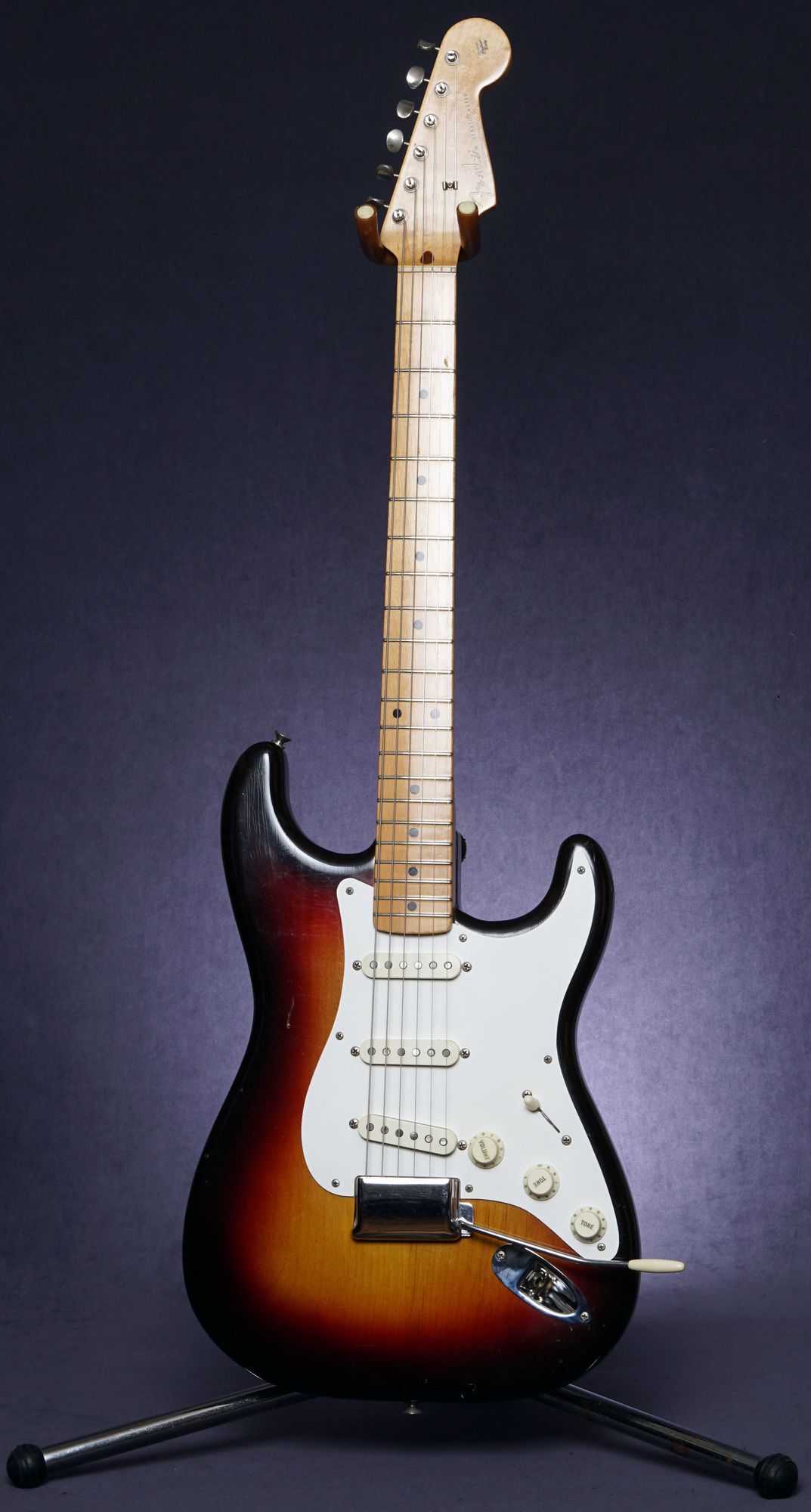
Photo: Lightburst / Wikimedia Commons / CC BY-SA 4.0 Fender
Stratocaster
1954
The guitar most people mean when they say “electric guitar.” Designed by a man who didn’t play one.
- Send a picture
Selmer
Modèle Jazz
1936
Built so a guitar could be heard over a dance band. In Django Reinhardt’s hands, it led one.