Supro
Dual Tone
Link Wray posed with one for Rumble. Bowie found two on eBay. James Murphy bought his because Bowie said so.
New York, early 2003. David Bowie is making an album, and he can have any guitar he wants. He goes on eBay and buys two cheap white Supros from the early 1960s. Link Wray, he’d point out later, had the same model.
- Introduced
- 1954
- Type
- Solidbody electric
- Class
- Production
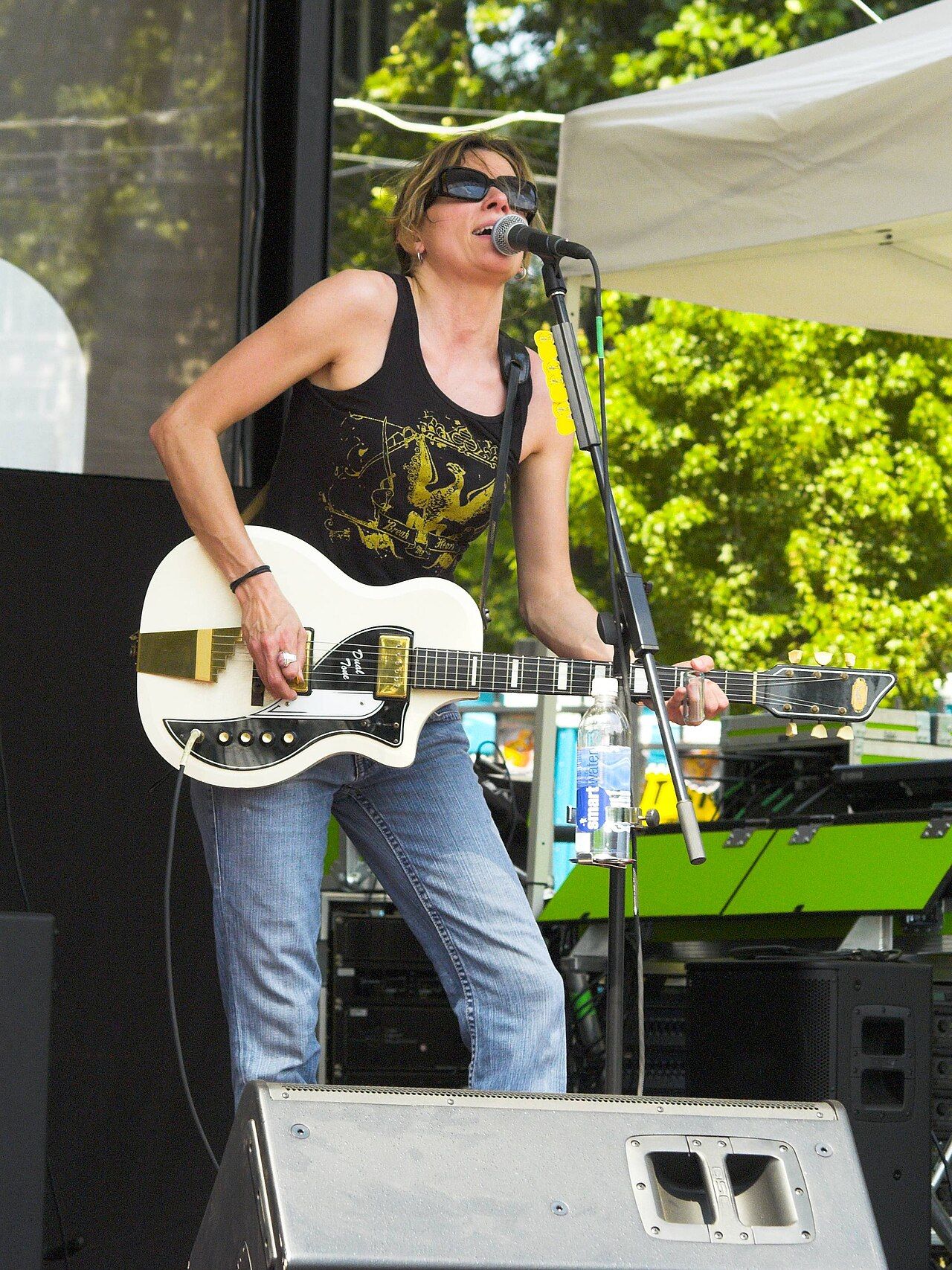
The short version
1954
The Duo-Tone
Supro launches a “super-powered electric Spanish guitar.” Within a year the name is Dual-Tone.
1956
$135
The Dual Tone’s price in that year’s catalogue. White plastic over wood, two big pickups.
1958
Rumble
Link Wray holds a Dual Tone in the promotional artwork. Zappa holds one in his high school yearbook.
1962
Fiberglass
The Dual Tone moves into a molded Res-O-Glas body. Some date the switch to 1963.
1966
Last call
The line is gone by the mid-’60s. Valco closes for good in 1968.
2003
Bowie’s eBay order
Two early-’60s Dual Tones, bought while he was making Reality. One becomes his main guitar on tour.
2017
Back, briefly
A revived Supro brings the Dual-Tone back. It has since been discontinued.
Side A
A1
The picture from 1958
In 2003 David Bowie could have walked into any guitar store in New York and pointed. Instead, while he was making Reality, he went on eBay and bought two white Supro Dual Tones from the early 1960s.
He later described the white Dual Tone as “the same cheap brand and model” Link Wray used on “Rumble.”
That’s Bowie’s version, and it’s half right in a useful way. The guitar Wray is holding in the promotional artwork for “Rumble” in 1958 is a Dual Tone. What he actually plugged in at the session, nobody has pinned down. But Bowie didn’t buy the session. He bought the picture. That’s how most of us buy guitars, if we’re honest.
A2
Two knobs for each pickup
Supro was the budget badge from Valco in Chicago. National sat above it, and the Montgomery Ward Airline came out of the same building. (Jack White’s red guitar is an Airline, not a Dual Tone. Same shop, different guitar.)
The Dual Tone showed up in 1954 as the Duo-Tone, a “super-powered electric Spanish guitar,” and got its better name within about a year. Some paperwork pushes the story back to 1953, and some forward to 1957. Depends which piece of paper you trust. By 1956 it was $135.
The name is the wiring. Two big single-coils sit under covers the size of humbuckers, so everyone assumes they’re humbuckers. They aren’t. Each pickup gets its own volume and its own tone, so you can set one fat and one bright and move between them. It’s a simple idea, and on a cheap guitar it felt like a lot of control.
The body is wood under a white plastic skin Valco called “No Mar.” The neck bolts on around an aluminum girder with no adjustable truss rod, and the strings cross a carved wooden bridge into a stepped, Art Deco tailpiece. It looks like a kitchen appliance from a very good kitchen.
“No Mar” may be the most honest product name in guitar history.
A3
Yearbooks and blues heroes
The Dual Tone was a guitar a kid could actually get hold of, and it turns up in some surprising hands.
Frank Zappa is holding a white one in his 1958 Antelope Valley High School yearbook. He never talked about owning it, so treat it as a guitar he was photographed with, not a guitar he made records on.
Rory Gallagher owned a 1957 Dual Tone, the version with the wider body and the slot switch. It wasn’t his workhorse. It was a nod to the American blues players he started out with.
Flip the record · By the numbers
$135
What a Dual Tone cost in the 1956 Supro catalogue.
$137.50
The 1963 list price for the new fiberglass Dual Tone. Seven years, two and a half dollars.
2
Early-’60s Dual Tones David Bowie bought on eBay in 2003.
1
Days it took Flip Scipio to fit Bowie’s tour guitar with a Bigsby and rainbow fret filler.
Side B
B1
Fiberglass, then nothing
Around 1962 Valco moved the Dual Tone into Res-O-Glas, two molded fiberglass halves around a wooden center block. The 1963 catalog announced an “All New Fiberglas Body” for $137.50. Seven years, and the price had gone up two and a half dollars.
It didn’t last. The Dual Tone’s final catalog year was 1965, and the line was gone by 1966. Valco changed hands in 1964, merged with Kay in 1967, and shut in 1968.
B2
Bowie’s rainbow guitar
Of Bowie’s two eBay buys, the 1961 hardtail ended up on the cover of the New Killer Star single. The second one went to a luthier, Flip Scipio, who fitted a Bigsby and a rainbow of filler on the top frets in a day. That guitar became the cover of A Reality Tour and Bowie’s main guitar on stage in 2003 and 2004.
The people around him noticed. Gerry Leonard said it was the only one Bowie wanted to play on that tour. Tony Visconti said it “was never meant to sound so good.” Earl Slick put it plainest:
I’ve never seen him get attached to a guitar, except that one.
B3
Pass it on
James Murphy of LCD Soundsystem went out and bought Dual Tones because Bowie told him to, and he used one on “Emotional Haircut.” Ry Cooder played one in the 1980s. A revived Supro brought the Dual-Tone back in 2017, and numbered Bowie tributes after that.
Link Wray held one in a photograph. Bowie knew whose guitar that was. Murphy took Bowie’s word for it. Nobody in this story bought a Dual Tone off a spec sheet. They bought the picture.
Put this on
You’ve read about it. Now hear it. Here’s what this guitar sounds like, and what to listen for.
A Reality Tour
The Dual Tone with the Bigsby and the rainbow frets was Bowie’s main guitar on this tour, and it’s on the cover.
Watch it on YouTube (opens in a new tab)Emotional Haircut
James Murphy bought Dual Tones on Bowie’s advice and used one here. A guitar passed down one recommendation at a time.
Find it on YouTube (opens in a new tab)
The cast
The people, and the specific guitars, that made the legend.
1958
Link Wray
The Dual Tone in the “Rumble” artwork
Photographed with one for the single. Whether it’s the guitar on the record is still an open question.
1958
Frank Zappa
A white Dual Tone
Pictured with it in his Antelope Valley High School yearbook. He never mentioned owning it.
1957
Rory Gallagher
1957 Dual Tone
A homage to the American blues players he started out with. Not his Strat, and not an Airline.
2003
David Bowie
Two early-’60s Dual Tones
A 1961 hardtail on the New Killer Star cover, and a customized one that carried A Reality Tour.
2017
James Murphy
Dual Tones, on Bowie’s advice
Used one on LCD Soundsystem’s “Emotional Haircut.”
Liner notes
Specs, construction, rarity, value, and every source we used.
Two fat single-coils, dual volume and tone, and a white Valco body — Dual Tone, not Jack White’s Airline Res-O-Glas.
- Body
- Single-cut; wood under plastic “No Mar” (Drowning in Guitars). Species unpublished (Guitar Gavel: poplar or alder, “mystery”). Christie's circa 1956: body 16 ¾". Later Res-O-Glas Dual Tones are two-piece fiberglass — not this table.
- Neck
- Kord-King bolt-on; aluminum girder, no adjustable truss rod (Zappa's Gear). Guitar Gavel: poplar, mahogany, or maple. Mix flagged.
- Fingerboard
- Rosewood, large white blocks (Zappa's Gear). Guitar Gavel also names ebony. Mix flagged.
- Scale
- 24 3/4" on the 1963 Res-O-Glas catalog Dual Tone (Drowning in Guitars). Premier Guitar on a 1964: “Gibson scale.” No millimetres invented for the 1950s guitar.
- Pickups
- Two large single-coils in humbucker-sized covers (gold-plated on many 1950s examples, Guitar Gavel)
- Hardware
- Carved compensated wooden bridge (Premier Guitar, Will Ray); graduated / Art Deco stairstep tailpiece; Kluson butterfly tuners
- Electronics
- Dual volume and dual tone. Early 2-way selector (Guitar Gavel). 1963 catalog: 3-way plus master volume. Mix flagged.
- Finish
- Arctic White / Ermine White typical. Plastic “No Mar” on wood; later Res-O-Glas is the color in the glass.
- Nut
- Unpublished this pass
Open the full research fileConstruction details, the complete player record, production numbers, dated value estimates, and sources
Classic living example = late-1950s Dual Tone (Chicago, Valco). No current typical Dual Tone SKU this pass: factory pages are amps and pedals; Sweetwater marks Americana Dual-Tone discontinued. Airline Res-O-Glas is Montgomery Ward, not this table. 2017 Americana Dual-Tone is a closed reissue. Bowie Limited Edition is a numbered tribute. Mixed inch/mm flagged where MusicRadar’s 2017 review prints millimetres against this inch table.
Construction
The job was a two-pickup Spanish electric that was not a Fender and not a Gibson, sold under Valco’s house budget brand. Chicago. Victor Smith, Al Frost, Louis Dopyera — V.A.L. plus Co. (Vintage Guitar, Michael Wright). Supro was the cheaper badge. National sat above it. Airline was Montgomery Ward’s catalog name. Same factory, different headstocks.
MusicRadar (Dave Burrluck): on its launch in 1954 this guitar was the Duo-Tone, “super-powered electric Spanish guitar.” By the next year it was Dual-Tone, wider, with the bass-pointed head. Guitar Gavel: Dual Tone 1954, originally Duo Tone. Christie's: launched 1954; white plastic-covered body; $135 in the 1956 catalogue — historical list, not 2026 street. David Bowie’s 2018 factory note puts a pickup boast in the 1953 catalog and Dual Tone in “early 1950s” books; by 1958 “totally dialled in.” Zappa’s Gear dates the 1524S Dual Tone to 1957. Drowning in Guitars: original line “around 1957.” Keep 1953, 1954, and 1957. This plate starts in 1954.
The name is the circuit. Two fat single-coils that look like humbuckers and are not. Volume and tone for each. Early examples: a 2-way selector (Guitar Gavel); a player can sometimes find both pickups in the switch’s dead spot, like an old Strat. Rory Gallagher’s estate, citing Mark Makin: the 1955 Dual-Tone had an asymmetrical head, butterfly tuners, a 12-inch-wide Arctic White “No Mar” body, and a rotary selector; 1957 went to a 13-inch body and a slot-style switch. Zappa’s Gear: bolt-on around an aluminum girder, no adjustable truss rod; split-level black-and-white guard; brass-plated hardware; strings over a carved rosewood bridge into a stairstep tail. Will Ray (Premier Guitar, March 2012): that carved wooden bridge is the original; a Tune-o-matic is a later fix. Guitar Gavel: body wood is a mystery. Do not invent alder.
Not an Airline Res-O-Glas. Jack White’s White Stripes guitar is a red 1964 Montgomery Ward Airline, Valco fiberglass, unofficially the J.B. Hutto model (Reverb News; Guitar Player, Dave Hunter). White, to Guitar Player, 2010: “You can do it with a piece of plastic.” Dual Tone is the Supro two-pickup Spanish that already existed in wood. It later got a Res-O-Glas body of its own. Same shop. Different badge, different silhouette. Do not hang White, Hutto, or Dan Auerbach’s Martinique here. Hendrix’s first guitar is an Ozark (Guitar Gavel). Off this slug.
Wright: Valco called the material Res-O-Glas, “Space Age Polyester Glass,” first on Supro, 1962. Bodies look solid. They are two molded halves. Necks stayed magnesium-reinforced wood Kord-Kings. MusicRadar: Res-O-Glas Dual Tone 1962, plain covers first, then silk-screened. Guitar Gavel: Res-O-Glas Dual Tone 1962; line gone 1966. Wright: Dual-Tone to Ermine White fiberglass by ’64. Drowning in Guitars: 1524G Dual Tone first in the 1963 catalog — “All New Fiberglas Body,” 24 3/4" Kord-King, 13 1/2" × 18" Arctic White, 3-way plus master volume, list $137.50; 1964 S424 $159.50; 1965 $149.50, last year. Keep 1962, 1963, and 1964. Premier Guitar (Wizard of Odd): a 1964 Dual Tone is fiberglass; except for a wood center block, Res-O-Glas is mostly hollow.
Wright: Valco sold to accountant Robert Engelhardt in 1964. Kay merger 1967. Valco/Kay closed 1968. MusicRadar: Dual Tone discontinued 1966. Keep both end years.
Absara revived the brand in 2014 (Wikipedia). Guitars returned 2017: Island solidbodies and Americana semi-hollows modeled on Res-O-Glas (MusicRadar). Americana Dual-Tone: chambered mahogany back, molded Acousti-glass top, rubber gasket, two-bolt neck, truss rod, Vistatone coils, volume and tone per pickup plus master. MusicRadar: overall depth 48 mm. That millimetre sits against the inch table above. Mix flagged. Sweetwater: Americana Dual-Tone no longer available. Factory home this pass is amps and pedals. Eastwood Dual Tone is another company. Not this slug.
Classic vs current: 1954–mid-1960s Valco Dual Tone — wood then Res-O-Glas, two fat single-coils, dual volume and tone — against no new Dual Tone you can order from Supro in 2026.
Players
Do not recruit Airline Res-O-Glas players as if they were this guitar. Jack White, J.B. Hutto, and Dan Auerbach’s Martinique stay off the Dual Tone table.
Link Wray. The Dual Tone this plate can name on paper. David Bowie’s 2018 factory note: it is the guitar in the promotional artwork for “Rumble” (1958). Premier Guitar (Will Ray) captions Wray with a Dual Tone. Bowie later told Mark Adams the white Dual Tone was “the same cheap brand and model used by Link Ray [sic] on the tune ‘Rumble’.” That is Bowie’s claim. The studio guitar for the 1958 single is not pinned here as Dual Tone.
David Bowie. Two early-1960s Dual Tones bought on eBay while recording Reality in New York, early 2003 (davidbowie.com). One, a 1961 hardtail, on the New Killer Star single cover. A second, Bigsby and rainbow top-fret filler by Flip Scipio in a day. That customized guitar is the A Reality Tour cover and the live main (2003–04). Earl Slick: “I’ve never seen him get attached to a guitar, except that one.” Gerry Leonard: it was the only one Bowie wanted to play on that tour. Sound on Sound, October 2003, via the later factory note: Tony Visconti, after Scipio’s work, “was never meant to sound so good.”
Frank Zappa. Antelope Valley High School 1958 yearbook: white Dual Tone (Zappa’s Gear). The same source: he never mentioned owning it; treat as a photographed guitar, not a catalog of later records.
Rory Gallagher. Estate plate: 1957 Dual Tone, second iteration after 1954, per Makin. Homage to the American blues guitarists he started with. Not his Strat. Not an Airline.
Also known to play (last, short): James Murphy bought Dual Tones on Bowie’s advice and used one on LCD Soundsystem’s “Emotional Haircut” (Far Out, quoting Uncut). Ry Cooder in the 1980s (Zappa’s Gear). No album credits invented for Cooder here.
Rarity
Factory does not publish Dual Tone unit totals. None invented.
The Valco run is closed. Wood “No Mar” Dual Tones (1954–early 1960s) and Res-O-Glas Dual Tones (1962/63–65/66) are different formulas on this name. Early Duo-Tone / rotary-switch examples are thinner on the ground than a standard late-1950s white Dual Tone. 2017 Americana Dual-Tone and the numbered Bowie tributes are other factories on this silhouette. They are not 1950s Valco.
White’s Airline is why department-store Res-O-Glas got expensive. Dual Tone got pulled along because it is the other white Valco two-pickup people already knew. That is demand, not a census. Bowie’s Scipio guitar and Wray’s photographed Dual Tone are unique objects. They are not a vintage Dual Tone.
Value
Informal estimate, 1 September 2026. Not an appraisal.
Ask vs sold labeled. Celebrity lots are not-comps. No invented medians or factory counts. Reverb Price Guide widget on vintage Dual Tone did not print a clean USD band in the static fetch this pass.
New street. No living Dual Tone cart on suprousa.com this pass. Sweetwater Americana Dual-Tone: discontinued. Musician’s Friend Dual-Tone: unavailable. Premier Guitar, 8 January 2019: Bowie 1961 Dual Tone hardtail street $999 — 2019 list, not a 2026 cart. MusicRadar, 21 March 2017: Americana Dual-Tone review £829 — 2017, not a 2026 street.
Used modern. 2017 Americana and 2018–19 Bowie tributes exist. Named Reverb Price Guide this pass, Bowie 1224DBHT hardtail (2019 White), Canadian rail: C$653–C$1,012 based on 77 orders Good to Mint. That is a labeled estimate on the reissue, not a vintage Dual Tone.
Vintage / collectible. Historical lists, not 2026 hammers: 1956 catalogue $135 (Christie's); 1963 $137.50 / 1964 $159.50 / 1965 $149.50 (Drowning in Guitars). Will Ray, 2012: Dual Tones then $1,200–$1,800 — dated 2012. Named asks this pass, not sold: Emerald City Guitars 1964 Dual Tone $1,895.25 (from $1,995); Reverb similar-rail 1950s Dual Tone $1,300; 1960 Dual Tone $1,999. Bowie’s two eBay guitars are celebrity objects, not a street tape.
See also
- danelectro-59 — another cheap 1950s student construction; lipstick masonite, not Valco
- gretsch-duo-jet — 1950s chambered solidbody; not a Dual Tone
- mosrite-ventures — another early-1960s shape guitar; not a Dual Tone
Sources
- MusicRadar, Dave Burrluck, Dual-Tone review — 1954 Duo-Tone; Dual-Tone 1955; Res-O-Glas 1962; discontinued 1966; 2017 Americana; 48 mm depth; £829
- Vintage Guitar, Michael Wright, Supro FolkStar — Valco names; Res-O-Glas 1962; Dual-Tone to Ermine White by ’64; Engelhardt 1964; Kay 1967; closed 1968
- Guitar Gavel, Super Supro Dual Tone — Dual Tone 1954 / Duo Tone; 2-way; gold-plated coils; Res-O-Glas 1962; gone 1966; Ozark is Hendrix
- Drowning in Guitars, 1963 1524G Dual Tone — No Mar on wood Dual Tones; 1963 catalog copy; 24 3/4"; $137.50 / $159.50 / $149.50; ~1957 original line
- Premier Guitar, Will Ray, 1957 Dual Tone — carved wooden bridge; Wray Dual Tone caption; 2012 tape $1,200–$1,800
- Premier Guitar, Wizard of Odd, 1964 Dual Tone — 1964 Res-O-Glas Dual Tone; wood center block; Dual Tone as Valco’s popular model; Auerbach Martinique
- davidbowie.com, Dual Tone recreation — two eBay Dual Tones, 2003; 1961 hardtail; Scipio Bigsby; Slick / Leonard; 1953 catalog; Rumble artwork
- Premier Guitar, Bowie 1961 Dual Tone — Sound on Sound Oct 2003; Visconti; street $999 (2019)
- Guitar World, Bowie 1961 Dual Tone — $999; 12" radius; 24.75" set maple
- Reverb News, Jack White and Airline — 1964 Airline Res-O-Glas; J.B. Hutto; $99 in 1964
- Guitar Player, Dave Hunter, Jack White — 1964 Montgomery Ward Airline Res-O-Glas; 2010 “piece of plastic”
- Zappa's Gear, Dual-Tone — 1958 yearbook; 1524S 1957; aluminum girder; Cooder 1980s
- Rory Gallagher, Dual Tone — 1957 Dual Tone; Makin 1954 / 1955 / 1957
- Christie's, circa 1956 Dual Tone — launched 1954; $135 in 1956 catalogue; body 16 ¾"
- Sweetwater, Americana Dual-Tone — discontinued; Acousti-glass; Vistatone; Ralph Keller
- zZounds, Dual Tone — 24 3/4"; Acousti-glass; two-bolt; Vistatone
- Musician’s Friend, Dual-Tone — unavailable
- Supro USA — living cart this pass is amps and pedals
- Far Out, James Murphy — Dual Tone on Bowie’s advice; “Emotional Haircut”
- Wikipedia, Supro — brand 1935; Valco; disuse 1968; revived 2014
- Wikipedia, Valco — Smith / Frost / Dopyera; Supro, Airline, National; closed 1968
- Reverb, Emerald City 1964 Dual Tone — ask $1,895.25
- Reverb, Bowie 1224DBHT Price Guide — C$653–C$1,012, 77 orders
Keep digging
Guitars this one gets compared to, confused with, or descended from.
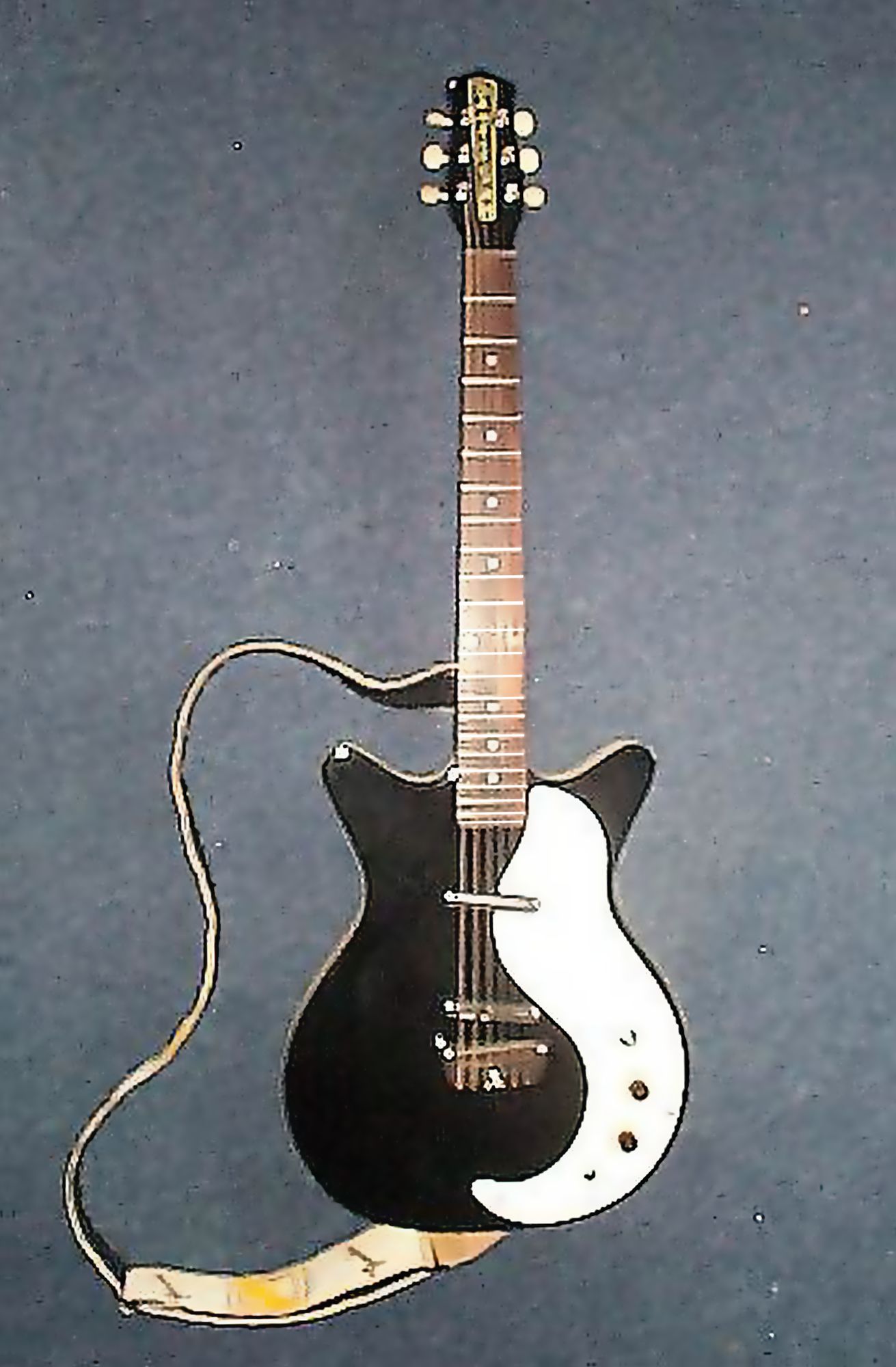
Danelectro 59-DC. Photo by Sander van Malssen. Licensed under CC BY-SA 2.0. Via Wikimedia Commons. Danelectro
59
1958
Jimmy Page’s has been shown at the Met. The same two lipsticks and coke-bottle head are hanging on a shop wall near you.
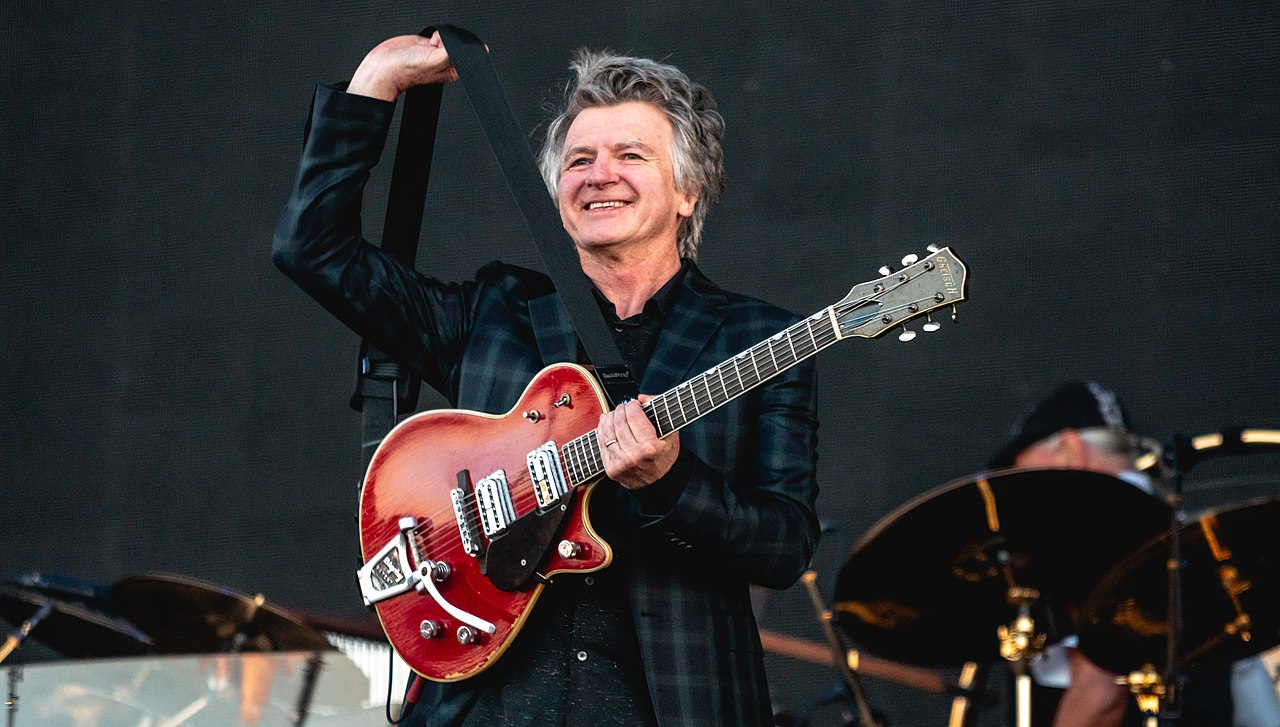
Photo: Raph_PH / Wikimedia Commons / CC BY 2.0 Gretsch
Duo Jet
1953
George Harrison bought his used in Liverpool as a teenager. In 1987 he put it on an album cover.
- Send a picture
Mosrite
Ventures
1963
Semie Moseley offered Nokie Edwards the guitar free. He paid $200, and the Ventures dropped their Jazzmasters.