Bigsby
Merle Travis
Merle Travis asked a friend for one guitar that would ring like a steel. He got exactly one.
A country picker wanted his electric to ring like a steel guitar. A patternmaker in Los Angeles who said he could make anything made him one, with six tuners down one side. It’s still one guitar, and it’s still in Nashville.
- Introduced
- 1948
- Type
- Solidbody electric
- Class
- Closed run
Have a photograph of this guitar? Send a picture
The short version
1899
The patternmaker
Paul Bigsby is born in Elgin, Illinois, on 12 December. Motorcycles come before guitars.
1946
The sketch
Late in the year, Travis draws a guitar on a radio program sheet over lunch. Another telling puts the drawing in 1948, on a menu.
1948
Finished
The company says it was built the year after the sketch. A photo dated late 1947 or early 1948 shows it, and one expert dates it 25 May 1948.
1948
The second one
In August, George Grohs gets the second guitar in trade for building the shop. His has the headstock scroll people remember.
1950
The granddaddy
Fender’s Broadcaster arrives. Fender’s own Don Randall writes that Travis is playing “the granddaddy” of it.
1951
The vibrato
The first Bigsby vibrato goes to Travis, on a different guitar. Some date it 1952.
1966
Sold
Bigsby sells the business to Ted McCarty, effective 1 January. He dies on 7 June 1968.
Side A
A1
Lunch, and a sheet of paper
Late in 1946, by the company’s telling, Merle Travis sat down to lunch with Paul Bigsby and drew a guitar on the back of a Pasadena radio program sheet. Six tuners in a row down one side of the head. Then he asked.
“Can you make this?”
“I can make anything.”
Another telling puts the drawing in 1948, and on a menu. Pick whichever lunch you like. Nobody disputes the answer.
They already knew each other from motorcycles. Bigsby was a patternmaker, born in Illinois in 1899, a racer who’d become a foreman at Albert Crocker’s motorcycle shop in Los Angeles. He wasn’t a guitar company. He was a man who could make anything, and Travis needed exactly one thing made.
A2
Why a steel rings and a hollowbody doesn’t
Travis had a problem he could hear. “I kept wondering why steel guitars would sustain the sound so long,” he said later, “when a hollowbody electric guitar like mine would fade out real quick.”
His answer was that the steel was solid. He wanted that, in a guitar you hold upright.
So Bigsby made the body out of figured maple, bird’s-eye or curly depending on who’s describing it, hollowed out and closed with Plexiglas on the back. Solid enough to ring, though one pair of experts says flatly that his were all semi-hollow. Keep that in mind before anyone calls it the first solidbody. It isn’t, and there were Spanish-necked Rickenbackers and Les Paul’s Log before it anyway.
He wound the single pickup himself, a blade at the bridge in a cast-aluminum housing. The strings go straight through the body. The walnut fiddle tail behind the bridge looks like it holds them. It doesn’t. It’s there because it looks good, and so are the heart, diamond, spade, and club inlays, because Travis asked for the whole deck.
I kept wondering why steel guitars would sustain the sound so long.
A3
The headstock it had first
The guitar in the old photographs isn’t quite the guitar you’d see now. A picture dated late 1947 or early 1948 shows it with no cutaway, two knobs, and no switch. The original headstock was longer, and its scroll turned the other way.
The second Bigsby guitar went to George Grohs, finished in August 1948, as payment for building Bigsby’s shop. Grohs designed his own headstock, the one with the scroll people remember. One historian thinks Travis had his changed soon after he saw it: the old head cut down, the scroll reversed. Later came a cutaway, three knobs, and a toggle beside the word “Merle” on the wooden pickguard.
When the first one was done is still argued. The company says the year after the sketch. One collector who knows Bigsbys well dates it 25 May 1948. This page says 1948, and keeps the earlier photo.
Flip the record · By the numbers
1
Pickup, a blade Bigsby wound himself, at the bridge.
1 a month
How fast a one-man shop turned out guitars. The wait ran two years or more.
6
Standard Bigsby guitars the company can still document. This is one of them.
Side B
B1
The granddaddy
Then Leo Fender, in Fullerton.
Travis said Leo borrowed the Bigsby for a week and came back with the prototype of what became the Telecaster. Fender said he never had it. That’s the whole quarrel, and it has never been settled.
But in 1950, Fender’s own Don Randall put it in writing: “He is playing the granddaddy of our Spanish guitar, built by Paul Bigsby—the one Leo copied.”
The Broadcaster came out that year. Fender’s first solid, by one account, still had three tuners a side; what it shared was the strings through the body. The 1954 Stratocaster headstock, six in a row, made Bigsby angrier still. There was a suit. It failed, because six-a-side heads go back to Stauffer and Martin. Still, George Gruhn, on the two pegheads, said “it would stretch the imagination to think this was a random coincidence.”
B2
One a month
Bigsby never built a factory. Billy Byrd, Butterball Paige, and Grady Martin ordered copies. Each is a different guitar. One man in Downey made his own pickups and turned out about one guitar a month, and you waited two years or more.
The vibrato is the Bigsby name most people know, and it isn’t on this guitar. The first one went to Travis in 1951, or 1952 depending who you ask, and it went on one of his Gibsons. By 1956 the vibrato was the business. There’s a story, and it is a story, that when somebody asked for another guitar like Merle’s, Bigsby said, “Hell no! Go to Fullerton and look up Leo Fender.”
You won’t find a record that says “this one.” Travis played it on recordings, radio, and stage, and nobody wrote down which sides. “Sixteen Tons” was cut in August 1946, before it existed, and on another guitar.
B3
Beside the Log
The company kept no log book. Fifteen years of looking turned up six standard Bigsby guitars still around. They don’t know how many there were. “We will never know exactly.”
Merle Travis’s is in the Country Music Hall of Fame in Nashville, next to Les Paul’s Log. You can’t buy it. Leo Fender’s factory made the guitar everybody got. This one was only ever Merle’s.
The cast
The people, and the specific guitars, that made the legend.
1948
Merle Travis
The Bigsby solidbody, the first one
Asked for it, played it on recordings, radio, and stage, and is the only player named on it. No single record is pinned to it.
1948
Paul Bigsby
Builder
A patternmaker and motorcycle man in Los Angeles. Built it by hand, pickup and all, and never tooled a production line.
1948
George Grohs
The second Bigsby, August 1948
Built Bigsby’s shop in trade for a guitar, and designed the headstock scroll that Travis’s later borrowed. A different instrument.
Leo Fender
Travis’s Bigsby, borrowed, by Travis’s account
Travis said Leo borrowed it for a week. Fender said he never had it. Keep both.
Liner notes
Specs, construction, rarity, value, and every source we used.
Six tuners on one side and a hollowed bird’s-eye body, built so Merle Travis could sustain like a steel — not a Travis Bean, and not the vibrato.
- Body
- Bird’s-eye maple, hollowed, Plexiglas back, metal bar across the back (Premier Guitar). Guitar.com: curly maple, chambered. Single cutaway is later. Premier: the body Fender copied was 1½" thick. No millimetres.
- Neck
- Six-in-line. Original headstock was longer and scrolled the other way (Premier Guitar; Vintage Guitar). Neck wood unpublished.
- Fingerboard
- Heart, diamond, spade, and club inlays (Premier Guitar). Wood, radius, and fret count unpublished.
- Scale
- Unpublished this pass
- Pickups
- One Bigsby blade, at the bridge; cast-aluminum housing
- Hardware
- String-through, six ferrules; decorative walnut fiddle tail and armrest; cast-aluminum nut and compensated bridge on two wheels; Kluson Deluxe six-in-line, ends machined so one screw holds two tuners. Not a Bigsby vibrato.
- Electronics
- Originally two knobs, no toggle (Vintage Guitar). Later three knobs and a toggle by the “Merle” inlay. Premier: a 3-way with capacitors on the one pickup. Mix flagged.
- Finish
- Natural maple. Figure contested: bird’s-eye (Premier) vs curly (Guitar.com).
- Nut
- Cast aluminum (Premier Guitar). Width unpublished.
Open the full research fileConstruction details, the complete player record, production numbers, dated value estimates, and sources
Classic living example = Merle Travis’s Bigsby, on display at the Country Music Hall of Fame in Nashville. Heritage Auctions, via Deke Dickerson, dates it 25 May 1948. Bigsby’s own history says the late-1946 sketch was built the following year. No current Merle Travis SKU this pass: bigsby.com sells vibratos (15 October 2026). The Grohs guitar, Butterball’s, Billy Byrd’s, and Grady Martin’s are other instruments. Travis Bean TB1000 is Clifford Travis Bean, 1974, an aluminum neck. Not this. No Gibson SKU. Scale, fret count, nut width, and neck wood unpublished. No millimetres invented. Do not average Premier’s 1½" with this catalog’s 1.75" early Telecaster.
Construction
The job was sustain. Travis, in Recollections of Merle Travis: 1944–1955, told Premier Guitar: “I kept wondering why steel guitars would sustain the sound so long, when a hollowbody electric guitar like mine would fade out real quick.” He decided the steel was solid. He wanted that in a guitar played upright.
Paul Adelburt Bigsby was a patternmaker, not a factory. Born 12 December 1899, Elgin, Illinois (Premier Guitar). Motorcycle racer, then foreman at Albert Crocker’s Los Angeles shop. He and Travis already knew each other from the bikes. Bigsby.com puts the start at lunch, late 1946: Travis sketched a guitar on a Pasadena radio program sheet. “Can you make this?” “I can make anything.” Christie’s 2007 note also says commissioned in 1946. Vintage Guitar (George Gruhn and Walter Carter) puts the ask in 1948, drawn on a menu. Keep the program sheet and the menu. Keep 1946 and 1948.
What year the wood was finished is the same argument. Bigsby.com: the drawing “was built the following year” — 1947 — and he played it on recordings, radio, and in public. Gruhn’s doubleneck piece says circa 1947. Willie G. Moseley (Vintage Guitar, December 1997): a photo R.C. Allen dates late 1947 or early 1948 already shows the guitar, no cutaway, two knobs, no toggle. Heritage Auctions, quoting Deke Dickerson, dates it 25 May 1948. Bigsby serials are month, day, year. The Fretboard Journal (25 May 2014) prints 52548 for that stamp. Wikipedia, Premier’s headstock chart, and Guitar.com’s caption say 1948. This plate starts in 1948. The company’s 1947 sentence and Allen’s late-1947 photo stay.
Premier (Michael Ross, 17 November 2011, from Andy Babiuk): bird’s-eye maple, hollowed, Plexiglas on the back, a metal bar across it. Guitar.com (Justin Beckner, 8 August 2022): curly maple, chambered, the back routed. Different words for the figure. Keep both. One blade he wound himself, aluminum cover as a shield, strings through six ferrules under a walnut fiddle tail that does not hold them. Heart, diamond, spade, club, because Travis asked for the deck. No cutaway yet.
The headstock people recognize is the second one. Premier: the original was longer and scrolled the other way; that wood was cut off and the scroll reversed. Moseley, from Allen: George Grohs built the shop in trade for the second guitar, done August 1948, and Grohs designed that peghead. Travis’s was the first guitar. Grohs’s was the first with the scroll that later sat on a Strat. Neither had a cutaway. Allen thinks Travis had his changed soon after he saw Grohs’s. The toggle ended up by the inlay of “Merle” on the wood scratchplate. Nashville shows the modified guitar.
It is not the first electric, and “first solidbody” stays qualified. Premier: fewer than a hundred Spanish-necked Rickenbackers in 1937, still close to a lap steel; a Slingerland solid that was a flipped lap steel; a Kauffman–Fender round-neck steel patented 1944. The A-22 is the 1932 lap steel, not those round-necks. Les Paul’s Log is early-1940s pine with Epiphone wings (Guitar.com). Bigsby’s own try for Les Paul, 1944, was lap-steel sized and hard to hold (Premier). Guitar.com’s octagon — aluminum top, three-a-side, neck-through, a “Les Paul” template — is that try or another one. Not this guitar. Gruhn and Carter: “to our knowledge he never built one; his were all semi-hollow.” Their measured example, a different Bigsby, is ¼" bird’s-eye on a brace grid. Keep both readings.
The vibrato is the other mash. These guitars left with the fiddle tail (Guitar.com). Premier, Wikipedia, and Babiuk in Guitar World (2021) put the first True Vibrato in 1951, and say it went to Travis. Travis, Guitar World, September 1980: he put that unit on his Gibson L-10. Dickerson, on a March 2026 Ask Zac video, dates the first vibrato 1952 and the first photo August 1952 on Travis’s Super 400. Keep 1951 and 1952. Keep the L-10 and the Super 400. Neither is this solidbody. Premier’s Hall of Fame photo still shows the fiddle tail.
Then Fender. Travis said Leo borrowed it for a week and brought back the Telecaster’s prototype. Premier: Fender said he never had it. Don Randall, 1950, via Babiuk: “He is playing the granddaddy of our Spanish guitar, built by Paul Bigsby—the one Leo copied.” Premier says that first Fender solid was still three-a-side, and took the cutaway, an inch-and-a-half body, and string-through. This catalog’s Telecaster has early examples typically 1.75". Do not average the two thicknesses. Broadcaster 1950, Telecaster name 1951. Six-in-line Klusons, ends cut down, came next. The 1954 Strat headstock angered him more. The suit failed: Premier notes six-on-a-side pegheads back to Stauffer and Martin. Gruhn: so close “it would stretch the imagination to think this was a random coincidence.”
He did not tool a line. Bigsby.com: Billy Byrd, Butterball Paige, and Grady Martin ordered copies. Premier spells him Tommy “Butterball” Page, and says Byrd’s was started for Jimmy Bryant, then sold on when Bryant signed with Fender. That one may be the first double-cut. Martin’s doubleneck is 1952 (Vintage Guitar). “Chattanoogie Shoe Shine Boy” is the doubleneck, not this guitar. Dickerson’s letter in the 2012 Heritage catalog: first Travis, second Grohs (later R.C. Allen), third Paige, fourth serial 51649, finished 16 May 1949. His order, not a shop ledger. Premier: Bigsby called the later ones Standards, and the third had two pickups. This table is one blade.
Grohs’s building sits on Phlox Street in Downey (Bigsby.com). No log. One man, his own pickups, “one guitar a month,” a wait of two years or more. By 1956 the vibrato was the work (Premier). Premier’s legend, when someone asked for another like Travis’s: “Hell no! Go to Fullerton and look up Leo Fender.” Sold to Ted McCarty effective 1 January 1966. Died 7 June 1968. Gretsch, 10 May 1999. Fender, 8 January 2019. The site now sells vibratos. A prototype page — two pickups, a Tune-o-matic, some with a B3 — is not this guitar.
Players
Do not hang “Sixteen Tons” here. Do not hang the re-necked Martin, the L-10, or a Super 400. Do not recruit Byrd, Paige, Bryant, or Martin. Do not recruit Clifford Travis Bean.
Merle Travis. The only player named on this instrument. Bigsby.com: recordings, radio, and public appearances, and no side is named. Moseley’s photo is Travis with Ginny Cushman, Allen’s date late 1947 or early 1948, guitar still uncut. Wikipedia: the single row of tuners “is thought to have inspired” the Broadcaster. That is a design sentence, not a track list.
The Merle Travis Guitar is a Capitol album, recorded 1955, released 1956. Wikipedia’s credit is “electric guitar.” It does not name this Bigsby.
The songs that belong on other guitars. “Sixteen Tons” was cut 8 August 1946 at Radio Recorders, out in July 1947 on Folk Songs of the Hills (Wikipedia). Before this instrument. Christie’s puts “Sixteen Tons” and “Dark as a Dungeon” on the Martin D-28 after the Bigsby neck, and puts this solidbody in the Hall of Fame. Premier: that neck is why Joe Maphis and Hank Thompson asked for the same re-neck. Christie’s adds Lefty Frizzell and Zeke Clements. Acoustics. The L-10 is where the 1980 account puts the vibrato. The Super 400 in the 2007 sale is a Gibson with a patent-pending tailpiece. Off this plate.
Also known to play: nobody else, on this serial. Copies are other guitars.
Rarity
You cannot buy this guitar. Country Music Hall of Fame, Nashville, beside Les Paul’s Log (Vintage Guitar). Not a market object. A shop copy is not it.
No log book, so no factory total (Bigsby.com). After fifteen years the company can document 47 steels, six standard guitars, one tenor, two doublenecks, two mandolins, and six necks still around. “We will never know exactly.” Those six standards are every Spanish electric they can point at, this one included. Not six Travis guitars. Dickerson’s first-four list is one expert. A serial dates a guitar. It doesn’t count a year.
Thinner than “a Bigsby”: the first shape, no cutaway and the scroll the other way, which survives as a photograph; one blade against the later two-pickup Standards. The Nashville guitar is one object. It is not a vintage Standard.
Value
Informal estimate, 15 October 2026. Not an appraisal.
Ask versus sold, labeled. The Hall of Fame guitar is not a comp. No price Bigsby charged Travis turned up in these sources. No invented median. The company’s survivor counts are not a price.
New street. None. bigsby.com this pass is vibratos. The prototype-guitar page does not offer a Merle Travis model. Fender has owned the brand since 8 January 2019 and did not put this guitar back on a cart.
Used modern. Shop-built copies exist. No clean 2026 sold band on them this pass. Don’t invent a midpoint from old ended listings.
Vintage / collectible. Premier Guitar, November 2011, on an original Bigsby guitar generally: $40,000–$80,000. That is a 2011 sentence, and it is not this instrument. Heritage Auctions, 21 April 2012, serial 51649, the 16 May 1949 guitar Dickerson calls the fourth standard: price realized $266,500 including buyer’s premium (Heritage press release, 2 May 2012). ArtDaily’s reprint of that sale prints the estimate as $25,000–$35,000. One later Bigsby. Not a comp for the Travis guitar. Heritage, 6 May 2025, serial 8149, a restored 1949 Standard (top and back re-skinned, non-original tremolo): Not Sold. No hammer. Mandolin Cafe, listing dated 15 September 2026: a 1949 Bigsby electric tenor, serial 10149, ask $190,000. A tenor. An ask. Not this guitar.
A 1949 Bigsby tenor was $350 when Eschol Cosby bought his (Vintage Guitar, Gruhn and Carter). Same article: Fender’s 1950 Esquire listed at $140, Gibson’s 1952 Les Paul at $210. Period lists for other guitars, not a 2026 price for the one in Nashville.
See also
- fender-telecaster — 1950 Broadcaster, the production solid Randall called this the granddaddy of. Not this guitar
- travis-bean-tb1000 — Clifford Travis Bean, 1974, aluminum through-neck. Not Paul Bigsby, and not Merle Travis
- rickenbacker-a-22 — 1932 aluminum lap steel, an earlier electric. Not this Spanish guitar
Sources
- Bigsby, Company History — late 1946 program-sheet sketch; “built the following year”; recordings, radio, public; Byrd, Paige, Martin ordered copies; Phlox Street, Downey; no log book; documented 47 steels, six standards, one tenor, two doublenecks, two mandolins, six necks; McCarty effective 1 January 1966; died 1968; Gretsch 10 May 1999; Fender 8 January 2019
- Bigsby, prototype guitars — later prototypes (two pickups, Tune-o-matic, some with a B3). Not this table
- Fender acquires Bigsby, 8 January 2019 — brand sale; living business is vibratos
- Premier Guitar, Michael Ross, Forgotten Heroes: Paul Bigsby, 17 November 2011 — birth 12 December 1899; death 7 June 1968; 1944 small solid for Les Paul; Travis sustain quote; bird’s-eye, Plexiglas back, metal bar; card inlays; walnut armrest and fiddle tail; string-through ferrules; opposite scroll; aluminum nut and bridge; one blade; 3-way with capacitors; machined Klusons; Randall 1950 letter; Fender’s denial; 1½" body as copied; Gruhn on the peghead; Byrd/Bryant; Page spelling; vibrato 1951, first to Travis; guitar era over by 1956; $40,000–$80,000 (2011)
- Premier Guitar, Paul Bigsby’s 110th birthday, 12 December 2009 — approached late 1946; six-on-a-side sketch; sale effective 1 January 1966
- Vintage Guitar, Willie G. Moseley, Bigsby Merle Travis, December 1997 — Country Music Hall of Fame; original non-cutaway; two knobs, no toggle; Grohs, August 1948, designed the scroll; Allen’s photo date late 1947 or early 1948
- Vintage Guitar, 1952 Bigsby doubleneck — Travis guitar circa 1947; Martin doubleneck is not this guitar; “Chattanoogie Shoe Shine Boy”
- Vintage Guitar, George Gruhn and Walter Carter, 1949 Bigsby tenor — 1948 menu sketch; “never built one; his were all semi-hollow”; ¼" tops on that guitar; tenor $350; Esquire $140 (1950); Les Paul $210 (1952)
- Guitar.com, Justin Beckner, 8 August 2022 — 1948 caption; curly maple, chambered; cutaway and headstock altered later; Randall letter; prior octagon / Les Paul template; vibrato 1951 to Travis; six-standard census
- Wikipedia, Paul Bigsby — completed 1948; strings anchored through the body instead of a tailpiece. Premier’s decorative fiddle tail is a separate claim
- Wikipedia, Merle Travis — single row of tuners; Broadcaster 1950; guitar at the Country Music Hall of Fame Museum
- Wikipedia, Bigsby Electric Guitars — Downey shop; McCarty 1966; Gretsch 1999; Fender 2019
- Wikipedia, Sixteen Tons — recorded 8 August 1946, Radio Recorders; Folk Songs of the Hills, July 1947. Not this guitar
- Wikipedia, The Merle Travis Guitar — Capitol album, recorded 1955, released 1956; personnel “electric guitar,” instrument not named
- Guitar World, Merle Travis on the vibrato, September 1980, republished 23 August 2026 — first unit mounted on the Gibson L-10
- Guitar World, Bigsby vibratos, Andy Babiuk, 18 May 2021 — Babiuk: first solidbody for Travis in 1948; first vibrato for Merle in 1951
- Heritage Auctions press release, 2 May 2012 — serial 51649, 21 April 2012, price realized $266,500 including buyer’s premium; “fourth guitar”
- Heritage Auctions, lot 54305, serial 51649 — Dickerson: Travis guitar dated 25 May 1948; serials are month/date/year; sequence Travis, Grohs, Paige, then 51649 (16 May 1949)
- ArtDaily, reprint of the 2012 Heritage result — estimate $25,000–$35,000; sold for $266,500
- Heritage Auctions, lot 85017, serial 8149 — 6 May 2025, Not Sold; restored; not the Travis guitar
- Christie’s, Merle Travis guitars press note, 8 March 2007 — commissioned 1946; solidbody now at the Hall of Fame; Sixteen Tons and Dark as a Dungeon attributed to the re-necked Martin D-28
- Fretboard Journal, 25 May 2014 — prints serial 52548 for the 25 May 1948 stamp
- Mandolin Cafe, 1949 Bigsby tenor listing, 15 September 2026 — ask $190,000; serial 10149; a tenor, not this guitar
- Deke Dickerson, comment on Ask Zac 267, March 2026 — first vibrato 1952; first photo August 1952 on Travis’s Super 400. Not this solidbody
Keep digging
Guitars this one gets compared to, confused with, or descended from.
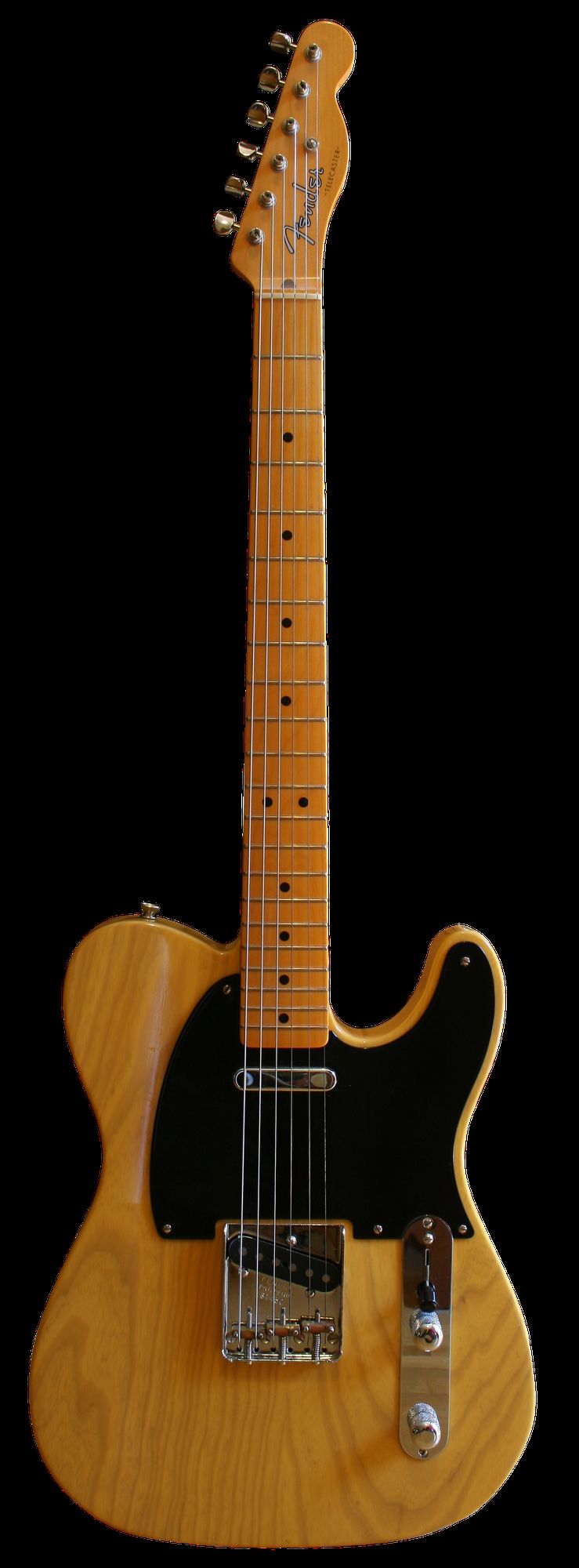
Fender Telecaster American Vintage 1952 with transparent background. Photo by Massimo Barbieri. Licensed under CC BY-SA 3.0. Via Wikimedia Commons. Fender
Telecaster
1950
Leo built it like a tool. The famous ones look like they just clocked off a double shift.
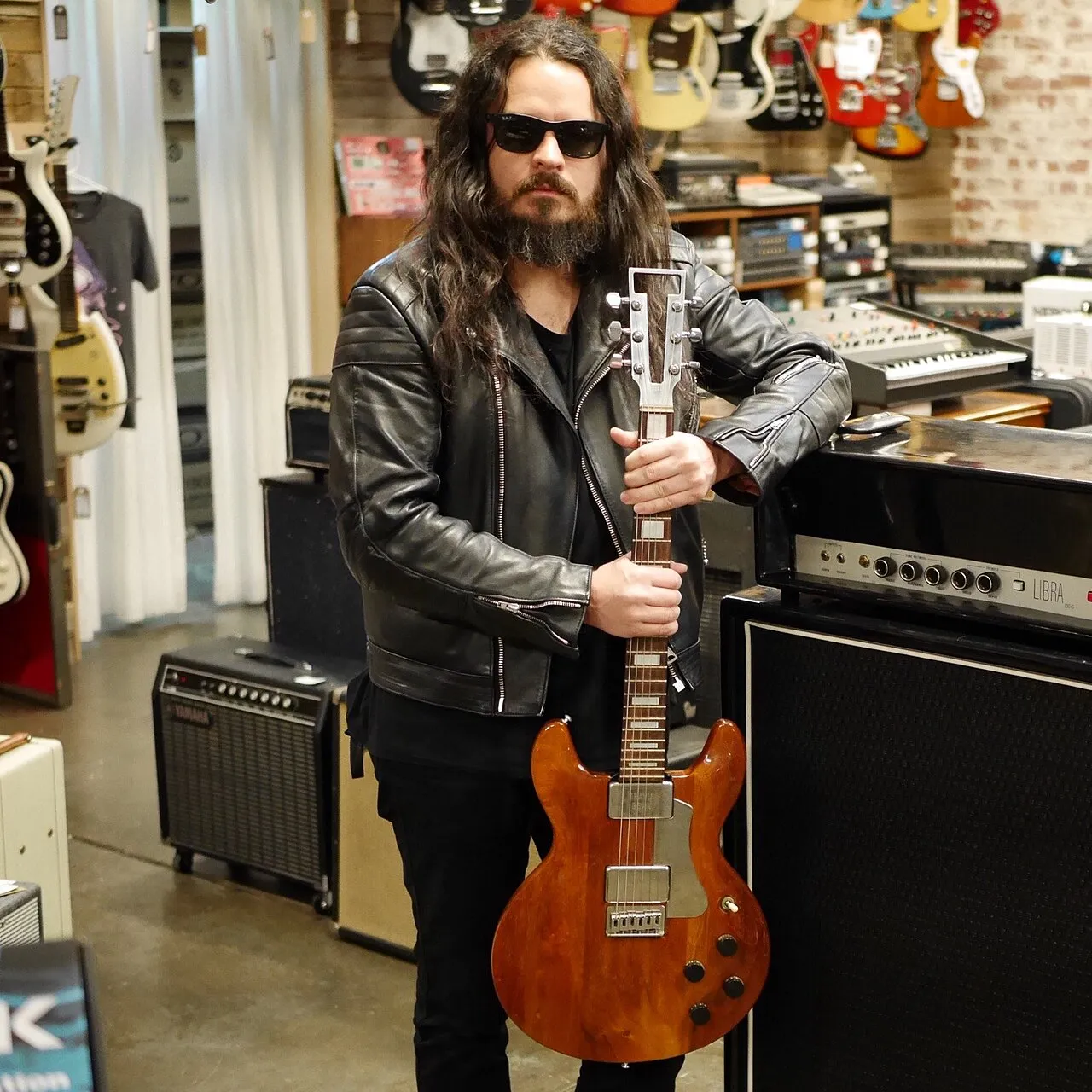
Photo: Somalley / Wikimedia Commons / CC BY-SA 4.0 Travis Bean
TB1000
1974
A motocross racer watched a repairman fight wooden necks all day. So he made one out of aluminum.
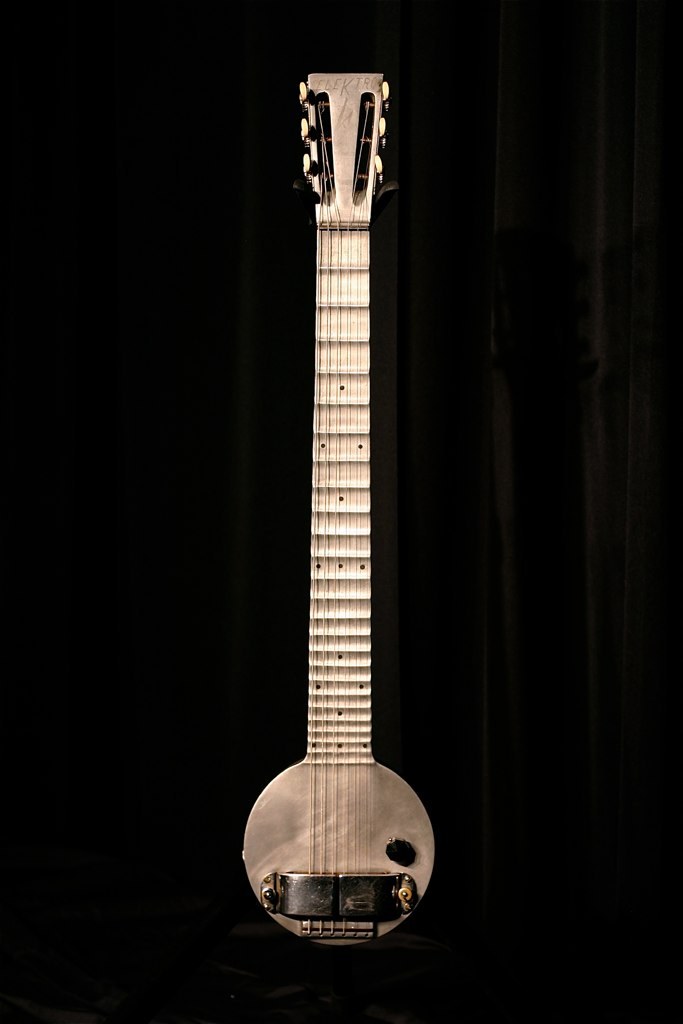
Photo: Museum of Making Music / Wikimedia Commons / CC BY 3.0 Rickenbacker
A-22 Frying Pan
1932
The first electric guitar you could buy looked like a frying pan. The patent office didn’t believe it worked.