Music Man
Cutlass
Leo Fender drew up the Cutlass in the ’70s. It took about forty years to make it onto a wall.
Fullerton, California, the late 1970s. Leo Fender’s Music Man guitars are ash, three-bolt, small-fretted, and, in Music Man’s own words today, “ear-piercingly bright.” One of them is a Strat-rooted design called the Cutlass. It never makes it into regular production.
- Introduced
- 2016
- Type
- Solidbody electric
- Class
- Production
Have a photograph of this guitar? Send a picture
The short version
1975
Leo’s design
Music Man dates Leo’s Cutlass design to 1975 on one page and 1977 on another.
1977
In the catalog
The original Music Man guitars appear in the new-products catalog, through 1980.
1983
A Cutlass, but a bass
The Cutlass I and II are graphite-neck basses. The guitar still hasn’t happened.
2016
Finally built
Ernie Ball Music Man releases the Cutlass in February. Street price $1,499.
2018
Roasted
The Cutlass RS arrives with a roasted maple neck. Hunter Hayes makes it his main guitar.
2019
Hayes’s own
A Hunter Hayes signature Cutlass, a hardtail with a piezo, starts with a run of 25.
2022
The HT
A sister with new pickups and a boost switch joins the family.
Side A
A1
The one that didn’t get made
Leo Fender’s Music Man years get told as a bass story, and they mostly are. But he designed guitars there too. Two of them, from the late ’70s, were a StingRay guitar that leaned toward the Jazzmaster and a Cutlass that leaned toward the Strat. They were ash, with three-bolt necks and small frets, and Music Man itself now calls them “ear-piercingly bright.”
The StingRay guitar shipped. The Cutlass didn’t, not as a guitar. It got designed, and then it never made it into regular production, not as a guitar, not the first time around. A Cutlass bass came along in the early ’80s, which doesn’t count.
So the Cutlass guitar sat there, a good idea from a man who’d had a few of them, waiting.
A2
San Luis Obispo needed a Strat
By 2015, Ernie Ball Music Man had the Silhouette and the Axis. What it didn’t have was a guitar you could hang on a wall next to a Strat and say, here, this is ours. So it went back to Leo’s designs. Sterling Ball called the new ones “adaptations of original Music Man designs from the 1970’s,” and in February 2016 the Cutlass was finally for sale, at a street price of $1,499. A revived StingRay guitar came out beside it, and the first colors were Black, Ivory White, Vintage Sunburst, and Vintage Turquoise. Two of the four have “Vintage” right there in the name.
It wasn’t a museum copy. The new one is alder, not ash, with a five-bolt neck instead of three, 22 stainless frets, and a Music Man four-and-two headstock that’s longer than the others. The neck goes from a soft V down low to a C up high.
A3
Three single-coils, no hum
The pickups are three single-coils voiced like the mid-’60s, with staggered poles. Single-coils sound great and buzz like a neon sign. Music Man’s fix is the Silent Circuit, powered by a 9-volt battery in a chamber in the back. It kills the hum and leaves the single-coil sound alone. The singles stay singles. They just shut up between songs.
The tremolo only goes down. The tuners lock, and the strings run straight through the nut to the posts, so when you let go of the bar it comes back in tune. That’s a small thing on paper and a big thing at the gig.
Leo’s idea, Music Man’s fixes. A Strat-shaped guitar that doesn’t hum and doesn’t wander out of tune.
Flip the record · By the numbers
1975–77
When Leo designed it. Depends which Music Man page you read.
$1,499
Street price of the first production Cutlass in 2016.
9
Volts in the battery that keeps three single-coils quiet.
25
Guitars in the first run of the Hunter Hayes signature model.
Side B
B1
The only guitar he wanted
Hunter Hayes found it the way players find guitars, by accident:
“I got to play one of these at a rehearsal. And it very quickly became the only guitar that I wanted to play.”
By 2018 the Cutlass RS was his main guitar, “night after night.” In 2019 Music Man gave him his own, a hardtail with piezo saddles for an acoustic sound, starting with a run of 25.
Eli Maiman of WALK THE MOON plays a custom black one. In 2019 he said it had been “my main go-to guitar ever since” he started on the model “three or four years ago.” Locking tuners, the compensated nut, a satin neck, and in his words, “super reliable” on the road.
B2
Forty years late, right on time
The family has grown since. There’s a Cutlass with a humbucker in the bridge, from 2017. The 2018 RS got a roasted maple neck, and in 2022 the HT arrived with new pickups and a boost switch. In 2023 a 100-piece run called the Classic ’58 went the other way, with a nitro finish and vintage-wound pickups. Jason Richardson’s signature, with 24 frets and two humbuckers, went about as far from Leo as the shape allows. The plain three-single-coil version is still on Music Man’s site.
Leo designed a guitar in the ’70s that nobody got to play. It sat through the rest of his career, a sale of the company, and three decades after that. Then a country singer picked one up at a rehearsal, and it was the only guitar he wanted.
Put this on
You’ve read about it. Now hear it. Here’s what this guitar sounds like, and what to listen for.
Hunter Hayes plays the Cutlass RS
Hayes on the guitar he picked up at a rehearsal and didn’t put down.
Watch it on YouTube (opens in a new tab)Inspired By Hunter Hayes
The short film about Hayes and his Cutlass, the one he plays “night after night.”
Watch it on YouTube (opens in a new tab)
The cast
The people, and the specific guitars, that made the legend.
1977
Leo Fender
The original design
Drew up the Cutlass in the Music Man years. It never went into regular production in his lifetime.
2016
Sterling Ball
Ernie Ball Music Man
Brought it back as one of the “adaptations of original Music Man designs from the 1970’s.”
2018
Hunter Hayes
Cutlass RS, then his own
Tried one at a rehearsal, and it became his main guitar. A signature model followed in 2019.
2019
Eli Maiman
Custom black Cutlass
WALK THE MOON’s guitarist. His “main go-to guitar,” and “super reliable” on the road.
Liner notes
Specs, construction, rarity, value, and every source we used.
Three staggered-pole singles, a Silent Circuit, and a 4+2 headstock — Music Man’s Cutlass, SLO’s Strat, not a Silhouette and not the bass.
- Body
- Alder, double-cut, contoured; 12-7/8" wide, 1-5/8" thick, 38-1/8" long (32.7 cm, 4.1 cm, 96.8 cm). Mix flagged.
- Neck
- Bolt-on roasted figured maple, 5-bolt sculpted joint; hand-rubbed oil and wax
- Fingerboard
- Roasted figured maple or rosewood, 10" (25.4 cm) radius, 22 high-profile medium-width stainless. Mix flagged.
- Scale
- 25-1/2" (64.8 cm). Mix flagged.
- Pickups
- SSS — three Music Man custom-wound mid-Sixties staggered-pole single-coils, Silent Circuit
- Hardware
- Music Man Modern tremolo, vintage bent steel saddles; Schaller M6-IND locking; 4+2 headstock 6-3/8" (16.2 cm)
- Electronics
- Passive 250k volume and tone, .022µF tone cap; transparent buffered output; 5-way lever; graphite-acrylic cavity, aluminum-lined pickguard
- Finish
- High gloss polyester body
- Nut
- Compensated; 1-5/8" (41.3 mm) at nut, 2-1/4" (56.9 mm) at last fret. Mix flagged.
Open the full research fileConstruction details, the complete player record, production numbers, dated value estimates, and sources
Current typical = hosted Cutlass RS SSS (San Luis Obispo; music-man.com, fetched 17 September 2026). Factory mixed inch/mm flagged; no millimetres invented. Guitar World, January 2016, prints .047µF on the first Cutlass; the hosted RS table prints .022µF. Keep both. Cutlass RS HSS and Cutlass HT are sisters, not this table — the hosted collection this pass lists those two. Jason Richardson (24-fret HH) and Hunter Hayes (hardtail piezo) are signature sisters. Sterling by Music Man Cutlass is another brand. Cutlass bass and 1983 Cutlass I / II (graphite-neck StingRay/Sabre basses) are basses. Silhouette is the 24-fret alder. Axis is the single-cut Floyd. StingRay is a bass — other slug. No Gibson SKU.
Construction
The job was a Strat San Luis Obispo could put on a dealer wall. Silhouette already existed. Axis already existed. Leo’s 1970s Music Man guitars had not become that guitar. What they built in 2016 is alder, three mid-Sixties staggered-pole singles, a Silent Circuit on a 9-volt, a 5-bolt heel, and a 4+2 headstock longer than the Silhouette’s. Dive-only Modern tremolo, bent-steel saddles, locking Schallers, straight pull. That is this guitar. It is not the 24-fret alder Silhouette. It is not Axis. It is not the StingRay bass, and it is not the StingRay guitar.
The 1970s name is the argument, not a census. Official guitars page: original MM Cutlass and StingRay guitars “designed and created in 1977,” new-products catalog 1977 through 1980, Strat-rooted Cutlass against a Jazzmaster-leaning StingRay guitar; ash, 3-bolt, small frets, “ear-piercingly bright.” The 2018 RS launch blog dates Leo’s design to 1975. Keep 1975 and 1977. Guitar World (Chris Gill, 6 January 2016): the Cutlass “never made it into regular production as a guitar model the first time around.” MusicRadar (4 December 2015): never into production, “although a bass variant existed in the early 80s.” The guitars CLF actually shipped were StingRay I / II and Sabre I / II. 1983 Cutlass I / II were graphite-neck basses. The 2016 Cutlass bass is another bass. This table is six strings.
Sterling Ball, February 2016: “adaptations of original Music Man designs from the 1970’s.” Official blog: February 2016 release; Black, Ivory White, Vintage Sunburst, Vintage Turquoise; “available now.” Gill’s review was already in print that January. Street $1,499. Vintage Guitar (Pete Prown, October 2017): $1,599. Historical, not 2026 street.
Contoured alder double-cut, 25-1/2" scale, 10" radius, 22 stainless, compensated nut. Headstock 6-3/8" — Gill: longer than previous Music Man guitar headstocks. Five bolts, sculpted joint, truss at the heel. Prown: soft V on the lower frets to a C up top. The trem only dives; locking tuners and the straight pull are why it comes back. Silent Circuit and buffered output on a 9-volt in a rear chamber — the singles stay singles. Gill 2016: 250k volume and tone, .047µF. Hosted RS: 250k, .022µF. The French Cutlass SSS page still prints .047µF. Do not pick a winner.
2017. Cutlass HSS (Casey Ball, 1 June 2017): “introduction last year,” then a ceramic Music Man humbucker at the bridge, same Silent Circuit on the two singles. Gill, 2018: HSS RS uses 500k pots. Sister. Not this table.
2018. Cutlass RS. Roasted figured maple, oil and wax, Firemist Silver. Launch blog: “designed by Leo Fender in 1975”; worldwide 18 August. Gill: roasted necks on all but Stealth Black; both RS models “less than eight pounds.” That is a review pair, not a factory weight.
2019. Hunter Hayes Artist Series Cutlass: hardtail, brass piezo saddles, neck-blend, boost, Tahoe Blue. MusicRadar, 17 May 2019: $2,499. Official YouTube: limited to 25 beginning mid-May. Signature sister. Jason Richardson’s 24-fret HH is another. Do not flatten either onto this SSS table.
2022. Cutlass HT (Premier Guitar, 10 August; Guitar.com, 11 August): heat-treated poles, neodymium, push-push boost, $2,899. Guitar Player (Dave Hunter): GraphTech nut, 8.2 lb sample, boost factory-set +12 dB, trim to 20 dB. Sister. Factory shop this pass: HT Buttercream $2,999.
2023. BFR Cutlass Classic ’58: roasted alder, nitro, three vintage-wound Alnico V singles, 100 worldwide. A named limited of this silhouette, not a 1970s guitar.
Classic vs current: 2016 maple neck, satin poly, three singles, Silent Circuit, dive-only Modern trem — against the hosted RS: roasted figured maple, oil and wax, same job. Collection page this pass is HT and RS HSS. The /cutlass URL is still the SSS RS. Sterling by Music Man Cutlass is another brand. Not a Silhouette. Not Axis. Not the bass.
Players
Do not hang a Silhouette, an Axis, a StingRay bass, or a Cutlass bass on this plate. Do not recruit the Jason Richardson 24-fret HH as if it were this guitar. Do not hang Hunter Hayes’s 2011 Hunter Hayes / “Wanted” on a 2016 instrument.
Hunter Hayes. The player who made the stock Cutlass a stage guitar, then a signature. Official Inspired By (14 August 2018): his main is the Cutlass SSS RS, “night after night.” Ernie Ball demo, 2 April 2018: “I got to play one of these at a rehearsal. And it very quickly became the only guitar that I wanted to play.” Billboard (2018): custom Cutlass. The 2019 Artist Series is the hardtail piezo sister. Album-to-guitar credits for named Hayes sides on the stock RS are unpublished here. None invented.
Eli Maiman (WALK THE MOON). Official Q&A, 26 June 2019: custom black Cutlass, “my main go-to guitar ever since” he started on the model “three or four years ago.” Locking tuners, compensated nut, satin neck, “super reliable” on the road. He also plays a Charcoal Spark St. Vincent HH — other slug. The Hunter Hayes hardtail “holds its own particular place in the stable.” No album-to-guitar credit invented.
Also known to play stays short. Official demos: Gretchen Menn; Ryan “Fluff” Bruce; Daniel Donato on the HSS intro. Jason Richardson is the 24-fret HH sister.
Rarity
You can buy a new Cutlass tomorrow. Current production. Not rare. Dealer stock this pass is mostly RS HSS and HT; the hosted SSS RS page is still up. Ernie Ball Music Man does not publish Cutlass unit totals. None invented. Serials date a guitar, they don’t count a factory. That is why a first-year census is unknown, not the chapter.
What is actually thinner: 2016–17 maple-satin SSS before the roast. BFR Classic ’58, 100 worldwide. BFR Cutlass HSS Floyd, 65 (Eddie’s Guitars). Hunter Hayes’s first Artist Series run, 25. Named limiteds of this silhouette or a sister, not a vintage run. A 1970s Cutlass guitar in regular production is the thing Gill and MusicRadar say did not happen. Sterling by Music Man Cutlass is another brand.
Value
Informal estimate, 17 September 2026. Not an appraisal.
Ask vs sold labeled. Celebrity lots are not-comps. No invented medians or factory counts. Reverb Price Guide widget on Cutlass SSS Tremolo did not print a clean USD band in the static fetch this pass. Flag: thin sold-comp access on SSS. HSS band below is labeled HSS, not this table.
New street. Sweetwater Cutlass RS HSS Black and Limestone $2,799, this pass (fetched 17 September 2026) — HSS sister, labeled adjacent. Music & Arts and zZounds the same $2,799. Factory shop Cutlass HT Buttercream $2,999, in stock this pass — HT sister. Named new RS SSS ask, not a hammer: $2,599 (Reverb). Historical, not 2026 street: Gill 2016 $1,499; Prown, October 2017, $1,599; Gill 2018 HSS RS $2,049; Guitar.com, August 2022, HT $2,899; Hunter Hayes 2019 $2,499. Do not borrow HSS or HT as the SSS number.
Used modern. Reverb Price Guide on Cutlass RS HSS: $1,079–$1,749 based on 264 orders Good to Mint — labeled HSS. Named HSS solds on that guide, not a midpoint: 19 December 2025 Very Good $1,649.99; 12 December 2025 Very Good $1,150; 1 December 2025 Mint $1,899. Sweetwater Gear Exchange used RS HSS Black $1,455–$2,155. Named sold, not a series: 2025 Limestone RS HSS mint $1,975 (Gear Exchange, 29 January 2026). Do not average HSS solds into an SSS median.
Vintage / collectible. This is a 2016 guitar. 2016–17 first-year maple-satin SSS examples are the scarce end of the same guitar, not a separate SKU. BFR Classic ’58 Reverb Price Guide $1,527–$2,260 based on 43 orders Good to Mint; named solds: 19 July 2026 Good $1,791.49; 16 June 2026 Excellent $1,700. The 100-piece ’58 and the 25-piece Hayes run are limiteds. They are not a 1970s Cutlass. Hayes’s and Richardson’s named objects are unique. Not comps.
See also
- music-man-silhouette — SLO’s first Ernie Ball guitar; alder, 24 frets, HSH, not this Strat outline
- music-man-axis — the single-cut Floyd; Eddie’s guitar after Kramer, not this
- fender-stratocaster — 25.5" bolt-on the Cutlass is answering
Sources
- Ernie Ball Music Man: Cutlass RS — hosted millimetre table, 17 Sep 2026; alder; 25-1/2" / 64.8 cm; 1-5/8" / 41.3 mm; roasted figured maple; 22 stainless; SSS Silent Circuit; .022µF; mixed inch/mm
- Ernie Ball Music Man: Guitars — 1977 design/create; catalog 1977–1980; ash, 3-bolt, small frets; modern Cutlass/StingRay as homage; Cutlass collection this pass: HT and RS HSS
- Ernie Ball Music Man: Cutlass collection — HT and RS HSS listed; SSS RS still at /cutlass
- Ernie Ball Music Man blog: StingRay and Cutlass — February 2016 release; Sterling Ball 1970s-adaptation quote; first colours; StingRay I/II guitar discontinued 1982
- Ernie Ball Music Man: Introducing the Cutlass HSS — Casey Ball, 1 June 2017; “introduction last year”; HSS sister
- Ernie Ball Music Man: 2018 Cutlass RS & StingRay RS — Leo design 1975; roasted figured maple; worldwide 18 August; Firemist Silver
- Guitar World, Chris Gill, 6 January 2016 — Cutlass never regular production first time; alder vs StingRay mahogany; 250k / .047µF; street $1,499; dive-only Modern trem; 6-3/8" headstock
- Guitar World, Chris Gill, 24 April 2018 — RS roasted maple; HSS RS 500k / .022µF ceramic bridge; street $2,049 HSS RS; both RS <8 lb
- Vintage Guitar, Pete Prown, October 2017 — $1,599 Cutlass; dive-only trem; V-to-C neck; Silent Circuit 9-volt rear chamber
- MusicRadar, Michael Astley-Brown, 4 December 2015 — NAMM 2016; Cutlass guitar never into production; early-80s bass variant
- Ernie Ball Music Man: Inspired By Hunter Hayes — Cutlass SSS RS as Hayes’s main, night after night
- Ernie Ball: Hunter Hayes plays Cutlass RS — 2 April 2018; rehearsal-to-only-guitar
- Billboard: Inspired By Hunter Hayes — custom Cutlass; 2018 film
- MusicRadar, 17 May 2019 — Hayes signature $2,499; hardtail piezo sister
- Ernie Ball: Hunter Hayes signature demo — limited to 25 beginning mid-May 2019
- Eddie’s Guitars: BFR Cutlass HSS Floyd — limited to 65
- Music Man France: Cutlass SSS — original SSS table still prints .047µF
- Ernie Ball Music Man: Eli Maiman Q&A — 26 June 2019; custom black Cutlass main go-to, three or four years
- Premier Guitar, 10 August 2022 — Cutlass HT launch
- Guitar.com, 11 August 2022 — Cutlass HT $2,899
- Guitar Player, Dave Hunter, 21 September 2022 — HT sister; GraphTech 1-5/8"; 8.2 lb sample; +12 dB factory boost
- Ernie Ball Music Man: BFR Spring 2023 — Cutlass Classic ’58; 100 worldwide
- Sweetwater: Cutlass RS HSS Black — $2,799, 17 Sep 2026
- Sweetwater: Cutlass RS HSS Limestone — $2,799, 17 Sep 2026
- Reverb: Cutlass RS HSS — Price Guide $1,079–$1,749 / 264 orders; named 2025 solds
- Reverb: Cutlass SSS Tremolo — USD Price Guide widget blank this pass
- Reverb: BFR Cutlass — $1,527–$2,260 / 43 orders; named 2026 solds
- Ernie Ball Music Man shop: Cutlass HT Buttercream — $2,999, in stock this pass
- Blue Book of Guitar Values: Music Man — Cutlass I as graphite-neck StingRay bass, 1982–87; not this guitar
Keep digging
Guitars this one gets compared to, confused with, or descended from.
- Send a picture
Music Man
Silhouette
1986
People laughed at Music Man’s first guitar. Then Keith Richards picked one up.
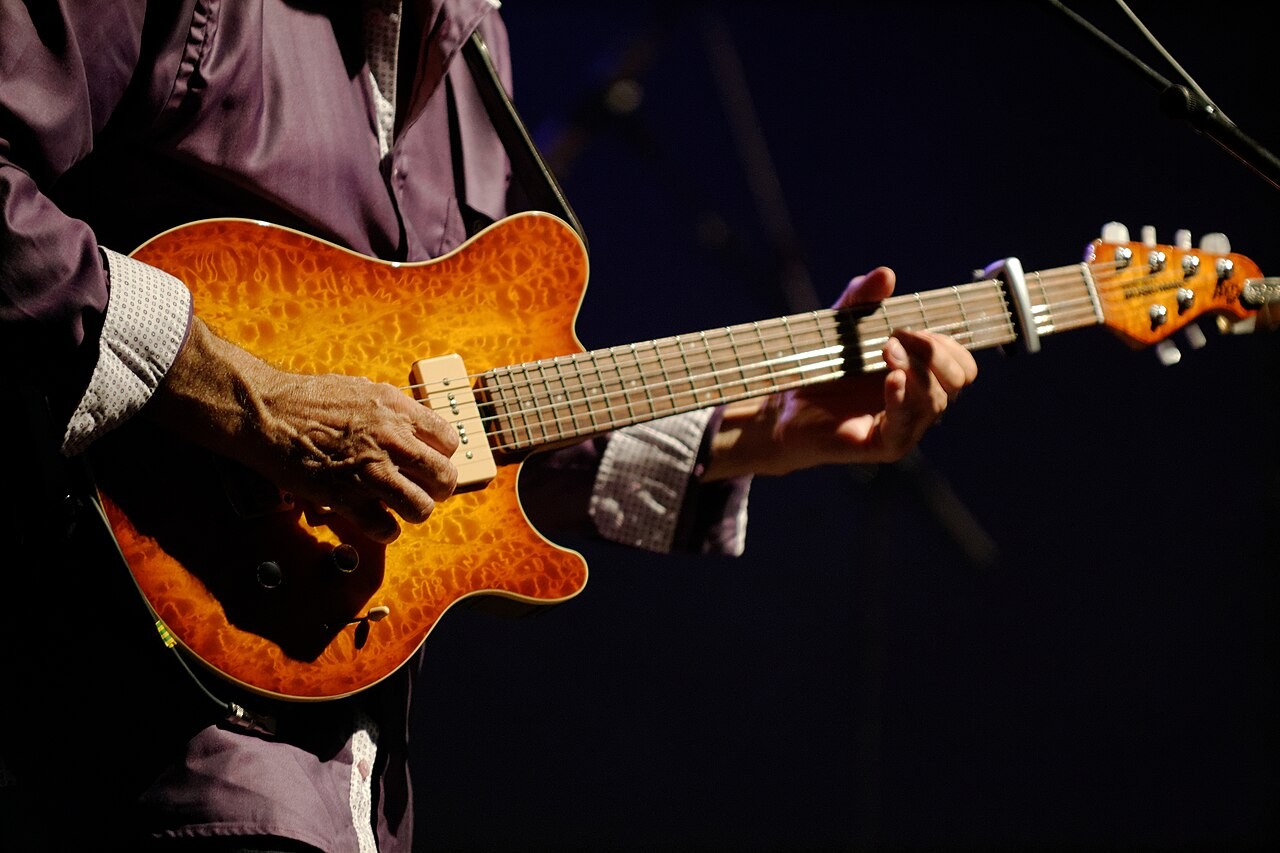
Photo: Kergourlay / Wikimedia Commons / CC BY-SA 3.0 Music Man
Axis
1991
They copied the neck off Eddie Van Halen’s worn-out Kramer. Then Eddie left, and the guitar stayed.

Photo: Lightburst / Wikimedia Commons / CC BY-SA 4.0 Fender
Stratocaster
1954
The guitar most people mean when they say “electric guitar.” Designed by a man who didn’t play one.