Music Man
Bongo
Sterling Ball asked BMW’s design studio for a bass. People thought he’d lost his mind. It’s still in production.
Music Man already had a famous bass, the StingRay, and a factory in San Luis Obispo full of people who knew how to build it. Sterling Ball wanted something that didn’t look like it. So he went to the studio that designs BMWs, and bet that bass players would try anything if it sounded good.
- Introduced
- 2003
- Type
- Solidbody bass
- Class
- Production
The short version
’90s or ’00s
The call to Designworks
The company history says early 2000s. A factory-tour transcript says the early ’90s. Both stay.
2003
NAMM
The Bongo is unveiled. “People thought I had lost my mind.”
2007
Systematic Chaos
John Myung comes back to Music Man on a stock five-string Bongo, and plays the six-string prototypes.
2008
The six goes public
The Bongo 6 is presented as part of the regular line, not a signature.
2024
Stainless
Stainless frets and new colors. Same bass.
2025
Triangulation
Dave LaRue plays a Bongo in the Steve Morse Band’s video.
Side A
A1
A bass nobody asked for
Music Man had a problem most companies would love. Its basses were the StingRay, the Sterling, and the StingRay 5, and they all looked like the StingRay. Sterling Ball wanted past that outline. He wanted newer electronics, a lighter body, and wood that rang.
He didn’t go to a guitar designer. He went to Designworks, BMW’s design studio in Southern California, which had already been turned down by other instrument makers. And he didn’t ask them for a guitar. His reasoning, years later: guitar players are a lot less open to change. Bass players, he figured, would move if it sounded good.
That’s a bet. It was a pretty good one.
A2
Four drawings and a sheet of wheat
Designworks spent about a year on it and came back with four concepts. One was code-named Bongo. One would have wrapped around the player and done away with the strap entirely. That one didn’t get built, which is probably for the best.
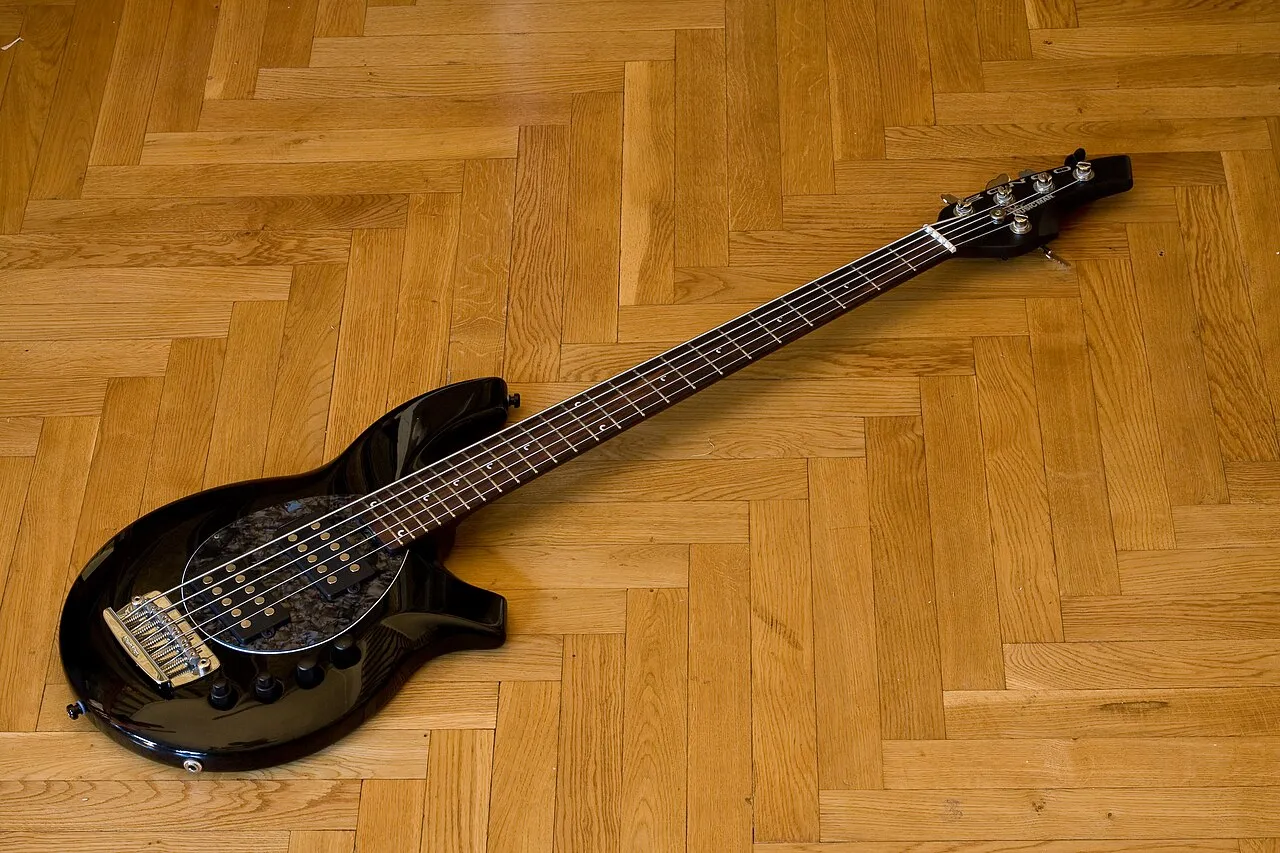
The winner was a compact double-cut with a short headstock, laid out so the upper frets sit within reach. The wood was the other fight. The old assumption was mahogany. According to the company history, the most resonant sample they tested was compressed wheat, and it sounded terrible. Basswood won.
When did this all start? The written history puts the brief in the early 2000s. In a 2010 factory tour, Dudley Gimpel places the first Designworks contact in the early 1990s. The dates don’t meet, so I’ll leave them both on the table. The bass itself you can date: 2003.
A3
“People thought I had lost my mind”
Music Man unveiled the Bongo at NAMM in 2003. Sterling Ball, looking back:
People thought I had lost my mind.
It doesn’t look like a StingRay, or much of anything else: a compact, sculpted double-cut with a stubby headstock, drawn by people who usually draw cars. Not everybody hated it. The buyer for the industry’s leading chain loved it. Ball also admits he thought the bass would have been dead by now.
What sold it was underneath. The Bongo has 24 frets, two full octaves, which no StingRay neck does. The company still calls it “the first and only 24-fret neck for a Music Man bass.” The preamp runs on 18 volts, two 9-volt batteries, where the original StingRay ran on one. More voltage means more headroom: you can dig in hard and the electronics don’t choke. The two-pickup versions got a four-band EQ and a blend knob.
Dave LaRue helped with that. He gave input during development, says he was on the team that set the four-band EQ, and played a five-string at the unveiling. Years later, on a Sweetwater demo, he called the 4 HH “my favorite bass and the one I play when I’m on tour in the studio.”
Flip the record · By the numbers
4
Concepts Designworks brought back. One was code-named Bongo.
24
Frets. The first and only 24-fret neck on a Music Man bass, per the company’s own guide.
18V
Two 9-volt batteries driving the preamp. The StingRay started on one.
0
Times it’s been discontinued. It was laughed at. It never left.
Side B
B1
Myung comes back
John Myung of Dream Theater had been away from Music Man for a long time. Images and Words was a Spector. Awake was a Tung. Train of Thought was a Yamaha. Then for Systematic Chaos he picked up a stock five-string Bongo, “as is,” at Avatar Studios in New York. It was, in his words, “the first album I used Music Man again after a long stretch.”
A six-string was already in development. In July 2007, Sterling Ball said Myung was playing the Bongo 6 prototypes exclusively and wouldn’t let him tweak them. Ball was clear that it “is not a signature bass” but “part of the regular line.” The public six arrived in 2008.
B2
Spending the prize money
Around 2007, Daniel Oliver of Nothing More won a Warped Tour battle of the bands. The prize was Guitar Center credit. He picked a Bongo, and he’s been on one since.
He could have spent that credit on anything in the store. He took the strange one. When he talks about it now, he talks about the sound: the low note, and an attack that makes fingers and a pick hard to tell apart. That’s Sterling Ball’s bet, won by one bass player with store credit.
The Bongo is still in the catalog, four, five, and six strings, built in San Luis Obispo. In 2024 it got stainless frets and new colors. In 2025 LaRue was still playing one, in the Steve Morse Band’s “Triangulation” video. Ball thought it would be dead by now. It was laughed at. It was never discontinued.
Put this on
You’ve read about it. Now hear it. Here’s what this guitar sounds like, and what to listen for.
Triangulation
Dave LaRue on a Bongo, the bass whose EQ he helped set. No Treble singled out his bass performance on this one.
Watch it on YouTube (opens in a new tab)Systematic Chaos
Myung’s first album back on Music Man after a long stretch, on a stock five-string Bongo, “as is.” The earlier Dream Theater records are other basses.
Find it on YouTube (opens in a new tab)Dave LaRue Bongo 4 HH demo
LaRue walks through the four-band EQ he helped set, and points out the two battery compartments.
Watch it on YouTube (opens in a new tab)
The cast
The people, and the specific guitars, that made the legend.
2003
Sterling Ball
Commissioned it
Took the brief to BMW’s Designworks studio because, as he saw it, bass players were more open to change than guitarists.
2003
Dave LaRue
Bongo 4 HH
Gave input during development and played a five-string at the unveiling. Calls the 4 HH “my favorite bass.”
2007
John Myung
Stock Bongo 5, then six-string prototypes
Dream Theater. Used a stock Bongo 5 on Systematic Chaos and played the Bongo 6 prototypes exclusively.
2007
Daniel Oliver
Bongo
Nothing More. Won Guitar Center credit in a Warped Tour battle of the bands, and spent it on a Bongo.
Liner notes
Specs, construction, rarity, value, and every source we used.
Basswood, 24 frets, and an 18-volt preamp in a body BMW’s studio drew — Music Man’s Bongo, not a StingRay and not the Myung signature.
- Body
- Solid basswood, double-cut, sculpted. 12-3/4" wide, 1-5/8" thick, 46" long (32.4 cm, 4.1 cm, 116.9 cm). Mix flagged.
- Neck
- Bolt-on select maple. 5 bolts, sculpted heel. Truss wheel at the headstock; no string removal.
- Fingerboard
- 24 high-profile wide stainless frets, 11" (27.9 cm) radius, half-moon markers. Ebony on Titan Gray and Stealth, rosewood on Blood Orange, maple on Mantis Green. Mix flagged.
- Scale
- 34" (86.4 cm). The 5 and the 6 print the same scale. Mix flagged.
- Pickups
- Two humbuckers, neodymium magnets. Guitar Center’s Blood Orange page calls the coils passive.
- Hardware
- Hardened-steel bridge plate, stainless saddles. Chrome, or matte black on Stealth Black and Titan Gray. Lightweight tapered-post tuners. Strings: Super Slinky 45–100 (#2834).
- Electronics
- 18V 4-band active preamp: volume, neck/bridge blend, treble, high-mid, low-mid, bass. Graphite-acrylic cavity, aluminum cover.
- Finish
- High-gloss polyester. Stealth Black and Titan Gray are matte. The 4’s neck line says gunstock oil and wax on Mantis Green and “Blood Moon”; Stealth and Titan Gray matte.
- Nut
- Compensated. 1-5/8" (41.3 mm) at the nut, 2-9/16" (65.1 mm) at the last fret. Mix flagged.
Open the full research fileConstruction details, the complete player record, production numbers, dated value estimates, and sources
Current typical = hosted Bongo 4 HH (San Luis Obispo; music-man.com, fetched 23 September 2026). Factory sheet mixes inches, centimetres, and millimetres. No millimetres invented. The 4’s fingerboard line does not name Gold Bar, Dazzler, or Mystique; the 5 and 6 tables do — ebony, rosewood, and maple in that order. “Blood Moon” is the sheet’s word. The color is Blood Orange. Bongo 5 and Bongo 6 are the same recipe with wider nuts: 1-3/4" (44.5 mm) and 2-1/4" (57.15 mm). John Myung artist basses, and Sterling by Music Man Bongos, are other instruments. StingRay is the slab. Silhouette and Axis are guitars. Not this table.
Construction
The job was a bass that did not look like the one San Luis Obispo already sold. StingRay, Sterling, StingRay 5. Sterling Ball wanted past that outline: newer electronics, a light body, wood that rang. He did not ask BMW’s Designworks studio for a guitar. His line, in the 2019 company account: guitar players are a lot less open to change. Bass players, he thought, would move if it sounded good.
Designworks, in Southern California, had already been turned down by other makers. About a year. Four concepts. One was code-named Bongo. One body would have wrapped the player and thrown the strap away. That one was not built. What shipped kept most of the concept that won: a compact double-cut and a short headstock, 8-1/8" (20.6 cm) on the current four, so the upper frets sit in reach.
Wood was the other fight. Mahogany was the old assumption. The history post says the most resonant sample was compressed wheat, and that it sounded terrible. Basswood won. Not ash. Not the StingRay slab.
2003. Released that year. Unveiled at the NAMM show. Sterling, later: “People thought I had lost my mind.” The buyer for the industry’s leading chain loved it. He also says he thought the bass would have been dead by now. An auto-transcript of Dudley Gimpel on Premier Guitar’s December 2010 factory tour places the Designworks contact in the early 1990s. The written history puts the brief after the new MINI, early 2000s. Keep both. The bass you can date is 2003.
Bolt-on. Five screws, sculpted heel, 34", 24 frets. Two octaves. A StingRay neck does not do that. Gimpel, on that tour, called it the only Music Man bass with a two-octave neck. The 2018 buyer’s guide still says “the first and only 24-fret neck for a Music Man bass.” Half-moon inlays. His transcript still ties the four-string headstock to the familiar 3+1.
The original four, in the 2018 buyer’s guide, was one bridge humbucker, neodymium magnets, proprietary tuners, and an 18V 3-band. Two pickups — humbucker and single-coil, or two humbuckers — went to a 4-band and a blend. Premier Guitar (Joe Coffey, 21 December 2010) has that band split, and in the present tense calls neodymium optional, “and/or a piezo-equipped bridge.” The history post calls this the first bass with both neodymium pickups and an 18-volt preamp. Three claims. Do not collapse them. The 18 volts are two 9-volts. LaRue points at the compartments on his 2014 Sweetwater demo. Guitar Center’s Blood Orange page calls the humbuckers passive. The battery feeds the preamp.
The five did not grow the scale. Buyer’s guide: extended range, same neck length. Still 34". The six is where the years split. Wikipedia’s company page: added in 2007. Sterling Ball, 23 July 2007, quoted on Wikipedia’s John Myung page: Myung was playing the Bongo 6 prototypes exclusively and would not let him tweak them. The six “is not a signature bass” but “part of the regular line.” Audiofanzine presents it 25 June 2008. Gimpel in December 2010 calls that six “the latest version.” Prototypes in 2007. A public six in 2008. The buyer’s guide says the six came only as a two-pickup bass, so 4-band from the start. The 2026 order form, all three, is HH only. The 4’s page still hosts the 2016 H, HS, and HH schematics. The model menu does not offer the H.
The compensated nut is the company’s patent, and the dates disagree. The history post: first Ernie Ball Music Man instrument to carry it. The parts shop: compensated nuts introduced in 2005, and they will not fit a standard nut shelf. A 2003 bass and a 2005 nut are not one fact. Current Bongos have it. The production six’s blank is 2-1/4". The shop says that blank will not fit a John Myung artist bass.
2024 is a spec change, not a new model. No Treble, 30 June: stainless frets, Stealth Black, Titan Gray, Blood Orange, Mantis Green, then $2,899–$3,099. The 2026 pages add Gold Bar, Dazzler, and Mystique, and still list fretless pau ferro, lined or unlined. Left-handed: No. The 5 keeps the 4’s width and thickness and runs 47-5/8" overall, headstock 9-3/4". The 6 is 13-1/2" wide, 47-3/4" long, nut 2-1/4". Weights are samples. No Treble, 2017, a 4 HH: 8 lb 4 oz (3.74 kg), “varies slightly.” Sweetwater Titan Gray 4, serial K06009: 8 lb 12 oz. Sweetwater 6, serial K12836: 10 lb 1 oz. Audiofanzine’s 2008 six: 11 lb. Do not average. Mix flagged on the kilograms.
Not a StingRay. Not the 1976 ash slab, the 3-bolt, or one Alnico humbucker on a 9-volt 2-band. The StingRay Special later took neodymium and 18 volts. It is still the other body. Silhouette and Axis are guitars. The John Myung artist six uses a five-string nut width, a rosewood and roasted-maple board, and a volume plus 5-way — not this 4-band. The 2025 Sterling by Music Man Bongo is Indonesian mahogany, ceramic humbuckers, a 2-band, a 12" radius, and dots.
Players
Dave LaRue helped the preamp, and he plays the bass. Sweetwater: input during development, and a 5-string at the unveiling. On the 2014 demo he calls a 4 HH “my favorite bass and the one I play when I’m on tour in the studio.” HS first, then the two humbuckers. He says he was on the team that set the 4-band. The Hipshot D-tuner on that demo is his, for Steve Morse gigs. Not factory. No Treble, 26 November 2025: the Bongo in the Steve Morse Band’s “Triangulation” video. Wikipedia still has him on a Sterling and a StingRay 5. Other basses. The 2025 StingRay II Grilver with his name is a guitar.
John Myung — from Systematic Chaos, not before. To MusicPlayers.com (Scott Kahn, 4 January 2014): Images and Words is a Spector. Awake is a Tung. Train of Thought is a Yamaha. Systematic Chaos is “the first album I used Music Man again after a long stretch,” on the stock five-string Bongo, “as is,” at Avatar Studios in New York. The body felt small. A six was already in development on that tour. Wikipedia, from 2006 recording footage: various Music Man basses, then a Bongo 5 HS in Inca Silver early on the 2007 Chaos in Motion tour — his first five-string tour since before Images and Words. Album bass and tour bass are not one serial.
The six he built after that is not this table. Five-string spacing on a six-string body, paint off the neck, a flatter back. On the 2013 self-titled album he split the record. HS, volume only, on “Surrender to Reason.” HH, with a selector he asked for, on “Along for the Ride” and “Illumination Theory.” About half and half. Ball’s 2007 line still covers the production six: not a signature. The 2020 John Myung Artist Series is the later one — that neck, preprogrammed EQ, the two-tone board. No Treble’s 2024 Vault refresh of the six was $3,099. Gear Gods, 24 June 2026: a John Myung Bongo 4 at the same figure, for Images and Words on the 40th-anniversary tour. Those songs were cut on the Spector. The tour bass is not the album bass.
Daniel Oliver has been on one since about 2007. Nothing More. A Warped Tour battle of the bands paid out in Guitar Center credit, and he picked a Bongo. In a 2025 interview the low note is the point, and the attack made fingers and a pick hard to separate. Gear Masters, 2 April 2019, behind The Stories We Tell Ourselves: a white double-humbucker Music Man gave him, and a single-humbucker he says sounds better. Bridge pickup. Treble mostly at zero, up when the strings die under the lights.
Also known stays short. The 2019 Designworks post captions David Flinn of Chelsea Grin — spelled Grinn there — on a Bongo. A photo, not a track sheet. Joe Dart’s clips on the factory page are demos. His bass is the StingRay.
Rarity
You can order one. The 2026 pages are live: 4, 5, and 6, HH, San Luis Obispo. That is not scarce. It is also not the StingRay’s much longer run.
No Bongo total has been published. None invented. Premier Guitar’s 2010 line of 50 to 100 instruments a day is the whole factory, every model. Dealer serials K06009 and K12836 identify basses on a shelf. They do not count a year.
What is thinner is the old menu. A single humbucker and the 3-band. An HS. A piezo bridge, still optional in Coffey’s 2010 description, absent from the 2026 table. A six from the 2008 window, before the form collapsed to HH. Fretless pau ferro is still a neck option, not the common order. The bass never left, so there is no reissue to confuse with it. The Sterling import is another factory. The Myung artist basses are another SKU. Neither is a vintage Bongo, and this shape was never a 1954 object. It was laughed at. It was not discontinued.
Value
Informal estimate, 23 September 2026. Not an appraisal.
Ask versus sold, labeled. No factory count. Artist instruments are not comps: LaRue’s Hipshot four, Myung’s prototypes and the artist series, Oliver’s white one.
New street. Sweetwater, Bongo 4 HH Titan Gray, $3,099 (fetched 23 September 2026). Bass Central’s 4 HH, $3,049. The 5 is $3,199 at Sweetwater (Mantis Green) and at Musician’s Friend. The 6 is $3,299 at Sweetwater, Stealth Black and Blood Orange. No Treble’s June 2024 range, $2,899–$3,099, is that announcement. Not a 2026 cart. The music-man.com configurator read $0.00 and “sold out.” Empty widget. Not a price.
Used modern. Reverb’s Bongo 4 HH guide: $1,166–$1,877, 121 orders, Good to Mint, widget wording “All Models.” Named 2025 solds, not a median: 24 December, Very Good, $1,272.24; 21 November, Excellent, $1,400; 6 November, Mint, $1,800; 29 August, Mint, $1,900. A clean used four still sells under new street.
The HS page is six named solds, November 2023 through 9 July 2025, $1,200 (Good) to $1,985 (Mint). A list. Not a band. Do not average it into the HH guide. H listings are on Reverb. No sold band isolated this pass.
Vintage / collectible. No separate published market. The outline is still a current order, so a 2003 example does not get a first-year premium from any sold series found here. Do not invent one. The John Myung artist six at $3,099 (No Treble, November 2024) and the John Myung 4 at $3,099 (Gear Gods, 24 June 2026) are signature street. Not a used Bongo 4.
The import is another shelf. No Treble, 21 January 2025: Sterling by Music Man Bongo $699.99, the five $779.99. Sweetwater’s Firemist Purple Satin four later showed $639.99 from $799.99. Indonesian mahogany, ceramic humbuckers, 2-band. Not the San Luis Obispo number.
See also
- music-man-stingray — 1976 ash slab, one Alnico humbucker, 9-volt 2-band; not this body
- spector-ns-2 — Myung’s Images and Words bass, before any Bongo
- music-man-silhouette — San Luis Obispo’s guitar; not a bass, not this outline
Sources
- Ernie Ball Music Man: Bongo 4 — current HH spec; 34" (86.4 cm); 11" (27.9 cm); 1-5/8" (41.3 mm); 12-3/4" / 1-5/8" / 46"; 5-bolt; 18V 4-band; stainless 24; fingerboard-by-color; “Blood Moon”; left-handed No; 2016 H / HS / HH schematics still hosted (fetched 23 September 2026)
- Ernie Ball Music Man: Bongo 5 — same scale; nut 1-3/4" (44.5 mm); headstock 9-3/4"; overall 47-5/8"; Gold Bar / Dazzler / Mystique fingerboard map
- Ernie Ball Music Man: Bongo 6 (Japan mirror of the spec table) — 13-1/2" wide, 47-3/4" long; nut 2-1/4" (57.15 mm); 34" (86.4 cm)
- The History of the Bongo Bass — Casey Ball; early-2000s brief; compressed wheat “sounded terrible”; basswood; first EBMM compensated nut; first bass with neodymium and 18V; released 2003; LaRue, Myung
- The History of the Bongo Bass: a collaboration with BMW’s Designworks — 27 November 2019; four concepts; code name Bongo; strapless idea not built; 2003 NAMM; Sterling on the reaction; Flinn caption spelled “Chelsea Grinn”
- The Bongo Bass Buyer’s Guide — 22 June 2018; original 4-string H, neodymium, 18V 3-band; two-pickup models 4-band; 5 without a longer scale; 6 as two-pickup only
- Premier Guitar, Joe Coffey, Builder Profile, 21 December 2010 — introduced 2003; H / HH / HS; optional neodymium and/or piezo; 4-band on two-pickup models, 3-band otherwise; SLO output 50–100 instruments a day, whole factory
- Premier Guitar factory tour, Dudley Gimpel, 31 December 2010 — Bongo 6 “the latest version”; 24-fret claim; 3+1 on the four; transcript says “early 90s” for the Designworks contact
- No Treble, 2024 Bongo collection, 30 June 2024 — stainless; four colors; $2,899–$3,099 then
- No Treble, Bass of the Week, Bongo 4 HH, 6 March 2017 — introduced 2003; sample weight 8 lb 4 oz (3.74 kg)
- Sweetwater: Bongo 4 HH Titan Gray — $3,099; serial K06009 at 8 lb 12 oz; compensated nut; LaRue on the 5 at the unveiling (fetched 23 September 2026)
- Sweetwater: Bongo 5 HH Mantis Green reviews — $3,199
- Sweetwater: Bongo 6 HH Stealth Black — $3,299; serial K12836 at 10 lb 1 oz
- Musician’s Friend: Bongo 5 HH — $3,199
- Bass Central: Bongo 4 — $3,049
- Guitar Center: Bongo 4 HH Blood Orange — pickups labeled passive; 18V preamp
- Reverb Price Guide: Bongo 4 HH — $1,166–$1,877, 121 orders, Good to Mint; named 2025 solds
- Reverb: Bongo 4 HS — six named solds, Nov 2023–July 2025, $1,200–$1,985; no guide band used
- Ernie Ball Music Man parts: 2-1/4" Bongo 6 compensated nut blank — compensated nuts introduced 2005; blank will not fit the John Myung artist bass
- Audiofanzine: Bongo 6, 25 June 2008 — presents the six; 11 lb sample; 2-1/4" nut
- Wikipedia: Music Man (company) — 2003; DesignworksUSA; 6-string added 2007; early piezo; HH only as of 2026
- Wikipedia: John Myung — 2006 recording footage; 2007 tour Bongo 5 HS Inca Silver; Ball, 23 July 2007, prototypes and “not a signature”
- MusicPlayers.com, Scott Kahn, 4 January 2014 — stock Bongo 5 on Systematic Chaos; Spector / Tung / Yamaha on the earlier albums; 2013 HS and HH split
- Sweetwater demo, Dave LaRue, 12 September 2014 — tour and studio bass; HS then HH; helped the 4-band; Hipshot is his
- No Treble, “Triangulation,” 26 November 2025 — LaRue on a Bongo in the video
- No Treble: John Myung Bongo 6 HH, 23 August 2020 — artist six; five-string nut width; volume and 5-way
- No Treble: Myung Bongo 6 colors, 19 November 2024 — Vault six, $3,099
- Gear Gods: John Myung Bongo 4, 24 June 2026 — signature four, $3,099; Images and Words tour, not the album bass
- Digital Tour Bus, Gear Masters, Daniel Oliver, 2 April 2019 — white HH and a single-humbucker; bridge pickup; treble at zero
- Daniel Oliver interview, 15 March 2025 — Bongo from about 2007, Warped Tour / Guitar Center credit
- No Treble: Sterling by Music Man Bongo, 21 January 2025 — import; mahogany; ceramic; 2-band; $699.99 / $779.99
- Sweetwater: Sterling by Music Man Bongo reviews — $639.99 from $799.99; not the SLO bass
Keep digging
Guitars this one gets compared to, confused with, or descended from.
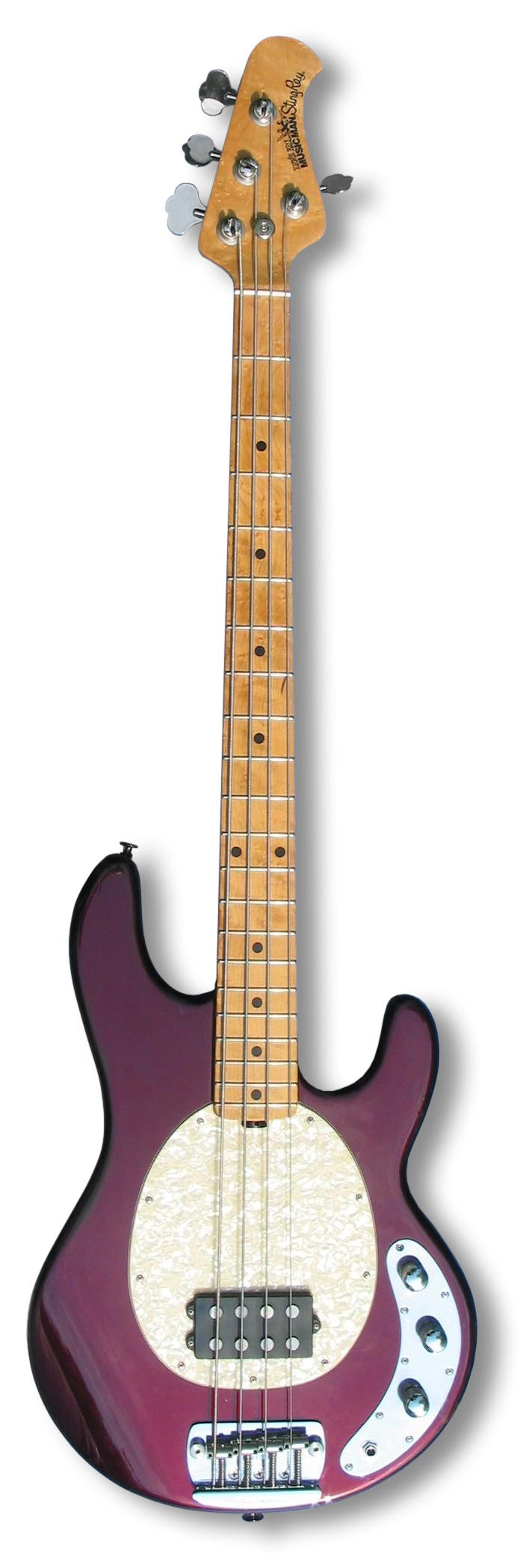
Photo: Th. Ott / Wikimedia Commons / CC BY-SA 3.0 Music Man
StingRay
1976
Leo Fender wanted a wide, bright bass. Louis Johnson hit it with his thumb, and funk had its sound.
- Send a picture
Spector
NS-2
1979
It started with a man looking for a belt sander. Sting found his lying on the stage before soundcheck.
- Send a picture
Music Man
Silhouette
1986
People laughed at Music Man’s first guitar. Then Keith Richards picked one up.