Music Man
JP6
Shaped to fit one shredder’s forearm, it became the secret weapon of a pop band’s guitarist.
The JP6 was John Petrucci’s first Music Man, a basswood guitar with a scoop cut where his arm rests. A teenager bought an early one with money his grandmother left him, and it ended up the backbone of a lot of The 1975’s guitar parts.
- Introduced
- 2001
- Type
- Solidbody electric
- Class
- Production
Have a photograph of this guitar? Send a picture
The short version
2000
The partnership
Petrucci starts working with Music Man, by his count more than eleven years before 2011.
2001
The JP6
The first John Petrucci signature from Ernie Ball Music Man is released.
2006
Piezo, and a new bridge pickup
A review guitar already has the piezo option, and a DiMarzio D Sonic at the bridge.
2009
LiquiFire and Crunch Lab
DiMarzio introduces the pair Petrucci uses throughout Black Clouds & Silver Linings. They become the JP6’s pickups.
2010
The sisters arrive
The JPX marks ten years with the company. More JPs follow, and the JP6 stays on sale.
2021
Twenty years
Music Man marks two decades of the line with a limited mahogany JP. A different recipe.
Side A
A1
Hand cream on a forearm
Sterling Ball rubbed hand cream on John Petrucci’s forearm and handed him a prototype. Petrucci played. The cream left a mark on the body where his arm rested, and the angle of it told them where to cut.
That cut stayed.
“The very first signature guitar that I developed with Music Man,” Petrucci calls it. It was released in 2001, though the partnership had started earlier. A guitar fitted that carefully to one man’s arm should belong only to him. It didn’t work out that way.
A2
Not the Ibanez
Before Music Man, Petrucci’s signature was an Ibanez, the JPM. The JP6 had to be something else, and it was. A basswood body, “no maple top,” 24 frets on a 15-inch board, and a floating vibrato that isn’t a Floyd. You don’t have to cut the ball-ends off your strings, the way the JPM’s Edge Pro made you. The case even had a cutout so the arm could stay on.
The pickups sit directly in the wood, no rings, so his pinky can rest under the bridge pickup. The neck is a round C, slightly thicker than the Wizard on the old Ibanez, closer to a vintage Strat. Five bolts and a sculpted heel.
The angle of it told them where to cut.
A3
The middle position
The interesting sound is in the middle of the three-way switch. Bridge is bridge, neck is neck. In the middle, one review heard only the inside coils of each humbucker, in parallel: quieter than a full humbucker, and brighter than the old Ibanez’s middle. Adam Hann, who plays an early JP6, calls his middle coil-split and out of phase. Both stay.
The pickups changed along the way, and nobody published a memo. The first JP6s had two DiMarzios wound for the model. By 2006 a review guitar had a D Sonic at the bridge. In 2009 DiMarzio introduced the LiquiFire and the Crunch Lab, which Petrucci used throughout Black Clouds & Silver Linings, and those became the JP6’s pair. A piezo bridge, for an acoustic voice on the same guitar, was already an option by 2006.
Flip the record · By the numbers
24
Stainless frets on a 15-inch radius board.
5
Bolts in the sculpted neck joint.
$2,275
List price in a 2006 review, for a Pearl Redburst with piezo.
7 lb 4 oz
The factory’s weight for a JP6. It varies.
Side B
B1
The sisters
Then came the sisters: the BFR, the JPX in 2010, the JPXI, the JP15, the JP16, the Majesty in 2014. Petrucci said in 2011 that a new model didn’t retire the old one, and his rig that year mixed a JP6 with a JPXI, a BFR, and seven-strings. So no Dream Theater record gets pinned on the JP6 alone. He used it. He wasn’t only using it.
In 2021 Music Man marked twenty years of his guitars with a limited JP in mahogany and figured maple. A different recipe. In October 2026, the factory’s JP6 page was still up.
B2
The secret weapon
Adam Hann bought an early JP6 as a teenager, with an inheritance from his grandmother, during a metalhead stretch. When his band started, the guitar went away.
The band was The 1975. On their second album, their manager told him to bring it. It became, in Hann’s words, “the backbone for a lot of the guitar.” He calls it his “secret weapon” on “Me & You Together Song” and “I Like America & America Likes Me.” It wears custom Pollock paint, and a rubber washer holds its switch in the middle position.
He’s gone looking for another original, because the later electronics don’t sound the same. Once, someone from Music Man at a show told him to hand it over so the factory could figure out exactly what it was.
They cut that scoop to fit one man’s arm. It fit a teenager spending his grandmother’s money, too.
Put this on
You’ve read about it. Now hear it. Here’s what this guitar sounds like, and what to listen for.
Me & You Together Song
Adam Hann calls his early JP6 the secret weapon behind this one. Listen for the middle position, the one he holds in place with a rubber washer.
Find it on YouTube (opens in a new tab)I Like America & America Likes Me
Another song Hann credits to the JP6. Same guitar, same switch.
Find it on YouTube (opens in a new tab)
The cast
The people, and the specific guitars, that made the legend.
2001
John Petrucci
JP6, among his Music Man guitars
Of Dream Theater. The reason it exists. By 2011 his rig mixed a JP6 with a JPXI, a BFR, and seven-strings, so no album is pinned to the JP6 alone.
Sterling Ball
The JP6 prototype
Put hand cream on Petrucci’s forearm, had him play the prototype, and cut the scoop where the mark landed.
2020
Adam Hann
Early JP6, custom Pollock paint
Of The 1975. Bought as a teenager with an inheritance from his grandmother. He calls it his “secret weapon.” The middle position is held with a rubber washer.
Liner notes
Specs, construction, rarity, value, and every source we used.
Basswood, a forearm scoop, and 24 frets — Music Man’s JP6, Petrucci’s first San Luis Obispo signature, not an Axis and not the Ibanez.
- Body
- Basswood, double-cut, forearm scoop; no maple cap. 12-1/2" wide, 1-3/4" thick, 37" long (31.8 cm, 4.5 cm, 94.0 cm). Mix flagged.
- Neck
- Bolt-on select maple, 5-bolt sculpted joint; gunstock oil and hand-rubbed wax. Stealth Black: ultra-light satin polyurethane
- Fingerboard
- Rosewood; ebony on Stealth Black. 15" (38.1 cm) radius, 24 high-profile wide stainless. Hosted table: JP Shields. Mix flagged.
- Scale
- 25-1/2" (64.8 cm). Mix flagged.
- Pickups
- HH — DiMarzio LiquiFire (neck), DiMarzio Crunch Lab (bridge), direct-mount; Fishman Powerbridge piezo on the hosted bridge line
- Hardware
- Custom John Petrucci Music Man floating tremolo. Hosted table: matte-black piezo, hardened steel, Fishman saddles. Schaller M6-IND locking; headstock 5-7/8" (14.9 cm)
- Electronics
- 500k volume and tone, .022µF; 3-way toggle; 3-way piezo/magnetic when applicable. Graphite-acrylic cavity, aluminum control cover
- Finish
- High gloss polyester
- Nut
- 1-11/16" (43.0 mm) at nut, 2-1/4" (57.2 mm) at last fret. Material unpublished on the hosted table. Mix flagged.
Open the full research fileConstruction details, the complete player record, production numbers, dated value estimates, and sources
Hosted John Petrucci 6 (San Luis Obispo; music-man.com, fetched 12 October 2026). Factory mixed inch/mm flagged; no millimetres invented. The page highlight still says piezo saddles are optional. The spec table prints a piezo bridge. Casey Ball’s 2018 buying guide agrees with the highlight. Keep both. Buying-guide weight 7 lb 4 oz (3.29 kg), varies. MusicPlayers’ 2006 review guitar was under 7.5 lb. Do not average. A 2015 factory-video description prints dot inlays as standard and shields as optional; the hosted table prints JP Shields. Keep both. JP6 BFR, JPX, JPXI, JP12, JP13, JP15, JP16, JP7, and Majesty are sisters. Sterling by Music Man JP models are another brand. The Ibanez JPM is the previous signature. Axis, Silhouette, Cutlass, Reflex, StingRay, and Bongo are other slugs. No Gibson SKU.
Construction
The job was Petrucci’s guitar after the Ibanez. San Luis Obispo already had a 24-fret alder and a Floyd single-cut. What they catalogued in 2001 is neither. Basswood, no maple cap, a forearm scoop cut to his arm, 24 frets on a 15" board, two DiMarzios direct-mounted, and a floating trem that is not a Floyd. That is this guitar. Not Axis. Not the Silhouette. Not the JPM.
Casey Ball’s buying guide (26 March 2018): the first Ernie Ball Music Man John Petrucci signature, the JP6, was released in 2001. The April 2017 Majesty post says the same launch. May 2021’s 20th-anniversary instruments count twenty years of that line. The work started earlier. Petrucci, to Joe Charupakorn (Premier Guitar, 20 September 2011): he had been with Music Man “over 11 years ago.” NAMM 2010 billed the JPX as a 10th anniversary with the company. Keep the partnership ahead of the catalog guitar. This plate starts in 2001.
He tells the scoop in the factory film (Ernie Ball, 21 April 2015). The JP6 is “the very first signature guitar that I developed with Music Man.” Sterling Ball put hand cream on his forearm and had him play a prototype. The mark was the angle. That cut stayed. The humbuckers are direct-mounted, no rings, so the pinky can sit under the bridge pickup. Maple neck, rosewood board, basswood, “no maple top.” The buying guide’s weight is 7 lb 4 oz. It varies. One review guitar is not a second official weight.
The neck is why it isn’t an Ibanez. MusicPlayers (6 October 2006), on a Pearl Redburst: a round C, slightly thicker than the Wizard on his old JPM, closer to a vintage Strat, flat enough that bends didn’t choke. Five bolts, a sculpted heel, a truss rod you adjust without pulling the neck or the strings. Headstock the Silhouette’s length, 5-7/8", not the longer Cutlass headstock of 2016. The trem is Music Man’s floater. You don’t cut the ball-ends off, the way the JPM’s Edge Pro made you. The case had a cutout so the arm could stay on.
The middle position is the wiring argument. MusicPlayers: bridge, neck, and in the center only the inside poles, in parallel. Quieter than a series humbucker. Same three-way idea as the JPM, which carried an Air Norton and a Steve’s Special. On the D Sonic JP6 they had, that middle was brighter than the Ibanez middle, and brighter than the previous JP6’s custom bridge. Adam Hann describes his own early middle as coil-split and out of phase. Keep both. The washer on his switch is his. See Players.
Pickups moved, and nobody published a change-order. DiMarzio: from the mid-1990s his neck was an Air Norton, or the custom in the Ernie Ball guitars. MusicPlayers, October 2006: earlier JP6s had two humbuckers wound for this model; the review guitar had a D Sonic at the bridge, the custom still at the neck. 2009. LiquiFire (neck, Alnico 5, 10.75 kΩ, output 300) and Crunch Lab (bridge, ceramic, 11.03 kΩ, output 410). Both DiMarzio pages: he used them throughout Black Clouds & Silver Linings. Crunch Lab looks like a D Sonic and is not one. He prefers the bar toward the neck, including on the JP baritone. The hosted table is this pair. Not the JPM’s Air Norton and Steve’s Special. Not a later Illuminator.
Piezo splits the same slug. Hann, and Matt Owen (25 October 2022): the original was magnetics, a 3-way, volume, and tone. Later guitars added a piezo toggle and a piezo volume. MusicPlayers already had one in October 2006 — third knob, rear trims, two jacks. The 2015 video description still prints chrome standard, piezo optional. Ball, 2018: optional here, standard on the BFR. The hosted page still disagrees with itself. See the caption.
BFR is the other body. Ball: alder, maple top, mahogany tone block — or koa on mahogany. Piezo standard. Polyester neck. 12-3/8" wide, not 12-1/2". 8 lb 7 oz, varies. Premier Guitar (24 April 2009): MSRP $4,199, Drop Sonic and HH-1 Custom on that review guitar. The 2017 Rooney note names LiquiFire and Crunch Lab on a BFR. Sister.
The later names are sisters too. 2010 JPX: chambered alder, maple top, mahogany block, 5-way. 2011 JPXI: no chambers, 20" radius. JP12 is basswood again, with a cap and a block, still 20". JP13 adds the boost and Illuminators, radius 17". JP15 is African mahogany and a roasted cap. 2016 JP16 keeps the scoop and the basswood, then fits a Floyd Rose 1000 Pro (buying guide; Guitar World, 22 January 2016, says Pro Series), Illuminators, 20 dB, and a 17" roasted neck. 2014 Majesty is another shape, neck-through. The 2021 anniversary JP is Honduran mahogany, a figured maple top, a mahogany neck, the same two DiMarzios, piezo, and 20 dB. $3,799 for the six-string (MusicRadar, 18 May 2021). Not this wood. JP7 is seven strings. Sterling’s JP50, JP60, and JP100 are another brand.
Petrucci told Charupakorn they keep a model on sale when the next one appears. That was 2011. The JP6 URL still served this spec on 12 October 2026. No factory end date in the sources here.
Classic vs current: 2001 basswood, custom DiMarzios, no piezo yet — against the hosted page, same body, LiquiFire and Crunch Lab, and a table that prints the piezo bridge. Not a BFR. Not a JP16. Not a Majesty. Not an Axis.
Players
Do not hang an Axis, a Silhouette, a Cutlass, a Reflex, a StingRay, or a Bongo here. The Ibanez JPM, the JP7, the BFR, the JP16, and the Majesty are other guitars. Joe Don Rooney’s CMA Fest instrument (Ernie Ball, 18 August 2017) is a JP6 BFR. Terminal Velocity is other signatures too: an Emerald Green Enchanted Forest and a Majesty Purple Nebula, Rainmaker and Dreamcatcher (Guitar World, Jon Wiederhorn, 7 January 2021). The Ibanez years stay on the Ibanez.
John Petrucci (Dream Theater). The reason it exists. DiMarzio: the LiquiFire and Crunch Lab, the hosted pair, are what he used throughout Black Clouds & Silver Linings. The pickups, on his Music Man guitars. Not one serial on every track. By A Dramatic Turn of Events the boat was already mixed. Charupakorn’s gearbox: a JPXI, a BFR, and a JP6, plus 7-strings and a baritone BFR. The photo is “one of his Music Man JP6 guitars” (Michael Hurcomb). He used it. He was not using only it.
Adam Hann (The 1975). The player who made an early JP6 a pop guitar. Gregory Adams (Guitar World, 9 July 2020): bought with inheritance from his grandmother, as a teenager, in a metalhead stretch. Custom Pollock paint, listed next to a Master Design Strat, a Jaguar, and a pair of Fanos. He calls it the “secret weapon” behind “Me & You Together Song,” and behind “Girls” and “I Like America & America Likes Me.” He calls that middle coil-split and out of phase. MusicPlayers heard inside coils in parallel. Keep both. Stan Bull (24 November 2022): it went away when the band started; on the second album the manager said bring it; it became “the backbone for a lot of the guitar” tracks. A rubber washer holds that switch in the middle. Adams: they hunted for another original, because later electronics don’t sound the same, and a Music Man person at a show told him to hand the guitar over so the factory could say what it was. Owen (25 October 2022): 2019 Lollapalooza footage. One object. Not a stock piezo JP6.
Also known to play stays short. No second name on this basswood guitar in the sources used here. None invented.
Rarity
Petrucci said in 2011 that a new JP model did not retire the old one. Ernie Ball Music Man does not publish JP6 totals. None invented. Serials date a guitar. They don’t count a year, which is why a first-year census is unknown.
What is thinner: a 2001 basswood guitar from before the piezo cavity, with the custom DiMarzio pair rather than a D Sonic or the 2009 set. Hann’s Pollock JP6 is that kind of object. One guitar. The 20th-anniversary JP had a limited ordering window and a signed certificate. No piece-count was published. Don’t invent one. It is mahogany and a flame top anyway. BFR, JPX through JP16, Majesty, the JP7, and Sterling’s JP are other guitars. They are not a 2001 JP6.
Sweetwater’s Stealth Black page, 12 October 2026, says that JP6 is no longer available. The factory spec page is still up. Reverb’s 2001–2021 line is the card, not a memo. No new basswood JP6 on a cart this pass. That is stock. It is not a factory total.
Value
Informal estimate, 12 October 2026. Not an appraisal.
Ask vs sold labeled. Celebrity lots are not-comps. No invented medians or factory counts. The Reverb Price Guide did not print a USD band on the static UK and Japan fetches this pass. Flag: thin sold-comp access on a live USD widget. A search retrieval of the same card printed $1,149–$2,046, 493 orders, Good to Mint, marketplace years 2001–2021. That retrieval, not a hammer watched on this date.
New street. None for the basswood JP6 this pass. Sweetwater’s Stealth Black page: no longer available, no guitar price. Historical, not 2026 street: MusicPlayers, 6 October 2006, prints $2,275, street under $1,600 for Pearl Redburst with a matching headstock and piezo, and as low as $1,300 without either. Case included. The 20th-anniversary six-string was $3,799 (MusicRadar, 18 May 2021) — mahogany, flame top, boost. Labeled adjacent. BFR MSRP $4,199 (Premier Guitar, 24 April 2009) is the other body. Don’t borrow either as the JP6.
Used modern. Named solds on that retrieval, not a midpoint: 2 December 2025 Very Good $1,850; 28 November 2025 Very Good $1,795; 8 November 2025 Mint $1,800; 7 November 2025 Very Good $2,500; 3 November 2025 Excellent $1,750; 25 October 2025 Excellent $1,444.15; 24 October 2025 Very Good $1,150. Do not average them. Named ask this pass, not a hammer: 2006 Pearl Redburst, Excellent, £1,879 (Express Music, Reverb UK), serial G33711, seller’s weight 8.1 lb, frets replaced with Jescar stainless. Modified. Not a stock-fret comp.
Vintage / collectible. A 2001 production guitar. Pre-piezo, custom-DiMarzio examples are the scarce end of the same slug, not a second model. Hann’s Pollock guitar is unique. Not a comp. The anniversary mahogany and the BFR are different recipes. Not a vintage JP6.
See also
- music-man-axis — SLO’s other basswood rock guitar; maple cap, Floyd, 22 frets, not this scoop
- music-man-bongo — John Myung’s Music Man bass in the same band; not this guitar
- music-man-silhouette — the first Ernie Ball guitar; 24 frets, alder, HSH, not Petrucci’s
Sources
- Ernie Ball Music Man: John Petrucci 6 — hosted table, 12 Oct 2026; basswood; 12-1/2" / 31.8 cm; 25-1/2" / 64.8 cm; 15" / 38.1 cm; 1-11/16" / 43.0 mm; LiquiFire and Crunch Lab; Fishman piezo on the bridge line; highlight still says piezo is optional; JP Shields; oil/wax vs Stealth Black satin; mixed inch/mm
- Ernie Ball Music Man: John Petrucci buying guide (Casey Ball, 26 March 2018) — JP6 released 2001; basswood; optional piezo; 15" radius; BFR woods and 8 lb 7 oz; sister specs for JPX through Majesty; JP6 weight 7 lb 4 oz
- Ernie Ball Music Man: Monarchy Majesty pre-order (Casey Ball, 4 April 2017) — line starts with the JP6 in 2001; Majesty initially introduced 2014
- Ernie Ball: John Petrucci demos the JP6 — 21 April 2015; first signature with Music Man; hand-cream prototype; direct-mount; no maple top; Crunch Lab and LiquiFire on that guitar; description prints chrome trem standard, piezo optional, dots standard
- MusicPlayers, 6 October 2006 — under 7.5 lb; 15" / 1-11/16" / round C vs Wizard; inside coils in parallel; custom DiMarzios then D Sonic bridge; piezo option already shipping; $2,275 / under $1,600 / as low as $1,300; JPM is the previous guitar, Edge Pro
- DiMarzio: Crunch Lab — introduced 2009; Black Clouds & Silver Linings; ceramic; 11.03 kΩ; looks like a D Sonic, isn’t; bar toward the neck
- DiMarzio: LiquiFire — introduced 2009; same album; Alnico 5; 10.75 kΩ; mid-1990s neck was Air Norton or the custom Ernie Ball version
- Premier Guitar, Joe Charupakorn, 20 September 2011 — working with Music Man “over 11 years ago”; models kept on sale; gearbox lists JPXI, BFR, and JP6; photo of a JP6
- Premier Guitar, NAMM 2010 JPX — 10th anniversary with Music Man; chambered alder, maple top, mahogany block; LiquiFire and Crunch Lab
- Premier Guitar, 12 January 2011 — JPXI; 20" radius; solid alder, mahogany block, maple top
- Premier Guitar, 24 April 2009 — BFR review; MSRP $4,199; Drop Sonic and HH-1 Custom on that guitar
- Premier Guitar, 21 May 2021 — 20th anniversary of the John Petrucci signature guitar; limited JP and Majesty
- MusicRadar, Jonathan Horsley, 18 May 2021 — 20th JP is mahogany, figured maple, mahogany neck, piezo, boost to 20 dB; six-string $3,799
- Guitar World, 22 January 2016 — JP16 keeps the JP6 arm scoop, then a Floyd, Illuminators, 17" radius; sister
- Guitar World, Gregory Adams, 9 July 2020 — Hann’s early JP6; grandmother’s money; Pollock paint; “secret weapon”; named songs; split and out-of-phase in his telling
- Guitar World, Stan Bull, 24 November 2022 — second album; “backbone”; washer on the switch
- Guitar World, Matt Owen, 25 October 2022 — original-run electronics vs later piezo; 2019 Lollapalooza
- Guitar World, Jon Wiederhorn, 7 January 2021 — Terminal Velocity on other signatures; Rainmaker and Dreamcatcher; not this set
- Premier Guitar, 2 February 2011 — Sterling JP100 and JP60; another brand
- Ernie Ball Music Man: Joe Don Rooney, 18 August 2017 — BFR at CMA Fest; not this basswood guitar
- Sweetwater: JP6 Stealth Black — no longer available, 12 Oct 2026; no guitar price on the page
- Reverb: John Petrucci Signature JP6 — card years 2001–2021; USD widget blank on static UK/JP fetches; search retrieval $1,149–$2,046 / 493 orders; named 2025 solds; UK ask £1,879 on a refretted 2006
Keep digging
Guitars this one gets compared to, confused with, or descended from.
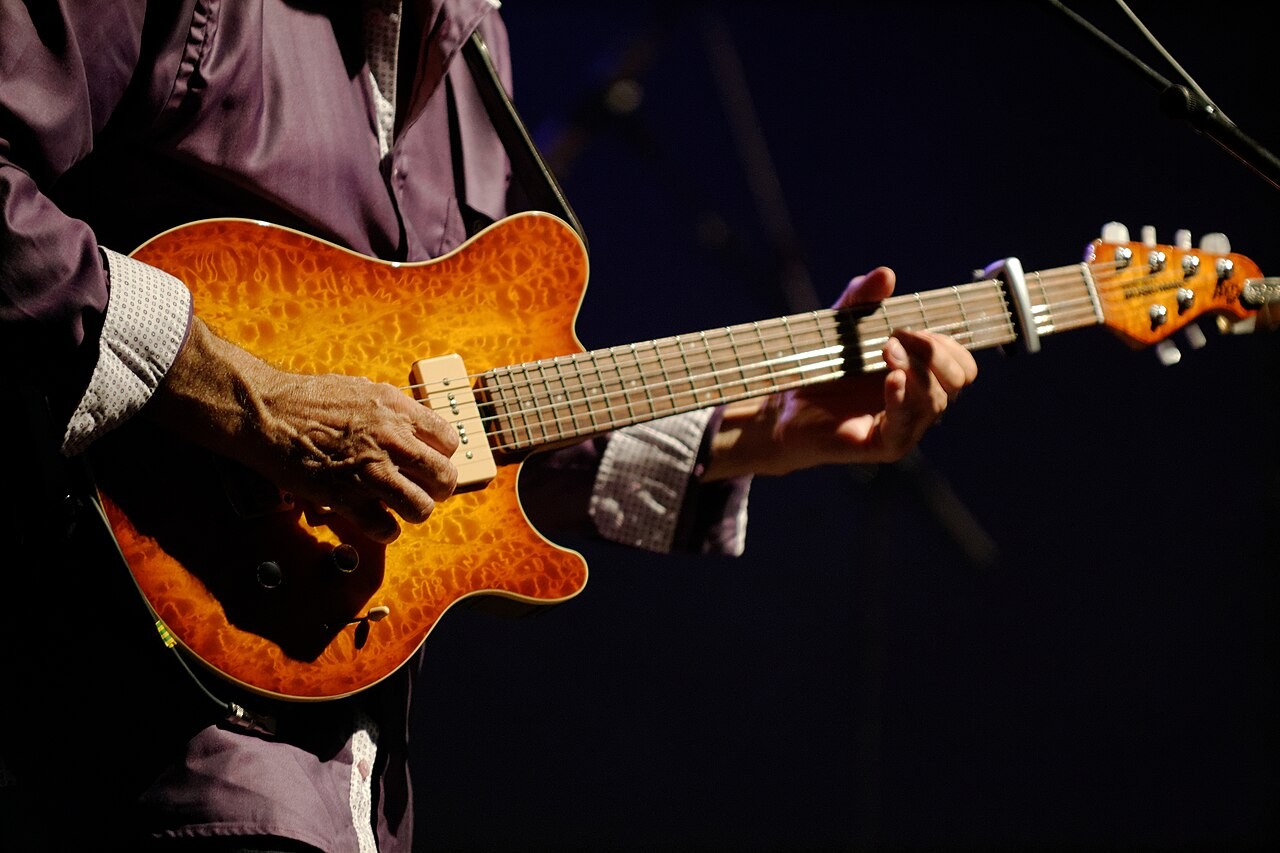
Photo: Kergourlay / Wikimedia Commons / CC BY-SA 3.0 Music Man
Axis
1991
They copied the neck off Eddie Van Halen’s worn-out Kramer. Then Eddie left, and the guitar stayed.
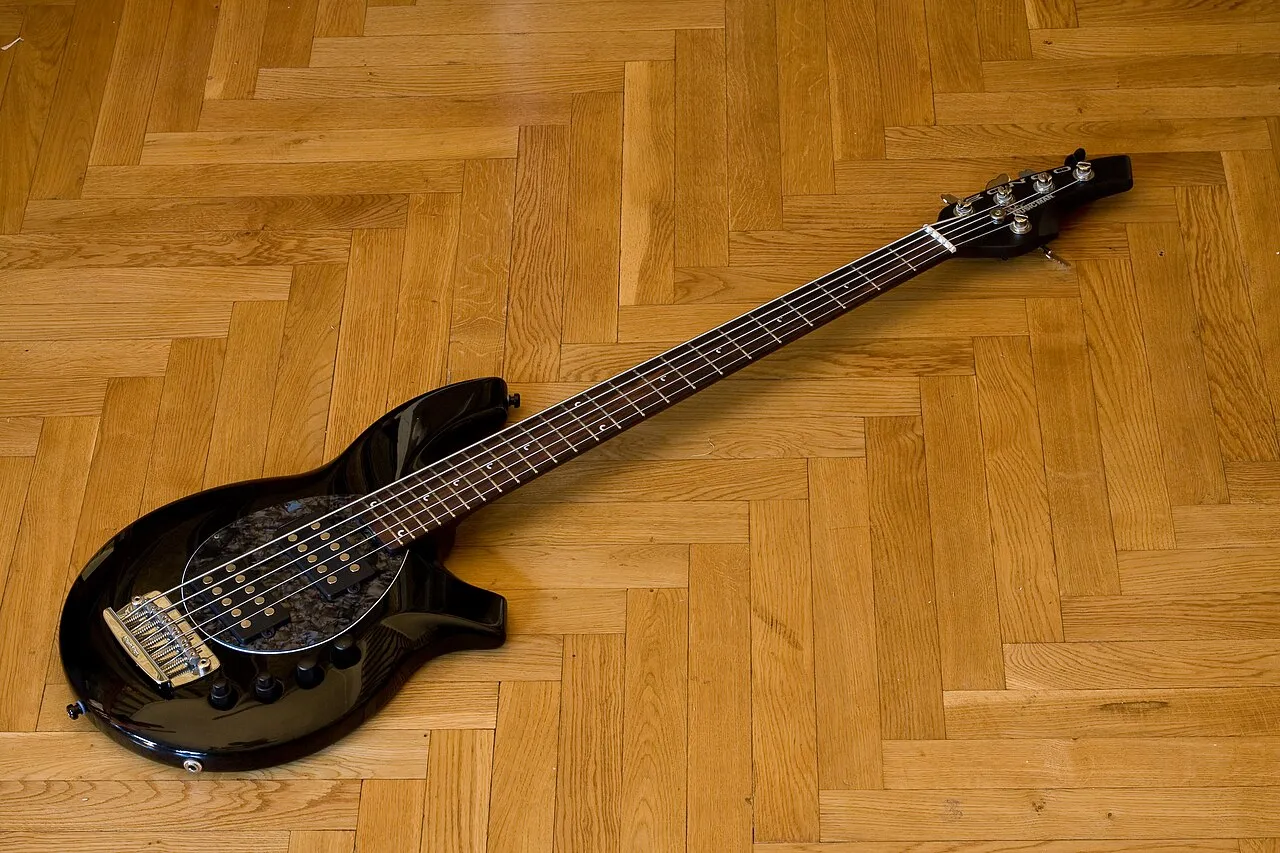
Photo: Serguei Trouchelle / Wikimedia Commons / CC BY-SA 3.0 Music Man
Bongo
2003
Sterling Ball asked BMW’s design studio for a bass. People thought he’d lost his mind. It’s still in production.
- Send a picture
Music Man
Silhouette
1986
People laughed at Music Man’s first guitar. Then Keith Richards picked one up.