PRS
Santana
Paul Reed Smith kept building guitars for Carlos Santana until Santana called him a guitar maker.
1976. Paul Reed Smith is a young Maryland guitar builder who wants Carlos Santana to play one of his guitars. Santana is already a star, and he has just started with Yamaha. He says no. Smith keeps coming back, and the guitar that finally wins Santana over becomes the template for this one.
- Introduced
- 1995
- Type
- Solidbody electric
- Class
- Production
Have a photograph of this guitar? Send a picture
The short version
1976
First no
Smith meets Santana, who has just started with Yamaha. He isn’t interested.
1980
The order
Fall, Merriweather Post Pavilion. A maple-top is delivered in thirty days, that November.
1984
The tremolo patent
Santana asked for a vibrato that stayed in tune. Smith and John Mann patent one.
1987
Blues for Salvador
Santana records the title track on “one of my custom PRS models.”
1995
The Santana Model
The first formal PRS signature. The first 100 are signed and numbered.
1999
Supernatural
Santana’s modified signature, nicknamed Salmon, plays almost all of the album.
2001
The SE
A cheaper Santana, PRS’s first guitar made outside Maryland, for $738.
2017
Santana Retro
The signature returns to the core line, copied from a pre-factory guitar.
Side A
A1
The answer was no
Paul Reed Smith met Carlos Santana in 1976. Santana had just started playing Yamahas, and he said no.
There’s another version of that night, or maybe another night. In Washingtonian’s telling, it’s the Capital Centre in Landover, Maryland, on a bill with Return to Forever. Smith has the Frampton guitar with him. Al Di Meola orders one. Santana doesn’t.
Either way, Smith didn’t go home and give up. His next offer was the kind you make when you’re young and sure: the next guitar would cost $2,000 if Santana fell in love with it, and nothing if he didn’t.
Most famous signature guitars start with a star signing a contract. This one started with a young builder refusing to take no for an answer.
A2
Thirty days in 1980
The order finally came in the fall of 1980, at Merriweather Post Pavilion. Smith brought an all-mahogany prototype that night. Santana wanted maple on top, and picked it out of a scrapbook. Smith delivered the guitar in thirty days, in November 1980. It was only the third maple-top he’d ever made.
That still wasn’t the end of the audition. How many guitars it took depends on who you ask. One account says four before Santana would call him a real maker, and that the early ones were “accidents of God.” In a 2026 interview Smith says it took three years, and it was the fifth one that got the words he wanted:
OK, you’re a guitar maker.
A3
A tremolo that stayed in tune
Then Santana asked for something hard: a vibrato that stayed in tune and wasn’t a locking system. Smith said yes, hung up the phone, and realized he didn’t know how to build it yet.
He figured it out. A roller nut, locks on the tuners, knife edges, and the string ends seated right by the saddles. PRS patented the design in 1984, with John Mann. It’s a little funny, because Santana’s famous solos barely touch a whammy bar. The tremolo is on his signature guitar because he asked for it, not because you hear it all over the records.
Flip the record · By the numbers
30
Days from order to delivery in 1980, for Smith’s third maple-top.
$2,000
Smith’s offer for the next guitar, if Santana fell in love with it. Free if he didn’t.
100
Signed and numbered at the start of the 1995 run.
$738
Retail for the 2001 SE Santana. The one a high-school player could buy.
Side B
B1
Blues for Salvador
By 1987 Santana was playing Smith’s guitars. He recorded “Blues for Salvador” on what he called “one of my custom PRS models.” That’s not the production guitar. There wasn’t one yet. It’s one of the customs the production model grew out of: his sound, on his guitar, eight years before anybody else could buy one.
B2
The Santana Model
In 1995 PRS finally put it in the catalog: the Carlos Santana Model, its first formal signature guitar. The support page says it “reproduces Santana’s original.” It had the older pre-’85 body shape, an eagle on the headstock, 24 frets, bird inlays, a shorter scale than the regular PRS, and paua shell around the edge of the top. The first 100 were signed and numbered.
That’s the whole design brief. Don’t invent a new guitar. Catalog the one he already played.
Santana kept playing modified versions. The one he calls Salmon was, in his words, “my Supernatural guitar,” on 99 percent of the 1999 album. Over the years the name split into a Santana II and a Santana III. In 2017 the signature came back to the core line as the Santana Retro, copied from a pre-factory guitar, down to the heel, the headstock, and the nut.
B3
For the kid in the back row
In 2001 PRS started its cheaper SE line, and the very first SE was a Santana. It was the first guitar PRS had built outside Maryland, and it retailed for $738. Santana said later that it took almost twenty years to get a guitar a high-school player could afford.
Santana took years to say yes to Paul Reed Smith. Then he spent almost as long asking for a version a high-school kid could buy. Smith had to earn his way to a Santana guitar. Santana made sure the next kid wouldn’t have to.
Put this on
You’ve read about it. Now hear it. Here’s what this guitar sounds like, and what to listen for.
Blues for Salvador
Santana says he played it on “one of my custom PRS models,” years before the production signature existed. It’s one of the customs the 1995 guitar grew out of.
Find it on YouTube (opens in a new tab)Supernatural
Santana calls the guitar nicknamed Salmon “my Supernatural guitar,” used on 99 percent of the album. It’s a modified PRS signature. On the track with Eric Clapton, both are on Strats.
Find it on YouTube (opens in a new tab)
The cast
The people, and the specific guitars, that made the legend.
1980
Carlos Santana
Custom PRS, then his signatures
Said no in 1976, ordered in 1980, and got the first formal PRS signature in 1995.
1976
Paul Reed Smith
Builder
Kept bringing guitars until Santana told him, “OK, you’re a guitar maker.”
1970s
Al Di Meola
A Smith custom
Ordered a guitar from Smith the night Santana didn’t.
1984
John Mann
Tremolo co-designer
On the 1984 patent for the vibrato Santana asked for.
Liner notes
Specs, construction, rarity, value, and every source we used.
Eagle on the headstock, 24 frets, and a scale that is not the Custom’s 25 inches — PRS’s Santana, the production shape of the guitar Paul built for Carlos, not a Custom 24.
- Body
- Solidbody; maple top with violin carve; mahogany back. Optional 10-Top
- Neck
- Set one-piece mahogany; Santana Retro; 7/8" at the 1/2 fret, 31/32" at the 12 1/2; PRS double-acting truss rod; eagle headstock. January 2025 Core book: rosewood headstock veneer
- Fingerboard
- Rosewood, 10" radius, 24 frets, bird inlays, PRS jumbo (.110" crown, .055" height)
- Scale
- 24.594"
- Pickups
- PRS Santana treble and bass humbuckers. Support pickup page: Alnico 4 treble, Alnico 2 bass
- Hardware
- PRS patented tremolo Gen III; Phase III locking tuners; nickel; Santana Om truss-rod cover. 10-Top: hybrid hardware
- Electronics
- Volume and tone; 3-way toggle
- Finish
- High-gloss nitro
- Nut
- PRS, 1 11/16"; body end 2 1/4"
Open the full research fileConstruction details, the complete player record, production numbers, dated value estimates, and sources
Current US Core Santana Retro (PRS electrics page, fetched 23 September 2026). The classic is the 1995–98 Carlos Santana Model: PRS support prints 24 1/4", 11.5" radius, paua purfling, twin mini-switches, pre-’85 body and eagle headstock. SE Santana is the import — not this table. Mixed inch/mm flagged. A 2018 Retro card (Nico-Nico) prints nut 43.1 mm and neck depths 22.2 mm / 24.1 mm against a stated 24.5" scale. Do not average those with 1 11/16" or 7/8" / 31/32". Sweetwater’s current Retro copy still says 24.5"; the factory page says 24.594". Do not average. Guitar World (Burrluck, February 2020) on the SE Santana Singlecut Trem — a different SKU — prints 622 mm (24.5"), nut 42.83 mm, radius 254 mm (10"). Not this Core table.
Construction
The job was to catalog the guitar Carlos already played. Not a Custom 24 with a different truss-rod cover. Shorter scale. Pre-’85 outline. Eagle. Twenty-four frets stayed. The 25" Core did not.
Smith met him in 1976 (Guitar World, Gill). Santana had just started with Yamaha and said no. Washingtonian (November 2006) is another night: Capital Centre, Landover, billed with Return to Forever, Smith carrying the Frampton guitar. Di Meola ordered. Santana did not. Later the next one was $2,000 if he fell in love with it, and free if he didn’t. That is 1980s custom money.
The order is fall 1980. PRS’s archive post: Merriweather Post Pavilion. An all-mahogany prototype that night, maple chosen from a scrapbook, delivered in thirty days, November 1980 — Smith’s third maple-top. Gill: four guitars before Santana would call him a maker; the early ones were “accidents of God.” Smith to Gabe Dalporto (Guitar World, 6 January 2026): three years, and the fifth got “OK, you’re a guitar maker.” Keep four and five. Keep both rooms. Neither object is a 1995 serial.
He wanted a vibrato that stayed in tune and was not a locking system (Guitar Player, October 2020). Smith said yes, hung up, and did not yet know how. Roller nut, locks on the tuners, knife edges, ball ends near the saddles. Patent 1984, with John Mann (PRS 35th timeline; Gen I about 1985–1995). That is why this signature has a trem the famous solos barely use.
1995. PRS support, Burrluck’s list, and the page says it may not be perfect: Carlos Santana Model, 1995–1998. “Reproduces Santana’s original.” First 100 signed and numbered. Pre-’85 body and headstock, eagle, 24 1/4", 24 frets, 11.5" radius, birds, maple with paua purfling, Santana humbuckers, tone, twin mini-switches. MusicRadar: that outline was not a production guitar until 1995. Wikipedia: first formal signature that year. This plate starts there. The 1980 maple-top is the template. It is not the SKU.
Not this guitar. Custom 24 (prs-custom-24): 25", Pattern Thin on the current Core, usually a 5-way, post-1985 headstock. CE 24 (prs-ce-24): bolt-on maple. McCarty (prs-mccarty): 22 frets, stoptail, Ted’s name. “Santana plays PRS” is not “that one is a Custom.”
Then the name splits. Santana II (1999–2007): similar, but a 3-way, volume and tone, artist-grade woods, Brazilian board and headstock overlay, eagle. Santana III, same row: 2000–current, 24 1/2", 10" radius, East Indian rosewood, wide-fat, covered Santana pickups, tremolo, volume and tone. The January 2025 Core book lists Retro, not III. Keep both. Brazilian 2003: 200 guitars, 24.5", 11.5", Brazilian neck and board, Santana III pickups, 10-top, gold/nickel, numbered backplate. Roadhouse’s 1998 Brazilian-board Santana I prints 24.5" and 11.5" against support’s 24 1/4". One card. Not a factory revision.
SE is the other factory. PRS blog, 9 February 2026: the line opens 2001 on the SE Santana, first guitar outside Maryland, retail $738, headstock “Santana SE,” slash inlays, flat mahogany. Santana (Guitar World, 30 November 2021): almost twenty years to get a student guitar a high-school player could buy. Premier Guitar, carrying the 21 September 2010 release: first SE at 24.5" and on the American silhouette — 22-fret wide-fat, carved maple, flame veneer. Current SE page: 24.594", 24 frets, bevel, multi-ply neck, Wide Fat at 7/8" and 61/64" (the Retro is 31/32" at the 12th), Santana “S,” molded tremolo, gig bag. Burrluck’s 2020 singlecut SE is a third guitar.
The living Core is the Retro. Press, 18 November 2016: the 2017 Core brings the signature back as Santana Retro, until then Private Stock only. Deeper carve, original heel, original headstock and nut, taken off a pre-factory guitar. Support’s row says 2018–present, 24.5", 11" radius. Nico-Nico’s 2018 10-top prints 10", 24.5", neck Santana and bridge 58/15, plus the millimetres in the caption. One guitar. PRS demo, 16 January 2024: scale moves to 24.594" starting in 2024. That walkthrough also says a bound board, original purfling, and covered Santana treble and bass. The live table prints 24.594" and 10" and does not print “bound.” Don’t invent the change. Don’t average 24 1/4" / 24.5" / 24 1/2" / 24.594".
Alnico 4 treble and Alnico 2 bass is the current pair (support pickup page), which also says the pair has been through many iterations. A 58/15 bridge on one 2018 is not the 2026 voice.
Players
Woodstock, 16 August 1969, is a red Gibson SG Special (gibson-sg-special). The Yamaha SG-2000 years are yamaha-sg-2000. The rainbow L-6S ads are gibson-l-6s. The 1991 Tom Anderson is not a PRS. Custom 24, CE 24, and McCarty are other plates. The gold-leaf singlecuts are not this double-cut.
Carlos Santana. Gill, 2020: the first PRS “wasn’t called that yet,” and “this model later became the Santana I.” “Blues for Salvador” (Blues for Salvador, 1987) was “one of my custom PRS models.” The production model does not exist yet. A 1987 solo is not a 1995 serial.
Supernatural (1999). Guitar Player, August 1999, while the record was new: still the signature PRS; with Eric, both on Strats. Guitar World, Sharma, 3 September 2025: the one he calls Salmon is “my Supernatural guitar,” 99 percent of the album. Keep both. Premier’s Rig Rundown (Ed Adair, Ryman, 23 April 2014): Salmon and Son of Salmon, locking saddles Paul drew and they fitted to Salmon. Modified signatures. Not a stock Retro, and not pinned to a Santana I or II card. Premier’s 2012 Shape Shifter box lists a Santana II. That is the 2012 rig. Not a credit for “Smooth.”
The later stage guitar is a singlecut. Burrluck, 2020: off the old double-cut, onto a gold-leaf Singlecut. Guitar World, 30 November 2021: that gold singlecut is Blessings and Miracles; he could not name the pickups. Vintage Guitar (Adams, 2022): the same gold-leaf guitar for the whole record, in use nearly ten years. Premier, January 2022: Vegas on three custom singlecuts, two gold-leaf and a red flame; the double-cut in the photo is labeled the earlier one. Private Stock cousins. Not the Core Retro. Not a 1995.
Also known to play stays short. No second name forced onto a catalog Santana this pass.
Rarity
You can order a new Core Santana Retro. It is regular US production, not rare. SE volume is another factory and should not be used to judge Core scarcity. PRS does not publish annual Santana unit counts. None invented.
What is actually thinner: the first 100, signed and numbered (PRS support) — the opening of a 1995–98 run, not the whole run. Brazilian 2003: 200, numbered. Private Stock Retros before the 2017 Core (PRS press) — no factory count on that program here. Support still has Santana III as current; the 2025 book does not list it. Used market is leftover I / II / III guitars plus Retros from 2017 on. Don’t invent a produced total for any chapter. Pre-factory maple-tops and Salmon are one-off objects. They are not a vintage Santana.
Value
Informal estimate, 23 September 2026. Not an appraisal.
Ask vs sold. Celebrity instruments are not comps. No invented medians or factory counts. The $2,000 custom deal (Washingtonian, 2006) and the 2001 SE retail of $738 (PRS blog) are period money. Guitar World, February 2020: Core Santana Retro “starts at $4,630”; SE singlecut $799. 2020 lists, not this street.
New street (US Core Santana Retro). Sweetwater, Santana Retro Orange, $5,040. Guitar Chalk’s vendor snapshot, 15 September 2026: Carroll Blue and Santana Yellow $5,040; 10-Top Orange $5,840. Sweetwater’s used-guide header lists a new 10-Top Santana Yellow at $5,840. Do not average a 10-Top with a standard top. SE Santana Yellow is not a Core comp: Sweetwater and zZounds $899; Guitar Chalk the same week $849. Do not average those two SE carts.
Used modern Core Retro. Reverb’s transaction history on Santana Signature Retro (the 2017–2023 guide; the dollar widget did not render on a direct fetch this pass): Excellent, 18 August 2026, $2,300; Excellent, 17 June 2026, $2,699; Mint, 2 December 2025, $3,800; Mint, 28 November 2025, $3,400; Excellent, 6 August 2025, $2,850; Excellent, 5 August 2025, $2,700; Excellent, 25 July 2025, $2,650. Named solds. Not a median computed here. Sweetwater’s Gear Exchange suggestion for a used 10-Top yellow is $3,796–$4,497 — a pricing-tool range, not those hammers. A 2024 yellow Excellent ask at $2,999 (Reverb, price-dropped from $3,200) is an ask. Don’t mix it into the sold list.
Vintage / 1995–98 / first 100. Thin public hammers this pass. Flag: thin sold-comp access. One named dealer sale, not a series: Roadhouse, a 1998 Santana I with a Brazilian board, signed headstock, $6,750 (page marked sold). Reverb’s 1995–98 guide did not print a dollar band on the fetch. Clean 2024–26 hammers for the signed first hundred were not extracted. Don’t invent one. Don’t use a six-year-old European ask, or a listing that says the guitar is a tribute and not a PRS.
Salmon, Son of Salmon, and the gold-leaf singlecut are his guitars. Not comps. A signed SE at Julien’s, 24 January 2020, $10,240, is a charity signature on an import. Not a Core Santana.
See also
- prs-custom-24 — 25" Core, post-1985 headstock; this signature is the other scale and the pre-factory outline
- yamaha-sg-2000 — the thick double-cut he played before the Maryland guitars
- gibson-sg-special — Woodstock, 16 August 1969; pointed P-90 Special, not a PRS
Sources
- PRS Santana Retro — current Core table; 24.594"; 10" radius; Santana Retro neck 7/8" / 31/32"; Gen III; Phase III; Om cover; eagle; high-gloss nitro; Santana / Santana; 10-Top hybrid option; fetched 23 September 2026
- PRS January 2025 Core price book (support attachment) — effective 14 January 2025; Santana Retro; 24.594"; rosewood headstock veneer; eagle; Santana treble and bass; 10-Top option. Santana III not on that signature list
- PRS Model History — Burrluck excerpt, “may not be 100% accurate”; Carlos Santana Model 1995–1998; first 100; 24 1/4"; 11.5"; paua; twin mini-switches; Santana II 1999–2007; Santana III 2000–current, 24 1/2", 10"; Brazilian 2003, 200 guitars, 24.5"; Santana Retro row 2018–present, 24.5", 11"
- PRS, Santana Retro press release, 18 November 2016 — 2017 Core; previously Private Stock; deeper carve, original heel, original headstock and nut
- PRS, The Santana Retro demo (16 January 2024) — scale 24.594" starting in 2024; walkthrough: bound board, purfling, covered Santana treble and bass, 10" radius
- PRS, How Has the SE Series Changed (9 February 2026) — SE Santana 2001; first guitar outside Maryland; retail $738; “Santana SE” headstock; slash inlays; flat mahogany
- PRS SE Santana — current import; 24.594"; 24 frets; bevel; flame veneer; Wide Fat 7/8" / 61/64"; multi-ply; Santana “S”; molded tremolo; gig bag
- PRS, About PRS Pickups — current Santana pair; Alnico 4 treble, Alnico 2 bass; iterations
- PRS, Meet the Model: Crossroads Pre-Factory Santana I — fall 1980, Merriweather; all-mahogany that night; maple ordered; thirty days; November 1980; third maple-top
- PRS 35th timeline — 1984 tremolo patent after Santana asked for a vibrato that stayed in tune; John Mann
- PRS, History of the Tremolo — John Mann Gen I, about 1985–1995
- Washingtonian, Guitar Heaven (1 November 2006) — Capital Centre; Return to Forever; Di Meola ordered; Santana did not; later $2,000 if he fell in love with it
- Guitar World, Gill, 35 PRS players (10 August 2020) — met 1976; Yamaha; order fall 1980; four guitars; “accidents of God”; “Blues for Salvador” (1987) on a custom; “later became the Santana I”
- Guitar World, Owen, Smith on Santana (6 January 2026) — fifth guitar; “you’re a guitar maker”
- Guitar Player, Treasures from the PRS Vault (19 October 2020) — non-locking tremolo request; roller nut, locks, knife edge
- MusicRadar, 30 years of PRS — 1980 maple-top No. 3; Santana outline not a production guitar until 1995; SE Santana 2001
- Premier Guitar, PRS Launches SE Santana (24 September 2010) — first SE at 24.5"; American silhouette; 22-fret wide-fat; carved maple and veneer
- Guitar World, Burrluck, SE Santana Singlecut Trem (21 February 2020) — 622 mm (24.5"); 42.83 mm nut; 254 mm radius; $799; Core Retro from $4,630; move to gold-leaf Singlecut
- Guitar World, Santana, Blessings and Miracles (30 November 2021) — gold singlecut on that album; almost 20 years to get student models
- Guitar World, Sharma, Santana (3 September 2025) — Salmon; “my Supernatural guitar”; 99 percent of the 1999 album
- Guitar Player, Santana on Supernatural (5 October 2023; interview August 1999) — still the signature PRS; Strats with Eric
- Premier Guitar, Rig Rundown: Carlos Santana (7 May 2014) — Adair; Salmon and Son of Salmon; locking saddles added to Salmon
- Premier Guitar, Shape Shifter (2 May 2012) — gear box: PRS Santana II
- Premier Guitar, Santana (3 January 2022) — Vegas custom singlecuts; photo called out as an earlier double-cut signature
- Vintage Guitar, Bret Adams, Carlos Santana (7 September 2022) — gold-leaf PRS for all of Blessings; nearly ten years
- Sweetwater, Santana Retro Orange — street $5,040; product copy still says 24.5"
- Sweetwater, used guide, Santana Retro 10-Top yellow — new header $5,840; suggested used $3,796–$4,497
- Sweetwater, SE Santana Yellow — $899; not a Core comp
- zZounds, SE Santana — $899
- Guitar Chalk, PRS price list (updated 15 September 2026) — Retro $5,040; 10-Top Orange $5,840; SE Santana Yellow $849
- Reverb, Santana Signature Retro 2017–2023 — transaction history cited above; product card still prints 24.5"; estimate widget did not render on a direct fetch
- Reverb, Carlos Santana Signature 1995–1998 — guide fetched; no dollar band this pass
- Nico-Nico / Gbase, 2018 Santana Retro 10-top — 24.5"; 10" radius; nut 43.1 mm; neck 22.2 mm / 24.1 mm; neck Santana, bridge 58/15
- Roadhouse Vintage, 1998 Santana I Brazilian — seller spec 24.5" / 11.5"; sold $6,750
- Wikipedia, PRS Guitars — signature production from 1995; SE series from requests for an affordable Santana
Keep digging
Guitars this one gets compared to, confused with, or descended from.
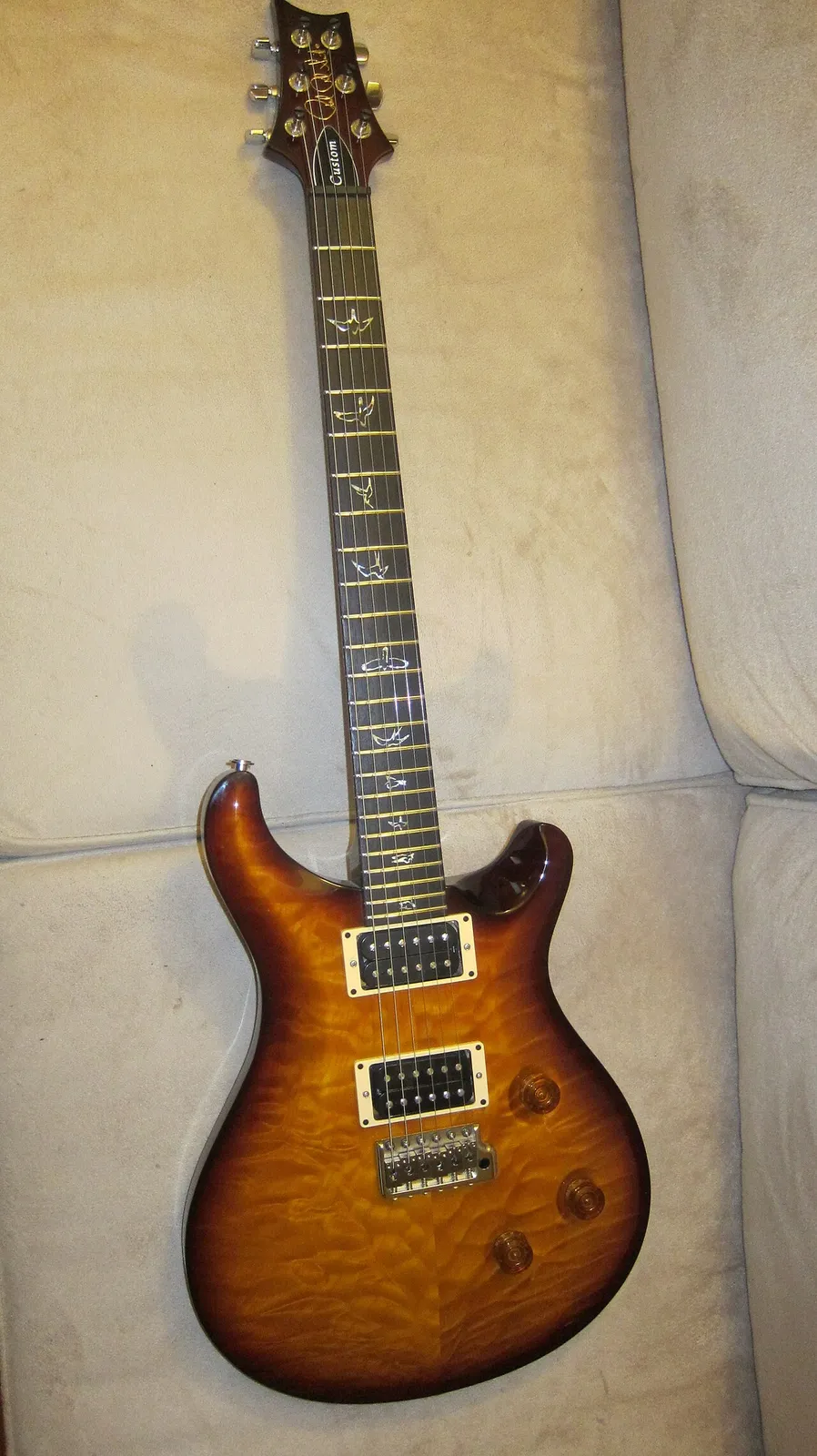
Photo: sbaimo / Wikimedia Commons / CC BY 2.0 PRS
Custom 24
1985
Paul Reed Smith spent a decade building guitars one at a time for touring stars. The Custom was for everybody else.
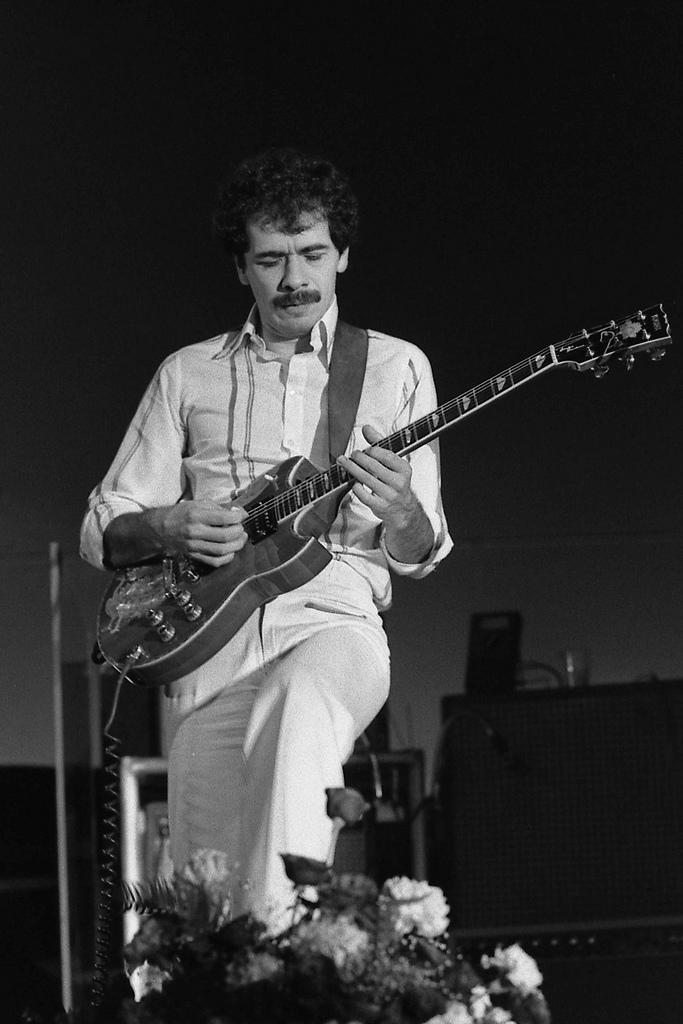
Photo: Chris Hakkens / Wikimedia Commons / CC BY-SA 2.0 Yamaha
SG-2000
1976
Santana told Yamaha to put a chunk of metal under the strings. They listened, and the notes stopped dying.
- Send a picture
Gibson
SG Special
1961
Townshend smashed them. Iommi stuck a monkey on one. Nobody was ever gentle with an SG Special.