PRS
CE 24
PRS meant it to be the cheaper, quicker one. Then a second-hand black one made Opeth’s Blackwater Park.
Opeth are making *Blackwater Park*, the record that comes out in 2001, and the guitar in Mikael Åkerfeldt’s hands isn’t a showpiece. It’s a black PRS he bought used from Anders Nyström of Katatonia. Not the fancy glued-neck Custom. The bolt-on one, the CE 24.
- Introduced
- 1988
- Type
- Solidbody electric
- Class
- Production
Have a photograph of this guitar? Send a picture
The short version
1988
The Classic Electric
PRS’s first factory bolt-on. Alder body, solid colors, no maple top, no birds.
1989
Just “CE”
Peavey objects to the word “Classic,” so the name gets shortened.
1995
Mahogany
A mahogany back replaces the alder.
2000
One Step Closer
Brad Delson is “pretty certain” his first PRS, a blue CE 24, is on Linkin Park’s first single.
2001
Blackwater Park
Åkerfeldt records it on a second-hand black CE 24. One account says every track but “Harvest.”
2009
Gone
Discontinued. PRS’s own dates say 2008 or 2009, depending on the page.
2016
Back
Revived in Stevensville with 85/15 pickups.
Side A
A1
The cheap one
Every guitar company has a flagship and a cheaper model, and the cheaper model is the one that ends up in real hands. It gets bought used. It gets passed between friends in bands. It gets played hard by people who can’t afford to be precious about it.
In 1988 Paul Reed Smith’s flagship was the Custom: a carved maple top, a glued-in mahogany neck, the full treatment. The new guitar was the Classic Electric, the first PRS with a bolt-on neck. It was supposed to be faster and cheaper to build, and it was sold as the cheaper way into a PRS.
The first ones don’t look much like what you’d picture. Alder bodies. Solid colors. No maple top, no bird inlays. PRS’s own account says the faster, cheaper part didn’t go to plan.
A2
Peavey had a problem with “Classic”
The name didn’t last either. Peavey objected to “Classic,” so by 1989 it was just the CE. Around the same time it started looking more like a PRS: maple tops, birds, and a black-faced headstock with Smith’s signature on it.
The body changed underneath. Alder came out in 1995, and a mahogany back went in, with one more alder chapter in 2008. The pickups turned over a few times along the way. So an early CE and a late one are two quite different guitars that happen to share three letters.
Alex Lifeson of Rush was drawn to it in the early ’90s.
A3
What the screws do
Here’s the whole difference in a sentence. The Custom has a mahogany neck glued into the body. The CE has a maple neck bolted on with screws. Almost everything else is familiar: the same 25-inch scale, 24 frets, birds, and on the current one a carved maple top over a mahogany back.
That’s not a cost-cutting footnote. To my ears, a bolt-on maple neck makes it a little quicker and snappier than the Custom, a bit more toward a Strat. The current one has PRS’s 85/15 pickups, a three-way switch, and a push/pull tone knob that splits the coils, which gets you six sounds. The neck has a satin finish, so your hand doesn’t stick to it.
It comes with a gig bag, where the Custom 24 gets a hardshell case. Consider it a hint about who PRS expects to be carrying it.
Flip the record · By the numbers
1st
PRS factory bolt-on. Every production PRS before it had a glued-in neck.
0
Maple tops and bird inlays on the very first Classic Electrics.
6
Sounds from a three-way switch and a push/pull tone knob.
7
Years off the line before it came back, by PRS’s own count.
Side B
B1
Somebody else’s black guitar
Now back to Opeth. Mikael Åkerfeldt bought a used black CE 24 from Anders Nyström, the guitarist in Katatonia. It became his main guitar, and it’s the one on Opeth’s Blackwater Park, released in 2001. “Bleak” is on it. One account says it’s every track except “Harvest.”
Åkerfeldt also has a couple of Custom 24s, a late-’80s blue one and a black quilted one, that he used in the studio later. They get mixed up with this story all the time. Blackwater Park is the bolt-on.
Meanwhile, Brad Delson of Linkin Park had bought his first PRS after seeing Mike Einziger of Incubus playing one. It was a blue CE 24. He’s “pretty certain” it’s on “One Step Closer,” from Hybrid Theory. That’s not a Custom 24 record either.
B2
Seven years off
PRS stopped making the CE around 2008 or 2009. Its own pages don’t agree on which, and I’m not going to referee.
In 2015 a few people at the company, Jack Higginbotham among them, decided to bring it back as a “tweaner,” something between the S2 line and the Core Standard. It returned in 2016, built in Stevensville, Maryland. Seven years off, by PRS’s count. (If the guitar in front of you says SE on the headstock, that’s the imported version, a different guitar with a veneer top.)
It never did become the flagship. It was never supposed to. It was the used one, the one a guy in another band would sell you, the one you bought after you saw somebody you admired playing a PRS. That’s how it ended up on Blackwater Park, and, if Delson’s memory is right, on “One Step Closer.”
Put this on
You’ve read about it. Now hear it. Here’s what this guitar sounds like, and what to listen for.
Bleak
Åkerfeldt says the black CE 24 is the guitar on Blackwater Park, and he names this song.
Find it on YouTube (opens in a new tab)Blackwater Park
The title track. One account puts the CE 24 on every song on the album except “Harvest.”
Find it on YouTube (opens in a new tab)One Step Closer
Brad Delson is “pretty certain” his first PRS, a blue CE 24, is on this one. Not a Custom 24 record.
Find it on YouTube (opens in a new tab)
The cast
The people, and the specific guitars, that made the legend.
2001
Mikael Åkerfeldt
Second-hand black CE 24
His main guitar at the time, and the one on Blackwater Park. His Custom 24s came later.
Anders Nyström
Previous owner
The Katatonia guitarist who sold Åkerfeldt the black CE 24.
2000
Brad Delson
Blue CE 24
His first PRS, bought after seeing Mike Einziger of Incubus with one.
early 1990s
Alex Lifeson
CE
The Rush guitarist was drawn to the CE in the early ’90s. No single record is pinned to it.
2015
Jack Higginbotham
The revival
One of the people at PRS who brought the CE back as a “tweaner” between the S2 and the Core line.
Liner notes
Specs, construction, rarity, value, and every source we used.
Bolt-on maple, 24 frets — PRS CE 24 — the guitar on Opeth’s *Blackwater Park*, not a set-neck Custom 24 and not an SE.
- Body
- Solidbody; maple top with violin carve; mahogany back
- Neck
- Bolt-on maple; Pattern Thin; scarfed; PRS double-acting truss rod; satin nitro
- Fingerboard
- Rosewood, 10" radius, 24 frets, bird inlays
- Scale
- 25"
- Pickups
- PRS 85/15 treble and bass humbuckers
- Hardware
- PRS patented tremolo; PRS low-mass locking tuners; nickel; “CE” truss-rod cover
- Electronics
- Volume and push/pull tone; 3-way toggle (six sounds with the coil-tap)
- Finish
- High-gloss nitro body; satin nitro neck
- Nut
- PRS, 1 11/16"; body end 2 1/4"
Open the full research fileConstruction details, the complete player record, production numbers, dated value estimates, and sources
Current US Core CE 24 (PRS electrics page titled CE 24 - 2024, fetched 25 August 2026). Premium gig bag, not the Custom 24 hardshell. SE CE 24 and SE CE 24 Standard are imported bolt-ons with 85/15 “S” pickups — not this table. Semi-hollow CE 24 and Floyd CE 24 are other Core SKUs.
Construction
Paul Reed Smith’s first factory bolt-on, 1988, as the Classic Electric. PRS support model history: CE24 1988–2008, 2016–present. PRS’s own “5 Fun Facts” blog says discontinued 2009, back seven years later. Keep both. The 2016 return is the living Core guitar, not a Custom 24 with screws.
Name. Peavey objected to “Classic.” Guitarist (Burrluck, Summer 2021): abbreviated to CE by 1989, later CE 24. Early 1988 Classic Electrics were a different object than the current maple-top Core: Burrluck — alder, opaque finishes, no maple tops, no birds, marketed as a cheaper bolt-on against the expensive set-neck Custom. Maple tops, birds, and a black-faced signature headstock arrive as the line is renamed. Do not hang a 2024 violin-carve Core photo on a 1988 Classic Electric.
Wood, pickups, carve — don’t flatten. PRS support: alder back 1988–1995 and 2008; mahogany back 1995–present (with alder again as a 2008 chapter). Pickups: Standard Treble/Bass 1988–1990; HFS/Vintage Bass 1991–2008; 85/15 from 2016. Current factory table is Pattern Thin. The support history still lists Wide Thin on the historic CE24 row — attribute, don’t pick. CE22 (1994–2008) is 22 frets, not this plate.
Why it existed. PRS blog (Jack Higginbotham): the 1988 CE was supposed to be faster/cheaper to build; it didn’t go to plan. 2015: Higginbotham, Judy, and Jim revive CE as a “tweaner” between S2 and Core Standard. Stevensville. Bolt-on maple neck is the identity. Set mahogany neck = prs-custom-24.
Not this guitar. SE CE 24 (maple veneer, Wide Thin, 85/15 “S”). SE CE 24 Standard (all-mahogany body, 2025 page). S2. Custom 24. Santana signatures (different scale/family). Fiore and other later bolt-ons are cousins, not this SKU.
Players
Mikael Åkerfeldt — second-hand black CE 24 on Opeth Blackwater Park (2001). Guitar World (Gill, 2020): bought from Anders Nyström (Katatonia); used to record the album (including “Bleak”). Guitar World (2026, 25th-anniversary interview): that black CE 24 was his main guitar then; he is “pretty certain” it was the bass the subway robber went for. Gearnews: every track except “Harvest.” Later late-’80s blue Custom 24 and quilted Custom 24 are other studio tools — they live on prs-custom-24, not as a reason to collapse this record.
Brad Delson (Linkin Park). Gill 2020: first PRS was a blue CE 24; he is “pretty certain” it is on “One Step Closer” (Hybrid Theory, 2000), after seeing Mike Einziger with a PRS. Do not file Hybrid Theory as a Custom 24 record. Einziger is a PRS player in that interview, not a documented Core CE 24 default here.
Alex Lifeson. PRS “5 Fun Facts”: CE attracted Lifeson in the early 1990s. Known-to-play; no named serial or album forced onto this plate.
Do not default Carlos Santana here. Do not default Ted Nugent / Custom 24 early adopters here.
Rarity
Current Core CE 24 is regular production, not rare. SE CE volume is a different factory and should not be used to judge Core scarcity. PRS does not publish annual CE 24 unit counts. None invented.
1988 Classic Electric / early CE (opaque, alder, no birds) is a short first-recipe window, not a korina-V census. 2009-or-2008 gap until 2016: used market is leftover 1988–2008 instruments plus post-2016 Core. Don’t invent a produced total for either chapter.
Value
Informal estimate, 25 August 2026. Not an appraisal.
Ask vs sold. No clean Reverb sold median extracted this pass. Don’t invent one. Åkerfeldt’s black CE 24 is a named object, not a comps tape.
New street (US Core CE 24). Sweetwater Core listings (25 August 2026 scrape) cluster about $2,699–$2,899. Below Core Custom 24 (~$4,690 typical). SE CE 24 ~$699 / SE CE 24 Standard ~$499 (Sweetwater) — not Core comps.
Used modern Core (2016–). Expect used to sit under current street; labeled 2024–26 solds were not isolated. Don’t invent a midpoint.
Vintage (1988–2008). Thin public hammers this pass. Early Classic Electric / maple-top CE 24s are a separate ask market from a 2024 Core. Don’t mix SE used averages into Core.
See also
- prs-custom-24 — set-neck Core 24; Blackwater Park is not that guitar
- fender-stratocaster — the bolt-on pole the original Classic Electric was aiming at
- gibson-les-paul-custom — Åkerfeldt also used Customs; Peter Lindgren’s 1973 Custom on that record is not this plate
Sources
- PRS CE 24 - 2024 — current Core spec table (maple/mahogany, 85/15, Pattern Thin, bolt-on)
- PRS Model History — CE24 1988–2008 / 2016–; alder vs mahogany; pickup eras
- PRS, 5 Fun Facts About the CE 24 — 1988 first maple neck; 2009 discontinue vs 2016 return; Lifeson; Higginbotham 2015 revival
- Guitarist / Burrluck, The Original Bolt-On — Classic Electric 1988, Peavey/CE rename, early opaque alder, 1994 mahogany
- PRS SE CE 24 — imported; not Core
- PRS SE CE 24 Standard - 2025 — all-mahogany SE
- Sweetwater PRS CE 24 series — Core ~$2,699–$2,899; SE bands (25 Aug 2026)
- Guitar World, 35 PRS guitarists (Gill 2020) — Åkerfeldt CE 24 / Blackwater Park; Delson CE 24 / Hybrid Theory
- Guitar World, Åkerfeldt on *Blackwater Park* 20 years — CE24 and Lindgren 1973 Custom
- Guitar World, Åkerfeldt 25th anniversary — black CE24 as main guitar; robbery
- Gearnews, Classic Albums: *Blackwater Park* — CE 24 except “Harvest”
- Axebition, History of the PRS CE — dealer timeline (1989 maple top; 2008 alder last year) — attribute, not factory census
Keep digging
Guitars this one gets compared to, confused with, or descended from.
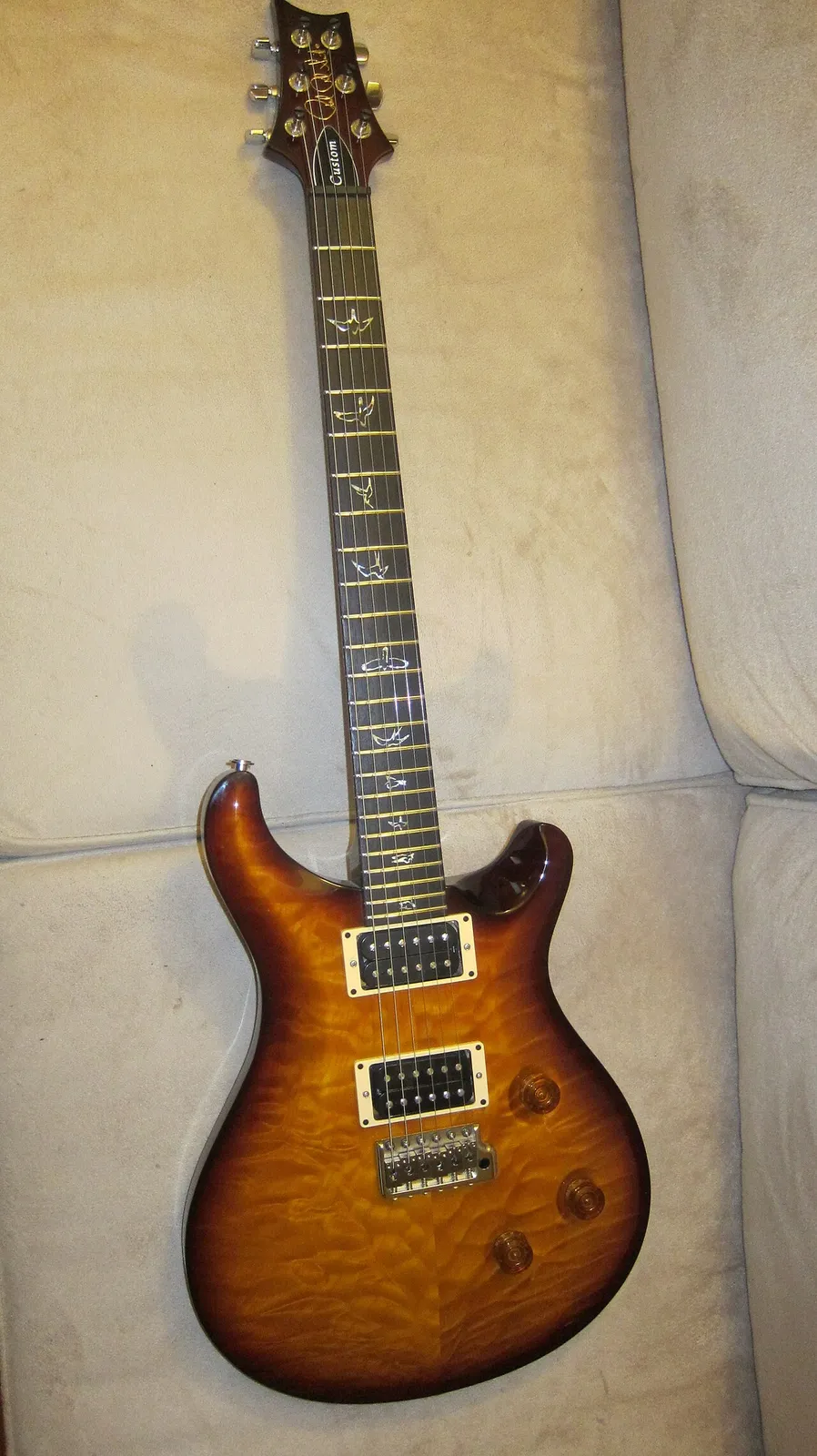
Photo: sbaimo / Wikimedia Commons / CC BY 2.0 PRS
Custom 24
1985
Paul Reed Smith spent a decade building guitars one at a time for touring stars. The Custom was for everybody else.

Photo: Lightburst / Wikimedia Commons / CC BY-SA 4.0 Fender
Stratocaster
1954
The guitar most people mean when they say “electric guitar.” Designed by a man who didn’t play one.
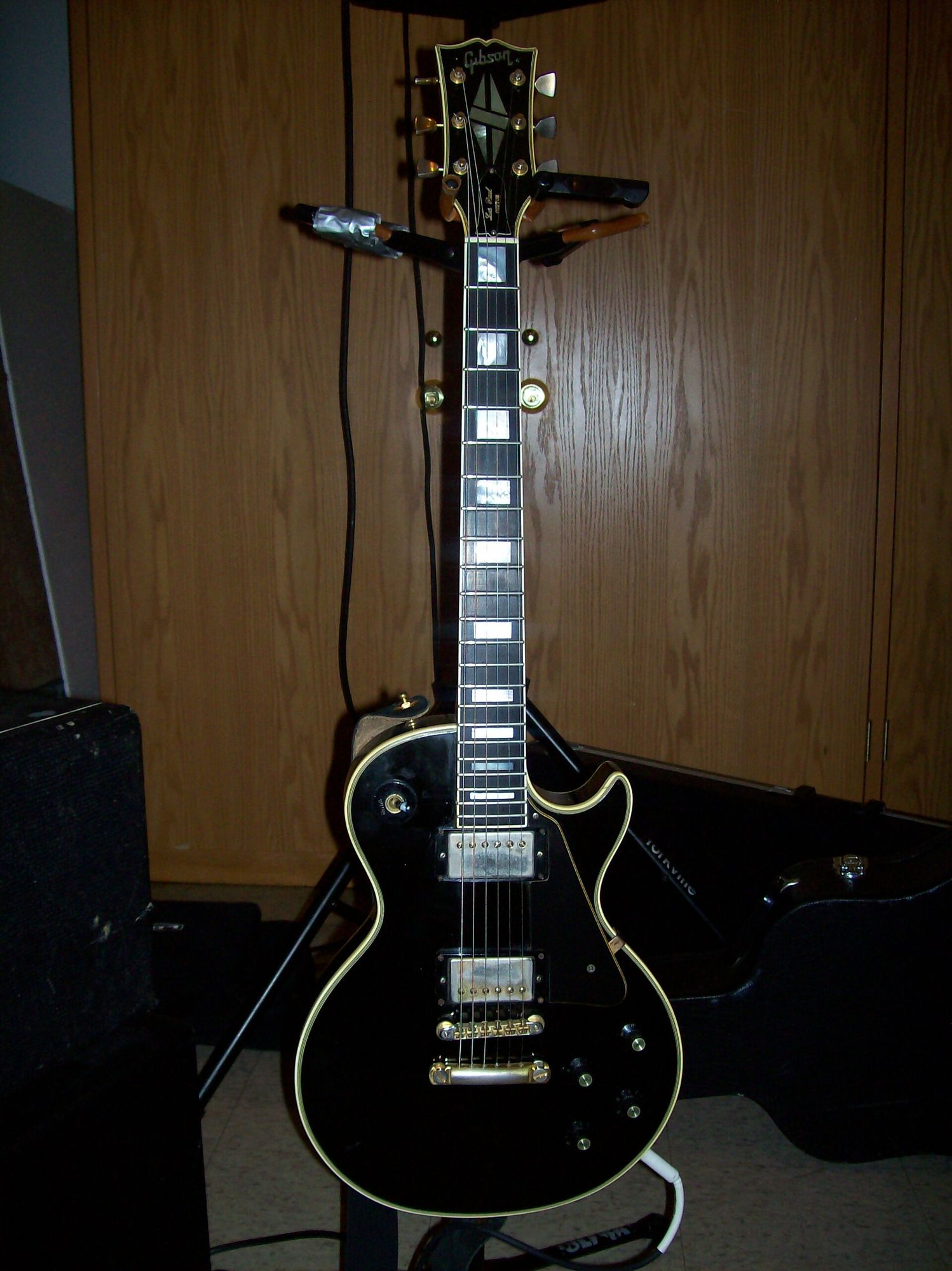
A 1974 Gibson Les Paul Custom guitar. Photo by Ibanez Guy. Licensed under CC BY-SA 3.0. Via Wikimedia Commons. Gibson
Les Paul Custom
1954
Jimmy Page paid his off in installments at 18. It was stolen in 1970. He got it back over 40 years later.