PRS
Hollowbody II
The quiet half of the song and the loud half, out of one hollow PRS with two jacks.
Matt Scannell writes Vertical Horizon’s songs on an acoustic, then has to play them with a band. Since 1998, PRS has carved a hollow guitar with maple on both sides of the air, and from 1999 it could carry a bridge voiced to act more like a soundhole.
- Introduced
- 1998
- Type
- Hollowbody electric
- Class
- Production
Have a photograph of this guitar? Send a picture
The short version
mid-1990s
A bridge at NAMM
Paul Reed Smith hears Lloyd Baggs’s X-Bridge and wants it on the McCarty and the Hollowbody.
1998
The hollows launch
The Hollowbody guitars and the McCarty Archtop arrive, carved from solid wood. The first piezo bridge goes into a Hollowbody II, shown that summer if memory serves.
1999
The piezo option
The piezo becomes an option on the Hollowbody, and the patent is filed in July.
2000
The patent
Dated August 29, with Krozack and Paul Reed Smith on the inventor line. Krozack remembers it as 1999.
2001
The fat cousin bows out
The deeper McCarty Archtop’s run ends. The Hollowbody’s doesn’t.
2019
A different Hollowbody II
The McCarty 594 Hollowbody II is announced, on a shorter scale. Its current page has no piezo.
2026
Standard equipment
The Core page lists the piezo as standard. Once an option, now the point.
Side A
A1
The song was written on an acoustic
Matt Scannell writes Vertical Horizon’s songs on an acoustic guitar. Then the band plays them, and the acoustic part has to go somewhere. Leave it out, he said in a PRS video in 2021, and it’s “almost disingenuous” to the song.
Scannell had watched Alex Lifeson do something else: blend a piezo with his electric sound, out of one instrument. (He remembers Lifeson’s as a bolt-on. That Rush guitar isn’t this one.)
What Scannell plays is a PRS Hollowbody II Piezo. He calls it “a sort of swiss army knife of guitars.”
A2
The II is the back
First thing to clear up: the II isn’t a second edition. It’s a piece of wood.
A Hollowbody I has a carved maple top and a mahogany back. The II adds a matching maple back, so you get maple, then mahogany sides, then maple again, with air in the middle. It came out in 1998 alongside PRS’s McCarty Archtop, and the f-holed hollows are credited to Joe Knaggs. They were carved from solid wood with CAD and CNC, not pressed from laminate.
The first ones were slim: an inch and three-quarters at the rim, three inches at the bridge. The Archtop was the fat cousin, deeper at both, and it was gone by 2001. The Hollowbody kept going.
It isn’t a 335 either. There’s no block running from top to back, just a small one to anchor the bridge. PRS’s own demo calls it fully hollow. A dealer’s description has that small block. Take both.
A3
Paul wanted a Martin in the bridge
In the mid-’90s, Paul Reed Smith heard Lloyd Baggs’s X-Bridge at NAMM and wanted it on the McCarty and the Hollowbody. His idea was to analyze a Martin D-28, string by string. Winn Krozack set the curves by ear, on six thirty-one-band equalizers, so the bridge would behave more like a soundhole.
The first piezo bridge they built was a stoptail, in a Hollowbody II.
Krozack believes they showed it at Summer NAMM in Nashville in 1998. The dates after that depend on who’s keeping them. He remembers the patent being awarded in 1999. The patent itself was filed in July 1999 and dated August 2000, with Krozack and Paul Reed Smith on it. The piezo became an option on the Hollowbody in 1999.
Flip the record · By the numbers
2
Carved maple plates, top and back. That’s the “II.” It isn’t a sequel.
6
Thirty-one-band equalizers used to voice the piezo by ear, chasing a Martin D-28.
25"
Scale length. The 594 hollow is 24.594", and a different guitar.
1 3/4"
Depth at the rim in the 1998 model history, 3" at the bridge.
Side B
B1
Two jacks, one guitar
The I, the II, and the Archtop got the piezo first. It has its own three-way switch and a blend knob, and the guitar has two outputs. Run one cable and blend to taste, or split them: humbuckers to the amp, piezo to the PA.
It started as an option. The current Core page lists it as standard, so a Hollowbody II without the two jacks is an older guitar, not a stripped-down new one.
Other things moved under the name, too. The 1998 guitars had McCarty Archtop pickups and a wide-fat neck. By 2020 the Core carried 58/15 LTs. The 2026 table says McCarty III, on a Pattern neck, 25-inch scale, 22 frets, built in Stevensville, Maryland. If you’re looking at a used one, ask the year.
And watch the neighbors. The McCarty 594 Hollowbody II, announced in 2019, is the same maple and mahogany sandwich on a shorter scale, with a two-piece bridge and no piezo on its current page. The SE Hollowbody II Piezo wears the shape but comes from another factory. Neither is this guitar.
B2
Two guitars in one
It isn’t the guitar you’ve seen on the biggest stages. If you’re picturing John Mayer with a PRS in Dead & Company, that’s a Silver Sky for about 90 percent of the show and a McCarty 594 for the rest. His “Stitched Up” groove clip is a Novax eight-string. Not this.
The people who play a Hollowbody II are the ones with a quiet song and a loud song, sometimes in the same song. Colin McAllister came to it from big jazz boxes and had been playing one live and in sessions for about three months when PRS filmed him in 2018.
Pablo Hurtado plays guitar in Camila, whose songs go from soft acoustic arpeggios to power chords and leads inside one song. He runs the piezo and the humbuckers, sometimes both at once, and PRS prints his words on the Hollowbody II Piezo page. He said “the PRS Hollowbody is my essential tool” for doing that live.
Scannell needed the acoustic part of his song to survive the band. Hurtado needed a whole song to fit on one strap.
“It’s like having two guitars in one. It quickly became my main axe.”
Put this on
You’ve read about it. Now hear it. Here’s what this guitar sounds like, and what to listen for.
Matt Scannell on the Hollowbody II Piezo
PRS’s own video. Listen for the three voices he describes, electric alone, acoustic alone, and the blend, out of one guitar.
Watch it on YouTube (opens in a new tab)Hollowbody II Piezo with Colin McAllister
Filmed at PRS in Stevensville. He’d been on a Hollowbody II for about three months, coming off big jazz boxes.
Watch it on YouTube (opens in a new tab)
The cast
The people, and the specific guitars, that made the legend.
2021
Matt Scannell
Hollowbody II Piezo
Vertical Horizon. Writes on acoustic and blends the piezo live so that part of the song stays. Calls it “a sort of swiss army knife of guitars.”
Pablo Hurtado
PRS Hollowbody, quoted on the Hollowbody II Piezo page
Camila. Uses piezo and humbuckers, sometimes blended, for songs that go from soft arpeggios to power chords. “It quickly became my main axe.”
2018
Colin McAllister
Hollowbody II Piezo
About three months on one when PRS filmed him, live and in sessions, coming off big jazz boxes.
1998
Joe Knaggs
Designer
Credited with PRS’s f-holed hollows.
1998
Winn Krozack
Piezo voicing
Set the piezo’s EQ curves by ear, so the bridge would behave more like a soundhole.
Liner notes
Specs, construction, rarity, value, and every source we used.
The II is two maple plates, not a second edition — PRS’s 25" hollow Core, not a Custom 24 and not an SE.
- Body
- Hollow; violin-carved maple top and back, mahogany middle
- Neck
- Set one-piece mahogany; Pattern; 7/8" at the 1/2 fret, 61/64" at the 12 1/2
- Fingerboard
- Rosewood, 10" radius, 22 frets, birds. PRS standard wire: .104" crown, .047" height
- Scale
- 25"
- Pickups
- PRS McCarty III humbuckers, plus an LR Baggs/PRS piezo in the stoptail
- Hardware
- Adjustable piezo stoptail; Phase III non-locking tuners with wing buttons; nickel. 10-Top and Back: hybrid hardware
- Electronics
- Volume and tone, 3-way toggle; piezo system with its own 3-way and a blend knob. Two outputs
- Finish
- High-gloss nitro
- Nut
- PRS, 1 11/16"; body end 2 1/4"
Open the full research fileConstruction details, the complete player record, production numbers, dated value estimates, and sources
Current US Core Hollowbody II Piezo (PRS electrics page, fetched 29 September 2026). Gig bag. Strings: PRS Signature 11-49, plain G. The 1998 model-history row is wide-fat, McCarty Archtop pickups, stoptail, piezo still an option, 1 3/4" at the rim and 3" at the bridge. McCarty 594 Hollowbody II is the other Core hollow: 24.594". SE is the import. Mixed inch/mm flagged. The Core table is inches. Do not convert 7/8" / 61/64" or 1 3/4" / 3". Guitar.com on the 2020 SE prints body thickness 63.5 mm and radius 10" / 254 mm. Burrluck’s “just under 4 mm” is that SE’s top laminate, not a Core depth. January 2026 factory demo says a bone nut; this table says PRS. Do not average.
Construction
The job was a Core electric that was actually hollow, and still one guitar. Maple on the top. Maple on the back. Mahogany between them. F-holes. A stoptail, not a 335’s block through the middle. Later, a piezo, so the acoustic half of a song and the humbucker half did not need a second instrument.
Dave Burrluck (Guitar World, 11 November 2020) credits those f-holed hollows to Joe Knaggs. The McCarty Archtop and the Hollowbody guitars launched in 1998, solid wood, CAD and CNC, not a pressed laminate. This plate starts there.
PRS’s model history — Burrluck’s excerpt from The PRS Guitars Book; the page says it may not be 100% accurate — files them as one row. McCarty Hollowbody, 1998–current. Also known as Hollowbody: carved spruce top, carved mahogany back and sides. Hollowbody I: carved maple top, mahogany back and sides. Hollowbody II: carved maple top and back, mahogany sides. Spruce and a 12-string share the paragraph. All of them, in that excerpt: 1 3/4" at the rim, 3" at the bridge, 22-fret wide-fat mahogany neck, rosewood, adjustable stoptail, McCarty Archtop pickups, 3-way. Piezo option added in 1999.
The number is the back. PRS, 20 August 2026: a I has a maple top and a mahogany back; a II adds the matching maple back. Brian Ewald, Core demo, 27 January 2026: violin-carved figured maple top and back around a mahogany core, and he calls it fully hollow. Not “mark two.” Not a Custom 24 with holes.
The Archtop is the thicker 1998 cousin, and that row ends in 2001: 2 3/4" at the rim, 4" at the bridge. A violin carve is the top. It does not make this an archtop.
Inside, it is not a Gibson stick. Sweetwater’s Core copy: no center block running top to back; a small block anchors the bridge. Ewald still says fully hollow. Keep both. Middle wood on the table is mahogany. Not an ES-335 (gibson-es-335). Burrluck on the 2020 SE — other factory — also finds no center block, a small piece under the bridge, and a top laminate just under 4 mm. Mix flagged. That millimetre is not a Core depth. He says the USA hollows stayed solid wood. The Core buyer’s guide puts the series in Stevensville, Maryland.
The two jacks are the piezo. Lloyd Baggs: Paul heard the X-Bridge at NAMM in the mid-’90s and wanted it on the McCarty and the Hollowbody. Paul’s idea was to analyze a Martin D-28, string by string. Winn Krozack set the curves by ear on six thirty-one-band equalizers, so the bridge would behave more like a soundhole. The first piezo bridge, he says, was a wraparound stoptail in a Hollowbody II. He believes they showed it at Nashville Summer NAMM, 1998. He says they applied that year and were awarded the patent in 1999. Patent 6111186, which PRS links, was filed 8 July 1999 and dated 29 August 2000. Inventor line: Edwin Krozack and Paul Reed Smith. Keep his 1999 and the patent’s 2000. Model history, and Reverb’s Hollowbody II Piezo years, put the option in 1999.
Jack Higginbotham: I, II, and the Archtop got it first, and the USA blend was not redrawn — blend knob, or split to an amp and a PA. SE uses two volumes. The live Core page says the piezo comes standard. It was an option. A non-piezo II is an earlier guitar, not the 2026 table.
Pickups moved under the name. The 1998 row says McCarty Archtop. Burrluck in 2020 has the Core on American 58/15 LT, a little less hot than the SE’s 58/15 “S.” The table fetched 29 September 2026 says McCarty III. zZounds, at the same street, still prints 58/15 LT. Don’t average. Ask the year.
The neck moved too. Wide-fat then. Pattern now, 7/8" and 61/64", 25", 22 frets. Not 24.594". That is the McCarty 594 Hollowbody II, announced 8 January 2019: same maple / mahogany / maple hollow, then a two-piece bridge, Pattern Vintage, a push/pull tone per pickup, and no piezo on the current 594 page. Burrluck, 2020: on a hollow, the McCarty name is now that 594. This truss-rod cover says “Hollowbody.”
Custom 24 (prs-custom-24) is the solid: 24 frets, usually a tremolo and a 5-way, same 25". CE 24 (prs-ce-24) is a bolt-on maple neck. McCarty (prs-mccarty) is the solid 22-fret guitar; this hollow only wore Ted’s name in the 1998 row. Santana (prs-santana) is the pre-’85 outline, 24 frets, another scale. Not a hollow. “Santana plays PRS” is not this guitar.
SE Hollowbody II Piezo wears the silhouette and is not Core. Live table, same day: figured-maple veneer, shallow violin carve, multi-ply neck, Wide Fat, ebony, bone nut, 58/15 LT “S,” magnetic volume and piezo volume, Classic 10-46s, gig bag. No country printed. Guitar.com puts the 2020 SE in China. Burrluck calls that generation five-ply. Don’t hang that laminate on the 2026 SE table, or either figure on Core. No S2 Hollowbody II on the pages fetched this pass.
Nut: Core table says PRS. Ewald, 27 January 2026, says bone. The SE table is the one that prints bone. Don’t borrow it. Case: the 2024 model-year page said a hardshell. The live page says a gig bag.
Players
The scene is one instrument doing both halves of the song. Not a Santana. Not a Custom 24. Not Mayer’s Dead rig.
Pablo Hurtado (Camila). PRS prints him on the Hollowbody II Piezo page. The quote says “PRS Hollowbody,” not “II,” so don’t upgrade the noun: Camila’s songs go from soft acoustic arpeggios to power chords and leads inside one song, and “the PRS Hollowbody is my essential tool” for doing that live. Piezo and humbuckers, sometimes blended. “It’s like having two guitars in one. It quickly became my main axe.” Named use. Not a session log that pins a serial.
Matt Scannell (Vertical Horizon). PRS factory video, 4 November 2021, titled on the Hollowbody II Piezo. He writes the band’s songs on acoustic and says dropping that live would be “almost disingenuous” to the song. He had watched Alex Lifeson blend piezo with electric first — and he remembers Lifeson’s as a bolt-on. That Rush guitar is not this hollow. Scannell’s line for this one: he thinks of the Hollowbody II as “a sort of swiss army knife of guitars.” Electric alone, acoustic alone, and the blend. No album-and-track credit in that video.
John Mayer is the trap. His clip of the “Stitched Up” groove, on his own channel, is a Novax 8-string, not a PRS. Dead & Company, in the 2025 interview carried by Yahoo: about 90 percent of the show is the Dead Spec Silver Sky, and a McCarty 594 is the other one — the “blowtorch” for the late-’60s songs. Not this hollow. A fan account has called the “Wheel” solo guitar a McCarty Hollowbody Spruce. That is not a Hollowbody II credit, and it is not an interview fetched here. Don’t file it.
Also known to play stays short. Colin McAllister, on PRS’s 2018 factory video, had been on a Hollowbody II for about three months, live and in sessions, coming off big jazz boxes. No record named. Nothing else pinned to a Core Hollowbody II this pass.
Rarity
You can order a new Core Hollowbody II Piezo. It is regular US production, not rare. SE volume is another factory and should not be used to judge Core scarcity. PRS does not publish Hollowbody II unit counts. None invented.
What is actually thinner: early non-piezo guitars from the years when the piezo was an option; 10-Top and Back; Wood Library; Private Stock. No annual split of those in the sources here. A UK Private Stock page caps a Hollowbody II 594 limited edition at 60. That is the other Core. It is not a census of this guitar.
Value
Informal estimate, 29 September 2026. Not an appraisal.
Ask vs sold. Celebrity instruments are not comps. No invented medians or factory counts. Burrluck, November 2020: Core Hollowbody II Piezo “from $4,900” (£4,749). That is a 2020 list, not this street.
New street (US Core Hollowbody II Piezo). Guitar Chalk, prices updated 15 September 2026: standard finishes $6,160 (Red Tiger, Antique White, Charcoal Burst on that list); 10-Top $7,760; Wood Library 10-Top $8,680. Do not average a 10-Top or a Wood Library guitar into $6,160. zZounds, Wraparound Smoke, $6,160 — and that page still says 58/15 LT, against the factory’s McCarty III. Wild West’s 2025 McCarty Sunburst example, McCarty III pickups, $6,160. Same street, one named dealer guitar. The McCarty 594 Hollowbody II 10-Top on Guitar Chalk’s same list is $7,230. Different Core. Don’t use it as a comp.
A new 2024 Charcoal Burst with 58/15 LT pickups was on Reverb at $5,236, down from $6,160 (listing total fetched 29 September 2026). Previous pickup. A discount on last year’s voice, not the 2026 table.
SE is not a Core comp. Musician’s Friend, SE Hollowbody II Piezo, Peacock Blue: $1,599, marked down from $1,899. Don’t average that with $6,160.
Used modern Core. Reverb’s Hollowbody II Piezo guide, as indexed 29 September 2026. The dollar widget did not render on a direct fetch the same day, so these rows are the indexed guide, not a widget re-opened. The guide’s own band: $2,168–$3,954, 155 orders, Good to Mint, and the line says “All Models.” Named solds on that index, year and 10-Top not printed on the rows: Excellent, 8 December 2025, $3,750; Very Good, 7 November 2025, $2,754; Very Good, 31 October 2025, $2,749; Excellent, 11 October 2025, $3,000; Excellent, 7 October 2025, $3,000; Excellent, 13 September 2025, $3,750; Very Good, 7 September 2025, $3,700. Named solds. Not a median computed here. Don’t read the $2,168 floor as a 2025 Core.
Indexed asks, not those hammers: a 2025 Excellent at $3,750 and a 2024 Excellent at $4,499 were still carts. A 2022 10-Top McCarty Sunburst Excellent ask had dropped to $5,050 from $6,600. A 2025 10-Top McCarty Tobacco Burst Excellent ask had dropped to $5,900 from $6,400. Don’t mix asks into the sold list, and don’t mix a 10-Top ask into a standard-top sale.
Vintage / 1998–early. Thin public hammers this pass. Flag: thin sold-comp access. No band invented. Hurtado’s and Scannell’s guitars are their guitars. Not comps.
See also
- prs-custom-24 — solid 24-fret Core, same 25" scale; not this hollow
- prs-mccarty — the solid 22-fret guitar; this hollow only borrowed the name in 1998
- gibson-es-335 — center-block thinline; the Hollowbody II’s block stops at the bridge
Sources
- PRS Hollowbody II Piezo — current Core table, fetched 29 September 2026; maple / mahogany / maple; 25"; Pattern 7/8" / 61/64"; McCarty III; piezo stoptail; Phase III wing buttons; PRS nut; high-gloss nitro; gig bag; 11-49 plain G; 10-Top and Back hybrid option; Hurtado quote
- PRS Hollowbody II Piezo, 2024 model year — that page printed a hardshell case
- PRS Hollowbody II Piezo, 2025 model year — McCarty III copy; previous model-year page
- PRS Model History — Burrluck excerpt, “may not be 100% accurate”; McCarty Hollowbody 1998–current; I vs II woods; 1 3/4" rim, 3" at the bridge; wide-fat; McCarty Archtop pickups; piezo option 1999; Archtop row 1998–2001, 2 3/4" / 4"
- PRS, McCarty 594 Hollowbody II announcement, 8 January 2019 — 594 details on the Hollowbody II platform; 24.594"; two-piece bridge; Pattern Vintage
- PRS McCarty 594 Hollowbody II — current 594 hollow table; no piezo; four knobs
- PRS SE Hollowbody II Piezo — import table, fetched 29 September 2026; veneer; shallow violin; multi-ply; Wide Fat; ebony; bone nut; 58/15 LT “S”; two volumes; 10-46; gig bag; no country printed
- PRS, piezo history with LR Baggs — Baggs, Higginbotham, Krozack; D-28 EQ; first bridge in a Hollowbody II; Summer NAMM 1998 (Krozack’s “I believe”); patent memory vs patent record
- US patent 6111186 — filed 8 July 1999; dated 29 August 2000; Edwin Krozack and Paul Reed Smith
- PRS, Hollowbody II Piezo demo, 27 January 2026 — fully hollow; maple sandwich; bone nut in the walkthrough; Pattern; 25"; McCarty III
- PRS, Hollowbody I vs II, 20 August 2026 — I is maple top / mahogany back; II adds the maple back
- PRS Core buyer’s guide — Core made in Stevensville; hollows at 24.594" and 25"
- Guitar World, Burrluck, SE Hollowbody Standard and II, 11 November 2020 — Knaggs; 1998 launch; solid-wood Core; McCarty name now only on the 594 hollow; Core II Piezo from $4,900; SE five-ply; top laminate just under 4 mm; no center block
- Guitar.com, SE Hollowbody II Piezo review, 15 December 2020 — China; 63.5 mm body; 10" / 254 mm; laminated. SE, not Core
- Sweetwater, Hollowbody II Piezo — small bridge block, not a full center block; indexed card $6,160. Direct pull blocked this pass
- PRS, Matt Scannell on the Hollowbody II Piezo, 4 November 2021 — Vertical Horizon; “swiss army knife”; Lifeson’s piezo guitar remembered as a bolt-on
- PRS, Hollowbody II Piezo with Colin McAllister, 3 October 2018 — Stevensville; about three months on a Hollowbody II; live and sessions
- John Mayer, “Stitched Up” groove — Novax 8-string; not a PRS
- Yahoo / Guitar World, Mayer and Weir on Dead & Company — Dead Spec Silver Sky; McCarty 594 for the humbucker songs
- PRS UK, Private Stock Hollowbody II 594 Limited Edition — 60 guitars; the 594, not this model
- Guitar Chalk, PRS price list, updated 15 September 2026 — Core II Piezo $6,160; 10-Top $7,760; Wood Library 10-Top $8,680; 594 hollow 10-Top $7,230
- zZounds, Hollowbody II — $6,160; page copy still says 58/15 LT
- Wild West, 2025 Core Hollowbody II Piezo — $6,160; McCarty III
- Musician’s Friend, SE Hollowbody II Piezo Peacock Blue — $1,599 from $1,899; not a Core comp
- Reverb, Hollowbody II Piezo — indexed guide $2,168–$3,954 and the sold rows above; widget did not render on a direct fetch; new 2024 58/15 LT listing at $5,236
Keep digging
Guitars this one gets compared to, confused with, or descended from.
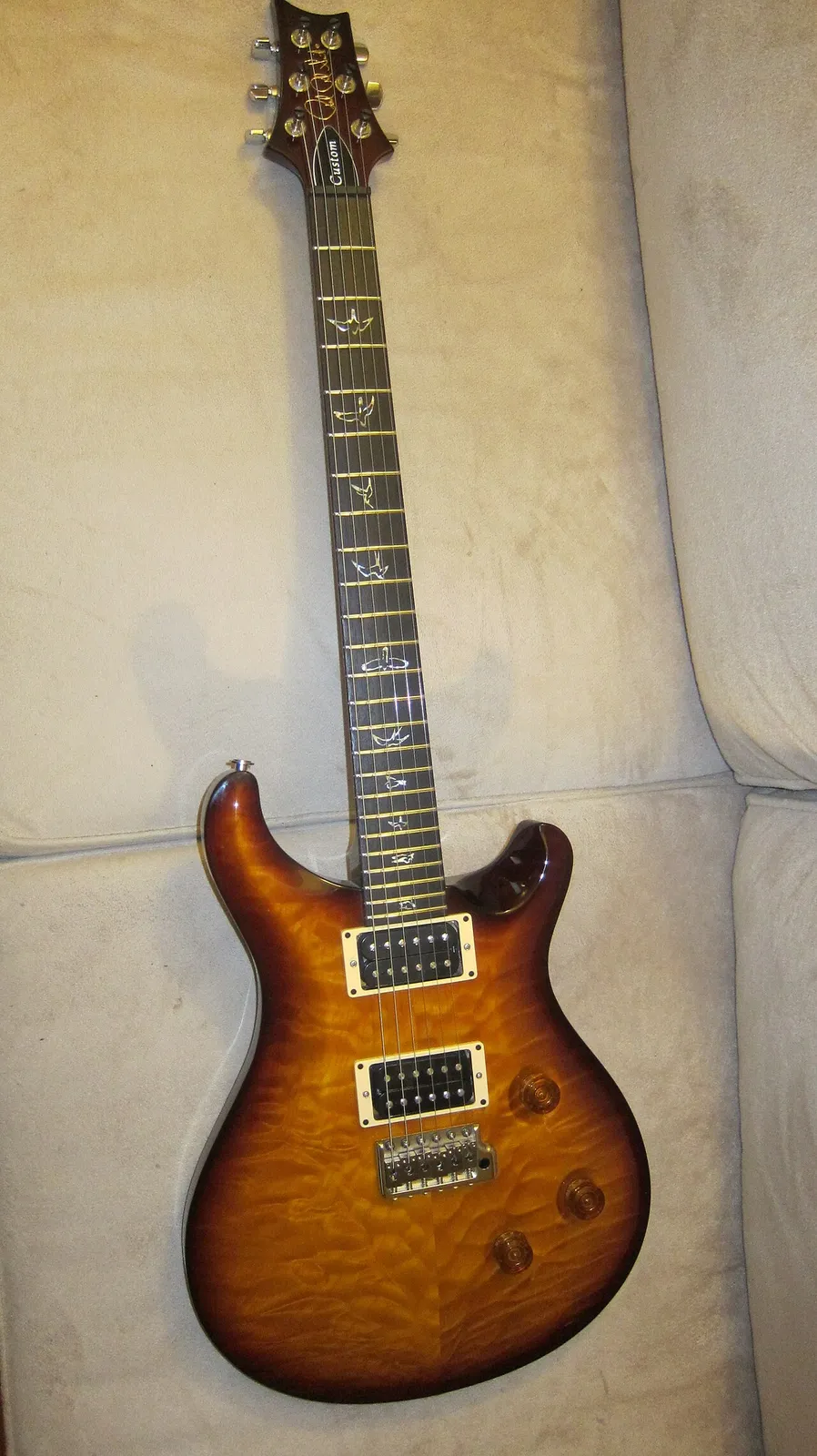
Photo: sbaimo / Wikimedia Commons / CC BY 2.0 PRS
Custom 24
1985
Paul Reed Smith spent a decade building guitars one at a time for touring stars. The Custom was for everybody else.
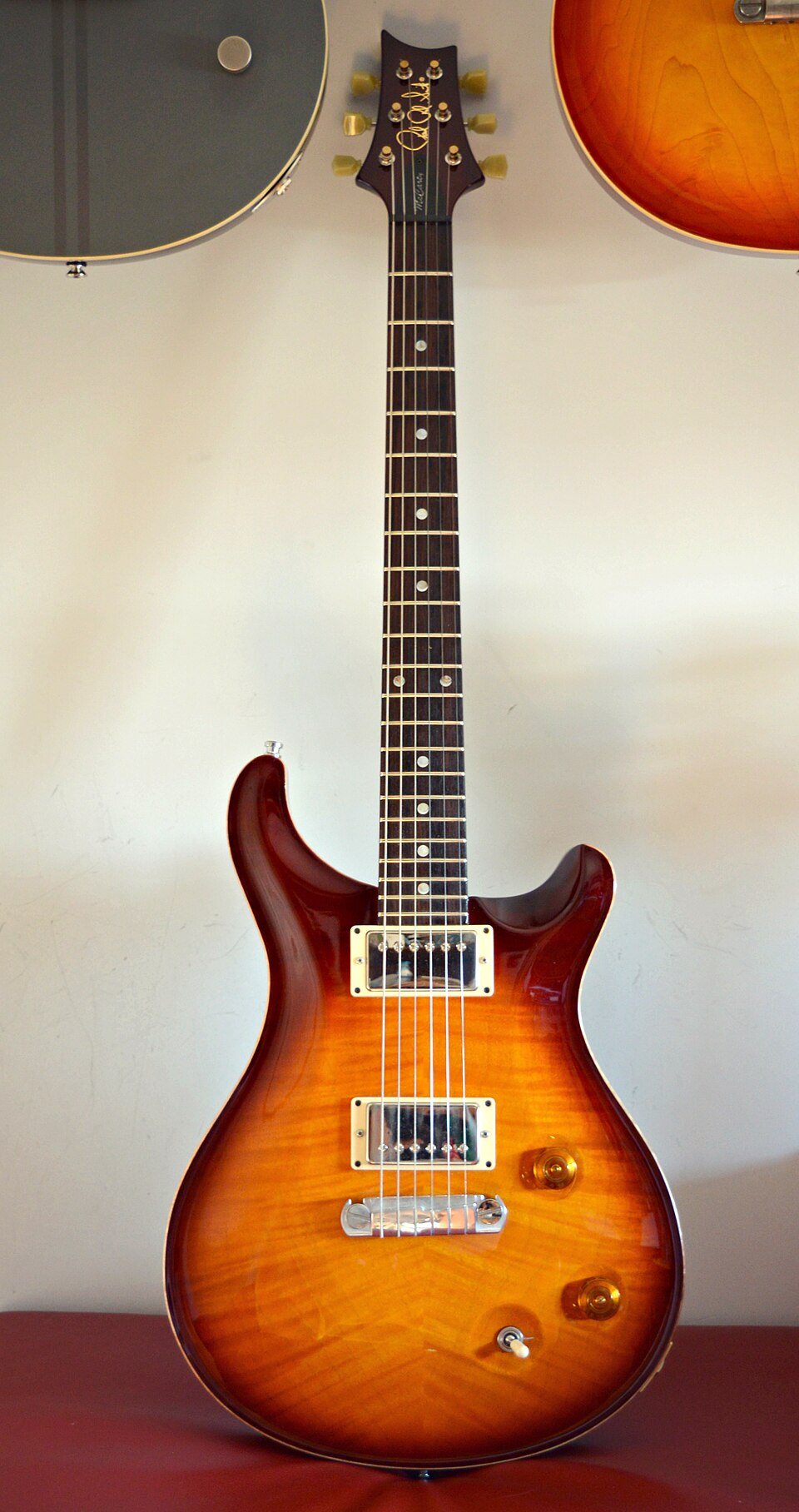
Photo: Freebird / Wikimedia Commons / CC BY-SA 2.0 PRS
McCarty
1994
Named for a man who never played guitar, built for a player who turned down having his own name on it.

Photograph of a vintage 1960 Gibson ES-335TD. Photo by Lightburst. Licensed under CC BY-SA 4.0. Via Wikimedia Commons. Gibson
ES-335
1958
Larry Carlton played three 335s off a shop wall, unplugged, paid $850 for one, and became Mr. 335.