Rickenbacker
4001
Geddy Lee bought one to sound like Chris Squire. He plugged it in. It didn’t.
1974. Rush has its first advance, and Geddy Lee spends about $400 of it on a Rickenbacker 4001, because Chris Squire plays one. What comes out of the amp is something else.
- Introduced
- 1961
- Type
- Bass
- Class
- Closed run
Have a photograph of this guitar? Send a picture
The short version
1961
The deluxe bass
Released in November, Fireglo first. A handful are made, then nothing until 1963.
1963
The one people picture
Smaller headstock, a mute bridge, a toaster pickup at the neck and a horseshoe at the bridge.
1964
Into England
The plain export version reaches Britain. Pete Quaife, John Entwistle, and Chris Squire get the first three.
1968
Horseshoe out
In December the bridge pickup becomes a Hi-gain. Rick-O-Sound stereo is on offer from mid-year.
1973
The collector line
Checkerboard binding goes plain, in July or August. In September the neck toaster goes too.
1974
Geddy’s
Rush’s first advance buys Geddy Lee a 4001, for about $400.
1979
The 4003
A thicker neck arrives on the bass meant to replace it, standard by mid-1980.
1985
The last ones
The last “true” 4001s, by one count. Others end it in 1980, 1981, or 1986.
Side A
A1
It didn’t sound like Chris Squire
- Rush has its first advance, and Geddy Lee wants to sound like Chris Squire. Squire plays a Rickenbacker. So Lee buys a 4001. “I think I paid about $400 for it,” he said later. Then he plugged it in.
“Much to my dismay, when I plugged it in, it didn’t sound like Chris Squire.”
So he worked on it. By then the deluxe 4001 came with Rick-O-Sound, a second jack that sends the two pickups out separately. Lee ran the neck pickup to a bass amp for the bottom and the bridge pickup to an amp set for the twang. Two amps, one bass.
A2
Not a Fender
The bass the 4001 grew out of, the 4000, was Rickenbacker’s answer to the Precision. The neck runs the full length of the body, with two truss rods, and the scale is 33¼ inches, not Fender’s 34. (Some sources print 33½.) When the 4000 first appeared is its own argument: 1953, 1957, or 1958, depending on how you count.
The 4001 is the 4000 in its good clothes. Two pickups, a bound body, triangle inlays. It was released in November 1961 in Fireglo. A handful were made, and then nothing until 1963.
In 1963 it became the bass people picture: a smaller headstock, a mute built into the bridge, a “toaster” pickup at the neck and a “horseshoe” over the strings at the bridge. In July 1962 it listed at $389.50, forty dollars more than the 4000.
A3
The third one into England
A twist: some of the most famous early Rickenbacker basses weren’t this exact model.
Chris Squire told the story more than once. Around 1964, the first three Rickenbacker basses into England went to Pete Quaife of the Kinks, John Entwistle, and then him, on an employee discount at Boosey & Hawkes. “I got the third one.” It was a Rose-Morris 1999, the export version of the plain 4001S: no binding, dots, one output. One account says he bought it in 1965.
Then he made it his. Fireglo, then wallpaper, then silver paper, then sanded, then cream. It was planed down to about three-quarters of its weight before Roundabout. He split the outputs himself and sent the bridge pickup to a guitar amp. On The Yes Album it’s that bass, on Rotosound roundwounds, through a Marshall. Asked about the pickups, he called them “all cockeyed and crappy.”
“It’s the inefficiency that makes it so good.”
Paul McCartney’s Rickenbacker is the same story with the other hand. A left-handed 4001S, the first left-handed Rickenbacker bass, which he took in 1965 and used through later Beatles work and Wings.
Flip the record · By the numbers
33¼"
Rickenbacker’s scale. Some sources print 33½. Not a Fender’s 34 either way.
$389.50
The 4001 on the July 1962 list, forty dollars over the one-pickup 4000.
3rd
Chris Squire’s place in line for the first Rickenbacker basses into England. “I got the third one.”
$400
About what Geddy Lee remembers paying in 1974.
Side B
B1
A neck made for flatwounds
The 4001’s neck was drawn for the strings of the early 1960s, flatwounds and tapewounds. The factory set was a medium-tension Maxima, already near what the neck could take. Put heavier roundwounds on and you voided the warranty. A sticker said so.
The two truss rods were a hairpin design. Correct one the usual way and you could split the fingerboard off the neck. Then there was tail lift: the bridge curling up off the body.
That’s why the 4003 exists. It arrived around 1979 with a thicker neck, standard by mid-1980. For a while the two were sold side by side. When the last 4001 left the line depends who you ask: 1980, 1981, 1985, or 1986.
B2
A different bass every few years
The 4001 never sat still. In December 1968 the bridge horseshoe became a Hi-gain pickup. Rick-O-Sound became standard on the deluxe in early 1970. In 1972 the one-piece maple neck became three pieces.
Then 1973, the year collectors watch. The checkerboard binding went plain, in July or August depending on which timeline you read. In September the neck toaster became a Hi-gain too. A checkerboard bass with a toaster and a horseshoe, from before that, is the one people hunt.
Cliff Burton went another way. In a list he wrote for the fan club in the summer of 1983: “I play a Rickenbacker 4001 bass.” Then he described what he’d done to it. Stock pickups out, a Gibson EB at the neck, a stacked Seymour Duncan at the bridge, another stacked pickup in the mute slot. He later found the 4001 wasn’t tough enough for the road and moved on.
B3
Nobody could copy the cream one
In 1991 Rickenbacker built a tribute: the 4001CS, a copy of Squire’s cream bass. One count says a thousand. Squire said Rickenbacker’s John Hall thought it was nine hundred and wasn’t sure, so Squire told him to build the other hundred. None of the copies sounded like the original.
It turned out the original’s bridge pickup was dead. The builder Michael Tobias said so. A new one went in. Squire didn’t like it. The old dead one went back.
Geddy Lee kept trying, too. His last studio attempt with the 4001 was Snakes & Arrows, and they stopped. But on the tour for that record, in 2007 and 2008, the old Jetglo came back out for “A Passage to Bangkok.” The bass he’d bought to sound like somebody else. It sounded like Geddy Lee.
Put this on
You’ve read about it. Now hear it. Here’s what this guitar sounds like, and what to listen for.
Moving Pictures
By Geddy Lee’s own count, half the songs are the Rickenbacker and half a Jazz Bass. He’s never said which half. Listen for the bite.
Find it on YouTube (opens in a new tab)A Passage to Bangkok (live)
Off the road after 1983, the Jetglo 4001 came back out for this one song on the 2007 and 2008 tours.
Watch it on YouTube (opens in a new tab)
The cast
The people, and the specific guitars, that made the legend.
1974
Geddy Lee
Jetglo 4001 with a Badass II bridge
Bought with Rush’s first advance to sound like Chris Squire. It didn’t. On the road from Rush’s first tours to 1983, then brought back for “A Passage to Bangkok.”
1965
Chris Squire
1964 Rose-Morris RM1999, a 4001S export
Unbound, dots, one output. The bass on The Yes Album, refinished until it ended up cream. Not a deluxe 4001.
1965
Paul McCartney
Left-handed 4001S
The first left-handed Rickenbacker bass. A main bass through later Beatles work and Wings. Not a bound 4001.
1983
Cliff Burton
4001, rewired
Stock pickups out, a Gibson EB at the neck and a stacked Seymour Duncan at the bridge. Later moved on to an Aria Pro II.
Liner notes
Specs, construction, rarity, value, and every source we used.
Two pickups on the 4000’s neck-through — the deluxe bass the 4003 was built to replace.
- Body
- Solid maple, cresting-wave, neck-through wings, checkerboard binding. About 1 1/4" deep in the settled shape.
- Neck
- Thru-body maple. One piece until March 1972, then three-piece. White: maple / shedua / maple. Brakes: a walnut center strip. Dual hairpin rods, nuts at the headstock only (factory FAQ).
- Fingerboard
- Bound rosewood, triangle inlays, 20 frets. Radius unpublished on an original sheet.
- Scale
- 33.25" / 33 1/4" (White; a 1965 dealer measure; the 4001C64 sheet, 84.5 cm). Kohman, Vintage Guitar: 33 1/2". Wikipedia’s infobox, citing Ashton: 33.5 in (850 mm). Mix flagged. Not 34".
- Pickups
- Neck toaster and bridge horseshoe, through December 1968.
- Hardware
- Cast-aluminum mute bridge, from 1963.
- Electronics
- Two volumes, two tones, 3-way. Rick-O-Sound optional from mid-1968, standard on the deluxe from early 1970. The 4001S stayed mono (White).
- Finish
- Fireglo first, November 1961 (Gruhn, via Wikipedia). Wikipedia also lists Autumnglo, Burgundyglo, Jetglo, Mapleglo, Azureglo.
- Nut
- Phenolic. Factory original width unpublished. Measured: 1 5/8" (Pure Vintage, a 1975) and 1 11/16" (The Loft, a 1980). The 4001C64 sheet prints 41.3 mm (1 5/8"). Mix flagged. Do not average.
Open the full research fileConstruction details, the complete player record, production numbers, dated value estimates, and sources
Classic living example is a deluxe 4001, 1963 through the early-1973 checkerboard toaster: bound, triangles, neck toaster, bridge horseshoe, 20 frets. Hi-gain takes the bridge in December 1968 and the neck in September 1973. A 21-fret run, about October 1969 through early 1971, kept the scale (White). No 4001 on the USA list of 1 January 2026. The 4001C64 page is Legacy, not currently produced — unbound, dots, mono, Hi-gain in the table and horseshoe in the brochure. Not this table. 4001S and the UK Rose-Morris 1999 are the unbound, dot, mono sibling.
Construction
The job was a bass that did not have to be a Fender. The Precision had the market at 34 inches, bolt-on. The market was still small, and Rickenbacker wanted in (White). The 4000 is what they drew: one horseshoe, a cresting-wave headstock, neck-through, two truss rods. The 4001 is that bass in deluxe clothes. Two pickups, binding, triangles. Not a 34-inch slab, and not the 4003 (rickenbacker-4003) Santa Ana still ships. The 4000 itself ran until 1984 (Wikipedia, citing Bacon). This model did not replace it.
The 4000’s year is not one year. Wikipedia, citing Boyer: designed 1953, at small shows by 1955, in sales kits 1957, on the price list 1958. Brakes calls 1957 the launch, at $279.50, sixty dollars over the Precision. Wikipedia repeats that price from him. Kohman, Vintage Guitar (April 2012): spring of 1957, and the 1958 list at $289.50 plus $59.50 for a case. White dates the design to 1957. Keep 1953, 1957, and 1958, and both prices. Neck-through and the dual rods were new on it (Brakes).
Scale is the same kind of split. White: Fender 34", Gibson 30.5", Rickenbacker 33.25". Kohman prints 33 1/2". Wikipedia’s infobox, citing Ashton, prints 33.5 in (850 mm), and a short scale of 30.5 in (770 mm). The prose also prints 33.5" and cites Brakes. Brakes’s article, as fetched, gives no scale. The C64 sheet is 84.5 cm (33 1/4"). A 1965 dealer measure is 33 1/4". Do not average. Mix flagged. Not 34".
1960, Brakes: the through-neck went from mahogany or walnut to maple. 1961, Rossmeisl enlarged the horns and built the deluxe. Wikipedia, citing Gruhn: released November 1961, Fireglo first. Just Rickenbackers opens that month. Register serial AK685 is dated 1961-11, Fireglo. Kohman: the end of 1961. White calls his dates guidelines. A 1961 prototype — the first 4001, or a deluxe 4000 with a second pickup, he will not say — then a handful of “production” 1961s, then nothing until 1963. This plate starts at 1961. The gap stays.
Those 1961s are not the picture. White: already about 1 1/4" deep, against the 4000’s about 1 5/8", checkerboard, a toaster, full-width triangles, and still a guitar bridge. Brakes dates the cut to after Rossmeisl left for Fender in 1962, when Dick Burke took the body from 1 5/8" to 1 1/4" and fitted the cast-aluminum bridge. Kohman dates the slimming to 1961, on the bass line. Keep all three. No original drawing in millimetres. The C64 sheet’s 31.8 mm (1 1/4") is a reissue.
1963, White: the bass people mean. Smaller headstock, a mute bridge, triangles with the point cut off, toaster and horseshoe. He launches the 4001S the same year: unbound, slightly contoured, dots only to the 17th fret. Wikipedia, citing Boyer: 1964, first as a special-order “4000+1.” Keep both. Rose-Morris sold it in Europe as the 1999. Most 1964 basses went to Britain (White). One jack, dots, no binding. Rose-Morris dropped the 1999 in 1969 (Wikipedia, citing Boyer). The 4001S stayed a special order. In December 1972 that standard bass, with the 4000, started leaving neck-through for a set neck. The later 4003S went back. Same outline, different joint.
Kohman, from the lists: July 1962, $389.50, forty dollars over the 4000, cataloged in Fireglo only, though other colors exist. July 1964: the 4001 at $429.50, the 4000 at $377.50, the silver case $59.50. A custom-color Jazz was $293.47, a Thunderbird IV $345, an Ampeg Wild Dog $449.50. Period list. Not a 2026 price.
Then the clock. December 1968: horseshoe off the bridge, Hi-gain on, under a chromed plastic cover (White). A few early 1969 horseshoes still show up. Rick-O-Sound from mid-1968, standard on the deluxe from early 1970. The 4001S stayed mono. March 1972: one-piece maple became maple / shedua / maple, and the wings went from walnut to maple (White). Brakes calls the strip walnut. Don’t merge the words.
1973 is the collector line. White, June 2025: around May, aluminum bridge to zinc, the gap tooth gone, two more screws. July, checkerboard binding to single-ply white. His January 2025 timeline says August. Just Rickenbackers says August. Keep both months. September, the neck toaster became a Hi-gain. May or June 1975, the neck pickup moved about half an inch toward the bridge. White’s bet is strength: the rout sat where the through-neck met the wings. Brakes puts the shortened triangles, and that 1972 strip, to the same job, on a different year. From 1976 to 1980 he finds no significant spec change. The horns grew chunkier from about 1972 to 1976, which he reads as worn templates copied forward.
The short headstock is two facts, both his. From about October 1969 through early 1971 the 21-fret board was longer on the same blank, so the headstock lost about half an inch. Scale stayed 33.25". In January 1971 that short headstock became standard on the 20-fret too. On the 4003 timeline, separately: the channel was a weak point, tension pulling the headstock forward, and it was shortened in part to cut string length. Don’t fold one into the other.
The neck is why a 4003 exists. Drawn for early-1960s flats and tapewounds. Factory strings through the end of the run were German Maxima S4440s, medium tension, already near the limit. Heavier rounds voided the warranty. A sticker said so. Correct a hairpin the usual way and you can split the board off. Tail lift is his name for the bridge curling off the body.
White dates the 4003 to 1979, standardized by mid-1980. Wikipedia debuts it in 1980 and, citing Ashton, puts the new truss rods on that debut. White’s 1979–80 changes are not those rods. A thicker two-piece neck, slim D to a fuller C. The same hairpins flipped to adjust at the body end, under a split guard. Two more screws through the tail of the bridge. Hall has said the 4003 launched with “a completely new truss rod system.” White: not true of 1979–84. Conventional single-action rods, back at the headstock, “as much as 3/8" of over- and under-bow at the 12th fret, no matter how heavy the string,” arrived late 1984 or early 1985. The factory FAQ is that later bass, and it skips the body-end years: a 4001 has “old style” rods, nuts only on top, small rectangular holes; “a later model 4003” has nuts at both ends and larger rounded holes. A 4001 never grew the second set. The vintage high-pass cap came off Rickenbacker basses in 1984. A 4001 still in the line is on the old side of that cut. The 2006 push-pull is a 4003 part.
The last year stays an argument. White: on the 1985 list, very few built, last “true” 4001s in December, sold beside the 4003. Just Rickenbackers: last known standard production 1985. Brakes: dropped in 1986. Wikipedia’s infobox runs 1961–1986, stacking Gruhn (1980), McIver (1981), and Boyer (1984), with serials showing builds through 1986. Bacon and Moorhouse, via rickbeat: 1961 to 1980, or possibly 1981.
The name came back on a different guitar. The 4001V63 (1984–2002) and the 4001C64 / C64S sit on a 4003S. White runs the C64 from 2002 to 2011. Wikipedia, citing Gruhn, releases it in 2001. Keep both. The V63 was meant to look like McCartney’s 1964 4001S, factory-fresh. White calls its horseshoe a Hi-gain with fake magnets, and allows a rumor of leftover real horseshoes on the first ones. The FAQ: that shell is the magnet, tungsten-steel horseshoes as polepieces over ceramic magnets. Originals magnetized the tungsten. The C64 brochure says horseshoe. The table says Hi-gain. The 4001CS (early 1991–2000) is the Squire tribute on the same bones. White counts 1,000. Squire told MusicRadar that Hall thought 900 and wasn’t sure. Squire told him to build the other hundred. None of them is on the January 2026 list.
Not this table. 4001FL, fretless, late 1972. 4001SS, a handful in December 1974, 30" in the shipping records, not the infobox’s 30.5". Two 4001/8 prototypes in 1973, for Squire and Entwistle, on the 1975 list and then gone. The 4004LK is a different number.
Players
The records people name were not all played on a bound 4001. Several of the famous ones are the export standard.
Chris Squire (Yes). A 1964 Rose-Morris RM1999, serial DC127. Guitar World (8 January 2020): dot inlays, no body binding, one output — a 4001S, not a deluxe 4001, and not a 4003. He told MusicRadar (9 January 2012) the first three into England, around 1964, went to Pete Quaife, John Entwistle, and then him, on an employee discount at Boosey & Hawkes. To Nick Beggs: “I got the third one.” The 2020 piece dates the buy to 1965. Keep both. Fireglo, then wallpaper, then silver paper, then sanded and cream. He said the planing was done before Roundabout, and the bass was down to about three-quarters of its weight. The Yes Album (1971) is that RM1999, Rotosound rounds, a Marshall 100-watt head and a 4×12, including “Yours Is No Disgrace” (Guitar World, 21 May 2023). He had already split the outputs himself, bridge pickup to a guitar amp. On the pickups, to Beggs: “all cockeyed and crappy,” and “it’s the inefficiency that makes it so good.” The 4001CS copies the cream bass. Guitar World: none of the copies, including that one, sounded like it. Michael Tobias, in the 2020 piece: the bridge pickup “was actually dead.” A new one went in. He didn’t like it. The old one went back.
Paul McCartney. The other 1964 export, and the first left-handed Rickenbacker bass (White). A 4001S, not a bound 4001. White: he turned it down, then in 1965 took it, and it was a main bass through later Beatles work and Wings. Wikipedia, citing Roberts: a left-handed 4001S from F. C. Hall in 1965. Squire’s guess was that he had his first. The public instrument is still the Höfner 500/1 (hofner-500-1). The early Beatles records stay there.
Geddy Lee (Rush). A 4001. Not a 4001S, and not a 4003. Guitar World (Joel McIver, 17 October 2023): in 1974, with Rush’s first advance, “I think I paid about $400 for it,” to sound like Squire. “Much to my dismay, when I plugged it in, it didn’t sound like Chris Squire.” Bottom end meant Rick-O-Sound, neck pickup to a bass amp, bridge to an amp set for the twang. Rush.com: a Jetglo of the 1970s with a Badass II, from the first tour in 1974 through the Grace Under Pressure warm-up in 1983, and back for “A Passage to Bangkok” in 2007 and 2008. The same page’s years-used line says 1975–1984. Keep 1974 and 1975. On Moving Pictures he says half the songs are the Ricky and half a Jazz. He does not name the split there. The last studio try was Snakes & Arrows. They stopped.
Cliff Burton (Metallica). A 4001 he rewired, then left. Equipboard prints a list he wrote for the fan club in summer 1983: “I play a Rickenbacker 4001 bass,” stock pickups out, a Gibson EB at the neck, a Seymour Duncan stacked Jazz at the bridge, a stacked Strat in the mute slot. Equipboard calls the finish Burgundyglo from video, and ties the bass to Kill ’Em All and parts of Ride the Lightning. That album line is Equipboard’s. Guitar Interactive: he did not find the 4001 robust enough for the road. The later bass is an Aria Pro II. Not this plate.
Lemmy Kilmister. Vintage Guitar (Willie G. Moseley, April 2016): in Hawkwind the bass was “usually forged with a Rickenbacker,” and “They’re very good instruments for a guitar player turned bass player.” Those Ricks carried Gibson Thunderbird pickups, from In Search of Space through Warrior on the Edge of Time. The piece does not print a model number. Do not promote it to a 4001 to tidy the sentence. The factory bass is the 4004LK, named in the November 2002 interview: three pickups, carved oak leaves, circa 2002. Wikipedia, citing Gruhn, dates that limited edition to 2005. Keep both. Not this table, and not a 4003.
Bruce Foxton (the Jam). Guitar World (8 January 2020): “It’s probably the most cool-looking bass out there.” He never got on with Rick-O-Sound. A quote, not a serial.
Also known to play stays short. Wikipedia’s list adds Geezer Butler, John Deacon, Mike Mills, and a long tail, without a model check here. None invented.
Rarity
You cannot order a new 4001. It is off the USA list. The bass a shop can still get is a 4003, and that neck is not this one.
Factory totals were never published. None invented. Serials date a guitar. They do not count a year. Kohman: production of all Rickenbacker basses before 1964 is “likely not more than a couple of hundred,” and he flags Richard Smith’s 1987 tabulation as incomplete — Rickenbacker told him the real numbers were somewhat higher. An estimate for every bass they built, not a 4001 census. White’s headcount is not a census either: over 100 people in the shop in the mid-1960s, eight by 1970, and he thinks this bass kept the lights on through the 1970s. He is arguing.
What was thin is the early bass. A handful in 1961, then nothing until 1963. White: 1965–67 the factory was busy with guitars, and not many basses got built. Paul Boyer: 21-fret 4001s, 1969–71, appear on no price list, and the count is unknown. A handful of 30" 4001SS basses. Two eight-string prototypes. Checkerboard toaster-and-horseshoe deluxes, before September 1973, are the scarce end of the number people hunt. Later-1970s Hi-gain 4001s are what the used market is full of. Old, not rare as a shape.
A V63, a C64, a 4001CS: 4003S bones, the old name on the cover. Squire’s DC127 and McCartney’s left-handed 4001S are one object each. They are not a price for a vintage 4001.
Value
Informal estimate, 6 October 2026. Not an appraisal.
Asking prices are not sold prices. The July 1962 list at $389.50 and the July 1964 list at $429.50 are period catalog, in Construction, not a 2026 price. Geddy’s “about $400” is 1974, as he remembers it. The 4000’s $279.50 and $289.50 are a different model. Artist basses are not comps. A 4003’s street price is not this guitar’s.
New street. None. USA list, 1 January 2026: no 4001, no C64, no V63. The deluxe on that list is the 4003 at $2,599, case included, and the 4003S at $2,299. Other model. The C64 page is a legacy page, not a cart.
Used modern. The reissue, which wears the name and is built like a 4003S. Reverb’s 4001V63 guide (page years 1984–2000): $2,025–$3,564, Good to Mint, 65 orders, “All Models.” Named hammers there: 18 August 2025, Very Good, $2,103.75; 13 September, Mint, $3,463; 9 November, Very Good, $3,100. No separate 2024–26 C64 sold band was captured. Don’t borrow the V63 range for one, or for a 1970s original.
Vintage / collectible. Reverb’s 4001 guide (page years 1973–1983): $2,122–$3,769, Good to Mint, 936 orders. That is the post-1973 Hi-gain bass, mixed finishes, not a toaster median. Named hammers: 22 November 2025, Very Good, $4,300; 5 December, Good, $2,100; 7 December, Good, $2,990. A shop ask, not a hammer: The Loft’s 1980 white, $3,500 (page 14 January 2026). Pure Vintage marked a 1975 Fireglo sold at $3,595 (page 4 December 2024). guitarprice.net (30 September 2026) compiles 1960s 4001s at $4,000–$8,000 and 1970s at $2,500–$4,000. Aggregator, not a sold table. Do not average it with Reverb.
No 2024–26 public hammer for a clean pre-1973 checkerboard toaster was captured. A 1965 Fireglo at MM Guitar Bar was asking £7,887 with replacement pickups and a refinished headstock back. Not a clean comp. Squire’s bass and McCartney’s are one each.
See also
- rickenbacker-4003 — the living Santa Ana bass; thicker neck, and after late 1984 a different truss rod; not a renamed 4001
- fender-precision-bass — the 34-inch bolt-on this neck-through was drawn against
- hofner-500-1 — McCartney’s identity bass; the 1964 left-handed 4001S is the other one
Sources
- rickenbacker101, 4001 timeline (Andy White, 21 June 2025) — 1961 prototype and a handful, then a gap to 1963; 33.25" from the 4000 design; body about 1 1/4" on the 1961; 4001S in 1963, dots to the 17th fret; horseshoe to Hi-gain December 1968; Rick-O-Sound; shedua stripe March 1972; binding to single-ply in July 1973; 1975 pickup move; horns chunkier about 1972–76; no significant spec change 1976–80; pricelist through December 1985; V63 and C64 on a 4003S, C64 dated 2002–2011; CS count 1,000; dates called guidelines
- rickenbacker101, 4001 transition timeline (Andy White, 24 January 2025) — checkerboard binding to plain in August 1973; he flags exceptions. July in the June timeline, August here. Keep both
- rickenbacker101, 4003 timeline (Andy White, 14 March 2025) — Maxima S4440; warranty sticker; hairpins vs roundwounds; headstock channel and the shortening, as a second reason; 1979 / mid-1980 4003; body-end rods; Hall’s “new truss rod” placed at late 1984 / early 1985; 3/8" relief; vintage cap off in 1984; tail lift
- Wikipedia, Rickenbacker 4001 — November 1961 and Fireglo first (Gruhn); 4000 in 1953 / 1955 / 1957 / price list 1958 (Boyer); $279.50 repeated from Brakes; prose prints 33.5" while citing Brakes; infobox 33.5 in (850 mm) and short 30.5 in (770 mm), citing Ashton; 4000 to 1984 (Bacon); 4001S in 1964 as “4000+1”; Rose-Morris dropped the 1999 in 1969 (Boyer); end-year 1986 with Gruhn 1980, McIver 1981, Boyer 1984; C64 release 2001 (Gruhn); 4004LK in 2005 (Gruhn); players list used only as a list
- Guitar World, Classic gear: Rickenbacker 4001 (Rod Brakes) — 4000 in 1957 at $279.50, $60 over the Precision; neck-through and dual rods; maple neck 1960; Burke after 1962, depth 1 5/8" to 1 1/4"; Hi-gain 1968; 1973 changes, including a walnut center strip and shortened triangles; dropped 1986. No scale figure in the article as fetched
- Vintage Guitar, The Bass That Waited (Peter Stuart Kohman, April 2012) — 4000 in spring 1957; 1958 list $289.50 plus $59.50 case; scale 33 1/2"; 4001 at the end of 1961; body slimming dated to 1961; July 1962 list $389.50; July 1964 list $429.50, 4000 at $377.50, case $59.50; Jazz $293.47, Thunderbird IV $345, Wild Dog $449.50; pre-1964 bass production “likely not more than a couple of hundred,” with Smith’s totals called incomplete
- Just Rickenbackers, 4001 timeline — inception November 1961; plain binding in August 1973; last known standard production 1985
- Rickenbacker FAQ — 4001 “old style” rods, nuts on top, rectangular holes; “a later model 4003” has nuts at both ends; reissue horseshoe is the magnet, not a lift-off cover
- Rickenbacker 4001C64 — 84.5 cm (33 1/4"), 41.3 mm (1 5/8") nut, 31.8 mm (1 1/4") deep, dots, mono; table says Hi-gain; brochure says horseshoe. Not this table
- Rickenbacker Legacy — 4001C64 and 4001C64S not currently produced
- Rickenbacker USA price list, 1 January 2026 — no 4001; 4003 $2,599; 4003S $2,299; case included
- Rickenbacker schematics — 4001 and 4001FL on the stereo drawing; 4001S, 4001C64, 4001C64S on the mono vintage drawing
- Guitar World, Geddy Lee (Joel McIver, 17 October 2023) — 1974, about $400; Rick-O-Sound; Moving Pictures half and half; Snakes & Arrows
- Rush.com, Rickenbacker 4001 — Jetglo, Badass II; tour 1974–1983; “A Passage to Bangkok” 2007–08; years-used line 1975–1984
- Guitar World, Chris Squire (8 January 2020) — RM1999, DC127; 4001S spec; bought 1965; Tobias on the dead bridge pickup
- Guitar World, Squire to Nick Beggs (22 August 2022) — third UK Rick; “cockeyed and crappy”
- MusicRadar, Chris Squire (9 January 2012) — Quaife, Entwistle, then him, around 1964; Hall’s 900, and the other hundred
- Guitar World, The Yes Album (Mike Brooks, 21 May 2023) — RM1999, Rotosound, Marshall, “Yours Is No Disgrace”
- Guitar World, Roundabout (3 October 2023) — planed before Roundabout; about three-quarters the weight
- Guitar World, 4001 appreciation (8 January 2020) — Foxton
- Vintage Guitar, Lemmy (Willie G. Moseley, April 2016) — Hawkwind Rickenbacker, Thunderbird pickups; model number not printed
- Vintage Guitar, Lemmy (November 2002) — the carved bass named in the interview is the 4004LK
- Equipboard, Cliff Burton’s 4001 — summer 1983 handwritten pickup list; Burgundyglo from video; album claim is Equipboard’s
- Guitar Interactive, Aria Pro II SB tribute (Tim Slater) — 4001 not robust enough for the road; later bass is the Aria
- Reverb, 4001 (1973–1983) — used guide $2,122–$3,769 (936 orders); named late-2025 hammers
- Reverb, 4001V63 guide, via a 2000 V63 listing — 1984–2000 guide $2,025–$3,564 (65 orders); named 2025 hammers
- guitarprice.net, Rickenbacker (30 September 2026) — 1960s $4,000–$8,000; 1970s $2,500–$4,000; aggregator, not solds
- The Loft at Lay’s, 1980 4001 white — ask $3,500; nut 1 11/16" (page 14 January 2026)
- Pure Vintage, 1975 4001 Fireglo — marked sold at $3,595; nut 1 5/8" (page 4 December 2024)
- MM Guitar Bar, 1965 4001 Fireglo — ask £7,887; measured scale 33 1/4"; replacement pickups; not a clean comp
- rickbeat, Model 4001 — Bacon and Moorhouse, as quoted: 1961 to 1980 or possibly 1981
- Rickenbacker Resource register, 1961 Fireglo AK685 — manufacturing date 1961-11. The page’s old eBay dollar table is not a 2026 price
- Paul Boyer, quoted on The Last Bass Outpost — 21-fret 4001s, 1969–71, absent from catalogs; number unknown
Keep digging
Guitars this one gets compared to, confused with, or descended from.
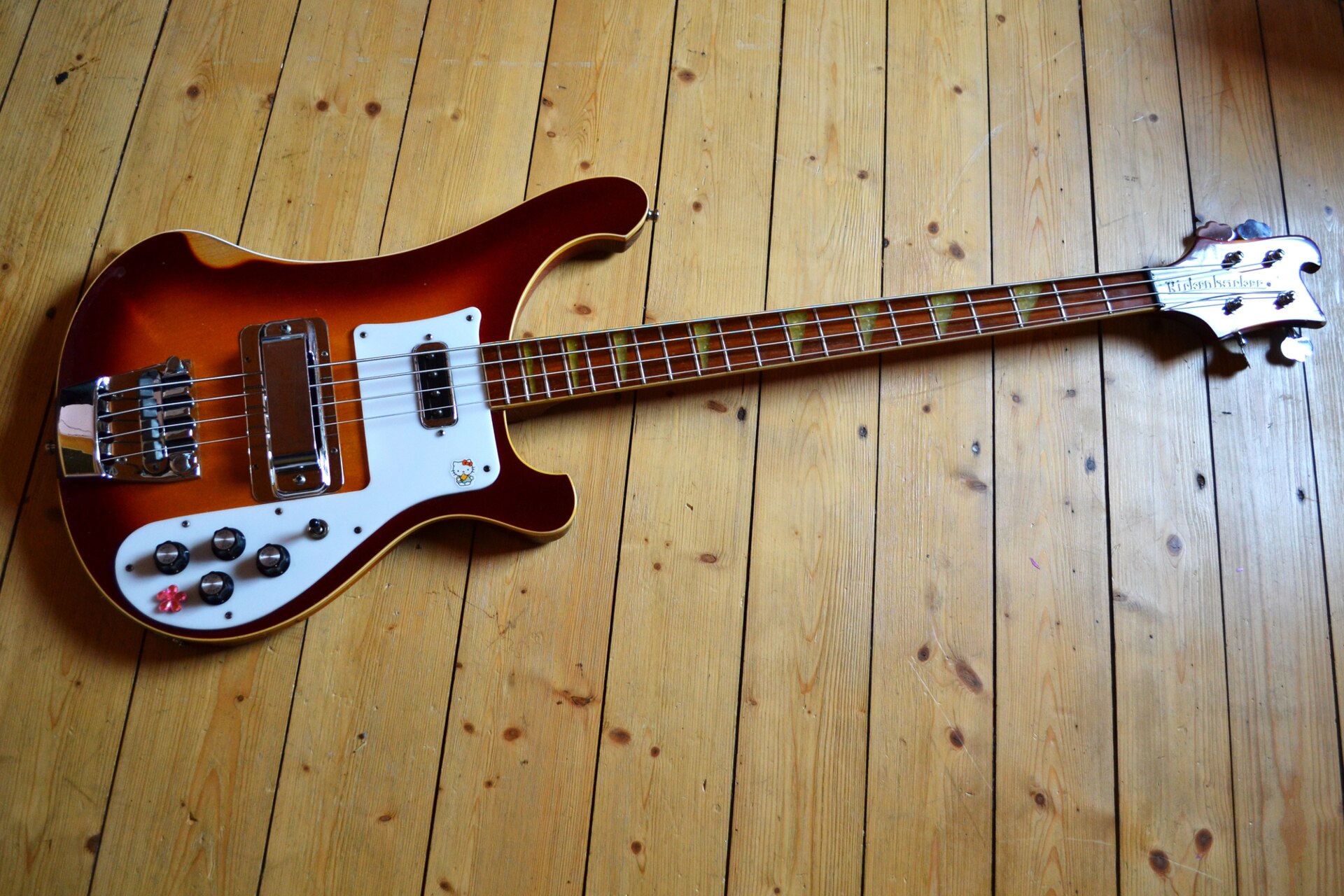
Rickenbacker 4003 (33 1/4" scale). Photo by DeLerkim. Licensed under CC BY-SA 2.0. Via Wikimedia Commons. Rickenbacker
4003
1980
Rickenbacker’s first answer to players’ new strings was to void the warranty. The 4003 was the better answer.

Photo: Infrahertzz / Wikimedia Commons / CC BY-SA 3.0 Fender
Precision Bass
1951
Leo’s bass let the player at the back be heard. You know their lines by heart. You mostly don’t know their names.
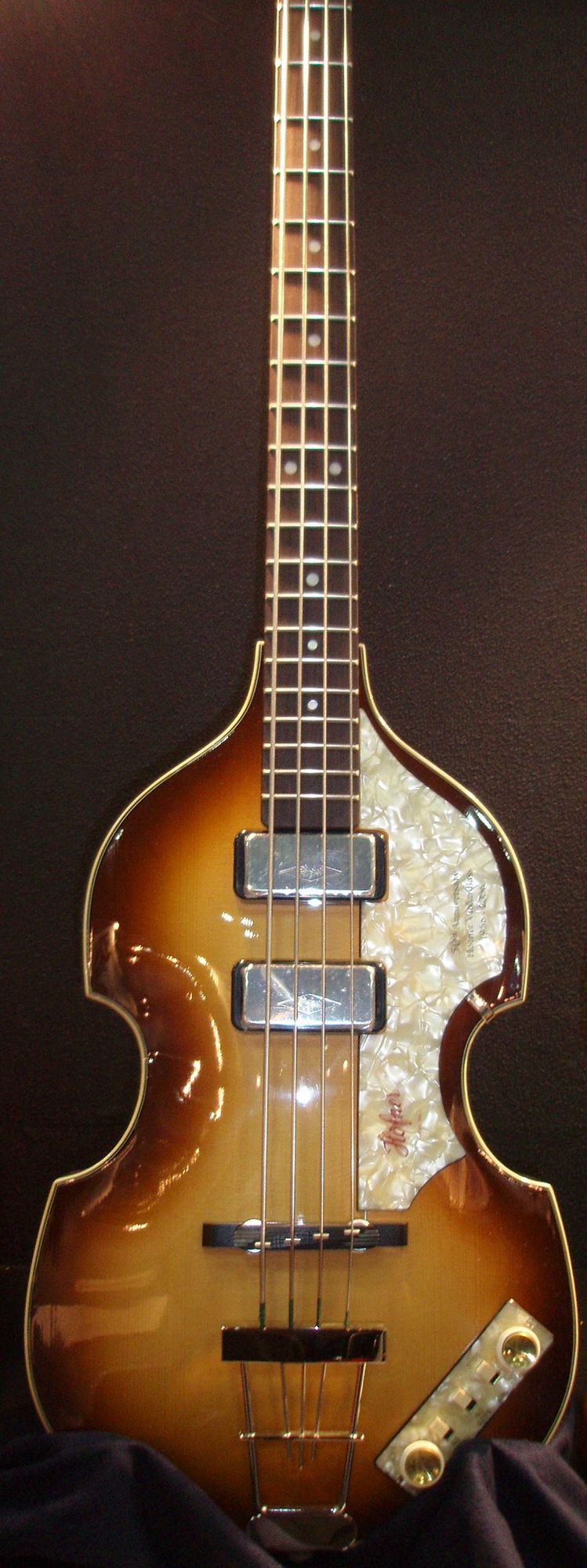
Höfner 500/1 Anniversary RH, equal to a ’61 Cavern Bass layout. Photo by CasinoKat. Licensed under CC BY-SA 3.0. Via Wikimedia Commons. Höfner
500/1
1956
McCartney bought the bass he could afford in Hamburg. It was stolen in 1972, and it came home in 2024.