Fender
Precision Bass
Leo’s bass let the player at the back be heard. You know their lines by heart. You mostly don’t know their names.
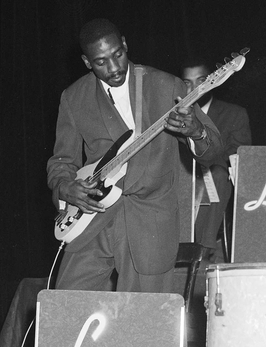
1952, a Lionel Hampton show. The bass player isn’t hugging a big wooden upright. He’s holding what looks like a Telecaster with a long neck, and it’s plugged in. Whether he was the first professional to do it is still an argument.
- Introduced
- 1951
- Type
- Solidbody electric bass
- Class
- Production

The short version
1951
First one built
The first commercial one is produced in October. Slab ash, blonde, one pickup.
1952
On the bandstand
One story puts Roy Johnson on one with Lionel Hampton. Others credit Monk Montgomery from 1953.
1954
Contours
Strat-style forearm and belly cuts, a white pickguard, and sunburst.
1957
The one you picture
Split-coil pickup, Strat-like headstock, and a gold anodized pickguard that scratched if you looked at it.
1960
A sibling
The Jazz Bass arrives in spring. Until then the Precision was Fender’s only bass.
1968
Telecaster Bass
Fender reissues the 1951 slab under a new name.
1983
The Funk Machine disappears
James Jamerson’s bass is stolen shortly before his death. It has never been recovered.
Side A
A1
A Telecaster with a long neck
Leo Fender didn’t invent the electric bass. Paul Tutmarc in Seattle was selling a fretted, solid-body electric bass in the mid-1930s. It sold in small numbers, with no national distribution. What Leo did was make electric bass a job.
The first commercial Precision came off the line in October 1951. The name is the whole pitch. An upright has no frets. This had frets, so you could land on a note the way a guitar player does, and land on it precisely.
It looked like what it was, a Telecaster’s big brother. Slab ash body, blonde only, a Tele-style headstock, and a maple neck held on with four screws. (Strictly speaking, that isn’t “bolt-on.” Everybody calls it that anyway.) One pickup, and a cover with a mute built in.
Leo tried different scale lengths and landed on 34 inches. Seventy-odd years later, that’s still what a bass is.
And think about who holds one: the player at the back of the bandstand, the one nobody watches. That’s where it stayed. That’s where it did its best work.
A2
Who was first is a fair fight
One story puts Roy Johnson on one with Lionel Hampton in 1952. Others credit Monk Montgomery, also a Hampton bassist, as the first touring and recording professional, from 1953. Both played in the same band. I wouldn’t crown either one.
A3
1957, the one you picture
A lot of photos captioned “a ’51 P-Bass” aren’t. They show the later shape, and that’s fair, because the later shape is the one that stuck.
In 1954 the body got Strat-style contours and a sunburst. In 1957 Fender redid almost everything else. The pickup became a split coil, two halves wired to cancel hum. The headstock went Strat-like. The strings loaded through the bridge instead of the body, with four saddles, one per string. And the pickguard became one piece of gold anodized aluminum with the electronics mounted to it. It looked incredible and scratched easily, so it turned into tortoiseshell plastic within a couple of years.
Fender says that design “endures today basically unchanged.” When a bass player says “P-Bass,” that’s what they mean.
Flip the record · By the numbers
34"
The scale Leo settled on after experimenting. It became the standard for electric bass.
2
Saddles on the original 1951 bridge, each one carrying two strings.
1957
The redesign Fender says “endures today basically unchanged.”
4-59
What Duck Dunn’s neck said when his son had it worked on. Dunn always believed it was a ’58.
Side B
B1
The Funk Machine
James Jamerson played a sunburst Precision he called the Funk Machine. Everybody, Motown included, calls it a 1962. Old photographs hint at features from about 1964 to 1966, so the last bass he played may be a bit younger than the legend.
His credits include “Dancing in the Street,” “My Girl,” “Reach Out I’ll Be There,” and “What’s Going On.” Which of his Motown sessions were on upright and which on the Precision is a question I’ll leave to people with the session sheets.
You’ve heard him a thousand times. Most people couldn’t tell you his name.
B2
Memphis and Los Angeles
Duck Dunn, of Stax and Booker T. & the M.G.’s, played a sunburst Precision with an anodized guard through most of his career. He believed it was a 1958. After he died, his son Jeff had some work done on it, and the neck turned out to be inscribed 4-59. It’s a 1959. His credits run through Otis Redding, Wilson Pickett, and Sam & Dave’s “Hold On, I’m Comin’.”
In Los Angeles, Carol Kaye played a Precision on Beach Boys sessions. Brian Wilson put it simply: “Carol played on ‘Good Vibrations’ and ‘California Girls,’ and she was, like, the star of the show.” Wilson had bought his own Precision in December 1961 and played it on Surfin’ Safari. On the later hits, it was often Kaye.
B3
Still under everything
The Precision never needed to be anybody’s showpiece. Sting has a small family of 1950s ones, and says his battered ’57 “has a growl that a modern bass guitar simply does not possess.” Steve Harris of Iron Maiden: “My main one is a ’71 and the other is a ’73.” Paul Simonon’s smashed one is on the cover of London Calling. John Entwistle wanted a Fender in 1959 and couldn’t get one (“I think Jet Harris was the only person who had one then”), so he built a Precision-style bass from photographs.
The Funk Machine was stolen shortly before Jamerson died in 1983. It’s never turned up. Put on “What’s Going On” anyway. He’s right there underneath the whole record, the person most listeners never looked at, holding the song up.
Put this on
You’ve read about it. Now hear it. Here’s what this guitar sounds like, and what to listen for.
California Girls
Carol Kaye’s Precision, and Brian Wilson named it as one of hers. Kaye says this is the one time she invented a lick for him.
Find it on YouTube (opens in a new tab)Money
Fender names this as a Roger Waters Precision track. Listen to that bass line going round in seven.
Find it on YouTube (opens in a new tab)
The cast
The people, and the specific guitars, that made the legend.
1953
Monk Montgomery
Early Precision
Lionel Hampton’s bassist. Often credited as the first touring and recording pro. Another story points at Roy Johnson.
1962
James Jamerson
“The Funk Machine”
Published as a 1962. Photos suggest it may be a little later. Stolen shortly before his death in 1983, never recovered.
1959
Donald “Duck” Dunn
Gold-guard sunburst Precision
Stax and Booker T. & the M.G.’s. He thought it was a ’58. The neck says 4-59.
1965
Carol Kaye
Wrecking Crew Precision
Beach Boys sessions including “California Girls,” “Wouldn’t It Be Nice,” and “Good Vibrations.”
1957
Sting
A small family of ’50s Precisions
A ’54, a ’55, and the worn ’57 he uses “all the time.” Not a ’51, whatever the replicas say.
1979
Paul Simonon
A smashed Precision
Pennie Smith’s photograph of it became the cover of London Calling.
Contact sheet
More photographs of this model, including one out in the wild.
In playPhoto: Leif Ørnelund / Wikimedia Commons / CC BY-SA 4.0
Liner notes
Specs, construction, rarity, value, and every source we used.
Leo’s 1951 answer to the upright: fretted, 34-inch scale, and — after 1957 — the split-coil most bassists still mean by “P-Bass.”
- Body
- Alder; contoured double-cutaway
- Neck
- Bolt-on maple, ’63 P-Bass profile; Posiflex graphite rods
- Fingerboard
- Maple or rosewood, 20 narrow-tall frets
- Scale
- 34" (864 mm)
- Pickups
- Single V-Mod II split-coil
- Hardware
- HiMass Vintage bridge; tapered-shaft tuners
- Electronics
- Volume and tone
- Finish
- Gloss urethane
- Nut
- Bone
Open the full research fileConstruction details, the complete player record, production numbers, dated value estimates, and sources
Current American Professional II 4-string (Fender.com $1,889.99; 5-string $1,989.99). This is the 1957-descended split-coil instrument, not the 1951 slab. Player II: alder, Modern “C,” 20 frets, 34", 1.625" nut, Alnico V split-coil, gloss polyester. The 2026 75th Anniversary AVII 1951 Precision is a year-dated slab reissue, not the workhorse spec.
Construction
The name refers to fretted intonation versus a fretless upright. Fender: “first commercial unit … produced in October 1951.” Vintage Guitar magazine: introduced late 1951. Continuous production since; Fender’s only bass until the Jazz Bass, spring 1960.
1951–56 original form. Slab (non-contoured) ash body, two horns for balance. Blonde only at introduction. Telecaster-style headstock. One-piece 20-fret maple neck, four screws (Fender notes “bolt-on” is technically incorrect). Heel-adjust truss rod. Black dots on maple. Early nut widths around 1-3/4" / 44 mm on a documented 1957 example (RetroFret); Player II is 1.625". Scale: 34" (864 mm) — Fender: Leo set 34" after experiment. This became the electric-bass standard.
Pickup: single-coil with four pole pieces, chrome cover. Joe’s: white string wrap on early coils; DC resistance roughly 6k–7.5k Ω typical. Hardware: string-through-body bridge with two pressed-fiber saddles (each carrying two strings) and a cover with mute. Kluson tuners; serial on the bridge plate into 1954–55. Volume and tone. Nitro blonde; sunburst from 1954. 1954/55: Strat-style forearm and belly contours, two-color sunburst, white pickguard.
1957 revision — the design Fender says “endures today basically unchanged.” Split-coil humbucking pickup (two coils, staggered poles) to cancel interference. Stratocaster-like headstock. One-piece gold-anodized aluminum pickguard with electronics mounted to it — scratched easily; soon tortoiseshell plastic. Strings loaded through the bridge rather than through-body; four individual threaded saddles. Two-screw plastic thumb rest; flat-top knurled knobs; redesigned covers. Vintage Guitar: mid-1957 timing; 1957 examples scarce because the revision hit late that year. Two-tone sunburst; three-tone from early 1958. RetroFret notes some 1957 Precisions still on ash even after Stratocaster had moved to alder — possible model lag, not a universal rule.
Later changes, not a SKU list: rosewood from 1959; extra headstock strap button 1960 (dropped 1969); round-lam vs slab boards 1962–63; Telecaster Bass 1968 — a 1951 Precision reissue (slab, single-coil, string-through, two-saddle), not a six-string Telecaster; 1972 Telecaster Bass with Seth Lover humbucker, 3-bolt, bullet truss; black guards standard 1974; Precision Bass Special (active) 1980; Elite 1983, short-lived; Japan Vintage reissues 1982; U.S. American Standard P-Bass 1987; Custom Shop from 1987.
Current American Professional II is the table above. Player II is the Mexican high-volume spec.
Players
Leo Fender made the electric bass a standard job. He did not invent the first electric bass anyone built — Paul Tutmarc's Audiovox 736 Electronic Bass Fiddle (mid-1930s, Seattle) was a fretted, horizontal, solid-body electric bass sold in small numbers with no national distribution. Casual photos of "a '51 P-Bass" often show the 1957-onward silhouette (split pickup, Strat-like headstock). A 1951 Precision looks more like a bass Telecaster.
Roy Johnson and William "Monk" Montgomery (Lionel Hampton). Fender: among the first professional users; Down Beat / Leonard Feather anecdote (via Richard Smith) at a 1952 Hampton show. Joe's credits Montgomery as first touring/recording professional (from 1953 — Fender's Feather story is 1952 with Johnson). Both were Hampton bassists. Don't treat either as the settled first.
James Jamerson, "the Funk Machine." Fender, Classic Motown, and Allan Slutsky's 1989 Standing in the Shadows of Motown all call it a 1962 Precision. Motown's photo essay on Jamerson in Studio A identifies "his trademark 1962 Fender Precision bass, dubbed 'the funk machine.'" The same page, citing Rock & Roll Hall of Fame induction credits (2000), attaches Jamerson to Martha & the Vandellas' "Dancing in the Street," the Temptations' "My Girl," the Four Tops' "Reach Out I'll Be There," and Marvin Gaye's "What's Going On." A detailed photographic argument following Guitar Player 1979 photos points to transition-logo / pearloid-dot features of c. 1964–66. Conservative language: early-1960s sunburst Precision nicknamed Funk Machine; "1962" is the canonical published year and may be too early for the last bass he played. Stolen shortly before Jamerson's death in 1983; never recovered. Do not invent which Motown masters are upright vs Precision vs later L.A. players; Motown's four-song Hall of Fame list is the conservative core. Fender's 2026 James Jamerson 1962 Precision Bass tribute is manufacturer confirmation of the association, not the original.
Donald "Duck" Dunn. Stax / Booker T. & the M.G.'s. Vintage Guitar: through most of his career he played a sunburst Precision with an anodized pickguard that became his trademark. He believed it was a 1958; after his death his son Jeff had work done and the neck was inscribed 4-59 — 1959. He also used a nearly identical 1959 rosewood-board Precision in the 1960s. Memorial biography lists him on Otis Redding's "Respect," "Dock of the Bay," and "I've Been Loving You Too Long," Wilson Pickett's "In the Midnight Hour," and Sam & Dave's "Hold On, I'm Comin'." Do not collapse every Stax hit onto one serial; the 1959 maple-neck Precision is the identity instrument. A later bass seen in The Blues Brothers (1980) is a different, on-screen Precision.
Carol Kaye. Fender: Wrecking Crew Precision on Beach Boys tracks including "California Girls," "Wouldn't It Be Nice," "Good Vibrations." Jas Obrecht's 1983 interview quotes Brian Wilson: "Carol played on 'Good Vibrations' and 'California Girls,' and she was, like, the star of the show." Kaye, in a MOJO remembrance of Wilson, says she invented a lick only once on "California Girls," and that Wilson "never [changed] the bass." Stay inside Beach Boys / L.A. sessions that she and Wilson claim. Motown claims are a known controversy and are omitted here on purpose.
Brian Wilson. Fender: Precision bought December 1961; Surfin' Safari (1962) with Wilson on P-Bass. Later Beach Boys hits on the Wilson productions listed above often used Kaye, not Brian — keep the personnel split.
Sting. 1950s Precisions — not a 1951 "Roxanne bass." MusicRadar (11 November 2021): on camera he shows a 1954 Precision he calls "the b-rig bass," and distinguishes it from the 1957 Precision he uses "all the time" (the heavily worn sunburst) and a 1955 backup. He told MusicRadar in 2016 that the battered '57 "has a growl that a modern bass guitar simply does not possess." No Treble (June 2025) saw the 1955 at the Isle of Wight festival, including Police songs. Recreations and fan names sometimes say 1951. Use his dates. The Police-era and solo-era P-Basses are a small family of 1950s Precisions, not one museum object.
Steve Harris (Iron Maiden). Guitar World (1 March 2025): "My main one is a '71 and the other is a '73." Fender's Steve Harris Precision Bass signature is built around that loyalty. Named instruments are the '71 and '73, not a 1950s relic.
Fender also documents: Roger Waters, "Money" (The Dark Side of the Moon, 1973) — a manufacturer claim about a specific track; Paul Simonon, smashed Precision photographed by Pennie Smith for the London Calling (1979) cover; Dee Dee Ramone, Ramones (1976) and the low-slung Precision image; George Porter Jr., the Meters' 1969 debut; Jet Harris (Shadows; among the first Precisions in Britain, 1959). John Entwistle told Guitar Player in 1974, quoted by Fender, that he wanted a Fender and "I think Jet Harris was the only person who had one then"; Entwistle built a homemade Precision-style bass from photographs in 1959, then owned many.
Bill Black is manufacturer-named; early Elvis records are upright — which later sides are Precision was not verified here. Fender's broader 1970s "same bass under Desperado and Red" paragraph is rhetorical and is not itemised here.
Rarity
Current production is not rare. Custom Shop and AVII 1951 reissues are limited versus Player, not vintage-scarce. Jamerson tributes are production/Custom Shop, not the original Funk Machine.
Official Precision Bass shipping totals are unpublished. Serials were shared with guitars; they are not shipping counts. Do not use the unconfirmed “195” first-year claim. Treat 1951 as the scarcest P-Bass year by a partial-year start (October), not a documented count.
1951–53 slab-body single-coil: scarcest. Joe’s: late-1951 the rarest slab subset. Late-1957 gold-guard first split-coils: short run — Vintage Guitar: the revision hit late that year. Gold anodized guard lasts until mid-1959. guitarhq.com considers 1957–59 gold-anodized maple-neck split-coils especially collectible among P-Basses. 1960s examples are far more common. Custom colors pre-CBS: premium versus sunburst.
Value
Informal estimate, 25 August 2026. Not an appraisal.
Asking prices are not sold prices. Original finish vs refinish, and provenance, can double or halve a result (Joe’s: refinish or replaced pickup can erase 50%+ of collector value). Artist-owned examples are a separate market. Reissues do not substitute for originals. Vintage P-Bass sold samples are thinner than Strat/Tele — thin-data on 1951 and 1957 especially. 2024–26 public sold ladders are thin. Prefer labeled dealer asks over invented medians. Older VG bass-guide figures sit far below 2026 dealer bands — do not mix.
New street. Mexico Player II about $850–$950. US American Professional II new $1,889.99. Reverb Price Guide sold estimate $922–$1,296 based on 674 Good–Mint orders — one of the few actual sold bands here. American Vintage II about $2,500–$2,650. Custom Shop about $4,600–$5,600 ask.
Used modern. Used Mexican P-Basses commonly about $450–$750. Japan ’57/’62/’70 reissues typical $1,000–$1,800 ask. CBS 1966–81: Edgewater excellent-original 1966–75 $4,000–$8,000; 1976–81 $2,000–$4,000.
Vintage / collectible. Edgewater, February 2026, excellent all-original: 1957–59 gold-guard $25,000–$45,000; 1960–64 $15,000–$30,000. 1951–53 slab: Joe’s sold/dealer $20,000–$40,000+ (March 2026); Edgewater $40,000–$75,000. Gap is the usual dealer-ask vs mixed sold. 1954 contoured single-coil: Edgewater $35,000–$65,000. Late-1957 first split-coils sit at the top of the $25,000–$45,000 band when case candy is complete.
Artist lots (the missing Funk Machine, named session basses) sit outside these ranges.
See also
- Stratocaster
- Telecaster
- Jazzmaster
- fender-mustang-bass — 30" student bass; Weymouth later, not this 34" Precision
Sources
- The Precision Bass story — October 1951 first unit, 34" scale, 1954 contours, 1957 split-coil revision, 1968 Telecaster Bass, players, CBS/Schultz/Custom Shop timeline.
- Vintage Guitar: Fender’s 1957 Precision Bass — late 1951 intro, 1954 changes, mid-1957 split-coil/gold guard/Strat headstock, scarcity of ’57 revision.
- Joe’s Vintage Guitars: 1951–53 Precision Bass guide — construction, Montgomery/Johnson, $20k–$40k+ 2026 dealer range.
- Joe’s Vintage Guitars: 1957–59 gold-guard P-Bass — gold-guard window; refinish haircut (April 2026).
- American Professional II Precision Bass — current spec, 34"/864 mm, V-Mod II split-coil; $1,889.99 (August 2026).
- Fender Precision Bass collection — Am Pro II $1,889.99 / 5-string $1,989.99.
- Sweetwater Player II Precision Bass — Player II spec, 1.625" nut, 20 frets, 34".
- Carter Vintage: 75th Anniversary AVII 1951 Precision — 2026 AVII ’51 $2,899.99, ash/nitro, 1.7" nut.
- Edgewater Guitars 2026 value guide — February 2026 P-Bass ranges; thin solds.
- Reverb Price Guide: American Professional II Precision Bass — sold estimate $922–$1,296, 674 orders.
- Vintage Guitar: 25 Most Valuable Basses — 2011 guide figures (dated; not 2026).
- Classic Motown: James Jamerson — 1962 Precision “funk machine”; four Rock Hall songs.
- Vintage Guitar: Donald ‘Duck’ Dunn — gold-guard identity bass; player said 1958, neck 4-59.
- Jas Obrecht: Carol Kaye interview — Brian Wilson on “Good Vibrations” and “California Girls” (1983 interview).
- MusicRadar: Sting on his 1954 Precision — 1954 / 1955 / 1957 family; not 1951 (11 November 2021).
- Guitar World: Steve Harris — named ’71 and ’73 Precisions (1 March 2025).
- RetroFret 1957 Precision Bass — 1957 spec notes (soft V, 1-3/4" nut, possible ash lag).
- guitarhq.com Fender — serials on early P-Bass bridges; 1957–59 gold-guard collectibility.
- Fender: James Jamerson 1962 Precision Bass — 2026 tribute; manufacturer confirmation of the association.
- Duck Dunn Remembered: biography — Stax session list.
- MOJO: Carol Kaye remembers Brian Wilson
- No Treble: Sting's Trio, Isle of Wight 2025 — 1955 Precision on Police songs.
- Fender: Steve Harris Precision Bass
- Vintage Guitar: The Audiovox 736 Electric Bass (Peter Blecha) — Tutmarc mid-1930s precursor.
- HistoryLink: Paul Tutmarc and Audiovox
Keep digging
Guitars this one gets compared to, confused with, or descended from.

Photo: Lightburst / Wikimedia Commons / CC BY-SA 4.0 Fender
Stratocaster
1954
The guitar most people mean when they say “electric guitar.” Designed by a man who didn’t play one.
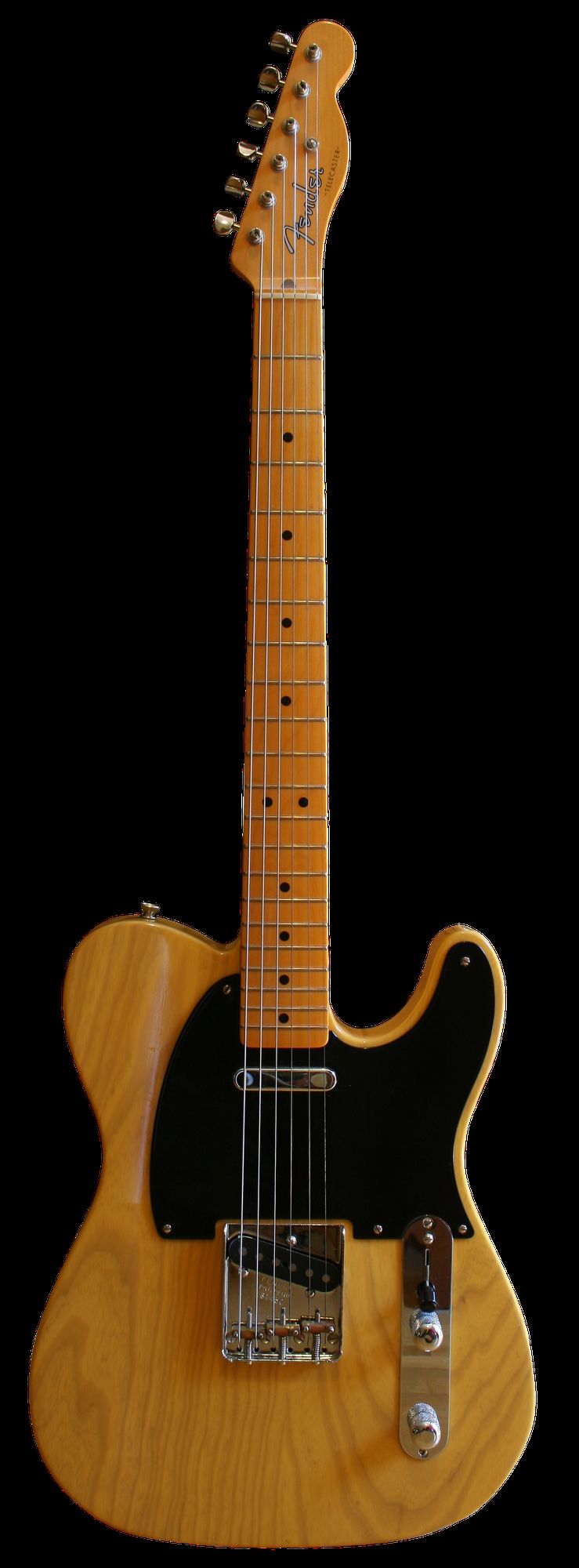
Fender Telecaster American Vintage 1952 with transparent background. Photo by Massimo Barbieri. Licensed under CC BY-SA 3.0. Via Wikimedia Commons. Fender
Telecaster
1950
Leo built it like a tool. The famous ones look like they just clocked off a double shift.
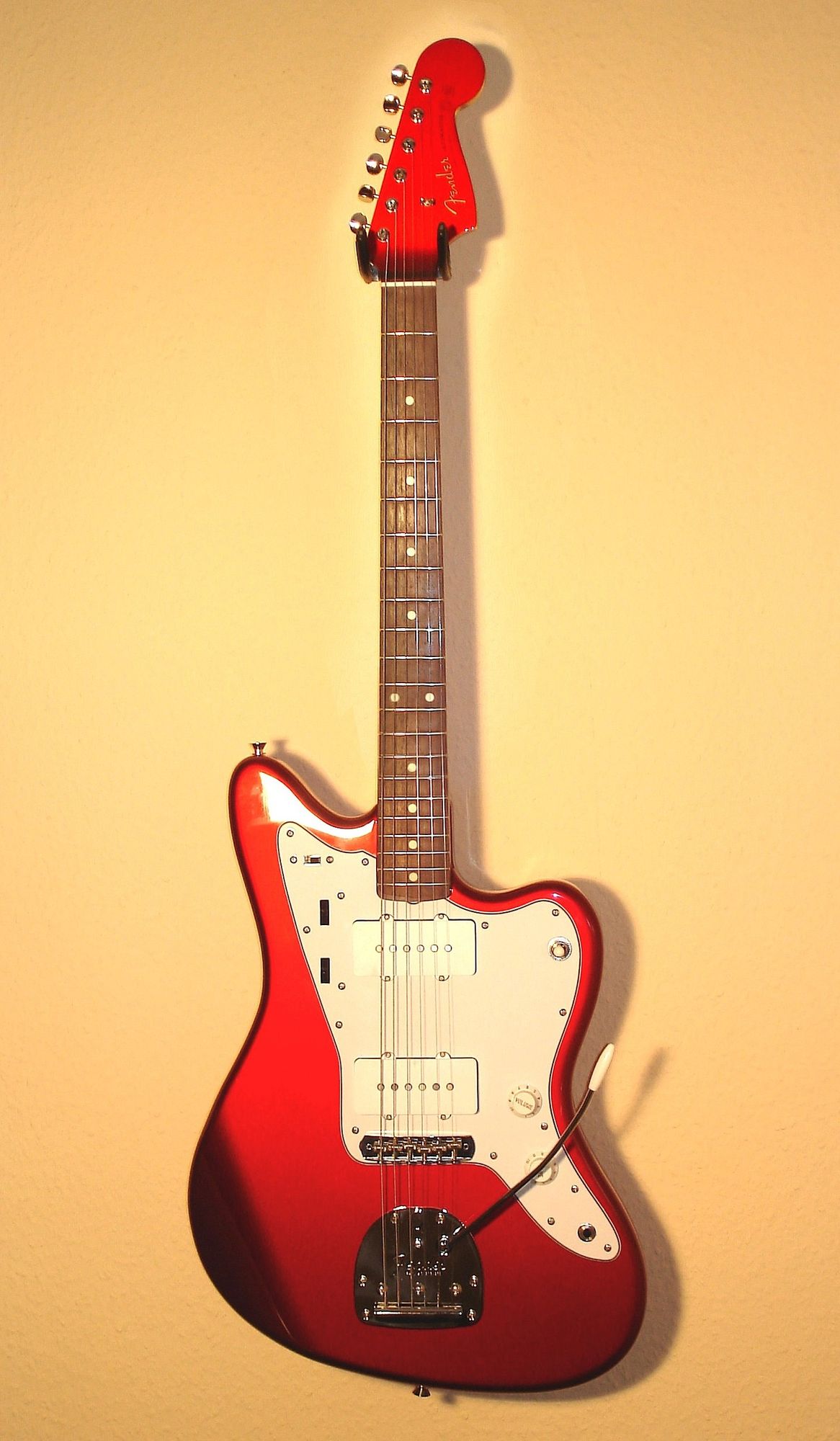
Photo: Dirk-X / Wikimedia Commons / CC BY-SA 4.0 Fender
Jazzmaster
1958
Fender built it for jazz players. Jazz players said no thanks. Surfers, punks, and noise bands said yes.