Rickenbacker
4003
Rickenbacker’s first answer to players’ new strings was to void the warranty. The 4003 was the better answer.
The late 1970s. Rickenbacker’s 4001 bass has a slim neck designed around the flatwound strings of its day, and players are putting on whatever strings they like. Rickenbacker’s answer is blunt: use somebody else’s strings and your warranty is void.
- Introduced
- 1980
- Type
- Bass
- Class
- Production
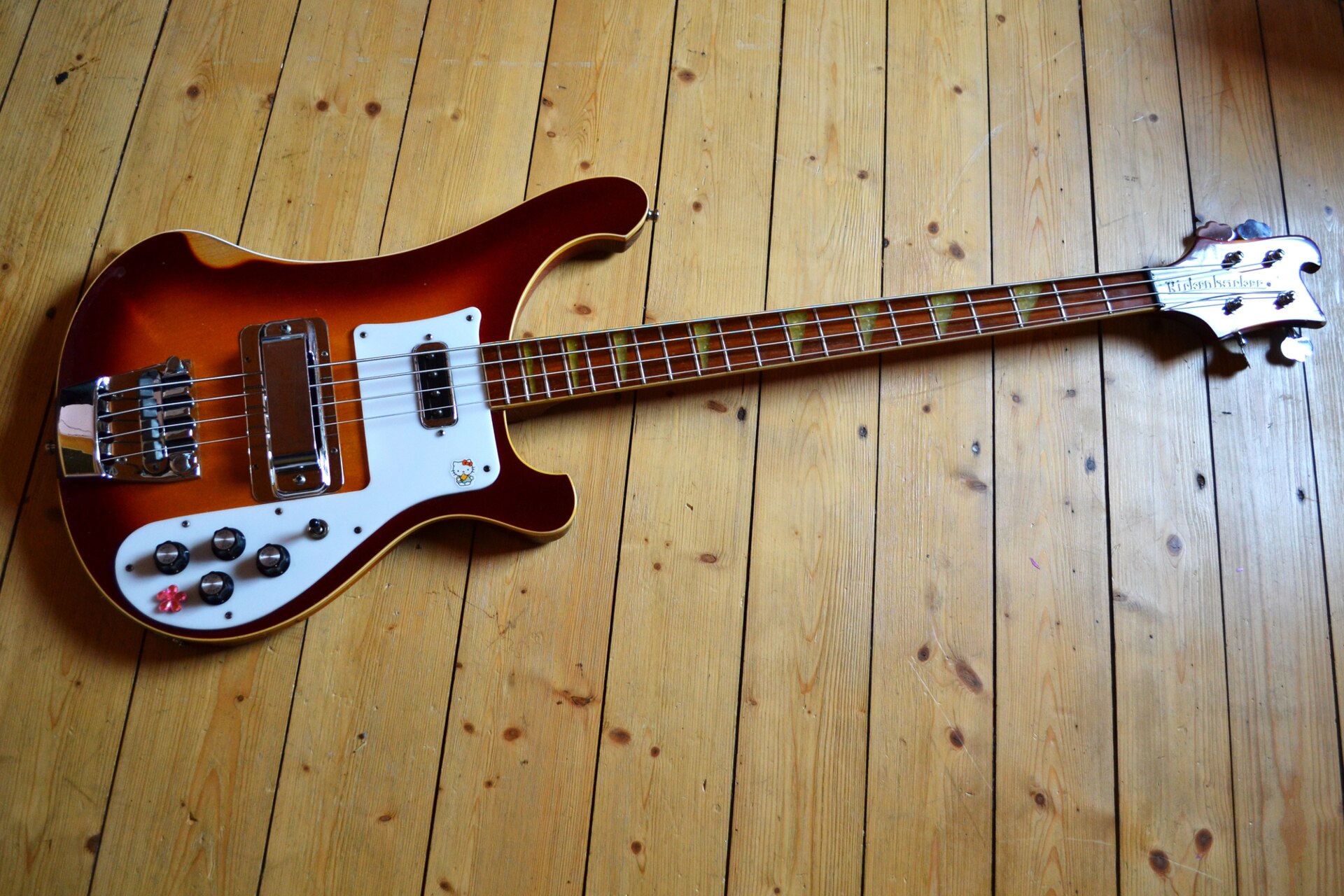
The short version
1961
The 4001
The bass everyone pictures arrives, on a 33¼-inch scale Rickenbacker has kept ever since.
1979
Prototypes
The first 4003s are built. Standard production follows in 1980.
1981
The plain one
The 4003S arrives, unbound and dot-marked, mono only.
1985
Last of the 4001s
The last “true” 4001s leave the factory in December, by the specialists’ count. Other accounts end the 4001 in 1981.
2006
The cap comes back
A push-pull control returns the vintage treble circuit that was dropped in 1984.
2019
Al Cisneros
Rickenbacker names a 4003 after the Sleep and Om bassist.
2022
New neck
A three-piece neck with a walnut stripe and a single dual-action truss rod.
Side A
A1
Our strings or no warranty
The Rickenbacker 4001 is the bass on a lot of records you love, and it had a problem. Its slim neck was designed around the strings people used when it came out, flatwounds. By the late 1970s, players were putting on whatever strings they liked.
Rickenbacker’s first answer, as the specialists tell it, was to void the warranty for anyone using non-factory strings.
That’s a company telling its customers to play the bass the way the factory designed it. It never works for long. Players are going to put on whatever strings make the sound in their head, and eventually somebody at the factory has to build for that.
A2
A thicker neck, a split guard, more screws
That bass was the 4003. The first ones were prototypes in 1979, and standard production started in 1980.
From across a room it looks like a late 4001: same cresting-wave body, same two pickups, same shape. Underneath, it’s a different structure. The neck got thicker. The twin truss rods got moved to the body end. The pickguard got split in two, and the bridge got extra screws so its tail wouldn’t lift under tension.
And it’s neck-through, maple and walnut running the whole length of the body, on the same 33¼-inch scale Rickenbacker has used since the 4000 in the late 1950s. That’s a little shorter than a Fender’s 34 inches, and no, it isn’t a misprint.
The deluxe 4003 has a bound body and neck, triangle inlays, and two output jacks, one mono and one stereo, called Rick-O-Sound, which sends the two pickups out separately so you can run them to two different amps. The manual says to use one jack at a time. The plain version, the 4003S, came in 1981 with dots, no binding, and one jack.
A3
The legend says new, the paperwork says later
Rickenbacker’s own John Hall has said the 4003 launched with a “completely new truss rod system.” The specialists say that’s not quite right for 1979 through 1983. The early 4003s kept a version of the old twin-rod setup. Conventional single-action rods, the kind you adjust at the headstock, came in late 1984 and 1985.
That’s the legend and the paperwork, and here the paperwork is on the specialists’ side.
The bass kept changing after that. In 1984 the factory dropped the old high-pass capacitor from the circuit. In January 2006 a push-pull knob brought it back. A new bridge in 2020, a three-piece neck with a walnut stripe and a single dual-action rod in 2022, and a shallower neck shape in 2023. The pickups are Hi-gains. Don’t let anyone sell you a regular 4003 as a “toaster bass.”
Flip the record · By the numbers
33¼"
Scale length, the same since the 4000 of the late 1950s. It is not a 34-inch Fender scale.
2
Output jacks, mono and Rick-O-Sound stereo. The manual says to use one at a time.
1985
The last “true” 4001s, by the specialist timeline. Other accounts say 1981. Either way, the two overlapped.
1,000
4001CS tribute basses made from 1991 to 2000, built on the 4003S, not the old 4001.
Side B
B1
The famous names are on the other bass
Here’s the awkward part. Nearly every famous Rickenbacker bass player you can think of played a 4001, not this.
Chris Squire of Yes played a 1964 Rose-Morris export 4001S. Geddy Lee bought a 4001 in 1974 after seeing Squire. Paul McCartney’s Rickenbacker was a left-handed 4001S from 1964. Lemmy played a modified 4000-series bass for years and then got his own 4004LK. Cliff Burton had a Burgundyglo 4001. None of those are 4003s.
The famous records have a 4001 on them. The 4003 is the one you can walk into a shop and order.
Even Rickenbacker’s 4001 reissues, the V63, the C64, and the 1,000-piece 4001CS that copied Squire’s bass, were built on a 4003S chassis. The old bass lives on inside the new one.
B2
Built for the way people play
When the 4001 ended is argued. Some say 1981. The specialist timeline keeps it on the price list through 1985, with the last true 4001s built that December. Either way, after that the 4003 was the Rickenbacker bass, and it still is, built in Santa Ana.
In 2019 Rickenbacker put a player’s name on one. Al Cisneros of Sleep and Om got the 4003AC: a re-engineered bridge, a two-way truss rod, hot-wound pickups, a walnut body, and green Sleep triangles in the fingerboard. It’s a heavy-music bass on a flagship design. Nothing about it is a vintage 4001 copy.
Rickenbacker started out telling players which strings they were allowed to use. The 4003 is what it built once it stopped arguing with the people holding the bass.
The cast
The people, and the specific guitars, that made the legend.
2019
Al Cisneros
Rickenbacker 4003AC
Sleep and Om. A signature built on the 4003, with hot-wound pickups, a walnut body, and green Sleep triangle inlays.
John Hall
Rickenbacker’s boss
Has said the 4003 launched with a “completely new truss rod system.” The specialists say that change came later.
1964
Chris Squire
1964 Rose-Morris 4001S
Yes. One of the sounds people mean when they say “Ricky bass,” and it came out of a 4001S, not a 4003.
1974
Geddy Lee
4001
Rush. Bought his after seeing Squire. It’s a 4001, whatever the internet says.
2002
Lemmy Kilmister
4001, later a 4004LK
Motörhead. A modified 4000-series bass for years, then his own 4004LK signature. Neither is a 4003.
Liner notes
Specs, construction, rarity, value, and every source we used.
Bound deluxe 4003 is the living Santa Ana bass: 33.25-inch neck-through, triangles, Rick-O-Sound stereo — not a 4001, not a 4003S, and not a 34-inch Fender.
- Body
- Solid maple; 13 1/2" × 1 1/4" × 44 13/16"; factory 9.0 lb (4.1 kg)
- Neck
- Thru-body maple & walnut
- Fingerboard
- Bound rosewood, 10" radius, triangle markers, 20 frets
- Scale
- 33 1/4" (33.25" / 84.5 cm) — not 34"
- Pickups
- 2× Hi-gain
- Hardware
- V2 / RIC bridge; tuners listed Schaller
- Electronics
- Mono and stereo (Rick-O-Sound); two 1/4" jacks
- Finish
- High-gloss; catalog Jetglo, Mapleglo, Fireglo
- Nut
- 42.9 mm (1 11/16"); 54.0 mm at 12th fret
Open the full research fileConstruction details, the complete player record, production numbers, dated value estimates, and sources
Current deluxe from rickenbacker.com (fetched 25 Aug 2026). Sweetwater 4003JG adds Bakelite nut, poly, and push/pull treble tone — not on the factory table. rickenbacker101: Gotoh tuners from mid-2023. Classic 4001-into-4003 neck/truss/cap/bridge is not this spec.
Construction
Rickenbacker International Corporation, Santa Ana, California. Solidbody electric bass. Neck-through. Not a 34-inch Fender-scale bass. 4003S, 4003W, and 4003SW are labeled relatives, not this table.
1979 prototypes / 1980 standardized production (rickenbacker101). Do not pick one year. Wikipedia dates the 4003 from 1980 and ends the 4001 in 1981; the specialist timeline keeps prototypes in 1979 and the 4001 on the pricelist through 1985 (last “true” 4001s December 1985). Overlap ~1980–1985. Cosmetically a late 4001 and an early 4003 are close. Structurally they are not.
The 4001’s slim neck was designed around period flats. Late 1970s: RIC voided warranty for non-factory strings (rickenbacker101). The 4003 kept the cresting-wave two-pickup silhouette, thickened the neck, moved dual hairpin rods to the body end, split the pickguard, and added extra bridge screws against tail-lift.
Deluxe 4003 ≠ 4003S ≠ 4001. Deluxe: bound body + bound rosewood board, triangles, mono and stereo (Rick-O-Sound), thru maple & walnut. 4003S: unbound, dots, mono only, thru-neck (unlike late set-neck 4001S). Factory 4003S copy says “no binding”; the same page’s table lists “Neck Binding: Yes” — page error. First 4003S 1981; returned 2015. 4001V63 / 4001C64 / 4001CS are 4003S-based reissues. Do not fold 4000, 4004, or 4005 here.
Scale has been 33.25" since the 4000 (1957–58 design / 4001 from 1961). Current official 4003 / 4003S / 4003W sheets: 84.5 cm / 33 1/4". Not 34".
Launch neck: thicker two-piece, dual hairpin rods from the body. Late 1984–1985: conventional single-action rods, headstock adjustment (John Hall quoted on rickenbacker101). Hall has said the 4003 launched with a “completely new truss rod system.” rickenbacker101: not accurate for 1979–83; that swap is 1984/85. One-piece Dec 1984–2009. Two-piece 2009. Feb 2022: three-piece walnut skunk stripe and a single dual-action rod. 2023: shallower “D.”
Do not call early 4003s “toaster basses” unless the bass is a reissue. Current 4003 = two Hi-gains. 4001 path: toaster + horseshoe to 1968; Hi-gain bridge from Dec 1968; neck toaster gone Sept 1973. Deluxe dual jacks: use one at a time (RIC manual via Sweetwater InSync). Vintage high-pass cap: removed 1984; push-pull returns it January 2006. V2 bridge August 2020. CNC Dec 1996 slimmed the horns. Factory board: “Rosewood”; rickenbacker101: chechen from late 2011.
Variants, not this SKU: 4003W (2014, walnut wings); 4003FL (1984–2008); 4003 Noir (2026 20-piece, No Treble) — still 33.25".
Players
Al Cisneros (Sleep, Om) — Rickenbacker 4003AC, 2019. No Treble (13 June 2019): based on the flagship 4003; re-engineered bridge, two-way truss rod, dual hot-wound treble pickups, green Sleep triangle inlays, walnut body in the 4003W manner. Factory-named 4003 artist. Not a vintage 4001 recreation.
The Yes / Rush / Motörhead / Beatles Ricky cliché is a 4001 / 4001S story. Chris Squire — 1964 Rose-Morris RM1999 (UK export of 4001S). RIC’s 4003S page names that 1964 4001S; the later 4001CS (1991–2000) copies it. Not a 4003. Geddy Lee — 4001, purchased 1974 after seeing Squire. Guitar World (17 October 2023): Rick-O-Sound; Moving Pictures split Ricky and Jazz. 4001, not 4003. GW dates the successor “’82 to date” — late against the 1979/80 specialist timeline. Paul McCartney — left-handed 4001S, 1964. Public identity remains Höfner. MusicRadar’s 4003 write-up borrowing McCartney is model-bleed. Lemmy Kilmister — 4001 / modified 4000-series, then factory 4004LK from circa 2002 (Vintage Guitar). Not a 4003 signature. Cliff Burton — Burgundyglo 4001, then Aria Pro II. Not 4003.
Wikipedia’s 4001 notable-players list is not 4003 documentation. Post-1981 “new Ricky bass” purchases are often 4003s by calendar — inference, not a named list. Wolstenholme (Muse) and Mills (R.E.M.) are not independently verified here as 4003 vs 4001 reissue.
Rarity
The 4003 is not scarce as a model. Continuous Santa Ana flagship since ~1980. Single-factory backorders are production-rate scarcity, not a limited run. Factory 4003 yearly totals: unpublished.
The vintage collector object is the 4001 (1961–1985), not this SKU. 1973 is the collector split on 4001s: checkerboard → single-ply white (July); toaster neck → Hi-gain (September). 4001V63, 4001C64 / C64S, and 4001CS (1,000, 1991–2000) are discontinued reissues on 4003S foundations — not 1960s originals. Do not treat a current 4003, a 4003S, or a V63/C64 as a vintage 4001. Scarcer inside this number: early 4003 (hairpin / split-guard / vintage-cap, to ~1984); 4003FL; dealer-limited colors. Artist-owned 4001s are a separate market.
Value
Informal estimate, 25 August 2026. Not an appraisal.
Asking prices are not sold prices. Sold comps are thin; Reverb price-guide pages bot-walled this pass, so no 2024–26 Reverb sold band. Prefer labeled dealer asks. 4001 vintage is not 4003 money. Artist-owned lots are not comps.
New street. About $2,599 for a deluxe 4003 (Guitar Center Fireglo; Fab Gear, live August 2026). 4003S about $2,299 (Fab Gear). 4003W $2,599 / 4003SW $2,259 (Fab Gear, sold out at capture).
Used modern. Sold tape is thin. Fab Gear sold a used 2014 4003 Fireglo at $2,089. guitarprice.net 2026 compilation (third-party, not a sold table) puts used 4003 at $1,600–$2,100 excellent.
Vintage / collectible. That band is the 4001, not this SKU. No 2024–26 public hammer for a clean 1960s deluxe 4001 was captured. guitarprice.net: 1960s 4001 $4,000–$8,000 — aggregator, not a 2026 sold median. Player-grade post-’73 4001: Fab Gear sold a 1973 Mapleglo at $3,500. Pre-1973 checkerboard: Andy Baxter asking £5,750 — ask, not sold. Do not treat a V63/C64 as a 1960s 4001.
See also
- rickenbacker-330-360 — the Santa Ana Capri six-strings; not a bass and not a 4001
- fender-precision-bass — the 34-inch bolt-on this neck-through 33.25" bass is not
Sources
- Rickenbacker 4003 — current deluxe: solid maple, thru-neck maple & walnut, rosewood/triangles, 33 1/4", 20 frets, 1 11/16" nut, Hi-gain, mono and stereo, V2, bound neck, Schaller listed
- Rickenbacker 4003S — dots, mono, same scale; copy = no binding; table “Neck Binding: Yes” conflict; McCartney/Squire named as 1964 4001S, not 4003
- Rickenbacker 4003W — walnut body, maple board, triangles, stereo, same scale
- Rickenbacker 4003SW
- Rickenbacker bass style
- Rickenbacker Legacy — McCartney Fireglo 4001S; Squire RM1999
- rickenbacker101, 4003 timeline — 1979/80 launch; neck/truss/bridge through 2025 (V2 2020, dual-action rod 2022, Gotoh 2023)
- rickenbacker101, 4001 timeline — 33.25" rationale; toaster/horseshoe → Hi-gain; Rick-O-Sound 1968/1970; 4001 end 1985; reissues on 4003S chassis
- Sweetwater 4003JG — dealer sheet: 33.25", push/pull treble tone, two jacks, poly gloss
- Sweetwater InSync, Rick-O-Sound — stereo TRS, one jack at a time (quotes RIC manual)
- No Treble, 4003 Noir 2026 — 33.25", ebony/bullseye, stereo Hi-gains, V2; 20-piece run
- No Treble, 4003AC — named 4003 artist (13 June 2019)
- MusicRadar, Cool and classic basses — 4003 produced 1979–current; 4001 still in production (to 1985 in this account); McCartney-bleed caveat (12 Dec 2011)
- Guitar World, Geddy Lee — 4001 vs 4003 split; Geddy 4001 1974; Moving Pictures Ricky/Jazz; 4001, not 4003 (17 Oct 2023)
- Vintage Guitar, Lemmy — Hawkwind Ricks + Thunderbird pickups; 4004LK from circa 2002. Not 4003.
- Wikipedia 4001 — lead only (scale 33.25", 4001→4003). Do not trust its 4001 end-year or notable-players list as 4003 evidence
- Wikipedia 4001CS — Squire RM1999 / 4001S; 4001CS is a 4001 tribute, 1991–2000
- Guitar Center, Rickenbacker bass — 4003 Fireglo $2,599
- Andy Babiuk’s Fab Gear, Rickenbacker basses — new street + sold 2014 4003 $2,089 + sold 1973 4001 $3,500 + LE asks
- Andy Baxter Bass — 2025–26 4003 £2,550 ask; 1973 checkerboard £5,750 ask; 1978 4001 £3,250 ask
- Reverb 4003 — bot-walled this pass; no sold band extracted
- Reverb buying guide, 4003/4001
- Equipboard 4001V63 — average $2,979 (May 2026)
- Equipboard 4001C64 — average $4,582 (May 2026)
- Bella Romeo, 4001V63 — $3,900 ask
- Cool Old Guitars, 2001 4001C64 — $4,307 ask
- Vintage & Rare, 1969 4001 — sold, price not shown
- The Guitar Broker, 1968 4001 — no public price
- guitarprice.net Rickenbacker — 2026 compilation; not solds
Keep digging
Guitars this one gets compared to, confused with, or descended from.
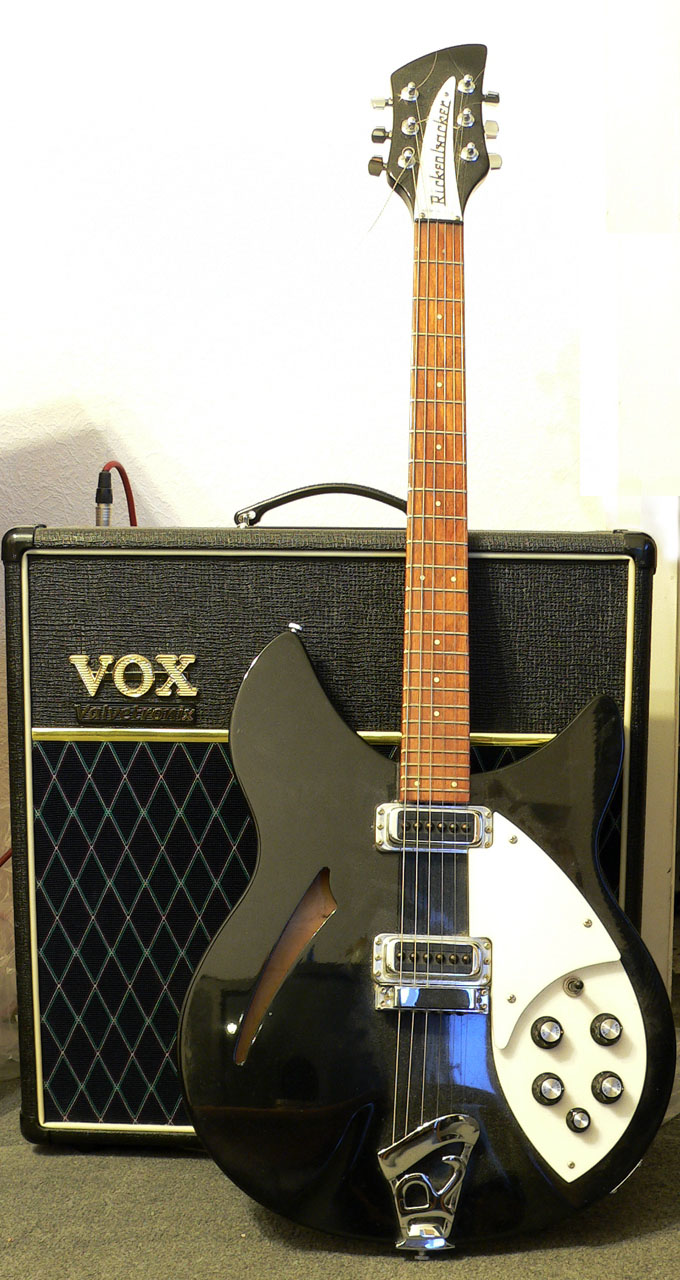
Rickenbacker 330JG. Licensed under CC BY-SA 3.0. Via Wikimedia Commons. Rickenbacker
330 / 360
1958
Same body, same neck, same pickups. The 360 got the binding. The 330 got Paul Weller’s, with “I AM NOBODY” on it.

Photo: Infrahertzz / Wikimedia Commons / CC BY-SA 3.0 Fender
Precision Bass
1951
Leo’s bass let the player at the back be heard. You know their lines by heart. You mostly don’t know their names.