Rickenbacker
330 / 360
360
Same body, same neck, same pickups. The 360 got the binding. The 330 got Paul Weller’s, with “I AM NOBODY” on it.
California, 1958. Rickenbacker rolls out a new line of semi-acoustic guitars and names it after the boss’s cat. There’s a plain one and a fancy one. For years, the fancy one is the more common of the two.
- Introduced
- 1958
- Type
- Semi-acoustic electric
- Class
- Production
Have a photograph of this guitar? Send a picture
The short version
1958
Capri
Roger Rossmeisl’s 300 series arrives, named for F.C. Hall’s cat. The 330 and 360 share a body.
1964
The split
The 360 gets a rounded-over top, the “New Style.” The 330 keeps its square edges.
1970
Hi-gain, 24 frets
The old “toaster” pickups give way to Hi-gains on the 6-string 360 around 1970. Six-strings go to 24 frets.
1981
Peter Buck’s Jetglo
Buck buys the black 360 he’ll play on every R.E.M. album from Murmur on.
1984
“What Difference Does It Make?”
Johnny Marr’s Jetglo 330, “tracked up,” on the intro.
2008
Stolen in Helsinki
Buck’s Jetglo 360 is stolen. It comes back.
2023
Back to 21
Rickenbacker returns the 330 and 360 to 21 frets, where they started.
Side A
A1
The plain one and the fancy one
In 1958 Rickenbacker introduced a line of semi-acoustic guitars called the Capri, after F.C. Hall’s cat. Roger Rossmeisl did most of the designing. There were two six-strings on the same body, and the only real difference was the trim.
Today the 360 is the deluxe. Bound body, bound neck, triangle markers, and a second output for stereo. The 330 is the standard. No binding, dot markers, mono only. Same maple, same set neck, same 24¾-inch scale, same pickups.
For a long time the fancy one was the more common one. Ask the Rickenbacker specialists and they’ll tell you 330s from before the mid-1980s are rarer than 360s from the same years.
The plain one had to wait for its people.
A2
Hollow, semi, and other lies
Let’s clear one thing up. You’ll read that the 330 is hollow and the 360 is semi-hollow. It’s false. Both are semi-acoustic: maple carved out from the back, with a slash soundhole on top. Neither one is a big empty box.
For the first six years they were close to twins. Then, in 1964, Dick Burke gave the 360 a rounded-over top, the “New Style,” with softer cutaways. The 330 kept its square edges and sharper horns. Stand them side by side today and the 360 looks like the 330 went to finishing school.
The pickups tell time, too. Early Rics have the chrome “toaster” pickups, and on six-string 360s those gave way to Hi-gains around 1970. The usual shorthand maps the toaster sound to Beatles and Byrds records and the Hi-gain sound to the Smiths, R.E.M., and Fugazi. That’s a rule of thumb, not a wiring diagram, but it’s a good one to listen with.
Two more things before you go shopping. From 1970 to 2022 the six-strings had 24 frets, so a lot of used ones do too. And if you’re after John Lennon’s little Rickenbacker, that’s a 325, a short-scale guitar on another page. George Harrison’s twelve-string is a 360/12, and it has its own story as well.
The 360 got the binding, the triangles, and the stereo jack. The 330 got whatever you brought to it.
A3
I AM NOBODY
The plain one’s people turned out to be English, and loud.
Pete Townshend’s smashing-era Rickenbackers were Rose-Morris export models, the 1997 and the 1998, built on the 330 platform, the 1997 with an f-hole. They were not American 360s, whatever the caption says. Later he used a 1964 330S/12 twelve-string in the studio around Face Dances.
Then came Paul Weller and the Jam. Weller played 330s, including a 1974 Fireglo that carries the words “I AM NOBODY.” On the plainer of the two guitars, that reads like the best joke a Rickenbacker ever told, whether anybody meant it that way or not.
In the Smiths, Johnny Marr played a Jetglo 330. Ask him for the best example of it and he’ll point you at one intro. In his words,
…the best example of that Ricky is ‘What Difference Does It Make.’ When you hear the intro to that, that’s my 330, tracked up.
Tracked up means layered, several passes stacked on top of each other until the chime turns into a wall. That’s the Smiths half of the rule of thumb, in one song.
Flip the record · By the numbers
24¾"
Scale length on both. The Lennon guitar with the short neck is a 325, and it’s a different page.
2
Output jacks on a 360, mono and Rick-O-Sound stereo. The 330 is mono only.
21
Frets, in 1958 and again since 2023. Six-strings from 1970 to 2022 had 24.
1964
The year the two stopped sharing a body shape.
Side B
B1
The deluxe keeps its man
The 360 had its champion, too. Peter Buck of R.E.M. bought a Jetglo 360 in 1981 to replace a Mapleglo one that had been stolen, and it became his main guitar. It’s on every R.E.M. album from Murmur in 1983 to Collapse into Now in 2011.
It was stolen too, in Helsinki in 2008, and it came back. Buck turns up on some lists as a 330 player. The famous guitar is a 360.
B2
Rickenbacker’s top seller
Somewhere in the middle of the 1980s the plain one became the popular one. From then on, the 330 was the high-volume guitar in the 300 series, and Rickenbacker’s John Hall has called it the company’s top seller.
It’s still built in Santa Ana, to order. In 2023 both models went back to 21 frets, the way they started in 1958. The 360 still has its binding and its stereo jack.
But it’s the 330, the one with nothing extra on it, that sells best. Weller’s says “I AM NOBODY.” A lot of people seem to have taken that as an invitation.
Put this on
You’ve read about it. Now hear it. Here’s what this guitar sounds like, and what to listen for.
What Difference Does It Make?
Marr says it himself. “When you hear the intro to that, that’s my 330, tracked up.” That’s the plain one, layered.
Find it on YouTube (opens in a new tab)Murmur
Peter Buck’s Jetglo 360, the deluxe one, on the first R.E.M. album. It stayed on every album through Collapse into Now.
Find it on YouTube (opens in a new tab)You Better You Bet
Pete Townshend in the studio with a 1964 330S/12, the twelve-string version of the plain model.
Find it on YouTube (opens in a new tab)
The cast
The people, and the specific guitars, that made the legend.
1970s
Paul Weller
1974 Fireglo 330, “I AM NOBODY”
The Jam. A 330 man, with the words right there on the guitar.
1984
Johnny Marr
Jetglo 330
The Smiths. His best example of that guitar, in his own words, is “What Difference Does It Make.”
1981
Peter Buck
Jetglo 360
Replaced a stolen Mapleglo 360, then got stolen itself in Helsinki in 2008 and recovered. Some lists call him a 330 player. The famous guitar is a 360.
1960s
Pete Townshend
Rose-Morris 1997
His smash-era Rickenbackers were UK export models built on the 330 platform, not American 360s.
1964
Dick Burke
Designed the New Style 360
Gave the 360 its rounded-over top in 1964, the change that split the two models.
Liner notes
Specs, construction, rarity, value, and every source we used.
Standard 330 and deluxe 360 share Capri construction from the same Santa Ana line. After 1964 the bodies diverge. This is not a 325, a 370, or a 4001.
- Body
- Semi-acoustic maple, 1 1/2" × 15"; square-edged flat sides | Semi-acoustic maple, 1 1/2" × 15"; rounded-over top (from 1964)
- Neck
- Set-in maple & walnut | Set-in maple & walnut
- Fingerboard
- Rosewood, 10" radius, dot markers, unbound | Rosewood, 10" radius, triangle markers, bound
- Scale
- 24 3/4" (62.9 cm) | 24 3/4"
- Pickups
- 2× Hi-gain single-coil | 2× Hi-gain single-coil
- Hardware
- ‘R’ tailpiece / 6-saddle; Gotoh tuners | ‘R’ tailpiece / 6-saddle; Gotoh tuners
- Electronics
- Mono only | Mono and stereo (Rick-O-Sound)
- Finish
- Catalog colors | Catalog colors
- Nut
- 1.63" | 1.63"
Open the full research fileConstruction details, the complete player record, production numbers, dated value estimates, and sources
Current spec from rickenbacker.com, plus 2023–24 updates. Both returned to 21 frets in 2023 (24-fret 1970–2022 on 6-string). Factory weight 8.0 lb either model. Overall length 39 1/2" (330) / 39 3/4" (360). 12-string variants (330/12, 360/12, 360/12C63) are related; they are not this page’s subject.
Construction
Rickenbacker 300 series. “Capri” in 1958, named for F.C. Hall’s cat. Designed principally by Roger Rossmeisl. Semi-acoustic: back-carved semi-hollow maple, slash/cat-eye soundhole, set neck, 24 3/4" scale. Built in Santa Ana, California, to order. Not a mass Asian line.
The useful split is deluxe vs standard, not “hollow vs semi.” Forum posts that “330 is hollow, 360 is semi” are false. Both are factory semi-acoustic.
330 — standard: unbound, dots, mono only, sharp/flat body edges (current).
360 — deluxe: bound neck/body, triangles, mono + Rick-O-Sound stereo, contoured/rounded body from 1964 New Style.
Through 1958–64 they were the same platform with deluxe trim only. Early 360s were flat-top bound 330s — “Old Style,” later a WB special-order flat-top. 1964 is the shape split: 330 keeps square-edged flat sides and sharper horns. 360 gets the rounded-over top (“New Style,” Dick Burke; first production August 1964) and more radiused cutaways.
Do not fold in 325 (short-scale, Lennon), 370 (3-pickup deluxe), or 4001 bass.
Vintage Toaster pickups to ~1970 on 6-string 360; 12-strings lagged into 1973. Production then Hi-gain. Toasters return on vintage/C-series reissues. Wikipedia 330 maps toasters to Beatles/Byrds-type records and Hi-gains to Smiths / R.E.M. / Fugazi-type records. Stylistic, not a wiring law.
Fifth blend knob from New Capri ~1961 on the neck pickup; vintage high-pass bridge capacitor removed ~1984. 360 stereo: two jacks (mono + Rick-O-Sound). Manufacturer spec is 330 mono. Aggregator pages that give the 330 stereo contradict the factory.
Dual truss rods were a hallmark for decades. 2024 core guitars (except 360/12C63) moved to a single dual-action rod (rickenbacker101 timeline). Catalog copy still shows the older narrative in places. Confirm on a given serial. Finished rosewood board (unfinished-board experiment 2021–22, reverted). Gotoh tuners from 2023; Schaller M6 mini before.
Fret count trips people. 21 originally; 24 from 1970 (6-string) / 1974 (12-string 360); back to 21 in 2023. Many used “modern” Rics are 24-fret.
12-strings share the compact combo headstock and Rickenbacker’s reverse pairing (octave struck second) after the first prototype. 360/12 is the deluxe 12; 360/12C63 is the Harrison-spec reissue (21 fret, trapeze, toasters, OS body) at $3,899 list (2026). Mentioned because players ask. Split that page later if Beatles/Byrds coverage needs it. Not the subject here.
Players
Model-match or don’t list it. John Lennon’s 325 is not this guitar. Harrison 360/12 is a labeled relative. McGuinn’s later 370/12 is not this page.
330 / 330-family. Pete Townshend — smash-era Rose-Morris 1997 (export of 335: 2 PU, dots, unbound, f-hole) and 1998 (3 PU). 330-platform UK exports, not US 360 deluxe. 1980–81 studio: 1964 330S/12. 1989: Fireglo 330/12. Whotabs is the sourced gear log. Don’t write “Townshend’s 330” as if it were a US deluxe 360. Johnny Marr (The Smiths) — Jetglo 330; “the best example of that Ricky is ‘What Difference Does It Make.’ When you hear the intro to that, that’s my 330, tracked up” (Reverb interview). Paul Weller (The Jam) — 330s, including a 1974 Fireglo serial NG 4292 with “I AM NOBODY” (Christie's). rickenbacker101 frames Weller and Marr on 330s vs Buck on 360. The Edge — 330/12 (Wikipedia 330 list; 12-string variant, not independently verified here beyond tertiary lists). Guy Picciotto (Fugazi) — Wikipedia 330 list.
360. Peter Buck (R.E.M.) — Jetglo 360 (purchased 1981) as primary early R.E.M. guitar; stolen Helsinki 2008, recovered (Guitar World / NME, 2021). Guitar World: played on every R.E.M. album from Murmur (1983) to Collapse into Now (2011). An earlier Mapleglo 360 was stolen; the Jetglo replaced it. Wikipedia’s 330 “notable players” list includes Buck. Treat that as conflation. The famous guitar is a 360.
Related 12-string (not this page’s subject). George Harrison — second Rickenbacker 12-string ever, 360/12 SN CM107 (Dec 1963), given February 1964; A Hard Day’s Night, “I Call Your Name,” “You Can’t Do That,” “Ticket to Ride,” and others. Second 360/12 (1965, New Style cutaways) on “If I Needed Someone.” This is 360/12, not 330. Roger McGuinn (The Byrds) — 12-string after seeing Harrison. Famous Mapleglo was a 360/12 with a third pickup added (not a factory 370/12 at first); later 370/12, which is not this entry. Townshend also used 360-family 12-strings (1964 360/12 Export; later a New Style Mapleglo 360/12 ex-Graham Nash; 1989/93 360/12V64). Those are 12-strings. His smashers were the 1997/1998 exports above.
Tom Petty. Heavy Rickenbacker user. Damn the Torpedoes cover is not a 360/12 and not the 360 body family. Vintage Guitar (November 2006): Petty and Mike Campbell call the red cover 12-string Campbell’s 660/12 — “the third Rickenbacker 12-string ever made,” first solidbody one. Later writers often call the same cresting-wave solidbody 12-string a 625/12 or 620/12; keep 625/12 as that later-writer line. Do not collapse the three numbers to one model. Body family is not 360. Petty’s blond recording 12-string — “the semi-hollow blond one” used to record “The Waiting” and “all those classic 12-string numbers” (VG 2006) — is 360/12-class. CultureSonar’s “360 12-string on the Torpedoes cover” is wrong.
Rarity
Current 330 and 360 are regular US production, but low-volume / dealer-wait compared with Fender/Gibson. 330 is Rickenbacker’s top seller (John Hall Q&A via Wikipedia 330). 360 is the deluxe sibling, also common. Pre-mid-1980s 330s are rarer than period 360s (Rickenbacker 101). From the mid-1980s the 330 became the high-volume 300-series guitar.
Actually scarce: 1958–64 flat-top deluxe (OS) 360s; mid-’60s 360/12 OS; documented 12-string prototypes. 360/12C63 is a current reissue, not vintage-scarce. 24-fret 1970s–2022 cores are common used. Factory totals unpublished here.
Value
Informal estimate, 25 August 2026. Not an appraisal.
Vintage 2024–26 hammers not captured. Prefer labeled asks over invented medians. No factory model counts.
New street. About $2,100 for a 330; about $2,500 for a 360; 360/12C63 $3,899. Rickenbacker USA Retail Price List, effective 1 January 2026 (includes standard case): 330 / 330W $2,149; 360 / 360W $2,599; 360/12C63 $3,899. Dealer examples: 330 MapleGlo $2,099 (Bill’s Music; Guitar Center Jetglo $2,099); 360 MapleGlo/Fireglo $2,499 (Bill’s Music); Motor City Guitar 360/12C63 Fireglo $3,899.
Used modern. Sold comps are thin. Unofficial aggregator guitarprice.net (2026; contains spec errors — e.g. it wrongly gives the 330 stereo): used 330 ~$1,400–$1,800; used 360 ~$1,800–$2,200. Not a Reverb sold table. Guitar Center used 360 Jetglo ask $1,859.99 (one listing). Modern 330s/360s typically sit near or slightly under new street; they are not a vintage market.
Vintage / collectible. 2024–26 hammers not captured. Older Rickresource forum: a ’60s 330 “usually… little less than twice a brand new one”; OS 360s “$5,000+”; two dealer ’66 365 OS Fireglo at $10,000 — pre-2024 forum/dealer, not 2026 solds. Do not treat aggregator vintage dollars as a sold band. Beatles association is a 12-string ask inflator, not a price for ordinary 360/12s. C63 recreations are not 1963 originals. 325 / Lightshow / Rose Morris oddities are adjacent, not 360 Core.
See also
- gretsch-6120 — hollowbody jangle with a Bigsby instead of an R-tailpiece
- gibson-es-335 — the other 1958 semi that stayed in production
- fender-jazzmaster — offset California, same era, different factory
Sources
Vintage Guitar, Rickenbacker electric 12-strings — later-writer 625/12 line on the Torpedoes cover guitar; do not collapse onto 660/12 or 360
Wikipedia 330 — 1958, Rossmeisl, toaster vs Hi-gain mapping, notable-players list (use cautiously)
Wikipedia 360/12 — Harrison CM107; McGuinn 370/12
Bill's Music, current 330/360 dealer prices — 330 $2,099 / 360 $2,499
Motor City Guitar, 360/12C63 — $3,899
Rickenbacker101, 330 timeline — pre-mid-1980s 330s rarer than period 360s; Weller/Marr 330 vs Buck 360
Vintage Guitar, Petty and Campbell — Nov 2006: Petty/Campbell say Torpedoes cover is 660/12 solidbody; blond recording 12-string on “The Waiting” is 360/12-class
Reverb, Marr on his guitars — Smiths Jetglo 330; “What Difference Does It Make”
Christie’s, Weller 1974 330 NG 4292 — “I AM NOBODY”
Guitar World, Buck Jetglo 360 theft — Helsinki 2008; recovered
Whotabs, 1964 330S/12 — Townshend Face Dances / “You Better You Bet”
Louder/Classic Rock: The Guitars That Built Rock — 330 — 1958 launch; Weller vs Townshend; Lennon 325 and Harrison 360/12 kept separate (11 Dec 2016)
NME: Buck Jetglo 360 recovered — Helsinki 2008 (22 Dec 2021)
Keep digging
Guitars this one gets compared to, confused with, or descended from.
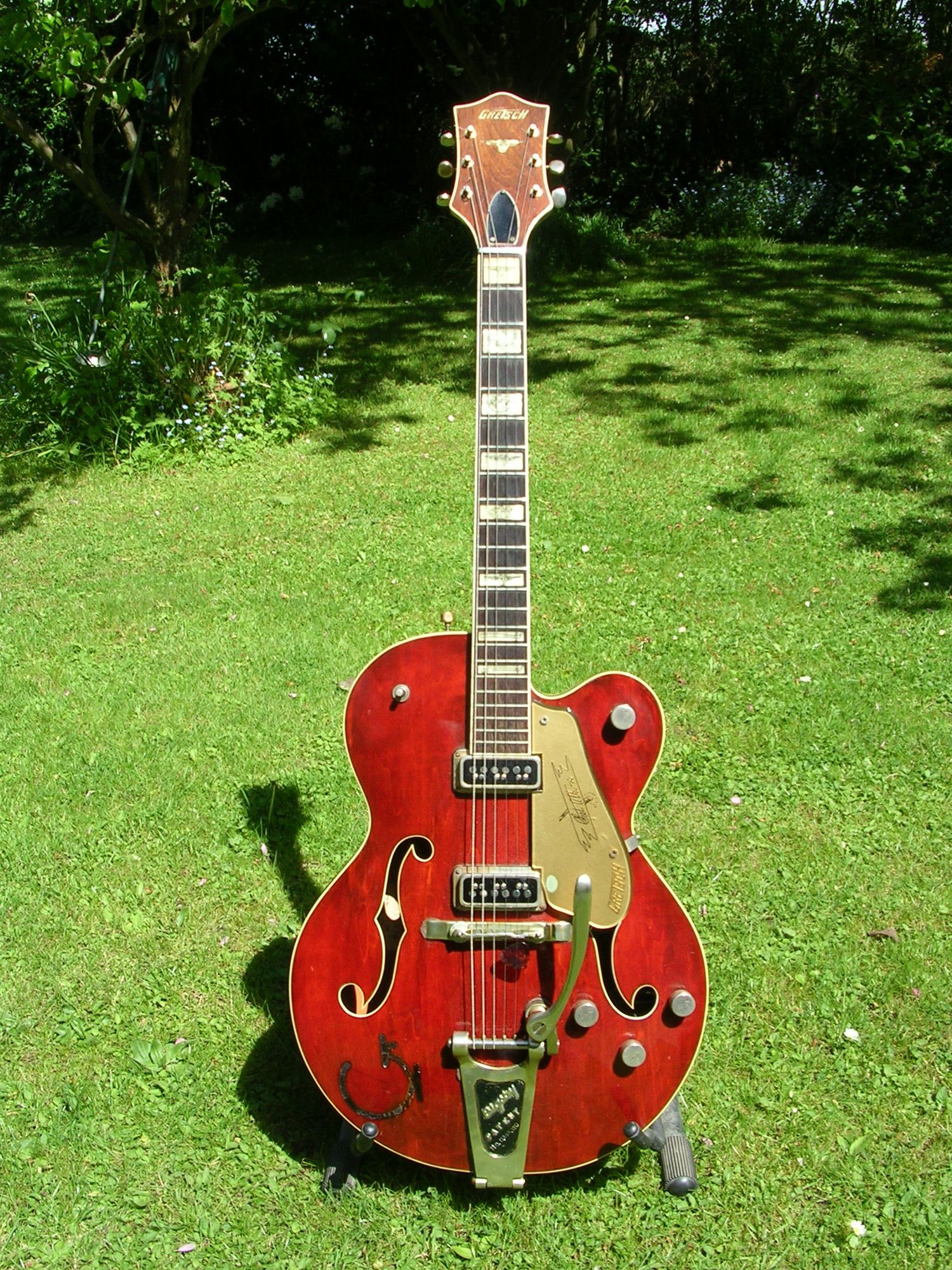
Gretsch 6120 G-Brand 1955. Photo by Francis pullen. Public domain (PD-self). Via Wikimedia Commons. Gretsch
6120
1955
Joe Walsh gave Pete Townshend one. Steve Miller gave Brian Setzer one. Chet Atkins just lent it his name.

Photograph of a vintage 1960 Gibson ES-335TD. Photo by Lightburst. Licensed under CC BY-SA 4.0. Via Wikimedia Commons. Gibson
ES-335
1958
Larry Carlton played three 335s off a shop wall, unplugged, paid $850 for one, and became Mr. 335.
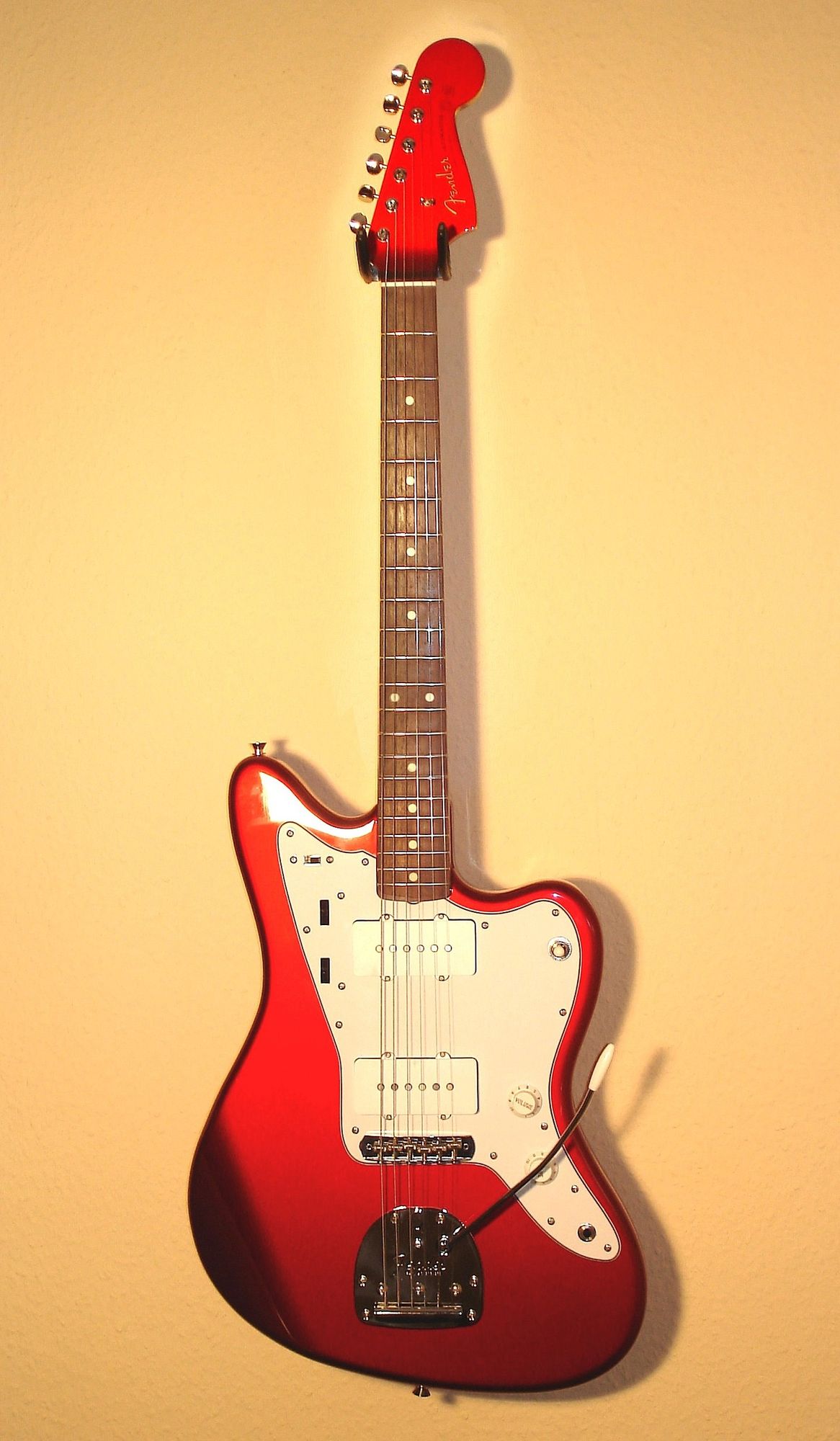
Photo: Dirk-X / Wikimedia Commons / CC BY-SA 4.0 Fender
Jazzmaster
1958
Fender built it for jazz players. Jazz players said no thanks. Surfers, punks, and noise bands said yes.