Rickenbacker
620
The Rickenbacker on the Damn the Torpedoes cover isn’t a 620. It’s still the reason the 620 is around.
October 1979. Tom Petty is on the cover of *Damn the Torpedoes* holding a red solidbody Rickenbacker twelve-string. It belongs to Mike Campbell, and nobody can agree on its model number. A quiet six-string in the back of the catalog is about to get very lucky.
- Introduced
- 1973
- Type
- Solidbody electric
- Class
- Production
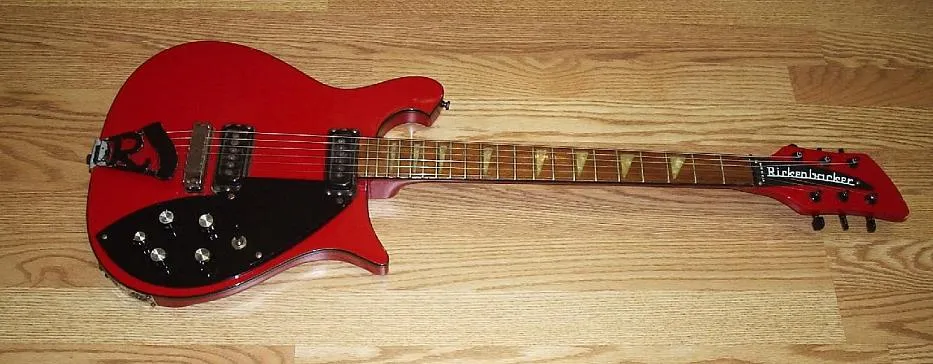
The short version
1958
The wave
The cresting-wave body shows up on the 450 and 425. The name for it comes decades later.
1962
The 625
A deluxe on a deeper body, with binding, triangles, stereo, and an Accent vibrato.
1969
The vibrato goes
The Accent license ends. No more vibrato 625s get built.
1973
The 620
A few special orders from 1970. On the price list and in real production by 1973, or 1974.
1979
The cover
Damn the Torpedoes, with Campbell’s 1963 solidbody twelve-string. Not a 620.
1980
The 620/12
January. The twelve-string goes into production, and the six-string finally gets its model stamp.
1999
A song about wanting one
Shiina Ringo’s “Marunouchi Sadistic” names a Ricken 620, and a price the narrator can’t pay.
2024
Still in Santa Ana
One dual-action truss rod replaces the pair. Twenty-one frets, same as always.
Side A
A1
The guitar on the cover
October 1979. Damn the Torpedoes comes out, and there’s Tom Petty on the cover, holding a red solidbody Rickenbacker twelve-string.
It isn’t Petty’s, and it isn’t a 620. It’s Mike Campbell’s, a guitar from 1963 that Petty and Campbell call the third Rickenbacker twelve-string ever made, and the first solidbody one. Campbell found it in the classifieds, and his first reaction was disappointment that it was a solidbody.
Nobody can agree what to call it. A 660/12. A 625/12 prototype. A 620/12 prototype. Three numbers, one guitar.
The six-string 620 had been on the price list since 1973 or so. It wasn’t on the cover. It was about to find out what the cover could do.
A2
A wave from 1958
The body is older than the number. Rickenbacker’s Combo 400 of 1956 was the “tulip.” The shape people now call the cresting wave appeared on the 450 and 425 in 1958. The earliest catalog anyone has found with the words “cresting wave” is from 1995. The shape didn’t wait for its name.
In 1962 Rickenbacker took that body upmarket. The deck went from 3/8 of an inch on the 450 to 3/4, the same as the semi-acoustics. That was enough depth for pickups on top and a six-saddle bridge with an Accent vibrato.
The deluxe version was the 625, in January 1962. Bound body, a one-piece maple neck running all the way through, triangle inlays on 21 frets, two “toaster” pickups, the Accent, five knobs, and mono and stereo outputs. A plain 615 followed in November. Same guitar, fewer frills.
A3
When the vibrato went
In 1969 the Accent license ran out, and the 625 stopped being built. The number hung around on price lists until 1974 anyway.
The guitar underneath didn’t go anywhere. Take a late 625, pull the vibrato and the roller bridge, fit an “R” tailpiece and a six-saddle bridge, swap the toasters for Hi-gain pickups, and you have a 620. A handful went out as special orders from 1970 to 1972. It was on the price list, and built in real numbers, by 1973. Some accounts say 1974. Keep both.
A 625 without the vibrato. That’s all it was, and that was plenty.
It’s a solid maple guitar with the neck running the full length of the body, bound top to bottom, and it has the stereo jack. It doesn’t need a vibrato to justify itself. For most of the ’70s, not a lot of people noticed it.
Flip the record · By the numbers
3/4"
The 1962 deck height, up from 3/8" on the 450. Enough room for pickups on top.
21
Frets, the whole way through. It never got the 330’s 24-fret years.
3
Model numbers for the one guitar on the cover. 660/12, 625/12, 620/12.
¥190,000
The price of a Ricken 620 in a 1999 song, for a narrator who doesn’t have it.
Side B
B1
Saved by a twelve-string
Then the album cover. In January 1980 the 620/12 went into full production, and six-string sales came along with it. By June the truss-rod cover finally carried a model stamp.
How much did it matter? The best guess, and it’s labeled a guess, is that Rickenbacker built more 620s in 1980 alone than in the previous decade. Nobody published the totals.
The same guess goes further. Put a 330/12 or a 360/12 on that cover instead, and the 620 would more than likely have gone out with the 450 in John Hall’s 1985 cut. The six-string was already in the catalog. The picture is why it stayed.
B2
¥190,000 in Ochanomizu
In 1999 Shiina Ringo put out “Marunouchi Sadistic,” on Muzai Moratorium. The lyric names a Ricken 620, a price of 190,000 yen, and Ochanomizu. The narrator doesn’t have the money. A song doesn’t pine for a guitar that got dropped from the catalog in 1985.
The 620 kept changing in small ways. A new bridge in 1984. Kluson tuners, then Grover, then Schaller, and Gotoh since 2023. A two-piece neck from 2009. The horn rounded off and then pulled back toward its old point. In 2024 a single dual-action truss rod replaced the pair. Through all of it, 21 frets.
Rickenbacker still builds it in Santa Ana. The 620/12, the twelve-string that saved it, isn’t on the 2026 USA price list. The six-string is.
The cast
The people, and the specific guitars, that made the legend.
1979
Mike Campbell
1963 solidbody twelve-string prototype, not a 620
Found it in the classifieds and was disappointed it was a solidbody. It became the cover of Damn the Torpedoes.
1979
Tom Petty
Holding Campbell’s twelve-string
On the Damn the Torpedoes cover. That picture, not a 620, is what lit up the model.
1999
Shiina Ringo
Jetglo 620
Her song “Marunouchi Sadistic” names a Ricken 620. Gear catalogs put a Jetglo 620 in her 2000 “Gibbs” video.
1985
Susanna Hoffs
Two 620/12s, not this six-string
The Bangles. Picked them up in the Different Light sessions, late 1985. The Rick she calls her video guitar is a 325.
Liner notes
Specs, construction, rarity, value, and every source we used.
Bound neck-through maple, triangles, two Hi-gains, and stereo — the deluxe cresting-wave solidbody, not a Capri and not the 12-string on *Torpedoes*.
- Body
- Solid maple, cresting-wave, bound. Factory: 33.7 cm (13 1/4") wide, 31.8 mm (1 1/4") deep, 94.0 cm (37") overall. Spec weight 3.6 kg (8.0 lb). Mix flagged.
- Neck
- Thru-body maple, bound. Two-piece center seam since 2009. Single dual-action rod from 2024.
- Fingerboard
- Factory: rosewood, triangle markers, bound, 21 frets, 25.4 cm (10") radius. Specialist: chechen since late 2011. Mix flagged on the radius.
- Scale
- 62.9 cm (24 3/4"). Mix flagged. Not the 325’s short scale.
- Pickups
- 2× Hi-gain
- Hardware
- ‘R’ tailpiece; 6-saddle bridge. Factory page: Gotoh. Several 2026 dealer bullets still say Schaller.
- Electronics
- Mono and stereo (Rick-O-Sound). Wildwood, on a 2026 guitar: two volumes, two tones, blend, 3-way.
- Finish
- High-gloss. January 2026 list: Mapleglo, Fireglo, Jetglo; white binding and pickguard; chrome and stainless.
- Nut
- 41.4 mm (1.63"). Mix flagged.
Open the full research fileConstruction details, the complete player record, production numbers, dated value estimates, and sources
Current production, rickenbacker.com and the USA list of 1 January 2026. A 1973 guitar is the classic: one-piece neck, Hi-gains, ‘R’ tailpiece, hairpin rods until late 1984. The 12th-fret width is 49.05 mm, printed “1 .931” with a stray space. Mix flagged. Do not reconvert or average. Weighed 2026 guitars sit under the 8.0 lb spec: Wildwood 2610726 at 7.58 lb; Parkway 2610676 at 7 lb 10.4 oz.
Construction
The job was a deluxe solidbody that still looked like a Rickenbacker and did not need a vibrato to justify the price. Neck-through maple, two pickups on the top, bound neck and body, triangles, a stereo jack. Santa Ana still builds it. Not a Capri (rickenbacker-330-360), not the bass (rickenbacker-4003), not a short-scale 325.
The outline is older than the number. The 1956 Combo 400 was the “tulip.” The cresting-wave body showed up on the 450 and the 425 in 1958. Andy White’s first catalog find of the words “cresting wave” is the 1995 600 Series book. The factory uses them now. The shape did not wait. Wikipedia’s “Late 1950s” is that body’s period, not the 620’s.
In 1962 they took the body up-market. Deck height went from 3/8" on the 450 to the 3/4" of the semis, enough for top-mounted pickups and a 6-saddle bridge with an Accent vibrato. White: the standard 615 listed $80 over the 450, the deluxe 625 $110 over. 1962 deltas, not a 620 price. Deluxe 625, January: bound, 21-fret one-piece maple through-neck, triangles, two toasters, Accent, five knobs, mono and stereo. Standard 615, November: Fireglow only, no binding, dots, mono, a contoured top. Same guitar otherwise.
The Accent license died in 1969. No vibrato 625s or 615s after that. Both numbers stayed on the pricelist until 1974, and some vibrato models lingered on lists as late as 1977 without being built. The non-vibrato deluxe is the 620. A handful of special orders, 1970–72. On the pricelist, and built at scale, in 1973. The Twelfth Fret says 1974. Keep both. This plate starts at 1973. An early 1973 guitar is a last 1969 625 with the Accent and roller bridge swapped for an ‘R’ tailpiece and a 6-saddle, and with Hi-gains instead of toasters.
It nearly stayed a footnote. Damn the Torpedoes, October 1979. Petty is holding a red solidbody 12-string. That guitar is not a 620. Vintage Guitar, November 2006: Petty and Mike Campbell call it Campbell’s 660/12, “the third Rickenbacker 12-string ever made,” the first solidbody one. White: Campbell found it in the classifieds and was disappointed it was a solidbody. Wikipedia dates the buy to 1977. White’s prose calls the December 1963 guitar a 625/12 prototype. His photo caption says “1963 620/12 Prototype.” Wikipedia says “the first 620/12,” then “actually called a prototype 625/12.” Three numbers. One object. Not this six-string, and not a 360/12.
The sleeve still changed the catalog. The 620/12 entered main-line production in January 1980. Six-string volume came with it. By June the truss-rod cover finally carried a model stamp. White’s guess, and he says “probably”: more 620s in 1980 alone than in the previous decade. Not a factory total. His counterfactual: a 330/12 or 360/12 on that cover, and the 620 would more than likely have left with the 450 in John Hall’s 1985 cut. The six-string was already a catalog guitar. The picture is why it stayed.
January 1984, Forrest White’s bridge: a spring behind the saddle replaced the locking nut. During 1984 the vintage high-pass cap on the bridge pickup came off. Late 1984 into early 1985 the hairpin rods became a pair of single-action rods. 2024 those became one dual-action rod. The cover has to come off to see which. Tuners ran Kluson Deluxe until that firm closed in late 1981, Grover from mid-1982, Schaller M6 Mini from March 1985 — the bushing widened the headstock about half an inch until 2007 — and Gotoh from mid-2023. The factory page and Wildwood’s 2026 Fireglo, serial 2610726, say Gotoh. Rainbow and Fab Gear still print Schaller.
CNC, around November 1996, rounded the horn and deepened the cutaway. A 2009 pass rounded the horn off the old tulip; August 2021 pulled it back toward the earlier point. 2009 is also when the neck went from one piece of maple to two, center-seamed. The factory page still prints “Rosewood.” Andy White: bubinga until late 2011, then chechen, which is what Wildwood lists on 2610726. Keep both. Full-width triangles returned in 2008, in acrylic. Boards went unfinished in August 2021 and were finished again by about September 2022. Twenty-one frets the whole way, not the 330’s 24-fret years. 610 is the standard trim, 1986 through the end of 1996: dots, unbound, mono, a contoured top. The 620/12 still has a factory page and is absent from the 1 January 2026 USA list. Neither is this table.
Players
Lennon’s 325, Harrison’s 360/12, and Fogerty’s ACME — a modified 1969 325 (Guitar World) — are other guitars. Campbell’s red 12-string is the 1963 prototype above, not a documented 620 six-string.
Shiina Ringo (椎名林檎). “Marunouchi Sadistic,” on Muzai Moratorium (無罪モラトリアム), 24 February 1999 (Japanese Wikipedia). The lyric names a Ricken 620, 190,000 yen, and Ochanomizu. A narrator who does not have the money. Not a receipt, and not a serial. Japanese gear catalogs put a Jetglo 620 in the 2000 “Gibbs” video. A catalog sighting, not an interview. The yen figure stays in 1999.
Susanna Hoffs. Twelve strings. Vintage Guitar (Kraig Sollenberger, September 2004): in the Different Light sessions, late 1985, she acquired 350s in Fireglo and Jetglo and two 620/12s. She answered “Definitely,” and called the Rickenbacker the sound she felt at home with. Production 12-strings, not this six-string table. The Rick she calls a video guitar is a 325. The 350SH (1988, 250 units, list $1,279) is a three-quarter semi. Not a 620.
Also known to play stays short. Wikipedia’s 620 list adds Mike Campbell, Steven Van Zandt, Chris Urbanowicz, Christopher Owens, Caleb Harper, John Dyer Baizley, and others, without a model check. Premier Guitar’s January 2025 Van Zandt gallery shows 1993Plus 12-strings, a 360, and a 360/12C63. No 620. The rest were not verified here. None invented.
Rarity
You can order a new 620. Regular Santa Ana production, case in the price, not a numbered run. Factory yearly totals are unpublished. Andy White’s “probably more in 1980 than the previous decade” is his guess, not a census. Serials date a guitar. They don’t count a year.
What was thin is the six-string before the album: a handful of 1970–72 special orders, then 1973–79 production, before the truss-rod cover carried the model. The vibrato 625 (1962–69) is the other scarce guitar, and a different number. Carter Vintage’s May 1963 Fireglo listing claims one of 70 in that finish that year. Dealer copy, not a factory census, and not a 620.
Value
Informal estimate, 29 September 2026. Not an appraisal.
Asking prices are not sold prices. The lyric’s 190,000 yen is not a comp. Artist-adjacent 12-strings and 625s are not 620 money. No invented medians.
New street. USA Retail Price List, effective 1 January 2026, case included: $2,249. At list: Wildwood Fireglo serial 2610726 $2,249; Fab Gear Fireglo $2,249; Parkway Fireglo serial 2610676 $2,249. Under list: Sweetwater’s Fireglo page $2,149, with Mapleglo and Jetglo at $2,249; Equipboard’s 17 September 2026 check had Sweetwater, Guitar Center, and Musician’s Friend at $2,149. Rainbow’s 2026 Jetglo, serial 2610750, was $1,919 against a $2,249 list, sale through 15 June 2026. That date has passed. Don’t treat it as September street. The 620/12 is not on that USA list. No 12-string price invented. UK asks are a different market: guitarguitar £2,999 (awaiting stock, 29 September 2026).
Used modern. Reverb’s 620 guide (page years 2012–2026): estimated used $1,258–$1,683, Good to Mint, 609 orders, “All Models.” Not a single-year median. Hammers on that page, guitar year not printed beside the price: 11 December 2025 Excellent $1,500; 13 December Excellent $1,509.55; 17 December Very Good $1,499; 24 December Excellent $1,595; 29 December Excellent $1,550; 2 January 2026 Excellent $1,300; 4 January Excellent $1,600. One used ask, year unpublished: Guitar Center Fireglo Excellent $1,799.99. Japan, 24 September 2026 (luxe-guitars.com): new sale examples ¥318,000; ordinary new listings ¥369,600–¥392,700; used asks ¥264,000–¥328,000. Yen, not converted.
Vintage / collectible. No 2024–26 public hammer for a clean 1973–79 six-string 620 was captured. Don’t borrow the Reverb 2012–2026 band for those. The vibrato ancestor is priced as a 625, and the comps are asks. Carter Vintage: May 1963 Fireglo $6,000. A 1967 Fireglo there was listed at $7,500 and marked sold, hammer not shown. Campbell’s 1963 prototype is one object, not a comp, and not a 620.
See also
- rickenbacker-330-360 — the Santa Ana Capri; semi-acoustic, the Ricky most players mean, not this solidbody
- rickenbacker-325 — short-scale, three pickups; Lennon’s and Fogerty’s ACME, not a 620
- rickenbacker-4003 — cresting-wave language on the neck-through bass; four strings, 33.25", not this guitar
Sources
- Rickenbacker 620 — current solid maple, thru-neck, rosewood triangles, 21 frets, 62.9 cm (24 3/4"), 41.4 mm (1.63") nut, 10" radius, Hi-gains, mono and stereo, ‘R’ tailpiece, 6-saddle, Gotoh, 8.0 lb; mixed inch/mm on the sheet (fetched 29 September 2026)
- Rickenbacker 620/12 — twelve-string page still up; not this table
- Rickenbacker USA price list, 1 January 2026 — 620 $2,249, case included; standard colors Mapleglo, Fireglo, Jetglo; 620/12 absent from the guitar list; Santa Ana address
- rickenbacker101, 620/610 timeline (Andy White, 19 April 2025) — 1962 625/615; 1969 Accent end; 1970–72 special orders; 1973 production; 1980 620/12; bridge, cap, rods, tuners, CNC, chechen, Gotoh, 2024 dual-action rod; Torpedoes as 625/12 in the prose and “620/12 Prototype” in a caption
- rickenbacker101, cresting wave (Andy White, 8 April 2026) — 1958 body on the 450; phrase in the 1995 600 Series catalog; 625 launches the 600-series outline in 1962
- rickenbacker101, neck construction (Andy White, 28 January 2025) — 620 one-piece maple through 2009, then two-piece
- Vintage Guitar, The Bangles (Kraig Sollenberger, September 2004) — Hoffs: two 620/12s and 350s in the late-1985 Different Light sessions; 325 as the earlier “video guitar”; 350SH, 1988, 250 units, list $1,279
- Vintage Guitar, Tom Petty and Mike Campbell (November 2006) — cover guitar called Campbell’s 660/12; third Rick 12-string, first solidbody; not a 620
- Japanese Wikipedia, 丸ノ内サディスティック — Muzai Moratorium, 24 February 1999; lyric names a Ricken 620
- 歌ネット, 丸の内サディスティック — 24 February 1999; lyric’s 620 / 190,000 yen / Ochanomizu (not quoted)
- 機材図鑑, 椎名林檎 — Jetglo 620 in the 2000 “Gibbs” video; gear catalog, not an interview
- The Twelfth Fret, 2012 620 — “introduced in 1974”; keep beside White’s 1973
- Wildwood, 620 serial 2610726 — $2,249; 7.58 lb; chechen; Gotoh; blend plus 3-way
- Parkway Music, 620 serial 2610676 — $2,249; 7 lb 10.4 oz
- Andy Babiuk’s Fab Gear, 620 Fireglo — $2,249; feature list still says Schaller
- Sweetwater, 620 — Fireglo $2,149; Mapleglo and Jetglo $2,249
- Rainbow Guitars, 2026 620 Jetglo serial 2610750 — list $2,249, sale $1,919 through 15 June 2026; Schaller in the bullet list
- Equipboard, 620 — 17 September 2026: Sweetwater, Guitar Center, Musician’s Friend at $2,149
- Reverb, 620 — used guide $1,258–$1,683 (609 orders, years on the page 2012–2026); named late-2025/early-2026 hammers
- Guitar Center, used 620 Fireglo — ask $1,799.99; year not on the listing
- guitarguitar, 620 Fireglo — £2,999, awaiting stock (29 September 2026)
- luxe-guitars.com, 620 prices — Japan shop survey, 24 September 2026; yen asks, not converted
- Carter Vintage, 1963 625 Fireglo — ask $6,000; dealer “one of only 70” Fireglo that year; a 625, not a 620
- Premier Guitar, Van Zandt gear gallery (6 January 2025) — 1993Plus, 360, 360/12C63; no 620 in the rack described
- Guitar World, Fogerty’s ACME — modified 325, not a 620 (29 August 2025)
- Wikipedia, Rickenbacker 620 — “Late 1950s” period is the body, not the model; features box still says Schaller; notable-players list used only as a list, not as proof
Keep digging
Guitars this one gets compared to, confused with, or descended from.
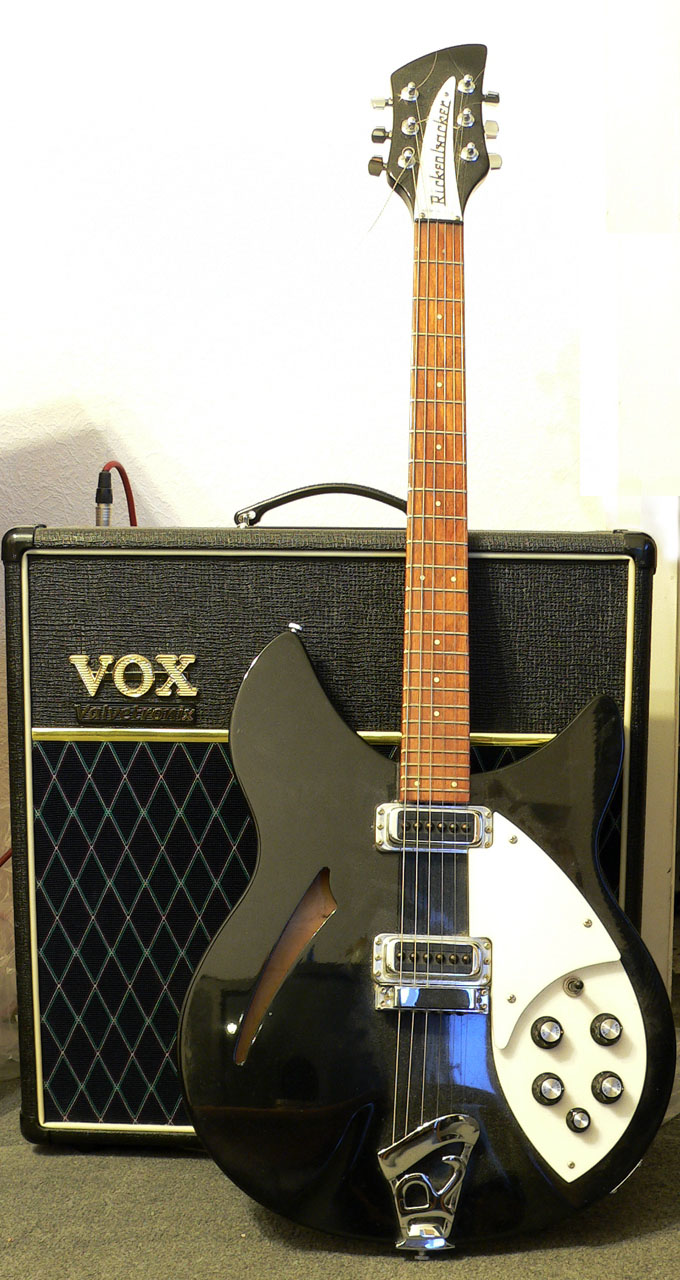
Rickenbacker 330JG. Licensed under CC BY-SA 3.0. Via Wikimedia Commons. Rickenbacker
330 / 360
1958
Same body, same neck, same pickups. The 360 got the binding. The 330 got Paul Weller’s, with “I AM NOBODY” on it.
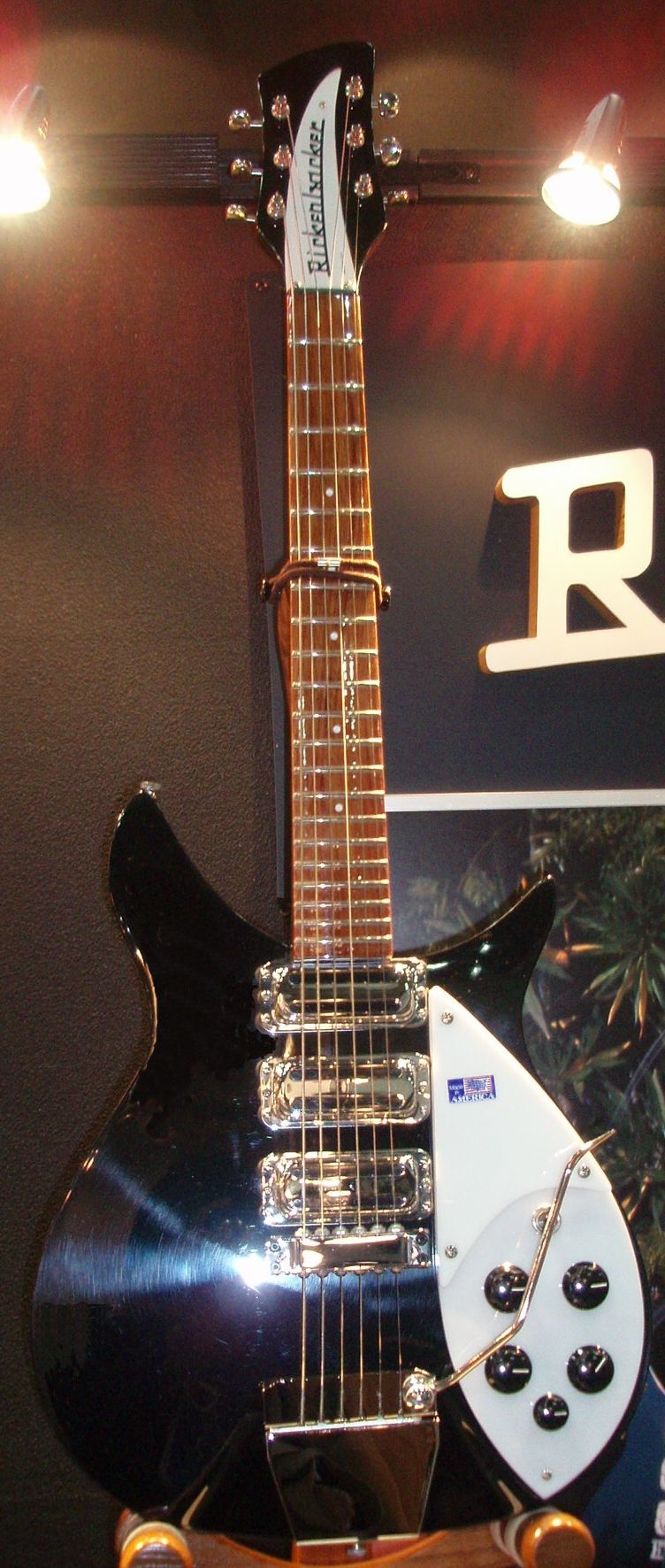
Rickenbacker 325C64. Photo by CasinoKat. Licensed under CC BY-SA 3.0. Via Wikimedia Commons. Rickenbacker
325
1958
Lennon bought it natural in Hamburg and had it painted black. The reissues copy the ends of that story, not the middle.
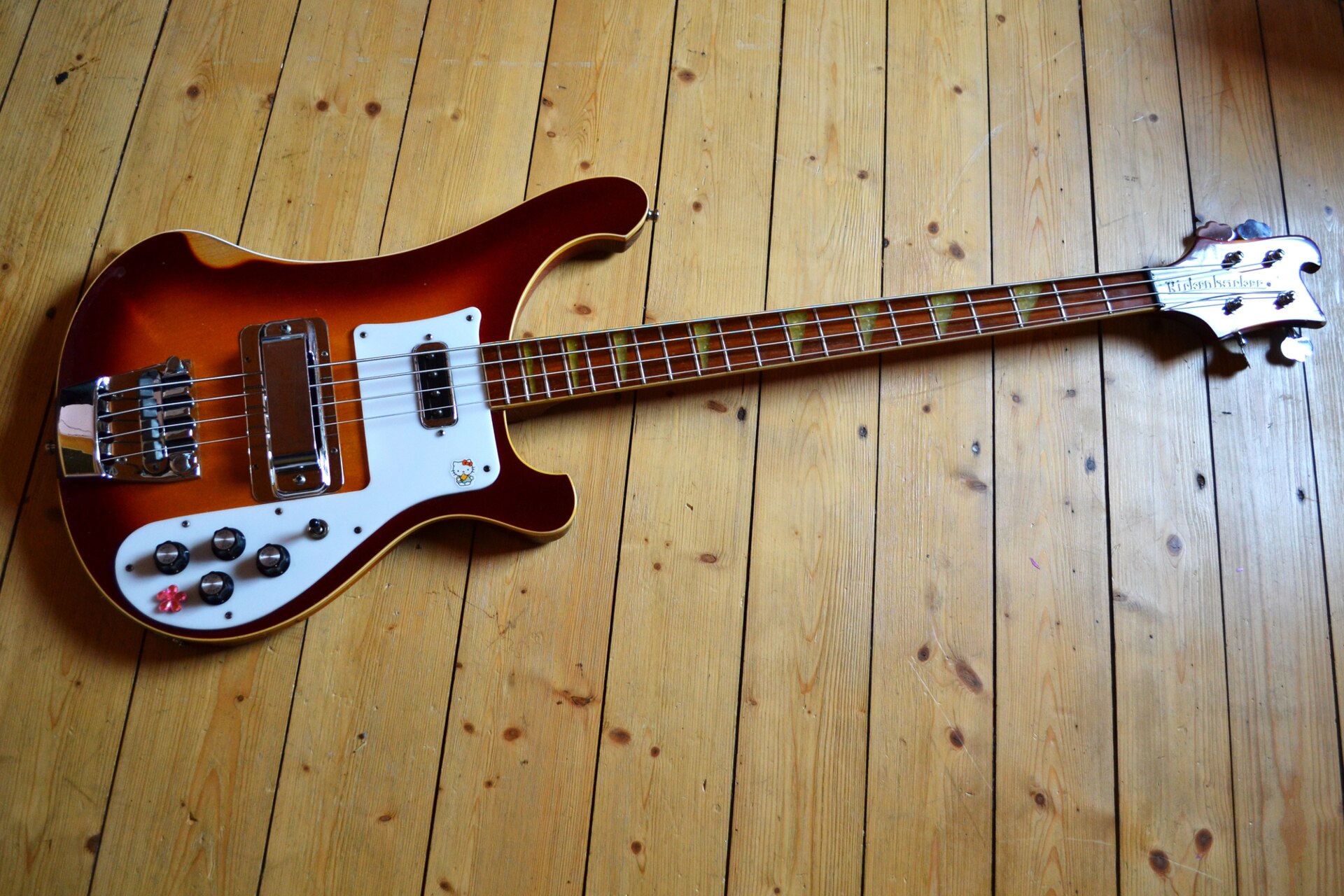
Rickenbacker 4003 (33 1/4" scale). Photo by DeLerkim. Licensed under CC BY-SA 2.0. Via Wikimedia Commons. Rickenbacker
4003
1980
Rickenbacker’s first answer to players’ new strings was to void the warranty. The 4003 was the better answer.