Rickenbacker
A-22 Frying Pan
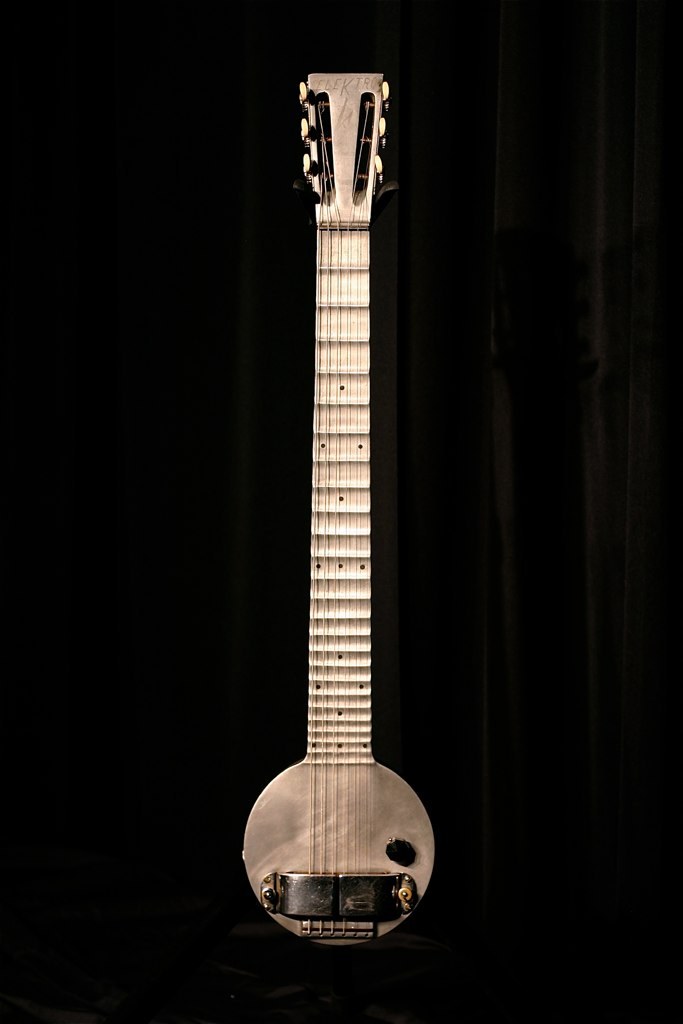
The first electric guitar you could buy looked like a frying pan. The patent office didn’t believe it worked.
Los Angeles, around 1931. George Beauchamp is winding a pickup coil on his dining table, first with a washing-machine motor, then with a sewing-machine motor. He wants a Hawaiian steel guitar that can be heard at the back of a hall. What he gets looks like kitchenware.
- Introduced
- 1932
- Type
- Solidbody electric (lap steel)
- Class
- Closed run
The short version
1931
A wooden pan
Harry Watson carves the prototype in a few hours. Somebody calls it the Frying Pan, and it sticks.
1932
Patent filed
Beauchamp files on 8 June. The examiners aren’t convinced it works.
1932
In production
Cast aluminum pans go into production in August. Seventeen guitar-and-amp sets by December.
1933
The price
$175 for the steel and an amp. By 1935 it’s $125.
1935
Bakelite
Rickenbacker brings out a Bakelite lap steel, and the pan takes a back seat.
1937
Granted
The patent comes through on 10 August, after musicians played it at the patent office.
1949
The spelling
The nameplate finally stops saying “Rickenbacher.” The ads had spelled it with a k for years.
Side A
A1
Wound on the dining table
The problem was volume. George Beauchamp wanted a Hawaiian steel guitar loud enough for a hall, and he’d already taken that problem to John Dopyera at National. National’s answer was the resonator guitar. It helped. It was still wood and air.
So Beauchamp tried electricity. With Paul Barth, he built a pickup out of two horseshoe magnets, with the strings running through the magnets and over a coil with six poles. As Rickenbacker tells it, he wound that coil on the dining table, first with a washing-machine motor and later with a sewing-machine motor.
That’s an invention. It isn’t a guitar yet. For that, somebody has to pick it up and play it, and somebody else has to believe what they’re hearing.
A2
A frying pan, carved in an afternoon
When the pickup worked, National’s factory superintendent, Harry Watson, carved a wooden neck and body for it in a few hours. It looked exactly like what it got called, the Frying Pan. Adolph Rickenbacker, who ran a tool-and-die plant and became Beauchamp’s partner, called it the Pancake.
The company came together in late 1931 as Ro-Pat-In. When exactly it became Electro String is a little fuzzy: Rickenbacker’s own history says it happened soon, and other accounts put the shareholder vote in 1934. Either way, the guitars said Rickenbacker, because it was easier to say than Beauchamp, and because Adolph’s cousin Eddie had already made it famous.
A3
Seventeen sets in 1932
Production started in August 1932, and the production pans weren’t wood. They were cast aluminum, neck and body in one piece, usually finished in gold. Workers stuffed the castings with newspaper, and that paper can still date a guitar today. The ads spelled the name Rickenbacker, but the metal nameplate said “Rickenbacher,” with an h, all the way to 1949.
The count for the first year is 17 guitar-and-amp sets, August through December. Thirteen sold, two went east as samples, and two sat in inventory for 1933. In 1933 you paid $175 for the steel and an amp. By 1935 it was $125.
Seventeen sets, thirteen sold. Year one of the electric guitar business, as Rickenbacker did it, would fit in a small shop.
You play it flat on your lap. The pickup is the whole look: a big horseshoe magnet arching over the strings, which run underneath it. The earliest ones, 1932 and 1933, have no knobs at all, just a jack. A volume control showed up around 1934, and a tone control later.
There were two lengths. The A-22 has a 22½-inch scale and the A-25 has a 25-inch one, same frying-pan silhouette. Which came first depends on who you ask. One version has the A-25 first, with the A-22 soon after and outselling it. Others title a 1932 pan an A-22. I’m not picking a winner.
And one honest flaw: aluminum expands in the heat of a stage, so the guitar goes out of tune.
Flip the record · By the numbers
17
Guitar-and-amp sets built from August to December 1932. Thirteen sold that year.
$175
The 1933 list price for the steel with its amplifier.
22½"
Catalog scale on the A-22. The A-25, same shape, is 25 inches.
0
Knobs on the earliest pans, 1932–33. A volume control showed up around 1934.
Side B
B1
The first electric on record?
In late January 1935, Bob Dunn played electric steel with Milton Brown and His Musical Brownies, and those sides are the usual answer when someone asks for the first electric guitar on a country-rooted record. One source names Dunn’s guitar an A-22. Another points to a Duolian with a homemade pickup. The record is real. Which guitar made it is still open.
That same year Rickenbacker brought out a lap steel made of Bakelite, and the pans took a back seat. When aluminum production actually ended is argued too, anywhere from 1939 to the 1950s. (If you’ve seen David Lindley with a Rickenbacker steel, that’s the Bakelite one, not this.)
B2
Play it for the examiner
Beauchamp filed his patent on 8 June 1932. The examiners weren’t convinced it worked, and the paperwork went back and forth, with a revised application in 1934.
So Rickenbacker did the obvious thing. It sent musicians to Washington. Hawaiian steel players, Sol Hoopii among them, performed at the patent office so a second examiner could hear it for himself.
The patent came through on 10 August 1937. By then other companies were already building electric guitars, and the frying pan’s head start was mostly used up.
There had been earlier tries. A Stromberg from 1928 put a transducer on a sounding board, and it didn’t take. What made the pan different is simple: it worked, and people heard it work. It took a steel player sitting down in a government office and playing it to turn a coil wound on a dining table into the first electric guitar anybody had to take seriously.
The cast
The people, and the specific guitars, that made the legend.
1931
George Beauchamp
Inventor
Wound the first coil on his dining table and filed the patent in 1932. His name was harder to say than Rickenbacker’s.
1931
Paul Barth
Co-builder of the pickup
Worked with Beauchamp on the two-horseshoe-magnet pickup that made the whole thing go.
1931
Harry Watson
Carved the prototype
National’s factory superintendent. Carved the wooden neck and body in a few hours.
1931
Adolph Rickenbacker
The name on the headstock
Tool-and-die man and partner. He called the guitar the Pancake.
1930s
Sol Hoopii
Played it for the government
One of the Hawaiian players who performed at the patent office so an examiner would believe the thing worked.
1935
Bob Dunn
An electric steel, model disputed
The usual answer to “first electric on record.” Whether his was an A-22 is still argued about.
Liner notes
Specs, construction, rarity, value, and every source we used.
Cast aluminum, a horseshoe magnet over the strings, and a 22½-inch scale — Rickenbacker’s A-22 Frying Pan, the first electric lap steel, not a Capri 325, not a 330, and not a 4003.
- Body
- Cast aluminum, circular; one-piece with neck; gold enamel typical
- Neck
- Cast aluminum, integral; slotted peghead
- Fingerboard
- Integral aluminum; raised / scalloped frets; colored dot markers
- Scale
- 22½" (A-22). A-25 is 25". Mix flagged on measured examples.
- Pickups
- One horseshoe-magnet pickup; strings under the magnet; 1½" magnet typical pre-war
- Hardware
- String-through; chromed nut and saddle; 3-on-a-plate open-gear tuners
- Electronics
- 1932–33: none onboard. Volume from ~1934. Tone later.
- Finish
- Gold enamel / gold lacquer on aluminum
- Nut
- Measured examples 2" (51 mm). Mix flagged.
Open the full research fileConstruction details, the complete player record, production numbers, dated value estimates, and sources
*Classic living example = 1930s Electro Hawaiian A-22. Not on Rickenbacker’s 2026 guitar list. Catalog scale 22½" (Gruhn; factory history). Measured pans sit under: Met 22¼" (56.5 cm); Retrofret 22¼" (565 mm), overall 28¾" (73 cm), nut 2" (51 mm). Mix flagged; do not average them. A-25 is the 25" sibling — same plate, not a second slug. 6- and 7-string both existed.*
Construction
The job was Hawaiian steel loud enough for a hall. Acoustic volume was already the problem George Beauchamp had taken to John Dopyera at National. Resonators helped. They were still wood and air. Beauchamp, with Paul Barth, built a pickup from two horseshoe magnets: strings through the magnets, over a coil with six poles. Factory history: he wound the coil on the dining table, washing-machine motor first, sewing-machine motor later.
When it worked, National’s factory superintendent Harry Watson carved a wooden neck and body in a few hours. Nickname Frying Pan. Adolph Rickenbacker also called it the Pancake. The wood prototype is 1931. Production is not wood.
Late 1931, Beauchamp, Rickenbacker, and partners formed Ro-Pat-In (Gruhn). Factory history dates the firm 1931 and says the name was soon Electro String. Gruhn puts the shareholder vote that renamed it Electro String Instrument Corporation in 1934, advertising as Rickenbacker Electro. Keep both. Shop: 6071 S. Western Ave., next to Rickenbacker’s tool-and-die plant. They used his name because it was easier to say than Beauchamp, and because cousin Eddie had already made it famous.
August 1932 is production (Gruhn). Not 1931. Gruhn’s records: 17 Hawaiian guitar-and-amp sets August–December 1932; the company sold 13, shipped two sample sets east, left two in inventory for 1933. 1933 list, steel with amp: $175. By 1935: $125. Period catalogs, not 2026 money.
This is a lap steel. It sits on the legs. Gruhn: Beauchamp knew the wood prototype had a round neck and frets that could go Spanish. Production pans were Hawaiian, cast aluminum, one piece. Workers stuffed the castings with newspaper; the paper can still date a guitar. Advertising spelled Rickenbacker. The metal nameplate kept Rickenbacher until 1949.
Two scales, same silhouette. A-22: 22½". A-25: 25". Factory history and Gruhn treat both as the Electro Hawaiian. Wikipedia’s gallery dates the first aluminum pan as a 1932 Ro-Pat-In A-25 and the A-22 as 1934. Tony Bacon: A-25 first in 1932, A-22 soon after, and the A-22 outsold it. Fretboard Journal will still title a 1932 pan as an A-22. Do not pick a winner. This table is the 22½" guitar.
Horseshoe magnets arch over the strings. The strings run under the magnet. Pre-war units are the 1½" magnet. Recessed jack on the bass rim. Earliest Electros, 1932–33, have no onboard controls (Retrofret). A single volume pot on the treble side is the second variation, about 1934. Tone comes later. Aluminum expands under stage heat; Gruhn and Fretboard Journal both note the guitar goes out of tune.
Beauchamp filed on 8 June 1932 (Gruhn). Smithsonian: a revised application in 1934. Examiners were not convinced it worked until Hawaiian players, including Sol Hoopii, performed at the office. U.S. patent 2,089,171, 10 August 1937. By then other companies were already building electrics. The Stromberg Electro of 1928 is the prior attempt: a transducer on a sounding board, not this pickup, and not a success.
1935 is when the pan stopped being the whole catalog. Rickenbacker introduced the style B Bakelite lap steel. Gruhn: the pans took a back seat. David Lindley’s Jackson Browne steels are that Bakelite guitar. Not this slug. End of aluminum production is contested. Wikipedia and the Met: 1932–1939. Gruhn: through 1950, gap 1950–54, redesigned 1954–57. Factory history: available into the 1950s. Keep the range.
Not a 325. Not a 330 or 360. Not a 4003. Those are Santa Ana Capris and a bass. This plate is Los Angeles, Electro String, a horseshoe on a frying-pan casting. No Gibson SKU. No current list price.
Players
Do not recruit Lennon, Harrison, Townshend, Petty, or Buck. Those are 325 / 360/12 / 330-platform / cresting-wave stories. Do not recruit David Lindley — factory history puts him on a Bakelite steel with Jackson Browne, not this aluminum pan.
Sol Hoopii. The named frying-pan scene is the patent office. Gruhn: Rickenbacker sent Hoopii and other musicians to Washington so a second examiner would believe the instrument worked. Factory history names Hoopii and Dick McIntyre as Hawaiian steel players who “played Rickenbackers on countless influential recordings.” That sentence is brand, not A-22 vs Bakelite. Wikipedia’s lap-steel page puts Hoopii later on the Bakelite and on Dickerson. Keep the patent-office guitar here. Do not flatten his discography onto this slug.
Bob Dunn is the usual “first electric on record” tell — Milton Brown and His Musical Brownies, Chicago, late January 1935, “Taking Off” among the sides (TSHA; DAHR). Wikipedia’s lap-steel page names that guitar a Rickenbacker A-22. Steel Guitar Forum writing on the same sessions points at a Duolian with a homemade pickup, later a Rick. Old Time Blues names Dunn’s electrified steel on 27 January 1935 without a model. Do not pick a winner. The Brownies session is real. The A-22 identity is not settled here.
Also known to play stays empty this pass. None invented.
Rarity
You cannot buy a new A-22 from Santa Ana. It is not on the 2026 guitar list. Closed original run, not a current SKU. The living 325C64, 330, 360, and 4003 are other guitars.
Factory yearly totals unpublished. None invented. What we have is Gruhn’s first-year set count: 17 Hawaiian guitar-and-amp sets August–December 1932, of which 13 sold that year. The Met’s example, serial 0107, is labeled “one of the first hundred or so” — museum inference, not a census. Dealer copy that “around 1,000” 6-string A-22s were made, or that most were melted in the war, is not a factory ledger. Omit it.
Actually scarce: 1932–33 pans with no onboard controls; documented 7-string A-22s; clean gold enamel. The Bakelite B is a different supply. Artist-owned objects, if they surface, are a separate market.
Value
Informal estimate, 3 September 2026. Not an appraisal.
Asking prices are not sold prices. No new street. 1933 list $175 with amp and 1935 $125 with amp are period catalogs, not 2026 comps. Celebrity lots, if they exist, are not-comps. None sourced here.
New street. None. Not a current Rickenbacker SKU.
Used modern. There is no modern A-22 production to make a used-modern band. Later Bakelite steels are other guitars.
Vintage / collectible. One named 2026 hammer: Los Angeles Modern Auctions, 5 June 2026, Front Porch Music sale, Rickenbacher A-22 7-string, serial 0030, estimate $1,000–$1,500, result $5,120. That is a 7-string. It is not a typical 6-string sale. Labeled asks, not hammers: Emerald City Guitars 1934 A-22 $5,559.75 (sold out at capture); eBay 1934 serial 0035 $6,790 (listing ended). Equipboard used ask $7,200 (12 March 2026). Rickresource’s eBay compilation for the same model/era (sample 18) printed min $646 / avg $2,841 / median $2,950 / max $7,995 — register tape, not a 2026 sold median. Do not average the LAMA 7-string hammer with those asks.
See also
- rickenbacker-325 — short-scale Capri; Lennon’s Hamburg guitar, not this lap steel
- rickenbacker-330-360 — Santa Ana Capri 330/360; not a frying pan
- national-style-o — Beauchamp’s earlier National resonator; not electric
Sources
- Rickenbacker, The Earliest Days of the Electric Guitar (factory history, Wayback) — 1931 Electro String; Watson wood prototype; horseshoe coil; 6- and 7-string; 22½" and 25"; newspapers in the castings; Bakelite B; Hoopii / McIntyre; Lindley on Bakelite, not this slug
- Vintage Guitar, George Gruhn, Rickenbacker A22 (March 2004) — first commercially available electric; Ro-Pat-In late 1931; production August 1932; 17 / 13 / 2 / 2 first-year sets; $175 / $125 with amp; A22 22½" / A25 25"; horseshoe, strings under the magnet; Rickenbacher nameplate to 1949; patent 8 June 1932 / granted 10 August 1937; Hoopii at the patent office; Bakelite B 1935; production through 1950, gap 1950–54, redesign 1954–57; aluminum and heat
- Fretboard Journal, Catch of the Day: 1932 Rickenbacher A-22 — 1932 Electro Hawaiian; A-22 22½" / A-25 25"; aluminum and stage heat; Bakelite 1935; catalog into the 1940s
- Metropolitan Museum of Art, A-22 Model, “Frying Pan” — ca. 1934; first commercially successful electric; cast aluminum, gold enamel; serial 0107; produced 1932–1939; length 28¾" (73 cm), width 7⅛" (18.1 cm), depth 2" (5.1 cm), scale 22¼" (56.5 cm). Mix flagged
- National Music Museum, Electric Hawaiian guitar, A-22 SN B232 — 1934 ca.; 23 cast scalloped raised frets; horseshoe with six poles; Rickenbacher Electro nameplate; Aluminum Alloy Casting Company
- Smithsonian Lemelson Center, Rickenbacker Frying Pan — wood prototype; patent 1932, revised 1934, granted 1937
- HISTORY.com, first electric guitar patent, 10 August 1937 — Patent 2,089,171 to George D. Beauchamp
- Wikipedia, Frying Pan (guitar) — 1931/1932–1939; Stromberg Electro 1928; gallery: 1931 maple prototype / 1932 A-25 / 1934 A-22 22.5" 23 fret
- Guitar.com, Justin Beckner, The untold history of Rickenbacker, 12 December 2022 — Ro-Pat-In 1931; selling 1932; patent 1937; 22.5" and 25"; Lindley mash onto Bakelite flagged
- Retrofret, 1935 A-22 SN 0181 — 1932–33 no onboard controls; volume-pot second variation; 28¾" (73 cm) / 7" (17.8 cm) / 1⅝" (4.1 cm); scale 22¼" (565 mm); nut 2" (51 mm). Mix flagged
- Los Angeles Modern Auctions, 5 June 2026, lot 176 — 7-string A-22 SN 0030; estimate $1,000–$1,500; result $5,120
- Emerald City Guitars, 1934 A-22 — ask $5,559.75, sold out
- Equipboard, Rickenbacker A-22 — used $7,200 (12 March 2026)
- TSHA Handbook, Bob Dunn — Brownies 1935; “Taking Off”; first electric on a country-rooted record. Model not named
- Old Time Blues, Decca 5070 — 27 January 1935; Dunn electrified steel; no A-22 model
- Wikipedia, lap steel guitar — Dunn 1935 named as A-22; Hoopii later Bakelite / Dickerson. Use cautiously
- Rickenbacker USA price list, 1 January 2026 — no A-22; 325 / 330 / 360 / 4003 are other SKUs
Keep digging
Guitars this one gets compared to, confused with, or descended from.
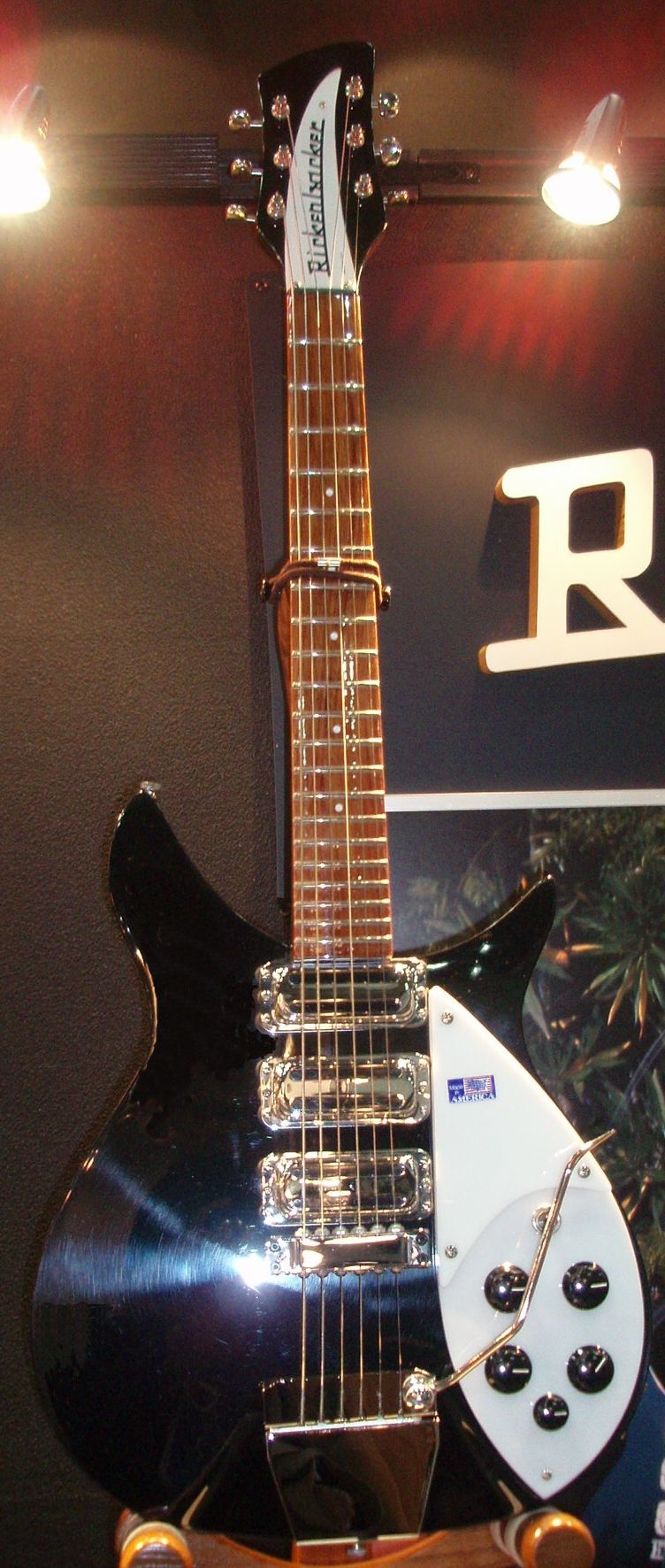
Rickenbacker 325C64. Photo by CasinoKat. Licensed under CC BY-SA 3.0. Via Wikimedia Commons. Rickenbacker
325
1958
Lennon bought it natural in Hamburg and had it painted black. The reissues copy the ends of that story, not the middle.
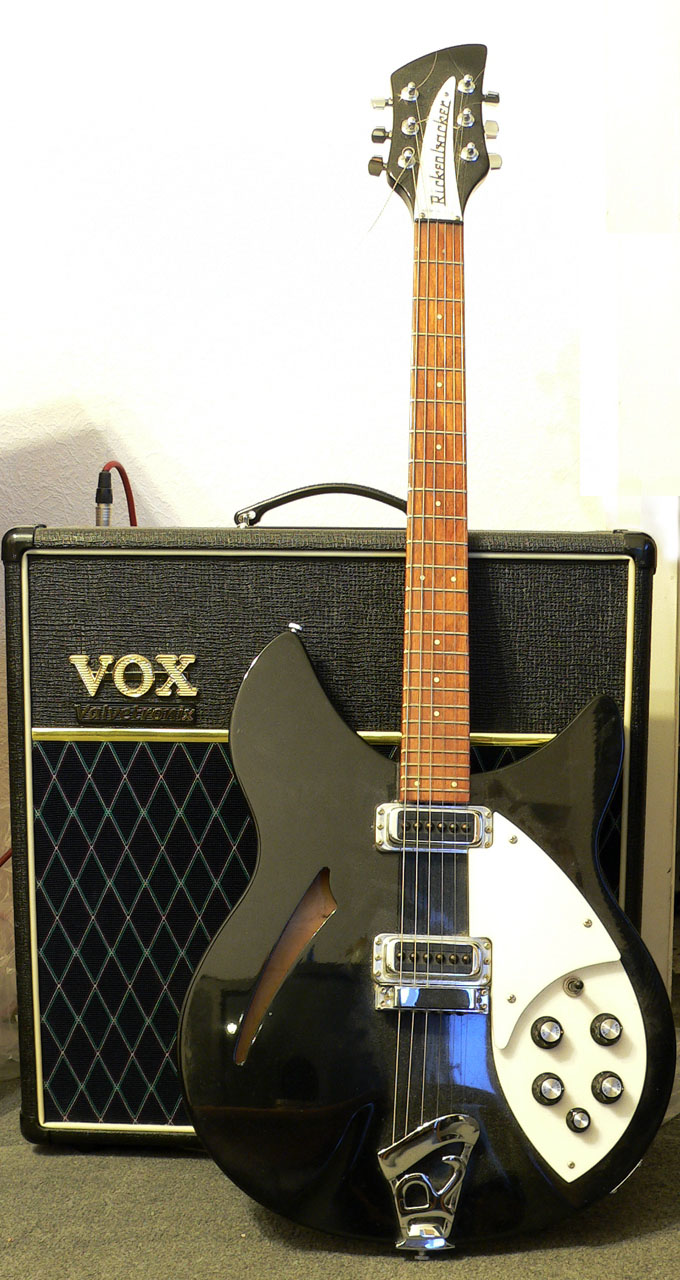
Rickenbacker 330JG. Licensed under CC BY-SA 3.0. Via Wikimedia Commons. Rickenbacker
330 / 360
1958
Same body, same neck, same pickups. The 360 got the binding. The 330 got Paul Weller’s, with “I AM NOBODY” on it.
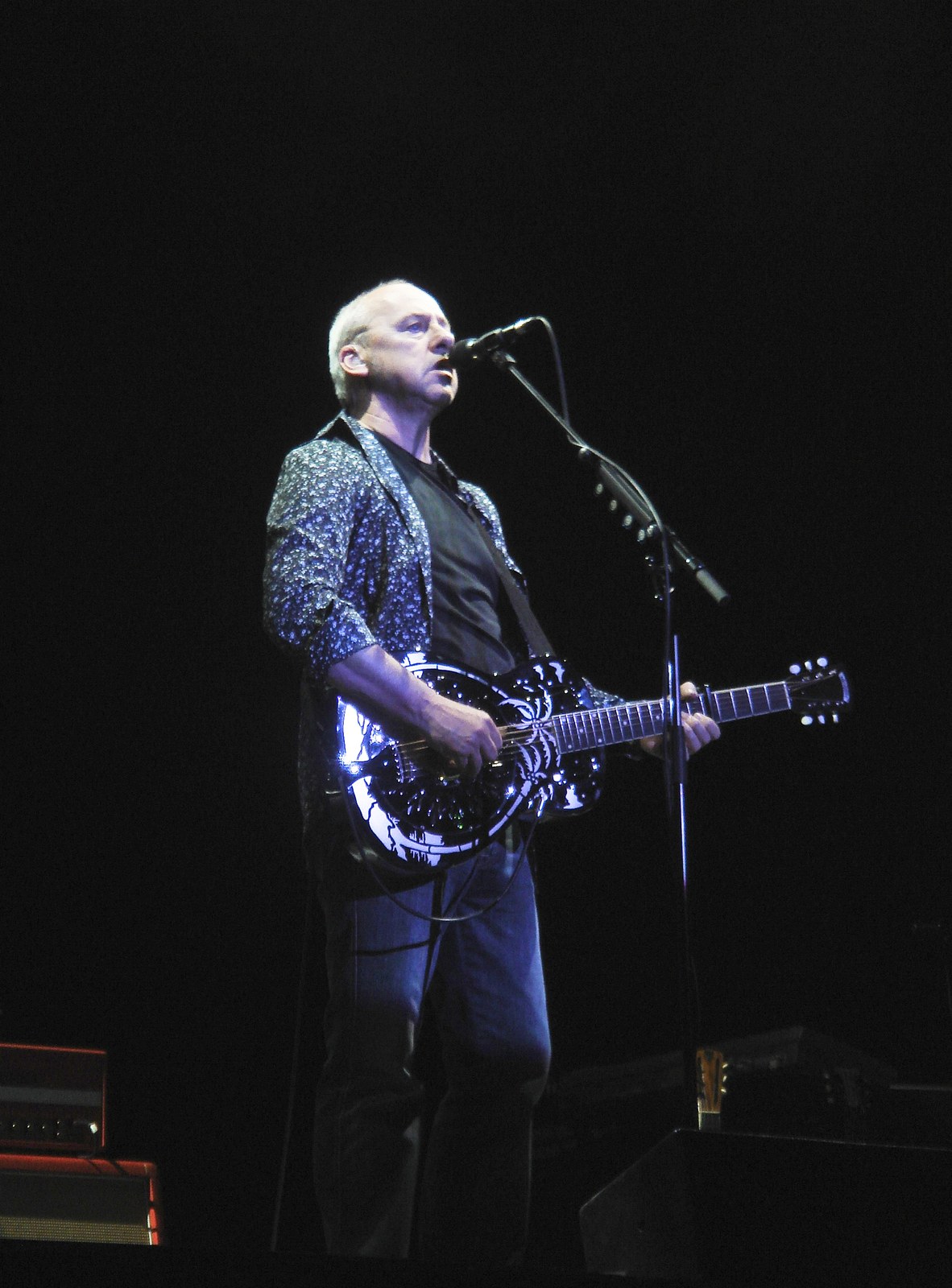
Photo: Chris J Bowley / Wikimedia Commons / CC BY 2.0 National
Style O
1930
A nickel-plated brass guitar from 1930s Los Angeles, and the one Mark Knopfler wouldn’t sell.