Rickenbacker
Electro Spanish Model B
In 1935 Rickenbacker built a fretted electric with a bolt-on neck and strings through the body. Out of Bakelite.
The Electro Spanish Model B is a small, black, molded-plastic guitar from Los Angeles with a horseshoe pickup and a neck you could unbolt and throw away. It was played upright, like a regular guitar. It isn't the Frying Pan, and it isn't the Bakelite lap steel it was molded alongside.
- Introduced
- 1935
- Type
- Solidbody electric
- Class
- Closed run
Have a photograph of this guitar? Send a picture
The short version
1932
A hollow one first
The company ships a hollow, Harmony-built Electro Spanish to Wichita. Wood, f-holes, and not this guitar.
1935
Bakelite
The Model B Spanish arrives that summer, alongside a Bakelite Hawaiian steel.
1936
The patent and the Vibrola
George Beauchamp files for a patent on the Spanish guitar on 26 May. By the middle of the year some leave the shop with a Kauffman hand vibrato.
1938
A second knob
A tone control joins the volume, by one account.
1939
$62.50
The guitar lists at $62.50 with a hardshell case. The patent is granted.
1943
Gone in the war
The six-string is discontinued. The Bakelite steel carries on into the '50s.
1950
The Esquire
Fender's Esquire is a wood guitar, but it has a bolt-on neck and strings that load through the back.
Side A
A1
Loud, on your lap
Los Angeles, 1935. Rickenbacker already had loud. The Frying Pan was loud. It also sat flat on your lap, and you played it with a steel bar.
If you wanted to fret chords like a regular guitarist, you could put a pickup on a hollow Spanish guitar. But a hollow guitar has a top, and a top that's close to an amp starts to howl.
The answer was black plastic. The Electro Spanish Model B was molded out of Bakelite, with thick walls, a detachable neck, and a body small enough to look like a toy. It cut the feedback down. It wasn't entirely solid, but it was a lot closer than a box.
The company's own history says it's the one that "made the most history." That's a different thing from selling well.
A2
Same mold, different guitar
It came out the same year as a Bakelite Hawaiian steel, and the two get mixed up. They shouldn't. The bodies came out of the same mold, but the parts don't swap. The Spanish joins the neck at the 14th fret, the steel at the 12th, and the pickup sits farther forward on the Spanish.
The mold gives it away anyway. The jack is on the bass side, off center, where it's fine on a lap and right in the way of your strumming elbow on a guitar.
The pickup is the frying-pan horseshoe, with the strings running under the magnet. On the early ones there's one octagonal volume knob and five chrome plates. The plates are covering hollows that are there for the mold and the weight, not the sound.
The nameplate reads "Rickenbacher," with an h, which the company stopped using in its catalog by 1937. The Spanish guitars kept wearing it.
A3
The neck you throw away
Everything about it was molded. The frets were part of the neck. So was the nut. There was no truss rod, presumably because Bakelite was supposed to make one unnecessary.
It wasn't. The necks warp, and molded frets and a molded nut are close to impossible to repair.
Somebody at the factory had seen that coming. The neck was held on by two machine screws, and a replacement cost $2.75. One guitar's guarantee card promised a new neck if you sent back the worn one with $2.25. The tuners, bridge, and everything else went into tapped holes with machine threads. Bakelite chips.
It was small, and it was not light. The company's own story says a full-size Bakelite guitar would have been a "sack of bowling balls," so they didn't build one. The small one was already hard to hold sitting down.
Flip the record · By the numbers
$62.50
The 1939 list price, hardshell case included.
$2.75
A replacement neck. A guarantee card on one guitar offers a new one for the worn one and $2.25.
14
Frets clear of the body. The Bakelite steel it was molded with has 12.
22½"
The scale, or 22⅝" on one guitar somebody measured.
Side B
B1
First, depending on what you count
You'll read that this was the first American electric guitar with a regular neck. It wasn't. There was a hollow Electro Spanish in 1932, and as many as ten handmade solid-maple Spanish prototypes. Another company had already tried a solid-wood Spanish electric in the early '30s and couldn't sell it.
What it was is narrower and better: a fretted electric with a bolt-on neck and strings loaded through the back, in a Bakelite body small and solid enough to keep the feedback down.
It claimed to be louder than any piano. It still lost to the Hawaiian. It's been called the company's most successful instrument, and it's also been called not a good seller. The steel stayed in production well into the '50s. The Spanish was gone during the war, by 1943.
B2
A motor in the back
By the middle of 1936, some of them came with Doc Kauffman's hand Vibrola. The idea was to let a Spanish guitar fake a steel. Pushing the handle moved the strings, though which way depends on which unit you're looking at.
Then came the version with a motor. The Vibrola Spanish has a second Bakelite shell on the back, almost twice as deep, with a motor, a flywheel, and a second cord to the wall. It was so heavy it needed a stand. Perry Botkin played one on Hollywood sessions, including an early Bing Crosby record.
That one is a different guitar. Kauffman played his own before, during, and after the war, which covers the years he was in business with Leo Fender, and reportedly wore out at least one of the throwaway necks.
B3
Build an Esquire out of Bakelite
Line it up next to a Fender Esquire. One guitar writer did, and found the same pieces: a neck you can unbolt and throw away, and strings that load through the back of the body. Make an Esquire out of Bakelite, he figured, and you've basically got a Model B Spanish. The bridge is different. The Rickenbacker has one compensated saddle, the Esquire three.
The Esquire came along in 1950, in wood. That's fifteen years after the Bakelite Spanish, and seven after it left the catalog.
Kauffman wore out his throwaway neck. His old business partner kept the idea and made it out of wood.
The cast
The people, and the specific guitars, that made the legend.
1936
George Beauchamp
Electro Spanish Model B
The frying-pan pickup man. Filed for the patent on the Spanish guitar in May 1936, granted in 1939.
1930s–40s
Doc Kauffman
His own Vibrola Spanish, the motorized version
Played it before, during, and after the war, the years he was in business with Leo Fender. Reportedly wore out at least one of the replaceable necks.
Perry Botkin
A motorized Vibrola Spanish
Played and endorsed one on Hollywood sessions, including an early Bing Crosby recording. It's the motorized sibling, not the plain one-knob guitar.
Neko Case
A mid-'30s Electro tenor, by a dealer's account
A Nashville dealer sold a four-string Electro as formerly hers, with a handwritten letter. Her 2006 rundown of her tenors doesn't mention a Rickenbacker.
Liner notes
Specs, construction, rarity, value, and every source we used.
Cast Bakelite, a bolt-on round neck, and a horseshoe over the strings — Rickenbacker’s Electro Spanish Model B, played upright, not the Frying Pan and not the Bakelite lap steel.
- Body
- Molded black Bakelite, small guitar outline. Five cover plates over cavities cut for the mold and the weight, not for air. Chrome on the early guitars. Guitar-list: white plates in 1940.
- Neck
- Bolt-on Bakelite. No truss rod. Two machine screws into tapped holes. Joins at the 14th fret.
- Fingerboard
- Integral Bakelite. Frets molded in, not a separate board you can refret. Dot markers.
- Scale
- Sources differ. A 1936 six-string listing and Wikipedia: 22½". That listing prints 572 mm. Gruhn’s serial C 2039: 22⅝".
- Pickups
- One horseshoe. Strings run under the magnet. Named pre-war examples: 1½" magnet.
- Hardware
- 1935 spec: string-through, open-gear tuners, machine threads, no wood screws. A hand Kauffman Vibrola shows up later. Not the launch guitar.
- Electronics
- Early: one octagonal volume on the bass side. Guitar-list, citing Richard Smith: a second knob, volume and tone, from 1938.
- Finish
- Black Bakelite. The plates are the trim.
- Nut
- Molded with the neck. Sources differ. The 1936 listing: 1¾" (44 mm). Gruhn’s C 2039: 1.760".
Open the full research fileConstruction details, the complete player record, production numbers, dated value estimates, and sources
The spec above is a 1935 six-string Electro Spanish Model B, Los Angeles, Electro String. Round neck, played upright. Not on the USA list of 1 January 2026. Not on the current Santa Ana guitar pages. The Bakelite lap steel (Model B, later BD) is the same era and a different instrument: Hill says the bodies and necks do not interchange, 14 frets clear here against 12 on the steel. The Vibrola Spanish is this outline with a motor in a deeper back. The four-string tenor is this body with another neck. The 1932 hollow Electro Spanish, and the Ken Roberts, are wood. Not the A-22. Not a 325, a 330, or a 4003. A tenor’s 1⅜" nut and 7 lb 11.2 oz (Cream City) belong to the four-string, not the six-string in the specs above.
Construction
The job was a guitar you could fret, loud enough for a band, that would not howl back at the amp. The Frying Pan already did loud. It sat on the lap. A hollow Spanish box with a pickup on it still had a top, and a top still fed back. Factory history, the page Rickenbacker still carries: the 1935 Bakelite Model B Spanish is the one that “made the most history.” Thick plastic walls. A detachable Spanish neck. Feedback knocked down. Not entirely solid. Gruhn: the chambers under the plates do not help the sound. They are how you mold Bakelite, and how you keep the weight down.
The launch is 1935, per the factory history. Premier Guitar (19 August 2009): introduced that year, at the same time as the Bakelite Electro Hawaiian. Guitar-list, citing Richard Smith’s History of Rickenbacker Guitars: summer 1935. Björn Eriksson’s model card: 1935 to 1943. Matthew William Hill’s Edinburgh thesis (2014) puts the earliest Bakelite Model B steels — B6, B7, B8, B10 — in July 1935, and the pans starting to leave the catalog. The round-neck guitar is the Spanish analogue of that steel, not a neck swap. Hill: it is a common mistake to treat them as one body. They are not interchangeable. Fourteen frets to the body here. Twelve on the Hawaiian. The horseshoe sits farther forward on the Spanish.
The steel’s birthday is the part people fight about, and it is not the guitar’s 1935 date. A Steel Guitar Forum timeline (J. D. Sauser) puts “B-models” in 1933/34, and says a standard-guitar version was also issued, with less success. Hartenberger’s card on a 1939 Spanish, serial C 288, says the same 1933/34 and then describes a steel. Wikipedia’s Electro-Spanish page says the guitar was “based on the 1931 Model B Hawaiian.” The factory page that article cites does not say 1931, and does not call the Bakelite steel a 1931 instrument. The forum’s 1933/34 is a date for the steel, not for this round neck.
Before any of that plastic, there were other Spanish electrics, and they are not this mold. Gruhn: after the frying-pan patent work of 1930–31, Electro made as many as ten handmade solid-maple Spanish-neck prototypes, 25 frets, 31¾" long, 1⅝" thick, 7" across. John Teagle (Vintage Guitar, April 1999) points at the same wooden prototypes in Richard Smith, Beauchamp with Harry Watson and Paul Barth. Adolph did not do wood. Wooden Spanish bodies were subcontracted. Vintage Guitar (Lynn Wheelwright, 10 January 2023): a company ledger from late September 1932 sends guitar #3, a Spanish model, to Gage Brewer of Wichita. That is the hollow flattop, Harmony-made, f-holes, slotted peghead. Guitar-list runs that hollow Electro Spanish 1932–1935, then the Ken Roberts. Premier’s line that the Bakelite was “the first commercially produced, American-made electric guitar with a standard or rounded neck” does not survive that 1932 guitar. What Premier gets right is narrower: among the wood electrics of the moment, this was the one with a Bakelite body and a round neck.
Vivi-Tone had already tried a solid-wood Spanish neck in the early ’30s and failed to sell it (Gruhn). Teagle: even if the 1935 Bakelite was not the first solidbody electric, the shape of the idea is still here. Build an Esquire out of Bakelite and you basically have a Model B Spanish. His 1949 is the prototype year he uses for that comparison. The Esquire in this catalog dates from 1950. Shared pieces he and Premier both name: a bolt-on neck you can throw away, and strings that load through the back. The bridge is not the same. The Rick is one compensated saddle. The Esquire is three.
What left the shop in 1935, Eriksson’s card and RetroFret’s early six-string: black Bakelite, five chrome plates, one horseshoe, one octagonal volume on the lower bass bout, string-through, molded frets. The 1936 catalog, quoted by Premier: small, easy to hold, fourteen frets to the body, and you can play up to the twenty-fourth because the body is small. Gruhn’s measured guitar, serial C 2039, has markers at 5, 7, 9, 12, 17, 21, and 24, and the 24th is not playable. Guitar-list: 23 frets, molded, and when they wore out you replaced the neck. The catalog’s 24th and Guitar-list’s 23 are two different counts.
Gruhn’s tape on C 2039, one guitar, not a factory drawing: body 1¾" thick, average wall .350", 7⅛" across the 19th fret, 5-7/16" at the waist, 9¼" at the lower bout, body length 14-1/16", overall 32-9/32". Scale 22⅝". Nut 1.760". Neck .930" at the first fret, 1.12" at the 12th. Molded frets .030" high. Two 15/32" screws, 3-7/16" apart. The 1936 Reverb listing, serial B-592, prints the conversions Gruhn does not: overall 32½" (82.6 cm), lower bout 9¼" (23.5 cm), depth 1¾" (4.4 cm), scale 22½" (572 mm), nut 1¾" (44 mm). Hartenberger prints 29.5 in by 9 in on C 288. MoPOP’s 1935 example, object 1996.69.1, prints 35½" as a body overall and another field at 82". That 82 is not a guitar. These are separate measurements of separate guitars.
The horseshoe is the frying-pan pickup. Strings under the magnet. RetroFret’s tenors and the Met’s motorized Spanish both call the pre-war magnet 1½", and the brackets on a post-1937 guitar are stamped with Beauchamp’s pickup patent 2,089,171 (granted 1937). A 1935 guitar need not wear that stamp. Gruhn puts the pickup 9/16" from the bridge on C 2039, closer to the waist than on the Hawaiian. All the hardware is tapped. Bakelite chips. No wood screws. The tuners on that guitar are the open-gear 12:1 grip gears used on the Hawaiian with the same outline. No bushings.
The neck was the part they expected to die. No truss rod. Gruhn presumes Bakelite was supposed to make one unnecessary. Teagle: a replacement neck was $2.75, under five percent of the instrument. The 1936 listing describes a guarantee card on B-592 that promised a new neck if you sent the worn one back, plus $2.25. Gruhn: the necks warp anyway, and the molded frets and the molded nut are close to impossible to repair. Guitar-list: wooden replacement necks after the war. That is a repair, not a new 1946 Model B.
The nameplate is the frying-pan surplus. “Rickenbacher Electro, Los Angeles,” lightning bolt, the spelling with the h. Premier: the company started using that form in 1934 and the catalog had dropped it by 1937. Gruhn: the plates stayed on the Spanish anyway. MoPOP: the h stayed on pegheads, and on Adolph’s card into the 1950s. The firm’s spelling is Rickenbacker by the 1960s.
The jack is the tell that the body was drawn for a lap. Gruhn: same mold as the Hawaiian, so the ¼" jack sits on the bass side, off center. Fine if the guitar is on your knees. In the way of your right elbow if you are strumming. Hill’s “not the same body” and Gruhn’s “same mold” can both stand. One mold, two finished instruments, parts that do not swap.
Then the guitar grew a tailpiece that was not a Strat tremolo. Teagle’s amp column (Vintage Guitar, April 1999): serials such as C89 and C112 line up with the first Bakelite Spanish guitars fitted with a Kauffman hand Vibrola, mid-1936. Andy White (10 February 2026): Kauffman applied in 1929, granted 1932, a side-to-side pivot so that half the strings rise and half fall. The point was to make a Spanish guitar fake a steel. Gruhn, describing the unit on C 2039, says the opposite motion: handle down lowers all six, handle up raises all six. The two descriptions differ. They may be two generations of a bad idea. White is clear that it is a dead end next to a Bigsby or a Strat. It was still the vibrato Rickenbacker had.
The motorized guitar is a different instrument. Factory history: Doc Kauffman’s Vibrola Spanish, so heavy it needed a stand. Gruhn: a second Bakelite shell on the back, almost twice as deep, 3-3/16", motor, flywheel, rheostats, pulleys, air holes. The Met’s 1939 example measures 3¼" (8.3 cm) deep, scale 22½" (572 mm), nut 1¾" (44 mm), overall 32½" (82.6 cm), and the tailpiece is stamped VIB-ROLA / PAT. NO. 1839395. A second cord goes to the wall. White dates the introduction to 1935 and the end to about 1940, “probably” more than the Ken Roberts run of roughly fifty, “not many more.” RetroFret, on a 1939 example: produced 1938–1942, not more than 90. Those counts are the motorized sibling, they do not agree, and they are not a census of the plain Model B. Hill: the motorized guitar is a Model B Spanish plus that mechanism. It is not the 1935 one-knob guitar in the specs above.
The plain Spanish did not get a long life. Guitar-list: discontinued during the war, 1943. Gruhn: gone after several years, while the Hawaiian Bakelite B stayed in production well into the ’50s. Premier: a few short years. Teagle mentions a one-off cutaway Bakelite Spanish from the late ’40s. One object. Not a restart. No current list price. The USA list of 1 January 2026 opens at the 620, the 660, the 330, the 360. No Model B.
1939 list, Gruhn: $62.50, with a Geib hardshell, three-ply, green plush, no compartments. He prices the tenor, Bakelite body and a wood neck, at the same $62.50. The $198.50 he gives for 1938 is the Model 200A amplifier in the motorized outfit (one 12", 15 watts), not this guitar. RetroFret’s “nearly $200 including the amplifier” is that outfit. Period money.
Beauchamp filed on the Spanish guitar 26 May 1936. Granted 1939 (Gruhn). No patent number in that article. 2,089,171 is the pickup patent, not this one. Hill notes a patent-style drawing in the Rickenbacker archives, Beauchamp’s Model B Spanish with a vibrato, “almost certainly never commercially made.” A drawing. Not the guitar in the specs above, and not the Kauffman units that did ship.
No six-string factory weight was captured. Factory history’s “sack of bowling balls” is a full-size Bakelite Spanish that they did not build, because it would have been unplayable. The guitar they did build was already hard to hold seated (factory; MoPOP). Gruhn: too heavy to be the travel guitar its size suggests, and not a good seller. MoPOP: it claimed to be louder than any piano, and it lost to the Hawaiian. Wikipedia’s page calls it the most successful instrument Rickenbacker made. The factory sentence is “made the most history,” which is not a sales figure, and Gruhn and MoPOP say the opposite of “most successful.”
Players
Lindley is not a Model B Spanish player: factory history puts him on a Bakelite steel with Jackson Browne. None of Hoopii, Lennon, Harrison, Townshend, Petty, or Buck is tied to this guitar. Gage Brewer’s guitar, in Wheelwright’s 1932 ledger, is the hollow Spanish, guitar #3. Alvino Rey’s guitar is a different instrument: Hill identifies an A-25, serial 30, as his, mounted in a holder that is not the original body. A Rickresource register note on a white-bodied 7-string pan is a guess (“Alvino Rey?”) and still a frying pan. Guitar-list’s “white Bakelite Spanish” for Rey is not that evidence. Les Paul: factory history says he owned a Rickenbacker and does not name the model. Hill says it has been asserted he used a Vibrola Spanish before the war. An assertion, not a session.
Perry Botkin. The sourced guitar is the motorized one. Factory history: he used one of the few Vibrola Spanish models on sessions with Bing Crosby and other Hollywood players. Vintage Guitar’s amp column: an early Crosby recording, Botkin on Vibrola Spanish, through a 200A. Gruhn says the Vibrola Spanish was used on some of Crosby’s early recordings and does not name the player in that sentence. Hill: Botkin endorsed it. Crosby is the singer. Botkin is the guitar. Not the one-knob string-through in the specs.
Doc Kauffman. Teagle: his own Vibrola Spanish, before, during, and after the war, which covers the years he was in business with Leo Fender. Reportedly wore out at least one of the replaceable necks. Again the motorized sibling. The story matters because the bolt-on neck is the part Fender kept. It is not a Model B discography.
Neko Case. A tenor, and a dealer attribution. Gruhn’s sold listing TG0407, mid-1930s Electro tenor: “formerly owned and used by Neko Case (handwritten letter included).” No price on that sold page. Fretboard Journal (the 2006 interview, republished 7 February 2009) walks her tenors and names a Gibson TG-0, a 1959 Gretsch Duo Jet, a Martin 5-17T, a 1958 Les Paul tenor, two Nationals, and a 1967 SG Special tenor. No Rickenbacker. The shop has the letter; the interview is silent. Four strings either way, not the six-string in the specs above.
No player is documented on the plain six-string.
Rarity
You cannot order a new one. The January 2026 USA list does not have it. The current guitar pages do not have it. Closed run. Not a reissue.
No factory total for the six-string. “Not a good seller,” “a few short years,” and “did not sell well next to the Hawaiian” are judgments, not ledgers. RetroFret’s “not more than 90” and White’s “probably more than fifty” belong to the motorized guitar, and they already disagree with each other. Neither number counts the plain six-string. Serials date a guitar. They do not count a year. RetroFret’s note that B69 is “one of the first hundred or so” Bakelite B models, Spanish or Hawaiian, is a dealer’s inference. Same kind of sentence the Met uses on an early pan. Not a census.
What is actually thinner: a 1935 one-knob, string-through, chrome-plate six-string whose molded neck is still straight; a tenor (RetroFret: a very small proportion, and only the first few early tenors used a Bakelite neck — later ones are maple and rosewood with metal frets); the motorized Vibrola Spanish, which is another supply and another depth. A 1940 white-plate guitar is later than the chrome ones. The Bakelite lap steel is the common cousin and a different market. A lettered tenor, if the letter holds, is one object.
Value
Informal estimate, 27 October 2026. Not an appraisal.
Asking prices are not sold prices. The 1939 $62.50 with case, and the tenor at the same figure, are period lists (Gruhn). The 1938 $198.50 is the 200A amp in the motorized outfit. Celebrity and lettered guitars are not comparable sales. No six-string factory count to multiply by a price.
New street. None. Not in Rickenbacker’s current line. No reissue.
Used modern. There is no modern Model B production to make a used-modern band. A 620, a 330, and a 325 are other guitars.
Vintage / collectible. One named 2026 hammer: Wright, 5 June 2026, Front Porch Music, Rickenbacher Electro-Spanish Model B, c. 1937, serial C1938, black Bakelite, Kauffman Vib-Rola, chipboard case. Estimate $1,000–$1,500. Result $2,261. That is a hand-vibrola six-string. It is not a 1935 one-knob guitar, and it is not a tenor. Same sale, not comps: an A-22 7-string at $5,120, a 1936 Electro B-7 lap steel at $1,408, a c. 1950 B-6 Panda lap steel at $732. Steels.
Older named hammer: eBay, 24 April 2019, from the estate of Leo Quan, round-neck Electro Spanish, serial B544, manufacturing date on the register 1935, sold $1,499.99 (Rickresource). Ownership. Not a record date.
Rickresource’s round-neck compilation, same model and era, sample 19: min $798 / avg $1,490 / median $1,500 / max $2,895. The register’s copyright line runs 1998–2021. Register tape, not a 2026 sold median.
Asks, not hammers. Gruhn’s catalog, c. 1936, Bakelite neck and body, original horseshoe, OHC, $6,500 (product EZ5973). The page says the catalog is not guaranteed current. Reverb, ended, ask only: 1936 serial B-592 at $3,500; a 1935 serial B 695 at $3,195, the listing page saying it was posted 12 years ago. A Cream City / Reverb bakelite-neck tenor was asked at $4,499. The shop page later read sold. Hammer not shown. A tenor either way.
Not comparable sales: Botkin’s Vibrola Spanish, Kauffman’s personal motorized guitar, the Gruhn tenor tied to Neko Case. One object each, and two of them are not the plain six-string.
See also
- rickenbacker-a-22 — cast-aluminum lap steel, 1932; the horseshoe starts here, the Bakelite body does not
- fender-esquire — Teagle’s wood reading of this silhouette; a Fender from 1950, not a 1935 Bakelite
- rickenbacker-325 — short-scale Capri; the later Rickenbacker people mean by a small electric, not this guitar
Sources
- Rickenbacker, The Story of Rickenbacker (legacy page) — 1935 Bakelite Model B Spanish; not entirely solid; feedback; hard to play seated; “sack of bowling balls” is the full-size guitar they did not build; Vibrola Spanish needs a stand; Bakelite lap steel is the other instrument; Lindley on that steel; Botkin on a Vibrola Spanish; Les Paul “owned a Rickenbacker,” model unnamed. Same text in the 24 December 2005 Wayback capture of history_early.asp
- Rickenbacker USA price list, 1 January 2026 — no Electro Spanish, no Model B; list opens with 620, 660, 330, 360
- Matthew William Hill, George Beauchamp and the rise of the electric guitar up to 1939 (University of Edinburgh PhD, 2014) — earliest Bakelite Model B steels July 1935; Spanish is not a Hawaiian with a different neck; bodies and necks do not interchange; 14-fret join vs 12; pickup farther forward; Vibrola Spanish is the Model B Spanish plus a motorized Kauffman unit; Botkin endorsed it; Les Paul “asserted”; Beauchamp vibrato drawing “almost certainly never commercially made”; Rey’s instrument an A-25, serial 30
- Vintage Guitar, John Teagle, Rickenbacker’s Bakelite Spanish Vs. Fender’s Esquire (April 1999; posted 20 November 2001) — 1935; “even if” not the first solidbody; Esquire comparison; replacement neck $2.75; two tapped bolts; string-through; Kauffman’s personal Vibrola Spanish, neck worn out; late-’40s cutaway one-off; wooden prototypes via Smith
- Vintage Guitar, John Teagle, Electro/Rickenbacher Amps (April 1999) — C89 and C112 as the first hand-vibrola Bakelite Spanish, mid-1936; 1935 Bakelite Spanish pictured with a 1935 amp; Botkin on a Crosby recording through a 200A
- Gruhn, Rickenbacker Electro Spanish Guitar (Wayback, 30 October 2006) — introduced 1935; up to ten maple prototypes; C 2039 measurements; 22⅝" and 1.760" nut; no truss rod; necks warp; $62.50 in 1939 with Geib case; patent filed 26 May 1936, granted 1939; same mold, bass-side jack; hand Vibrola on the measured guitar; motorized depth 3-3/16"; tenor $62.50; discontinued after several years, Hawaiian B into the ’50s; not a pure solidbody
- Premier Guitar, 1935 Rickenbacker Electro Spanish (19 August 2009) — introduced 1935 with the Bakelite Hawaiian; “Rickenbacher” plate; 1936 catalog quote, 14 frets to the body, up to the 24th; bolt-on and string-through shared with the Broadcaster; motorized vibrato in the same short run
- Guitar-list, Model B Spanish — summer 1935 to 1943, citing Smith; six-string and tenor; 23 molded frets; one octagonal volume, two knobs from 1938; white plates 1940; wooden necks after the war; not the hollow 1932–35 Electro Spanish
- Guitar-list, hollow Electro Spanish — 1932–1935 Harmony flattop; a different guitar from the Bakelite Model B
- Rickbeat, Model B Spanish Electro (Björn Eriksson) — 1935–1943; 1935 card: black, horseshoe, five chrome plates, one octagonal knob, string-through, molded frets
- Museum of Pop Culture, Electro Spanish Model B, 1935, 1996.69.1 — Bakelite, five chrome plates, detachable neck, molded frets, string-through; heavy, hard to play seated; lost to the Hawaiian; “louder than any piano” is the claim. Dimension fields (35½", and an 82" field) do not match measured guitars. Not used as measurements
- Metropolitan Museum of Art, Electro Vibrola Spanish, 1939 — the motorized sibling: 32½" (82.6 cm), 9¼" (23.5 cm), depth 3¼" (8.3 cm), scale 22½" (572 mm), nut 1¾" (44 mm); 1½" horseshoe stamped 2089171; tailpiece PAT. NO. 1839395; second cord to the wall
- Andy White, The Kauffman Vibrola (10 February 2026) — hand unit applied 1929, granted 1932, side-to-side; Vibrola Spanish introduced 1935, motorized, until about 1940; “probably” more than the Ken Roberts’ roughly fifty. His guess. Ken Roberts is the hollow guitar, 1934 or 1935
- Vintage Guitar, Lynn Wheelwright, Ro-Pat-In’s First Electric Spanish (10 January 2023) — September 1932 ledger, guitar #3 Spanish to Gage Brewer. The hollow guitar, not this Bakelite
- RetroFret, Electro Spanish, 1935, serial B69, item 11435 — introductory year; one octagonal volume and the jack on the bass side; five chrome plates; “one of the first hundred or so” Bakelite B models, Spanish or Hawaiian. Dealer inference, not a census
- RetroFret, Electro Spanish tenor, 1939, item 9615 — introduced 1935 with the Bakelite Hawaiian; limited run; few tenors; early tenors Bakelite-neck, this one maple and rosewood, 23 metal frets, bone nut; 1½" horseshoe stamped 2089171; overall 32⅜" (82.2 cm), lower bout 9¼" (23.5 cm), depth 1¾" (4.4 cm), scale 22⅝" (575 mm)
- RetroFret, Vibrola Spanish, 1939 — not more than 90, 1938–1942; nearly $200 with the amplifier; depth 3¼" (8.3 cm); scale 22½" (572 mm); nut 1¾" (44 mm)
- Reverb, 1936 Electro Spanish, serial B-592, item 1120008 — ended ask $3,500; 32½" (82.6 cm) / 9¼" (23.5 cm) / 1¾" (4.4 cm); scale 22½" (572 mm); nut 1¾" (44 mm); neck card described as $2.25. Ask, not a hammer
- Wright, 5 June 2026, lot 181 — c. 1937 Electro-Spanish Model B, serial C1938, Kauffman Vib-Rola; estimate $1,000–$1,500; result $2,261. Same sale: A-22 7-string $5,120; B-7 lap steel $1,408; B-6 Panda $732. Those are not comps
- Rickresource register, Electro Spanish round neck, serial B544 — Leo Quan estate; eBay ended 24 April 2019 at $1,499.99. Round-neck sample on that register: min $798 / avg $1,490 / median $1,500 / max $2,895, n = 19. Tape, not a 2026 median
- Gruhn catalog, c. 1936 Model B Electro Spanish, EZ5973 — ask $6,500; page says the catalog is not guaranteed current
- Gruhn, Electro tenor TG0407 — sold; “formerly owned and used by Neko Case (handwritten letter included).” No price. Letter not printed
- Fretboard Journal, Four on the Floor: Neko Case (7 February 2009; interview 2006) — her tenors as of that interview: TG-0, 1959 Duo Jet, 5-17T, 1958 Les Paul tenor, two Nationals, 1967 SG Special tenor. No Rickenbacker
- Wikipedia, Electro-Spanish Model B — scale 22.5"; “1931 Model B Hawaiian” and “most successful” are not in the factory page the article cites. A secondary source beside Hill, Gruhn, and MoPOP, not in place of them
- Steel Guitar Forum, J. D. Sauser timeline, via the Bakelite B thread — forum dating: B-models 1933/34; a standard-guitar version “with much less success.” Not a catalog
- Rickresource register, A-22/7 serial C48 — “Alvino Rey?” on a 7-string pan in a white guitar body. A guess, and not this guitar
- Hartenberger World Musical Instrument Collection, 1939 serial C 288 — length 29.5 in, width 9 in; one octagonal volume; 23 frets; the 1933/34 sentence describes the steel. Outlier measurements
- Cream City Music, Electro-Spanish Model B tenor, 1935–37 — Bakelite neck and body; 22½" scale; nut 1⅜"; 7 lb 11.2 oz; one octagonal volume. A tenor. Page later read sold; hammer not shown. Reverb ask on the same description was $4,499
Keep digging
Guitars this one gets compared to, confused with, or descended from.
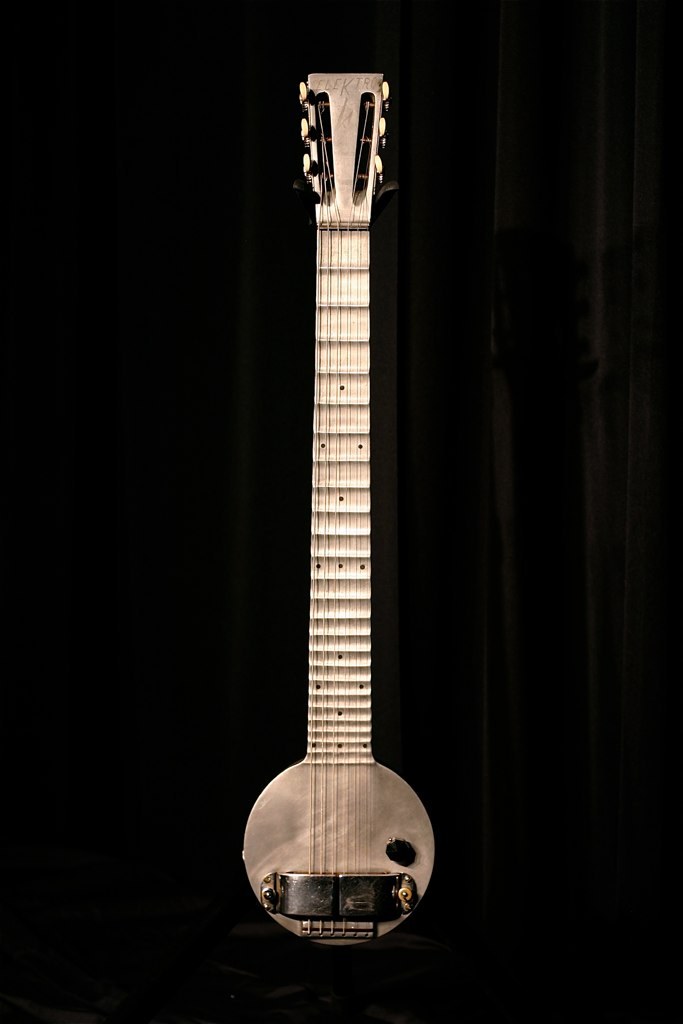
Photo: Museum of Making Music / Wikimedia Commons / CC BY 3.0 Rickenbacker
A-22 Frying Pan
1932
The first electric guitar you could buy looked like a frying pan. The patent office didn’t believe it worked.
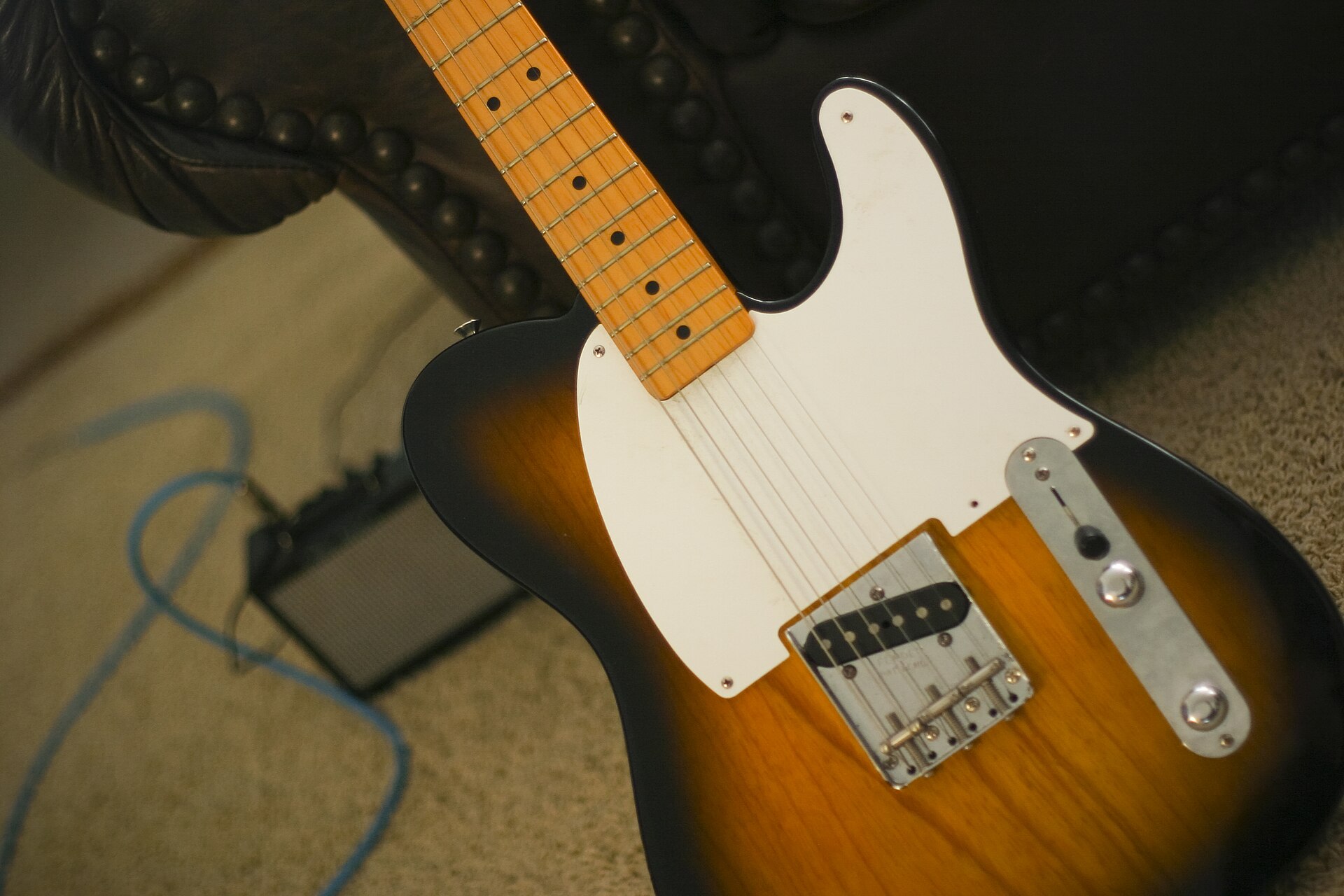
Fender Esquire. Photo by manley.josh. Licensed under CC BY 2.0. Via Wikimedia Commons. Fender
Esquire
1950
Fender’s first electric Spanish guitar settled on one pickup, and it’s been mistaken for its little brother ever since.
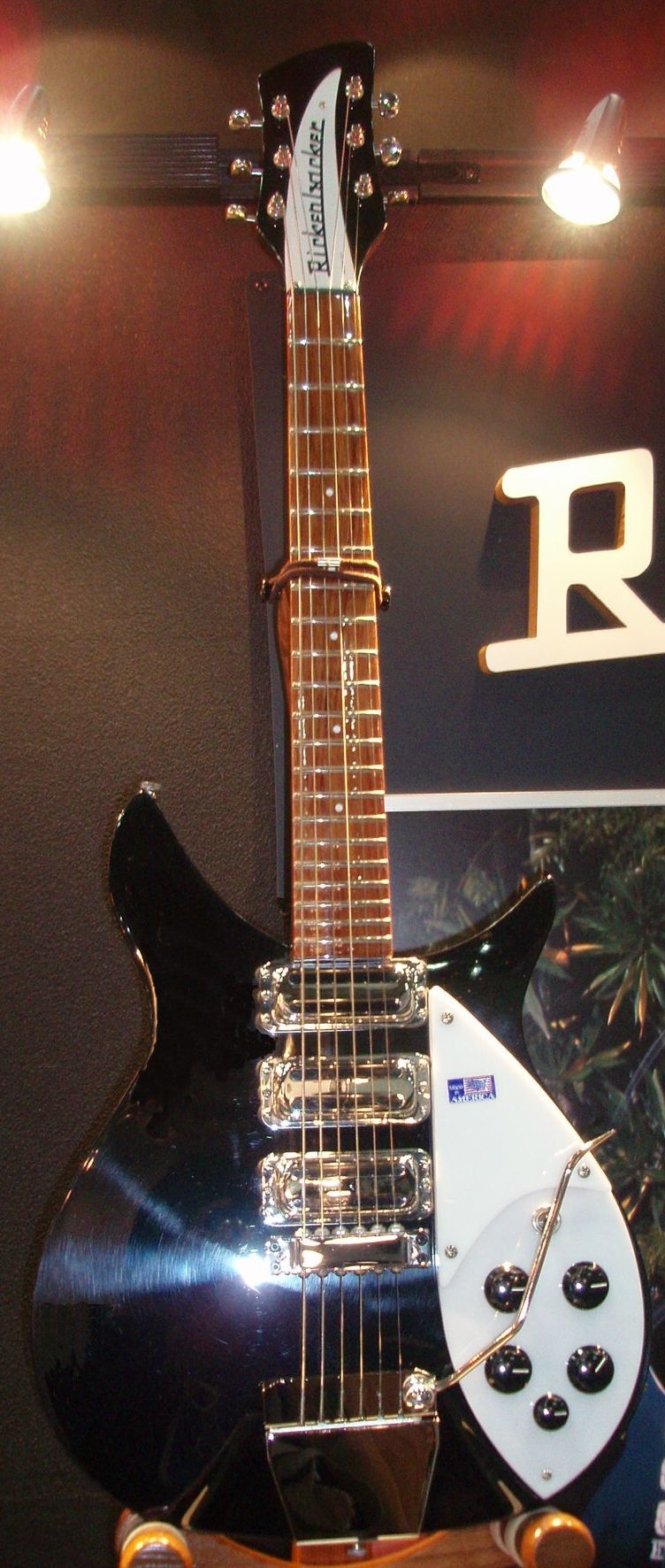
Rickenbacker 325C64. Photo by CasinoKat. Licensed under CC BY-SA 3.0. Via Wikimedia Commons. Rickenbacker
325
1958
Lennon bought it natural in Hamburg and had it painted black. The reissues copy the ends of that story, not the middle.