Teuffel
Birdfish
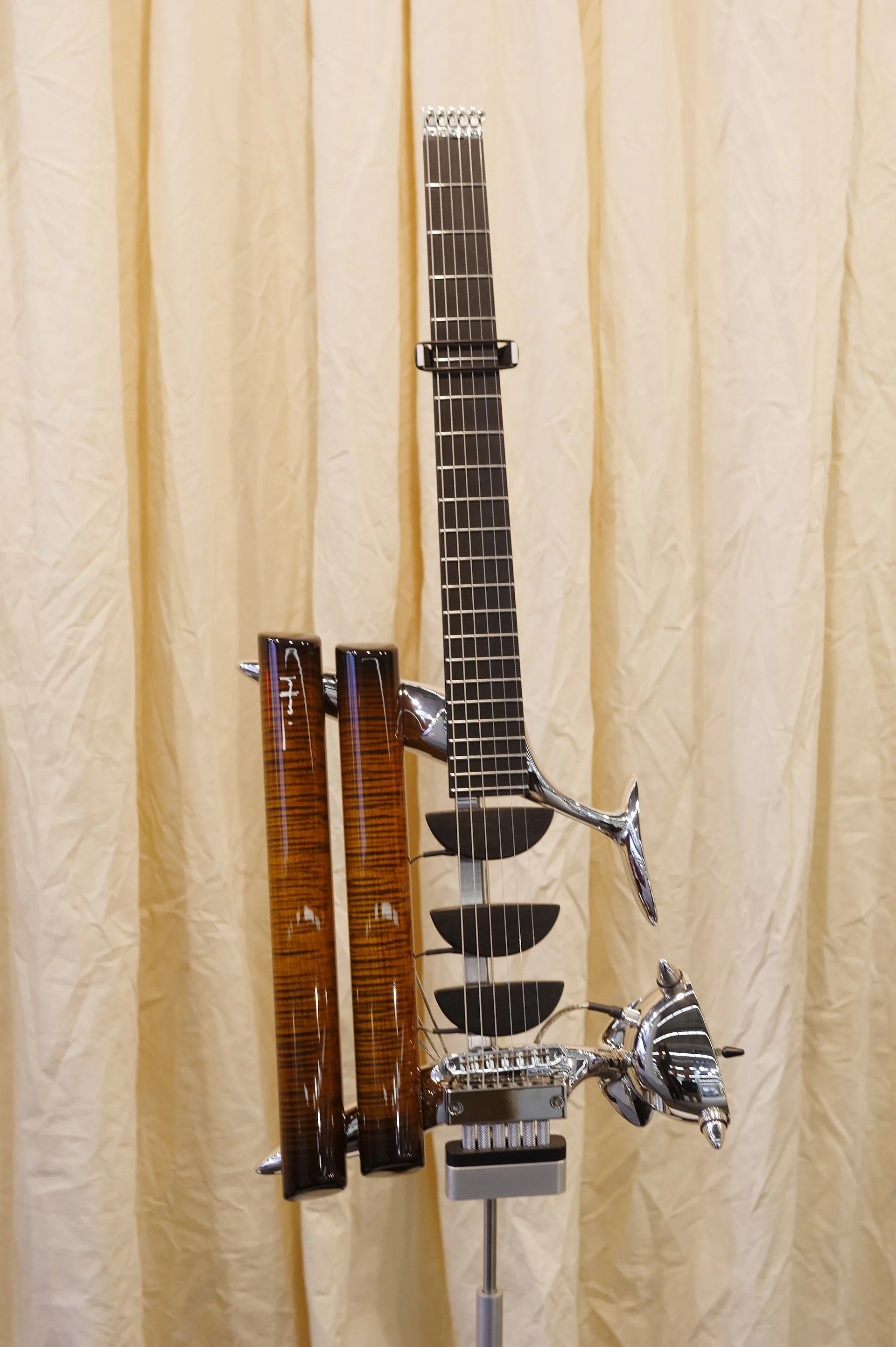
An aluminum bird, an aluminum fish, and two bars of wood you can unscrew. That’s the whole guitar.
In the spring of 1995 a design student in Germany brought a guitar to Frankfurt that showed you what an electric guitar is made of, by letting you take it apart. He’s still building it, a few a year.
- Introduced
- 1995
- Type
- Solidbody electric (modular)
- Class
- Production
The short version
1988
Teuffel opens
Ulrich Teuffel starts his company on 1 June, building fairly ordinary electrics and basses.
1992
Design school
He begins four years of industrial design in Karlsruhe, with Hartmut Esslinger of Frog Design.
1995
Frankfurt Musikmesse
The Birdfish is shown in the spring, sand-cast, with bought-in pickups. The first buyer is from Luxembourg.
1996
Lost wax
Ceramic forms arrive, for lost-wax castings in place of the sandbox.
1999
Number 76
A British magazine reviews no. 76 of 500 and hears that Billy Gibbons has bought one.
2003
Mescalero
Gibbons tells Guitar World the Birdfish “really shines” on ZZ Top’s new album.
2008
Prodigy
A freestyle line arrives beside the classic, with other woods and other plating.
2017
236 made
That’s the count at the time of a profile. The series stops at 500.
Side A
A1
Four months to Frankfurt
In the spring of 1995, Ulrich Teuffel took a guitar to the Frankfurt Musikmesse that he had finished in about four months, maybe four and a half. Reinhold Wagner had asked him whether he’d come to the show. Teuffel had never cast metal before. He cast this one in sand.
It didn’t look like a guitar so much as a guitar’s parts list. Two aluminum shapes, one he called the bird and one the fish. Two bars of wood bolted between them. A neck with no headstock. A rail with pickups on it.
He was still a design student when he showed it. The first buyer, Mil Garofalo, came from Luxembourg.
A2
Metal like wood
Teuffel learned metalwork as an apprentice at Mercedes-Benz. The plant, he said, taught him to work metal as if it were wood. As a trainee he built ten acoustic guitars there. The first one he counts was a Steve Klein shape, copied from photographs in a book, because the plans weren’t in the pictures.
He opened his company on 1 June 1988 and built ordinary electrics for a while: about twenty set-neck Dr. Mabuse guitars, and around thirty basses. When the Birdfish started, he stopped the basses. He was afraid they’d dilute the work.
From 1992 to 1996 he studied industrial design in Karlsruhe, with Hartmut Esslinger of Frog Design. The lesson he took was to think in concepts first, then work out which puzzle each piece belonged to. He wanted the new guitar to be shocking. If it wasn’t, he told one interviewer, it would already be for sale.
A3
Take it apart
So he took the electric guitar down to strings, wood, pickups, and controls, and let you see each one.
The neck bolts to the bird. The control box sits on the fish. The tone comes from the two wooden bars bolted across them: alder or maple, swapped without slackening the strings. The strings preload the bars, the way an acoustic’s strings load its bridge, and there are no routs cut into the bars for pickups. The pickups ride on a rail beside the wood. There are five of them in the set, from a P90-type humbucker to a hot PAF to two single-coils, wound in his shop. Three go on the rail at once. Any of them in any slot, slid wherever you like.
The aluminum is supposed to stay out of the way. His site says it passes vibration almost without filtering. He told an interviewer that the translator had overshot, and that every part has an effect. He had made test joints in brass, steel, aluminum, and hardwood, and the aluminum came closest to the hardwood.
The tuners are at the bridge, and a steel locking nut holds the strings, so you use ordinary ones. The bridge is a Tune-o-matic. In 1995 he couldn’t make a bridge yet, so he bought one, and he came to like that link to older guitars. The knobs are aluminum, because brass ones crackle in the amp when you touch them.
Flip the record · By the numbers
500
The cap on the series. A ceiling, not a count of how many exist.
5
Pickups in the set. Three ride the rail at once, in any order.
<20
Instruments a year through his hands, all models. The wait is about two years.
4½
Months it took to build the first one for Frankfurt. Maybe four.
Side B
B1
Sand, then wax, then a block
Teuffel describes the Birdfish in four stages, and he says it stayed the same guitar through all of them.
In 1995 it was sand-cast aluminum, with Seymour Duncan and DiMarzio pickups molded into his covers. Next came custom pickups he didn’t wind himself. Then he wound his own, and the bird and fish went to lost wax and ceramic molds, with copper, nickel, and chrome plating on top. A British review of number 76, in 1999, describes that kiln-and-vacuum shop. The last step was cutting the bird and fish out of solid blocks of aircraft-grade aluminum, because castings were uneven and a CNC had cost too much at the start.
There has been no active circuit in one since 1995.
B2
The quote, not the song
Billy Gibbons had bought one by 1999. In 2003 he told Guitar World about ZZ Top’s Mescalero:
It really shines on Mescalero because of that dirty, raunchy tone. I defy any other instrument, besides these odd-ball things, to get that crazy.
That’s the Birdfish on record. No song on the album is pinned to it, and Gibbons was playing a 1959 Gretsch Jupiter Thunderbird on that album too, so take it as the album he named, not a track credit.
Kirk Hammett owns one. In 2020 he posted it next to his Teuffel Tesla as “A Teuffel Two.” David Torn is the trap here: his custom Teuffel is a Tesla, not a Birdfish.
B3
Still coming off the rail
The series is capped at 500. Number 76 was out by June 1999. By 2017, 236 had been made. Teuffel says fewer than twenty instruments a year go through his hands, every model counted, and the wait is about two years.
Not much else has changed. Since 2003 the fingerboard has been sealed, and since 2006 the neck has had his own two-way truss rod. The bird and fish are now cut from a block in Neu-Ulm, on his own machines, and plated in his own shop.
It is still two pieces of metal holding two pieces of wood, with three pickups on a rail. Loosen a few screws and you can see exactly what you’re hearing.
Put this on
You’ve read about it. Now hear it. Here’s what this guitar sounds like, and what to listen for.
Mescalero
Gibbons said the Birdfish “really shines” on this album, for its dirty, raunchy tone. No song is pinned to it, and he used a Gretsch Jupiter Thunderbird on the record too. It’s the album he named, not a track credit.
Find it on YouTube (opens in a new tab)
The cast
The people, and the specific guitars, that made the legend.
1995
Ulrich Teuffel
Designer and builder
Trained in metalwork at Mercedes-Benz, studied industrial design, and showed the first Birdfish while still a student.
1995
Mil Garofalo
The first Birdfish sold
From Luxembourg. Bought one at the Frankfurt Musikmesse, the first buyer.
2003
Billy Gibbons
A Birdfish, bought by 1999
Said it got a sound on Mescalero no other instrument could, “besides these odd-ball things.”
2020
Kirk Hammett
A Birdfish, beside his Tesla
Posted the pair as “A Teuffel Two.” No Metallica recording is tied to the Birdfish.
Liner notes
Specs, construction, rarity, value, and every source we used.
An aluminum bird, an aluminum fish, and wooden bars you can unscrew — Teuffel’s Birdfish, not a stainless spine and not a graphite paddle.
- Body
- Two aluminum sculptures. The “bird” takes the neck. The “fish” takes the control box. Two wood tone bars bolt across them. Factory overall: 780 mm long, 320 mm wide, 60 mm thick — his inches, 30.71" × 12.61" × 2.36". Mix flagged.
- Neck
- Bolt-on, one-piece bird’s-eye maple, asymmetrical V, headless. Three screws into threaded inserts. His own two-way stainless truss since 2006: 48 g (1.7 oz). The neck itself, 320 g (11.3 oz). Mix flagged.
- Fingerboard
- The maple of the neck, sealed on top since 2003. Compound radius 350 mm (13.7") at the nut to 450 mm (17.7") at the 22nd fret. 22 frets, Dunlop 6105. Phosphorescent dots. Mix flagged.
- Scale
- 648 mm (25.5"). Mix flagged.
- Pickups
- Five in the set, three on the rail at once: a P90-type humbucker, a PAF, a hot PAF, a left-wound single, a right-wound single. Alnico. Wound in the shop. Each one slides, and each one can sit in any position.
- Hardware
- Tuners at the bridge: aluminum sliders, stainless spindles. Tune-o-matic. Steel locking nut, so the strings are ordinary, not double-ball.
- Electronics
- Volume, tone, Schaller Megaswitch: bridge / both / middle / both / neck. Switchcraft 1/4" jack. The control box slides. Pickup leads are 2.5 mm Switchcraft plugs.
- Finish
- Soft color on the bars: apricot, fire, sapphire, olive, charcoal. Chrome on the aluminum — nickel, then copper, then nickel, then chrome.
- Nut
- Steel locking nut, each string clamped on its own. Width 43.4 mm (1.71"). Mix flagged.
Open the full research fileConstruction details, the complete player record, production numbers, dated value estimates, and sources
Classic living example = the Birdfish he cuts now (Neu-Ulm): high-alloy aluminum from a solid block, chrome, bird’s-eye maple, one set of American red alder bars and one of Michigan maple, five pickups, flight case, tools. Factory weight: maple bars 3.1 kg (6.83 lb), alder bars 2.9 kg (6.39 lb). Eddie’s, this pass, weighs a Sapphire Classic, serial 245, at 7 lb 2 oz. Do not average. 1995 sandbox-cast guitars, with Seymour Duncan and DiMarzio pickups molded into his covers, are the first stage, not this table. Prodigy (from 2008) is the freestyle line — other woods, other plating. MIDI is a piezo bridge and a second box on a classic, not a second slug. Tesla, Niwa, Coco, and Antonio are other guitars.
The Fellowship of Acoustics’ showcase prints a different classic: Alpine maple rather than Michigan maple, an “Asymmetric D,” Wagner stainless frets, nut 43 mm / 1.69", radius given only as 13.7". Guitarist (Ben Bartlett, June 1999), on serial 76, prints maple and swamp ash, not alder, and a Schaller clamp behind the nut. Do not average those with the factory sheet. No Gibson SKUs.
Construction
The job was a guitar you could take apart. The wood that makes the tone unscrews. The pickups slide off a rail. Aluminum holds them, and it is supposed to stay out of the way.
Ulrich Teuffel builds in Neu-Ulm, between Stuttgart and Munich (Tony Bacon, via Reverb News, 23 October 2017). Metalwork apprenticeship at Mercedes-Benz. He told Premier Guitar (Shawn Hammond, 20 December 2011) the plant taught him to work metal as if it were wood, and that he made ten acoustics as a Daimler-Benz trainee. The first one he counts is a Steve Klein shape from photographs in Donald Brosnac’s book — the plans were not in the pictures. Company 1 June 1988. Then ordinary electrics: Dr. Mabuse, set mahogany, 20 of them, and about 30 basses. He stopped the basses when the Birdfish started. He was afraid they would dilute the work.
Industrial design, 1992–1996, Karlsruhe, with Hartmut Esslinger of Frog Design (Bacon). He told Bacon the lesson was to think in concepts, then sort which puzzle the pieces belonged to. He was still in that study when the guitar went public.
Spring 1995, Frankfurt Musikmesse. His page: the first showing, Mil Garofalo of Luxembourg the first buyer. He told Jamie Gale (July 2024) the push was Reinhold Wagner asking if he would come to the Messe, and that the build took four months, maybe four and a half. Casting was new to him. This plate starts in 1995. A Hamburg Reverb listing calls one polished, unchromed guitar “prototype number nine,” with a 2023 overhaul certificate from the shop. An ended listing claims five polished-aluminum guitars, no serials, shipped to Japan in 1995/96. He does not publish a prototype count. Do not average five and nine. Neither claim is an earlier birth year.
He wanted it shocking or, he told Bacon, it would already have been for sale. Reduce the electric to strings, wood, pickups, controls. Put the wood beside the strings so a pickup can come off. Two bars, not a slab, preloaded by the strings the way an acoustic bridge is loaded — his account of the attack. No pickup routs, so the bars are not carved out under the coils.
Bird on top, neck bolted to it. Fish below, the control box on it. A rail between them. Three of the five pickups on the rail, any of them in any seat. The site says aluminum passes vibration almost without filtering, so you hear neck and bars. He told Hammond the translator overshot: every part has an effect. Prototypes in brass, steel, aluminum, and hardwood; the aluminum joint came closest to the hardwood. Keep both.
Not a Gittler (gittler). One stainless rod, a pickup on each string, no wooden body, New York, 1975. This is two sculptures and two bars of wood. Not a Steinberger GL (steinberger-gl). Headless too, tuners at the bridge, 1984, but a graphite paddle with EMG 81 and 60. Van Halen’s Steinberger stays on that plate. Not a Strandberg Boden (strandberg-boden). Chambered wood, EndurNeck, production from 2014. Headless there is weight and a wrist. Headless here is how the wood and the coils come off.
Four stages, and he says the identity held. Hammond has them in Teuffel’s words. First: Duncan and DiMarzio pickups molded into his covers, aluminum sand-cast. His bird-and-fish page dates that to 1995, a sandbox. Next: custom pickups he did not wind. Next: he wound them; lost-wax aluminum, then chrome. The same page dates ceramic forms to 1996. Bartlett’s June 1999 review of no. 76 is that room: wax, ceramic, a kiln, aluminum under vacuum, then copper, nickel, chrome, and five pickups he calls handmade. Last, already the latest step when Hammond asked: aircraft-grade aluminum cut from the block, because castings were uneven and a CNC had been too expensive at the start. His own locking nut replaced the Schaller/Steinberger clamp. The site’s “currently” is that step — a high-alloy that will not cast. Knobs stay aluminum. Brass crackles in the amp when you touch it. No active circuit since 1995.
The bridge stayed a Tune-o-matic. He used a ready-made one in 1995 because he could not make a bridge yet, and later liked the link to older guitars (Hammond). His construction page: Gotoh and Schaller, the only bought bridge. Bartlett calls the 1999 bridge a custom ABM. Do not collapse the names.
2003: fingerboard top sealed; the back sealed, pores open. 2006: the two-way truss, for dry rooms and the tropics. 2008: Prodigy, beside the classic — other woods, other plating. The 20th-anniversary guitar on his site is gold, quilted maple, claro walnut, ebony over alpine maple. The nickel Birdfish is pau ferro, flamed alpine maple, and red alder. Eddie’s serial 259 is alpine flamed maple and Cuban mahogany. Not the alder-and-Michigan-maple table.
A classic can take the MIDI set: RMC piezo saddles, a second box, a Roland 13-pin, magnetic and synth kept apart. Upgrade, not this spec.
1995 is sand, and somebody else’s pickups in his shape. What he sells now is a block he machines, his coils, and his nut. Bacon, 2017: every part in the workshop, a five-axis machine, and he had taken the plating back too.
Players
Do not hang a Tesla on this plate. Do not hang Mescalero on one guitar. Do not recruit a Steinberger, a Gittler, or a Boden player because the headstock is missing.
Billy Gibbons (ZZ Top). The one with a record. Bartlett, at the Frankfurt Messe for the June 1999 review: Teuffel told him Gibbons had bought one. Guitar World, June 2003, as Teuffel quotes it and as Wikipedia’s equipment note repeats it: “It really shines on Mescalero because of that dirty, raunchy tone. I defy any other instrument, besides these odd-ball things, to get that crazy.” Mescalero is 2003. It is not only this guitar. Vintage Guitar’s interview on that album leads with the 1959 Gretsch Jupiter Thunderbird, the Bo Diddley guitar, found in a case at the bottom of the stack. Wikipedia’s same equipment paragraph puts the Jupiter on Mescalero and the Birdfish on Mescalero. Pearly Gates is the 1959 Les Paul. Eliminator is a Dean ML. No song on Mescalero is pinned to the Birdfish here. The quote is the use.
Kirk Hammett (Metallica). He owns one. His post, 13 August 2020: “A Teuffel Two : Tesla and Birdfish.” Two guitars. Equipboard identifies a black Birdfish on “The Judas Kiss” in the Quebec Magnetic film. That is Equipboard’s ID, not a studio sheet. Hammond, 2011: from 2009 Teuffel used a pickup configuration he had made for Hammett — in the paragraph about the Tesla and Niwa bridge humbucker, not a Birdfish track. No Metallica master is pinned to this frame.
David Torn is the trap. Teuffel’s Birdfish page names him. Hammond does not put a Birdfish in his hands. The Birdfish was already designed when Torn showed up. A year after the Tesla, Torn asked for a custom Tesla with a Steinberger TransTrem and a control for his looper. Henry Kaiser’s on-camera Teuffel, in the 2009 shop film, is that Tesla — hum, kill switch, microphonic feedback. The artists-page line under the Orgy / Julien-K credit (Amir Derakh) is a Tesla, live, in A440. None of those three gets a Birdfish scene off the laundry list.
Also known to play stays short, and it is his list, not a session log: Dusty Hill, Page Hamilton, Hans Zimmer. No Helmet track, no score, no bass part pinned. Hill is a bassist. Do not invent the instrument.
Rarity
You can still order one. You cannot order it like a Strat. His sales page: the work that goes through his hands is fewer than twenty instruments a year, all models, and the wait is about two years. Hammond, 2011, heard twenty-five a year, the whole shop, from $7,000 to $15,000. Those are 2011 figures for every model he was building. They are not a 2026 Birdfish census, and they are not a unit total.
The series is capped at 500. That is a ceiling he prints, not a count of how many exist. Bartlett’s guitar was no. 76 in June 1999. Bacon, at the time of the 2017 book: 236 made. A 2010s nickel listing calls itself no. 228. Eddie’s carts this pass are serials 245 and 259. Serials date a guitar. They do not count a year, and they do not prove the numbers in between were all Birdfish. He does not publish a year ledger. None invented. That is why a first-year census is unknown, not the chapter.
What is actually thinner: the 1995 sandbox castings; unplated aluminum, which the two listings above cannot agree how to count; Prodigy one-offs, gold and nickel and the woods that are not alder and Michigan maple. Gibbons’s Mescalero guitar and Hammett’s Birdfish are single objects. They are not a used classic.
Value
Informal estimate, 21 October 2026. Not an appraisal.
Ask vs sold labeled. Celebrity instruments are not comps. No invented medians or factory counts. No 1995 list price appears in the sources used here. He has mostly sold them himself.
New street. Eddie’s Guitars, this pass, two guitars you can put in a cart: Birdfish Classic, Sapphire, serial 245, $16,000; Birdfish Prodigy, alpine flamed maple and Cuban mahogany, serial 259, $25,900. The same two asks are on guitar-list’s Reverb snapshot of 7 October 2026. The Fellowship of Acoustics’ showcase prints a Classic at €17,750 — apricot, and the spec line that disagrees with the factory sheet above. Do not average dollars and euros. Bacon, 2017: €12,800–€21,000, plating and wood, the price then, not a 2026 receipt. Ultimate Guitar (14 June 2026) rounds the living guitar at about $16,500 and up. A magazine sentence, not a cart. Watch-shop channels paste his own copy at other numbers: MB&F CHF 21,000; Chronopassion €24,700. Do not average those with Eddie’s.
Used modern. No clean sold band this pass. Don’t invent a midpoint. Named asks, not hammers. Guitar-list, 7 October 2026: a mint “Saphirblau” $19,971.20; a 2000s blue/red, very good, $10,450 plus shipping; a 2000s apricot, excellent, $16,500; a 2010s nickel, mint, $22,841.90. Reverb’s brand page the same month printed that 2010s nickel at $22,991.41. A separate Reverb results page printed a 2010s nickel at $25,017.79 and a Saphirblau at $21,612.88. Converted asks. Do not average them. An older ask, not 2026: Lark Street’s circa-1997, $8,500, listed three years ago.
Vintage / collectible. There is no separate 1950s market. Early unplated guitars are the scarce end of the same series. The Hamburg “prototype number nine,” listed a year ago: ask $15,374.82, down from $34,439.59. The ended Santa Cruz listing of a 1995 unplated guitar, eight years ago: ask $19,000, with that seller’s “only five” claim. Neither is a hammer. Gibbons’s guitar and Hammett’s are not a street tape.
See also
- gittler — a stainless spine and a pickup per string, 1975; no wooden bars to unscrew
- steinberger-gl — headless, tuners at the bridge, 1984; a graphite paddle, not this frame
- strandberg-boden — another headless with the tuners at the bridge; chambered wood and an EndurNeck, not bird and fish
Sources
- Teuffel, Birdfish — spring 1995 Musikmesse; Mil Garofalo the first buyer; series limited to 500; four stages since 1995; Gibbons quote cited to Guitar World 6/03; his player list
- Teuffel, facts — 780 × 320 × 60 mm and his inch conversions; 648 mm / 25.5"; bird’s-eye maple; neck thickness and width; compound radius; Dunlop 6105; 22 frets; five pickups; weights 3.1 kg / 2.9 kg and his pound conversions; alder and Michigan maple; the set in the case
- Teuffel, bird and fish — 1995 sandbox cast; ceramic forms from 1996; solid high-alloy block now; nickel/copper/nickel/chrome; aluminum knobs against brass crackle; headless tuner, stainless spindles
- Teuffel, construction — bars on bird and fish; neck bolted to the bird; control box on the fish; rail; Gotoh and Schaller Tune-o-matic as the only bought bridge
- Teuffel, tone bars — alder and Michigan maple; no pickup routs; string preload; swap without slacking the strings
- Teuffel, pickups — five pickups, any position; Alnico, wound in the shop; 2.5 mm Switchcraft; Schaller Megaswitch positions; sliding control box
- Teuffel, neck — one-piece bird’s-eye; truss 48 g since 2006; neck 320 g; fingerboard sealed from 2003; locking nut; three threaded inserts
- Teuffel, MIDI — piezo RMC and a second box; any classic can be upgraded; signals split
- Teuffel, colors — apricot, fire, sapphire, olive, charcoal
- Teuffel, vita — company 1 June 1988; Dr. Mabuse and JFK; design study 1992–1996; Birdfish at the end of it; Coco two years later; Tesla; Niwa late 2007
- Teuffel, Prodigy — high-end line from 2008
- Teuffel, 20th-anniversary Birdfish — gold; quilted maple; claro walnut; ebony over alpine maple
- Teuffel, nickel Birdfish — pau ferro; flamed alpine maple and red alder
- Teuffel, sales (USA and EU) — fewer than 20 instruments a year through his hands; wait about two years
- Guitarist, Ben Bartlett, June 1999, via teuffel.com — no. 76 of 500; Baden-Württemberg International Design Award 1998; Talent Award 99; Gibbons had bought one; maple and swamp ash; Schaller clamp; ABM tune-o-matic in that review
- Premier Guitar, Shawn Hammond, 20 December 2011 — Neu-Ulm; Mercedes / Daimler-Benz; Esslinger; four stages in his words; aircraft aluminum and the locking nut as the latest step; ~25 guitars a year, $7,000–$15,000, all models; ~20 Dr. Mabuse, ~30 basses, basses stopped; Torn’s custom is a Tesla; aluminum-versus-hardwood prototypes; the translator correction; no active circuits since 1995; Hammett pickup configuration from 2009 in the Tesla/Niwa paragraph
- Reverb News, Tony Bacon, 23 October 2017 — Neu-Ulm; Karlsruhe and Esslinger; 236 made at the time of writing; €12,800–€21,000; CNC and plating in the shop
- Jamie Gale, “Ulrich Teuffel Lost 10kg Creating the Birdfish,” 19 July 2024 — Reinhold Wagner’s Messe invitation; four to four and a half months; casting was new
- Wikipedia, Billy Gibbons, equipment — Mescalero and the Jupiter Thunderbird; the Birdfish quote; Pearly Gates as the Les Paul; Eliminator on a Dean ML
- Vintage Guitar, Billy Gibbons on Mescalero — the album’s guitar conversation opens on the Gretsch Jupiter, not the Birdfish
- Kirk Hammett, 13 August 2020 — “A Teuffel Two : Tesla and Birdfish”
- Equipboard, Kirk Hammett — identifies a black Birdfish on “The Judas Kiss” in Quebec Magnetic; not a studio sheet
- KRAUT & REDNECK, Tesla film, 21 August 2009 — Henry Kaiser demonstrates the Tesla, the next design after the Birdfish
- Eddie’s Guitars, Teuffel — Classic Sapphire #245 at $16,000, 7 lb 2 oz; Prodigy #259 at $25,900; dealer bio repeats the 2011 output figures and is not a 2026 census
- guitar-list, Birdfish asks, USA, 7 October 2026 — new $16,000 and $25,900; used asks $19,971.20, $10,450, $16,500, $22,841.90
- Reverb, Teuffel brand — same new carts; converted used asks already off the 7 October snapshot; no sold band
- Reverb, 1995 “prototype number nine” — seller’s label; ask $15,374.82 from $34,439.59; listed a year ago; 2023 shop certificate
- Reverb, 1995 unplated, ended — ask $19,000, listed eight years ago; seller’s “only five,” not a factory count
- Reverb, Lark Street circa 1997 — ask $8,500, listed three years ago
- The Fellowship of Acoustics, showcase — Classic €17,750; Alpine maple, Asymmetric D, Wagner frets, 43 mm / 1.69"
- MB&F, Birdfish — CHF 21,000; factory copy, watch-shop channel
- Chronopassion, MB&F × Teuffel — €24,700; same channel, not Eddie’s cart
- Ultimate Guitar, 14 June 2026 — still in production on that date; about $16,500 and up, the writer’s round number
Keep digging
Guitars this one gets compared to, confused with, or descended from.
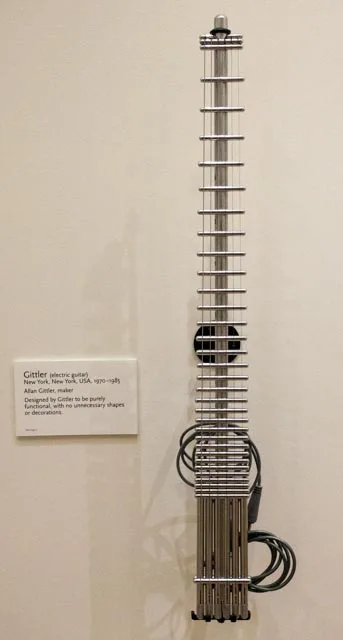
Photo: Frank Kovalchek from Anchorage, Alaska, USA / Wikimedia Commons / CC BY 2.0 Gittler
Gittler
1975
Allan Gittler kept taking parts off a guitar until all that was left was the guitar.
- Send a picture
Steinberger
GL
1984
No headstock, no wood, and designed by a man who didn’t play. Eddie Van Halen wrote two songs on it in days.
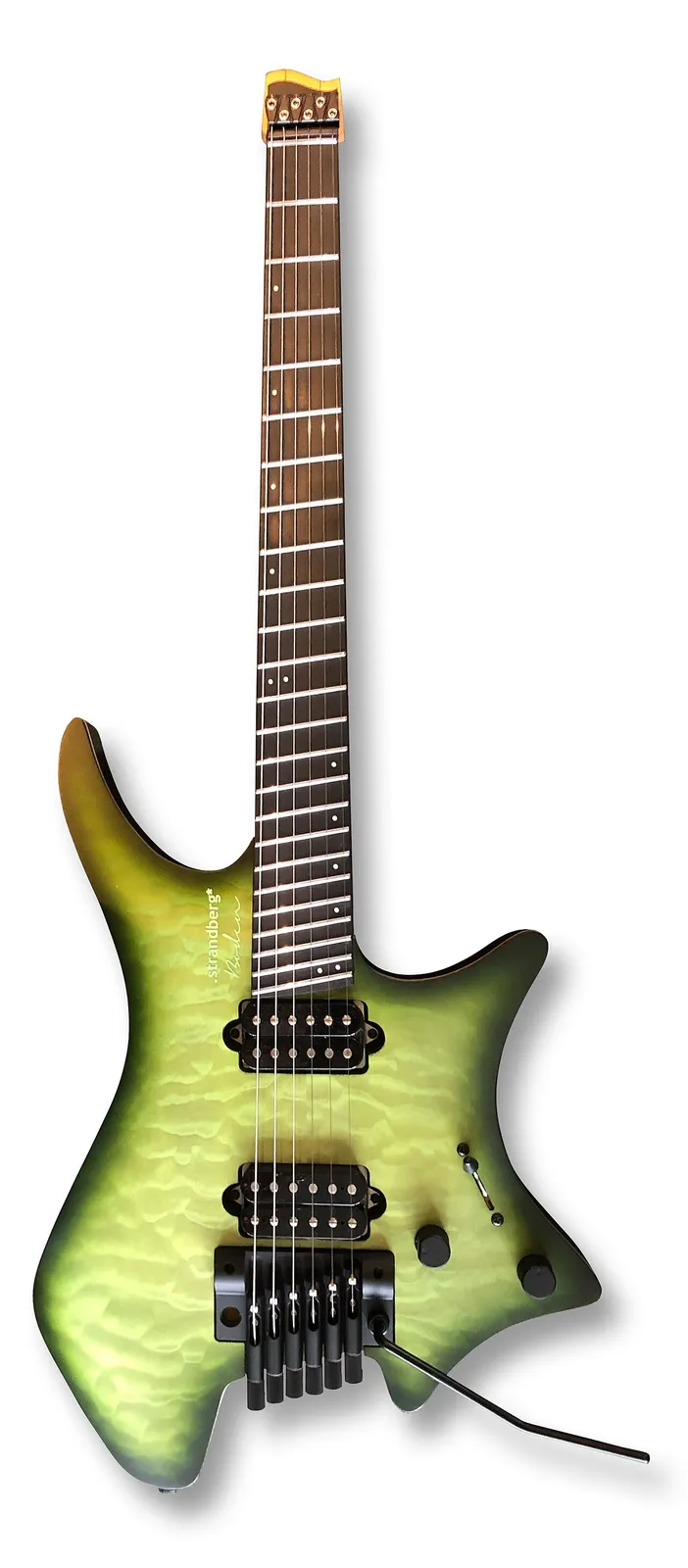
Photo: Auge=mit / Wikimedia Commons / CC BY-SA 4.0 Strandberg
Boden
2014
It started with a sore shoulder. A Swedish engineer built a guitar that would stop fighting him.