Ampeg
Dan Armstrong
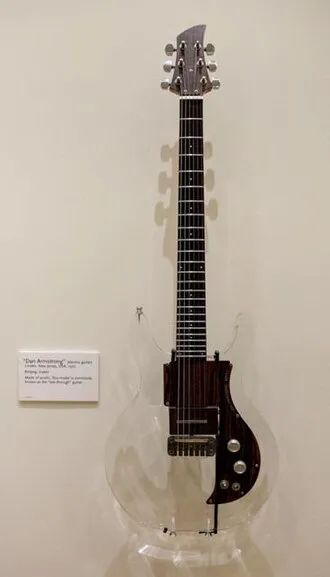
A repairman who spent his days inside other people’s guitars designed one you could see straight through.
New York, the late 1960s. Dan Armstrong fixes guitars for a living, first on 48th Street, then down in the Village. Touring bands know him. Session players know him. And he has an idea for a guitar made of something that doesn’t care about wood grain at all.
- Introduced
- 1969
- Type
- Solidbody electric
- Class
- Production
The short version
1968
The door opens
Armstrong and Ampeg find each other around the NAMM show. Who approached whom depends on who’s telling it.
1969
The show-stopper
The clear guitar debuts at Chicago NAMM in June, at $290.
1969
Keith gets one
Ampeg puts one in Keith Richards’s hands at rehearsals before the Stones’ U.S. tour.
1970
Up to $340
The list price climbs from $290 to $340.
1971
Dropped
Ampeg stops making it, after a little more than a year of regular production.
1998
Back again
The first of several Japanese-made reissues. Some date it to 1999.
Side A
A1
The man behind the repair counter
Dan Armstrong spent his working life inside other people’s guitars. He had a repair shop on 48th Street in New York, then on LaGuardia Place in the Village. He played sessions. Touring bands knew where to find him.
Ampeg, meanwhile, was an amp company that kept trying to be a guitar company too. How the two got together is told two ways. In one, Armstrong walks into the 1968 NAMM show with an idea for a clear guitar. In the other, Ampeg’s new owners ask him for advice, a friend walks him past the booth, and he offers to design some electrics. Either way, by 1969 he had a contract.
And after years of looking inside other people’s guitars, he designed one where there’s no inside to hide.
A2
Carved, not molded
The body is Lucite, the same clear acrylic sold as Plexiglas or Perspex. Everybody assumes it came out of a mold. Armstrong set the record straight in 1973.
Everybody thinks you mold this stuff. You don’t. The body is carved out of a solid board of plastic, like carving out of wood, except that instead of sanding it to finish, you polish it off.
His reason was sustain. Steel guitars ring, he figured, because the material is rigid and consistent. Wood varies from board to board. A block of acrylic doesn’t. Ampeg’s 1969 catalog said the plastic “virtually eliminates all unwanted vibrations,” and told owners to polish out scratches with toothpaste.
The catch is the weight. They averaged about ten pounds. That mass is where the long, even sustain comes from, and it’s also why some players picked one up and handed it back.
A3
Swap the pickup, not the guitar
The best idea on it has nothing to do with plastic. There is one pickup, and it slides out. Loosen a thumb-screw on the back, pull it, and slide in another. Bill Lawrence, who shared Armstrong’s shop, made six of them: Rock, Country, and Jazz, each in a Treble or Bass voice. A new guitar came with two. The rest were $35 each at the dealer.
So instead of a pickup selector, you changed the whole character of the guitar in a minute, with a screwdriver you didn’t need. Ampeg still insisted on a switch, so Armstrong made it a tone and standby switch instead of a pickup selector. There are 24 frets and cutaways deep enough to use them, a plain metal bridge with a single rosewood saddle, and a pickguard made of Formica, the stuff on your kitchen counter.
Flip the record · By the numbers
$290
List price in 1969. It was $340 a year later.
10 lb
What these guitars averaged. That’s where the sustain comes from, and why some got handed back.
6
Slide-in pickup voicings. Rock, Country, and Jazz, each in Treble or Bass.
24
Frets, with cutaways deep enough to reach all of them.
Side B
B1
Keith’s see-through
It was the show-stopper of the Chicago NAMM show in June 1969, listed at $290. But most people who weren’t at NAMM know it because of Keith Richards.
Late in 1969, Ampeg put one in his hands at rehearsals with the Stones’ new guitarist, Mick Taylor, ahead of the American tour. His had a white prototype pickup where production ones are brown. He played it at Madison Square Garden that November for Get Yer Ya-Ya’s Out!, and it’s on the album’s original cover. By one account it was around his neck at Altamont. Ampeg ran the photo as an ad.
One caution. There’s a photo caption that puts this guitar at the June 1968 “Sympathy for the Devil” session. The model didn’t exist yet.
Ronnie Wood played one through the early Faces years. Later the list got long: Joe Perry, Tom Verlaine, Johnny Thunders, Lou Reed, Randy California, Dave Grohl, Josh Homme.
B2
Gone by 1971
By 1971 it was over. Why depends on who you ask: conservative players and an expensive body, money trouble between Armstrong and Ampeg, a fight over cost and quality, or credit he felt he never got for amp ideas. Probably some of each. Armstrong closed the Village shop and left for London.
The factory logs didn’t survive, so nobody knows how many were made. The collectors’ best guess from the serial numbers is about 2,350.
The guitar didn’t stay gone. A Japanese reissue arrived in 1998 or 1999, depending on who’s counting, then another in 2006, and a 40th-anniversary run in 2009. You can’t order a new one from Ampeg today.
Pick one up and hold it to the light. There’s no grain to read and nothing hidden in the body. After a career of opening up everybody else’s guitars, Dan Armstrong built one you never have to open to see inside.
Put this on
You’ve read about it. Now hear it. Here’s what this guitar sounds like, and what to listen for.
Get Yer Ya-Ya’s Out!
Recorded at Madison Square Garden in November 1969, with Keith’s clear Dan Armstrong in the mix. It’s on the album’s original cover too.
Find it on YouTube (opens in a new tab)
The cast
The people, and the specific guitars, that made the legend.
1969
Keith Richards
Clear Dan Armstrong with a white prototype pickup
Got it at rehearsals with new guitarist Mick Taylor. On Get Yer Ya-Ya’s Out!, and around his neck at Altamont.
1970s
Ronnie Wood
Dan Armstrong
His guitar in the early Faces years, before he was a Stone.
1969
Dan Armstrong
Designer
Repairman, session player, and the man who decided a guitar body could be carved from a block of plastic.
1969
Bill Lawrence
Pickups
Shared Armstrong’s shop and wound the six slide-in pickups.
1969
Matt Umanov
Prototypes
Built the first ones.
1974
David Bowie
Lucite guitar, reported
Reported to have used one on the Diamond Dogs sessions. Attributed, not documented.
Liner notes
Specs, construction, rarity, value, and every source we used.
A carved Lucite body, a sliding pickup, and 24 frets — Ampeg’s Dan Armstrong guitar, not the See-Through bass.
- Body
- Clear Lucite (PMMA; also sold as Plexiglas / Perspex), double-cutaway, carved from a block
- Neck
- Bolt-on maple; four screws under the pickguard (Hunter)
- Fingerboard
- Rosewood, 24 frets, small dots
- Scale
- 24 3/4" (Bacon; Hunter). Blue Book ARMG-2: 24.5". Mix flagged.
- Pickups
- One interchangeable Bill Lawrence single-coil in a sliding slot
- Hardware
- Danelectro-style metal bridge with a rosewood saddle; Schaller, then Grover
- Electronics
- Volume, tone, 3-way tone / standby toggle (not pickup select)
- Finish
- Polished Lucite; woodgrain Formica pickguard and headstock overlay
- Nut
- Ivory (guitar.com). Dealer listings 1 5/8". Mix flagged.
Open the full research fileConstruction details, the complete player record, production numbers, dated value estimates, and sources
Classic living example = 1969–71 Linden, NJ Lucite guitar (Tony Bacon: ARMG-1; Blue Book: ARMG-2). No current typical SKU this pass. Factory inches only; no millimetres invented. Scale mix flagged. See-Through bass (ARMB-1; fretless ARMUB-1 from 1970) is the sibling, not this table. ADA6 Japan reissue (Blue Book 2006–11) and the wood London Series stay off this table.
Construction
The job was a guitar Ampeg could sell with its amps, built from something that did not care about grain. Ampeg was an amp company. Everett Hull’s “amplified peg.” Burns imports in 1963, Horizontal basses in 1966, Unimusic ownership by 1967, and another try at a guitar line. Dan Armstrong was the repairman on 48th Street, then LaGuardia Place in the Village: session player, shop, the person touring bands already knew.
How the deal started is told two ways. Dave Hunter (Guitar Player, 23 August 2023): Armstrong walked into the 1968 NAMM show with a clear-guitar idea; Ampeg signed him onto the Grammer acoustic line it had just bought. Tony Bacon (Reverb News, 17 October 2019): Unimusic asked him for advice in ’68, a friend walked him through Ampeg’s booth, and he offered to design electrics. Guitar.com (Justin Beckner, 9 May 2023): the contract to build clear guitars and basses is 1969. Keep 1968 as the door. This plate starts in 1969.
Vintage Guitar (Phil Feser, April 2007): if you were at the 1969 Chicago NAMM, this was the show-stopper. The Dan Armstrong Registry dates dealer introduction to that show, 22–26 June 1969, and treats A101D as the first retail serial. Guitar World (Dave Burrluck, 27 November 2023) puts regular production late 1969 to ’71. Keep NAMM and late-year shipping.
The body is the point. Not molded. Armstrong, to Guitar magazine’s Jeffrey Pike in 1973 (Hunter; Bacon): “Everybody thinks you mold this stuff. You don’t. The body is carved out of a solid board of plastic, like carving out of wood, except that instead of sanding it to finish, you polish it off.” He wanted rigid, consistent material because steel guitars sustain; wood varies. Lucite, Plexiglas, Perspex — same PMMA. Ampeg’s ’69 catalogue (Bacon) called the plastic so dense it “virtually eliminates all unwanted vibrations,” and told owners to polish scratches with toothpaste. Hunter: the guitars averaged 10 pounds. That mass is the sustain story. It is also why some players handed them back.
Matt Umanov built the prototypes. Bill Lawrence, sharing Armstrong’s shop, made the pickups. Six voicings in one slot: Rock, Country, Jazz, each Treble or Bass. Loosen a thumb-screw on the back, slide one out, slide another in. Bacon: a new guitar shipped with Rock Treble and Country Bass; the rest were dealer accessories. Vintage Guitar: $35 each. Ampeg still wanted a switch on a one-pickup guitar. Armstrong used it for tone and standby, not pickup select. Feser: early tuners wandered; Grover became standard, and the toggle got a slight rewire.
Bolt-on maple, 24-fret rosewood, deep cutaways so both octaves clear the body. Bacon and Hunter print 24 3/4". Blue Book’s ARMG-2 line prints 24.5". Mix flagged. The bridge is a flat metal plate with one rosewood saddle — Danelectro-simple against the rest of the object. Formica on the guard and the peghead, the same laminate as a kitchen counter, stamped Dan Armstrong Ampeg.
Not the bass. ARMB-1 is a fixed stacked humbucker on the same Lucite, 30 1/2" (Bacon). Fretless ARMUB-1, 1970. Bill Wyman, Jack Bruce, Geezer Butler belong there. Do not hang them on this guitar.
1971: dropped. Bacon: conservative players and an expensive body, “little more than a year.” Feser: financial issues between Armstrong and Ampeg. Burrluck: a disagreement, then London. Guitar.com: quality-versus-cost, plus no credit on SVT / V-series ideas. Keep the drop year; do not pick a winner among the reasons. Armstrong closed the Village shop and left. The wood London Series (set-neck, sliding pickup on a ramp, 1972–75) is a different guitar. Not this slug.
Reissues are other factories on this silhouette. Feser: 1998 summer NAMM, Fujigen, Kent Armstrong pickups, until 2001. Bacon: 1999, again 2006, 40th-anniversary 2009. Blue Book: first wave through 2002; ADA6 2006–11, 24.75". Keep 1998 and 1999. No living Ampeg guitar cart this pass.
Classic vs current: 1969–71 Linden Lucite — carved PMMA, Lawrence slide-in, rosewood saddle, $290 list (Bacon) — against nothing you can order new, and against a Japan ADA6 that is not this table.
Players
Keith Richards (The Rolling Stones). The reason anyone who did not go to NAMM knew this guitar. Bacon: Ampeg put one in his hands late 1969 at rehearsals with new guitarist Mick Taylor, ahead of the U.S. tour; the one he got has a prototype white pickup, where production units are brown. Burrluck: October 1969. It is on Get Yer Ya-Ya’s Out! (recorded Madison Square Garden, November 1969) and on that album’s original cover. Burrluck puts it around his neck at Altamont. Ampeg ran the photo as an ad. Do not use the Getty caption that puts this guitar on the June 1968 Sympathy for the Devil session — the model did not exist yet.
Ronnie Wood (Faces). Hunter and Burrluck: the guitar in the early Faces years, before he was a Stone. Not Keith’s object.
Also known to play (Hunter / Bacon / Beckner laundry list, last, short): Joe Perry; Tom Verlaine; Johnny Thunders; Lou Reed; Arthur Lee; John Kay; Randy California; later Mike Campbell, Dave Grohl, Josh Homme. V&A: a Lucite guitar “reported to have been used” by David Bowie on the Diamond Dogs sessions, 1974 — attributed, not a studio log. Leslie West and Paul McCartney are on Feser’s list; Guitar.com’s left-handed McCartney is rumour. No named instruments invented for that list. Do not recruit Wyman, Bruce, or Butler.
Rarity
No current Lucite SKU. Ampeg does not publish Dan Armstrong unit totals. The Registry (October 2023): manufacturing logs did not survive the ownership changes. None invented.
Serials date a guitar, they don’t count a factory. Registry: first retail A101D (A001D–A100D reserved for prototypes, “unlikely that anything near that number were ever produced”); highest documented A2850D; a gap A1601D–A1999D around a 18 March 1971 wiring-bulletin split at A2000D. Their serial-math estimate is about 2,350 guitars for 1969–71. That is a registry guess, not a factory total. Bacon: a handful of black-plastic bodies. Those, the white-pickup prototype Keith got, and first-batch Grover-less examples are the scarce end. Reissues (Fujigen 1998–2001/02, ADA6 2006–11) are later objects. They are not a 1969 guitar. Keith’s and Bowie’s are unique. They are not a vintage Dan Armstrong.
Value
Informal estimate, 2 September 2026. Not an appraisal.
Ask vs sold labeled. Celebrity lots are not-comps. No invented medians or factory counts. Reverb Price Guide widget did not print a clean band in the static fetch this pass.
New street. No living cart. Feser’s 2007 ADA6 list $1,899 is a reissue price, not 2026 street.
Used modern. Japan ADA6 / later reissues are a different object. Named asks this pass, not hammers: Reverb ADA6 Black $1,345; ADA6 Clear $3,000. A 2008 reissue sold listing at $2,050 (Southside Guitars; listed years ago) is dated, not a 2026 median.
Vintage / collectible. 1969 list $290, 1970 $340 (Bacon) — historical, not 2026 street. Named 2026 solds from the Dan Armstrong Registry, not a midpoint: 8 March no-reserve A1087D $2,007; 7 March eBay A1148D $2,513; 2 August A2222D $3,000. Named asks this pass, not hammers: Reverb ARM G-2 $3,900 (dropped from $7,000); a five-pickup 1969 $6,795; Registry A2434D $8,000; A589D $4,950. Original extra pickups and an unmolested rosewood saddle move the number; a swapped Tune-o-matic is common and is not a factory guitar. Christie's London, 31 January 2024, Mark Knopfler collection, serial A2257D: estimate £2,500–£4,000, hammer £37,800. Celebrity, not a street tape.
See also
- steinberger-gl — later non-wood paddle; graphite, not Lucite
- danelectro-59 — lipstick shorthorn; the Dan Armstrong bridge is Danelectro-simple
- parker-fly — carbon-glass skin on a wood core, not a carved Lucite block
Sources
- Reverb News, Tony Bacon, 17 October 2019 — 1969 launch; Lucite carved not molded; ARMG-1 / ARMB-1; 24 3/4"; six Lawrence pickups; $290 / $340; Keith late 1969 white pickup; dropped 1971; reissues 1999 / 2006 / 2009
- Guitar Player, Dave Hunter, 23 August 2023 — 1968 NAMM approach; 1969 guitar and bass; PMMA; 10 lb average; 24.75"; four screws under the guard; 3-way as tone/mute; 1971 end
- Guitar World, Dave Burrluck, 27 November 2023 — prototypes 1969; late 1969–71; October 1969 Keith; Get Yer Ya-Ya’s Out!; Altamont; See-Through nickname
- Vintage Guitar, Phil Feser, April 2007 — 1969 Chicago NAMM; 24 frets; $35 pickups; Grover after early tuners; 1998 Fujigen–2001; ADA6 $1,899; 24.5" on that reissue
- Guitar.com, Justin Beckner, 9 May 2023 — 1969 contract; Umanov prototypes; ivory nut; Brazilian rosewood; London Series 1972–75; 1998 SLM reissue
- Blue Book of Guitar Values, Dan Armstrong See-Thru — ARMG-2 24.5" 1969–71; ADA6 24.75" 2006–11
- Dan Armstrong Registry, guitar totals — October 2023; A101D first retail; ~2,350 serial-math estimate; A1601–A1999 gap; 18 March 1971 bulletin
- Dan Armstrong Registry, dating — 22–26 June 1969 NAMM; Linden; logs unpublished
- Dan Armstrong Registry, new items — named 2026 solds A1087D $2,007; A1148D $2,513; A2222D $3,000
- Guitar World, Keith Richards: a life in guitars — 1969 tour; see-through in live rotation
- V&A, Dan Armstrong / Ampeg guitar — 1969–71 Lucite; Bowie Diamond Dogs sessions reported 1974
- Christie's, Knopfler Dan Armstrong, 31 January 2024 — A2257D; estimate £2,500–4,000; sold £37,800; celebrity
- Reverb, Ampeg Dan Armstrong Lucite Guitar Clear 1969 — 1969–71; Price Guide widget blank this pass; named asks
- Premier Guitar, 1972 Dan Armstrong London — London Series wood set-neck; not the Lucite
Keep digging
Guitars this one gets compared to, confused with, or descended from.
- Send a picture
Steinberger
GL
1984
No headstock, no wood, and designed by a man who didn’t play. Eddie Van Halen wrote two songs on it in days.
Danelectro 59-DC. Photo by Sander van Malssen. Licensed under CC BY-SA 2.0. Via Wikimedia Commons. Danelectro
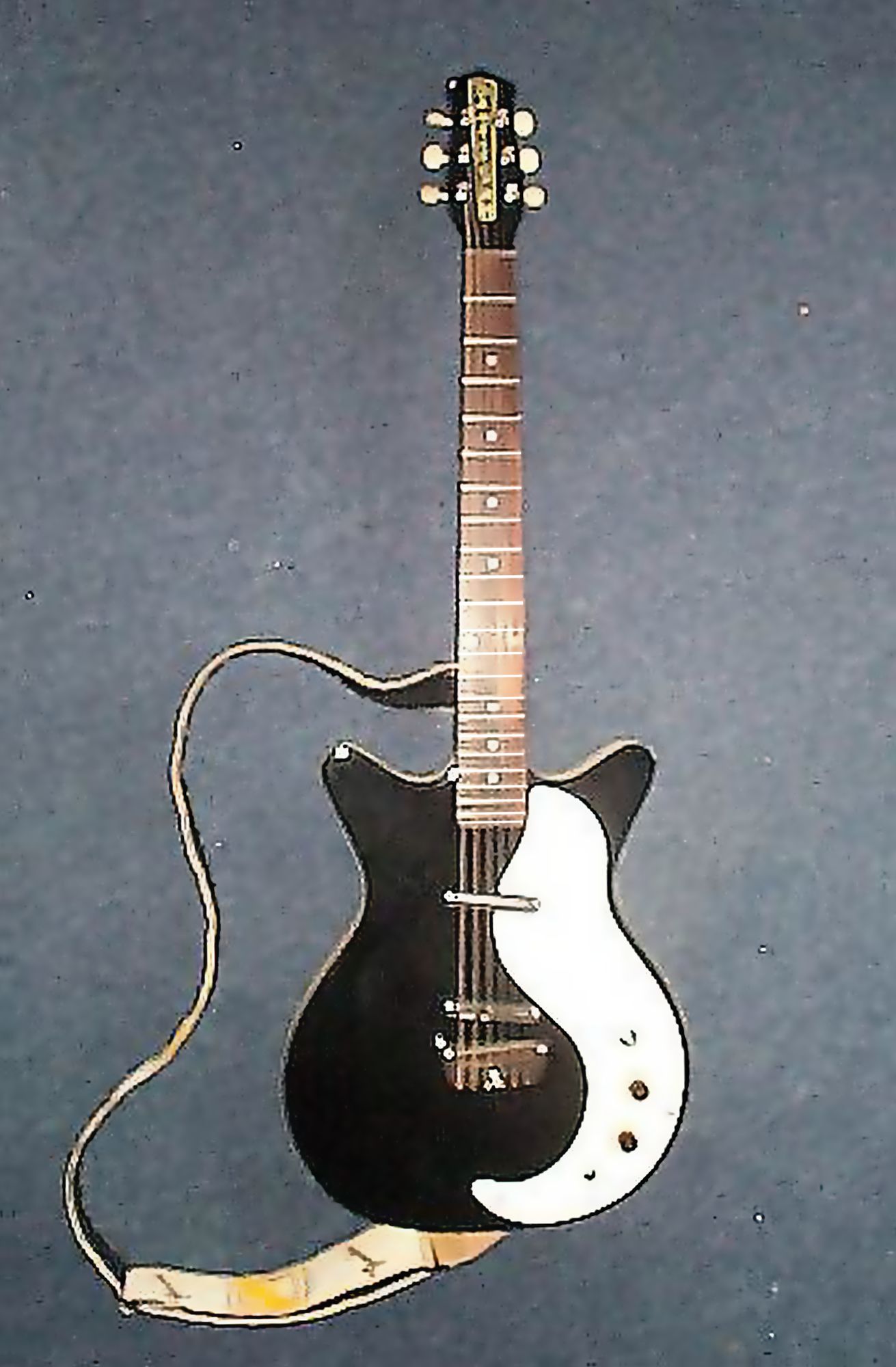
59
1958
Jimmy Page’s has been shown at the Met. The same two lipsticks and coke-bottle head are hanging on a shop wall near you.
- Send a picture
Parker
Fly
1993
Ken Parker built it like a lobster: wood on the inside, and all the strength in a skin thinner than the paint.