Hagstrom
Swede
The first ones said L.P. on them. Then Hagstrom named the guitar after where it came from.
Älvdalen, Sweden, 1970. Hagstrom’s factory starts shipping a new single-cutaway solidbody: mahogany, two humbuckers, an ebony fingerboard, and a badge that reads Hagström L.P. Everybody knows what those two letters are supposed to make you think of.
- Introduced
- 1970
- Type
- Solidbody electric
- Class
- Production
The short version
1970
The L.P.
The first examples leave Älvdalen badged Hagström L.P.
1972
The Swede
By now it’s in the line under its own name.
1973
For the select few
Hagstrom’s ad puts Domenic Troiano next to the line “The Swede — for the select few.”
1974
ABBA, and Ampeg
Benny Andersson is photographed with a Swede. Ampeg takes over the U.S. line.
1978
Sustain Blocks
Hagstrom’s brass Sustain Blocks first appear on Swedes and Super Swedes.
1982
The last Swedish Swedes
Swede production in Sweden ends. The plant closes the next year.
2023
A new generation
A new Swede shows up at NAMM with a glued-in neck and a maple cap.
Side A
A1
Two letters on the headstock
Some guitars start out honest about what they are. This one started out wearing somebody else’s name.
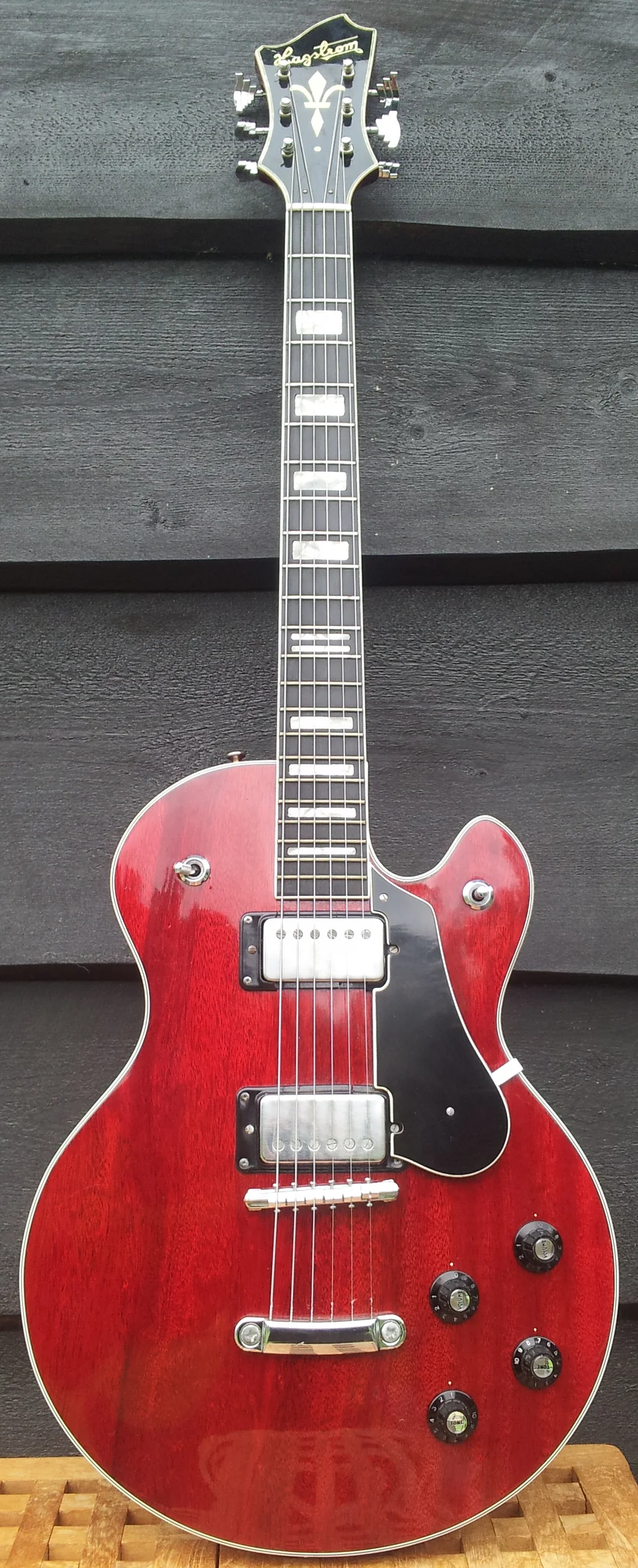
In 1970 Hagstrom, up in Älvdalen, started building a single-cut solidbody with two humbuckers. The first ones, from 1970 and ’71, carried a badge that said Hagström L.P. You didn’t need a decoder ring. The outline was a Les Paul’s, the pickups were humbuckers, and the idea was plain enough: a Les Paul, made in Sweden.
Then Hagstrom changed its mind. By 1972 at the latest, the guitar had a new name, and the name wasn’t borrowed from anybody. They called it the Swede.
A2
A Les Paul only from the outside
Here’s what the L.P. badge didn’t tell you. Under that outline, the Swede was built like nothing from Kalamazoo. The body was bound mahogany, with no maple cap on top. The mahogany neck bolted on. The board was ebony, with pearloid blocks. Instead of a Gibson-style truss rod, there was Hagstrom’s own H-Expander rail in the neck.
The humbuckers were mounted in reverse, and the controls went further than a Les Paul’s: two volumes, two tones, a pickup selector, and a second three-way switch that reshaped the tone. All mahogany, no maple lid, means a warmer, rounder guitar than the thing it was imitating, and that second switch gives you more ways to get there.
The headstock was the giveaway that this was its own guitar. It was the “duck’s foot,” a shape already on the Jimmy, James D’Aquisto’s carved hollowbody for Hagstrom. Finishes started in cherry, then natural and black, then white. Hagstrom’s own 1973 copy admitted, “The Swede … it took us a long time to make.”
The badge said L.P. The neck bolted on, the top was all mahogany, and the headstock looked like a duck’s foot.
A3
For the select few
Hagstrom’s 1973 ad put Domenic Troiano, of Mandala, Bush, and the James Gang, next to the line “The Swede — for the select few.” But the players who made it famous were closer to home.
The Swede was the instrument of choice of Björn Ulvaeus, of ABBA. There’s a 1974 photograph of the band with Benny Andersson, far right, holding one, and a 1975 still of Björn with a Swede on The Eddy-Go-Round Show. Which ABBA records it’s actually on, I can’t tell you, and I won’t pretend to. What you can say is that the most famous Swedish band in the world stood in front of cameras holding a guitar called the Swede.
Flip the record · By the numbers
7,500+
Swedes shipped from 1970 to 1979, in at least 26 batches, by one rough count. Not a factory ledger.
2
Three-way switches on the original. One picks the pickups; the other shapes the tone.
24.75"
Scale length. The Super Swede sister stretches it to 25.5".
1983
The Älvdalen factory closes. The Swede family was the last model out of it.
Side B
B1
The last one out of Älvdalen
In 1974 Ampeg took over the U.S. line. In 1978 the Swede got Hagstrom’s brass Sustain Blocks, which the company had been working on since 1976. Around 1977 a fancier sister arrived, first called the Swede DeLuxe, then the Super Swede: a glued-in neck and a longer scale. That’s a different guitar, and it’s where coil-tapping came in.
There was a stranger sister too. From the mid-’70s Hagstrom built the Swede Patch 2000, a Swede wired to drive a synthesizer, and a few hundred of them went out the door. It’s a real guitar and a real curiosity, and it’s a story for another day.
By one rough count, just over 7,500 Swedes shipped between 1970 and 1979. The last Swedish ones came in 1982. The factory closed in 1983, and the Swede and Super Swede were the last model out of Älvdalen.
B2
Still called the Swede
Hagstrom came back in the 2000s. The company dates its return to 2004; others say 2005. By 2006 there was a licensed Swede again, built in China. In 2023 a New Generation Swede showed up at NAMM, and it has things the 1970 guitar never did: a glued-in neck, a carved maple cap, stainless frets, locking tuners, and pickups you can split to single-coil with a pull of a tone knob. The scale is still 24.75", and the Super Swede is still the longer one.
So half a century on, the Swede finally has the recipe that would have made the L.P. badge honest. Nobody’s asked for the badge back. It’s built in China now, and it’s still named for the place it came from.
The cast
The people, and the specific guitars, that made the legend.
1975
Björn Ulvaeus
Swede
The Swede was his instrument of choice in ABBA. Pictured with one on The Eddy-Go-Round Show.
1974
Benny Andersson
Swede
Photographed with a Swede in 1974, far right in the shot. A photograph, not a session log.
1973
Domenic Troiano
Swede
Of Mandala, Bush, and the James Gang. The face of Hagstrom’s “for the select few” ad.
1970s
Larry Coryell
Swede or Super Swede
Listed on both the Swede and the Super Swede in the ’70s. His 1979 Hagstrom ads are for the Super Swede.
early 1970s
James D’Aquisto
The duck’s-foot headstock
The headstock shape came off the Jimmy, his guitar for Hagstrom, and went onto the Swede.
Liner notes
Specs, construction, rarity, value, and every source we used.
A 24.75-inch mahogany single-cut with two humbuckers and a duck’s-foot head — Hagstrom’s Swede, not a Les Paul and not the Super Swede long-scale.
- Body
- Mahogany, ¾" carved maple top with flame maple veneer, single-cut, single-ply ivoroid
- Neck
- Mahogany, set, Nape-Tenon
- Fingerboard
- Resinator, 14.4" radius, 22 stainless medium jumbo, Crest inlays, lions at the 12th. Mix flagged.
- Scale
- 24.75" (628 mm). Mix flagged.
- Pickups
- Two Lundgren Design AlNiCo-2 No. 2 humbuckers, splitable (neck 7.3K, bridge 8.3K)
- Hardware
- Long Travel Tune-O-Matic; Hagstrom Direct Mounted Sustain Blocks; 19:1 locking
- Electronics
- Two volume with R/C, two tone with push-pull coil splits, 3-way toggle
- Finish
- Gloss; Mandarin Burst, Crimson Flame, Dark Storm, Gold typical
- Nut
- GraphTech Black Tusq XL, 43 mm. Mix flagged.
Open the full research fileConstruction details, the complete player record, production numbers, dated value estimates, and sources
Current typical = Hagstrom Swede (New Generation / MK III, hagstromguitars.com, fetched 17 September 2026). Factory mixed inch/mm flagged; no millimetres invented for the 14.4" radius, no inches invented for the 43 mm nut. Factory scale 24.75" (628 mm); guitar guitar prints 24.75" – 629mm. Do not average. Factory neck depth 20 mm / 21.5 mm at 1st / 12th; Thomann prints 21 mm / 22.5 mm. Keep both. No USD list on the factory page this pass. Optional case C-51. Super Swede is the 25.5" / 648 mm sister — same factory family, not this table. Ultra Swede is the 7/8-body compact — sister, not this table. Swede Tremar and Select Swede stay on this name. Swede Bass is a bass. Swede Patch 2000 is the synth hybrid. Impala is the 1963–67 double-cut. Viking is a hollow. No Gibson SKU lives here.
Construction
The job was a Swedish single-cut for the Les Paul sound Hagstrom was already selling Gibson to cover. Guitar.com (Justin Beckner, 16 January 2024) dates the model to 1970. Premier Guitar (Zachary Fjestad, 11 March 2013): “first introduced in 1970.” Vintage Guitar and Bass: available 1970–1982, companion bass a year later. Studio (Micke Linderoth, 2 October 2019): first examples 1970–71 wore Hagström L.P., then the name became Swede. Michael Wright (MyRareGuitars, 18 December 2017) has the Swede “in the line by 1972.” Keep 1970, the L.P. badge, and Wright’s 1972. This plate starts in 1970.
Vintage Guitar and Bass is blunt about the mash: it looks like a Les Paul and is built like one only in the outline. Bound mahogany. No maple cap. Bolt-on mahogany neck, ebony with pearloid blocks, 22 frets, nut 1 11/16", scale 24 3/4". Two reverse-mounted humbuckers. Two volume, two tone, a pickup selector, and a second 3-position tone switch. Fleur-de-lys — the duck’s-foot head already on D’Aquisto’s Jimmy. Vintage Guitar (Wright, 7 January 2010): that headstock went onto the Swede and onto Hagstrom’s Viking thinlines in the early ’70s. Finishes started cherry, then natural and black, then white. H-Expander rail in the neck, not a Gibson rod. 1973 copy (Vintage Guitar and Bass): “The Swede … it took us a long time to make.”
Not a Les Paul (gibson-les-paul-standard). Different factory, different joint, no maple cap on the original. Kalamazoo’s single-cut is set-neck, carved maple over mahogany, 1952, then the 1968 reissue. This is Älvdalen, bolt-on, flat mahogany, 1970. Ancestor in the single-cut job. Not that guitar. No Gibson SKU.
Not Super Swede. Fjestad: Super Swede (first Swede DeLuxe, circa 1977) is the set-neck, longer-scale, coil-tap sister. Studio: glued neck, bound ebony, zero fret, longer mensur. Factory overview: Super Swede takes 25.5" / 648 mm. This table is 24.75". Not Impala — 1963–67 double-cut with a bank of switches (Premier Guitar, Alex Maiolo, 19 April 2016). Not Viking. Not Ultra Swede. Not the Swede bass (HB 903 / HG903, 1971–76). Not Patch 2000. No Gibson SKU.
1974. Ampeg took the US line. Vintage Guitar and Bass: the 1975 catalogue numbers the guitar HG803. Wright: Ampeg from 1974 through the rest of the decade.
1976–78. Factory Swede page: Sustain Block design work from 1976; the brass blocks “made [their] first appearance on Swede and Super Swede guitars produced in 1978.” Wright: Patch 2000 version of this silhouette 1977; his example is 1978. Wikipedia: Patch 1976–1979. Keep the range. That is a synth guitar. Not this table.
1977–83. Super Swede / DeLuxe is the other single-cut. Vintage Guitar and Bass shipping: Swede De Luxe 518 (1977–80); Super Swede 1,316 (1980–81); Ultra Swede 250 (1983). Last Swedish Swedes 1982 (Vintage Guitar and Bass; Swedish Wikipedia). Plant closed 1983 (Guitar.com). Wikipedia treats Swede and Super Swede together as 1970–1983, last model out of Älvdalen. Keep both the 1982 Swede cutoff and the 1983 plant.
The living guitar is the post-return Swede. Hagstrom dates the international return 2004. Guitar.com dates the relaunch 2005. Swedish Wikipedia puts licensed Swede production from 2006 (Tricor AB; China assembly, Korea pickups, North American woods) with Custom 58s and coil splits the original Swede did not have — split came first on Super Swede. NAMM 2023 (Guitar World, Matt Parker, 4 April 2023; MusicRadar, Rob Laing, 3 April 2023): New Generation Swede and Super Swede, Lundgren Design, nape-tenon, volute, stainless frets, 19:1 locking, 24.75" vs 25.5". That Swede is this table. China, not Älvdalen.
Classic vs current: 1970 Swede — bolt-on mahogany, no maple cap, reverse humbuckers, two 3-ways, ebony, 24 3/4" — against the 2026 New Generation: set Nape-Tenon, ¾" maple cap, Lundgren No. 2s with push-pull splits, Resinator, Sustain Blocks, dealer street from 969 €.
Players
Do not recruit Super Swede, Impala, Viking, H-II, Kent, H8, or Swede Bass players as if they were this guitar. Pat Smear is H-II / Super Swede / the 2013 signature. Elvis Presley is the 1968 Viking II. Noel Redding is the H8 bass on Axis: Bold as Love. David Bowie’s 1974 Hagstrom in Guitar.com is a Kent. Kevin Parker is Impala. Rutger Gunnarsson is Super Swede Bass.
Björn Ulvaeus. The named Swede player. Guitar.com: the instrument of choice of Björn Ulvaeus, of ABBA. Wikipedia’s Hagström-users list runs a still of Ulvaeus with a Swede on The Eddy-Go-Round Show, 1975. Named object in a picture. Which Polar sides that guitar is on are unpublished here.
Benny Andersson. Same Guitar.com piece: ABBA photographed 1974, Andersson (far right) holding a Swede. Peter Bischoff / Getty. A photograph. Not a session log.
Domenic Troiano. Vintage Guitar and Bass: 1973 ad, “The Swede — for the select few,” featuring Troiano (Mandala, Bush, James Gang). Factory ad. Not a named album credit.
Also known to play stays short. Wikipedia’s users list has Larry Coryell on Swede and Super Swede in the ’70s; Studio groups him with Swede / Super Swede; Vintage Guitar and Bass’s 1979 ads are Super Swede (“A Hagstrom Star — Larry Coryell”). Keep the split. None invented.
Rarity
The current New Generation Swede, Super Swede, Ultra Swede, Tremar, and Select are regular production. Hagstrom does not publish Swede unit totals as a factory ledger. None invented.
Vintage Guitar and Bass prints shipping as “at least 26 batches” of Swede 1970–1979, “just over 7,500 instruments.” Further: Swede Patch 336 (1976–77); Swede De Luxe 518 (1977–80). Their table, not a factory book. Keep it attributed. Super Swede 1,316 and Ultra Swede 250 are other silhouettes. Studio’s “over 1,500” Super Swedes to 1983 is Super Swede, not this count. Guitar.com’s 1960s company figure — about 7,000 guitars a year — is all models, and earlier than this guitar.
Serials date a guitar, they don’t count a factory. Run numbers overlap years; that is why a first-year census is unknown, not the chapter. Wikipedia’s serial decoder: first three digits are the production run; “53” prefix from 1975/76 is bookkeeping. Fjestad: the same prefix from the early 1970s. Keep both. Vintage Guitar and Bass comments: batch 811 was 150 Swedes in 1971.
The thin vintage window is the 1970–71 L.P.-badged first run and complete originals with the reverse humbuckers and both 3-ways unmolested. Ulvaeus’s photographed Swede is one object. Current Chinese Swedes are not scarce.
Value
Informal estimate, 17 September 2026. Not an appraisal.
Ask vs sold labeled. Celebrity lots are not-comps. No invented medians or factory counts. Hagstrom’s Swede product page did not print a USD MAP this pass.
New street. Thomann Swede Gold 969 € (from UVP 1,149 €), in stock, C-51 included; listed since June 2023. guitar guitar MK III Gold £1,099.00 (from RRP £1,275.00). MusicRadar at NAMM 2023: both New Generation models to retail £1,375 with a hardcase — launch copy, not 2026 street. Named US asks, not a factory MAP: Rockin Instruments Crimson Flame with case $1,299.00; Reverb new MK III Crimson Flame $1,299; new Dark Storm with case $998.17. Super Swede and Ultra Swede streets are adjacent SKUs, not this table. Musician’s Friend’s older Custom 58 Swede page is unavailable this pass (historical cart $579.00 Wild Cherry) — that is the 2006-era reissue, not the Lundgren table.
Used modern. Named asks this pass, not hammers: Reverb open-box MK III Mandarin Burst $1,099.99 (from $1,149.99); Musician’s Friend used Standard Swede Trans Cherry $1,049.99. Ultra Swede used money is a different guitar.
Vintage / collectible. Named asks, not hammers: Austin Vintage 1970s black $1,599; Reverb c.1975 mahogany $1,349; 1973 $1,295; 1970s cherry $999; Vintage Guitar and Bass eBay snapshot, 1970s mahogany with case $1,062. Do not average those asks. First-year L.P.-badged Swedes sit at the scarce end of the same slug, not a separate SKU. Studio’s used Super Swede “ca 20,000 kronor” (2013/2019) is Super Swede, not this table.
See also
- gibson-les-paul-standard — the 1952 Kalamazoo single-cut this Swedish mahogany is not
- hagstrom-viking — Hagstrom’s 1965 hollow; not this solid
- gretsch-duo-jet — another single-cut solid, a different factory and a different job
Sources
- Hagstrom, Swede — mahogany; ¾" carved maple / flame veneer; Nape-Tenon; Dual Action H-Expander; Resinator; 24.75" (628 mm); 14.4"; 22 stainless medium jumbo; Crest / lions; GraphTech Black Tusq XL 43 mm; 2× Lundgren AlNiCo-2 No. 2 (7.3K / 8.3K) splitable; 19:1 locking; Sustain Blocks (design 1976, first on Swede / Super Swede 1978); Long Travel Tune-O-Matic; C-51; Mandarin Burst / Crimson Flame / Dark Storm / Gold; fetched 17 September 2026
- Hagstrom, Swede / Super Swede overview — Swede 24.75" / 628 mm; Super Swede 25.5" / 648 mm; Lundgren No. 2 vs No. 2 + No. 5
- Hagstrom, our history — electrics from 1958; Swede and Super Swede among the solidbodies
- Vintage Guitar and Bass, Hagstrom Swede — HG803; 1970–1982; reverse humbuckers; 24 3/4"; bound mahogany, no maple cap; bolt-on; ebony; 22 frets; 1 11/16"; two 3-ways; cherry then natural / black / white; just over 7,500 (1970–79); Patch 336; De Luxe 518; Super Swede 1,316; Ultra 250; 1973–75 ads; Ampeg / HG803
- Vintage Guitar and Bass, Hagstrom Swede Bass — guitar launched 1970; bass 1971; Ampeg January 1974
- Premier Guitar, Zachary Fjestad, Hagstrom Super Swede, 11 March 2013 — Swede 1970; Super Swede / DeLuxe circa 1977; Swede bolt-on vs Super set neck; Swede two 3-ways vs Super coil-tap
- Guitar.com, Justin Beckner, A Brief History of Hagstrom Guitars, 16 January 2024 — Swede 1970; Ulvaeus; Andersson 1974 photo; electrics 1958; ~7,000/year in the 1960s; Swedish production ended 1983; relaunch 2005
- Studio, Micke Linderoth, Hagström Swede & Super Swede, 2 October 2019 — 1970–71 as Hagström L.P. then Swede; bolt-on 1–2 screws, no maple cap; Super Swede 1977 as DeLuxe, set neck, longer scale; Ulvaeus; Super Swede >1,500 to 1983
- Wikipedia, Hagström — Swede originally Hagström LP / Les Paul; Swede and Super Swede 1970–1983; Patch 2000 1976–1979; Impala 1963–1967; last Älvdalen model; serial run/sequence; “53” prefix 1975/76
- Swedish Wikipedia, Hagström Swede — 1970–1982 / 2006–; 628 mm (24.75"); last Swedish 1982; plant 1983; Tricor 2006 China; Custom 58 reissue; split first on Super Swede; Tremar / Select
- Wikipedia, List of Hagström users — Ulvaeus, Eddy-Go-Round 1975 still; Coryell Swede and Super Swede
- Vintage Guitar, Michael Wright, 1976 Hagstrom Jimmy (Wayback, 7 January 2010) — D’Aquisto headstock on the Swede and early-’70s Viking thinlines
- MyRareGuitars, Michael Wright, 1978 Hagstrom Patch 2000 Swede, 18 December 2017 — Swede in the line by 1972; Ampeg 1974; Patch 1977; SuperSwede 1978 maple cap; brand out 1983, revived 2004
- Guitar World, Matt Parker, NAMM 2023 Swede / Super Swede, 4 April 2023 — set neck; maple cap; 24 ¾" vs 25 ½"; Lundgren 7.3K / 8.3K vs 13.2K; nape-tenon; UK £1,375 (~$1,700)
- MusicRadar, Rob Laing, NAMM 2023 Swede / Super Swede, 3 April 2023 — June 2023 ship; £1,375 with hardcase; 2 cm maple; 14.4"; 19:1; Mandarin Burst / Crimson Flame / Dark Storm / Gold
- Premier Guitar, Alex Maiolo, Hagstrom Impala Review, 19 April 2016 — Impala 1963; not this single-cut
- Thomann, Hagstrom Swede Gold — 969 € from UVP 1,149 €; 628 mm (24.75"); 21 / 22.5 mm neck; C-51; since June 2023; fetched 17 September 2026
- guitar guitar, Hagstrom Swede MKIII Gold — £1,099.00 from £1,275.00; 24.75" – 629mm; fetched 17 September 2026
- Rockin Instruments, New Generation Swede Crimson Flame — $1,299.00 with case
- Musician’s Friend, Hagstrom Swede Electric Guitar Wild Cherry — unavailable this pass; Custom 58 reissue cart $579.00
- Musician’s Friend, used Hagstrom Standard Swede Trans Cherry — used ask $1,049.99
- Reverb, Hagstrom Swede Vintage 1970s Black (Austin Vintage) — ask $1,599
- Vintage Guitar and Bass, Hagstrom Swede for sale snapshot — 1970s mahogany with case eBay ask $1,062
- Reverb named asks this pass, not a Price Guide widget: c.1975 mahogany $1,349; 1973 $1,295; 1970s cherry $999; new MK III Crimson Flame $1,299; Dark Storm with case $998.17; open-box Mandarin Burst $1,099.99 from $1,149.99
Keep digging
Guitars this one gets compared to, confused with, or descended from.

2006 Gibson Les Paul Standard (SN 000660573). Photo by wetwebwork. Licensed under CC BY-SA 2.0. Via Wikimedia Commons. Gibson
Les Paul Standard
1952
Gibson made about 1,500 sunburst Les Pauls, decided nobody wanted them, and stopped. Then the British blues boom happened.
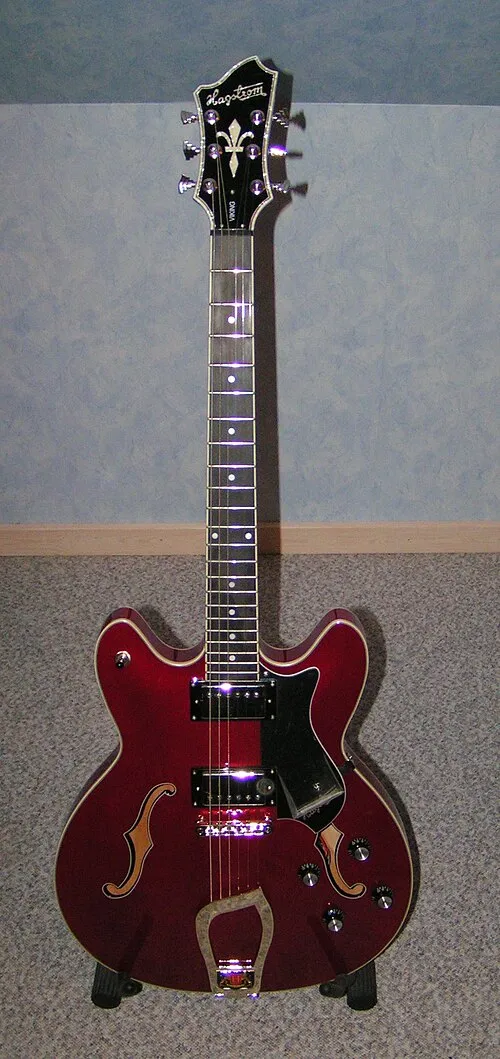
Photo: Søren1234 / Wikimedia Commons / Public domain Hagstrom
Viking
1965
Elvis needed something flashy for the Comeback Special. A session man had a Swedish guitar in his trunk.
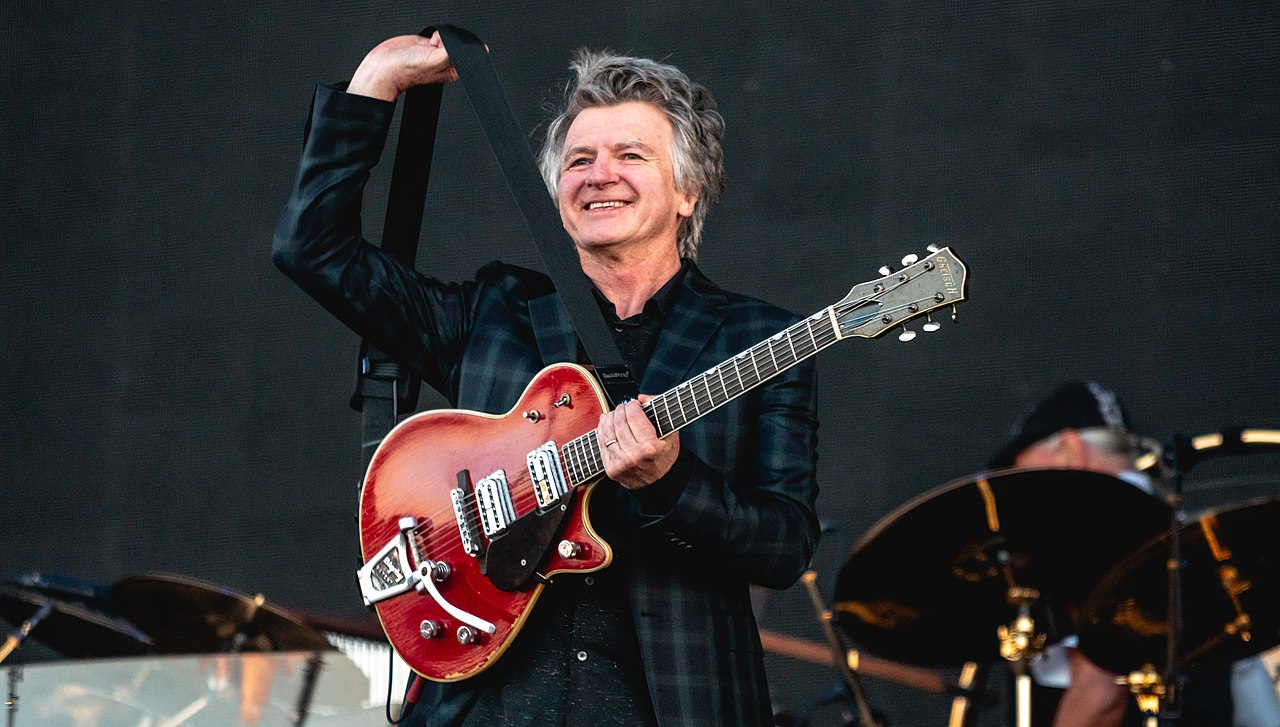
Photo: Raph_PH / Wikimedia Commons / CC BY 2.0 Gretsch
Duo Jet
1953
George Harrison bought his used in Liverpool as a teenager. In 1987 he put it on an album cover.