Univox
Hi-Flier
A Japanese copy of a Mosrite, found in pawnshops by a kid who kept breaking them.
Around 1968 a factory in Matsumoto that used to make sewing machines started shipping a Mosrite lookalike to an American importer. It was cheap, it was not quite a copy, and twenty years later it was the guitar Kurt Cobain could find, play, and smash.
- Introduced
- 1968
- Type
- Solidbody electric
- Class
- Production
The short version
1963
The one it looks like
Semie Moseley builds the Ventures Model in Bakersfield. The Hi-Flier borrows the silhouette and nothing else.
1968
Phase One
Univox guitars start arriving from Matsumoku, sunburst, two covered single-coils, rocker switches. Some say 1967.
1971
$82.50
A sunburst Hi-Flier lists at $82.50, plus $12 for the case. Phase Two, which some date to 1969, has a thinner body and a 3-way switch.
1974
Humbuckers
Phase Three brings Univox’s own white-bobbin humbuckers, maybe a year earlier. Mid-’70s is the peak, so this is the common one.
1977
Phase Four
A stop-bar replaces the vibrato. The line ends somewhere between 1977 and 1980, depending who you ask.
1988
Bleach, and the first smash
On 30 October a Phase Three becomes the first guitar Cobain wrecks on stage. In late December, Nirvana records Bleach on Hi-Flyers.
1993
In Utero
A couple of Hi-Flyers are in the room, alongside a Mustang and a borrowed Veleno.
Side A
A1
Found by chance
On 14 July 1989, the night after a Nirvana show at Maxwell’s in Hoboken, Kurt Cobain explained his guitar to John Robb.
“I really like Univoxes, and that’s what I play all the time,” he said. “But they are hard to find because they are Mosrite copies that were made in the late ’60s and the early ’70s.”
That is the Univox Hi-Flier in two sentences. A copy, made far away, out of production, turning up wherever it turned up. Nobody bought one for the name on the headstock. You bought one because it was there, it was cheap, and it sounded like something.
He wasn’t finished. Hold on to the rest of that quote.
A2
The Ventures were still big in Japan
The guitar it looks like came first. In 1963 Semie Moseley in Bakersfield built the Ventures Model, a Stratocaster flipped and carved, with “The Ventures” on the head. By the late ’60s America had moved on. Japan hadn’t. The Ventures were still filling halls there, and Japanese shops traced the shape.
Univox wasn’t a factory. It was a brand of Unicord, an American company that had started making Univox amps in the ’60s. The guitars came from Matsumoku, in Matsumoto City, in a plant that used to build Singer sewing machines. The same outline went out under other badges, including an Aria that one writer calls identical.
When it started depends who you ask. Most of the history says 1968. A few lists say 1967. One history admits nobody really knows when, or exactly where, the first ones were made. Keep both years.
A3
Not a P-90, not a Mosrite
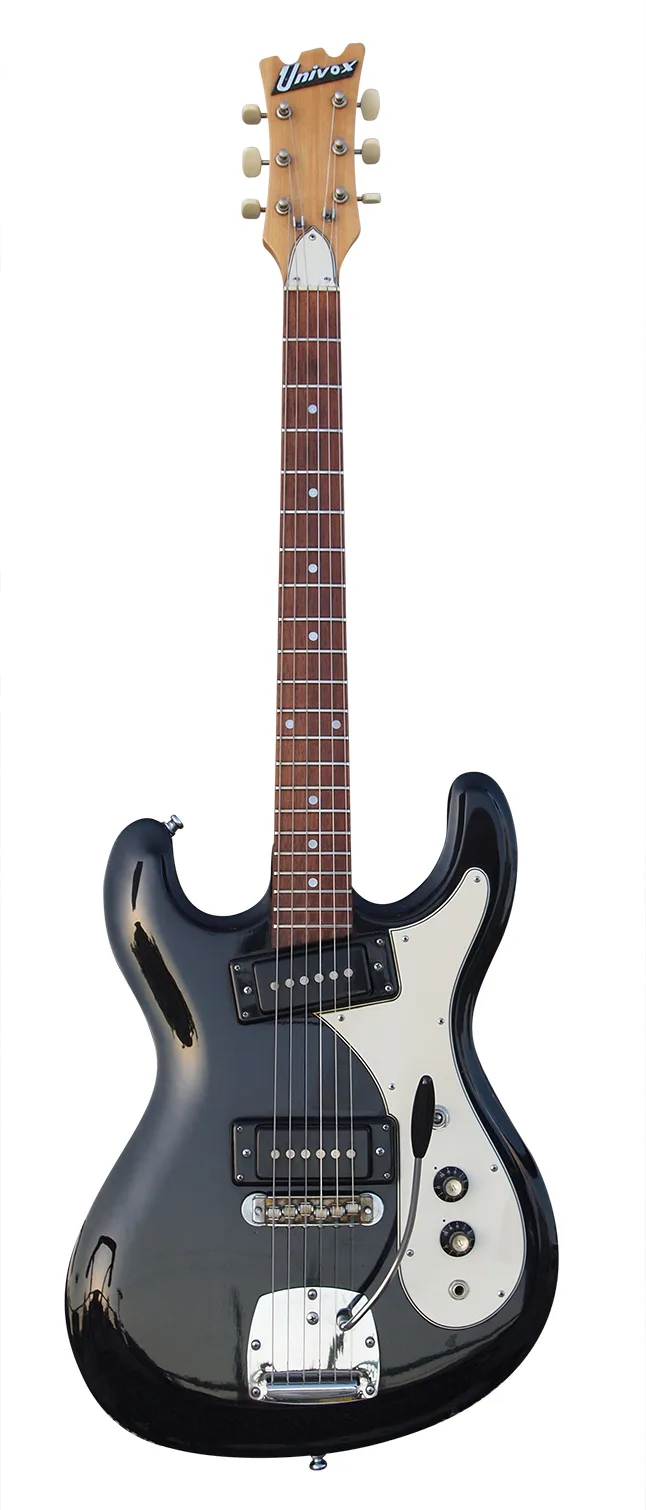
Stand one next to a real Mosrite and the differences jump out. Big dot inlays where Mosrite used tiny ones. Ordinary Japanese hardware. Lincoln-hat knobs. A Jazzmaster-style vibrato and a roller bridge instead of Moseley’s own tailpiece. The body is thinner and much lighter than the original.
The first ones came in three-tone sunburst with a pearloid guard, a thick neck, two black rocker switches, and two black-covered pickups that look like P-90s. They aren’t. They’re single-coils of their own design, and they don’t pretend to be anything fancier.
Phase Two thinned the body, swapped the rockers for an ordinary 3-way, and added a white guard and a white finish. It shows up in 1969 or in 1971, depending on the source. In 1971 a sunburst one listed at $82.50, and the case was another $12. That was the point. This was the Mosrite shape for players who couldn’t spend Mosrite money.
Flip the record · By the numbers
$82.50
A sunburst Hi-Flier on the 1971 list. The case was another $12.
4
Phases, from rocker switches and a vibrato to humbuckers and a stop-bar.
$100
What one Tacoma shop charged Cobain on average, for several, over five years.
Side B
B1
Remarkably hot for the time
Around 1974, maybe a year earlier, the Hi-Flier got humbuckers. Univox’s own, with white bobbins under a chrome cover, already on the Ripper and the Gimme. One writer calls them “remarkably ‘hot’ for the time.” That swap is where the guitar stopped being a straight Mosrite copy and started being its own loud, slightly rude thing.
Natural finishes and maple boards showed up. Production peaked in the mid-’70s, which is why Phase Three is the one you see most.
Phase Four, around 1977, dropped the vibrato for a stop-bar and swapped the top-hat knobs for a pair of speed knobs. Then the Hi-Flier stopped. Depending on the list it ended in 1977, 1978, 1980, or just the late ’70s. Nobody published how many were made, and the serials can’t date them. Korg bought Unicord in 1985. Matsumoku burned in 1987.
By then the guitars were already in the pawnshops.
B2
Several, at about a hundred dollars each
In photos from late 1987, Cobain is holding a sunburst Hi-Flyer built for a right-hander, flipped over and strung lefty.
A shop in Tacoma kept him supplied. “A whole bunch of Univox Hi-Flyers,” the owner remembered, “both the P-90 version and ones with humbuckers… We sold him several of them for an average of $100 each over the course of five years.” The humbucker ones were his favorite before Nevermind.
When Nirvana made Bleach in late December 1988, the engineer remembered “these Univox guitars [Hi-Flyers] that looked like Mosrites,” stock pickups and all. Once he got one back from Cobain in two pieces and soldered it together.
On 30 October 1988, a Phase Three Hi-Flier became the first guitar Cobain demolished on stage. A piece of its neck sits in a museum collection now.
Nobody bought one for the name on the headstock.
Nevermind isn’t this guitar. That’s Japanese Strats, a Jaguar, and a Mustang. But the Hi-Flyers came back for In Utero, where the engineer counted “a couple of Univox Hi Flyer guitars — they were off-brand Mosrite copies,” along with a Fender Mustang and a Veleno he’d brought from Chicago and restrung lefty.
B3
Keep breaking them
Here’s the rest of what he told Robb, the night after Hoboken:
“You just have to find them by chance in pawn shops, and I’m just gonna keep breaking them every time I get one.”
The guitar outlived him. In 2002 Lee Ranaldo took a new sunburst Univox with two single-coils on Sonic Youth’s Murray Street tour of Europe, for “Eric’s Trip” and “Kissability.” It “didn’t even make it to the west coast.”
A Mosrite is something you keep. The Hi-Flier was the one you found, and found again after the last one broke.
Put this on
You’ve read about it. Now hear it. Here’s what this guitar sounds like, and what to listen for.
Bleach
The engineer remembers Univox Hi-Flyers that looked like Mosrites, with their stock pickups. The whole record is the Hi-Flier sound before anyone had a reason to upgrade it.
Find it on YouTube (opens in a new tab)In Utero
A couple of Hi-Flyers were in the room, along with a Mustang and a Veleno. Which track is which guitar isn’t written down, so listen to it as a mix, not a Hi-Flier album.
Find it on YouTube (opens in a new tab)
The cast
The people, and the specific guitars, that made the legend.
1988
Kurt Cobain
Hi-Flyers, right-handed, flipped and strung lefty
Of Nirvana. A sunburst one in late-1987 photos. Bought several from a Tacoma shop, both single-coil and humbucker versions, and broke a lot of them. Nevermind is other guitars.
2002
Lee Ranaldo
New sunburst Univox, two single-coils, white guard
Of Sonic Youth. Used on the Murray Street European tour for “Eric’s Trip” and “Kissability.” It “didn’t even make it to the west coast.”
E
Phase Four Hi-Flier
Of Eels. Captioned with one in a photograph. That’s the whole record.
Liner notes
Specs, construction, rarity, value, and every source we used.
A Japanese reverse-Strat, two covered pickups, and a Jazzmaster vibrato — Univox’s Hi-Flier, not a Mosrite Ventures.
- Body
- Reverse-offset solid. Chicago Music Exchange 1970s examples: poplar. Wikipedia: plywood (dubious) / poplar. vintageunivox: plywood vs “real wood,” split. Guitar Heap: poplar, German carve. Mix flagged.
- Neck
- Bolt-on maple
- Fingerboard
- Rosewood typical on Phase 1–2. Maple on many later Phase 3 natural and black (Wikipedia). vintageunivox: 22 frets. Reverb product pages and Eastwood: 21. Mix flagged.
- Scale
- Chicago Music Exchange, two 1970s examples: 24 5/8" and 24". Eastwood reissue: 24 3/4" (628 mm). Mix flagged. Do not average.
- Pickups
- Phase 1–2: two black-covered single-coils that look like P-90s and are not (Wikipedia). Phase 3–4: twin Univox humbuckers, white bobbins, open-top covers (Wright; Reverb News).
- Hardware
- Phase 1–3: roller bridge and Jazzmaster-style vibrato (Wright; Wikipedia). Phase 4: wrap-around stop-bar. Lincoln-hat knobs (Wright).
- Electronics
- Phase 1: dual black rocker switches. Phase 2 on: volume, tone, 3-way.
- Finish
- Three-tone sunburst first; black, white, then natural. Wright: high-gloss three-tone polyurethane typical; all-white fairly rare.
- Nut
- Chicago Music Exchange: 1-9/16". Eastwood reissue: 1 5/8". Mix flagged. No millimetres invented from the inches.
Open the full research fileConstruction details, the complete player record, production numbers, dated value estimates, and sources
Classic living example = vintage Matsumoku Univox Hi-Flier (Japan). No current Univox guitar SKU this pass. Eastwood Hi-Flier is the living Phase 4 homage — basswood, bolt-on maple, 24 3/4" (628 mm), 21 frets, wrap-around, $899 (fetched 15 October 2026). Hi-Flier bass is the short-scale sibling, not this table. Aria 1702T is Wright’s identical Matsumoku outline under another badge. Not a Mosrite Ventures (mosrite-ventures). No Gibson SKU. Mixed inch/mm flagged on Eastwood’s 24 3/4" (628 mm). Do not average 24" / 24 5/8" / 24 3/4".
Construction
The job was a Mosrite the American counter could sell without paying Bakersfield. The Ventures still filled Japanese halls after the U.S. had moved on. Japanese shops traced the reverse-Strat. Univox put its name on one and shipped it west.
Univox was a Unicord brand, not a Tokyo factory. Wikipedia: Unicord bought Amplifier Corporation of America in 1964 and started Univox amps; Univox-branded guitars began arriving from Matsumoku in 1968. Reverb News: Unicord to Gulf+Western around 1967, then a merger with Merson, and by 1968 Univox guitar construction was in Japan. Premier Guitar (Frank Meyers, 11 July 2021): Matsumoku, Matsumoto City, a former Singer sewing-machine plant. Wright, Vintage Guitar: circa 1968, the first Ventures-style Japanese guitars; at about the same time Aria and Univox began marketing Mosrite inspirations in the U.S., “quite possibly Matsumoku,” the Aria 1702T and the Univox Hi Flyer identical. Keep Matsumoku as the named shop and Wright’s “quite possibly.”
When it started is split. Wikipedia’s Hi-Flier page: debuted 1967. Reverb’s Phase I / Custom years: 1967–1969. Wright, Reverb News (“Phase One Hi-Fliers… debuted in ’68”), vintageunivox (“around 1968”), and Wikipedia’s Univox brand page put the Japanese guitar line in 1968. Keep both. This plate starts in 1968. Reverb News: “No one really knows for sure when or even exactly where the Hi-Fliers started being made.”
Not a Ventures Model (mosrite-ventures). Semie Moseley, Bakersfield, 1963: German carve, tilted Mosrite singles, Vibramute, “The Ventures” on the head. Wright on this guitar: overall Mosrite appearance, large dots unlike Mosrite’s microdots, typical Japanese hardware, Lincoln-hat knobs, a Jazzmaster-style vibrato. Wikipedia: reversed offset, two U-shaped cuts echoing Mosrite’s three-notch “M,” thinner and much lighter than the original. Same silhouette job. Different factory, different pickups, different tail. Johnny Ramone’s Ventures II, and Cobain’s Gospel Mark IV on Nevermind (Guitar.com, on mosrite-ventures), stay off this slug.
What you get, at the start, is two single-coils that look like P-90s. Wikipedia: they are not; distinct construction. Phase 1: three-tone sunburst, pearloid guard, thicker body and neck, a bar string tree, larger dots except at the twelfth fret, dual rocker switches, a raised “Univox” badge. 1968 Custom (Wikipedia): black offered, red tortoiseshell guard, often slimmer, “Univox Custom” badge — leftover hollowbody Custom stock, Wikipedia’s guess, not a ledger. Reverb’s Phase II overview: debuted 1969, thinner body, 3-way in place of the rockers. Wikipedia dates Phase Two to 1971: separate string trees, uniform smaller dots, white three-layer guard, white finish added; midway, the metal badge gave way to a block “UNIVOX” silk-screen under the lacquer. Keep 1969 and 1971. vintageunivox’s 1971 availability: U1800 sunburst, 1801 black, U1802 white; original cost $82.50 plus $12 for the case. Premier Guitar: list around $90 in the early ’70s. 1970s money, not 2026 street.
1973 or ’74 (Wright) / 1974 (Wikipedia; Reverb News): Phase Three. Univox’s own humbuckers, white bobbins under a pinkish-beige cover in a chrome housing, already on the Ripper and the Gimme. Wright: “remarkably ‘hot’ for the time.” Reverb News: that swap took the guitar out of straight Mosrite-copy territory. Natural finish arrives. Maple boards on naturals and many later blacks. Wikipedia: peak production mid-1970s, so Phase Three is the common one now.
1977 (Wikipedia; Reverb Phase IV years 1977–1979): Phase Four. Stop-bar instead of the Jazzmaster vibrato. Knobs go from in-line top-hats to a horizontal speed-knob pair. Black guards on sunburst and natural; white and black keep white. End of the line is split: Wright, through 1977, then Westbury; Wikipedia Univox, 1978; Wikipedia Hi-Flier, 1980; Reverb News, late ’70s. Keep the range. Korg bought Unicord in 1985. Matsumoku burned in 1987 (Reverb News).
Same Matsumoku outline wore other badges: Aria 1702T (Wright), and Wikipedia’s DeArmond, Unicord, Raven, DIA, PAN. Siblings. Not this headstock. The Hi-Flier bass is a short-scale four-string; vintageunivox found no regular-scale bass. Off this table.
Eastwood’s Hi-Flier is another factory on the Phase 4 hardtail. Current cart, 15 October 2026: basswood, chrome-housed white humbuckers, wrap-around, 24 3/4" (628 mm), 21 frets, $899. Not a 1968 Univox.
Classic vs current: a 1968 Matsumoku Hi-Flier — reverse-offset, bolt-on, covered pickups, Jazzmaster vibrato — against an Eastwood Phase 4 you can order in 2026, wrap-around, basswood, $899.
Players
Do not hang a Mosrite Ventures, a Ventures II, or Cobain’s Gospel on this plate. Do not pin Nevermind here. The Hi-Flier bass is a bass.
Kurt Cobain (Nirvana). The guitar people search. Guitar World (Chris Gill, August 1997 / 17 February 2021): late-1987 Skid Row-era photos show a right-hand sunburst Hi-Flyer flipped and strung lefty. His first electric was not this — Cobain, to Azerrad via that piece: a used electric for his 14th birthday, “I don’t think it was even a Harmony. I think it was a Sears.”
Jack Endino, same Guitar World, on Bleach (Reciprocal, late December 1988): “these Univox guitars [Hi-Flyers] that looked like Mosrites.” Stock pickups. He got one off Cobain in two pieces after a smash and soldered it. Rick King, Guitar Maniacs, Tacoma: “a whole bunch of Univox Hi-Flyers — both the P-90 version and ones with humbuckers… We sold him several of them for an average of $100 each over the course of five years.” Humbucker Hi-Flyers were the pre-Nevermind favorite in that piece. Nevermind is the Japanese Strats King sold him after Geffen, plus the Jaguar and the Mustang.
John Robb, 14 July 1989, the night after Maxwell’s in Hoboken, quoted by MoPOP: “I really like Univoxes, and that’s what I play all the time. But they are hard to find because they are Mosrite copies that were made in the late ’60s and the early ’70s. You just have to find them by chance in pawn shops, and I’m just gonna keep breaking them every time I get one.” Premier Guitar (Meyers): he saw that Maxwell’s set on a Hi-Flier. MoPOP: a c. 1974–77 Phase 3, smashed 30 October 1988, the first guitar Cobain demolished on stage; a neck fragment is in the collection. Unique object. Not a vintage Hi-Flier.
Steve Albini, Louder (Owen Cummings, 17 August 2023), on In Utero: “He used a couple of Univox Hi Flyer guitars — they were off-brand Mosrite copies, a Fender Mustang and a Veleno guitar I had brought from Chicago and re-strung lefty.” A couple, among others. Which tracks sat on which guitar is unpublished here. Eastwood’s Phase 4 copy is the white hardtail they say is the Heart-Shaped Box video guitar. Maker copy. Not a session log.
Lee Ranaldo (Sonic Youth). Sonic Youth Gear Guide: a new sunburst Univox, two single-coils, white guard, used on the 2002 Murray Street European tour — “Eric’s Trip,” “Kissability” — listed as “univox” on the set lists. “Didn’t even make it to the west coast.” Reverb News names him on the model. A later guitar. Not Daydream Nation.
Also known to play stays short. Premier Guitar names Dexter X (Hayden Thais, formerly Man or Astro-man?). Wikipedia captions E of Eels on a Phase IV. None invented.
Rarity
You cannot buy a new Hi-Flier from Univox. The Japanese run ended with the brand. Eastwood’s Hi-Flier is another factory on the Phase 4 silhouette. It is not a 1968 Matsumoku.
Univox did not publish Hi-Flier unit totals. None invented. Wikipedia: serials cannot date these guitars; it is uncertain whether production records were kept. That is why a first-year census is unknown, not the chapter.
Wikipedia: Phase Three is the common one because mid-1970s was the peak. What is actually thinner: the thick early Phase 1 with rockers and the bar tree; Custom badges; Wright’s all-white. Completeness is the scarce end — un-rewound covers, original vibrato, a neck pocket that has not split. Cobain’s smashed objects, including MoPOP’s 1988 fragment, are unique. They are not a vintage Hi-Flier.
Value
Informal estimate, 15 October 2026. Not an appraisal.
Ask vs sold labeled. Celebrity lots are not-comps. No invented medians or factory counts. Period $82.50 plus $12 case (vintageunivox, 1971 U1800) and around $90 (Premier Guitar, early ’70s) are 1970s money, not 2026 street. Rick King’s $100 average is 1980s–90s pawnshop.
New street. None under Univox. Eastwood Hi-Flier cart $899 (fetched 15 October 2026). Some colors pre-order this pass.
Used modern. Eastwood reissues trade used. Reverb Price Guide, Eastwood Univox Hi-Flier Reissue, Good to Mint, 38 orders: $360–$571. Named solds on that rail, not a series average: 15 January 2026 Excellent $460; 27 December 2025 Excellent $475; 27 June 2025 Mint $550.
Vintage / collectible. Reverb Price Guide, Phase II (1969–1974, Good to Mint, 138 orders): $976–$1,767. Named solds on that same guide: 30 December 2025 Good $1,695; 27 December 2025 Very Good $1,795; 8 December 2025 Very Good $1,900; 28 October 2025 Very Good $825. Phase I / Custom (1967–1969, 23 orders): $615–$966 — smaller sample; named solds wander (5 September 2025 Good $1,700; 12 June 2025 Good $980; 29 April 2025 Good $225). Do not average the band with those hammers. Phase III and Phase IV dollar widgets did not print a band in the static fetch this pass. Flag: thin sold-comp access on those two. Named asks, not hammers: Phase III black $1,640; Phase IV natural $1,299; Phase IV white Fair $900. Premier Guitar, July 2021: “old Hi-Fliers tilt up to a grand” — a 2021 ceiling, not a 2026 median. MoPOP’s smashed 1988 Phase 3 is one object. Not a comp.
See also
- mosrite-ventures — the 1963 Bakersfield reverse Strat this Japanese import copied and is not
- eastwood-sidejack — Eastwood’s Mosrite you can gig; they also reissue this Hi-Flier as another SKU
- teisco-spectrum-5 — neighbor Japanese import electric; German-carve deluxe, not this Mosrite outline
Sources
- Vintage Guitar, Michael Wright, Univox Hi Flyer — circa 1968 Ventures-style Japanese guitars; Aria 1702T and Univox Hi Flyer identical, quite possibly Matsumoku; large dots, Lincoln-hat knobs, Jazzmaster-style vibrato; 1973 or ’74 white-bobbin humbuckers; three-tone polyurethane typical, all-white fairly rare; line through 1977, then Westbury
- Vintage Guitar, Michael Wright, Univox Guitars — Merson/Unicord Part 1 — Merson / Unicord / Gulf+Western; ca. 1974 or ’75 Hi Flyer with later see-through humbuckers
- Reverb News, A Brief History of the Univox Hi-Flier Guitar (25 May 2016) — Unicord / ACA / Gulf+Western ~1967 / Merson; Japan guitars likely ~1968; Phase One debuted in ’68; Phase Three 1974 white-bobbin humbuckers; Phase Four ~1977 stop-bar; out of production late ’70s; Korg 1985; Matsumoku fire 1987; Cobain and Lee Ranaldo; Eastwood Phase 4
- Wikipedia, Univox Hi-Flier — marketed roughly 1967–1980; 1967 debut; Custom 1968; Phase Two 1971; Phase Three 1974; Phase Four 1977; discontinued 1980; P-90 lookalikes distinct; plywood/poplar split; Matsumoku house model, Aria / DeArmond / Raven / DIA / PAN badges; serials cannot date; Phase Three most common
- Wikipedia, Univox — Unicord / ACA 1964; Matsumoku guitars 1968; phased out 1978 for Westbury; Korg 1985; Hi-Flier loosely Mosrite, popularized by Cobain
- Premier Guitar, Frank Meyers, Kurt Cobain’s Hair and a Real Hi-Flier (11 July 2021) — 1971 example; Matsumoku / former Singer plant; early-’70s list around $90; 2021 “tilt up to a grand”; ~9k singles on that ’71; Lee Ranaldo and Dexter X; Maxwell’s 1989
- Premier Guitar, Frank Meyers, Weird Guitars: Vintage Freak Show (5 June 2014) — Nirvana at Maxwell’s 1989 on a Hi-Flier
- Guitar World, Chris Gill, The definitive Kurt Cobain guitar gear guide (17 February 2021; August 1997) — late-1987 flipped sunburst Hi-Flyer; first guitar Sears/Harmony, not this; Endino on Bleach Univox Hi-Flyers, stock pickups; Rick King, both P-90 and humbucker, ~$100 each over five years; humbucker Hi-Flyers pre-Nevermind favorite; Nevermind Japanese Strats
- Louder, Owen Cummings, Steve Albini on *In Utero* (17 August 2023) — a couple of Univox Hi Flyer guitars, Mustang, Veleno
- MoPOP, Univox Hi-Flyer fragment smashed by Kurt Cobain, 30 October 1988 — c. 1974–77 Phase 3; first on-stage demolition; John Robb, 14 July 1989, Univox / Mosrite-copy / pawn-shop quote
- Sonic Youth Gear Guide, Univox Hi-Flyer — Lee Ranaldo, 2002 Murray Street European tour; sunburst, two singles
- vintageunivox, Univox Hi-Flier — debuted around 1968; 22-fret rosewood; plywood vs poplar split; 1971 U1800 / 1801 / U1802, $82.50 + $12 case; Custom; shortneck bass $99.50; Unicord logo
- Reverb Price Guide, Univox Hi-Flier Phase II — years 1969–1974; 21 frets; Phase II debuted 1969 in the overview; Good-to-Mint $976–$1,767 (138 orders); named solds Dec 2025 $1,695 / $1,795 / $1,900, Oct 2025 $825
- Reverb Price Guide, Univox Hi-Flier Phase I / Custom — years 1967–1969; Good-to-Mint $615–$966 (23 orders); named solds Sep 2025 $1,700 / Jun 2025 $980 / Apr 2025 $225
- Reverb Price Guide, Univox Hi-Flier Phase III — years 1974–1977; 21 frets; dollar widget did not print a band this pass
- Reverb Price Guide, Univox Hi-Flier Phase IV — years 1977–1979; wrap-around; dollar widget did not print a band this pass
- Reverb Price Guide, Eastwood Univox Hi-Flier Reissue — used Good-to-Mint $360–$571 (38 orders); named solds through 15 January 2026
- Eastwood, Hi-Flier — basswood; Phase 4 chrome-housed white humbuckers; wrap-around; 24 3/4" (628 mm); 21 frets; nut 1 5/8"; $899 (fetched 15 October 2026)
- Chicago Music Exchange, Univox High Flyer, 1970s sunburst — poplar; maple/rosewood; 24 5/8"; nut 1-9/16"; 6 lb 5 oz
- Chicago Music Exchange, Univox Hi Flyer Phase 3, 1970s sunburst — poplar; 24"; nut 1-9/16"; 7 lb 7 oz; Phase 3 from 1974, Phase 4 from 1977
- Guitar Heap, Univox Hi-Flier (27 May 2025) — available 1968; poplar, German carve; 22-fret rosewood; Phase 1 flat-pole vs Phase 2 screw-pole singles