Ampeg
AEB-1
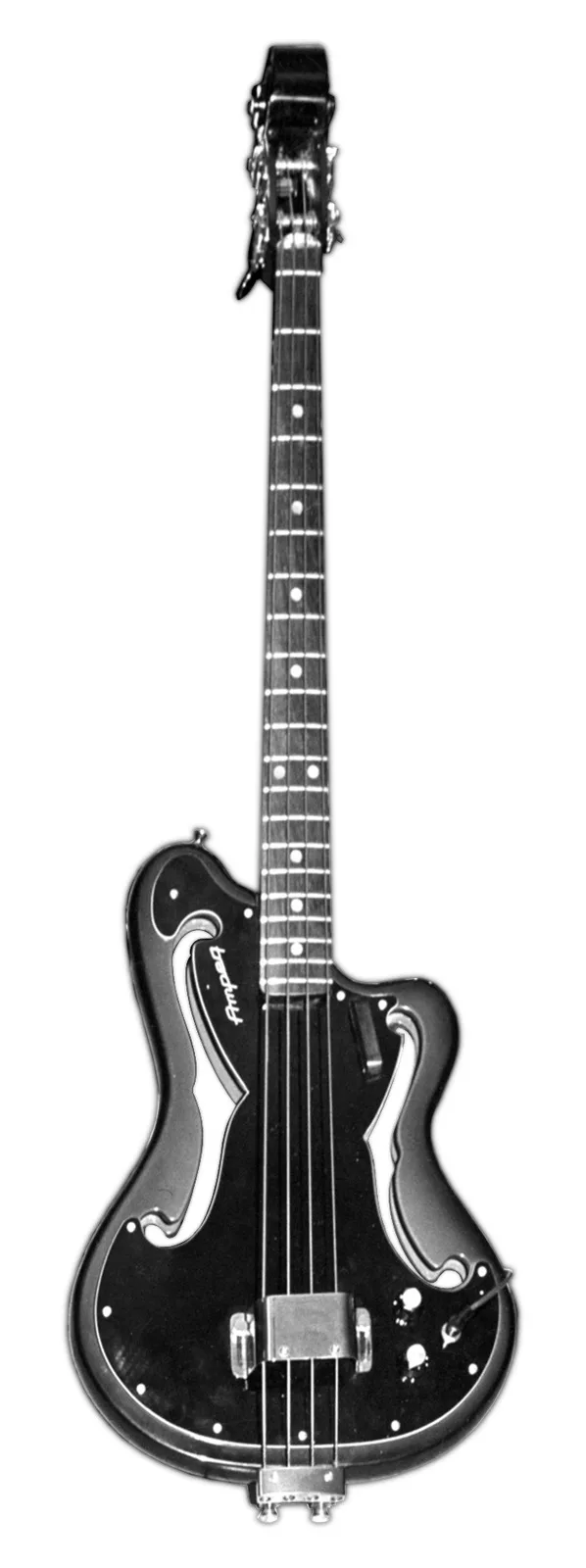
An electric bass with a violin scroll, built by an amp company whose boss thought fretted, steel-strung basses were a fad.
Linden, New Jersey, 1966. Upright players are being handed electric basses whether they like it or not, and Everett Hull, who runs Ampeg, isn’t a fan of where that’s going. So the amp company builds an electric bass that still looks back at the upright, drawn by a young guy in its own shop.
- Introduced
- 1966
- Type
- Solidbody bass (Scroll Bass)
- Class
- Production
The short version
1962
The Baby Bass
Ampeg’s plastic upright arrives. A version of its pickup ends up under this bridge.
1966
Patent filed
Dennis Kager files the design on 30 March. The bass is shown at Chicago NAMM in July.
1966
The fretless twin
The AUB-1, same body with no frets, is often called the first commercial fretless bass guitar.
1967
New owners
Unimusic buys Ampeg in September. Kager leaves.
1968
Hull resigns
The founder quits in October. Standard AEB-1s stop being built around this time.
1996
Not a reissue
The AEB-2 turns up at NAMM with a carved scroll, a 35-inch scale, and a different pickup.
Side A
A1
A bass for a man who didn’t want one
Ampeg made amplifiers. Even the name was about amplifying: the “amplified peg.” By the mid-1960s the man behind it, Everett Hull, had a problem he didn’t much like. Upright players were being handed electric basses. James Jamerson was pushing a Precision through an Ampeg B-15 into the kind of overdrive Hull disliked. And Fender, now owned by CBS, was selling the basses.
Ampeg had already tried to meet those players halfway. The Baby Bass, a plastic upright, came out in 1962 and stalled. Imported Burns basses cost too much to matter. Gary Karr remembered Hull’s line: “I want to put a dent into CBS’ Fender.”
The dent wasn’t going to be a copy. It was going to look back at the upright, on purpose, from the scroll down.
A2
A Jazzmaster with a violin’s head
Jess Oliver asked Dennis Kager to draw it. Kager had been in the shop since 1964, and he filed the design patent on 30 March 1966. The body outline is the Jazzmaster he played in a band called The Driftwoods, long on the bass side and short on the treble.
Kager wanted a triangular headstock with an A on it. Somebody, probably Hull, put the Baby Bass scroll on instead. The factory already knew how to make that part, and now the bass pointed straight back at the upright.
Two f-holes go right through the body. They were drawn facing one way and built facing opposite ways. It showed at Chicago NAMM in July 1966 and listed at $324.50.
A3
The pickup that never hears the string
This is where it gets strange. The brochures called it the mystery pickup, a version of the Baby Bass unit. Under the bridge sits a steel diaphragm, and under that, two coils cast in epoxy. The coils hear the diaphragm move. They never hear the string at all. That’s why it would work with gut strings, and it is not a piezo.
What comes out is almost all low end, between 40 and 300 Hz. A round, percussive thump, plus a metallic ring up around 1500 to 2000 Hz if you leave the tone knob open. The players who know these basses roll the tone off and leave it there.
It’s an electric bass that was never quite sure it wanted to be one.
Kager said later that he never liked that pickup and wanted a magnetic one. He didn’t get it. Hull thought fretted basses with metal strings were a fad. The strings run about three inches longer than a Fender set, with the tailpiece floating an inch off the body, so you have room to pluck like an upright player. The action is stiff because the diaphragm wants the pressure.
Flip the record · By the numbers
$324.50
List price in the 1960s.
40–300 Hz
Where almost all of the pickup’s output lives. That’s the thump.
3"
How much longer the strings run than a Fender set, so you can pluck it like an upright.
~750
Fretted AEB-1s, by one specialist’s count. The records were lost, and other counts differ.
Side B
B1
The fretless twin
The AUB-1 is the same bass without frets, and it gets a lot of the attention. It’s usually called the first commercial fretless bass guitar, in 1966, four years before Fender offered a fretless Precision.
Rick Danko of The Band played one, and he threw the mystery pickup out for a P-bass unit. That’s his fretless, not this fretted bass, so don’t file The Band here.
B2
Lost records and cracked lacquer
Nobody knows how many were made. The production records were lost when Ampeg changed hands. Unimusic bought the company in September 1967, Kager left, and Hull resigned in October 1968. One specialist’s count is about 750 fretted and 400 fretless, roughly 1,150 of the pair. Other estimates for the pair run to about 1,200. Nobody has a ledger.
What’s actually hard to find is one that hasn’t been fixed. Dozens have had the mystery pickup filled in and a P-bass pickup and a Fender bridge put in its place. The original lacquer typically came apart after about fifteen years. The mute bar is usually gone. The AEB-2 of 1996 was a different bass with a different pickup, and Ampeg doesn’t make an AEB-1 today.
B3
Roll the tone off
The people it was built for did turn up. Joe Long of the Four Seasons had studied upright, hurt his hand, and played left-handed, and he had a lefty AEB-1 made. Decades later Jah Wobble got a late-’60s one from Bill Laswell. The frets are out and an EMG is in, so it has its own story. It’s still that body and that scroll.
Most people who convert one are trying to make it behave like a normal electric bass. Plenty of them do. But find one with the mystery pickup still in it, put on flats, and roll the tone knob all the way down. What you hear is Everett Hull’s bass, still refusing to let go of the upright.
The cast
The people, and the specific guitars, that made the legend.
1966
Dennis Kager
Designer
In Ampeg’s shop since 1964. Drew the outline from the Jazzmaster he played in The Driftwoods and wanted a magnetic pickup. He didn’t get one.
1966
Everett Hull
Ampeg’s founder
Thought fretted basses with metal strings were a fad. Wanted to “put a dent into CBS’ Fender” anyway.
Joe Long
Left-handed AEB-1
The Four Seasons. An early endorser who had a lefty made. The band’s hits were cut on his Jazz Bass, not this.
Billy Rath
AEB-1
Played with Johnny Thunders. Named as an AEB-1 user, with no particular session pinned to it.
2020
Jah Wobble
Late-’60s AEB-1, defretted
A gift from Bill Laswell. Frets out, an EMG in, and Rotosound flats.
Liner notes
Specs, construction, rarity, value, and every source we used.
A scroll peghead, f-holes cut through the body, and a pickup under the bridge that never reads the strings — Ampeg’s fretted Horizontal Bass, not the fretless and not the Lucite Dan Armstrong.
- Body
- Semisolid maple, two f-holes through the body, large black guard. Johnson: three maple blocks on a ¼" birch-plywood back. Vintage Guitar counts the same build as four pieces (two bouts, center block, plywood back). RetroFret #149 page: 47" (119.4 cm) long, 14½" (36.8 cm) wide, 1¼" (3.2 cm) deep at the rim. Mix flagged.
- Neck
- Bolt-on maple. Four screws; neck-angle setscrew under a black plate on the back (Johnson). Vintage Guitar: sometimes clubby.
- Fingerboard
- Ebony on most; some rosewood; Johnson’s #793 is a blonde he reads as padauk. 20 frets (Blue Book; Johnson measures action at the 20th). Dots. Zero fret.
- Scale
- Vintage Guitar: traditional 34". RetroFret #149 prose: “the same as a Fender at 34".” The same page’s measurement line, and Chicago Music Exchange #176: 34½" (RetroFret also prints 876 mm). Mix flagged. Do not average.
- Pickups
- One “mystery” pickup under the bridge. Steel diaphragm over two coils cast in epoxy. Not a piezo. Not a string-reading magnetic.
- Hardware
- Block tailpiece on two steel posts, about an inch off the body (Johnson); dual strap buttons; muting bridge cover. 2+2. RetroFret #149: side-mounted Kluson. Strings about 3" longer than a Fender set; overall length with windings 45" (Vintage Guitar).
- Electronics
- Volume and tone. No selector.
- Finish
- Almost all red/black sunburst (Johnson). Catalog line (Vintage Guitar): cherry red, white, blue, “burnished tones.” A few 1966 left the factory black, tobacco, turquoise/black, or white with gold trim — some of those painted over the burst at the factory.
- Nut
- Zero fret, plus the aluminum string spacer (Vintage Guitar). Measured width: RetroFret #149 1⅝" (41 mm); CME #176 1-9/16". Mix flagged.
Open the full research fileConstruction details, the complete player record, production numbers, dated value estimates, and sources
Classic living example = 1966–68 Linden, NJ AEB-1, the fretted Horizontal Bass / Scroll Bass. No current Ampeg AEB-1 this pass. AUB-1 is the fretless twin. ASB-1, SSB, and AMB-1 / AMUB-1 are other Horizontal Basses. The 1996 AEB-2 and Eastwood’s EEB-1 are later objects. RetroFret’s inch/cm and inch/mm pairs are flagged. Do not convert the rest. Do not average 34" and 34½".
Construction
The job was an electric bass Everett Hull could stand. Ampeg made amps. The “amplified peg.” Jamerson was already pushing a Precision through a B-15 into the overdrive Hull disliked. The Baby Bass, the plastic upright from 1962, had stalled, and the Burns imports had been too expensive to matter. Players who had lived on uprights were being handed a horizontal bass. Gary Karr remembered the line: “I want to put a dent into CBS’ Fender.”
The dent was not a copy. Jess Oliver asked Dennis Kager, in the shop since 1964, age 21. By 30 March 1966 Kager had filed the ornamental-design patent. The outline is the Jazzmaster he played in The Driftwoods — long bass bout, short treble bout. He wanted a triangular peghead with an “A” on it. Someone, Vintage Guitar says probably Hull, put the Baby Bass scroll on instead. The new bass would point at the upright, and the factory already knew how to make that headstock.
Chicago NAMM, July 1966, is the public start. Johnson: on the bench that spring, in production right after the show, running into the middle of 1968. Vintage Guitar: late 1966 and 1967. RetroFret on #149: building by September 1966, the bulk through summer 1967, trailing into late 1968. This plate starts in 1966.
It is not a hollow, and it is not a slab. Two f-holes go through the bouts. They were drawn facing one way and built opposed. Johnson: three maple blocks on a back cut from ¼" birch plywood. Vintage Guitar’s four-piece count is those two bouts, the center block, and that back. A black guard in five-layer engraver’s plastic covers most of the top. Cracks by the tailpiece are an age problem on this glue-up, not a separate model.
The pickup is the argument. The brochures called it the mystery pickup, a variation of the 1963 Baby Bass unit — early instruction sheets printed that patent number. Aluminum bridge, Bakelite block, steel diaphragm, two coils in epoxy under it. Johnson measures the diaphragm at 5" square, two layers of 0.018" spring steel. Vintage Guitar’s name for the metal is silectron. Keep both. The coils hear the diaphragm move. They do not hear the string. That is why gut would work. It is not a piezo. Output sits almost entirely in the 40–300 Hz range: a percussive thump, plus a metallic ring around 1500–2000 Hz if you leave the tone open. The players Johnson knows roll the tone off and leave it there.
Hull wanted it that way. Fretted basses with metal strings, he thought, were a fad. Kager told Vintage Guitar he never liked the Baby Bass pickup and had wanted a magnetic on this one. He did not get it. Very few left Linden on gut. LaBella flats, or LaBella black tapes. No factory roundwounds.
The tailpiece hangs about an inch off the rim on two posts, with two strap buttons so the bass can lean on an amp. Strings run about 3" longer than a Fender set — break angle, and room to pluck like an upright. Overall, windings in, 45". The action is stiff because the diaphragm wants that downforce. Scale is the fight in the table: traditional 34" against a measured 34½", including both figures on RetroFret’s own #149 page. Don’t average them. The nut is a zero fret and an aluminum spacer, and the two measured widths don’t agree either.
Not the AUB-1. Same body, same pickup, no frets. Wikipedia, citing Roberts, and Tony Bacon: the first commercial fretless bass guitar, 1966. Vintage Guitar: four years before Fender offered a fretless Precision, 1970. Rick Danko is on that magazine’s user list as Model AUB-1, and the same article has him throwing the mystery pickup out for a P-bass unit. Do not file The Band on this fretted bass. Which records that mod is on are unpublished here.
The other Horizontal Basses are a short wrong turn, not this table. Devil Bass, ASB-1 and fretless AUSB-1, 1967 into early 1968: Mike Roman wanted Danelectro Longhorn horns. Same pickup, same tailpiece, same $324.50, Vintage Guitar’s estimate perhaps 100. A left-handed Devil is not Joe Long’s bass. SSB / SSUB, mid-1967–68: visible magnetic poles, 30½", list $189.50, Kager’s triangle back on the headstock. Fred Smith of Television is the SSB on that user list. AMB-1 and fretless AMUB-1, late 1968 into 1969: covered humbucker, string length down around 43", a volume pot that pulls to kill, list $324.50 then $325, Vintage Guitar’s estimate perhaps 600, done before 1970. Novoselic, Michael Been, and George Biondo are AMB-1 on that list.
Unimusic bought Ampeg in September 1967. Kager left. Hull resigned in October 1968. Johnson still has standard AEB-1s built into early 1968, and unsold ones sitting in inventory in 1970. Summer 1967 hybrids mixed this bass with the magnetic model on the bench. Not a clean AEB-1.
Late 1996, St. Louis Music showed Johnson’s AEB-2 / AUB-2. Vintage Guitar: not a reissue — carved scroll, 35", ash, piezo plus a magnetic, Rick Turner preamp. His shop’s current AMB-2 is his. Eastwood’s EEB-1 is a mahogany humbucker on the outline. Japanese clones put this tailpiece on an AMB-1 pickup and sometimes drop the zero fret. Classic vs current: 1966–68 Linden, list $324.50, against no new AEB-1 from Ampeg.
Players
Danko’s fretless, the Devil Bass, the AMB-1, and Wyman’s Lucite bass stay off this plate.
Joe Long (the Four Seasons). Vintage Guitar’s early endorser, on an extremely rare left-handed AEB-1. RetroFret, writing up a left-handed Devil: a couple of lefty AEB-1s are known, and Long had one made. Upright student, injured hand, in the band from 1965, playing left-handed. The hits are not this bass. Vintage Guitar’s piece on his stack-knob Jazz calls that the primary recording and stage bass — “Can’t Take My Eyes Off You,” “Beggin’,” “Opus 17,” “I’ve Got You Under My Skin,” “C’mon Marianne,” Genuine Imitation Life Gazette. Nothing here puts those sides on the scroll.
Billy Rath (Johnny Thunders’ band). Vintage Guitar’s user list: Model AEB-1. No session is pinned in that article. L.A.M.F. is not claimed here.
Jah Wobble. Reverb News, 28 October 2022: a late-’60s AEB-1 that Bill Laswell gave him. Frets out, lines in, an EMG soapbar made for a 5-string, Rotosound flats. Seller Andy Baxter: used in the studio, most recently on Nocturne in the City (2020). Metal Box is why the name is familiar. That article does not put the record on this bass. A defretted EMG bass is not the mystery-pickup object either.
Also known to play stays short because the rest of that user box is other model codes. They do not move onto this slug.
Rarity
No new AEB-1 from Ampeg. The outline is easy. This pickup is not.
Ampeg published no model total. Vintage Guitar: the production records were lost in the buyouts, so a factory count is impossible and every figure below is an estimate. Keep them apart. Johnson: about 750 fretted AEB-1s and about 400 AUB-1s, roughly 1,150 of the pair, a small crew in Linden. Tailpiece serials from #001 toward about #1250; about a hundred of those numbers are Devil Basses on the same part; the highest AEB-1/AUB-1 he had seen was #1217. Vintage Guitar’s chronology: perhaps 1,200 of the pair, late 1966–67, “incomplete information.” Blue Book: approx. 1,150 of the pair, 1966–68. Do not average 750 with 1,150. One is fretted only. The others are both models. None is a ledger.
What is actually thin: a mystery pickup nobody has gutted. Johnson has seen dozens filled and refit with a BadAss or a Fender bridge and a P-bass pickup. Lose the tailpiece and the serial goes with it. Original lacquer is the other scarce thing — he says it typically came apart after about 15 years, so most are cracked, chipped, or repainted. The mute bar is missing on most (RetroFret). Non-burst 1966 colors, and lefties, are the short end. SS Vintage’s #072, fretted to the 12th and fretless after that, neck plate “Special Oder for Syd Warner,” is one factory special. Not a model.
Value
Informal estimate, 22 September 2026. Not an appraisal.
Ask vs sold labeled. Celebrity instruments are not comps. No invented medians. No Reverb Price Guide band this pass. List was $324.50 (Vintage Guitar; the Devil Bass shared it) — 1960s money. That article’s “average of about $1,000” is March 1997.
New street. None under AEB-1. Eastwood’s EEB-1 lists at $999 (fetched this pass): mahogany, one humbucker, 34", 1⅝" nut. Their line that originals “sell for more than $2,500” is catalog copy, not a sold tape.
Used modern. No clean sold band for that tribute isolated this pass. Don’t invent one, and don’t price a 1967 off it.
Vintage / collectible. Named asks, not hammers. Chicago Music Exchange #176, sunburst they date 1967: $4,500, down from $5,995. Crack repair at the tailpiece joint, original electronics. The sheet’s 9 lb 10 oz is that bass, not a model weight. RetroFret #149, 1966, in stock at $6,500: excellent, mute missing, one saddle screw changed. Do not average the asks. No clean 2026 dollar for a P-pickup conversion isolated here. The Syd Warner half-fretless, Reverb ask $6,995, is not a stock comp. Heritage sold #654 on 5 December 2025; the hammer was not on the public page this pass. Wobble’s defretted bass had no price in the Reverb News piece.
See also
- fender-precision-bass — the CBS bass Hull said he wanted to dent; the pickup reads the strings
- hofner-500-1 — the other violin-family electric bass; hollow, short scale, not this scroll
- ampeg-dan-armstrong — 1969 Linden Lucite guitar; the See-Through bass is that instrument’s sibling, not the AEB-1
Sources
- Vintage Guitar, Ampeg Horizontal Basses (March 1997) — Kager; patent filed 30 March 1966; July 1966 NAMM; Jazzmaster outline; scroll instead of a triangle; four-piece maple and plywood; opposed f-holes; zero fret; 34" scale; 45" overall; mystery pickup and Baby Bass patent; $324.50 list; Joe Long lefty AEB-1; Danko on AUB-1 with a P-bass swap; Billy Rath on AEB-1; Devil Bass perhaps 100; SSB $189.50 and 30½"; AMB-1/AMUB-1 perhaps 600, end before 1970; Unimusic September 1967; Hull resigned October 1968; perhaps 1,200 AEB-1/AUB-1, records lost; 1997 “about $1,000”; AEB-2 at winter NAMM, late 1996, 35", not a reissue; user list and chronology
- Bruce Johnson, AEB-1 & AUB-1 — NAMM July 1966; production into mid-1968; about 1,150 of the pair; ~750 AEB-1 and ~400 AUB-1; serials to ~#1250 shared with ~100 Devils; highest AEB/AUB seen #1217; inventory into 1970; diaphragm pickup, not a piezo; gut vs LaBella; tailpiece and +3" strings; plastic scroll caps; ebony, rosewood, one padauk; ¼" birch-ply back; 5-layer guard; lacquer failure; P-bass conversions
- Bruce Johnson, vintage setup — action at the 20th fret; four neck screws and angle setscrew; 40–300 Hz, ring at 1500–2000 Hz; 5" diaphragm, two layers of 0.018" spring steel, Bakelite block
- Reverb News, Tony Bacon, 17 October 2019 — 1966 AEB-1 and AUB-1; AUB-1 as first commercial fretless; transducer under the bridge; later magnetics; Devil Bass separate
- Blue Book of Guitar Values, AEB-1 — 1966–68; 20 frets; dots; two knobs; approx. 1,150 AEB-1 and AUB-1
- Wikipedia, Bass guitar — first commercial fretless is the AUB-1, 1966, citing Roberts 2001
- RetroFret, AEB-1 #149 — $6,500 ask, in stock; September 1966 production; scale printed as both 34" and 34½" (876 mm); 47" (119.4 cm), 14½" (36.8 cm), 1¼" (3.2 cm); nut 1⅝" (41 mm); Kluson; mute usually missing. Mix flagged.
- RetroFret, left-handed ASB-1 — Joe Long had a left-handed AEB-1 made; that Devil is not his
- Vintage Guitar, Joe Long’s stack-knob Jazz Bass — the Jazz, not the AEB-1, on the named Four Seasons sides
- Reverb News, Jah Wobble AEB-1, 28 October 2022 — Laswell gift; defretted; EMG soapbar; Nocturne in the City (2020); not a Metal Box credit
- Chicago Music Exchange, 1967 AEB-1 #176 — ask $4,500 from $5,995; 34½"; nut 1-9/16"; 9 lb 10 oz on that bass; tailpiece-area crack repair
- Eastwood EEB-1 — tribute, list $999; mahogany; humbucker; 34"; 1⅝" nut. Not the mystery pickup.
- Reverb, Syd Warner factory special #072 — fretted to 12 then fretless; ask $6,995; not a stock comp
- Heritage Auctions, 5 December 2025, serial #654 — sold; hammer not public this pass
Keep digging
Guitars this one gets compared to, confused with, or descended from.

Photo: Infrahertzz / Wikimedia Commons / CC BY-SA 3.0 Fender
Precision Bass
1951
Leo’s bass let the player at the back be heard. You know their lines by heart. You mostly don’t know their names.
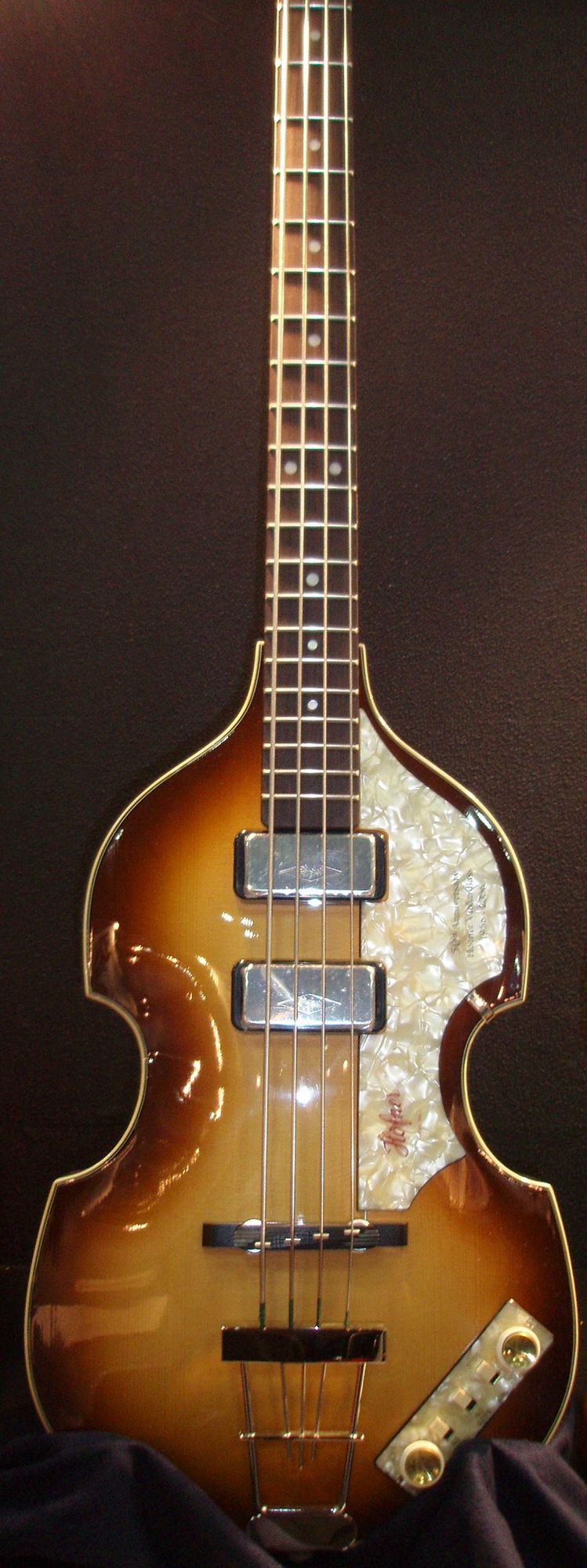
Höfner 500/1 Anniversary RH, equal to a ’61 Cavern Bass layout. Photo by CasinoKat. Licensed under CC BY-SA 3.0. Via Wikimedia Commons. Höfner
500/1
1956
McCartney bought the bass he could afford in Hamburg. It was stolen in 1972, and it came home in 2024.
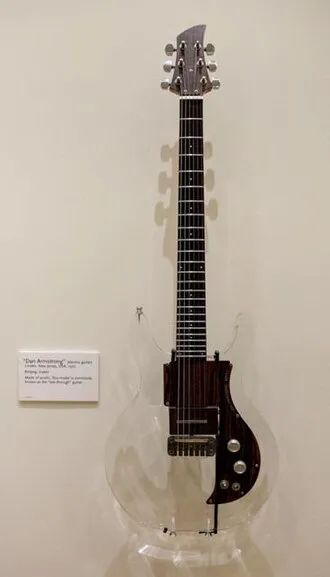
Photo: Frank Kovalchek / Wikimedia Commons / CC BY 2.0 Ampeg
Dan Armstrong
1969
A repairman who spent his days inside other people’s guitars designed one you could see straight through.