Bond
Electraglide
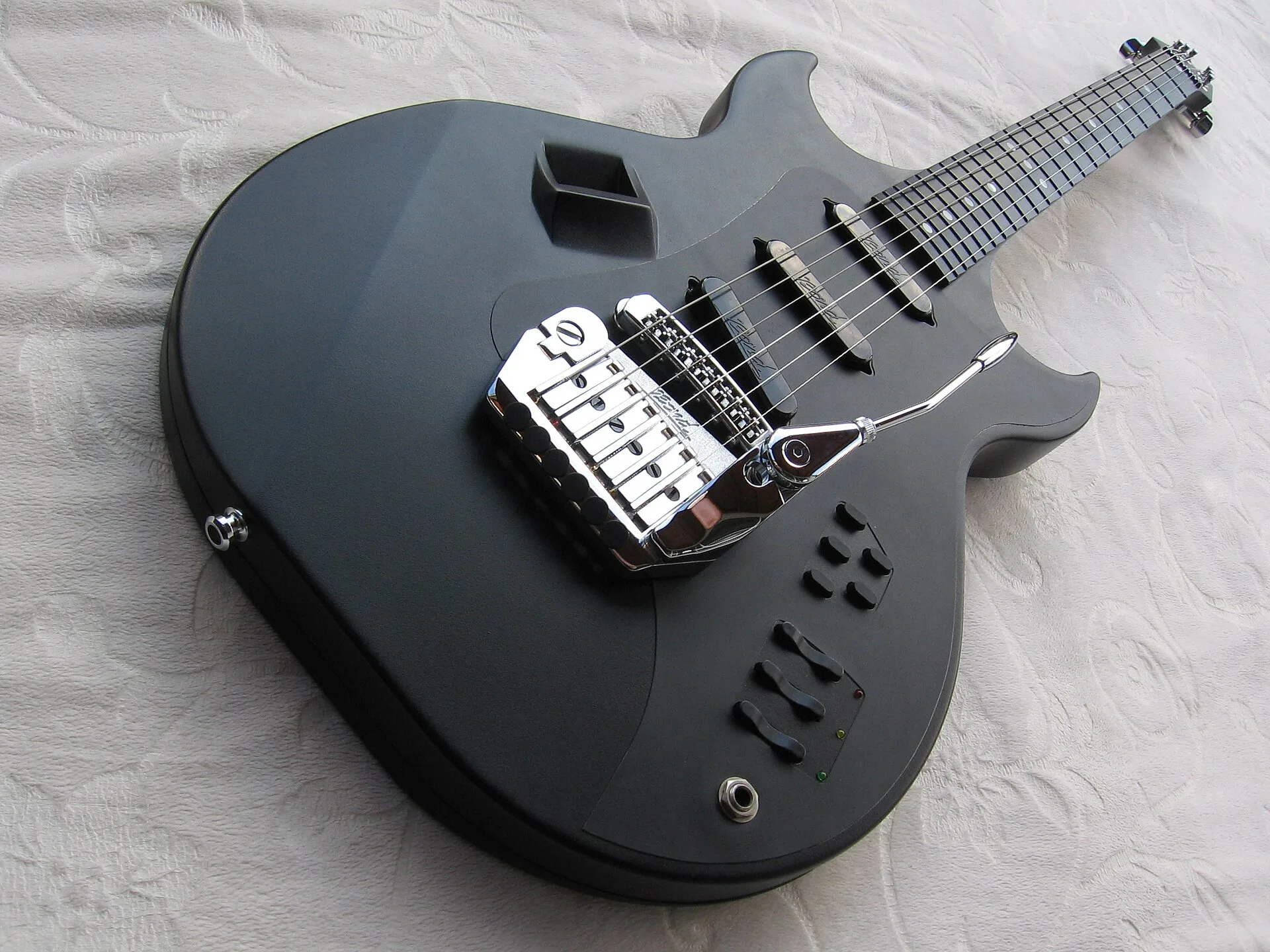
No wood, no frets, no knobs, and not a sound until you plugged the guitar itself into the wall.
In 1984 a factory in the Scottish Highlands started building a one-piece carbon-fibre guitar with a stepped staircase for a fingerboard and a digital readout for a volume knob. It was meant to be the future. Its most famous moment is a terrible noise, made on purpose.
- Introduced
- 1984
- Type
- Solidbody electric
- Class
- Production
The short version
1972
A sawtooth on a Gibson
Andrew Bond meets Ian Flooks. Bond has already put a sawtooth board on his Gibson.
1973
Patents
The two file patents and incorporate Bond Guitars Ltd.
1984
Muir of Ord
In February, about £250,000 spent and a factory up outside Inverness. By November, the guitar has “finally arrived. Almost.”
1985
In the shops
Early in the year. By June the company says the boards are moving from phenolic resin to aluminium.
1986
The factory stops
In January the Scottish factory has ceased. Bond Guitars stops trading that year.
1987
One Tree Hill
The Edge tells an interviewer the fuzz at the end of the song is the Bond.
1999
Andrew Bond dies
His son Ashley later brings the name back. There’s no new guitar to order.
2013
Into a museum
National Museums Scotland acquires one.
Side A
A1
A factory in the Highlands
In February 1984 there was a new 10,000-square-foot factory just outside Inverness, at Muir of Ord, put up with the help of government schemes. Ian Flooks said about £250,000 had been spent getting there. Forty people would work there, on a guitar with no wood in it.
What they were building was a guitar with every part of a guitar replaced. No wooden body. No fret wire. No knobs. Not even a normal cable out of the guitar. Everything about it was meant to be the future.
A2
A sawtooth on a Gibson
Andrew Bond was English, a former bus conductor. When he met Ian Flooks in 1972 he’d already put a sawtooth board on his own Gibson. In 1973 the two of them filed patents and set up Bond Guitars Ltd.
Flooks had another career. In 1979 he started an agency, Wasted Talent, and within a year its books had The Clash, Ian Dury, Talking Heads, Eurythmics, and U2. Keep that list in mind. Flooks was the agent.
A3
A staircase for a fingerboard
The body and neck were one piece of moulded carbon fibre. Not graphite, an early reviewer was careful to say. It was black, thin, with a double cutaway and no heel at all, because there was nothing to join.
Then the fingerboard. Bond called it a pitchboard. Where each fret would be, the board steps down 1 mm, and the string stops on the lip. Twenty-two steps, on a Fender-length 25½" scale. It got sold as fretless, which it isn’t. You can’t slide through the steps.
It got sold as fretless, which it isn’t.
The first boards were phenolic resin. By June 1985 the company was saying aluminium, for tolerances the resin missed.
The pickups depend who you ask: three single-coils in the 1985 reviews, Schaller in the shop guitars, but later accounts give it humbuckers.
Flip the record · By the numbers
22
Steps on the pitchboard. No fret wire. Each step drops 1 mm.
0–9
The volume, shown as a lit digit in red, yellow, and green.
£583
The UK price in June 1985, with hard case and VAT.
1,000–1,400
How many were made. No factory total was ever published.
Side B
B1
No box, no guitar
The controls are why it needs the wall. Five push-buttons pick the three pickups and flip their phase. Three rockers run volume, treble, and bass, the tones in 2 dB steps. Your volume shows up as a digit from 0 to 9, lit red, yellow, or green.
The guitar plugs into a mains box through a moulded 4-metre lead with a stereo jack, and a 15-volt supply wakes it up at zero. Then a normal cable runs from the box to the amp.
No box, no guitar.
B2
“Finally arrived. Almost.”
It had been unveiled at Frankfurt more than two years before a June 1985 review: prototypes, then revisions, the press ahead of the factory. A review in November 1984 opened with “finally arrived. Almost.” The first ones came off the line that year and reached the counters in early 1985. In June 1985 one cost £583 in Britain, hard case included.
It didn’t last. By January 1986 the Scottish factory had stopped, with talk of building overseas, a bass, an onboard tuner. None of it shipped. Somewhere between 1,000 and 1,400 were made. Andrew Bond died in 1999.
A lot of the players who turned up with one were from bands on that roster. Dave Stewart is in the 1984 catalog with one. Mick Jones played one with Big Audio Dynamite on The Tube in 1986. Will Sergeant of Echo & the Bunnymen and John Turnbull of the Blockheads had them.
B3
An attempt to sound obnoxious
And the Edge had one, from about 1983 or 1984. In 1987 he told an interviewer about the guitar “without proper frets. Instead it has little serrations.” It wasn’t working for him, he said, until he “really sort of abused it.” The neck was “some kind of plastic,” so he bent it until the strings vibrated on the board, and ran it through a transistor amp, very loud.
That’s the heavy fuzz at the end of “One Tree Hill.”
The guitar of the future, with its carbon shell and its glowing digits and its box on the floor, made the record by sounding broken. “It was an attempt to sound obnoxious,” he said.
“People complained bitterly.”
Put this on
You’ve read about it. Now hear it. Here’s what this guitar sounds like, and what to listen for.
One Tree Hill
The Edge says the heavy fuzz at the end is the Bond. Wait for the last stretch.
Find it on YouTube (opens in a new tab)Exit
The Edge put the Bond on tracks near the end of side two. That’s usually read as “Exit” and “Mothers of the Disappeared.” His own sentence is vaguer, so treat this one as a good bet, not a credit.
Find it on YouTube (opens in a new tab)E=MC² (The Tube)
Mick Jones with a Bond on Channel 4’s The Tube.
Watch it on YouTube (opens in a new tab)
The cast
The people, and the specific guitars, that made the legend.
1987
The Edge
Bond Electraglide, got around 1983 or 1984
Of U2. Says it wasn’t working until he “really sort of abused it.” The fuzz at the end of “One Tree Hill.”
1986
Mick Jones
Bond Electraglide
Of Big Audio Dynamite, in the mid-1980s. Played “E=MC²” with one on The Tube. He’d left the Clash before the shop guitars.
1984
Dave Stewart
Bond Electraglide
Of Eurythmics. Pictured with one in the 1984 Bond catalog, and at Frankfurt in 1985 with Bond and Flooks.
Will Sergeant
Bond Electraglide
Of Echo & the Bunnymen.
John Turnbull
Bond Electraglide
Of Ian Dury & the Blockheads.
Liner notes
Specs, construction, rarity, value, and every source we used.
No fret wire, a carbon shell, and a volume that only exists if you plug the guitar into the wall — Bond’s Electraglide, not a Melody Maker and not a Steinberger.
- Body
- One-piece moulded carbon fibre, thin double-cut, black. Production backs unscrew (One Two, March 1985). Lewin: carbon fibre, not graphite.
- Neck
- Integral with the body; heel-less. The Edge, 1987: “some kind of plastic,” more flexible than wood.
- Fingerboard
- Detachable stepped pitchboard, 22 steps, no fret wire. Phenolic on first production; aluminium announced June 1985. Step drops 1 mm (One Two, November 1984). Dots. Mix flagged.
- Scale
- 25 1/2" (In Tune, June 1985; Chicago Music Exchange #000739). Dealer cards also print 647 mm and 648 mm. Mix flagged.
- Pickups
- Three single-coils. 1985 shop reviews: Schaller, low-impedance. Proto called EMG (One Two). Wright later: humbucker / single / humbucker. Mix flagged.
- Hardware
- Schaller. Chromed stop with fine tuners, roller saddles, enclosed 3+3 machines. Vibrato version catalogued.
- Electronics
- Five push-buttons (pickups and phase); three rockers (volume, treble, bass); angled LED, 0–9. External phantom supply. 15 V (One Two, March 1985).
- Finish
- Black only (In Tune). Matte on the guitars that survive.
- Nut
- Slotted metal, height by two Allen screws (Electronic Soundmaker, April 1985). CME #000739 measured 1 5/8".
Open the full research fileConstruction details, the complete player record, production numbers, dated value estimates, and sources
Classic living example = Muir of Ord Electraglide (Ross-shire), the 1985 shop guitar: phenolic pitchboard, then aluminium. No current typical Electraglide SKU this pass. Bond Guitars Limited’s Heritage ’84 is an access list, not a cart. Bond Cellotar is a 2025 bowed hybrid on Reverb, not this table. CME #000739, one phenolic example: 8 lb 5 oz, 7.25" radius, neck .85" at the 1st and .91" at the 12th, no adjustable truss rod. guitar-list prints “around 4 kg.” Mix flagged. Do not average 8 lb 5 oz with 4 kg, or 647 mm with 648 mm. Not a Melody Maker. Not an SG. Standalone. No Gibson SKUs.
Construction
The job was a solid electric that did not use wood, wire frets, or pots. A moulded carbon double-cut. Notes from a staircase. Volume as a digit on a screen, and only if the guitar is plugged into the mains.
Andrew Bond was English, and a former bus conductor (JazzTimes). Wikipedia: he and Ian Flooks met in 1972; Bond had already put a sawtooth board on his Gibson; they filed patents and incorporated Bond Guitars Ltd in 1973. Wright, citing a Guitar Player review: a pitchboard on an acoustic that same year. Keep both. They are not written as one guitar. Flooks built Wasted Talent in 1979. Within a year the book included The Clash, Ian Dury, Talking Heads, Eurythmics, and U2 (Wikipedia).
February 1984. Tony Bacon, One Two Testing: Flooks said about £250,000 had been spent, and a 10,000-square-foot factory had gone up just outside Inverness on government schemes. Wikipedia: Muir of Ord, the Highlands and Islands Development Board, 40 employees. Cooper, In Tune, June 1985: Muir of Ord, Ross-shire.
This plate starts in 1984. Cooper: unveiled at Frankfurt more than two years before the June 1985 review — prototypes, then revisions, the press ahead of the factory. Lewin, One Two Testing, November 1984: “finally arrived. Almost.” About £450. Wikipedia: first ones off the line in 1984. Cooper: in the shops early 1985. Keep the unveil, the 1984 line, and the 1985 counter.
Lewin, November sample in hand: a phenolic board screwed to “a one-piece carbon fibre (not graphite) neck and body.” JazzTimes later says a graphite neck. Bond called the board a pitchboard. Twenty-two steps, Fender-like 25 1/2" (Cooper). Where a fret would sit, the moulding drops 1 mm and the string stops on the lip (Lewin). Mix flagged against the inch scale. Sold as fretless. Lewin says that tag is off. You cannot slide through the steps.
June 1985. Cooper, on a production guitar: every first-run board he knew was still phenolic. Bond’s P.R. then moved the claim to aluminium, for tolerances the resin missed. Guitar Gavel: phenolic early, aluminium the last year or so. Keep both.
The controls are why it needs a wall. David Sidley designed them (Lewin; Wright later spells it Dave Siddeley). Five push-buttons — three pickups, two for phase — and three rockers for volume, treble, and bass. The screen reads 0–9 in red, yellow, and green (Cooper). Tones quoted at ±10 dB, in 2 dB steps. A 15 V phantom supply wakes it at zero (Colbert, March 1985). Cooper: mains box, moulded 4-metre lead, stereo jack, then a normal cable from the box to the amp. No box, no guitar.
Pickups disagree. Lewin: three single-coils, “EMG type.” Colbert on that proto: three black EMGs, height fixed, body glued shut. By March 1985 the weight is down, the logo has moved to the headstock, the pickups adjust, and the back unscrews. Schwartz (April) and Cooper (June): three Schaller single-coils, low-impedance in Cooper. Blue Book agrees. Wright, 2016: humbucker, single, humbucker. Wikipedia’s infobox: three humbuckers. Don’t average a 1985 review with a 2016 memory.
Hardware is chromed Schaller. Fine-tuner stop — Cooper says TP6-like, Schwartz a Gibson Tuna-Matic tail — roller saddles, enclosed machines. No per-saddle height (Cooper). Nut height on two Allens (Schwartz). The vibrato on the same list is this guitar with a bar, not a second slug.
Colbert calls the outline a very thin, SG-like double-cut, neck raked, no heel, because it is one piece. Wikipedia says the 1962 Melody Maker double-cut. Not a Melody Maker (gibson-melody-maker). Not an SG (gibson-sg). Kalamazoo, wire frets, pots. No Gibson SKUs.
Not a Steinberger GL (steinberger-gl). Schwartz had both out in April 1985. Graphite, headless, real frets, EMG 81 and 60, Newburgh. This has a headstock, a staircase, and a box on the floor. Not a Parker Fly (parker-fly): wood under a carbon skin, 1993, stainless frets. Ovation had cast an aluminium board into the neck in the mid-1970s (Guitar Gavel). This one unscrews.
January 1986. International Musician: the Scottish factory had stopped. Talks of an overseas build, a bass, an onboard tuner. The bass was already a plan in Lewin’s 1984 piece. Neither shipped in this file. Wikipedia: ceased trading 1986. Andrew Bond died 1999.
Ashley Bond, his son, brought the name back (Wikipedia). Heritage ’84 on bondelectraglide.com: CNC aluminium boards, a claimed 50, a prototype run “being prepared,” names only. Ultimate Guitar, 23 August 2026: carbon-composite still to come. bondguitars.co.uk is a Rebel prototype and an interest button. Not a guitar you can order.
Classic vs current: a 1985 Muir of Ord guitar — one-piece carbon, 22-step pitchboard, Schaller hardware, an LED and a wall box — against no new Electraglide on a counter in 2026.
Players
Do not hang a Melody Maker, an SG, a GL, or a Fly on this plate. A Reverb title that says “The Edge” is a nickname, not his guitar.
The Edge (U2). Guitar World, Joe Bosso, 1987, republished 9 March 2021. He calls it a “Bond Electric Light” — the transcript’s name — “without proper frets. Instead it has little serrations.” It wasn’t working until he “really sort of abused it.” Heavy fuzz at the end of “One Tree Hill,” and “the last three tracks on the middle of side two — that sound is from the Bond.” Wikipedia and The Twelfth Fret read that as the solo on “One Tree Hill,” plus “Exit” and “Mothers of the Disappeared.” His sentence is the one above. He had got it “three or four years” earlier, so about 1983 or 1984, prototype years as easily as a shop guitar. The neck was “some kind of plastic.” He bent it until the strings vibrated on the board. “It was an attempt to sound obnoxious.” Transistor amp, very loud. “People complained bitterly.”
Mick Jones (Big Audio Dynamite). Wikipedia: a Bond with BAD in the mid-1980s. Guitarhive: “E=MC²” on Channel 4’s The Tube, 1986. JazzTimes also files him with The Clash. He was out of that band in 1983, before the shop guitar. No Clash side is pinned here.
Dave Stewart (Eurythmics). guitar-list: pictured with one in the 1984 Bond catalog. Wikipedia: Frankfurt 1985, with Bond and Flooks. No Eurythmics track is named.
Also known to play, last and short: Will Sergeant, Echo & the Bunnymen; John Turnbull, Ian Dury & the Blockheads (JazzTimes). Flooks was the agent. That is the list. No Gilmour, and no Adrian Belew — the Belew line rides with dealer copy that also invents optical sensors.
Rarity
You cannot buy a new Electraglide from Muir of Ord. International Musician had the factory stopped by January 1986. The Heritage ’84 list and the Rebel prototype are other objects. They are not a 1985 carbon guitar.
Bond published no factory total. None invented. Wikipedia, citing Burrows (2013) and Bacon’s encyclopedia (2000): between 1,000 and 1,400. JazzTimes and guitar-list: about 1,400. Keep the spread. Serials date a guitar. They don’t count a year. Chicago Music Exchange has shown #000739. The Music Zoo has shown #001238. A number in the twelve-hundreds fits the top of that range. It is not the top.
What is thinner is a complete one, supply and lead still with it, motherboard still waking up. Phenolic boards were already the superseded spec on the company’s own say-so by June 1985. The Edge’s guitar is one object. It is not a vintage Electraglide.
National Museums Scotland acquired one in 2013 (Wikipedia, citing the museum). The story URL did not open this pass.
Value
Informal estimate, 21 October 2026. Not an appraisal.
Ask vs sold labeled. Celebrity lots are not-comps, and no celebrity lot turned up. No invented medians or factory counts. No clean Reverb Price Guide band. Flag: thin sold-comp access.
Period money, not 2026 street. Lewin, November 1984: about £450, and a band of £450–£500, supply and case included. Cooper, June 1985: £583 including hard case and VAT; tremolo £612.73. Wright (MyRareGuitars, 1 February 2016) remembers a US list of $1,195 stoptail and $1,295 vibrato, Unicord, with the transformer, a locking strap, and a case. His later memory, not a 1985 ad on the desk. Flooks’s £250,000 is development money he claimed in February 1984, not a guitar price.
New street. None. Heritage ’84 was taking names, not payment. A new Bond Cellotar at $1,999 on the same Reverb brand page is a different instrument.
Used modern. There isn’t one. The original run is the market.
Vintage / collectible. Named asks on Reverb’s Bond page this pass, USD as the site converted them, not hammers: 1985 black, very good, $3,582.46; 1986 black, excellent, $1,791.23 (cut from $2,746.55); an ’84–’85 mint ask titled “The Edge,” $3,576.49; a 1984 very-good ask $3,344.53; a 1984 matte very-good ask $1,316.17; a 1980s black very-good ask $2,740.58. Do not average those. The 1980s page that prints $2,822.82 is the one that invents optical sensors. Ignore the sensors. Named older sold, not a 2026 tape: $895, listing seven years old, hairline crack at the neck. An excellent ’84–’85 sold at $1,800; the page printed no date. Vichy Enchères: #000513, called 1985, estimate €800–€1,200, sale set 7 November 2026. Not a hammer. The Edge’s guitar is not in this list.
See also
- steinberger-gl — the other 1984 composite; graphite, headless, real frets, not this staircase
- parker-fly — 1993 carbon-glass skin over wood, stainless frets, not a moulded Electraglide
- gibson-melody-maker — the double-cut people see in the outline; wire frets, Kalamazoo, not this
Sources
- In Tune, Gary Cooper, “Premium Bond?”, June 1985 — Frankfurt unveil more than two years earlier; shops early 1985; Muir of Ord; phenolic then aluminium announced; 22 steps; 25 1/2"; Schaller low-Z single-coils; 4 m lead; ±10 dB in 2 dB steps; £583 / tremolo £612.73
- One Two Testing, Jon Lewin, “The Bond Guitar”, November 1984 — early review, “finally arrived. Almost.”; carbon fibre not graphite; phenolic screwed on; 1 mm drop; EMG-type single-coils; David Sidley; about £450
- One Two Testing, Tony Bacon, “Bond Guitar”, February 1984 — about £250,000 spent; 10,000 sq ft factory outside Inverness
- One Two Testing, Paul Colbert, March 1985 — proto EMG single-coils, glued body; production back unscrews; 15 V phantom; SG-like heel-less double-cut
- Electronic Soundmaker, Curtis Schwartz, “String Driven Things”, April 1985 — Schaller single-coils; five push-buttons; Allen-screw nut; Tuna-Matic tail; reviewed beside a Steinberger
- International Musician, “No more British Bonds”, January 1986 — Scottish factory ceased; overseas talks; bass and onboard tuner not yet built
- Wikipedia, Bond Electraglide — 1984–1986; Melody Maker outline; 1,000–1,400 (Burrows; Bacon); first off the line 1984; 40 employees; ceased trading 1986; NMS acquisition 2013; 1985 Frankfurt with Dave Stewart; died 1999
- Guitar World, Joe Bosso, The Edge, 1987 / 9 March 2021 — “Bond Electric Light”; “One Tree Hill” and “the last three tracks on the middle of side two”; three or four years earlier; neck bend; “obnoxious”
- JazzTimes, Mac Randall, updated 19 June 2024 — English ex-bus conductor; about 1,400, 1984–1986; Edge, Stewart, Jones, Sergeant, Turnbull; Flooks
- MyRareGuitars, Michael Wright, “Fretless Wonder”, 1 February 2016 — 1972 acoustic pitchboard via Guitar Player; HSH claim; Unicord; US list $1,195 / $1,295; introduced 1984, dropped 1986
- Blue Book of Guitar Values, Bond Electraglide — 1984–86 card; three single-coils; five push-buttons; three rockers; LED; black
- Guitar Gavel, David Still, 22 May 2023 — phenolic then aluminium; detachable board; Ovation’s one-piece aluminium neck; about £580 “in the neighborhood”
- Chicago Music Exchange, Electraglide #000739 — 8 lb 5 oz; 25 1/2"; 1 5/8" nut; 7.25" radius; phenolic; no truss rod
- The Music Zoo, Electraglide #001238 — serial in the twelve-hundreds; phenolic board; case and supply
- Jimmy Egypt, 1984 Electraglide — 25.5" printed as both 648 mm and 647 mm
- guitar-list, Bond Electraglide — about 4 kg; about 1,400; Dave Stewart in the 1984 catalog; fretboard material on this page disagrees with the 1985 reviews
- The Twelfth Fret, Bond Guitars (archived) — “One Tree Hill,” “Exit,” “Mothers of the Disappeared” reading; about 1,400
- Guitarhive, The Bond Electraglide — Mick Jones, “E=MC²,” The Tube, 1986
- Ultimate Guitar, 23 August 2026 — Heritage carbon-composite “still to come”; 22 steps cited to Denmark Street
- Bond Guitars, Heritage ’84 list — access list; prototype run being prepared; 50 claimed; no payment
- Bond Guitars Limited — Rebel prototype; register interest
- Reverb, Bond electric guitars — asks this pass, $1,316.17 to $3,582.46; Cellotar $1,999 is not an Electraglide
- Reverb, 1980s black, Woodstock Guitars — ask $2,822.82; optical-sensor copy rejected
- Reverb, sold ’84–’85 matte black — sold $1,800; date not printed
- Reverb, sold 1980s “graphite” — sold $895; listed seven years before this pass
- Interencheres / Vichy Enchères, #000513 — estimate €800–€1,200; sale 7 November 2026
Keep digging
Guitars this one gets compared to, confused with, or descended from.
- Send a picture
Steinberger
GL
1984
No headstock, no wood, and designed by a man who didn’t play. Eddie Van Halen wrote two songs on it in days.
- Send a picture
Parker
Fly
1993
Ken Parker built it like a lobster: wood on the inside, and all the strength in a skin thinner than the paint.
Photo: Jason / Wikimedia Commons / CC BY-SA 2.0 Gibson
Melody Maker
1959
Gibson built it to be outgrown. Billy Gibbons pinstriped his on day one. Joan Jett never traded up.