Brian May / Brian May Guitars
Red Special
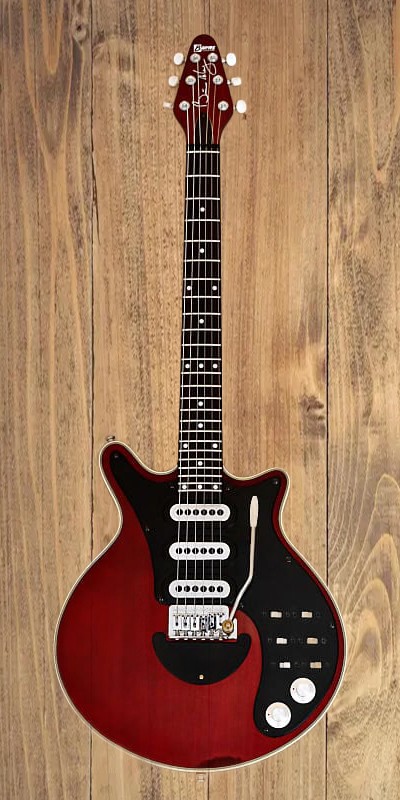
A teenager and his dad built it from a fireplace mantel, a knitting needle, and motorcycle parts. It played every Queen show.
Feltham, west London, 1963. Brian May wants an electric guitar the way every teenager in England wants an electric guitar, and he doesn’t have the money. His father, Harold, is an electronics engineer with a workshop and a lot of patience. So they build one.
- Introduced
- 1964
- Type
- Solidbody electric
- Class
- Production
The short version
1963
Work begins
Hand tools, a spare bedroom in Feltham, and whatever’s lying around the workshop.
1964
Finished
The dates vary by source. May himself says it took about two years.
1966
First gig
Molesey Boat Club, with his band 1984.
1970
New knobs, new band
May turns a set of knobs on a lathe, just before Queen.
1998
First restoration
Greg Fryer rebuilds the finish, binding, and electrics.
2002
The palace roof
May plays the national anthem on top of Buckingham Palace, on this guitar.
Side A
A1
Too broke for a Stratocaster
Almost every famous guitar in the world was bought. Somebody walked into a shop, or answered an ad, or got lucky at a pawn counter. This one was made, at home, by a teenager and his dad, and that’s the whole reason it sounds like nothing else.
I couldn’t afford to buy an electric guitar… I couldn’t even afford a copy of the Fenders and Gibsons that looked so enticing in the brochures. So my dad and I decided we would make one.
That’s Brian May. His father, Harold, was an electronics engineer, the kind of man whose workshop was full of useful scrap. They set up in a spare bedroom in Feltham in 1963 with hand tools and no plan to buy anything they could make. It took them somewhere around two years, depending on who you ask. May says two.
Think about what that means. Every decision on this guitar, the scale, the switches, the springs, was argued out between a father and a son at a workbench. Nobody at a factory signed off on any of it.
A2
A house, turned into a guitar
This is where it gets good. The neck came from an old fireplace mantel, a “hundred-year-old-ish” piece of mahogany, in May’s words. It had wormholes. They filled them with matchsticks.
The body is oak from an old table in the middle, blockboard on the wings, a mahogany veneer over the top, and white plastic shelf edging around the sides as binding. The red that gave the guitar its name is Rustin’s Plastic Coating, a furniture finish you could buy at the hardware store. They left pockets inside the body on purpose, because May wanted it to sing and feed back like a hollowbody. He planned to cut an f-hole too, and then he saw how nice the top looked and couldn’t bring himself to do it.
The hardware reads like a list of things a father would tell you not to touch. The bridge is aluminium from Harold’s stock, filed down and cut into six little rollers. The tremolo balances on a knife edge and is held by two motorcycle valve springs. The arm came off a bicycle saddlebag rack. The tip on the end is a piece of his mother Ruth’s knitting needle.
The tip of the whammy bar is a piece of his mother’s knitting needle. I think about that more than I should.
A3
Twenty-four frets and six little switches
Nobody should mistake this for a Strat. It has three pickups and a tremolo, sure, but the scale is 24 inches, shorter than a Strat or a Les Paul. It has 24 frets plus a zero fret, because May “could never understand why people stopped at 22.”
The real secret is the switching. May tried homemade pickups first, and they misbehaved whenever he bent a string. Then he bought three Burns Tri-Sonics and wired them in series, with a little on/off slider and a phase slider for each one. No five-way. Six switches and a lot of combinations. The “Bohemian Rhapsody” solo is the neck and middle pickups together with one flipped out of phase, which is why it sounds like a voice. He plays with a coin instead of a pick, an old English sixpence.
It has one real flaw, and he’s honest about it. That floating tremolo means if you break a string, the tuning goes everywhere. May to Guitar Player: “the whole thing goes out. It’s hopeless. You just have to put it down.”
Flip the record · By the numbers
~100
Approximate age, in years, of the fireplace mantel the neck was cut from.
24
Frets. May “could never understand why people stopped at 22.”
2
Motorcycle valve springs in the tremolo. Fender used tension springs. The Mays used compression.
0
Times the neck has needed a truss rod adjustment, according to May.
Side B
B1
One guitar, one band
He first played it at a gig in 1966, at the Molesey Boat Club, with a band called 1984. Around 1970, just before Queen, he turned a new set of knobs for it on a lathe. After that, it’s on every Queen album and at every Queen concert.
A few things people pin on it are wrong, and he’d want you to know. The “We Will Rock You” video is a backup guitar. In the “Play the Game” video he’s holding a cheap Strat, because Freddie Mercury grabbed the real one. And “Crazy Little Thing Called Love” was recorded on Roger Taylor’s Fender Esquire.
When you can’t buy a replacement, you make copies. A luthier named John Birch built the first official backup, and May smashed it onstage in 1982. In the late ’90s Greg Fryer restored the original and made three exact copies, which got named John, Paul, and George Burns. A few companies have made production versions since then. None of them is the one from the bedroom in Feltham.
B2
Still on the job
In 2002, May stood on the roof of Buckingham Palace and played “God Save the Queen” to the whole country. The neck in his hands was still the fireplace. According to May, it has never needed a truss rod adjustment, and other than the zero fret, the frets are the originals.
Every Queen record you’ve ever heard has that spare bedroom in it. When you hear the guitar on “Bohemian Rhapsody” singing like a voice, you’re hearing six little switches a teenager wired up his own way, because nobody was around to tell him how it was supposed to be done.
You can buy a Red Special copy today, from May’s own company, and it’s a nice guitar. But the original isn’t for sale, and it probably never will be. It isn’t a collector’s item. It’s a father and son’s project that happens to have played to millions of people, and the best argument ever made for building the thing you can’t afford.
Put this on
You’ve read about it. Now hear it. Here’s what this guitar sounds like, and what to listen for.
Bohemian Rhapsody
Wait for the guitar solo. That’s the neck and middle pickups on together, one wired out of phase, which is why it sounds like a voice. It’s one of the sounds those six homemade switches were built to find.
Find it on YouTube (opens in a new tab)God Save the Queen (live on the roof of Buckingham Palace)
The same guitar from the spare bedroom in Feltham, nearly forty years later, standing on top of the palace.
Watch it on YouTube (opens in a new tab)
The cast
The people, and the specific guitars, that made the legend.
1964
Brian May
The Red Special
Designed it, built it with his dad, and played it on every Queen album and concert.
1963
Harold May
Co-builder
Electronics engineer and Brian’s father. The aluminium for the bridge came out of his stock.
1963
Ruth May
Donor, one knitting needle
Brian’s mother. The tip of the tremolo arm came from her knitting needle.
1979
Roger Taylor
A Fender Esquire
“Crazy Little Thing Called Love” was cut on Roger’s Esquire, not the Red Special.
1998
Greg Fryer
Restorer
Rebuilt the original and made three exact copies, nicknamed John, Paul, and George Burns.
Liner notes
Specs, construction, rarity, value, and every source we used.
Three Burns Tri-Sonics in series, a 24-inch scale, and a knife-edge arm from a bicycle rack — Brian May’s homemade Red Special, not a Stratocaster.
- Body
- Chambered blockboard with oak insert, mahogany veneer. Vintage Guitar: 1.6" (40 mm) thick. Mix flagged.
- Neck
- Mahogany bolt-on from a fireplace mantel; tenon past the middle pickup
- Fingerboard
- Black-painted oak, 7.25" radius, 24 frets plus zero fret. Vintage Guitar 7.25" (184.15 mm); Wikipedia 7¼" (180 mm). Mix flagged.
- Scale
- 24". Vintage Guitar 24" (609.5 mm); Wikipedia 24" (610 mm). Mix flagged.
- Pickups
- Three Burns Tri-Sonic single-coils, series-wired
- Hardware
- Homemade aluminium roller bridge; knife-edge tremolo with motorcycle valve springs; bicycle-saddlebag arm
- Electronics
- Master volume, master tone; on/off and phase slider per pickup
- Finish
- Rustin’s Plastic Coating over mahogany veneer — the red
- Nut
- Zero fret with Bakelite string guide. Vintage Guitar 1.84" (46 mm); Wikipedia 1⅞" (47 mm). Mix flagged.
Open the full research fileConstruction details, the complete player record, production numbers, dated value estimates, and sources
Classic living example = original 1963–64 Red Special (Feltham). Current street guitar is the Brian May Guitars Special (Korea) and Super (Czech Republic). Guild BHM1 / BM01 and Burns 2001–04 are earlier production objects, not this table. Mini May, Rhapsody acoustic, and Bri-Bass stay off this slug. No Gibson SKU. Mixed inch/mm flagged; do not average 609.5 / 610 mm, 46 / 47 mm, or 180 / 184.15 mm.
Construction
The job was an electric Brian could not buy. Vintage Guitar (Michael Dregni, February 2015, from Brian May’s Red Special with Simon Bradley): “I couldn’t afford to buy an electric guitar… I couldn’t even afford a copy of the Fenders and Gibsons that looked so enticing in the brochures. So my dad and I decided we would make one.” Guitar Player, January 1983: “seeing as I couldn’t afford a Stratocaster.” Harold May was an electronics engineer. Spare bedroom in Feltham, hand tools, whatever was in the workshop.
They started in 1963. Wikipedia: August 1963, finished October 1964. May to the Guardian (Ruth Huntman, 18 October 2014) and to Guitar.com (26 April 2017): two years. Guitar.com files it 1963–65. The 2014 book marks a fiftieth. This plate starts in 1964.
What they built is not a Strat. Double-cut, three pickups, a floating arm — and then it stops looking like Fullerton. Scale 24", shorter than a Strat or a Les Paul. Twenty-four frets plus a zero fret, because May “could never understand why people stopped at 22” (TGM / Dave Burrluck on the 1993 Guild). Oak from a table as the centre block, blockboard wings, mahogany veneer, white plastic shelf-edging for binding, Rustin’s Plastic Coating for the colour that named it. Neck from a “hundred-year-old-ish” fireplace mantel (May’s book via Wikipedia); wormholes filled with matchsticks. Bolt-on, one large bolt and two screws into the oak, tenon past the middle pickup. MusicRadar / Guitarist (Simon Bradley, 3 October 2014): that bolt also anchors the truss rod. May to Vintage Guitar: the neck has never needed a truss-rod turn. Original frets, other than the zero, have never been replaced.
The body is chambered on purpose. May wanted it to sing and feed back. He meant to cut an f-hole and didn’t, once the top looked finished. Guitar Player: “It’s not exactly like any other guitar… the sort of shape that the semi-acoustic guitars had in those days, like the Gibson ES-335. But it’s not symmetrical.” Not a 335. Not a Strat. Catalogued here as a solidbody because that is the job it does; the pockets are still there.
Hardware is workshop scrap made to a drawing. Aluminium bridge from Harold’s stock, filed, then sliced into six roller saddles. Knife-edge tremolo, two Norton motorcycle valve springs in compression, not Fender tension. Arm from a bicycle saddlebag holder; tip from Ruth May’s knitting needle. May to Guitar Player: if you break a string, “the whole thing goes out. It’s hopeless. You just have to put it down.” Homemade pickups first — north-south pole pieces that rushed when he bent. Then Burns Tri-Sonics from the Burns shop (Tottenham Court Road / St Giles, MusicRadar and Guitar Magazine October 1999). Two coils potted in Araldite; series wiring, six sliders, on/off and phase per pickup. That is the vocabulary. It is not a Strat 5-way. A Vox fuzz lived under the guard early; he pulled it for AC30 grind. Greg Fryer inlaid the May Star over the hole in 1998.
Not a Stratocaster (fender-stratocaster). Different scale, different switching, different tremolo, different factory — there was no factory. Not a Guild, Burns, or Brian May Guitars replica of itself. Those are later objects on this silhouette. No Gibson SKU.
Restorations: Fryer 1998 (veneer, binding, finish, electrics, acrylic surrounds). Andrew Guyton, April 2016 (lacquer cracks, zero fret again, service the trem). Tuners wore out and were replaced; locking Schaller M6s by the 2014 book. Knobs May turned on a lathe around 1970, just before Queen.
Production is a different shop each time. Greco unofficial first, Japan, early 1980s; May used one on Top of the Pops for “Good Old Fashioned Lover Boy.” John Birch, first official backup, maple, natural; smashed onstage August 1982. Guild BHM1 from 1984 (TGM; Wikipedia 1983–85): solid mahogany, DiMarzio, Kahler — close outline, not the construction. Guild again 1993–95, BM01 Signature/Pro closer, Schaller trem, Seymour Duncan Tri-Sonic-style. Burns London, Korean, October 2001 to July 2004 (Guitarist Best Electric Guitar of the Year 2001). Brian May Guitars from 2004 — May, Barry Moorhouse, Pete Malandrone — took the line. Current Special: chambered Indonesian mahogany, set neck, ebony, Wilkinson WVP two-point, BM Tri-Sonic-style, Korea. Super: Czech Republic, closer neck and knife-edge. Fryer’s three 1996–97 copies — John, Paul, George Burns — and Guyton’s 2004 run of 50 (40 red, 10 green) are shop replicas, not a street SKU.
Classic vs current: 1964 Feltham homemade — oak, blockboard, fireplace mahogany, Burns Tri-Sonics in series — against a Korean Special and a Czech Super you can order in 2026.
Players
Do not hang a Strat, a Tele, or an Esquire on this plate as if they were the Red Special. Do not recruit Guild, Burns, or Guyton copies as the original. Do not flatten every Queen record before the guitar existed.
Brian May. The guitar is his. Vintage Guitar: first played 1966, Molesey Boat Club, Putney, with 1984. Guardian: on every Queen album and every concert; national anthem from the roof of Buckingham Palace, 2002. Vintage Guitar (Wolf Marshall, A Night at the Opera): homemade Red Special, Vox AC30s, and Deacon’s Deacy throughout; “Bohemian Rhapsody” solo on an out-of-phase neck-plus-middle setting. “Fat Bottomed Girls” live in drop D later moved to a green Guyton; Fryer’s John is the standard-tuning backup. The original still tours.
Videos and sessions that are not this guitar: “We Will Rock You” and “Spread Your Wings” clips used the Birch (snow, then a backup). “Play the Game” video, a budget Satellite Strat, because Mercury snatches it. “Crazy Little Thing Called Love” cut on Roger Taylor’s Esquire; live on a Telecaster into 1992. Those objects live on their own plates.
Also known to play stays last and short. Guitar.com: Teenage Fanclub’s Raymond McGinley used an authorised Guild copy on Grand Prix (1995). That is a Guild, not Feltham. None invented.
Rarity
The original is one guitar. It is not a production total.
You can buy a new Brian May Guitars Special tomorrow. Super is the dearer current line, Czech, not a 1964 object. Burns 2001–04 and Guild 1980s/90s are closed runs.
Guild did not publish a factory ledger. Named estimates for the BHM1: 316 (Guitar Magazine October 1999 / TGM Burrluck), around 330 (Guitar Interactive, 2016), 300 (Guitarist via Brian May Central). Keep the spread. None is a factory count. 1993 BM01: TGM limited edition of 1000; Guitar Interactive around 2,000 including cheaper variants. Keep both. Guyton 2004: 50. Fryer: three. Burns and BMG street totals are unpublished. None invented.
Serials on Burns/BMG heads (BHM-) date a guitar. They don’t count a year.
What is actually thinner: the original; Birch (glued, barely a guitar); Fryer’s John / Paul / George Burns; Guyton’s fifty. Those are unique objects. They are not a vintage Red Special you can shop.
Value
Informal estimate, 10 September 2026. Not an appraisal.
Ask vs sold labeled. Celebrity lots are not-comps. No invented medians or factory counts. Cooper Owen, via Guitar.com (2017): the original is “impossible” to value. That is one object. Not a comp.
New street. Brian May Guitars shop, this pass: Special Antique Cherry list £995, UK £895 inc. VAT, worldwide £745.83. Super Antique Cherry UK £3,295, worldwide £2,745.83. Super left-hand £3,795. Music Store dealer snapshot £849 on the Special. Guitar.com’s 2017 £649 / £2,950 is 2017 money, not 2026 street.
Used modern. Burns 2001–04 and later BMG Specials. Reverb Price Guide on Burns Brian May Signature Special Red (Canada widget): C$766–C$1,420, 94 Good-to-Mint orders — CAD, not a USD median. Named asks, not hammers: Reverb US 2004 black Burns $1,330 (from $1,400); Reverb UK 2001 BHM-0204 £1,071 (from £1,260). Gardiner Houlgate, 5 December 2025: a Korean BMG Special, electrics needing attention, sold £420 against £300–400. Do not average those with a Super or a Guild.
Vintage / collectible. The original is not on the market. Guild BHM1 / BM01 are the closed American runs. Named asks, not 2026 hammers: Reverb BHM1 serial 101, ended $4,449 (listed about six years before this pass). Digimart, Japan, Guild BM-01 ¥748,000. Do not average those asks. Heritage 2015 BHM1 lot is one older auction, price unpublished here.
See also
- fender-stratocaster — three pickups and a tremolo; 25.5" Fullerton, not this 24-inch Feltham homemade
- burns-marvin — Burns of Romford; the Tri-Sonics came from that house, the Marvin is a different guitar
- fender-esquire — the guitar May recorded “Crazy Little Thing Called Love” on; this plate is not that
Sources
- Vintage Guitar, Michael Dregni, Homemade Royalty: Brian May’s Red Special (February 2015) — 1963 start; oak/blockboard/mahogany veneer; 1.6" (40 mm); 7.25" (184.15 mm); nut 1.84" (46 mm); 24" (609.5 mm); 24+zero; Burns Tri-Sonics series; six sliders; 7.99 lb (3.63 kg); 1966 Molesey Boat Club; MSG 5 February 1977
- Vintage Guitar, Lisa Sharken, Brian May (December 1998) — fireplace neck; oak insert; blockboard; shelf-edging; bicycle-arm / knitting-needle tip; handmade pickups then Burns; six switches; Fryer copies vs Guild 1984
- Vintage Guitar, Wolf Marshall, Fretprints: A Night at the Opera (September 2025) — Red Special throughout Opera; “Bohemian Rhapsody” neck+middle out of phase; Palace roof 3 June 2002
- The Guardian, Ruth Huntman, 18 October 2014 — two years, hand tools; fireplace neck; every Queen album and concert; Palace 2002; 50th anniversary book
- Guitar Player, January 1983 / Phil Weller recap — couldn’t afford a Strat; not a 335; handmade pickups’ north-south rush; Burns pickups; knife-edge / motorcycle springs / rollers; two years, 17 at completion
- Guitar.com, Hitmakers: Brian May Red Special (26 April 2017) — 1963–65; 24" scale; Burns reverse-wound/potted; Birch / Fryer / Guyton / Burns / Guild / BMG; Cooper Owen “impossible” to value; McGinley Grand Prix 1995; 2017 street £649 / £2,950
- MusicRadar / Guitarist, Simon Bradley, Red Special up close (3 October 2014) — 46 mm nut; 7.25" oak board; late-1963 vibrato tests; Burns shop Tottenham Court Road; Fryer 1998 surrounds and May Star; Schaller M6; zero fret
- Wikipedia, Red Special — August 1963 / October 1964; 24" (610 mm); Guild 1983–85 and 1993–95; Burns 2001 Korea; BMG after Burns; Fryer John/Paul/George Burns; Guyton 2004 run of 50; Birch August 1982; Greco TOTP; Esquire on “Crazy Little Thing Called Love”
- Brian May Guitars, The BMG Special — Burns winter 2001; BMG 2004; current Special spec; Antique Cherry list £995 / UK £895 / worldwide £745.83
- Brian May Guitars, The BMG Super — Czech Super; UK £3,295 / worldwide £2,745.83; left-hand £3,795
- Brian May Guitars, home — Guild and Burns as prior issues; commercial Red Special “come home” as of 2004
- Brian May World / Guitar Magazine Vol.10 No.2, October 1999 — 1963, 18 months; Guild BHM1 316; BM Ltd 1993
- TGM, Dave Burrluck, Guild Brian May Limited Edition — 1984 first official replica, 316; 1993 limited 1000; 24" scale; 24 frets
- Guitar Interactive, Super Special Rhapsody (2016 PDF via BMG) — BHM1 around 330; 1993 around 2,000 including variants; Burns ~2001; BMG ~three years later
- Brian May Central, Burns Brian May Guitars (archive) — Burns October 2001–July 2004; then Brian May Guitars
- Reverb, Burns Brian May Signature Special Red — Korean Burns; 24" scale; three Tri-Sonics; named 2004 black ask $1,330
- Reverb Canada Price Guide, Burns Brian May Signature Special Red — C$766–C$1,420, 94 Good-to-Mint orders
- Reverb UK, Burns London Brian May Red Special 2001 BHM-0204 — ask £1,071 from £1,260
- Reverb, Guild Brian May BHM1 1984 serial 101 — ended ask $4,449; 316 circulated figure
- Gardiner Houlgate, 5 December 2025, lot 199 — BMG Special sold £420
- Music Store, Brian May Red Special — dealer £849
- Digimart, Guild BM-01 Brian May Signature — 1993–94 BM-01 ask ¥748,000; 1000 limited copy
- May, Brian; Bradley, Simon. Brian May’s Red Special (Carlton / Hal Leonard, 2014) — construction memoir behind the Vintage Guitar and Guardian pieces
Keep digging
Guitars this one gets compared to, confused with, or descended from.

Photo: Lightburst / Wikimedia Commons / CC BY-SA 4.0 Fender
Stratocaster
1954
The guitar most people mean when they say “electric guitar.” Designed by a man who didn’t play one.
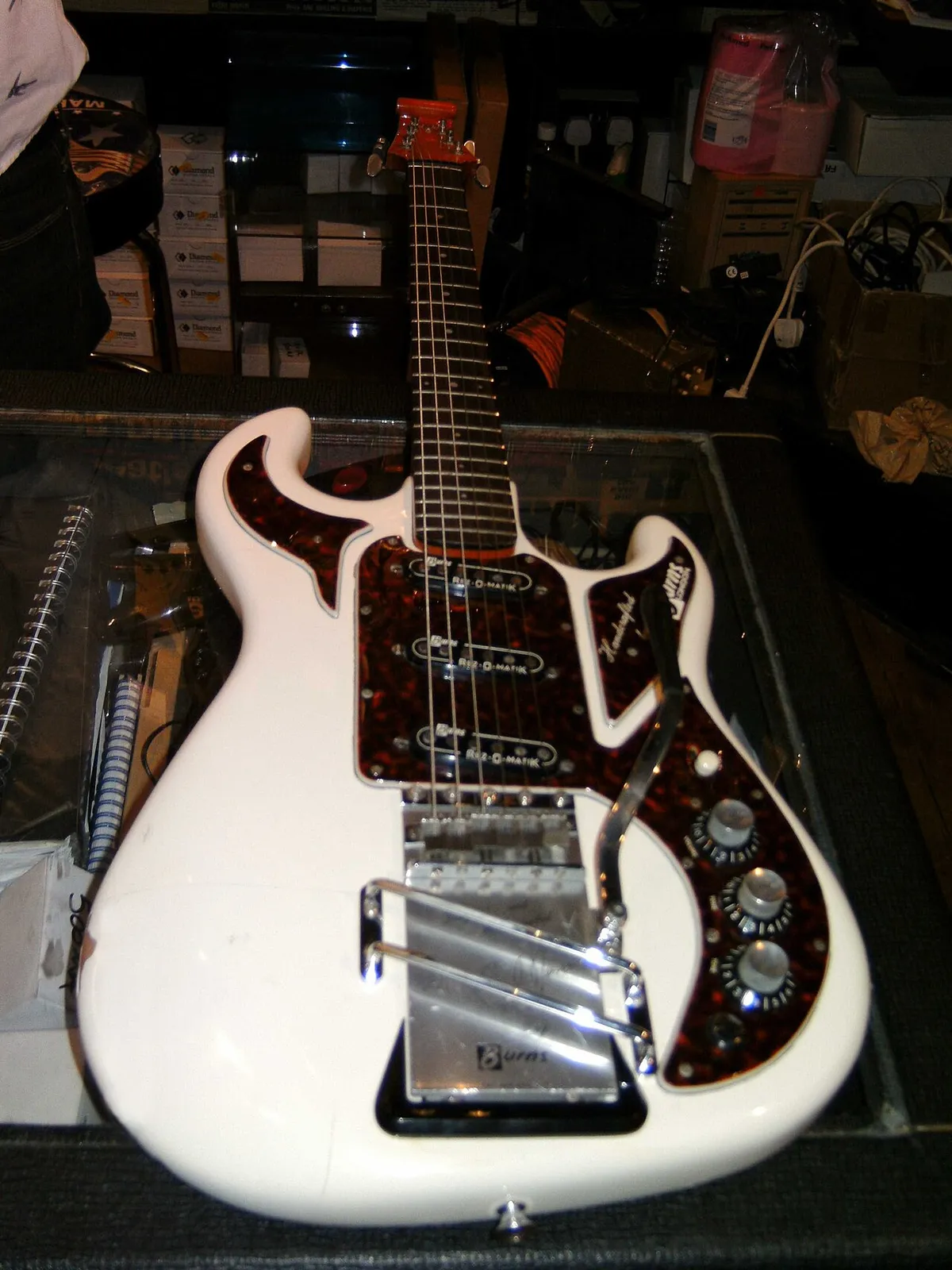
Photo: Bruce Marvin / Wikimedia Commons / Public domain Burns
Marvin
1964
Burns built Hank Marvin more than 30 prototypes to keep him in tune. Then somebody checked his jacket.
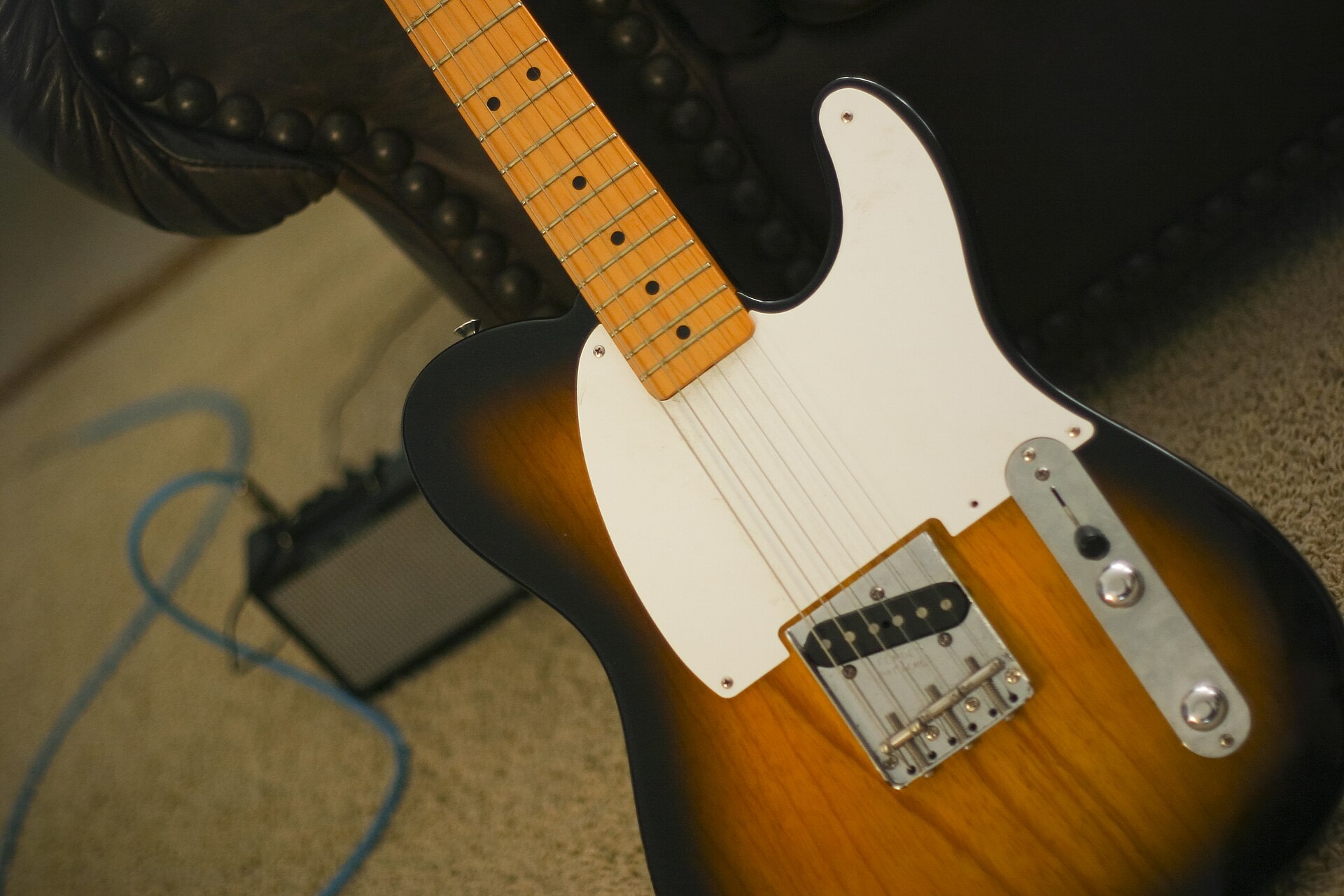
Fender Esquire. Photo by manley.josh. Licensed under CC BY 2.0. Via Wikimedia Commons. Fender
Esquire
1950
Fender’s first electric Spanish guitar settled on one pickup, and it’s been mistaken for its little brother ever since.