Vox
Mark III
Vox built Brian Jones a white teardrop, then sold everyone else a different guitar. The reissues chose his.
New York, 25 October 1964. The Rolling Stones play *The Ed Sullivan Show* for the first time, and off to one side Brian Jones is holding a guitar shaped like a lute, white, with two pickups. There isn’t one like it in any Vox catalog. Vox made it for him.
- Introduced
- 1963
- Type
- Solidbody electric
- Class
- Production
Have a photograph of this guitar? Send a picture
The short version
1963
The prototypes
Mick Bennett builds the first teardrop prototypes at Vox in December.
1964
Ed Sullivan
Jones plays the white prototype on the Stones’ first Sullivan show, 25 October.
1965
The catalog version
Commercial teardrops are made in Britain and Italy, with three pickups and a vibrato. Some accounts start sales earlier.
1966
$339.90
The U.S. list price for the teardrop, by now sold as the Mark VI.
1998
Called Mark III
Korg reissues the teardrop in America and gives it the name Mark III.
2007
The Jones guitar, at last
A fiftieth-anniversary Mark III, white, two pickups, fixed bridge. About seventy get made.
Side A
A1
The guitar on Sullivan
Most people who know this guitar know it from one picture: Brian Jones, bowl haircut, holding a white teardrop on The Ed Sullivan Show in October 1964. It’s one of the great images of the British Invasion.
The funny thing is, you couldn’t buy that guitar. Not in 1964, and not for a long time after. The one in Jones’s hands was a prototype, and Vox built a different guitar for everybody else.
Jones used it a lot through 1964 and ’65. One of his teardrops is in the Hard Rock collection now. The album-by-album credits are murkier, so we’ll leave those alone.
A2
A lute from Dartford
Vox had already made one original guitar, the five-sided Phantom. The teardrop was the second. Underneath it’s still a Strat-style guitar, bolt-on maple neck and single-coil pickups. The body is shaped like a lute, and you can’t confuse it with a Fender or with the Phantom from across a room.
In December 1963, Mick Bennett built the first teardrop prototypes at Vox. The one that went to Jones was white, with two pickups and a Stratocaster hardtail bridge, the strings running through the body. When he first played it in public is fuzzier. One account says Bridlington, July 1964. By October it was on American television.
Vox made one of these for a Rolling Stone, and then sold everybody something else.
A3
Three names for one shape
Here’s where it gets confusing, so pour a coffee.
The teardrop first came out as the Phantom Mark VI. Then Vox dropped the word Phantom “to avoid confusion with the original Phantom VI,” and it was simply the Mark VI. That didn’t help much, because the factory’s own name for Jones’s prototype was Mark III, and by the 1980s writers were filing the whole teardrop line under Mk III. When Korg reissued the droplet in 1998, they made that official and called it the Mark III.
And in that same 1998 catalog, the name Mark VI went on the pentagon. The names swapped. If you own one of each, I’m sorry.
Flip the record · By the numbers
2
Pickups on Jones’s prototype. The catalog guitar had three.
$339.90
U.S. list price in 1966. Historical money.
~70
Anniversary Mark IIIs finished in 2007–08, out of a planned 100.
22
Frets, plus a zero fret, on the 1960s teardrop.
Side B
B1
The one they actually sold
The teardrop that went into shops, whether you date it from 1963, 1964, or 1965, wasn’t Jones’s. It had three pickups, a Hank Marvin-style vibrato arm, a quick three-way toggle instead of the Phantom’s rotary knob, and a zero fret. Like the Phantom, production spread to Eko in Italy, whose guitars had a padded cushion that snapped onto the back.
The 1966 American catalog sold it hard: “Exclusive teardrop design; detachable padded cushion on back; exclusive 2-way string damper; quick-flick 3 position pick-up switch; vibrato; sunburst or popular colors.” List price $339.90. There was a twelve-string, a nine-string, a bass, and even a thinline version. Bill Wyman had a teardrop bass. The Dave Clark Five posed with a black teardrop guitar and a black teardrop bass.
Jones’s two-pickup version, strangely, wasn’t offered at all in the ’60s.
B2
Coming back as his
Later players kept finding the shape. Robert Smith played a Mark VI when he helped out on guitar with Siouxsie and the Banshees. Chris Martin played one later still.
The reissues are where the story turns. The 1998 Korg run was a long time coming: prototypes turned up at a trade show in 1995, and guitars finally shipped in the summer of 1998, built in Minnesota. Counting every model, they made almost 700 between 1998 and 2000. The run included a fixed-bridge Mark III Custom in white, two pickups, painted headstock. The reissues sold at $1,400, which is a lot for a British beat guitar, and sales faded by 2001. In 2007, for Vox’s fiftieth anniversary, they tried again with a USA-made Mark III: white, two pickups, fixed bridge. A hundred were planned. About seventy got made.
There was a cheaper three-pickup short-scale in 2013, and there’s a little teardrop travel guitar in the catalog now. But both times Vox built the teardrop in America, it skipped the three-pickup guitar it had actually sold in the ’60s and went back to two pickups. The second time it went all the way: white, fixed bridge, two pickups. It went back to Ed Sullivan, and the guitar it once made for one Rolling Stone and nobody else.
Put this on
You’ve read about it. Now hear it. Here’s what this guitar sounds like, and what to listen for.
The Rolling Stones on The Ed Sullivan Show
Their first appearance, 25 October 1964. Keep your eye on Brian Jones and the white teardrop prototype. Vox never sold that version in the ’60s.
Watch it on YouTube (opens in a new tab)
The cast
The people, and the specific guitars, that made the legend.
1964
Brian Jones
The white prototype
Two pickups, a Stratocaster hardtail bridge, strings through the body. Vox never sold that version in the ’60s.
1963
Mick Bennett
Builder
Built the first teardrop prototypes at Vox, including the one for Jones.
1960s
The Dave Clark Five
Black teardrops
Photographed with a black teardrop guitar and a black teardrop bass.
Robert Smith
A Mark VI
Played one while helping out on guitar with Siouxsie and the Banshees.
Chris Martin
A Mark VI
Same lute shape, a generation later.
Liner notes
Specs, construction, rarity, value, and every source we used.
A lute-shaped teardrop with a bolt-on — Vox’s Mark III, not the pentagonal Phantom, whatever the 1960s catalog stamped on the headstock.
- Body
- Teardrop / lute solidbody. Italian examples: snap-on padded back. Wikipedia: maple or ash. A Reverb 1966 listing prints basswood. Mix flagged.
- Neck
- Bolt-on maple; six-in-line paddle headstock. Showroom: “C” profile. Eko necks: aluminum double-T bar
- Fingerboard
- 22 frets, pearloid dots, zero fret typical. Wikipedia: rosewood. Guitar Player on a 1966 Mark XII: ebony. Mix flagged.
- Scale
- 25½" (Showroom V222). Guitar Player Mark XII: 25". A Reverb 1966 listing: 25". RetroFret 2000 reissue: 25½" (648 mm). Mix flagged. No millimetres invented for the 1960s guitar.
- Pickups
- Production Mark VI: three single-coils. Jones prototype / 1998 Mark III: two
- Hardware
- Roller bridge; Hank Marvin (Bigsby-inspired) vibrato; 2-way string damper. Jones prototype: Fender Stratocaster hardtail, string-through
- Electronics
- 3-position toggle (not the Phantom rotary). Master volume and tone
- Finish
- 1966 U.S. catalog: sunburst or popular colors. Jones prototype: white, painted headstock
- Nut
- Showroom: ~1.6" at the nut, ~2" at the twelfth. Reverb 1966 listing: 1.6". RetroFret 2000 reissue: 1 11/16" (43 mm). Mix flagged.
Open the full research fileConstruction details, the complete player record, production numbers, dated value estimates, and sources
Classic living example = 1960s teardrop (Dartford, then Eko), cataloged as V222 Mark VI / Phantom Mark III. No current typical full-size Mark III SKU this pass: factory guitar pages are Bobcat, Giulietta, and the minis. Mark III Mini (476 mm / 18-3/4"; two coils; terentang) is a ¾-scale travel guitar on this silhouette, not this table. 2013 Mark III is a 24" (610 mm) basswood short-scale, Japan/Europe only. Apache (2011) is onboard-amp travel. Mark XII, Mark IX, Mark IV bass, V252 thinline, and Wyman bass stay on this plate, not as second slugs. 1998 Mark VI is the pentagon. Mixed inch/mm flagged. Do not average 25½" / 25".
Construction
The job was a second original Vox shape after the pentagon. Still a Strat under the paint: bolt-on maple, coils, a vibrato. The outline is a lute. You cannot confuse it with a Fender, and you cannot confuse it with the five-sided Phantom (vox-phantom).
Jennings already had student copies — Apache, Stroller, Clubman — from a furniture shop, because American electrics were effectively locked out of the UK. The Design Centre in London drew the Phantom in 1962. The teardrop came next.
The name is the trap. Vox Showroom: introduced 1963 as Phantom Mark VI, then the Phantom name was dropped “to avoid confusion with the original Phantom VI,” and the teardrop was simply Mark VI. Factory’s current European-history page: Phantoms “were joined by the teardrop-shaped Mark VI and Mark XII in 1964.” Guitar Player (Dave Hunter): Mark series “joined the fold in ’63.” Wikipedia: a year after the Phantom; two-pickup prototype for Brian Jones. Tune Your Sound quoting a factory timeline: first Phantom Mark III prototypes built by Mick Bennett at Jennings, December 1963; a white two-pickup six-string with a Fender Stratocaster bridge given to Jones. RetroFret: Jones received that guitar in June 1964; commercial teardrops 1965, UK and Italy. Japanese Guitar Magazine (Nobuaki Suzuki, 14 February 2025): prototype in Jones’s hands by the end of 1963; first public use “said to be” 11 July 1964, Bridlington. Keep 1963, 1964, and 1965. This plate starts in 1963.
Not a Phantom. Five sides, rotary 3-way, coffin. That guitar is the other slug. The teardrop used the same paddle neck, the same Hank Marvin vibrato, and a three-position toggle instead of the Phantom’s rotary. Showroom: same Strat-inspired triple-coil layout as the Phantom VI. Guitar Interactive (Jonathan Graham, 7 December 2023) gives the Mark VI two single-coils and a Bigsby-style bridge — that is Jones’s prototype, not the three-coil catalog guitar. Keep both.
Jones’s white two-pickup, Strat hardtail, string-through, was not a catalog SKU. Showroom: “oddly was not offered commercially by Vox in the 1960s.” Production teardrops grew a third coil and the Hank Marvin arm. Paul Day (One Two Testing, January 1984) still files the teardrop line as Mk III — six, 12-string, and bass — with two single-coils and a padded back. The 1960s headstock said Mark VI. The later factory, and Jones’s guitar, said Mark III. Do not flatten them.
The 1966 U.S. catalog on the V222: “Exclusive teardrop design; detachable padded cushion on back; exclusive 2-way string damper; quick-flick 3 position pick-up switch; vibrato; sunburst or popular colors.” Scale 25½". Twenty-two frets, zero fret, dots, truss at the heel. Eko’s double-T extrusion in the neck. U.S. list $339.90 — historical, not 2026 street. U.S. market first in the 1965 “King of the Beat” catalog. Showroom: by 1965 JMI supplemented UK production at Eko. Guitar Player: guitar production moved to Eko in 1966. Keep both.
Siblings on the silhouette, not second slugs: V223 Mark XII (Guitar Player: U.S. 1966, list $369.90 plus $44.90 deluxe case); V231 Mark IX nine-string; V224 Mark IV bass; V252 Mark VI thinline “acoustic”; V248 Wyman bass. Those are teardrop-shaped. They are not this table.
1998. Korg reissued the droplet in the United States and called it Mark III. Vox Showroom: “In 1998, Vox reissued the droplet shaped Mark VI guitar, calling it the Mark III.” The 1998 press release: poplar, maple, rosewood, two single-coils; Bigsby in black, red, ocean green; fixed-bridge Mark III Custom in white with painted headstock and chrome guard. The same catalog’s Mark VI is the pentagon. The names swapped. Minnesota build (North Coast Music / Tone X): prototypes at Winter NAMM 1995, shipments summer 1998. A planned Mk XII twelve-string was scrapped. Showroom: almost 700 guitars of all models — Mk III, Mk VI Phantom, Mini XII — between 1998 and 2000. That is not a Mark III census. Sales “waned by 2001 due to a steep $1400 retail price.” Historical, not 2026 street.
2007. Fiftieth-anniversary Mark III, USA, white, two coils, fixed bridge, zero fret, “57-07” inlay, serial prefix 5707. Planned 100. Showroom, from a Korg USA document: production stopped short; factory-authorized run “limited to about seventy instruments,” ended 2008. Serials were assigned randomly, so the highest listed number is not a count. Premier Guitar (27 November 2007): northern hardwood / aspen, maple/rosewood, Alnico single-coils, Kluson-style tuners, chrome guard.
2013. Full-size Mark III again, teardrop, not a Mini. Showroom: basswood and a 22-fret maple/rosewood neck from the Apache I; three single-coils, 5-way, vibrato; 24" (610 mm) scale. MusicRadar (Rob Power, 16 May 2014): £289 / €339. Not sold in the United States. Japan and Europe. Guitar Interactive: Mark III the teardrop, Mark V the coffin. Those carts are closed. Factory pages in 2026 are Bobcat, Giulietta, and the minis.
Classic vs current: 1963–67 Dartford-then-Eko teardrop — lute outline, bolt-on, zero fret, Hank Marvin vibrato, three coils on the catalog guitar, two on Jones’s — against no new full-size Mark III, and a Mark III Mini you can order: terentang, two coils, 476 mm. Jack Charles’s Phantom Guitarworks is Oregon replicas, not Vox.
Players
Do not recruit Phantom players as if they were this guitar. Ian Curtis’s Special stays on the pentagon. Tony Hicks’s Phantom XII stays there. Bill Wyman’s teardrop is a bass.
Brian Jones (Rolling Stones). The guitar this plate is named for. White two-pickup prototype, Strat hardtail, string-through. Guitar Player (Rod Brakes, 25 October 2023): prototype Vox MK III teardrop on the Stones’ Ed Sullivan debut, 25 October 1964. Japanese Guitar Magazine: first public use said to be Bridlington, 11 July 1964. RetroFret dates receipt June 1964. Tune Your Sound quoting factory copy: used extensively 1964 and ’65. Hard Rock’s collection holds a Jones teardrop (Hard Rock vault film; Wikipedia photograph, Hard Rock Café Sacramento). Album-to-guitar credits for named Decca/London sides are unpublished here. The object is the fact. Unique object, not a comp.
Robert Smith. Guitar Player: a Mark VI when assisting as guitarist with Siouxsie and the Banshees. That is the teardrop, not a Phantom. Which year and which Siouxsie record are unpublished here.
Chris Martin. Guitar Player: later still, a Mark VI. Same silhouette. Which Coldplay stage is unpublished here.
The Dave Clark Five. Vox Showroom photographs a black teardrop guitar and a black teardrop bass with the band. Named as a period user of the shape, not a serial.
Also known to play stays short. MusicRadar’s 2014 review spots Tom Petty and Kasabian’s Sergio Pizzorno “wielding one.” Wikipedia’s Mark III page files David Bowie’s Vox at Hard Rock Café Warsaw as a Mark VI. None invented.
Rarity
Factory does not publish 1960s teardrop unit totals. None invented. Serials date a guitar. They don’t count a year.
The 1960s UK-then-Italy run is closed. 1998–2001 USA reissues are closed; Showroom’s ~700 is all models in that order, not a Mark III figure. The 2007 anniversary is thinner: about seventy of a planned 100. Jones’s white prototype is a unique object. It is not a vintage Mark III.
What is actually thinner on this name: UK Dartford examples against the Italian majority; two-pickup Jones-spec guitars against three-coil V222s; complete originals with the damper and the snap-on pad still on the back. Apache, the 2013 short-scale, and the Mini are other objects on the lute.
Value
Informal estimate, 21 September 2026. Not an appraisal.
Ask vs sold labeled. Celebrity lots are not-comps. No invented medians or factory counts. Period $339.90 (1966 U.S. list, Vox Showroom) is 1960s money, not 2026 street. 1998 $1400 retail (Showroom) is that cart, not this one.
New street. No living full-size Mark III cart. Mark III Mini is the ¾-scale sibling, not this guitar: voxampshop atom (21 March 2025) $109.99–$129.99 by color; official-store sale this pass $99.99 from $129.99. UK factory shop £149. 2013 MusicRadar £289 / €339 is a closed Japan/Europe SKU.
Used modern. Mini Reverb Price Guide $119–$149 (13 Good-to-Mint orders; named solds include March 2026 Excellent $135 and May 2026 Excellent $219.12 — do not average). 1998–2001 USA Mark IIIs trade used. No clean 2024–26 reissue median isolated this pass. RetroFret’s c. 2000 Mark III Custom (Minnesota, serial 00225244) sold; the dollar was unpublished on the plate.
Vintage / collectible. Named asks this pass, not a midpoint: Mojo’s Music V222 $2,200. Older named asks, not hammers: Reverb 1966 sunburst $1,799.99 (ended); Wunjo NOS Italian-parts Mark VI $1,599.99 (ended). Guitar.com’s 2016 V252 thinline at £2,195 is the hollow sibling, not this table. Jones’s Hard Rock guitar is one object. Not a comp.
See also
- vox-phantom — the five-sided sibling; not this teardrop
- fender-stratocaster — three pickups and a bolt-on, the layout under the lute
- burns-marvin — another British Invasion shape guitar; Hank Marvin is the name on the vibrato
Sources
- VOX Guitars European History — 1961 student line; 1962 Dartford Phantom; Mark VI / XII 1964; Brian Jones on the teardrop; Eko / Crucianelli
- VOX Mark III Mini — living ¾-scale; terentang; maple; purpleheart; 476 mm / 18-3/4"; 19 frets; two single-coils; nut 42 mm / 1.654"; 2.1 kg / 4.63 lbs; Aqua Green, Marble, Loud Red
- The VOX Showroom, V222 Mark VI — 1963 as Phantom Mark VI, then Mark VI; Jones two-pickup not catalog; Eko 1965; U.S. 1965 King of the Beat; 1966 catalog copy; 25½" scale; ~1.6" nut; 22 frets; zero fret; double-T; $339.90 list
- The VOX Showroom, 1998–2001 Korg guitars — 1998 press: poplar/maple/rosewood; droplet Mark III two coils, Bigsby or fixed; Mark III Custom white; 1998 Mark VI is the pentagon
- The VOX Showroom, 1998 inside story — Hawkins / Vetsch / NAMM 1995; order 1998; Mk III teardrop vs Mk VI Phantom; ~700 all models 1998–2000
- The VOX Showroom, 2013 Mark III — 1963 Mark VI three coils; 1998 reissue as Mark III, $1400 retail, waned 2001; 2013 basswood, 22 frets, three coils, 5-way, vibrato, 24" / 610 mm; not sold in the U.S.
- The VOX Showroom, 50th Anniversary Mk III — Jones two-pickup white; 2007 USA; planned 100; about 70; serial prefix 5707; ended 2008
- Guitar Player, Dave Hunter, Vox teardrop — Design Centre 1962 → Phantom; Mark series ’63; Eko 1966; Mark XII 25" scale, ebony, Hank Marvin vibrato, three coils; U.S. 1966 list $369.90 / case $44.90; Jones / Smith / Martin on Mark VI
- Guitar Player, Rod Brakes, Stones on Sullivan — 25 October 1964; Jones prototype Vox MK III teardrop
- Wikipedia, Vox Mark III — period 1963–67, 1998–present; 25.5"; maple/ash; rosewood; Mark VI/IX/XII; Jones two-pickup Strat-bridge prototype; 1998 USA; 2007 run of 100; Apache 2011; Bowie Mark VI at Hard Rock Café Warsaw
- Wikipedia, Vox (company) — 1962 Phantom; Mark VI a year later, Jones prototype two pickups; Wyman bass; 1998 Phantom and teardrop reissues
- MusicRadar, Rob Power, Vox Mark III review, 16 May 2014 — 2013 reissue; 610 mm / 24" scale; £289 / €339; Jones introduced the teardrop; Petty / Smith / Pizzorno spotted
- Premier Guitar, VOX Mark III Limited Edition Teardrop, 27 November 2007 — USA; aspen / northern hardwood; maple/rosewood; two Alnico single-coils; fixed bridge; white; chrome guard
- RetroFret, Vox Mark III Custom, c. 2000 — Minnesota; ~700 all models 1998–2001; Jones June 1964, two pickups, Strat hardtail; commercial teardrops 1965 three pickups; measured 25½" / 648 mm, nut 1 11/16" / 43 mm
- Guitar Interactive, Jonathan Graham, 7 December 2023 — Mark VI within a year, two coils in that copy; Jones on Sullivan; 2013 Mark III teardrop / Mark V coffin; current Mark III Mini
- One Two Testing, Paul Day, January 1984 — teardrop line as Mk III six / 12 / bass; two single-coils; padded back; damper
- Guitar Magazine (Japan), Nobuaki Suzuki, 14 February 2025 — Mick Bennett prototype; in Jones’s hands by end of 1963; first public use said to be 11 July 1964, Bridlington; production MK III Hank Marvin vs prototype Strat bridge
- Tune Your Sound, 50th Anniversary Mark III — quotes factory December 1963 Phantom Mark III prototypes; Jones 1964–65
- VOX Amps USA shop, Mark III Mini — official-store street this pass $99.99 from $129.99; factory copy calls the 1960s guitar Mark VI
- VOX UK shop, Mark III Mini — UK street £149
- Reverb Price Guide, Vox Mark III Mini — years 2022–2026; China; used $119–$149 (13 orders); named solds; new asks from $279.99 to $129.99
- Reverb, 1966 Mark VI sunburst — ended ask $1,799.99; listing 25" / 1.6" nut / basswood / three coils
- Mojo’s Music, V222 Mark VI — ask $2,200
- Guitar.com, 1966 V252 Mark VI Acoustic, 25 August 2016 — thinline sibling; ask £2,195; Mark VI 1963; Jones early adopter
- Hard Rock, Brian Jones teardrop — collection object; vault film
Keep digging
Guitars this one gets compared to, confused with, or descended from.
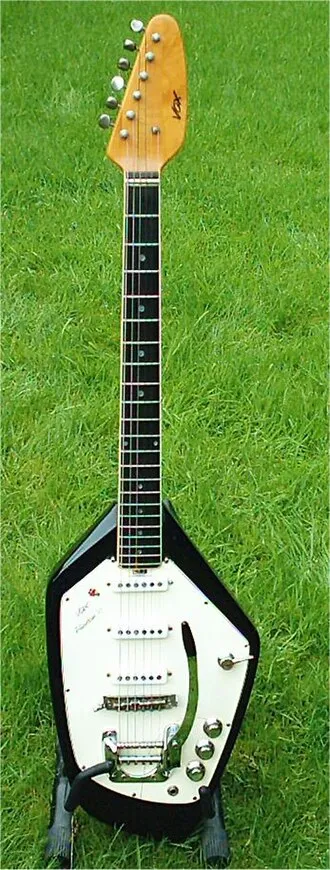
Photo: LittleRoughRhinestone / Wikimedia Commons / Public domain Vox
Phantom
1962
No Fenders in Britain, so Vox built a Strat in a five-sided coat you could spot from the back of the hall.

Photo: Lightburst / Wikimedia Commons / CC BY-SA 4.0 Fender
Stratocaster
1954
The guitar most people mean when they say “electric guitar.” Designed by a man who didn’t play one.
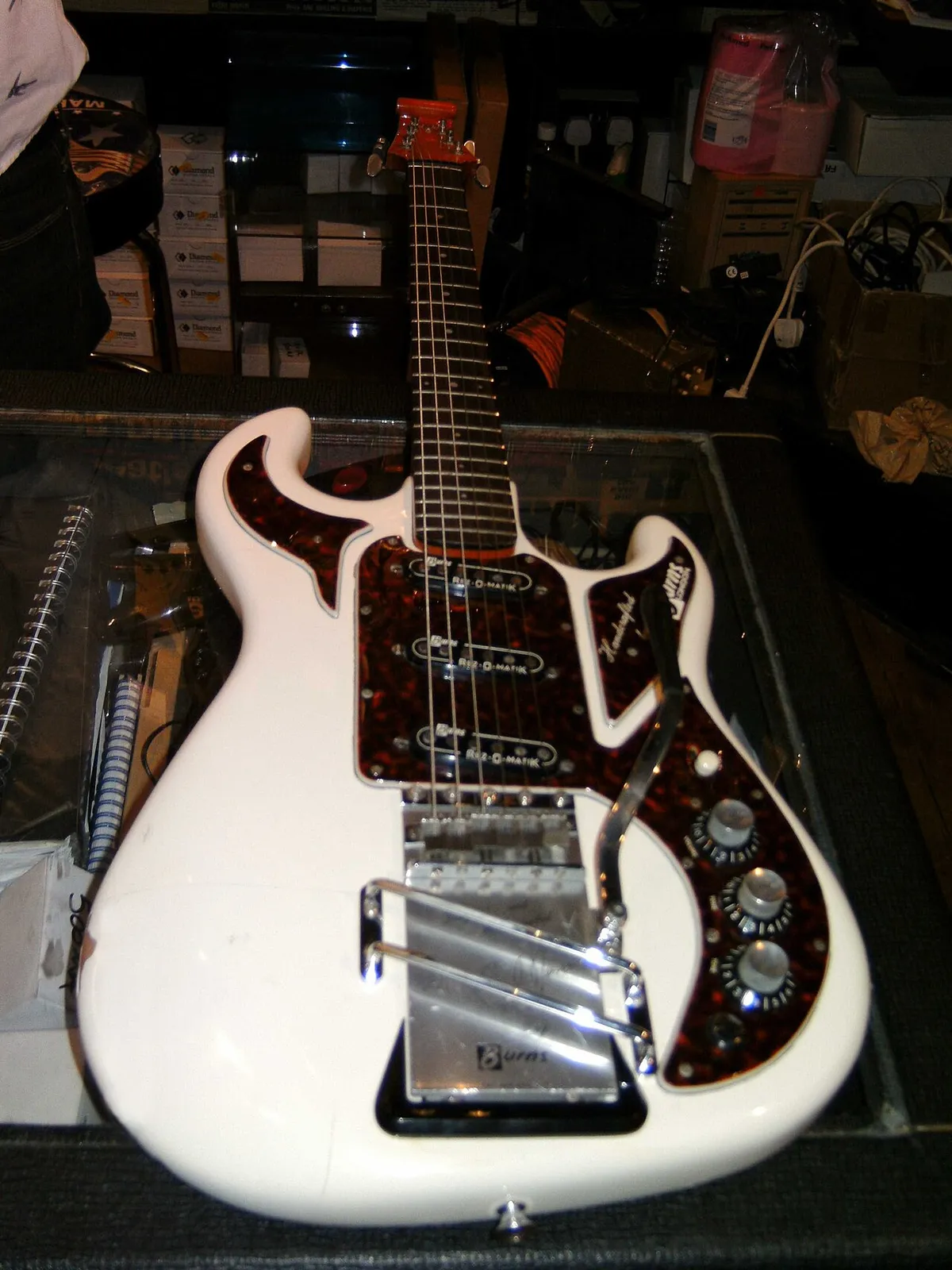
Photo: Bruce Marvin / Wikimedia Commons / Public domain Burns
Marvin
1964
Burns built Hank Marvin more than 30 prototypes to keep him in tune. Then somebody checked his jacket.