Gibson
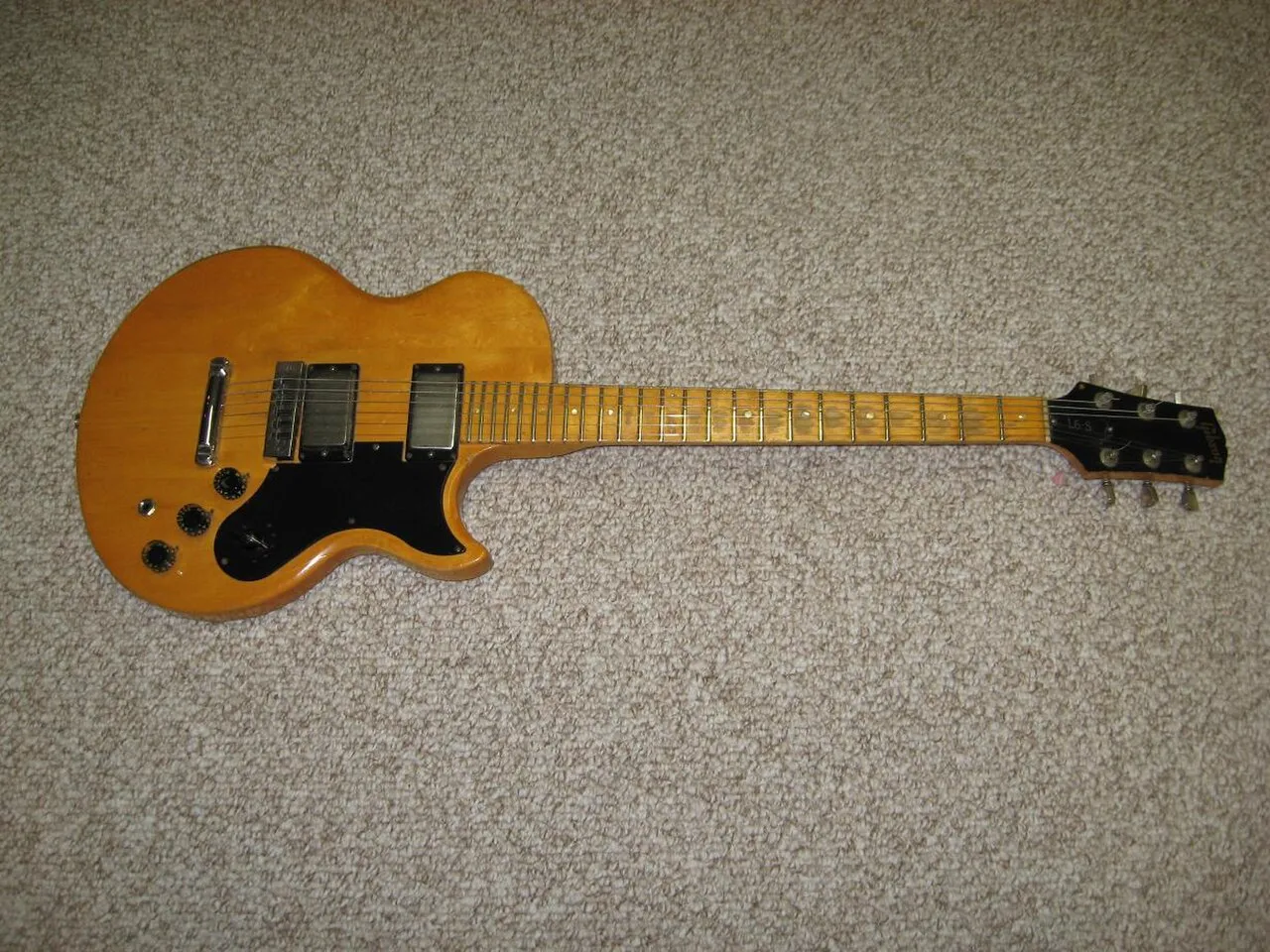
L-6S
Bill Lawrence drew a guitar with nine sounds. The budget cut it to six. Santana called it his rainbow.
In 1972 Gibson asked Bill Lawrence to bolt a multi-sound switching system onto the SG. He thought that made no sense, and talked them into letting him design a whole new guitar instead, as long as he stayed under a set production cost. He didn’t get everything he drew. What he did get was the first Gibson with 24 frets and a knob with six sounds on it.
- Introduced
- 1973
- Type
- Solidbody electric
- Class
- Production
The short version
1972
A free hand, on a budget
Lawrence talks Gibson into a new solidbody, as long as he stays under a set production cost.
1973
Summer NAMM, Chicago
The L-6S launches as the affordable cousin of the L-5S. List price in June, $495.
1974
The peak
The ledger shows 5,044 Customs shipped. Santana’s “rainbow” ad runs.
1974–75
Two siblings
The Deluxe and the bolt-on Midnight Special arrive. Sources split on the year. Neither gets the six-way.
1975
On The Midnight Special
Paul Stanley plays a white Midnight Special on NBC on 1 April.
1976
“Just another Les Paul-style Gibson”
Lawrence’s verdict on what the guitar had become under new ownership.
1980
Deleted
Gibson News announces the end in June. Stragglers leave Nashville into 1981 and 1982.
2011
The L6S
A reissue with a different six-way. It’s gone again by 2026.
Side A
A1
The guy who wanted nine sounds
In 1972, Gibson asked Bill Lawrence to design a multi-sound system for the SG Standard. That made no sense to him. So he went to marketing and talked them into a new solidbody instead. They gave him, as he put it, “a free hand as long as I observed a set production cost limit.”
That last part is the whole story. Lawrence drew a guitar with two three-way toggles and nine sounds: Les Paul, Strat, Tele, all on one instrument. He designed a three-post stainless bridge that could become a tremolo. He wanted the body edges chamfered.
Then the budget got to it. The contours would have cost “a mere $25 more.” They were cut. The bridge became a stock Schaller and a stop tailpiece. Somebody else drew the pickguard. The pickups got big existing covers. And the two toggles became one six-position rotary knob.
Most guitars that get watered down on the way to the factory just end up worse. This one still had enough left in it for a guitarist to call it his rainbow.
A2
A plank of maple with 24 frets
What shipped at Summer NAMM in Chicago, in 1973, was sold as the affordable version of the L-5S, Gibson’s upmarket solid. Same wide single cutaway, plain maple instead of curly, a flat slab with no carved top. It was not a Les Paul.
It had two firsts. It was the first all-maple Gibson solid, and it had the first Gibson neck with 24 frets, two full octaves, when 22 was the usual count. The cutaway was large enough that you could actually reach them. The scale stayed at Gibson’s 24¾".
The price was the other point. In January 1975 the L-6S listed for $499. A Les Paul Custom was $710. The L-5S was $899.
A3
One knob, six guitars
The rotary switch was a chicken-head knob. Here’s the map, starting from the counterclockwise stop:
- Both pickups in series. Fat and loud.
- Neck pickup alone.
- Both in parallel, the normal two-pickup sound.
- Both in parallel and out of phase, with a capacitor cutting the neck’s bass. Kin to a Strat’s in-between sounds.
- Bridge alone.
- Both in series, out of phase.
The pickups are ceramic Super Humbuckers under chrome covers, the bridge one wound a little hotter. The knobs are volume, a midrange control, and a treble roll-off. You don’t get Lawrence’s nine sounds. You do get a Gibson that can go from a humbucker growl to something thin and glassy without a second guitar.
Even with these changes, the early production L-6S was still an excellent performer.
That’s Lawrence, being generous about his own compromised design.
Flip the record · By the numbers
24
Frets. The first Gibson neck with a full two octaves. The usual count was 22.
6
Positions on the rotary switch. Lawrence had drawn two toggles and nine sounds.
$499
January 1975 list. A Les Paul Custom was $710, an L-5S $899.
$25
What Lawrence says the body contours he wanted would have cost. They didn’t make it.
Side B
B1
Santana’s rainbow
A natural 1972 prototype went from Kalamazoo to Carlos Santana, so he could try the 24 frets, the rotary, and the hand-poured, tar-backed Super Humbuckers. He tested it, then bought several and played them through the 1970s. Gibson put him in its ads in 1974 and 1976, with a natural Custom and a headline: “Santana Calls it His Rainbow.” He was on the cover of the 1975 Solid Body brochure too.
No specific Santana album side is pinned to a specific L-6S, so I won’t pin one. The ads are the fact.
Al Di Meola got an ad of his own in 1977, with an ebony Custom: “It’s the Best Two Guitars Al DiMeola’s Played.” Careful, though. By his own account, Casino and Romantic Warrior were a ’65 Les Paul Deluxe.
B2
The cheap siblings
By 1974 or 1975 (the sources disagree), Gibson split the line. The original became the Custom. Below it came the Deluxe, with strings through the body and a plain three-way switch, and the Midnight Special, a bolt-on that never appeared on a price list. Neither got the six-way.
Paul Stanley played Midnight Specials in Kiss’s early days, and remembered them this way:
Gibson was giving me these guitars, and they were called Midnight Specials, they had this weird white sparkle metal-flake finish and a bolt-on neck. They were free and sounded pretty good.
The factory ledger calls the finish white. Sparkle is his memory. Either way, he had one on NBC’s The Midnight Special on 1 April 1975.
B3
What was left
The L-6S sold. The ledger shows 5,044 Customs shipped in 1974 alone. Then it faded: by 1979, ten. Gibson’s newsletter announced the end in June 1980, and a few leftovers trickled out of Nashville into 1981 and 1982, many in Silverburst. In 2011 Gibson tried an L6S reissue with a different six-way. That’s gone now too.
Lawrence’s own verdict was hard. By 1976, he said, it had become “just another Les Paul-style Gibson solid-body. All that remained of my original design was the thin, lightweight body with its large cutaway for easy access to all 24 frets.”
He’s right about what was lost. But he left out the knob. Six sounds on a cheap maple slab, the part the cost limit couldn’t take away, and Gibson sold it to the world with one word from Santana: rainbow.
Put this on
You’ve read about it. Now hear it. Here’s what this guitar sounds like, and what to listen for.
Kiss on The Midnight Special
Paul Stanley with a white L6 Midnight Special, the bolt-on sibling, on the NBC show that shares its name. If you see a guitar get smashed, that’s a Marauder. Stanley says he never played one live, only broke them.
Watch it on YouTube (opens in a new tab)
The cast
The people, and the specific guitars, that made the legend.
1972
Bill Lawrence
Designer
Designed the guitar and the six-way idea behind it, then watched most of his design get cut down.
1974
Carlos Santana
1972 prototype, then several Customs
Tried a Kalamazoo prototype, bought several, and played them through the ’70s. The face of the “rainbow” ads and the 1975 brochure cover.
1977
Al Di Meola
Ebony L-6S Custom
In a 1977 Gibson ad. His Casino and Romantic Warrior guitar is a ’65 Les Paul Deluxe, not this.
1975
Paul Stanley
White Midnight Special
“They were free and sounded pretty good.” The bolt-on sibling, not the six-way Custom.
Liner notes
Specs, construction, rarity, value, and every source we used.
Twenty-four frets and a six-way rotary on a flat maple slab — Gibson’s L-6S, not a Les Paul, not the solid L-5S, and not an SG.
- Body
- Solid maple slab; single-cut. Catalog: 13½" wide, 16½" long, 1¼" thick. Piece count disagreed.
- Neck
- Set maple, three-piece. Joins for a full two octaves.
- Fingerboard
- Maple, rosewood, or ebony; 24 frets; dots. A few early examples have blocks.
- Scale
- 24¾". Crave, on a 1977 Deluxe: 24¾" (629 mm). Mix flagged. Not a second scale.
- Pickups
- Two chrome-covered ceramic Super Humbuckers (parts 13682 neck, 13683 bridge)
- Hardware
- Wide-travel Tune-o-matic and stopbar. Some late guitars wear a harmonica bridge.
- Electronics
- Master volume, midrange, treble roll-off; six-position rotary. Passive.
- Finish
- Natural maple gloss and ebony are the volume finishes. Tobacco sunburst, wine red, cherry, cherry sunburst. Silverburst from 1980.
- Nut
- Catalog 1 9/16". Crave’s 1977 Deluxe: 1 11/16". One 1975 Custom listing prints 40 mm. Mix flagged.
Open the full research fileConstruction details, the complete player record, production numbers, dated value estimates, and sources
Classic living example = 1973–early-1980s L-6S Custom, the six-way guitar. At launch it was just the L-6S. No current Gibson L-6S or L6S this pass. The 2011–12 L6S is not this table: 490R / 498T, coil-splits, SlimTaper .800" / .930", list $2,599. Deluxe is the three-way string-through. Midnight Special is the bolt-on, never on a price list. Not a Les Paul, not an SG, not an ES, not the L-5S. No millimetres invented for the body. Do not average the two nut widths, or treat 629 mm as a different scale.
Construction
The job was a cheap multi-sound Gibson that could sit under a Les Paul and answer a Fender. Bill Lawrence, quoted by vintageguitarandbass.com from his own site: in 1972 he was asked to design a multi-sound system for the SG Standard. That made no sense to him. He talked marketing into a new solidbody, “a free hand as long as I observed a set production cost limit.”
He did not get the guitar he drew. Existing pickup covers. No chamfered contours — “a mere $25 more” would have bought them. He had designed a three-post stainless bridge that could become a trem, and two three-way toggles for nine sounds: Les Paul, Strat, Tele. What shipped was a six-position rotary, large humbucker covers, a stock Schaller bridge with a stop tailpiece, and a pickguard somebody else drew. “Even with these changes, the early production L-6S was still an excellent performer.”
Summer NAMM, Chicago, 1973. vintageguitarandbass.com: the affordable L-5S. Same wide single-cut. Maple, not the L-5S’s curly maple. Vintage Guitar (Bob Dragich) dates that upmarket solid to 1972. Gibson’s Ron Wood page says 1973. Keep both. It is not the hollow L-5 (gibson-l-5-ces), and it is not a Les Paul (gibson-les-paul-standard): flat slab, no carved cap. January 1975 zone-1 list: L-5S $899, Les Paul Custom $710, this guitar $499, Deluxe $359–$409. Historical list, not 2026 street.
What shipped is 1¼" maple and the first Gibson neck with 24 frets. Usual count was 22. Scale stays 24¾", not a Fender 25½". Dots. A 1973 flyer shows blocks; the site says a few early ones do, and it is unclear if that left the prototype stage. Three-piece set neck (Premier). Body plies are not settled: Wikipedia says one-piece, then notes a Gibson-verified 1976 is two-piece; Ishibashi’s 2006 shop page says three-piece body and neck. Keep all three.
The rotary is the point. Premier and Wikipedia, same map, chicken-head, position 1 at the counterclockwise stop:
- Both pickups, series, in phase.
- Neck alone.
- Both, parallel, in phase.
- Both, parallel, out of phase, neck bass cut by a capacitor. Fuller than a naked out-of-phase, kin to a Strat’s in-between.
- Bridge alone.
- Both, series, out of phase.
Premier calls the knobs master volume, midrange, and a tone that is brightest at 10. vintageguitarandbass.com prints the third as “treble roll-off.” The bridge Super Humbucker is wound a tad hotter (Premier). Ceramic, four-conductor, chrome covers.
Then the line split, and the year is not agreed. Shipping ledger: Midnight Special cells start 1974, Deluxe cells 1975. The site’s narrative matches that, and says the original was renamed Custom once the Deluxe existed. Premier puts both siblings in 1974. Wikipedia dates the Deluxe 1974–1979. Keep 1974 and 1975. Neither gets the six-way. Deluxe: set neck, rosewood, black “tar back” covers — epoxy potting, Premier says — three-way, strings through. Midnight Special: bolt-on, three-way, string-through, harmonica bridge, designated L6 Midnight Special with the S dropped. Never catalogued, never price-listed. The site hedges that some cheaper bodies may have been alder. The spec lines still say maple.
Lawrence again: “When the new ownership took over, there were even more changes, and by 1976, the L6-S had become just another Les Paul-style Gibson solid-body. All that remained of my original design was the thin, lightweight body with its large cutaway for easy access to all 24 frets.”
Kalamazoo first. Nashville “certainly by the end of 1977, perhaps earlier.” List moves from $495 (June 1973) to $539 (May 1974), back to $499 (January 1975; lefty $549), and $649 in the January 1980 column. Premier’s bookends are the same $495 to $649, and he puts a 1980 Strat list at $995. His comparison, not a Fender scan in hand.
The stop is a smear. Wikipedia: off the price lists in 1979, Custom still catalogued and still made in Nashville in 1980. The shipping footnote prints last appearances as 7/1/80 (Custom) and 1/6/79 (Deluxe), day and month not expanded. Deluxe has a January 1979 price and no January 1980 cell. Gibson News, June 1980, announces the deletion. Stragglers leave Nashville into 1981 (Custom, Deluxe) and 1982 (Midnight Special), many in Silverburst, a finish the 1973–79 cells never show. The June 1981 Specials folder still lists the Custom as a close-out. Premier stops at 1980. Keep the smear.
2011. It returns as L6S, the second hyphen gone. Archived product page, 18 April 2012: Antique Natural or Silverburst nitro, $2,599, 24 medium-jumbo frets, 12" radius, 490R neck and a hotter 498T bridge. Gibson’s six-way is now bridge humbucker, bridge single, both singles, both humbuckers, neck single, neck humbucker. Series and out-of-phase are gone. Wikipedia’s reissue section swaps the pickups to 490T/498R. Prefer Gibson’s page. Wikipedia also says a two-piece body and a conventional neck, not the old narrow-at-the-nut taper. Japanese Wikipedia dates the reissue to 2011 only; the English section says 2011–2012; the infobox still says “2011–present.” Sweetwater’s Silverburst page (DSL6TSBCH) is up and marked gone. Classic against current: the 1973 six-way, and no new L-6S to order in September 2026.
Players
Do not hang a Les Paul, an SG, or an L-5S on this plate. Di Meola’s Casino and Romantic Warrior guitar, in his own later telling, is a Les Paul. The guitars Stanley smashed are Marauders.
Carlos Santana — the rainbow ads, and a 1972 prototype. The ads, not a career-long identity, and no album side pinned to a serial. vintageguitarandbass.com: 1974 and 1976, “Santana Calls it His Rainbow,” a natural Custom in the pictures. Julien’s, 17–18 November 2023: a natural 1972 prototype, letter from Larry Cragg dated 31 March 2022. It came from Kalamazoo so he could try the 24 frets, the rotary, and the hand-poured tar-back Super Humbuckers. He tested that one, then bought several and played them through the 1970s, including the 1974 campaign and the 1975 Solid Body brochure cover. Sold at $5,120 (estimate $4,000–$6,000). One object. Not a production 1973, and not a comp.
Al Di Meola — the 1977 ad, not Elegant Gypsy by default. Mid-1977 Gibson ad, ebony Custom: “It’s the Best Two Guitars Al DiMeola’s Played.” That picture is the fact. Premier Guitar (Joe Bosso, 1 September 2015) has him on a ’65 Les Paul Deluxe for Casino and Romantic Warrior. Guitar Player’s interviews on “Race with Devil on Spanish Highway” do not name this model. Do not move those tracks onto the L-6S.
Paul Stanley — a Midnight Special, December 1974 into 1975. Not the six-way Custom. Premier’s 2021 lede files him on the Custom. His own sentence does not. Axeology, quoting Metal Edge presents KISS Alive (1996): “Gibson was giving me these guitars, and they were called Midnight Specials, they had this weird white sparkle metal-flake finish and a bolt-on neck. They were free and sounded pretty good.” The ledger’s word is White, 161 guitars, cells in 1975–77. Sparkle is his memory. Keep both. First possible sighting, Axeology: 12 December 1974, Davenport, before those white cells. Kiss Timeline: 1 April 1975, NBC’s The Midnight Special, the white one. The guitars he broke are Marauders. Vintage Guitar, March 1997, via that timeline: “Truly, the Marauder was the guitar that I broke on stage every night, I never played one live.”
Also known, short, and not a session log. Premier’s same lede names Dave Davies, Prince, Pat Martino, and Keith Richards on the Custom, no guitar and no year. Gibson’s 2011 page names Rich Williams of Kansas next to Santana, no song. vintageguitarandbass.com’s user list adds Lady Bo and Johnny Borrell. Wikipedia’s unsourced crowd — McLaughlin, Oldfield, Malcolm Young, Prince on a Deluxe — is not repeated here as fact. Keith’s documented loan is the other solid: Vintage Guitar (Dragich) has Ron Wood lending Richards a custom single-pickup L-5S for the 1988 X-Pensive Winos tour. That is not an L-6S.
Rarity
You cannot buy a new L-6S. The 2011 reprint is gone, and it was a different circuit anyway. The count in hand is the vintageguitarandbass.com ledger, 1973–1979 only. Nashville stragglers after that are real and uncounted. Wikipedia’s round numbers — over 12,000 Customs, around 3,500 Deluxes, some 2,000 Midnight Specials — are this ledger, rounded. The cells:
| 1973 | 1974 | 1975 | 1976 | 1977 | 1978 | 1979 | |
|---|---|---|---|---|---|---|---|
| Custom | 181 | 5,044 | 2,115 | 2,516 | 1,131 | 1,463 | 10 |
| Deluxe | — | — | 1,239 | 964 | 964 | 313 | 3 |
| Midnight Special | — | 1,149 | 763 | 129 | 29 | 3 | 4 |
The page’s total line prints Custom 12,297, Deluxe 3,483, Midnight Special 2,077, which adds to 17,857. The Deluxe and Midnight Special totals match their own columns. The seven Custom columns, as printed, add to 12,460, not 12,297 — 163 guitars the total line does not explain. Using the columns, the three models add to 18,020. Keep both. Peak year is 1974, and it is mostly Customs. By 1979 the factory is shipping a handful. Premier’s “more than 18,000” can be either reading, plus the uncounted stragglers. Do not average them.
The 1973 finish split inside those 181 is 179 natural maple and 2 ebony. The site says cherry-sunburst and tobacco-sunburst 1973s exist anyway, and it is unclear whether the ledger omitted them. Keep that hole. Scarce on purpose, inside the printed cells: Custom cherry 16 (all 1975), Custom wine red 25. Natural and ebony are the ordinary Custom. White Midnight Specials are 161, not a secret run of one. Serials — six-digit stamps, then the eight-digit decals — date a guitar. They don’t count a year. That is why a 1980–82 addendum is unknown, not the chapter.
What is actually thinner: first-year wide-cutaway Customs that still have Lawrence’s six-way and the Super Humbuckers; block-inlay early ones, if they left the prototype stage; wine red and cherry; a real Silverburst from the closeout, which the 1970s cells never show. Santana’s 1972 prototype and Stanley’s sparkle Midnight Special are unique objects. They are not a vintage L-6S.
Value
Informal estimate, 23 September 2026. Not an appraisal.
Asking prices are not sold prices. Celebrity lots are not-comps. A Deluxe is not a six-way Custom. A Midnight Special is not either. The 2011 L6S is not 1973 money. Period $495 (June 1973) and $649 (January 1980) are 1970s money, not 2026 street. Sold comps are thin this pass: one listing-page widget, no order count, and the Reverb Price Guide page itself did not render a dollar band. Don’t invent a median.
New street. None. No L-6S in the current Gibson line. Historical, not a cart: 2011–12 L6S list $2,599 (Gibson page archived 18 April 2012). Sweetwater’s Silverburst listing (DSL6TSBCH) is discontinued and prints no 2026 price.
Used modern. No clean Reverb Price Guide band for the 2011–12 L6S isolated this pass. Don’t invent one from the dead list price.
Vintage / collectible. A Reverb listing for a Very Good 1973 natural printed an estimated-used widget of $1,131–$1,451. The same listing’s ask was $1,799. Widget under the ask. Treat as that page’s range, not a series. Premier, 25 October 2021, had one tobacco-burst Custom asking $1,495 and called about $1,400–$1,700 the going range that month. Dated. Not 2026. A 1973 black on Reverb this pass is asking $1,449, down from $1,595, with a Les Trem, Sperzel tuners, and a brass nut. Modified. Not a clean Custom. Do not average the widget, the 2021 range, and the asks.
Santana’s prototype, Julien’s, sold at $5,120. One 1972 object with a tech’s letter. Not a comp for a 1974 natural.
See also
- Les Paul Standard — carved mahogany and a maple cap, 22 frets, a three-way. Not this flat 24-fret slab
- L-5 CES — the hollow jazz box. The solid L-5S, no plate here, is the expensive cousin this was priced under
- Stratocaster — the bolt-on Lawrence was trying to answer with a six-way. Different scale, different neck
Sources
- vintageguitarandbass.com, Gibson L6-S — Summer NAMM 1973; first all-maple Gibson solid; first 24-fret Gibson; Lawrence 1972 quote (budget, SG brief, $25, nine-sound toggles, Schaller + stop, by 1976 “just another Les Paul-style”); Custom / Deluxe / Midnight Special specs; 24¾"; 13½" × 16½" × 1¼"; nut 1 9/16"; parts 13682 / 13683; Kalamazoo then Nashville by end of 1977; Gibson News June 1980; stragglers to 1981 / 1982; 2011 reissue; Santana and Di Meola ads. A 1975 ebony Custom in the page’s for-sale block prints a 40 mm nut. One listing. Mix flagged
- vintageguitarandbass.com, L6-S shipping and pricing — 1973–79 cells; printed totals Custom 12,297 / Deluxe 3,483 / Midnight Special 2,077; Custom columns add to 12,460, not 12,297; cherry 16; wine red 25; white Midnight Special 161; zone-1 prices June 1973–January 1980; January 1975 comparison with L-5S, Les Paul Custom, SG, Deluxe, Marauder; footnote prints last lists 7/1/80 and 1/6/79, day and month not expanded
- Premier Guitar, Richie Owens, Gibson L6-S Custom (25 October 2021) — designed 1972, released 1973; first solid-maple-slab; 3-piece neck; 24 frets; six positions including the capacitor on 4; volume / midrange / bass-treble; ceramic Super Humbuckers; harmonica bridge on a final-year guitar; debut $495 to $649; 1980 Strat list $995; more than 18,000 by 1980; Deluxe and Midnight Special “1974”; tar-back potting; player lede; 13½" × 1¼"; October 2021 ask $1,495 and range about $1,400–$1,700
- Wikipedia, Gibson L6-S — 1973 release; 24.75"; six-way map; Custom renamed when the Deluxe arrived; over 12,000 / about 3,500 / about 2,000; price lists 1979, Custom still made 1980 in Nashville; one-piece vs a verified two-piece 1976; 2011–12 reissue wiring and the 490T/498R swap; infobox “2011–present” disagrees with the section head. Page is citation-thin. Player crowd not used as fact
- Wikipedia (Japanese), Gibson L6-S — developed 1972, released 1973; reissue dated 2011 only
- Gibson L6S product page (archived 18 April 2012) — Antique Natural and Silverburst; $2,599; 490R neck, 498T bridge; split-coil six-way; SlimTaper .800" / .930"; 24 frets; 12" radius; Santana and Rich Williams named, no songs
- Sweetwater, Gibson L6S Silverburst — item DSL6TSBCH no longer available; no 2026 price
- Julien’s Auctions, Santana 1972 L6-S prototype — 17–18 November 2023; Cragg letter 31 March 2022; Kalamazoo prototype; several later guitars; 1974 ad; 1975 brochure cover; sold $5,120; estimate $4,000–$6,000
- vintageguitarandbass.com ads: Santana 1974, Santana 1976, Di Meola 1977 — “Santana Calls it His Rainbow”; ebony Custom, “the Best Two Guitars Al DiMeola’s Played”
- Premier Guitar, Al Di Meola (Joe Bosso, 1 September 2015) — ’65 Les Paul Deluxe on Casino and Romantic Warrior; not this plate
- Axeology, Paul Stanley Midnight Special — And Party Every Day p. 100 on the Gibson deal; Stanley 1996 quote, sparkle metal-flake, bolt-on; 161 white, 1975–77; December 1974
- Kiss Timeline, 1 April 1975 — white Midnight Special on the NBC show; Vintage Guitar, March 1997, Marauder quote. The smashed guitar is not this model
- Vintage Guitar, Bob Dragich, L-5S Ron Wood — L-5S introduced 1972 as a solid L-5; Wood loaned Richards a single-pickup L-5S in 1988. Not an L-6S
- Gibson, Ron Wood L-5S (legacy product page) — dates the L-5S introduction to 1973. Disagrees with Dragich. Not this plate
- Ishibashi, Legendary Guitar, 1977 L-6S — shop copy as of 2006: maple body and neck, both three-piece laminate. One of three piece-counts
- Crave Guitars, 1977 L6-S Deluxe — one Deluxe: 24¾" (629 mm); nut 1 11/16"; string-through; three-way. Mix flagged
- Carter Vintage, 1975 L6-S natural — one guitar: maple, 24.75", nut 1.57", 12" radius, 8 lbs. Not a factory average
- Reverb, 1973 L6-S Custom natural — ask $1,799; listing widget $1,131–$1,451; no order count
- Reverb Price Guide, L6-S Custom 1973–1980 — years 1973–1980; 24 frets; 24.75"; set maple; dollar widget did not render this pass. Featured ask: 1973 black, modified, $1,449 from $1,595
- Gibson.com product search, 23 September 2026 — no current L-6S / L6S SKU
Keep digging
Guitars this one gets compared to, confused with, or descended from.

2006 Gibson Les Paul Standard (SN 000660573). Photo by wetwebwork. Licensed under CC BY-SA 2.0. Via Wikimedia Commons. Gibson
Les Paul Standard
1952
Gibson made about 1,500 sunburst Les Pauls, decided nobody wanted them, and stopped. Then the British blues boom happened.
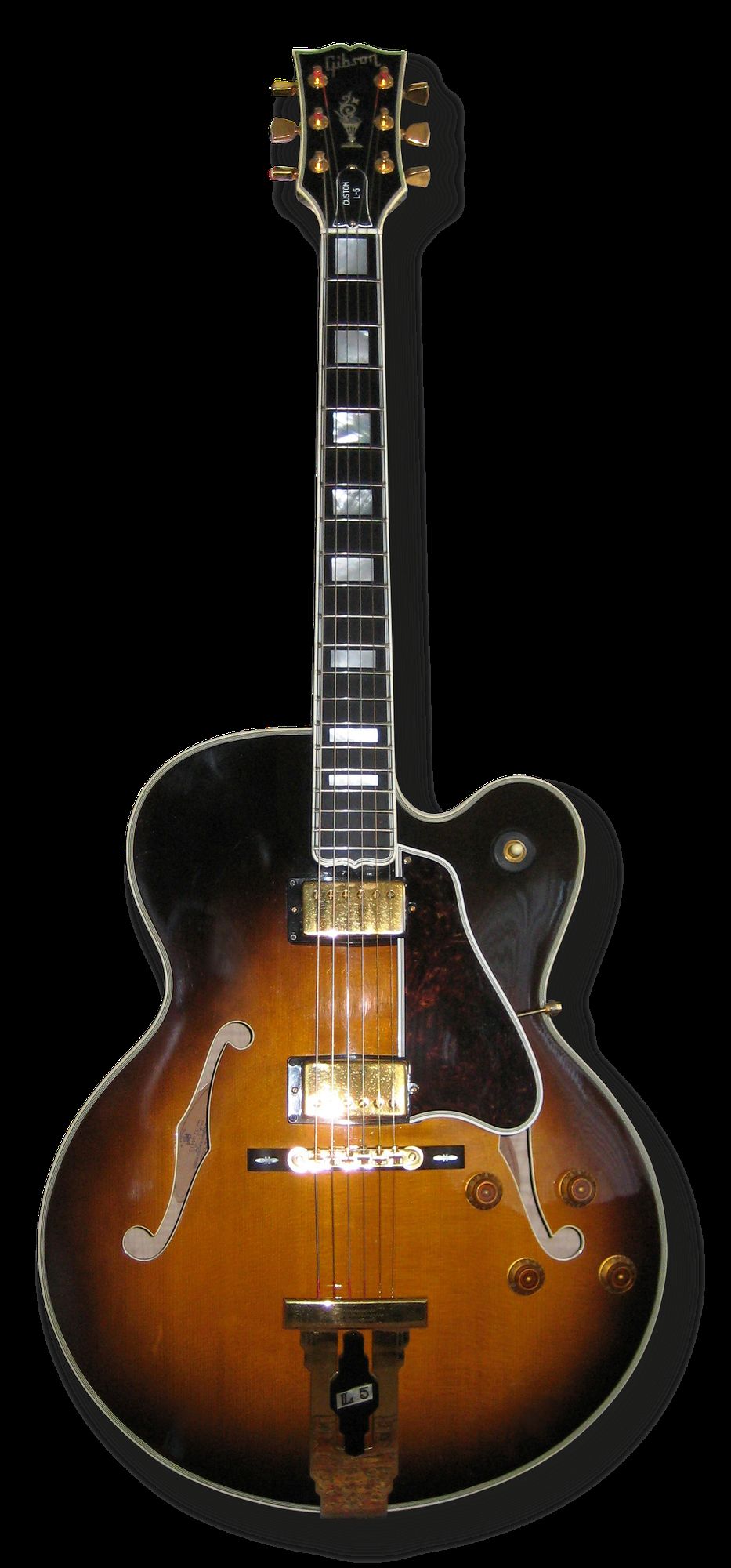
Gibson L-5 CES Tobacco Burst. Photo by Cruciniacus; isolated background by Auge=mit. Licensed under CC BY-SA 3.0. Via Wikimedia Commons. Gibson
L-5 CES
1951
In the ’50s Gibson shipped a few dozen a year. Wes Montgomery and Scotty Moore made them count.

Photo: Lightburst / Wikimedia Commons / CC BY-SA 4.0 Fender
Stratocaster
1954
The guitar most people mean when they say “electric guitar.” Designed by a man who didn’t play one.