Gibson
Blueshawk
It looks like a small Les Paul, plays on a Fender scale, and hides a coil that never hears the strings.
Gibson built the Blueshawk in 1996, a little chambered single-cut with the blues in its name and in its pickups. It never made the posters. Carl Perkins got the first one, and B.B. King fell for it.
- Introduced
- 1996
- Type
- Solidbody electric
- Class
- Production
Have a photograph of this guitar? Send a picture
The short version
1993
The first Hawk
The Nighthawk shows at Winter NAMM, a compact single-cut on a 25½-inch scale. The Blueshawk borrows its outline.
1996
A prototype on the Rock Walk
On 11 June, Gibson hands Carl Perkins a red Blueshawk at his Hollywood Rock Walk induction, and he plays it.
1996
Launch
The Blueshawk launches in July. J.T. Riboloff files his dummy-coil patent the same month.
1997
Chicago Blue
A third finish joins Ebony and Heritage Cherry. A Maestro vibrato version runs from 1997 to 2000.
1999
Little Lucille
Gibson builds B.B. King a Blueshawk variant with a Tune-o-matic and his TP-6 tailpiece.
2005
The end, give or take
Production stops in 2005, or in spring 2006, depending who you ask.
2015
The Epiphone
Epiphone shows a Blueshawk Deluxe at Winter NAMM, with mahogany and P-90 PROs. A different guitar under the same name.
Side A
A1
A red guitar on the Rock Walk
On 11 June 1996, Carl Perkins was inducted into the Hollywood Rock Walk. Tom Petty introduced him. Gibson brought a present: a red guitar nobody had seen yet, the first prototype of something called the Blueshawk. Perkins played it right there.
The next month it went on sale. It wasn’t a Les Paul and it wasn’t a 335, and it was never going to be on anybody’s poster. It had the blues in its name and in its pickups, and that turned out to be enough for some of the right people.
A2
A small Gibson on a Fender scale
The job was a Gibson that could do P-90 blues work on a Fender scale. The outline came from the Nighthawk, a compact single-cut Gibson had shown in 1993. From across a room it looks like a small Les Paul. Up close, almost nothing matches.
The body is poplar, not mahogany, under a flat maple top with two f-holes. Gibson routed small chambers into it, so it’s a solid guitar with pockets, not a hollow one. There’s no center block like a 335 and no carved cap like a Les Paul. The back has a contour, closer to a Strat’s belly cut than a slab. It weighs around six and a half pounds, under seven, depending who weighed it.
The scale is 25½ inches, Fender’s length, where Gibson usually uses 24¾. The strings load through the body, more hardtail Tele than stopbar. If you’ve only played Gibsons, the extra length is the first thing your hands notice.
A3
The coil that gets out of its own way
The pickups are the point, and they aren’t P-90s, though the cream soapbar covers fool people. They’re Blues 90s, with fixed poles instead of adjustable screws, wound with fewer turns than a P-90.
The clever part sits in the back cavity: a third coil, a dummy, with no magnets and nowhere near the strings. It never hears a note. All it does is cancel hum. Play the neck or the bridge pickup alone and the dummy is wired in with it, quieting the buzz single-coils are famous for. Pick the middle position and the two Blues 90s cancel each other, so the dummy drops out.
“The main feature of the BluesHawk is that you can obtain a good single-coil, fast attack-type sound with hum-cancelling capability,” Riboloff said. He designed it, and he patented the dummy coil the same month the guitar launched. On the dummy: “It’s wired into the circuit in a unique fashion to where it knows to get out of its own way when it’s not needed.”
It never hears a note. All it does is cancel hum.
Flip the record · By the numbers
25½"
Scale length. Fender’s number, not Gibson’s usual 24¾.
6
Positions on the Varitone rotary. The first one is bypass.
18
Sounds, three pickup settings times six. Some count 21. They’re counting bypass as a change.
7,200
Turns of 42-gauge wire on the sounding coils, per Riboloff’s patent.
Side B
B1
Six ways to lose the middle
Then there’s the rotary knob: a six-way Varitone, a cousin of the one on the ES-345. Position one is bypass, plain Blues 90. Two through six notch more and more of the midrange out, each one a little hollower. Pull up the tone knob and the Varitone switches off, so you can jump straight back.
Three pickup settings times six positions makes eighteen sounds. Some people say twenty-one. They’re counting bypass as a change. It isn’t.
The hardware was gold. The finishes were Ebony and Heritage Cherry, and Chicago Blue from 1997. Gibson painted “Blues Hawk” in script on the top, just above the fingerboard. From 1997 to 2000 you could get one with a Maestro vibrato instead of the string-through.
B2
B.B. King’s infatuation
The Blueshawk didn’t pile up famous names. Billy Lee Riley held one on the cover of Hot Damn!, a 1997 blues album that got a Grammy nomination. That’s the photograph. Which tracks it’s on isn’t on the record.
Then, in February 1999, Gibson announced Little Lucille, a guitar for B.B. King. It kept the Blues 90s and the dummy coil and the long scale. It swapped the string-through for a Tune-o-matic and his TP-6 fine-tuner tailpiece, bound the board, and came in black. Gibson’s announcement said it was “Inspired by B.B. King’s infatuation with the Gibson Blueshawk.”
Little Lucille isn’t Lucille. Lucille is an ES-355 with the f-holes gone. And it isn’t a Blueshawk either. It’s a variant, built for one man.
The original stopped in 2005 or 2006, depending who you ask. Epiphone used the name in 2015 for a mahogany guitar with P-90s, a different recipe. You can’t order a Gibson Blueshawk today.
Lucille got the stage, the name, and the stories. But for a while the most famous blues guitarist alive had a crush on the little one, and Gibson built him one of his own.
The cast
The people, and the specific guitars, that made the legend.
1996
Carl Perkins
The first prototype, red
Presented to him by Gibson at his Hollywood Rock Walk induction on 11 June 1996, with Tom Petty introducing him. He played it there. A 1996 guitar, not a Sun Records one.
1996
J.T. Riboloff
The Blueshawk, as designer
The named designer. His patent on the dummy coil was filed in July 1996 and granted in 1999, assigned to Gibson.
1997
Billy Lee Riley
A Blueshawk, on the cover of Hot Damn!
Pictured with one on the cover and in the booklet of his Grammy-nominated blues album. Which tracks it plays on isn’t on record.
1999
B.B. King
Little Lucille, a Blueshawk variant
Gibson said the guitar was inspired by his infatuation with the Blueshawk. Tune-o-matic, TP-6, bound board. Lucille herself is still the ES-355.
Liner notes
Specs, construction, rarity, value, and every source we used.
Two Blues 90s, a dummy coil, and a Varitone on a chambered 25½-inch Hawk — Gibson’s Blueshawk, not a Nighthawk and not a Les Paul.
- Body
- Single-cut poplar, bound solid maple top, two f-holes and routed tone chambers, contoured back. Compact Hawk outline.
- Neck
- Set mahogany. Narrow with slight V. zZounds / TopGuitars: 0.800" at the 1st fret, 0.850" at the 12th. Peghead pitch 14.
- Fingerboard
- Unbound rosewood, pearl diamonds, 22 frets. Little Lucille binds the board. Not this table.
- Scale
- 25½". blueshawk.info: 25.5 inches / 64.8 cm. Mix flagged. Not Gibson’s 24¾".
- Pickups
- Two cream Blues 90 soapbars; dummy coil in the rear cavity. Not a dog-ear or soapbar P-90.
- Hardware
- Gold. Low-profile string-through, six saddles. Gibson / Kluson Deluxe tuners. Optional Maestro. Stock gig bag.
- Electronics
- Master volume, master tone (push/pull Varitone bypass), 3-way blade, six-way rotary Varitone. Passive.
- Finish
- Ebony, Heritage Cherry (clear), Chicago Blue (clear). Chicago Blue: Blue Book 1997–2005.
- Nut
- blueshawk.info spec 1.7" / 4.2 cm; history table 1.62". zZounds / TopGuitars: 1 5/8". Mix flagged.
Open the full research fileConstruction details, the complete player record, production numbers, dated value estimates, and sources
Classic living example = 1990s Gibson USA Blueshawk (DSBH): maple over poplar, Blues 90s, dummy coil, Varitone, string-through, 25½". No current Gibson USA Blueshawk this pass (fetched 12 October 2026). Maestro (Blue Book 1997–2000) is the vibrato sibling, not the table. Little Lucille (1999) is Tune-o-matic / TP-6, bound board, Ebony — not this guitar. The Hawk, Landmark, and Nighthawk share the outline and are other Hawks. Epiphone Blueshawk Deluxe (2015) is mahogany, P-90 PROs, flame veneer — import, not this table. Reverb’s “1994–2006” window is a dating band, not a factory intro. Mixed inch/mm flagged on blueshawk.info’s 25.5 inches / 64.8 cm, 1.7" / 4.2 cm, and ~6.5 lb / 2.95 kg. Do not average the nut widths, or treat 64.8 cm as a different scale.
Construction
The job was a Gibson that could do P-90 blues work on a Fender scale without becoming a Les Paul or a 335. Same compact single-cut the Nighthawk had already put on the floor. Poplar, not mahogany. Chambers and f-holes, not a solid M-series slab. Blues 90s and a dummy coil, not soapbars. A six-way Varitone. Scale 25½", not 24¾". Strings through the body.
J.T. Riboloff is the named designer. The Nighthawk (gibson-nighthawk) is the first Hawk: Winter NAMM 1993, M-series, solid mahogany and maple, five-way. blueshawk.info: the Blueshawk launched July 1996. Carl Perkins was handed a prototype that June. Riboloff’s dummy-coil patent, assigned to Gibson, was filed 8 July 1996 and granted 27 April 1999 (U.S. 5,898,121). This plate starts in 1996. Reverb’s “1994” and guitar-list’s “1993” are other Hawks leaking onto the product page. Keep them off the intro.
It looks like a small Les Paul from across a room. It is a different platform. Wikipedia and the older Academic copy: Nighthawk outline, twin f-holes, “flat (uncarved) top.” Blue Book: single-cut poplar, bound solid maple top, two f-holes. blueshawk.info FAQ, the sentence that matters: “No — the BluesHawk is a semi-hollow, solid bodied guitar which has smallish cavities cut into the body.” German Wikipedia: poplar with routed chambers and a maple top. It is not an ES-335 (gibson-es-335). No maple-poplar-maple laminate, no maple stick through the middle, no 16-inch wings. It is not a Les Paul (gibson-les-paul-standard). No carved maple cap, no mahogany back, no Tune-o-matic and stop. Contoured back, closer to a Strat’s belly cut than a Les Paul slab. Weight on the spec sheet: around 6.5 lb / 2.95 kg; Wikipedia: under 7 lb. Mix flagged. Do not average.
The pickups are the point, and they are not P-90s. Soapbar covers. Fixed Alnico poles, not adjustable screws over a bar magnet. blueshawk.info: Alnico 5, 42-gauge wire, fewer turns than a P-90, poles the same height. The patent: 7,200 turns of 42 AWG, pole pieces Alnico II. Keep 5 and II. Dummy coil in the back, no magnets, away from the strings. Riboloff, via blueshawk.info: “The main feature of the BluesHawk is that you can obtain a good single-coil, fast attack-type sound with hum-cancelling capability.” Neck or bridge alone, the dummy is in series. Middle, the two Blues 90s cancel each other and the dummy drops out. “It’s wired into the circuit in a unique fashion to where it knows to get out of its own way when it’s not needed.” Not a stacked P-100. Not a soapbar Special (gibson-les-paul-special).
The six-way is kin to the ES-345 Varitone (gibson-es-345), not that guitar’s stereo board. Position 1 is bypass — blueshawk.info: the vanilla Blues 90, the same as the tone knob pulled. Positions 2–6 notch more of the midrange out. Push/pull on the tone kills the rotary so you can jump back. Eighteen combinations if you count three pickup positions times six. Some people say twenty-one; they are counting position 1 as a change. It isn’t.
Hardware is gold. Bridge is the Nighthawk’s low-profile string-through, six saddles, closer to a hardtail Tele than a stopbar. Maestro is catalog 1997–2000 (Blue Book); Reverb often files those as “Bigsby.” Prefer Maestro. Stock case is a black Gibson USA gig bag (Blue Book; zZounds).
Three finishes, same circuit. Ebony. Heritage Cherry. Chicago Blue from 1997 (Blue Book). Wikipedia: a painted cursive “Blues Hawk” just above the board, between the neck pickup and the front strap pin. Pearl logo and double diamond on a blackface peghead.
Siblings, not this table. The Hawk (Blue Book 1996–97): mahogany, two 490R, wrapover, chrome, dots. Landmark: park finishes on a Nighthawk, two minis, no Blues 90s. Little Lucille, Gibson press 16 February 1999: “Inspired by B.B. King’s infatuation with the Gibson Blueshawk.” Tune-o-matic and TP-6, cream binding on body and board, Grover, Ebony, hard case. Same Blues 90s and dummy coil. Same 25.5"; nut 1.6875" on that sheet. It is not Lucille. Lucille is an ES-355 with the f-holes gone (gibson-es-355).
The stop is a smear. Blue Book: mfg. 1996–2005. Wikipedia and blueshawk.info: discontinued Spring 2006. One Audiofanzine owner dates the cut to April 2006. Keep 2005 and 2006. Gibson did not publish a Blueshawk factory total. None invented.
2015. Winter NAMM, Epiphone Blueshawk Deluxe. MusicRadar and Premier Guitar (15 May 2015): mahogany, contoured back, maple with AAA flame veneer, P-90R PRO and P-90T PRO, dummy coil, six-way VariTone, string-through, bound board, SlimTaper D, 25.5". Midnight Sapphire, Translucent Black, Wine Red. Premier Guitar: MSRP $832. Not Blues 90s. Not poplar. Not a Gibson USA guitar. Classic against current: the 1996 DSBH — poplar, Blues 90s, dummy coil, Varitone, 25½" — and no new Gibson USA Blueshawk to order in October 2026.
Players
Do not hang a Les Paul, a Nighthawk, an ES-335, or Lucille on this plate. Do not move “Blue Suede Shoes” onto a 1996 prototype. Do not recruit the Little Lucille as if it were this string-through. Wikipedia’s unsourced crowd is not repeated here as fact.
Carl Perkins — the first prototype, 11 June 1996. Wikipedia, citing Billboard (6 July 1996, p. 14, “Don’t Step on His Shoes”): he received the first prototype Blueshawk in 1996. Rockhurst Auctions, May 2023, with a letter from his son Stan: Gibson presented the red Blueshawk at Perkins’s Hollywood Rock Walk induction that 11 June; Tom Petty introduced him; Perkins played the guitar there. One object, from the family. Not a session log for Sun Records, and not a 1956 guitar.
**Billy Lee Riley — Hot Damn!, 1997, the cover.** German Wikipedia: Riley on the cover and in the booklet of the Capricorn blues album, Grammy-nominated that year, with a Blueshawk. Discogs personnel: Riley vocals, harmonica, rhythm guitar; James Lott lead and rhythm. The photograph is the fact. Which tracks on which guitar are unpublished here.
B.B. King — Little Lucille, 1999, not this table. Gibson’s 16 February 1999 release: a Blueshawk variant with his TP-6 and Varitone. Endorsement on the factory sheet. Lucille remains the ES-355. Do not file “The Thrill Is Gone” here.
Also known to play stays last and empty of inventions. No session log invented.
Rarity
You cannot buy a new Gibson USA Blueshawk. The 2015 Epiphone Deluxe is gone, and it was a different factory and a different pickup. Little Lucille is the other Hawk with Blues 90s. It is not this string-through.
Gibson did not publish Blueshawk unit totals. None invented. Nashville eight-digit serials date a guitar. They don’t count a year. That is why a 1996 census is unknown, not the chapter. Reverb’s “1994–2006” product-page window is a dating band, not a factory intro; blueshawk.info, Blue Book, and Wikipedia start the model in 1996. guitar-list’s “1993” is the Nighthawk leaking.
What is actually thinner: first-year 1996 Heritage Cherry and Ebony with the Blues 90s and dummy coil still stock; Chicago Blue from 1997; a real Maestro from the 1997–2000 window. Perkins’s Rock Walk guitar and a signed Little Lucille are unique objects. They are not a vintage Blueshawk.
Value
Informal estimate, 12 October 2026. Not an appraisal.
Asking prices are not sold prices. Celebrity lots are not-comps. A Maestro is not a string-through. A Little Lucille is not a Blueshawk. The 2015 Epiphone Deluxe is not 1996 Blues 90 money. No 1996 catalog list located this pass. Historical $832 (2015 Epiphone Deluxe MSRP, Premier Guitar) is an old import list, not 2026 street and not this table.
New street. None under Gibson USA Blueshawk this pass. gibson.com (12 October 2026) has no current Blueshawk SKU. Epiphone Deluxe is discontinued reference copy, not a Gibson hammer.
Used modern. 2015 Epiphone Deluxe trades used. No clean Reverb Price Guide band isolated this pass. Don’t invent a midpoint from the dead $832 list.
Vintage / collectible. Reverb Price Guide on Blueshawk 1994–2006 (392 orders, Good to Mint): $823–$1,271. That page’s band. Named solds, not a series: Very Good $950 (13 December 2025); Excellent $950 (5 December 2025); Excellent $1,163.75 (22 November 2025); Good $850 (18 November 2025); Excellent $1,150 (26 October 2025); Good $650 (24 October 2025); Good $699.99 (14 October 2025). Named asks, not hammers: 1996 Heritage Cherry $1,795; Chicago Blue $1,599; 1998 Maestro cherry $1,399 (from $1,999); Heritage Cherry $1,462.45; Ebony $999. Do not average the widget, the solds, and the asks. Little Lucille Price Guide printed “used estimate unavailable” this pass; named asks on that page sit far above this band. Not a Blueshawk. Perkins’s Rock Walk guitar, if it ever trades, is one object. Not a comp.
See also
- Nighthawk — same 25½-inch Hawk outline, string-through, gold. Solid M-series, five-way. Not this chambered Blues 90
- ES-345 — the 1959 stereo/Varitone 335. Laminate, maple block, 24¾". Not a Blueshawk
- Les Paul Special — two soapbar P-90s on a 24¾-inch mahogany slab. Not Blues 90s, not 25½", not this body
Sources
- Wikipedia, Gibson Blueshawk — 1996–2006 Gibson, 2015 Epiphone; semi-solid, two cavities, f-holes; maple over poplar; 25.5"; Blues 90s and dummy coil; Varitone; string-through; Maestro option; Heritage Cherry / Chicago Blue / Ebony; Perkins prototype 1996 (Billboard, 6 July 1996); Little Lucille; discontinued Spring 2006. Relies on primary sources
- blueshawk.info, history (archived 21 December 2012) — Nighthawk 1993–1999; Blueshawk launched July 1996, discontinued Spring 2006; Riboloff; Blues 90 introduced 1996; Hawk family specs; Blueshawk nut 1.62"; Little Lucille nut 1.7"
- blueshawk.info, specification (archived 8 May 2013) — maple/poplar, f-holes, tone chambers, contoured back; 25.5 inches/64.8 cm; nut 1.7"/4.2 cm; ~6.5 lb/2.95 kg; Kluson Deluxe; Maestro option; no left-handers found
- blueshawk.info, FAQs (archived 12 July 2012) — not a 335; cavities in a solid; Nighthawk vs Blueshawk; Varitone pos. 1 bypass; 18 sounds; Blues 90 ≠ P-90
- blueshawk.info, P90 / Blues 90 (archived 18 June 2012) — P-90 chronology (Paul Day, Guitarist); Blues 90 as descendant
- blueshawk.info, Little Lucille (archived 23 November 2014) — Gibson 1999 copy; TP-6 / Tune-o-matic; bound board; Ebony; hard case vs gig bag
- U.S. patent 5,898,121, John T. Riboloff / Gibson, filed 8 July 1996, granted 27 April 1999 — dummy winding; 7,200 turns 42 AWG; Alnico II poles on the sounding coils
- Gibson, B.B. King embraces Gibson’s ‘Little Lucille’ (Reno Kling, 16 February 1999) — inspired by King’s Blueshawk; Blues 90s; dummy coil; 25.5"/1.6875"; Tune-o-matic/TP-6; Ebony
- Blue Book, Gibson Blueshawk (DSBH, DSNB) / BluesHawk w/Maestro — poplar, 2 f-holes, bound solid maple top; 25.5"; pearl diamonds; string-through; Blues 90s and dummy coil; gig bag; Chicago Blue 1997–2005; mfg. 1996–2005; Maestro 1997–2000
- zZounds, Gibson Blueshawk — 1996 intro copy; maple/poplar; 25-1/2"/1-5/8"; Blues 90s; Varitone; gold; gig bag
- TopGuitars.info, Gibson BluesHawk Guitar Review (22 February 2006) — 0.800"/0.850"; peghead pitch 14; 1 5/8" nut; .010–.046
- Wikipedia (German), Gibson Blueshawk — 1996–2006; poplar chambers, maple top, f-holes; Alnico poles; dummy coil on neck/bridge; Varitone pos. 1 bypass; Perkins 1996; Riley hot damn! 1997 cover
- Wikipedia, Gibson Little Lucille — Blueshawk variant; Tune-o-matic/TP-6; B.B. King; infobox 1996–2006 vs 1999 launch
- Wikipedia, Lucille (guitar) — Little Lucille 1999, Blueshawk-based; Lucille itself is ES-355, no f-holes
- Reverb News, Tony Bacon, A Timeline of “Other” Gibsons (11 January 2024) — Hawk family context; Nighthawk 1993–99; The Hawk 1996–97
- Unique Guitar Blog, The Gibson Nighthawk Guitar (7 July 2015) — Blueshawk 1996
- MusicRadar, NAMM 2015: Epiphone Blueshawk Deluxe (23 January 2015) — mahogany, maple + AAA flame veneer, P-90 PRO, VariTone; Midnight Sapphire / Translucent Black / Wine Red
- Premier Guitar, Epiphone Dobro Hound Dog M14 & Blueshawk Deluxe (15 May 2015) — Deluxe MSRP $832
- Rockhurst Auctions, Carl Perkins Gibson Blues Hawk, Hollywood Rock Walk — 11 June 1996; Tom Petty; Stan Perkins letter; Gibson presentation
- Reverb Price Guide, Gibson Blueshawk (1994–2006) — estimated used $823–$1,271 (392 orders, Good to Mint); named solds $950 / $950 / $1,163.75 / $850 / $1,150 / $650 / $699.99; product window 1994–2006 (dating band)
- Reverb Price Guide, Gibson Little Lucille BB King Signature — years 1999–2004; used estimate unavailable this pass
- guitar-list, Gibson Blueshawk series — DSBH/DSNB; Maestro 1997–2000; Little Lucille 1999–2006; 1993 start is Nighthawk contamination
- The Music Zoo, 1997 Blueshawk Ebony — one guitar: 25.5"; 6 lb 6 oz; 0.800"/0.960"; Blues 90s; gig bag
- Audiofanzine, Gibson BluesHawk — one owner: discontinued April 2006
- Discogs, Billy Lee Riley, Hot Damn! (Capricorn, 1997) — Riley vocals, harmonica, rhythm guitar; James Lott lead and rhythm
- gibson.com product search, 12 October 2026 — no current Gibson USA Blueshawk SKU
Keep digging
Guitars this one gets compared to, confused with, or descended from.
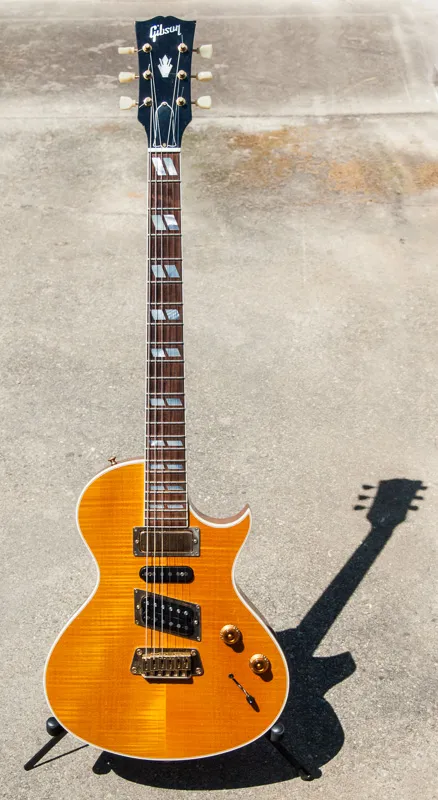
Photo: Craig418 / Wikimedia Commons / CC BY-SA 3.0 Gibson
Nighthawk
1993
From across the room it’s a Les Paul. Up close it’s Gibson trying to do a Stratocaster’s job.
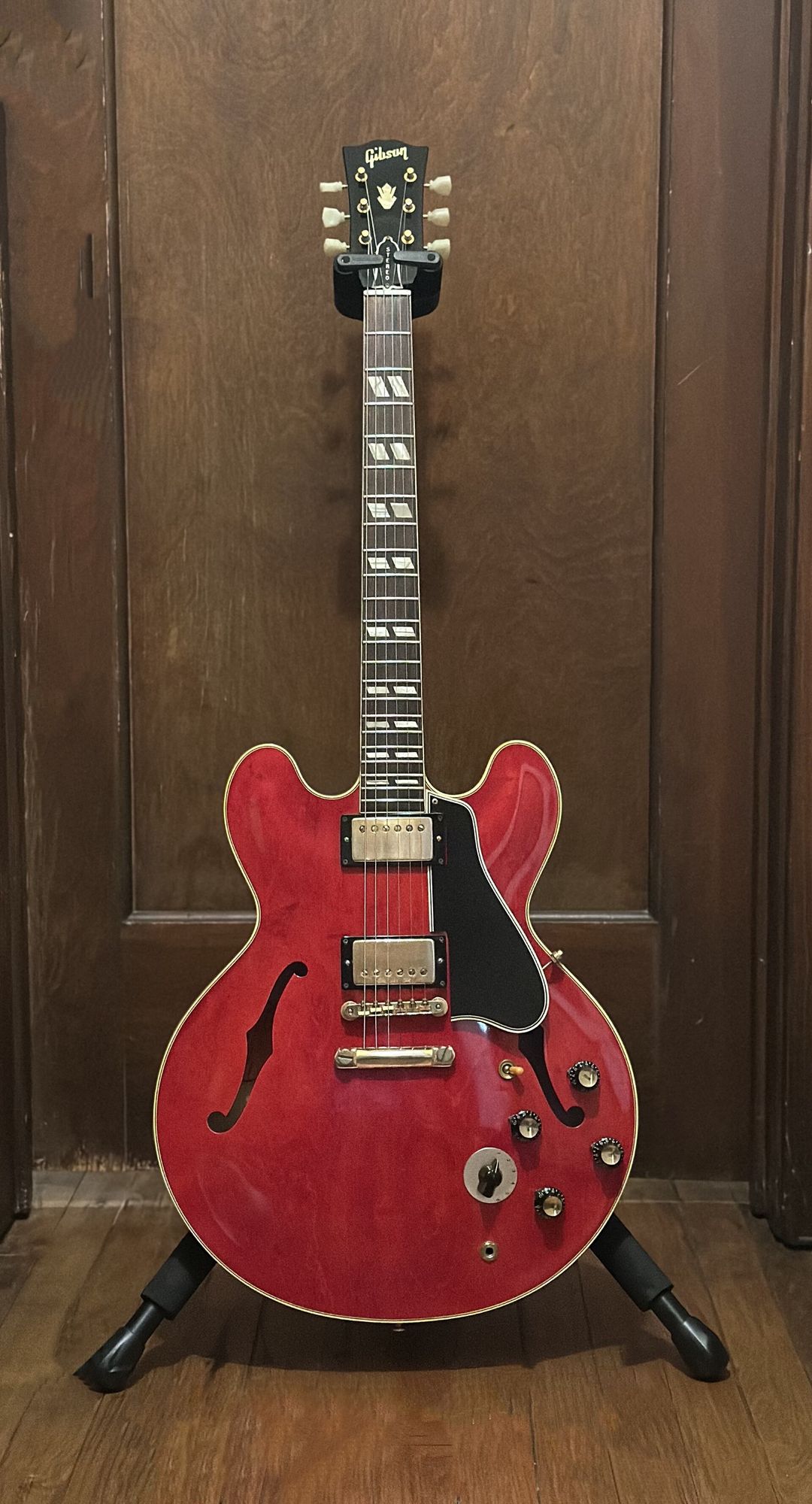
1960 Gibson ES-345TDC. Photo by Lightburst. Licensed under CC BY-SA 4.0. Via Wikimedia Commons. Gibson
ES-345
1959
Marty McFly plays one in 1955, four years before Gibson made it. Nobody in the theater minded.
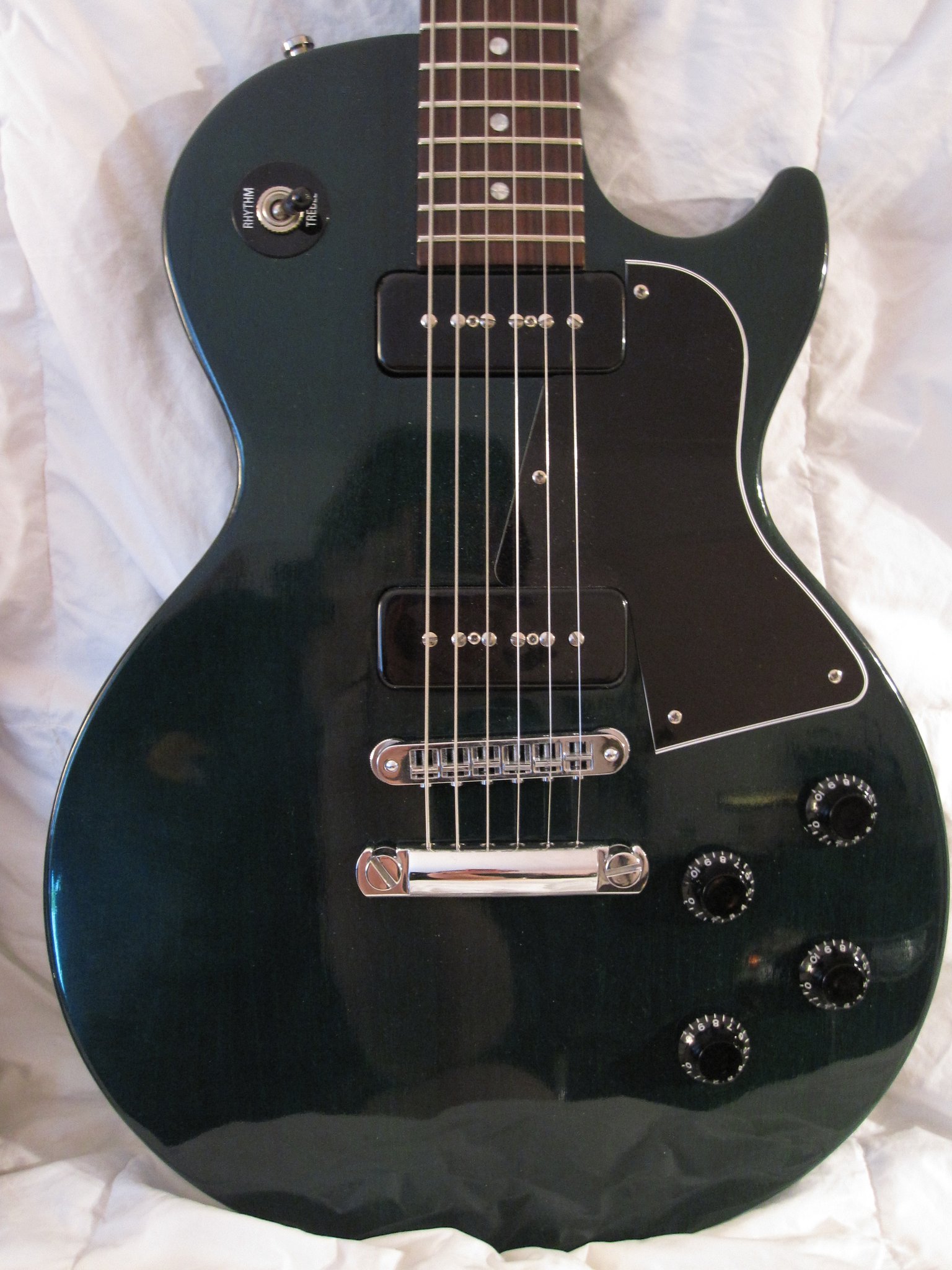
Gibson Les Paul Special 1998 Spearmint. Photo by A Gibson Man. Licensed under CC BY-SA 3.0. Via Wikimedia Commons. Gibson
Les Paul Special
1955
Dan Armstrong modified it. Marc Bolan traded it in. Bob Marley bought it and made it his.