 Guitaripedia
D'Aquisto
New Yorker
He started at D'Angelico's for $35 a week. He ended up keeping the New Yorker alive under his own name.
Kenmare Street, Manhattan, the early 1950s. A Brooklyn teenager who wants to play jazz guitar goes to work for John D'Angelico. When the master dies, the apprentice finishes his last guitars, loses his name, and spends decades turning the New Yorker into a D'Aquisto.
- Introduced
- 1965
- Type
- Archtop acoustic
- Class
- Closed run
Have a photograph of this guitar? Send a picture
The short version
1935
Born in Brooklyn
James L. D'Aquisto, on 9 November.
1951–53
Kenmare Street
He starts at D'Angelico's shop. The sources give three different years.
1964
The last ten
John D'Angelico dies on 1 September. Jimmy finishes the ten guitars still in the shop.
1966
The first New Yorkers
The earliest guitars called New Yorkers under his own name. They still look like late D'Angelicos.
1967
New style
The f-holes start bending into Jimmy's smoother S.
1972
Grant Green's Deluxe
An 18-inch New Yorker Deluxe with Green's name in pearl on the board.
1986
All wood
The New Yorker Classic, with no celluloid, and no metal he could avoid.
1995
Fifty-nine
He dies in California in April, at the age D'Angelico was.
Side A
A1
Thirty-five dollars a week
Kenmare Street, Manhattan. A teenager from Brooklyn walks into John D'Angelico's shop wanting to be a jazz guitarist.
Depending on who you ask, that was 1951, 1952, or 1953. Jimmy D'Aquisto was born in 1935, so he was somewhere around seventeen. He remembered the pay exactly:
"I was making $35 a week. I was like the runner."
Tuners, tailpieces, the engraver, the windows, the floor. Whatever needed doing.
Then D'Angelico's health failed. The first heart attack was in 1959 or 1960, depending on the source. The earlier assistant had already left, and Jimmy took more and more of the bench.
A2
The last ten, and a lost name
John D'Angelico died on 1 September 1964, at 59.
There were ten guitars in the shop still unfinished. Jimmy finished them. He bought the business. And, on what one account calls a bad decision, he lost the D'Angelico name.
So he kept going under his own. A new inlay on the headstock. A move out to Huntington, on Long Island. His first instrument under his own name came in 1965, and one account says it was styled after a D'Angelico New Yorker. Another says the first numbered guitar was a 16-inch plywood hollow electric. Both are still standing.
The first guitars a shop actually calls New Yorkers are from 1966, and they look like late D'Angelicos. One dealer says only the first fifteen stayed in that style. In April 1967 a customer got a receipt for one written on John D'Angelico's own pad, with a sticker for the Long Island shop stuck on it.
That's the guitar in a sentence: the same customers, the same shape, the master's paper, and a new name on the sticker.
A3
Bending the f-hole
The changes came slowly, and they're all Jimmy's.
The f-holes went first, around 1967, bending from D'Angelico's into a smoother, more fluid S. The peghead moved from the broken-scroll pediment toward a rounder top. By 1974 there was a circular cutout with a brass acorn finial in it, the mark people use to spot a New Yorker. D'Angelico's stairstep tailpiece gave way to a contoured ebony one.
The guitar came in two widths. The Deluxe was the big one, 18 inches across, the size of the old Kenmare New Yorker. The Special was 17. Later some got oval sound holes, which he preferred.
Mel Bay had played D'Angelico New Yorkers. In 1974 he got a D'Aquisto: 18 inches, carved spruce, figured maple, sunburst, gold tuners. The back of the peghead reads "Especially made for Mel Bay," and it's the guitar in the photographs for his method books.
Flip the record · By the numbers
$35
His weekly wage at D'Angelico's, by his own account
10
Unfinished D'Angelico guitars he completed after the master died
18 / 17 in
The Deluxe and the Special, the two widths that shared the name
256
Carved acoustic archtops, 1965 to 1994, in one count. All models, not only New Yorkers.
Side B
B1
Days without putting it down
In 1972 Grant Green got an 18-inch New Yorker Deluxe in sunburst, with his own name in mother-of-pearl on the fingerboard.
His son later said they went to collect it at Jimmy's house, and that his father spent days without putting it down. Green kept it until he died in 1979, and used it on several of his later records. It's in his hands in a photograph from The Main Attraction.
The one you can hear it on is Easy, from 1978. George Benson, who owned the guitar after Green, says so, and calls it "Grant Green's last recording as a leader." Benson also says it's a favorite of the guitarists who visit him.
B2
Fifty-nine
In 1986 Jimmy called Gary Larson, who was waiting on a traditional New Yorker, and described something else: an archtop all of wood. No celluloid. No metal, except where he couldn't avoid it. Larson took it, the first New Yorker Classic, and later let it go because he wanted an 18-inch sound.
That was where Jimmy was heading. By one account he stopped building the New Yorker-style guitars in 1991. Factories put his name on other things, from Hagstrom, Fender, and later Aria in Japan, but none of them were carved on his bench.
How many he made, nobody quite agrees. One careful count finds 341 guitars, 256 of them carved acoustic archtops. Others say about 370. Nobody has counted the New Yorkers.
He died in April 1995, in California, at 59. His tools and his bench went to the National Music Museum. Fifty-nine was the age he had expected, because it was D'Angelico's.
Put this on
You’ve read about it. Now hear it. Here’s what this guitar sounds like, and what to listen for.
Easy
George Benson, who owned the guitar after Green, says you can hear this New Yorker Deluxe on Easy, "Grant Green's last recording as a leader."
Find it on YouTube (opens in a new tab)
The cast
The people, and the specific guitars, that made the legend.
1972–79
Grant Green
1972 New Yorker Deluxe, 18 inches, his name in pearl
Owned it until he died in 1979 and used it on several later recordings, Easy among them.
1979
George Benson
The same 1972 Deluxe
Kept Green's guitar after his death. Says it's a favorite of the guitarists who visit him.
1974
Mel Bay
1974 New Yorker
"Especially made for Mel Bay" on the peghead, and in the photographs for his method books. His earlier New Yorkers were D'Angelico's.
1966
Sal DiTroia
1966 New Yorker Special
Built for him, and later back on Jimmy's bench for an ebony tailpiece and pickguard.
1986
Gary Larson
The first New Yorker Classic
Was waiting on a traditional New Yorker when Jimmy called with the all-wood idea. Took it, wanted an 18-inch sound, and let it go.
John D'Angelico
Teacher
His own New Yorker, from 1936, is a different guitar by a different maker. It's the shape Jimmy learned.
Liner notes
Specs, construction, rarity, value, and every source we used.
Carved spruce and maple in the Kenmare shape, then Jimmy's own S-holes and an ebony tail.
- Body
- Hand-carved cutaway archtop. Spruce top, maple back and sides. Vintage Guitar calls 18" typical of a 1974 New Yorker. RetroFret, a 1967 Deluxe: 18 1/8 in (46 cm) wide, 3 1/2 in (8.9 cm) deep. The Special is the 17" form (archtop.com, a 1980, also 3" deep). A 1972 shop guitar: 17" × 3". National Music Museum, a 1982 New Yorker: lower bout 458 mm (17-7/16"), ribs about 76 mm (3"), spruce X-brace.
- Neck
- Maple. One piece on Vintage Guitar's 1974 example. No single profile is published for every New Yorker.
- Fingerboard
- Ebony, mother-of-pearl split blocks or split rectangles. The 1974 example has 22 frets.
- Scale
- No single length. Wexer, 1966 Deluxe, and Umanov, a 1968: 24 3/4". RetroFret, 1967 Deluxe: 25 in (635 mm). A 1972 17-inch example and archtop.com's 1980 Special: 25". National Music Museum, 1982, nut to bridge: high E 641 mm (24-11/16"), low E 645 mm (24-29/32"). One 1975 listing prints 25.5".
- Pickups
- None on the plain acoustic. A floating pickup is common on individual guitars: DeArmond, Palen, or a Gibson Johnny Smith, depending on which one.
- Hardware
- Early tails follow the D'Angelico stairstep. Later: Jimmy's contoured ebony tail and an ebony bridge. Grover Imperial on the 1974; Schaller on the 1980 and the 1982.
- Electronics
- None on a plain acoustic. A floater may carry a volume, a tone, or a lead/rhythm switch on that guitar.
- Finish
- Sunburst is what the named guitars usually wear, blond and violin sunburst included. Matt Umanov described one clear red and wrote that it was the only one he knew.
- Nut
- Not one width. Wexer, 1966: 1 23/32". RetroFret, 1967: 1 11/16 in (43 mm). A 1972 example: 1.75". archtop.com, 1980: 1 3/4". National Music Museum, 1982: 46 mm (1-11/16"). One 1975 listing prints 1.7".
Open the full research fileConstruction details, the complete player record, production numbers, dated value estimates, and sources
Specs are for Jimmy D'Aquisto's carved New Yorker, Deluxe and Special included; no new guitar from his bench carries the name, and the Japanese DQ-NYE is a different instrument.
Construction
The job was the guitar Kenmare's customers still wanted after John D'Angelico was gone. A big carved archtop, one at a time. Jimmy D'Aquisto built it under his own name.
James L. D'Aquisto was born in Brooklyn on 9 November 1935. He went to D'Angelico's shop as an aspiring jazz guitarist. Wikipedia has the visit in 1951 and the apprenticeship in 1952. Vintage Guitar (George Gruhn and Walter Carter) has him working there from 1952, age 17. Blue Book of Guitar Values, citing Paul William Schmidt's Acquired of the Angels, and the Long Island Music and Entertainment Hall of Fame, put the start around 1953. He told the wage himself: "I was making $35 a week. I was like the runner." Tuners, tailpieces, the engraver, the windows, the floor.
D'Angelico's health failed. Sources differ on the first heart attack: Wikipedia gives 1959, Gruhn and Carter give 1960. Jimmy took more of the bench. Vincent "Jimmy" DiSerio, the earlier assistant, had already left. John D'Angelico died on 1 September 1964, age 59. Jimmy finished the last ten guitars still in the shop, bought the business, and, Wikipedia says, lost the D'Angelico name on a bad decision. Blue Book has him still repairing at 37 Kenmare Street, then fitting a headstock with his own inlay.
The first year under that inlay is 1965, and it is not a catalog launch. Blue Book: one year after the death he sold his first instrument, styled after a D'Angelico New Yorker, and moved the shop to Huntington, New York. Giovanni Ghiazza, tallying Schmidt's appendix in Accordo, dates the own-name work from May 1965. Wikipedia puts the Huntington move in 1966, Farmingdale in 1973, and Greenport in 1980. Blue Book puts Greenport in the late 1980s. The National Music Museum places a May 1982 New Yorker in Greenport, which fits the earlier of those two. Fretboard Journal also dates the own-name guitars from 1965.
That 1965 instrument is not automatically this model. Guitar Player (Tom Wheeler) describes serial 1001, a 1965, as plywood and 16 inches wide, a hollow electric. Owner Tom Van Hoose calls it Jimmy's first serial-numbered hollowbody electric. United Guitar in New Jersey supplied the laminate bodies. Wheeler's first-period plywood guitars run 1965 to 1967.
The earliest guitars a shop calls a New Yorker are 1966. Laurence Wexer: serial 1006, an 18-inch New Yorker Deluxe, "the 6th guitar made under his own name," still looking like a late D'Angelico. He writes that only the first fifteen stayed in that style, and he gives that one a 24 3/4" scale and a 1 23/32" nut. TR Crandall: serial 1012, a New Yorker Special, signed James L. D'Aquisto, 20 October 1966, built for Sal DiTroia. RetroFret: serial 1017, signed 18 April 1967 in Huntington Station, the seventeenth numbered guitar, spelled Delux on the instrument. RetroFret calls it the second with the new, more fluid f-holes, and says 1016 is the first the ledger marks "new style." The peghead is still the D'Angelico shape, pediment on top, a pearl "New Yorker" scroll under the D'Aquisto script. The April 1967 receipt is on John D'Angelico's pad, with a sticker for the Long Island shop. Rudy's Music has serial 1021, completed 11 September 1967, the model name on a scroll rather than on the hotel mark, the truss-rod cover still that hotel shape.
Gruhn and Carter name the two changes that stick: the peghead, from a broken-scroll pediment toward a round top, and the f-holes, toward a smoother S. The customers were the same people, so the guitars stayed handmade archtops in the D'Angelico line. Vintage Guitar, on Mel Bay's, calls a circular peghead cutout with a brass acorn finial the New Yorker mark. Serial 1086, finished 7 December 1974, is their "typical New Yorker of the period": 18 inches, carved spruce, S-holes, Venetian cutaway, figured maple, sunburst, one-piece maple neck, 22-fret ebony with split-rectangle pearl, adjustable ebony bridge, ebony tailpiece, gold Grover Imperials, multi-ply white binding. The peghead back reads "Especially made for Mel Bay."
Two widths shared the name. The Deluxe is the 18-inch guitar: RetroFret's 1967 at 18 1/8 in (46 cm) by 3 1/2 in (8.9 cm), scale 25 in (635 mm), nut 1 11/16 in (43 mm); the Met's Guitar Heroes page gives Grant Green's 1972 Deluxe, serial 1055, as 18 in (45.7 cm). Skinner measured that same guitar at 17 15/16 in across the lower bout and 21 3/8 in along the back. The Special is the 17-inch form. archtop.com, serial 1138, signed and dated completed 26 February 1980, ledger delivery 30 May 1980: 17", 3" deep, 25" scale, 1 3/4" nut, X-braced spruce, carved flame maple, ebony board, S-holes, ebony bridge, tail, and finger rest. The museum's 1982, serial 1158, signed 3 May and again 10 May, is labeled New Yorker and measures 458 mm (17-7/16") at the lower bout, ribs about 76 mm (3"), nut 46 mm (1-11/16"), spruce X-brace. String length, nut to bridge: high E 641 mm (24-11/16"), low E 645 mm (24-29/32"). Not every 17-inch guitar wears the Special name. Oval holes turn up as well. Fretboard Journal, on a 1978 Special: D'Aquisto preferred the oval, and by then the guard was sleeker and the tail was wood. TR Crandall's 1973 Special, serial 1069, is an oval-hole X-braced one.
The Excel is the other carved model carried over from D'Angelico. It is not this guitar. The New Yorker Classic is a later break. In 1986 Jimmy called Gary Larson, waiting on a traditional order, and described an all-wood archtop: no celluloid, no metal except where he could not avoid it. Larson took serial 1191, the first Classic. Gruhn and Carter: lighter than a typical 17-inch archtop, maple purfling instead of layered binding, a small ebony guard, an ebony tail, a plain board with no position markers. Larson wanted an 18-inch sound and let it go. Blue Book dates the Avant Garde to 1987 and says the Excel and New Yorker-style models stopped in 1991. The Solo (four soundholes, nine built) and the Centura arrive in that account in 1994. Other guitars.
So are the factory instruments with his name on them. Hagstrom's Jimmy, by 1969 in Gruhn and Carter, is a 16-inch electric with a pressed birch body, not a carve. Fender's D'Aquisto Standard and Elite, 1984, are Japanese laminate boxes at 15 3/4 inches. Blue Book's Ultra and Deluxe are Stephen Stern's Custom Shop guitars; the electric page says they were discontinued in 2002, and the acoustic page still has them in production. Neither page is describing this New Yorker. John D'Angelico's New Yorker is the 18-inch Kenmare guitar, a different maker, from 1936. Steve Miller's guitar at the Met is a 1993 instrument in the later all-wood style, gift of 2012, accession 2012.246, 17 inches wide. A YoungArts note from the museum calls that one a Centura Deluxe.
Aria in Japan built a licensed DQ-NYE. Blue Book lists it from 2002 as current: 17 inches, 25.5-inch scale, 22 frets, solid Sitka, flame maple, a floating mini-humbucker. Aria's page prints a pressed Sitka top, laminated flamed-maple back and sides, thickness 3-1/8", scale 25-1/2", and ¥340,000 before tax with a hard case, and says the agency business has ended. archtop.com, on a 2008 example, calls the line discontinued. Jazzwise, 8 April 2010, reviewed a new 17-inch one at a penny under £2,500. Pressed spruce and a laminated back are not Jimmy's carve.
He died in California in April 1995, age 59, the age he had expected because it was D'Angelico's. Wikipedia gives 17 April. Find a Grave gives 18 April, in Corona, where he was visiting Fender's Custom Shop; the obituary it quotes says he died on a Monday. Forbes says April 1995 and leaves the day. His tools and the bench went to the National Music Museum, which also holds the 1982 New Yorker, serial 1158, gift of Erwin Gudelsky in 2021, object 15633.
Players
Grant Green — 1972 New Yorker Deluxe, serial 1055. The Met's Guitar Heroes page: spruce, maple, ebony, brass, celluloid, mother-of-pearl, honey sunburst, cutaway, 18 in (45.7 cm). Green owned it from 1972 until he died in 1979, used it on several later recordings, and George Benson owned it after him. A photograph from the 1976 album The Main Attraction shows him with it. "Easy" (Lionel Richie, arranged by Green) was recorded for Versatile in 1978. Skinner, 14 October 2007, is the same guitar: signed 13 September 1972, stamped 1055, lower bout 17 15/16 in, back 21 3/8 in, provenance ex-Grant Green (the lot spells the surname Gren) and George Benson's collection. Benson's note there: it can be heard on Easy, "Grant Green's last recording as a leader," and it is a favorite of guitarists who visit him, naming Russell Malone and Mark Whitfield. Estimate $50,000–$70,000. No hammer from that lot has been published. Premier Guitar, 16 February 2009, has Rudy Pensa's account. Green's son told him they collected it at D'Aquisto's house, and that Green spent days without putting it down. Pensa: an 18-inch tobacco-sunburst New Yorker, spruce, flamed maple, ebony, Green's name in mother-of-pearl on the board. After the death it sat with Benson until Pensa bought it. Premier, at that date, placed it at Rudy's Music. The Met exhibition page credits Joshua R. Tarnow of New Jersey and does not give an accession number. Green's earlier Gibson ES-330, and the L-7 after it, are other guitars.
Mel Bay — 1974 New Yorker, serial 1086. Vintage Guitar: completed 7 December 1974, "Especially made for Mel Bay" on the peghead, and in the photographs for the method books. The New Yorkers he had played before that were John D'Angelico's. Different maker.
Sal DiTroia — 1966 New Yorker Special, serial 1012. TR Crandall: signed 20 October 1966, built for DiTroia, and later back in Jimmy's shop for a refinish, the ebony tail and pickguard, and Schaller tuners. The listing says the guitar was most likely on many of his recordings. That "most likely" is the seller's.
Gary Larson's guitar is the New Yorker Classic, serial 1191, not a Deluxe. Gruhn and Carter, 1986. He was on the traditional waiting list, received the plain all-wood guitar, and parted with it.
Jazz Guitar Today (2022) names Joe Pass and Jim Hall with his jazz archtops, and Steve Miller, Paul Simon, and Janis Ian besides. The page does not say New Yorker. Ian's, in Vintage Guitar, is the flat-top Spring Song. Miller's at the Met is the 1993 Centura-style guitar.
Rarity
The bench ended with his death in April 1995. Blue Book says the New Yorker-style models had already stopped in 1991. There is no new carved one to order.
No New Yorker total has been published. Counts of everything he built disagree, and they are not this model. Ghiazza's reading of Schmidt: 341 guitars and 3 mandolins, 256 of them carved acoustic archtops, May 1965 to November 1994. Forbes and the Long Island hall say about 370. A serial dates one guitar. Wexer calls 1006 the sixth under Jimmy's own name. RetroFret calls 1017 the seventeenth. Neither figure counts New Yorkers.
Thinner inside that: an early one that still wears the D'Angelico peghead, which Wexer limits to the first fifteen; an 18-inch Deluxe; a seven-string. Wexer calls a 1973 18-inch seven-string Deluxe one of only seven carved seven-strings. Green's 1055, Bay's 1086, and DiTroia's 1012 are single instruments.
The Japanese DQ-NYE uses the name and does not restock the carve. Hagstrom's Jimmy, the Fender D'Aquisto models, the Excel, the Classic, the Centura, and John D'Angelico's New Yorker are other guitars.
Value
Informal estimate, 29 October 2026. Not an appraisal.
No period list price for a D'Aquisto New Yorker has been published. Prices below are asking prices unless marked sold. Green's guitar is one object, not a comparable: Skinner's October 2007 estimate was $50,000–$70,000, and no hammer has been published.
New street. Nothing from his bench. The licensed Japanese guitar is a different instrument. Jazzwise, 8 April 2010, put a new 17-inch one at a penny under £2,500. Aria's DQ-NYE page prints ¥340,000 before tax, with a hard case, and says the agency has ended. Blue Book still lists that model as current from 2002. archtop.com calls the line discontinued.
Used modern. Japanese DQ-NYE guitars only. A late-1990s example on Reverb was marked sold at a listed $3,000. Ended asks, not confirmed hammers: a Junior at $2,209.60; a blonde DQ-NYE at $3,833.30; a 2000s example at $3,010.13; a 2006 natural at $2,645.49.
Vintage / collectible. Shop asks, not a sold median. RetroFret asks $57,500 for the 1967 Deluxe, serial 1017. Rudy's Music asks $69,995 for the 1967 New Yorker, serial 1021; $69,999 for the 1980 Deluxe seven-string, serial 1140; and $79,000 for a 1982 New Yorker Special, serial 1152. Matt Umanov listed a 1968 red 18-inch New Yorker, scale 24 3/4", at $52,000 and marked it sold; the page does not date the sale. Laurence Wexer has asked $48,500 for a 1973 18-inch seven-string. An ended Reverb ask, not a hammer: $65,000 for a 1972 17-inch. A current Reverb Canada ask for a 1975: C$100,682.70. archtop.com's "can fetch over $50K" is a dealer's sentence. Skinner, Boston, 2–3 May 2004, sold a 1968 New Yorker, serial 1031, signed 14 December 1968, lower bout 17 in. The lot page prints $22,325 and $19,000 against an estimate of $16,000–$18,000. That result is 2004 money.
See also
- New Yorker — John D'Angelico's 18-inch Kenmare guitar, from 1936. The shape Jimmy learned. A different maker.
- L-5 CES — Gibson's carved 17-inch jazz box, pickup in the top. Not this bench.
- Fratello — a later 17-inch carved archtop, the pickup hung off the guard. Not a D'Aquisto.
Sources
- Wikipedia, Jimmy D'Aquisto — born 9 November 1935, Brooklyn; shop visit 1951, apprenticeship 1952; the $35-a-week account; D'Angelico's 1959 heart attack; death 1 September 1964; last ten guitars finished by D'Aquisto; loss of the name; Huntington 1966, Farmingdale 1973, Greenport 1980; died 17 April 1995, age 59; tools to the National Music Museum.
- Vintage Guitar, George Gruhn and Walter Carter, D'Aquisto New Yorker Classic — work from 1952, age 17; heart attack 1960; ten guitars finished; peghead and S-holes; New Yorker and Excel carried over; Hagstrom Jimmy by 1969, 16" pressed birch; Fender Standard and Elite, 1984, 15 3/4" laminate; New Yorker Classic 1986, serial 1191, for Gary Larson. Originally November 2007.
- Vintage Guitar, Mel Bay's D'Aquisto — circular peghead and brass acorn finial; serial 1086, completed 7 December 1974; 18" typical spec of the period; inscription "Especially made for Mel Bay."
- Blue Book of Guitar Values, D'Aquisto — citing Schmidt, Acquired of the Angels: met around 1953; 37 Kenmare; 1965 first instrument, styled after a D'Angelico New Yorker, Huntington; Farmingdale 1973; Greenport in the late 1980s; Avant Garde 1987; Excel and New Yorker-style models discontinued 1991; Solo, nine built, and Centura, 1994; died April 1995. The acoustic-guitars page repeats the biography and still has the Fender Ultra and Deluxe in production; the electric page says those two were discontinued in 2002.
- Blue Book, D'Aquisto (current mfg.) New Yorker Electric — Japanese New Yorker, 17 in, 25.5 in scale, 22 frets, filed as 2002–present.
- Aria, DQ-NYE New Yorker — pressed Sitka, laminated flamed maple, 17" width, body 3-1/8", scale 25-1/2", 22 frets, floating humbucker; ¥340,000 before tax with hard case; agency business ended.
- RetroFret, 1967 New Yorker Delux, serial 1017 — Huntington Station; signed 18 April 1967; seventeenth numbered guitar; 1016 as first "new style"; 18 1/8 in (46 cm), 3 1/2 in (8.9 cm), scale 25 in (635 mm), nut 1 11/16 in (43 mm); April 1967 receipt; ask $57,500.
- Laurence Wexer, 1966 New Yorker Deluxe, serial 1006 — 18"; sixth guitar under his own name; first fifteen in the earlier style; scale 24 3/4"; nut 1 23/32".
- TR Crandall, 1966 New Yorker Special, serial 1012 — signed 20 October 1966; built for Sal DiTroia; later shop work by D'Aquisto; the seller's "most likely" on recordings.
- TR Crandall, 1973 New Yorker Special, serial 1069 — oval-hole, X-braced.
- Rudy's Music, 1967 New Yorker, serial 1021 — completed 11 September 1967; Huntington; ask $69,995.
- Rudy's Music, 1980 New Yorker Deluxe seven-string, serial 1140 — 18"; spruce and flame maple; ebony bridge, guard, and tail; ask $69,999.
- archtop.com, 1980 New Yorker Special, serial 1138 — 17", 3", 25", nut 1 3/4"; X-brace; completed 26 February 1980; ledger delivery 30 May 1980; the Special as the 17" form.
- archtop.com, 2008 DQ-NYE/N — Japanese recreation; "originals of which can fetch over $50K"; that line called discontinued.
- National Music Museum, New Yorker, serial 1158 — Greenport, May 1982; spruce X-brace; lower bout 458 mm (17-7/16"); nut 46 mm (1-11/16"); ribs about 76 mm (3"); string length 641 mm (24-11/16") and 645 mm (24-29/32"); gift of Erwin Gudelsky, 2021, object 15633.
- Met Museum, Guitar Heroes: New Yorker Deluxe, 1972 — serial 1055; 18 in (45.7 cm); Grant Green, 1972 until his death in 1979; The Main Attraction (1976); "Easy," Versatile, 1978; Benson afterward; credit Joshua R. Tarnow, New Jersey. No accession number on that page.
- Met Museum, Steve Miller's D'Aquisto — 1993, Greenport, 17 in, gift 2012 (2012.246). The YoungArts note calls it a Centura Deluxe. Not this model.
- Premier Guitar, Grant Green's D'Aquisto New Yorker, 16 February 2009 — Rudy Pensa; the son's account; 18" tobacco sunburst; name in pearl; Benson, then Rudy's Music.
- Skinner, 14 October 2007, lot 22 — 1055, signed 13 September 1972; back 21 3/8 in; lower bout 17 15/16 in; Benson's note on Easy, Malone, and Whitfield; estimate $50,000–$70,000.
- Skinner, 2–3 May 2004, lot 27 — 1968 New Yorker, serial 1031, signed 14 December 1968; lower bout 17 in; page prints $22,325 and $19,000; estimate $16,000–$18,000.
- Guitar Player, Tom Wheeler, via Gale — 1965, serial 1001, plywood 16" hollow electric; Van Hoose; United Guitar bodies, 1965–67.
- Fretboard Journal, 1978 New Yorker Special — own-name work from 1965; oval hole preferred; wooden tailpiece.
- Accordo, Giovanni Ghiazza, tally of Schmidt — own-name work from May 1965; 341 guitars and 3 mandolins; 256 carved acoustic archtops, May 1965–November 1994.
- Forbes, D'Aquisto's Last Guitar, 29 May 2002 — about 370 guitars; died April 1995, age 59.
- Long Island Music and Entertainment Hall of Fame — apprenticeship given as 1953; about 370 guitars.
- Find a Grave, James D'Aquisto — 18 April 1995, Corona, California; the quoted obituary says he died on a Monday, age 59, while visiting Fender.
- Jazzwise, 8 April 2010 — a new 17" New Yorker, a penny under £2,500.
- Jazz Guitar Today, 5 July 2022 — Pass, Hall, Miller, Simon, Ian named with D'Aquisto guitars generally, not as New Yorker players. The page's byline also shows a later edit date of 20 September 2023.
- Laurence Wexer, 1973 seven-string — 18" Deluxe; "one of only seven carved seven strings"; ask $48,500.
- Matt Umanov, 1968 red New Yorker — 18", scale 24 3/4"; the only clear red he knew; listed $52,000 and marked sold.
- Guitars 'n Jazz, 1972 17" New Yorker — 17" × 3", scale 25" (635 mm), nut 1.75", X-braced; the floater called a Palen. A matching Reverb listing calls the floater a DeArmond and shows an ended ask of $65,000.
- Reverb, 1975 New Yorker — current ask C$100,682.70; that listing prints scale 25.5" and nut 1.7".
- Reverb, late-1990s Japanese New Yorker — marked sold at a listed $3,000.
- Reverb, DQ-NYE Junior — ended ask $2,209.60; the listing calls it a 15-inch pressed-spruce body.
- Reverb, blonde DQ-NYE — ended ask $3,833.30.
- Reverb, 2000s Japanese New Yorker — ended ask $3,010.13.
- Reverb, 2006 DQ-NYE natural — ended ask $2,645.49; the listing dates the Aria run 2002–2010.
Keep digging
Guitars this one gets compared to, confused with, or descended from.
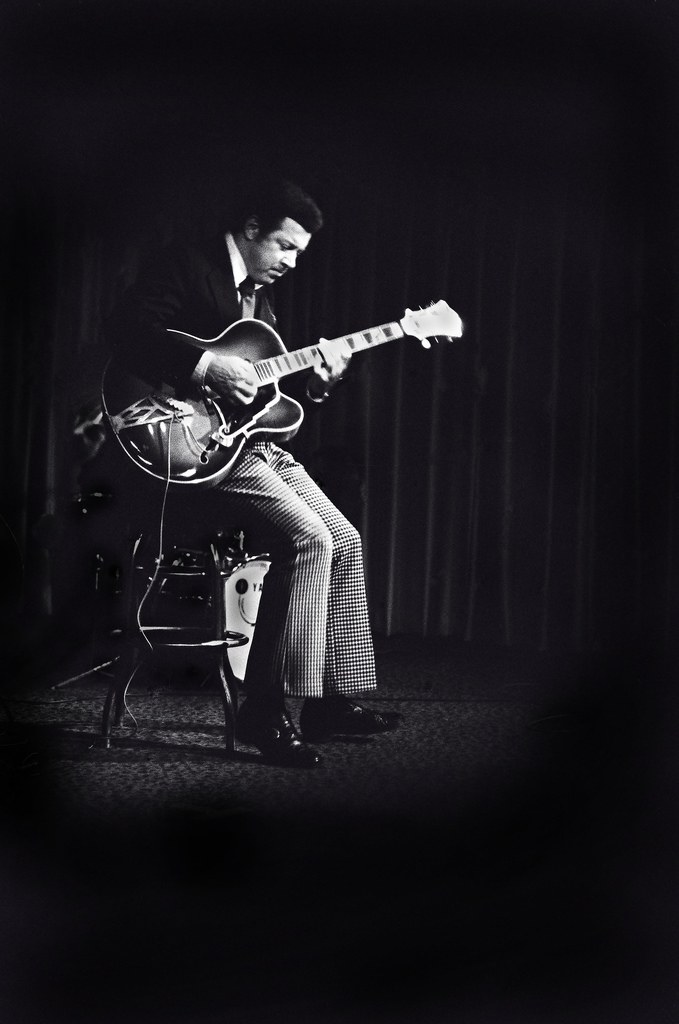
Photo: Tom Marcello / Wikimedia Commons / CC BY-SA 2.0 D'Angelico
New Yorker
1936
One man carved them by hand on Kenmare Street. When he died in 1964, the name kept going. The guitar didn’t.
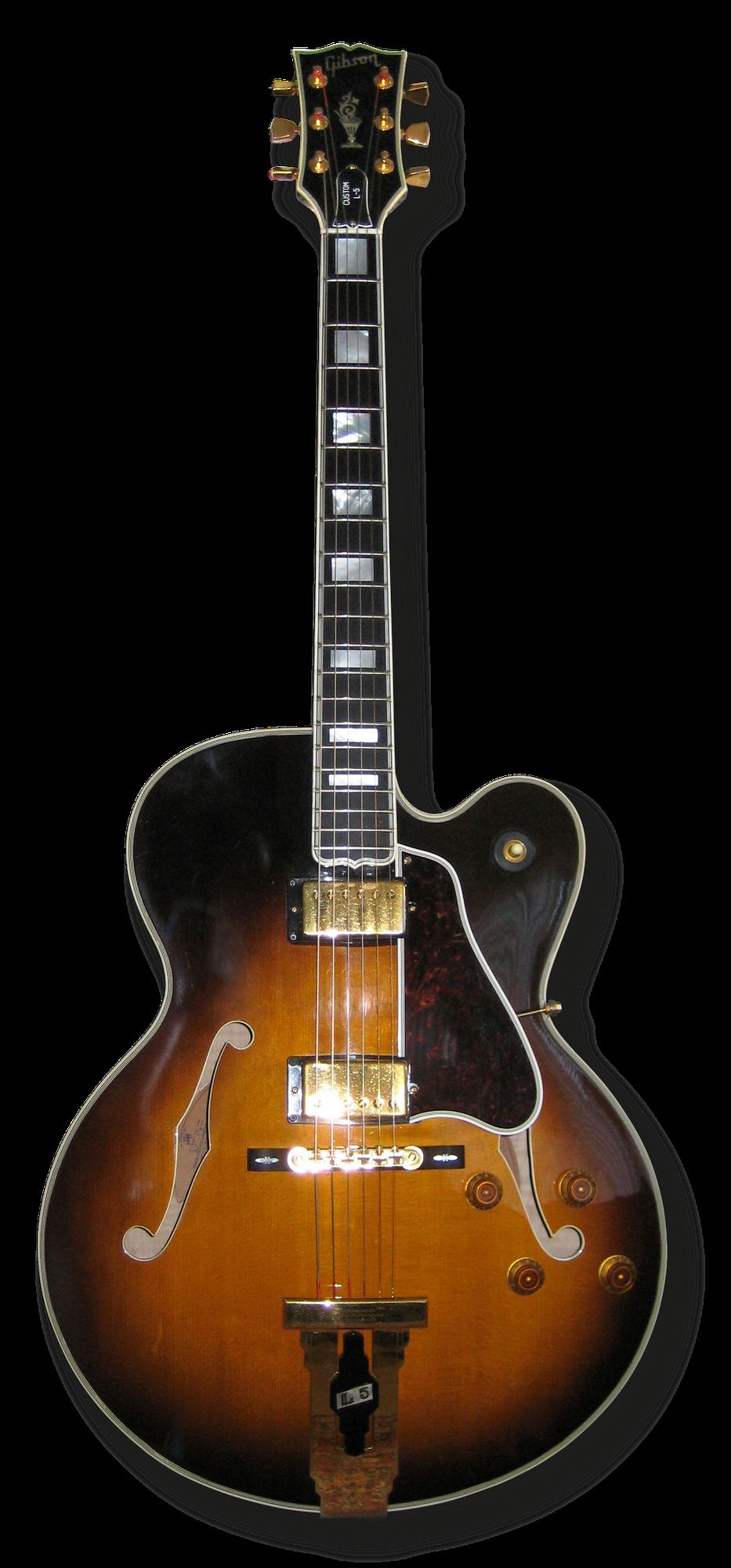
Gibson L-5 CES Tobacco Burst. Photo by Cruciniacus; isolated background by Auge=mit. Licensed under CC BY-SA 3.0. Via Wikimedia Commons. Gibson
L-5 CES
1951
In the ’50s Gibson shipped a few dozen a year. Wes Montgomery and Scotty Moore made them count.
- Send a picture
Benedetto
Fratello
1982
Benedetto hung the pickup off the pickguard, so nobody ever had to cut a hole in the spruce.