Maccaferri
G-40
Plastic, f-holes, and a neck you tilt with a screwdriver: Mario Maccaferri's guitar that would never warp.
In 1953, at a lunch in the Waldorf-Astoria, a reed maker from New York unveiled an archtop molded from Dow Styron, for $39.95. It was built so nothing could happen to it. For the most part, nothing did.
- Introduced
- 1953
- Type
- Archtop acoustic
- Class
- Closed run
Have a photograph of this guitar? Send a picture
The short version
1939
New York
Mario Maccaferri arrives in the United States, where cane for reeds is hard to get.
1949
The Islander
His plastic ukulele goes on sale at $5.95.
1952
The first year, on one count
The family's own table starts G-40 production here.
1953
The Waldorf
On 29 April, Dow throws a lunch for two plastic guitars, a flat-top and the DeLuxe Arched Top.
1954
With case
The G-40 is advertised at $45.95 with its case.
1964
A new name
French American Reeds becomes Mastro. The guitar doesn't change.
1969
Boxed up
The instruments stop. The rights go to Carnival, which never builds them.
Side A
A1
Out of reeds
Mario Maccaferri got to the United States in 1939, and his trade by then was reeds, for clarinets and saxophones. The cane was hard to get. Plastic, the way one museum tells it, was the substitute he found at the New York World's Fair that year.
Yes, that Maccaferri. His name was already on a famous guitar, the 1930s Selmer from Paris. This is not that guitar. Django's is that one. The concert career was over by then; one account says a hand injury, another a swimming accident in 1933.
What he had now was a plastics shop, French American Reeds, and an idea that an instrument didn't have to be wood to sound like one. Wood moves when the weather does. Plastic doesn't.
A2
It frets good
He proved it on a ukulele first. The Islander came out in 1949 at $5.95, and a museum now calls it the first plastic stringed instrument.
Then Arthur Godfrey got hold of one. The story goes that he told Maccaferri, poolside at a Miami hotel, that a cheap uke with passable tone was a million sales, and then he said it on television: "It frets good, has good tone… and it's only $5.95!" Maccaferri spent years trying to pay him. Godfrey never took a dime.
By March 1950 the shop was turning out about 2,500 ukes a day, then 6,000. Nearly 350,000 in the first year. By the time it was over, the count was past nine million ukuleles.
So a guitar looked like the obvious next move.
A3
Lunch at the Waldorf
Dow Chemical spent two years testing its plastics for the job, and its man put the tooling at around $350,000. On 29 April 1953 Dow threw a lunch at the Waldorf-Astoria to show off two "full, master size" guitars. One was a flat-top with a cutaway, $29.95: the G-30. The other was the DeLuxe Arched Top, $39.95: the G-40. This one.
Harry Volpe and Rey de la Torre came and played, so the guitar would "speak for itself." Maccaferri played a lively Neapolitan melody. The photograph from that day has Maccaferri holding the flat-top, and Volpe holding something that looks like a G-40. Nobody wrote down which one de la Torre played. Andrés Segovia, an old acquaintance from the 1920s, lent his name too.
The lunch is the public start. The family's own table puts production starting in 1952. Both dates stand.
Flip the record · By the numbers
$39.95
The DeLuxe Arched Top's price at the 1953 launch. The flat-top G-30 was $29.95.
$350,000
Roughly what Dow's man said the tooling cost, after two years of tests.
100+
Parts in the guitar, and not all of them plastic.
9 million
Plastic ukuleles. Not guitars. Nobody knows how many G-40s there are.
Side B
B1
A hundred parts and a screwdriver
Pick one up and it's small, shaped a lot like the Selmer, with Maccaferri's square cutaway and two f-holes. The top is ivory plastic. The back and sides are one molded shell in a reddish-brown swirl meant to read as rosewood. It's not all plastic, though. There are more than a hundred parts, and under that arched top are wooden braces, laid out in a fan.
It takes steel strings, on a glued archtop bridge with a trapeze tailpiece. The tuners are planetary, banjo-style, 14 to 1.
The neck is the clever part, and the part he patented. Plastic outside, a metal sheath, a wood core running through the body to a bolt. Turn the bolt with a screwdriver and the neck angle changes. Where you put the screwdriver depends who's describing it: a plug at the bottom of the top, a screw at the rear, a spot under the tailpiece. The promise was that it would never warp.
By February 1954 the G-40 was advertised at $45.95 with its case.
B2
Nine million ukes, hundreds of guitars
The guitars never got the Godfrey treatment. Whether the run was brief or long depends who you ask: one curator calls it apparently short, but the G-40 was still at the top of the line in the 1965 catalog. In 1964 the company became Mastro. Same guitar, new name on the door.
In 1969 the instruments stopped. There was criticism and slow sales, the rights went to Carnival, and Carnival never made them. Maccaferri boxed up the parts and said no more.
Nobody can tell you how many G-40s there are. They have no serial numbers, and the nine million is ukuleles.
B3
Still in the box
The boxes stayed. Around the year Maccaferri turned 90, someone helping take inventory of his warehouse counted hundreds of unsold plastic guitars. By the early 1990s the leftovers, of every kind, came to nearly 5,000 instruments, sold off in a last purge before his death on 16 April 1993.
So some of the G-40s that turn up now never left the warehouse until then. Decades in a box, and when you open it, the neck is where he set it.
The cast
The people, and the specific guitars, that made the legend.
1953
Mario Maccaferri
Designed the G-40
Played a Neapolitan melody at the Waldorf lunch. The photograph has him on the flat-top G-30, not this one.
1953
Harry Volpe
What looks like a G-40, at the Waldorf
Played at the launch so the guitar could "speak for itself." Also lent it his endorsement.
1953
Rey de la Torre
A Maccaferri plastic guitar, model not named
Played at the same lunch and endorsed it. Which guitar he held isn't recorded.
1953
Andrés Segovia
An endorsement, not a performance
An old acquaintance from the 1920s. His name was on the plastic guitar's launch, not on a record.
Liner notes
Specs, construction, rarity, value, and every source we used.
A Dow Styron cutaway with f-holes, wood under the plastic top, and a neck you tilt with a screwdriver — Maccaferri’s G-40, not Django’s Selmer and not the flat-top G-30.
- Body
- Small single-cutaway archtop, two f-holes. NMM 10458: one-piece Dow Styron back and sides; arched Dow Styron top, wood fan-braced. Lower bout 340 mm (13-1/4"), upper 256 mm (10-3/16"), waist 226 mm (9"), depth 88 mm (3-7/16") at the neck and at the bottom. Smithsonian’s 1954 guitar prints overall 38" × 13 1/4" × 4 1/2" (96.52 × 33.655 × 11.43 cm). Powerhouse H5315 prints width 345 mm and depth 130 mm, and does not name the axis. The Met prints 7 3/4 × 24 5/8 in. (19.7 × 62.5 cm) and does not name the axes. Mix flagged. Do not average. Do not convert a figure a source gave in one unit only.
- Neck
- Bolted on. NMM: a slight cutaway at the treble side of the heel. Plastic outer back and fingerboard, a metal sheath Wright calls an “armored neck,” and a wood core through the body.
- Fingerboard
- Plastic. NMM 10458: 20 metal frets. The white dots are part of the neck back, not separate inlays. Ukulele Magazine calls a zero fret a signature of all his plastic guitars. This card does not list one. Don’t add it.
- Scale
- NMM 10458, vibrating string length 620 mm (24-7/16"). Cream City’s guitar: 24 3/4". Garrett Park’s: 24.5". Mix flagged. Do not average. Do not invent millimetres for 24 3/4" or 24.5".
- Pickups
- None.
- Hardware
- Glued plastic archtop bridge and a trapeze (Wright). Planetary tuners, banjo-style, 14:1, three gears (Wright). NMM: red plastic “Maccaferri” on the peghead, and a red shield marked M/M. No serial.
- Electronics
- None.
- Finish
- Ivory or cream top. Back and sides in a swirled reddish-brown to dark red-black “rosewood” plastic (Wright; Powerhouse). Not a color catalog.
- Nut
- NMM 10458: 47 mm (1-7/8") at the nut; the board is 57 mm (2-1/4") where it meets the body. Cream City and Garrett Park also print 1 7/8". The museum pair is one width in two units.
Open the full research fileConstruction details, the complete player record, production numbers, dated value estimates, and sources
Classic living example = NMM 10458, French American Reeds DeLuxe Arched Top / G40, no serial, ca. 1953–1964 on that card because the papers still name French American Reeds. Not the flat-top G-30. Not an Islander ukulele. Not a 1964 Beatle toy. Nothing to order new. Smithsonian 1994.0136.01 and Powerhouse H5315 are other guitars. Standalone. No Gibson SKUs. Mixed inch/mm flagged. Do not average the scales, the lengths, or the depths.
Construction
The job was a guitar that would stay put when the weather did not. He had already proved the trick on a ukulele. The arched top was the expensive version of the same idea.
Mario Maccaferri landed in the United States in 1939 (NMM; Smithsonian). Cane for clarinet and saxophone reeds was hard to get. Plastic at the New York World’s Fair that year is the NMM’s account of how he got to a substitute. He filed a reed patent in 1941. It was awarded in 1942. The concert career was already over. The Met says a hand injury. Ukulele Magazine (Sandor Nagyszalanczy, Fall 2015) says a swimming accident in 1933. The shop he brought over was French American Reeds. Nagyszalanczy puts it in the Bronx. The Met puts the plastics works in the Bronx too. Don’t file that as the only address. Smithsonian’s 1954 G-40 is credited to Mount Vernon. The 1952 bridge patent is Mario Maccaferri of Rye, assignor to French American Reeds of New York. Keep the Bronx, Mount Vernon, and Rye.
The ukulele is why a guitar seemed worth the dies. NMM: the Islander, 1949, $5.95, “the first plastic stringed instrument.” Nagyszalanczy’s poolside story, Kenilworth Hotel, Miami: Arthur Godfrey told him that an affordable uke with passable tone was a million sales. Godfrey then said it on television. The magazine’s line is “It frets good, has good tone… and it’s only $5.95!” Maria Maccaferri told Nagyszalanczy that Mario tried for years to pay Godfrey, and Godfrey never took a dime. By March 1950, about 2,500 ukes a day. Orders backed up, and the rate went to 6,000. Nearly 350,000 in that first year. Nagyszalanczy’s “more than 9 million plastic ukuleles” is the figure when the instrument business went to Carnival in 1969. Powerhouse, citing Evans 1977, says “over nine million.” Wright’s phrase is “the 9 million uke mark.” That number is ukuleles. It is not a G-40 count.
Dow’s Amos Ruddock, in The Music Trades of May 1953, as Wright reports it: two years of tests on Styron and on another Dow plastic, Ethocel, and tooling “around $350,000.” The public day is the one Dow threw. Waldorf-Astoria, New York, 29 April 1953. Two guitars, “full, master size.” The flat-top with an arched bottom, cutaway, $29.95. The DeLuxe Arched Top, $39.95. Wright: those become the G-30 and the G-40. The G-30 is the flat one. This plate is the arch. The family site’s table prints G-40 production as 1952–1969, and the same page’s heading once says “Flat-top” over an arch-top title. Keep 1952 and 29 April 1953. YAML introduced: 1953 is the luncheon, not a claim that nothing plastic existed in the shop in 1952, and not a vote that the family table is wrong.
The patents are earlier than the ad, and they are not a caption that says “G-40.” Application of 15 May 1950 becomes US 2,597,154 (20 May 1952). The divided bridge patent, US 2,614,448 (21 October 1952), shows its example as a ukulele: body, neck, and head in one injection-molded polystyrene piece, strings tied to the bridge. That is the Islander’s kind of molding. It is not this bolted archtop. US 2,793,556, filed 17 February 1953, granted 28 May 1957, is a guitar: six strings, a tailpiece, a thin plastic bell in an injection-moldable polystyrene, the string pull taken onto a bar in the neck, and a screw so you can change the neck angle without retuning. Two months before the Waldorf. An example in the patent, not a measured G-40.
What left the shop is small, Selmer-shaped, with his square cutaway and two f-holes (Wright). More than 100 parts, and not all of them plastic. NMM 10458: Dow Styron, arched top, one-piece shell for the back and sides, wood braces under the top in a fan, where a wood archtop of those years would have an X or parallel bars. Tops in ivory. Backs in a rosewood swirl. Steel strings. Not the nylon on the ukes. The G-40 bridge is glued on, archtop-fashion, with a trapeze that holds the strings. The early G-30’s bridge is molded in, and the strings stop there. Wright: a later G-30 trapeze was decoration, not the anchor. Don’t hang a G-30 tailpiece on this one.
The neck is the part he was willing to patent. Bolted, with a cutaway heel. Plastic outside, metal sheath, wood in the middle, and that wood running through the body to a bolt you turn with a screwdriver. Wright: pull a metal plug on the top, down at the bottom of the lower bout. Powerhouse: an adjusting screw at the rear. Alex Bishop (8 September 2014): under the tailpiece. Three descriptions of where you put the driver. Don’t pick a hole. Wright: the design was guaranteed never to warp. No card here prints a truss rod. Don’t invent one. NMM counts 20 metal frets. The 1957 patent’s example counts 21, including a master fret at the nut. Ukulele Magazine says a zero fret is on all the plastic ukes and guitars. The measured card is silent. Don’t add the fret.
Scale, nut, and the two shop weights sit in the table. They don’t agree, except the nut, and they are not averaged. Garrett Park’s 12" radius and the neck at .82" and .92" are that one consignment guitar, not a catalog.
February 1954, The Music Trades again: the G-40 at $45.95 with the case. The same ad’s G-16 Islander Guitar is a cheaper round-hole flat-top. Not this plate. Wright’s 1965 catalog still puts the G-40 archtop and the G-30 flat-top at the top of the line. Powerhouse’s curator, citing Evans, calls the guitar run apparently brief. Keep both. Showtime and Romancer are later molded classicals. Their tilt screw sits inside the body at the heel. Different neck. The Beatle toys of March 1964, shown at the Toy Show, are the ones Wright calls injection-molded polystyrene in Beatle Red and Beatle Orange. Jr., Yeah Yeah, Beatle-ist. Not a G-40.
The name on the door changes without the guitar changing. NMM’s story: French American Reeds becomes Mastro Plastics Corporation in 1964. The same card’s date note says Mastro Industries. Wright’s July 1964 Music Trades says Mastro Industries, Inc. Keep both. Instruments stop in 1969. NMM: criticism, slow sales, the rights sold to Carnival, which never built them. Wright: he boxed the parts and said no more. Nagyszalanczy, helping inventory the warehouse the year Maccaferri turned 90, counted hundreds of unsold plastic guitars and remembered the boxes as G-30 archtops. Wright, the launch copy, the NMM, and the family table call the G-30 the flat-top. Don’t retitle this guitar off one memory. Wright’s leftover figure is nearly 5,000 instruments in the early-1990s liquidation, with a last purge before the death on 16 April 1993, much of it through Elderly and A.S.I.A. Hundreds, and nearly 5,000. Neither one is a G-40 census.
Not this guitar. The G-30. An Islander, a TV Pal, a G-16, a Romancer, a Showtime, a Beatle toy, a Maestro. The Selmer Modèle Jazz. A Busato. An Adamas. A Lucite Dan Armstrong. No Gibson SKUs.
Players
No side in the sources read sits on a G-40. The names attached to it are a lunch and an endorsement list. Godfrey stays on the uke. Django stays on the Selmer.
Harry Volpe, and Rey de la Torre, 29 April 1953. Wright, from The Music Trades: both came to the Waldorf lunch and played, so the guitar would “speak for itself.” Then Maccaferri played a lively Neapolitan melody. The photograph in that piece has Maccaferri on a G-30 and Volpe holding what Wright says “looks like a G40,” with an ivory fingerboard. De la Torre’s model is not named. Don’t give both men the arched top. Don’t call the lunch a session.
Andrés Segovia. Wright: Maccaferri brought the plastic guitar out bearing endorsements from Segovia, de la Torre, and Volpe. Segovia was an old acquaintance from the 1920s, in that sentence. An endorsement in the launch story is not a G-40 on a record, and it is not the 1930s Selmer. Don’t promote it.
Arthur Godfrey is the Islander. The $5.95 line is a ukulele on television. Nagyszalanczy is plain that the guitars did not get that ride. Not a cast credit here.
Mario Maccaferri designed it and, at the lunch, was photographed on the flat-top. That is not a G-40 credit. A seller’s aside that Jeff Beck owns one, and a listing titled Ronnie Lane whose text names a different owner, are not sources. Leave them off.
Also known to play: nobody else, on a named G-40, in a named year.
Rarity
You cannot order a new G-40. The instruments stopped in 1969. Carnival did not build the design. No reissue turned up this pass. A guitar that sat in the Bronx warehouse until the 1980s or the early 1990s is still that run, unplayed. It is not a later factory.
There is no G-40 total. 10458 has no serial. Chicago Music Exchange prints N/A in the same blank. Wright: a guitar count is impossible, and it did not approach the ukes. The 9 million, the nearly 5,000 leftovers, and Nagyszalanczy’s hundreds are not this model. A stamp that was never there cannot date a year. That is why a first-year census is unknown.
What is actually thinner: a top whose wood braces are still glued down, and whose plastic has not split. A headstock overlay that has not lifted — shops keep mentioning that separation. The tilt plug still in its hole. A trapeze that is not broken. Gardiner Houlgate’s lot 919 (December 2024) was sold with the tailpiece at fault. A G-30 is not a G-40. A Beatle Jr. is not a G-40. Smithsonian’s 1954 guitar is one object. So is 10458. So is Powerhouse H5315, bought 28 September 1954 from French American Reeds.
Value
Informal estimate, 23 October 2026. Not an appraisal.
Ask against sold, and label which is which. No invented median. A Selmer Modèle Jazz is not a comp. A G-30 is not this table. Dow’s “around $350,000” is what Ruddock said the tooling cost in 1953. It is not a guitar. The 9 million is ukuleles.
New street. None. No maker page and no reissue. Historical list, not 2026 street: the DeLuxe Arched Top at the April 1953 launch, $39.95 (The Music Trades, via Wright). The brochure with Smithsonian’s 1954 guitar prints the same $39.95. February 1954, The Music Trades: $45.95 with case. Don’t call $45.95 the bare guitar. The family site shows 1964 and 1965 price-list images. No figure was readable off them this pass. None invented.
Used modern. No reissue, so no separate modern used market. New-old-stock from the warehouse is the original guitar.
Vintage / collectible. No Reverb Price Guide band isolated on the G-40 this pass. Flag: thin sold-comp access. Named dealer ask, fetched 23 October 2026: Rics Vintage, a G-40 the shop dates “1952/4,” with replacement tuner gears, $1,695. Not a hammer. The seller’s year is not a serial date. Named sold, not a series: Gardiner Houlgate, lot 919, tailpiece at fault, estimate £200–300, hammer £220. The Day Two page dates that sale 4 December 2024. The four-day sale page dates it 3 December 2024. One lot. A broken tailpiece is not a clean guitar. Don’t average $1,695 with £220. Older ended Reverb asks, not a 2026 tape and not solds: Six String Sing, very good, $499 (listed six years ago); The Rock Inn, excellent, a glued crack on the lower horn, $726.14 (listed four years ago); Copper Chord, poor, a tuner button missing and the tailpiece broken, $349.99 (listed four years ago). Don’t average those with the live ask or the hammer.
See also
- selmer-maccaferri — Henri Selmer’s 1930s oval-hole Modèle Jazz; Django’s wooden guitar, not this Styron archtop
- ovation-adamas — a carbon sandwich over a Lyrachord bowl; a later composite acoustic, not Dow Styron and not an f-hole cutaway
- ampeg-dan-armstrong — a carved Lucite solidbody electric; the other plastic guitar people mean, and not this one
Sources
- Vintage Guitar, Michael Wright, “Maccaferri History” (5 March 2002) — the live page is the opener only. Full text on the 25 June 2009 archive. Waldorf luncheon 29 April 1953; Music Trades May 1953; Ruddock, two years, Styron and Ethocel, tooling around $350,000; G-30 $29.95 and DeLuxe Arched Top $39.95; Volpe “looks like a G40”; Segovia, de la Torre, Volpe endorsements; 14:1 planetary tuners; glued bridge and trapeze; wooden struts; armored neck and top-bout tilt plug; February 1954 ad, G-40 $45.95 with case; in the line to 1969; 1965 catalog; Beatle toys as injection-molded polystyrene; nearly 5,000 instruments left in the early 1990s; death 16 April 1993. DjangoBooks reprints the plastic-guitar section (28 December 2005). One article, not two counts.
- National Music Museum, eMuseum, NMM 10458 — DeLuxe Arched Top / G40; French American Reeds; New York; ca. 1953–1964; no serial; Dow Styron; fan bracing; 20 metal frets; 935 mm overall; 620 mm (24-7/16") scale; nut 47 mm (1-7/8"); bouts and depth as in the table; red Maccaferri letters and M/M shield. Older writeup, archived 10 March 2009: introduced 1953; Islander 1949 at $5.95; 1964 name change; production ceased 1969; Carnival never built them. The date note says Mastro Industries; the body text says Mastro Plastics Corporation.
- Smithsonian, National Museum of American History, 1994.0136.01 — French American Reeds, Mount Vernon, 1954; Dow Styron; brochure $39.95; overall 38 in × 13 1/4 in × 4 1/2 in (96.52 × 33.655 × 11.43 cm); gift of Maria Maccaferri
- The Met, Guitar Heroes, G-40 model, ca. 1953 — archtop with f-holes; plastic; 7 3/4 × 24 5/8 in. (19.7 × 62.5 cm); private collection; Bronx factory in the bio note
- Powerhouse Museum, H5315 — arched-top G-40, moulded Styron, c. 1953; neck-through, wood core, steel sheath, rear tilt screw, plastic nut; width 345 mm, depth 130 mm; gift of French American Reeds, acquired 28 September 1954. Curator Michael Lea (April 2009), citing Evans 1977: ukulele sales “over nine million”; guitar production “apparently only continued briefly.” That last clause fights the 1965 catalog. Keep both.
- Ukulele Magazine, Sandor Nagyszalanczy (Fall 2015) — Bronx shop 1939; Godfrey at the Kenilworth; the $5.95 line; unpaid endorsement; March 1950 output; more than 9 million ukes by the 1969 sale to Carnival; zero fret called a signature of the plastic ukes and guitars; guitars did not sell and were warehoused; hundreds of new-old-stock guitars when Maccaferri turned 90; his memory of G-30 boxes as archtops
- Mario Maccaferri site, G-40 — table prints produced 1952–1969; a heading on that page says Flat-top; 1964 and 1965 price-list images, figures not readable this pass. Model index calls the G-40 the arch-top and the G-30 the flat-top.
- US 2,597,154 — stringed musical instrument, filed 15 May 1950, granted 20 May 1952. The parent of the bridge patent.
- US 2,614,448 — bridges, granted 21 October 1952. The example drawn is a ukulele: one-piece injection-molded polystyrene body, neck, and head. Not the bolted G-40.
- US 2,793,556 — neck junction, filed 17 February 1953, granted 28 May 1957. Guitar-type example: injection-moldable polystyrene bell, tailpiece, neck-angle screw, 21 frets including a master fret. A patent, not a measured G-40.
- Alex Bishop, “1953 G40 Maccaferri Guitar” (8 September 2014) — tilt screw described as under the tailpiece; wood fan braces under the arched top
- Cream City Music, 1950s G40 Deluxe — 24 3/4" scale; 1 7/8" nut; 3 lb 13.8 oz. Page marked sold. No price printed.
- Garrett Park Music, 1950s G40 Deluxe — one guitar: 24.5" scale, 1 7/8" nut, 12" radius, neck .82" / .92". No price on the page.
- Chicago Music Exchange, G40 1950s — sold out; serial N/A; 3 lb 14 oz. No price printed.
- Rics Vintage Guitars, “G40 1952/4” — ask $1,695, add to cart, fetched 23 October 2026. Seller: replacement tuner gears. Not a hammer. The year is the shop’s, not a serial.
- Gardiner Houlgate, lot 919 — tailpiece at fault; estimate £200–300; hammer £220. Day Two page: 4 December 2024. The four-day sale page dates the sale 3 December 2024. One lot.
- Reverb, Six String Sing, G-40 — ended ask $499; listed six years ago
- Reverb, The Rock Inn, G40 — ended ask $726.14; listed four years ago; glued crack on the lower horn
- Reverb, Copper Chord, G40 — ended ask $349.99; listed four years ago; poor, missing a tuner button, broken tailpiece
Keep digging
Guitars this one gets compared to, confused with, or descended from.
- Send a picture
Selmer
Modèle Jazz
1936
Built so a guitar could be heard over a dance band. In Django Reinhardt’s hands, it led one.
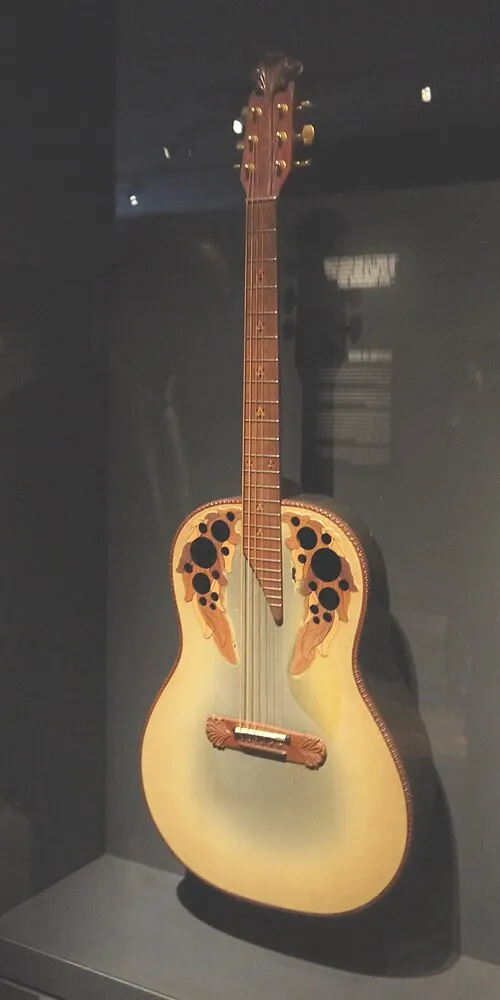
Photo: Eden, Janine and Jim / Wikimedia Commons / CC BY 2.0 Ovation
Adamas
1976
Seven years, 186 changes, and no hole in the middle. Ovation rebuilt the acoustic guitar top from scratch.
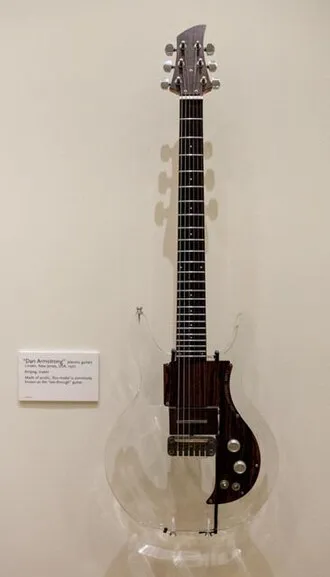
Photo: Frank Kovalchek / Wikimedia Commons / CC BY 2.0 Ampeg
Dan Armstrong
1969
A repairman who spent his days inside other people’s guitars designed one you could see straight through.