 Guitaripedia
Monteleone
Radio Flyer
As a boy he pressed his ear to the side of a guitar. Years later he put a sound hole there.
A house with no television until 1956, and a radio that kept going, carrying the guitar records. John Monteleone named an archtop for that radio in 1993. Then he gave it holes in its side, so the person holding it could hear what the room hears.
- Introduced
- 1993
- Type
- Archtop acoustic
- Class
- Production
Have a photograph of this guitar? Send a picture
The short version
1947
Born in Manhattan
John Monteleone, son of a sculptor and patternmaker whose family came from Palermo.
1956
The television arrives
Until then, the radio in the house carried the guitar records.
1973
Heard it on the radio
He hears Mandolin Brothers on the radio, drives to Staten Island, and becomes their repairman.
1978
The Eclipse
His first archtop, a traditional design, built in Bay Shore.
1992
Radio City
The Deco prototype. He calls it and the Radio Flyer the first designs truly his own.
1993
The Radio Flyer
The prototype, by the museum catalogue's date. A seller calls a 1994 guitar the first one.
1995
Holes in the side
He first tries side sound holes, with shutters, on a convertible built for Scott Chinery.
1997
Dolphins and ports
A blonde 18-inch Radio Flyer with dolphin holes on top and his sound holes in the side.
Side A
A1
No television until 1956
The house had no television until 1956. What it had was a radio, and the radio kept going.
New York was Radio City then, and the radio carried the guitar records. John Monteleone was born in Manhattan in 1947, the son of a sculptor and patternmaker whose family came from Palermo. There's a photograph of him at the family house in Islip, out on Long Island, around 1952.
He couldn't afford a Martin, so as a boy he built himself a guitar. One day he laid his ear against its side. The sound in there, he said later, was the sound he wanted to get out.
He'd spend decades getting it out.
A2
Radio again
He graduated from Tarkio College in 1970 with a degree in applied music. In 1973 he heard Mandolin Brothers on the radio, drove to Staten Island, and became their repairman.
By 1976 he had his own shop in Bay Shore. His first archtop, the Eclipse, came in 1978: a 17-inch body, and by his own account a traditional design.
Then came two that were his. He told an interviewer the Radio Flyer was the break from the tradition, followed by the Radio City, and that he built them for himself. The museum catalogue has it the other way round, with the Radio City prototype in 1992 and the Radio Flyer in 1993. One seller calls a guitar built in September 1994 the Radio Flyer prototype. Depending on who you ask, the first one is 1993 or 1994.
The name is no mystery. He says so himself:
"The Radio Flyer is a tribute to the radio, its place in history, and its far reaching influences on the guitar."
Flip the record · By the numbers
1956
The year the Monteleone house got a television. Before that, the radio.
17–18 in
Widths measured on Radio Flyers. He doesn't make the same guitar twice.
5–7
Instruments a year, every model, from one man working alone
3+ years
The wait for a commission, as of 2023
Side B
B1
A hole in the side
An archtop throws its voice out into the room, and the person holding it has to lean over the top to meet it. Monteleone wanted that voice without the lean.
So in the mid-1990s he went back to that boy's ear. The first real trial was in 1995, on a Rocket Convertible built for Scott Chinery's series of blue guitars. He'd meant to build a Radio City and built a convertible instead: double-walled, with sound holes in the side facing the player, and doors to slide them shut. One writer counts three holes, all shuttered, two on the side and one in front, so he could hear how they worked together. It's called Side-Sound now, a registered trademark, and it's on many of his instruments.
On some of his guitars he turned the top hole too: an ellipse set on a diagonal, so the bass side of the top gets more area and the treble side less, with the tone bars placed to match. On the Radio Flyer the words don't agree. The museum says "dolphin" holes, a profile says elliptical, a seller says oval.
That means the very first Radio Flyers came before the ports. The descriptions of a 1993 and a 1995 don't mention them. The blonde 1997 shown at the Metropolitan Museum in 2011, alongside D'Angelico and D'Aquisto guitars, has dolphin holes on top and his holes in the side. A 2005 has two side holes in the bass rim.
B2
He doesn't make the same guitar twice
Measure a few and they won't agree. One is 18 inches wide, another 17. Scales run from 25 inches to 25 and a half. The nuts differ by fractions. Spruce on top and maple underneath is the pair he likes, but that's about the only constant.
In 2024 an 18-inch Radio Flyer was on the bench for Steve Salerno, a jazz and classical player. Salerno put it simply:
"He doesn't make the same guitar twice."
Monteleone works alone in Islip, five to seven instruments a year, all on commission, and the wait was three years at least as of 2023. Around 2009 someone photographed Kevin Bacon playing one. Nobody has yet tied a Radio Flyer to a record.
Mark Knopfler wrote a song called "Monteleone," but it's about the man, and the first Monteleone he ever held was a Radio City, which he handed back.
No two of them match. But the later ones have a hole in the side, about where a boy once put his ear.
The cast
The people, and the specific guitars, that made the legend.
c. 2009
Kevin Bacon
A 1995 Radio Flyer Deluxe
Photographed playing it. No recording on it has been identified.
2024
Steve Salerno
An 18-inch Radio Flyer, on commission
The jazz and classical player had one on Monteleone's bench in 2024. A commission, not yet a finished credit.
2011
Thomas Van Hoose
The 1997 Radio Flyer
Lent the blonde 18-inch to the Metropolitan Museum's Guitar Heroes show.
1995
Scott Chinery
The Rocket Convertible, 1995
The side sound holes were first tried on a guitar for his blue-guitar series. Not a Radio Flyer, but it's where the ports came from.
Mark Knopfler
A Radio City, handed back
His first Monteleone was a Radio City, and he gave it back. His song "Monteleone" is about the maker, not this guitar.
Liner notes
Specs, construction, rarity, value, and every source we used.
Dolphin holes on the top and ports in the side — John Monteleone’s Islip archtop, named for the radio, and still built one at a time.
- Body
- Hand-carved archtop, one guitar at a time. Spruce top, maple back and sides on the named examples. The Met’s 1997, serial 162: spruce, maple, ebony, blonde, 18 in. (45.7 cm) wide. Rudy’s serial 168, completed January 1995: 18", spruce, flame maple. Dream Guitars’ 1998, serial 174B: 17" lower bout, 3" deep, body 20.5" long, upper bout 12.5", Adirondack spruce, red maple, Venetian cutaway. Carter’s 1993 prints no width: spruce, figured maple, nitro, X-brace. A seller’s text for a 2005, serial 211, reproduced on 24 August 2020: 18" lower bout, 2.75" deep.
- Neck
- Maple. Figured maple on Carter’s 1993. Red maple on Dream Guitars’ 1998, profile C on that guitar. No single profile is published for the model.
- Fingerboard
- Ebony. Macassar ebony on Rudy’s 168. Carter’s 1993: 9.5" radius. No factory fret count has been published. Dream Guitars’ “frets to the body: 14” is how many clear the body on serial 174B, not a total.
- Scale
- No single length. Carter’s 1993: 25.5". The seller of serial 146: 25 1/2". Dream Guitars’ 1998 prints both 25.4000 in and 645 mm. The 2005 seller’s text: 25".
- Pickups
- None on the plain acoustic. Dream Guitars’ 1998: none. The seller of serial 146: a floating pickup on the bridge, and a second bridge in the case.
- Hardware
- Ebony bridge and tail on the named acoustics. Rudy’s 168: Macassar ebony bridge, heel cap, finger rest, and tail, all his, with Schaller machines and ebony buttons. Dream Guitars’ 1998: African ebony tail, bridge, and guard; gold Schaller with ebony buttons. Carter’s 1993: original ebony bridge, original Schallers.
- Electronics
- None on a plain acoustic. A floater, when one is fitted, belongs to that guitar.
- Finish
- Blonde on the Met’s 1997. Nitro on Carter’s 1993. Dream Guitars’ 1998: hand-rubbed nitrocellulose, gone honey-amber. Not one finish for every guitar.
- Nut
- Not one width. Carter’s 1993: 1.72". The seller of serial 146: 1 3/4". The 2005 seller’s text: 1.75". Dream Guitars’ 1998 prints 1.8100 in and 46 mm on the spec lines, and 1 13/16" in the prose.
Open the full research fileConstruction details, the complete player record, production numbers, dated value estimates, and sources
The specs above are measured Radio Flyers. No current catalog sheet has been published, and he still builds the model to order. A Radio Flyer Deluxe is the name on some of them. The seven-string Special, the Radio Flyer mandolin, the Radio City, and the Rocket Convertible are different instruments.
Construction
The job was the sound at the player’s ear. An archtop throws its voice into the room. The person holding it leans over the top to meet it. John Monteleone wanted that voice without the lean.
He was born in Manhattan in 1947. The Long Island Museum catalogue has the family from Palermo, his father Mario a sculptor and patternmaker, and the household settled in Islip. Premier Guitar, in 2012, says he grew up in Manhattan. The catalogue’s photographs put him at the family house in Islip about 1952. He graduated from Tarkio College in 1970 with an applied-music degree. Newsday: in 1973 he heard Mandolin Brothers on the radio, drove to Staten Island, and became the repairman. The catalogue puts his own shop in Bay Shore in 1976, at 41 Degnon Boulevard, and the Islip workshop in 1990. Newsday’s 2024 visit calls that shop 2,400 square feet. Maple and spruce, he told them, are the pair he likes for an archtop.
The first archtop was not this one. The catalogue: Eclipse, serial 107, prototype 1978, a 17-inch body, built in Bay Shore. He told Acoustic Guitar that the Eclipse was the traditional design, and that the Radio Flyer was the break from it, followed by the Radio City. He called those two the first designs that were really his own, and he said he built them for himself.
The years and that order do not sit together. The same catalogue dates the Radio City prototype to 1992 and the Radio Flyer prototype to 1993, and quotes him: “The Radio Flyer is a tribute to the radio, its place in history, and its far reaching influences on the guitar.” On the Met’s page for the 1997 he writes the longer version. New York was Radio City. The house had no television until 1956. The radio kept going, and it carried the guitar records. Carter Vintage offers a 1993 and does not give it a serial or call it the prototype. A DHR listing for serial 146 gives a build date of 21 September 1994 and calls that guitar the prototype. The catalogue’s 1993 and the seller’s 1994 are two accounts of the first one.
The holes are a later idea than the name. Tony Bacon, Reverb News, 30 January 2023: as a boy he laid an ear on the side of a guitar he had built because he could not afford a Martin, and the sound in there was the one he wanted out. In the mid-1990s he worked on it. The first practical trial was a 1995 Rocket Convertible prototype for Scott Chinery’s blue-guitar series. The catalogue’s guitar is serial 166, loaned by the Archtop Foundation: he had meant to build a Radio City, and built a convertible instead, double-walled, with two ebony-bound sound holes in the side facing the player and sliding doors. Bacon counts three holes, all with shutters, two on the side and one in front, so he could hear how they worked together. Bacon calls Side-Sound a registered trademark, and says it is now on many of the instruments. Premier Guitar, 5 November 2012, has the other half of the top: an elliptical sound hole, rotated so the bass side of the top gets more area and the treble side runs shorter. The catalogue says the same of the Grand Artist guitar that borrows the Rocket’s layout. Diagonal ellipse, lower end nearer the treble end of the bridge, tone bars placed to match.
So a 1993 Radio Flyer is earlier than that trial. Carter’s 1993 sheet does not mention side ports. Rudy’s description of serial 168, completed January 1995, does not either. The Met’s Guitar Heroes page, for serial 162, a 1997, does: the model “includes ‘dolphin’ sound holes on the top and incorporates Monteleone’s idea for sound holes on the side.” Spruce, maple, ebony, blonde, 18 in. (45.7 cm) wide, lent by Dr. Thomas Van Hoose. The exhibition, Guitar Heroes: Legendary Craftsmen from Italy to New York, ran at the Metropolitan Museum from 9 February to 4 July 2011. A seller’s text for serial 211, a 2005, says an oval hole on the top and two side-sound holes in the bass rim. Dolphin, elliptical, oval: the Met, Premier Guitar, and that seller are not using the same word.
The body is not one cell. Salerno told Newsday why: “He doesn’t make the same guitar twice.” The widths, depths, scales, and nuts in the specs above are those guitars, not a factory sheet. Carter’s 1993 is the only one of them with an X-brace printed. Newsday, updated 24 August 2024: an 18-inch Radio Flyer was then on the bench for Steve Salerno, and he would not say the price. The same article: these days Monteleone only builds on commission. Bacon, in January 2023, put the wait at three years at least, and has him working alone.
The near neighbors are his, and they are other guitars. Radio City is the 1992 Deco prototype. The Rocket Convertible is the 1995 side-port experiment. The catalogue says the Radio Volante takes this guitar as its foundation and is not the same instrument. The Electric Flyer is the laminate electric. The Radio Flyer mandolin is a mandolin. Dream Guitars’ seven-string Radio Flyer Special, serial 192, is this body with an Electric Flyer neck. The Eclipse and the scroll-bodied Grand Artist are other designs of his. John D’Angelico’s New Yorker, Jimmy D’Aquisto’s New Yorker, and the Stromberg Master 400 are other benches.
Players
Kevin Bacon — serial 168, in a photograph. The Long Island Museum catalogue includes a Vincent Ricardel photograph, about 2009, courtesy of Rudy Pensa: Bacon playing Radio Flyer number 168. That is the 1995 Deluxe Rudy’s still lists. No recording on it has been identified.
Steve Salerno — a commission, not a finished credit. Newsday, 24 August 2024: an 18-inch Radio Flyer was in the works for him. He plays jazz and classical, and a photograph in that article shows him at the Jazz Loft with Monteleone and Monteleone’s daughter Sam. The caption does not name the guitar in his hands.
Mark Knopfler is a Radio City story, then a guitar named Isabella. The catalogue: the first Monteleone he held, handed to him by Rudy Pensa, was a Radio City, and he handed it back. He later commissioned Isabella, named for his daughter. His song “Monteleone,” on Get Lucky (2009), is about the maker. It is not a claim that the record is this model.
Ben Harper’s Monteleone is a lap steel. Fretboard Journal, April 2017, and Acoustic Guitar, 30 November 2020: the Radio City Special Deluxe, Monteleone’s first guitar built for lap style, with the Radio City ornament. The catalogue’s 2019 photograph is that steel. Not a Radio Flyer.
Newsday names Eric Clapton, Julian Lage, and Anthony Wilson among the people he has built for, and does not call any of those guitars a Radio Flyer. The Four Seasons quartet, 2002–2006, is the set on loan from the Met. Other guitars.
A seller’s text for serial 211, a 2005, reproduced on a forum on 24 August 2020, calls that Radio Flyer a commission for Robert James Waller. The catalogue’s Waller instrument is a Quattroport, serial 193. The heading dates it 1993. The text says it was built in 1998. That is a different model. No other player has been sourced to a Radio Flyer on a record.
Rarity
You can still commission one. You cannot pick a standard one off a wall. He works alone, and Newsday, 9 October 2026, says he makes five to seven instruments a year. That is every instrument, not a Radio Flyer count.
No Radio Flyer total has been published. Newsday’s August 2024 article says he has built 228 guitars. The reporter’s figure, and it is every guitar. In the same piece he says he has made 266 mandolins. Other instruments. A serial dates one guitar. It does not count a year. The catalogue’s 1993 prototype, the seller’s serial 146, the Met’s 162, and Rudy’s 168 are single instruments.
A Radio Flyer Deluxe is this model with the Deluxe name on it. It does not add a second supply. A seven-string Special, a Radio Flyer mandolin, a Radio City, a Rocket Convertible, and a Radio Volante do not restock it either.
Value
Informal estimate, 29 October 2026. Not an appraisal.
Asks are not sale prices. A photograph is not a comparable sale. A Radio Flyer mandolin, a seven-string Special, a Radio City, and a Rocket Convertible are a different market.
No 1990s list price for this model has been published. Newsday’s “about $850” is what he said he charged when he was building mandolins a working player could afford. That is not a Radio Flyer.
New. Commission only, as of the August 2024 article. Salerno would not say what the 18-inch on the bench cost. Bacon, 30 January 2023, had just seen a dealer advertising a new 2022 Radio Flyer Deluxe at $150,000. He does not name the shop. Monteleone’s answer was that it is what the market will bear. The published ranges are wider than this model, and they do not match each other. Newsday, 24 August 2024: his archtops sell for $55,000 to $175,000. Newsday, 9 October 2026: five to seven instruments a year, $75,000 to more than $100,000 each. All instruments in that sentence, not a Radio Flyer price list.
The same bench, used. There is no student line to split off from the old ones. A 1993 and a 2008 are the same kind of object. On 29 October 2026, Carter Vintage asked $95,000 for its 1993, marked down from $120,000. Rudy’s asked $95,000 for serial 168. Newsday, 24 August 2024, reported Rudy’s ask for a 1995 Radio Flyer Deluxe at $120,000, and did not print the serial. Gary’s Classic Guitars asked $125,000 for a 2008. The same shop’s Gbase line showed $125,000, and “Was $169,900,” marked 26% off. An ended Reverb listing from Gary’s, shown as listed four years before it was checked, displayed $129,400, and the description says $175,000. Those three figures do not agree, and none of them is a hammer. Dream Guitars marks serial 174B, the 1998, as sold, and prints no price. An ended Reverb listing for serial 146 showed an ask of $79,500. The page said the listing was nine years old. No hammer was printed. The seller calls that guitar the prototype.
Not this guitar. Dream Guitars asks $125,320 for the 2001 seven-string Radio Flyer Special, serial 192. A Reverb listing from that shop showed $125,820. Seven strings, and an Electric Flyer neck.
No sold median for a six-string Radio Flyer has been published. The photograph of Kevin Bacon with serial 168 is not a sale.
See also
- New Yorker — John D’Angelico’s 18-inch Kenmare archtop; a different maker, and the guitar Monteleone remembers seeing at twelve
- New Yorker — Jimmy D’Aquisto’s later carved guitar in that shape; not a Radio Flyer
- Master 400 — Boston’s 19-inch rhythm archtop; another bench, not Islip
Sources
- Long Island Museum exhibition catalogue, Musical Masterworks (PDF) — born Manhattan 1947; Islip; Bay Shore 1976; Islip shop 1990; Eclipse serial 107, 1978, 17"; Radio City prototype 1992; Radio Flyer prototype 1993 and the tribute line; Rocket Convertible serial 166, 1995, Chinery, two side holes; Radio Volante based on the Radio Flyer; Quattroport serial 193 for Waller (heading 1993, text 1998); Kevin Bacon with number 168, c. 2009, Vincent Ricardel; Knopfler’s Radio City and Isabella
- Met, Guitar Heroes: Radio Flyer, 1997 — serial 162; spruce, maple, ebony; blonde; 18 in. (45.7 cm); dolphin sound holes and side sound holes; his radio text; lent by Thomas Van Hoose
- Met, Guitar Heroes exhibition — 9 February–4 July 2011; D’Angelico, D’Aquisto, Monteleone
- Newsday, Liza N. Burby, updated 24 August 2024 — Islip shop from 1990, 2,400 square feet; Mandolin Brothers 1973; maple and spruce; 266 mandolins; about $850 then; archtops $55,000–$175,000; 18-inch Radio Flyer for Steve Salerno; Rudy’s 1995 Deluxe at $120,000; 228 guitars; commissioned work only; “doesn’t make the same guitar twice”
- Newsday, David J. Criblez, updated 9 October 2026 — five to seven instruments a year, $75,000 to more than $100,000
- Reverb News, Tony Bacon, 30 January 2023 — Side-Sound first tried on the 1995 Rocket Convertible; three shuttered holes; registered trademark; three-year wait; new 2022 Radio Flyer Deluxe advertised at $150,000; works alone
- Premier Guitar, Gayla Drake, 5 November 2012 — grew up in Manhattan; side ports; elliptical sound hole rotated for the bass side
- Acoustic Guitar, 2023 interview — Eclipse, then Radio Flyer, then Radio City, built for himself; Four Seasons on permanent exhibition at the Met
- Acoustic Guitar, 30 November 2020 — Harper’s Radio City Special Deluxe lap steel, not this model
- Fretboard Journal, podcast 145, April 2017 — Harper’s first Monteleone lap steel, the Radio City Special Deluxe
- Rudy’s Music, 1995 Radio Flyer Deluxe, serial 168 — completed January 1995; 18"; spruce; flame maple; Macassar ebony; Schaller; ask $95,000 on 29 October 2026
- Carter Vintage, 1993 Radio Flyer — spruce, figured maple, nitro, X-brace, 9.5" radius, 25.5" scale, 1.72" nut; ask $95,000, down from $120,000, on 29 October 2026
- Dream Guitars, 1998 Radio Flyer, serial 174B — 17" × 3"; 20.5" long; 25.4000 in and 645 mm; nut 1.8100 in and 46 mm, prose 1 13/16"; no pickup; sold, no price
- Dream Guitars, 2001 seven-string Radio Flyer Special, serial 192 — Radio Flyer body, Electric Flyer neck; ask $125,320
- Gary’s Classic Guitars, 2008 — ask $125,000 on 29 October 2026; Side Sound ports in the description
- Gbase, Gary’s 2008 — $125,000; “Was $169,900”; 26% off
- Reverb, ended listing, serial 146 — build date 21 September 1994; seller calls it the prototype; 18"; 25 1/2"; 1 3/4" nut; floating pickup; ended ask $79,500
- Reverb, ended Gary’s 2008 listing — displayed $129,400; description says $175,000; listed four years before it was checked
- Mark Wein forum, 24 August 2020, quoting a Reverb listing for serial 211 — 2005; oval hole; two side holes; 18" × 2.75"; 25" scale; 1.75" nut; seller’s Waller claim
- Apple Music, “Monteleone” — Get Lucky, 2009; the song is about the maker
Keep digging
Guitars this one gets compared to, confused with, or descended from.
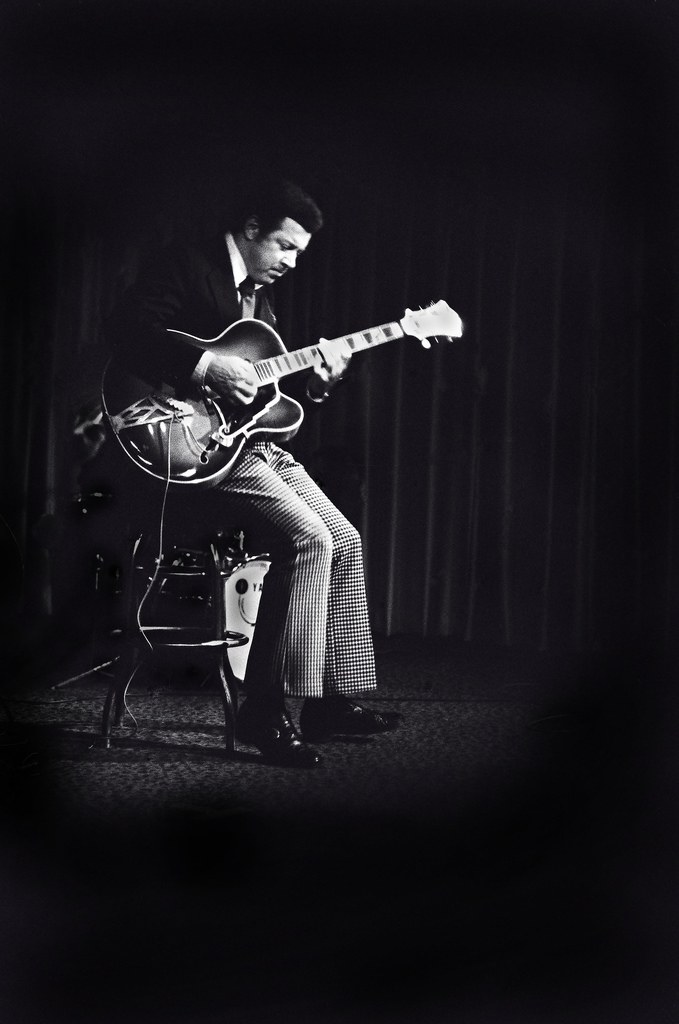
Photo: Tom Marcello / Wikimedia Commons / CC BY-SA 2.0 D'Angelico
New Yorker
1936
One man carved them by hand on Kenmare Street. When he died in 1964, the name kept going. The guitar didn’t.
- Send a picture
D'Aquisto
New Yorker
1965
He started at D'Angelico's for $35 a week. He ended up keeping the New Yorker alive under his own name.
- Send a picture
Stromberg
Master 400
1937
Nineteen inches across, so the guitar player nobody watched could still be heard over the horns.