Dingwall
Combustion
Built to get a small bass shop through a recession. Then the pros started touring on the cheap one.
Saskatoon, 2008. Sheldon Dingwall builds expensive basses by hand in a Canadian workshop, paying Canadian wages and Canadian mortgages. Then the recession hits, and the bass business gets cut in half. His way through it is a cheaper bass, built on the other side of the world.
- Introduced
- 2009
- Type
- Solidbody bass
- Class
- Production
Have a photograph of this guitar? Send a picture
The short version
1987
Dingwall starts
Sheldon Dingwall opens shop in Saskatoon, in 1987 or 1988 depending who you ask.
1993
Fanned frets
Ralph Novak’s slanted-fret idea goes onto a Dingwall five-string at the NAMM show.
1996
The fire
On 18 October a fire takes the shop, the tools, and the records.
2000
The Afterburner
The first new bass after the fire. By 2009 it’s the company’s best seller.
2009
The Combustion
A simplified Afterburner, made in China and finished in Canada. Early ones reach players by 2010.
2012
“Their cheapest model”
Periphery’s Nolly Getgood is touring the world on Combustions.
2018
More strings
A six-string and a left-handed model arrive. Around the same time, Duran Duran’s John Taylor gets interested.
Side A
A1
The lifeboat
Most cheap versions of expensive instruments are an afterthought. Somebody in marketing notices a gap in the price list and fills it. The Dingwall Combustion wasn’t that. It was a lifeboat.
Sheldon Dingwall had been building high-end basses in Saskatoon since the early ’90s. Then came the 2008–2009 recession, and he watched his trade get cut in half. His own explanation is simple: North American instruments are expensive by nature, because the mortgages, the gas, and the wages are North American. If the company was going to survive, it needed a bass that cost less. That meant China.
A2
A shop that already burned down once
This was not a company that gave up easily. Dingwall started in Saskatoon in 1987 or ’88, depending who you ask, and started building basses in 1992. The big idea came from Ralph Novak, whose fanned frets went onto a Dingwall five-string at the 1993 NAMM show.
Then, on 18 October 1996, a fire took the shop, the tools, and the records. Dingwall rebuilt. The first new bass after the fire was the Afterburner, in early 2000, and by 2009 it was the company’s best seller. The Combustion is the Afterburner, simplified.
A3
Three extra inches of B
Here’s what the fan does. On a normal bass every string is the same length, which is fine until you get to a low B. Down there the string goes floppy and the note turns to mush. Novak’s frets are slanted, so every string gets its own length. On the five-string Combustion the G is 34 inches, like a regular bass, and the B is 37. Three extra inches on the string that needs them most. Nolly Getgood says the 37-inch B is “kind of like a grand piano.” That’s about right. It’s tight and it has a real note in it.
The frets are small, banjo-size wire, a direction Lee Sklar pointed Sheldon in. And there’s a four-position selector that gets you everything from a Jazz-style bark to a Music Man punch without touching a screwdriver.
Flip the record · By the numbers
37″
Length of the low B string on the five-string. The G is 34″, standard bass length.
$1,199
Street price for an early Combustion in 2010.
4
Positions on the pickup selector, from a Jazz-style bark to a Music Man-style punch.
1996
The year Dingwall’s shop burned down. The company rebuilt, which is sort of the point.
Side B
B1
Built in China, finished in Canada
Sheldon didn’t mail a drawing to a factory and hope. The necks got Canadian truss rods, the pickups were Canadian, the preamps and strings came from the U.S., and China did the building. Then every bass came back to Canada, where they took it apart and went over the fit, the finish, and the setup before it went out the door. He called it a “world instrument.”
The first ones were in the works in 2009 and in players’ hands by 2010, at about $1,199. That’s real money, but it’s a long way from a hand-built Dingwall.
B2
Philippines to Sweden
The player who made people notice was Nolly Getgood of Periphery. He wasn’t shy about it:
I use Dingwall basses. I use their cheapest model, which is called the Combustion.
He toured on them from the Philippines to Sweden and never had to touch the truss rod. The live bass-cam video of “Make Total Destroy,” from Manchester in 2012, is that bass doing exactly what it was built to do. His studio sound on Periphery II is another story, and his own favorite tracking sound on that record was a Jazz Bass, so don’t hang the album on a Combustion. By 2014 he had his own signature model, built on the same line.
Around 2018 John Taylor of Duran Duran came around to it, too, playing Combustions on stage before Dingwall made him signature basses of his own.
B3
Still running
The Combustion you buy today isn’t quite the 2009 one. The early basses were alder, with two pickups and a simple two-band EQ. Now it’s swamp ash, up to three pickups, a three-band EQ, and a quilted maple top if you want one. Same fan, same trip across the Pacific and back for a Canadian setup.
It got a four-string in 2016 and a six-string in 2018. In January 2019 Dingwall was already talking about its tenth anniversary. Sheldon has said it was always a platform you could customize, “like a Harley Davidson,” and the signature basses for Nolly, Taylor, and others are all built on it.
The Afterburner is still made in Canada, by hand, for people who want the top shelf. It’s still there because a cheaper bass kept the doors open when times got hard. And the people who make their living on stage keep reaching for the cheap one, and saying so out loud.
Put this on
You’ve read about it. Now hear it. Here’s what this guitar sounds like, and what to listen for.
Make Total Destroy (live, Manchester Academy)
The bass-cam video from November 2012. That’s Nolly’s touring Combustion, and you can hear what three extra inches of low B does to a riff.
Watch it on YouTube (opens in a new tab)
The cast
The people, and the specific guitars, that made the legend.
2009
Sheldon Dingwall
Founder
Designed the Afterburner in Saskatoon, then worked out how to build a cheaper version without letting go of the setup.
1993
Ralph Novak
The fanned fret
His slanted-fret idea is the heart of the Combustion. It gives each string its own length.
2012
Adam “Nolly” Getgood
Touring Combustions
Periphery’s bassist. Played them from the Philippines to Sweden without a truss rod tweak. His signature NG model came later.
2018
John Taylor
Combustion on stage
Played one with Duran Duran before getting signature models of his own. The bass on Rio was a different instrument.
1994
Lee Sklar
Not this one
Met Sheldon at the 1994 NAMM show and steered him toward small frets. His own Dingwall is a Custom Shop bass.
Liner notes
Specs, construction, rarity, value, and every source we used.
A 37-inch B, Novax fans, and an EMG three-band on a swamp-ash Afterburner — Dingwall’s China/Canada five-string, not the Custom Shop, and not Nolly’s NG.
- Body
- 2–3 pc swamp ash; optional quilted maple top; Afterburner silhouette. Matte black pickguard available.
- Neck
- 5-piece maple bolt-on, four bolts; medium-thin / slim “C.” Factory: 21 mm / .827" at 1st, 24 mm / .945" at 12th. Mix flagged.
- Fingerboard
- Maple or pau ferro; 24 banjo-size (18% hard nickel silver) frets; 240 mm (9.45") radius. Mix flagged.
- Scale
- Novax fanned. 5-string 37"–34" (B–G). 4-string 36.25"–34". 6-string 37"–33.25". Factory inches. Bass Magazine prints 940–864 mm on a 4-string. Mix flagged. No millimetres invented for this 5-string table.
- Pickups
- 2 or 3 Dingwall FD3n neodymium. Quad-Tone 4-position.
- Hardware
- Dingwall Minimalist one-piece bridge; licensed Hipshot Ultralite; smoked chrome. 5-string bridge spacing 18 mm / .709". Mix flagged.
- Electronics
- EMG B30EQ 3-band (factory). Bass Magazine 2023: EMG BT07 3-band. Master volume, Quad-Tone, bass / mid / treble, active/passive.
- Finish
- Natural Ash, 2-Tone Blackburst, Vintageburst, Indigoburst, Whalepoolburst, Ultravioletburst. Gloss polyester typical on Sweetwater.
- Nut
- Graphtech Black Tusq. 5-string 45.5 mm / 1.8" (4-string 42 mm / 1.65"; 6-string 55 mm / 2.2"). Mix flagged.
Open the full research fileConstruction details, the complete player record, production numbers, dated value estimates, and sources
Current typical = Combustion 5-string (Ready to Play; China/Canada hybrid; dingwallguitars.com/bass/combustion/, fetched 21 September 2026). Factory prints mixed inch/mm on radius, nut, and spacing; scale stays inches on that page. 4- and 6-string exist. NG is Nolly’s alder / Darkglass cousin. Nashville Edition is Neve / blend. JT is nyatoh / Neve. Kyle Konkiel is a limited signature. Not the Canadian Custom Shop Afterburner. Mixed inch/mm flagged. No millimetres invented.
Construction
The job was a Dingwall a working player could take on the road. Sheldon’s Saskatoon Custom Shop already had the long B and the fans. Canadian mortgages, Canadian gas, Canadian labor — Sheldon, Bass Musician Magazine (2017): North American instruments are expensive by nature. The 2008–2009 recession cut the trade in half. Survival meant a cheaper bass, and that meant China.
The company is older than this bass. Wikipedia: Sheldon founded Dingwall Designer Guitars in Saskatoon in 1987. TalkBass wiki, from Wayback of the factory site: established 1988. Keep both. Bass in 1992. Ralph Novak’s fanned-fret idea — Klein advert, a show-floor blessing — went onto a Voodoo 5-string at 1993 NAMM (Wikipedia; Guitar Interactive). TalkBass: shared booth with Novax at 1994 NAMM, where he met Lee Sklar. 18 October 1996, fire took the shop, tools, and records. Afterburner, early 2000, was the first new bass after the fire, and by 2009 the number-one seller. This plate is not that Custom Shop bass. It is the simplified import of that silhouette.
2009. TalkBass wiki lists Combustion that year: China, FD3-A pickups, EMG BT07 2-band. Music Gear Review (Dave Molter, 29 June 2010): he heard in 2009 that Dingwall was planning a Chinese-made active bass at about $1,199 street, and bought one in 2010. Reverb has dated 2010 examples, including a matte-black 5-string serial 00242. TalkBass’s November 2010 website snapshot: first China model, 2–4 pc alder, 5-piece maple, sonokilin (wenge optional), 24 banjo frets, two FD-3A, EMG BT 2-band. Keep 2009 and 2010. This plate starts in 2009. TalkBass’s January 2019 “10th anniversary” Combustion is counting from that start.
Sheldon did not mail a drawing and hope. Bass Musician Magazine: Canadian truss rods, Canadian pickups, U.S. preamps, U.S. strings; China did the manufacturing; the bass came back to Canada and they took the whole thing apart for fit, finish, and setup. “World instrument,” he called it. Factory still: hybrid manufacturing, final fret level and setup in Canada.
What you get is the Afterburner outline with a Novax fan. Factory: 5-string B at 37", G at 34" — three inches of extra speaking length on the string that usually goes floppy. 4-string E at 36.25". 6-string C at 33.25". Banjo-size frets (Lee Sklar pointed Sheldon at small wire; Sklar’s own Custom Shop bass uses mandolin size — not this table). 24 frets. Four-bolt maple. Magnetic battery cover. Hipshot Ultralites, shortened with Dingwall so the string breaks over the nut. The current bridge is the Minimalist one-piece; earlier Combustions used individual Hipshot/Dingwall saddles.
The circuit is the other half. Early: two pickups, volume per pickup, bass and treble (Molter 2010). Later: Quad-Tone rotary — factory 3-pickup map is bridge / bridge+middle (MM-style) / bridge+neck (J-style) / neck. Two-pickup Combustions use neck / both series / both parallel / bridge (MusicRadar, Mike Brooks, 12 December 2016). Factory current preamp is EMG B30EQ 3-band, plus active/passive. Bass Magazine (E. E. Bradman, 9 January 2023) prints EMG BT07 3-band on a BEAD tester. Keep both names. Guitar Interactive 2016 called the preamp 18V — reviewer copy, not on the current factory sheet. Do not flatten voltage.
Then the catalog moved. 2016: 4-string (TalkBass; Guitar Interactive, 3 November 2016). MusicRadar’s 2016 5-string: swamp ash, two rectangular neodymiums, EMG, 52 mm nut — a review measurement against current factory 45.5 mm / 1.8". Do not flatten. 2017: rounded pickup shells. 2018: 6-string, left-hand, new shop for Combustion production. January 2019: quilted maple top, pau ferro, carbon-fiber neck reinforcement, 2-way truss (TalkBass). Guitar Interactive 2016 still had a bone nut and an alder-or-ash choice; some 2026 dealer sheets still print bone. Current factory nut is Tusq.
Not the NG. Adam “Nolly” Getgood’s signature, NAMM 2014, shipping September 2014 (No Treble): alder, maple board, Darkglass Tone Capsule, carbon-fiber-print guard, racing colors. Same hybrid line, different bass. Not the JT. John Taylor signature: nyatoh, pau ferro, Rupert Neve 2-band, Rio eye. Not Nashville Edition (NAMM 2025): same Combustion platform, Neve, blend instead of Quad-Tone. Sheldon, factory: the Combustion was always a platform you could modify, “like a Harley Davidson.” Not D-Roc (ex-D-Bird). Not Afterburner I / II / ABZ. No Gibson SKU.
Classic vs current: 2009–2010 alder 5-string — two FD-3A, EMG 2-band, vol/vol/bass/treble, sonokilin or maple — against a living Ready to Play 5-string: swamp ash, optional quilt, FD3n, EMG 3-band, Quad-Tone, Tusq, 37"–34". Same fan. Same hybrid. Same slug.
Players
Do not hang a Custom Shop Afterburner or a Lee Sklar signature on this plate. Do not recruit the NG as if it were this bass. Do not flatten Rio onto a 2018 Combustion.
Adam “Nolly” Getgood (Periphery). The player who made the import visible. No Treble (Kevin Johnson, 20 December 2012): “I use Dingwall basses. I use their cheapest model, which is called the Combustion.” Touring instrument — Philippines to Sweden, never a truss tweak; 37" B “kind of like a grand piano.” The Manchester Academy “Make Total Destroy” bass-cam (November 2012) is that live tone. He recorded all the bass on Periphery II: This Time It’s Personal (2012). Thomann (2026): favorite tracking sound on that record was a Jazz Bass; he ordered two Combustions after trying one at the London Bass Show, “launched I don’t know if it was a year or two before.” Keep both. Do not stamp P2 studio as Combustion. NG-2 is NAMM 2014. Later Periphery is the signature. Not this table.
John Taylor (Duran Duran). Bass Magazine (Bradman, 13 September 2024): interested around 2018; used Combustion and NG3 with the band, then the limited Rio Dream 4-string (2023, 82 units, $2,830) and the JT signature. Combustion on that stage, not the Aria that cut Rio. The Aria stays on aria-pro-ii-sb-1000.
Also known to play stays short. Kyle Konkiel (Bad Wolves) has a Combustion signature; No Treble (26 November 2025): 2025 run limited to 100, alder, rosewood, Matte Army Green — adjacent SKU, not this table. Wikipedia’s endorsing list (Sklar, Umansky, others) is not a Combustion census. None invented.
Rarity
You can order a new Combustion. Ready to Play is the living line: China assembly, Canadian setup. Custom Shop Afterburner, Prima, Super J, and the Lee Sklar bass are other factories and other money. They are not this slug.
Dingwall does not publish Combustion unit totals. None invented. Serials date a bass. They don’t count a year. That is why a first-year census is unknown, not the chapter.
What is actually thinner: 2009–2010 alder, two-pickup, 2-band examples (Molter’s Olympic White; Reverb 2010 serial 00242). Pre-quilt, pre-3-pickup, pre-4-string. Nolly’s tour Combustions and Taylor’s stage Combustions are unique objects. They are not a used Combustion. NG, JT, Nashville Edition, and the Konkiel 100 are limited or adjacent SKUs on the silhouette. They are not a 2009 5-string.
Value
Informal estimate, 21 September 2026. Not an appraisal.
Ask vs sold labeled. Celebrity lots are not-comps. No invented medians or factory counts. US Reverb Price Guide dollar widget did not print a clean band this pass. Flag: thin sold-comp access. Period $1,199 street (Music Gear Review, 2010) is 2010 money, not 2026 street. Bass Magazine’s January 2023 tester listed $2,500 — dated.
New street. Named Sweetwater carts, fetched 21 September 2026, not a midpoint: Combustion 4 Natural Ash / pau ferro $2,945; 4 Vintage Burst / maple (quilt) $3,095; 5 Indigo Burst / pau ferro (quilt) $3,295; 6-string Natural Ash / pau ferro $3,145, quilt bursts $3,395. Ish Guitars 2025 5-string demo, was $3,345, now $2,699. Nashville Edition is labeled adjacent: Sweetwater 5-string $3,895; 6-string $3,995–$4,095. Rio Dream $2,830 (2023, 82 units) is a limited JT, not a Combustion median.
Used modern. Named asks, not hammers: Combustion 4 Good $1,800; UK Excellent 5-string £1,599. Reverb Norway Price Guide for Combustion 6: kr15,058–kr20,992 based on 32 orders Good to Mint — labeled foreign-currency estimate, not a 2026 USD sold median computed here. Do not average those asks with new street.
Vintage / collectible. First-year 2009–2010 alder 2-pickup examples trade as used modern. No 2024–26 public first-year sold ladder isolated this pass. Nolly’s and Taylor’s stage basses are one-objects. Not comps.
See also
- music-man-stingray — 1976 active bolt-on; parallel frets, 34", not a 37" B
- fender-jazz-bass — two skinny coils, 34"; the J-layout this Afterburner is not
- spector-ns-2 — another modern five with active EQ; Ned’s curve, parallel 34"
Sources
- Dingwall, Combustion — hybrid China/Canada; swamp ash Afterburner body; 5-piece maple bolt-on; Novax 34–37"; 240 mm radius; FD3n; EMG B30EQ; Quad-Tone map; Minimalist bridge; Hipshot Ultralite; Graphtech Black Tusq; 4/5/6; maple or pau ferro; 24 banjo frets
- Dingwall, Combustion (spec page) — 240 mm / 9.45" radius; per-string scales; nut 42 / 45.5 / 55 mm; spacing 19 / 18 / 18 mm; 2–3 pc swamp ash; EMG 3-band; FD-3n; 2- or 3-pickup
- Dingwall, Nashville Combustion — NAMM 2025; Neve 2-band; blend; Sheldon “Harley Davidson” platform; NG and JT as earlier Combustion derivatives
- Wikipedia, Dingwall Designer Guitars — Saskatoon 1987; bass 1992; Novak fans; Voodoo 1993 NAMM; fire 1996; Combustion as China/Canada hybrid, swamp ash, FD-3N, EMG 3-band; NG as alder / Darkglass cousin
- TalkBass wiki, Dingwall-Club — established 1988; 1993 NAMM; fire 18 October 1996; Afterburner early 2000; Combustion 2009 China / FD3-A / EMG BT07 2-band; Nov 2010 alder / sonokilin / two FD-3A; 2016 4-string; 2017 rounded pups; 2018 6-string / lefty / new shop; Jan 2019 quilt, pau ferro, 10th anniversary, carbon fiber, 2-way truss
- Bass Musician Magazine, The Birth of The Combustion Series — Sheldon Dingwall to Michel Laredo, 26 July 2017; 2008–2009 recession survival; simplified Afterburner; Canadian rods and pickups; U.S. preamps and strings; China manufacturing; teardown and setup in Canada
- Music Gear Review, Dave Molter, One hot bass in the Dingwall Combustion (29 June 2010) — 2009 plan; 2010 purchase; Bass Central; alder; maple board; two Dingwall pickups; Vol/Vol/Bass/Treble; 9.2 lb; $1,199 street
- MusicRadar, Mike Brooks, Dingwall Combustion 5 (12 December 2016) — China/Canada; swamp ash; 4.4 kg; 37" B; 52 mm nut; two neodymiums; EMG; four-position rotary; £1,200
- Guitar Interactive, Dingwall Combustion 5 (21 January 2016) — China assembly, Canadian setup; alder or swamp ash; FD3n; 18V EMG 3-band (reviewer); 4-position; bone nut; truss at body end; rosewood option
- Guitar Interactive, Combustion 4 and NG-2 4 (3 November 2016) — 1993 NAMM; Novak blessing; Combustion 4 swamp ash; NG-2 alder / Darkglass; banjo frets; FD3n
- Bass Magazine, E. E. Bradman, Combustion BEAD (9 January 2023) — China/Canada; swamp ash / quilt; 36.25"–34" (940–864 mm); FD-3N ×3; EMG BT07 3-band; Quad-Tone; $2,500
- Bass Magazine, E. E. Bradman, John Taylor Signature 5 (13 September 2024) — Taylor on Combustion and NG3 with Duran Duran from ~2018; Rio Dream 2023, 82 units, $2,830; JT nyatoh / Neve adjacent
- No Treble, Kevin Johnson, Nolly Getgood (20 December 2012) — Combustion as touring bass; 37" B; recorded all bass on Periphery II (instrument unspecified there); “Make Total Destroy” live
- No Treble, Dingwall now shipping NG-2 (11 September 2014) — NAMM 2014 intro; shipping Sept 2014; alder; Darkglass 3-band; two FD-3n
- No Treble, Kyle Konkiel Signature Combustion (26 November 2025) — 2023 signature; 2025 run of 100; alder; rosewood; EMG 3-band; Minimalist bridge
- Dingwall / Andertons, Nolly on the NG — Combustion tried at London Bass Show, launched a year or two before; original pickups further apart; NG as later pitch
- Thomann, Nolly on bass, tone & Dingwall (31 March 2026) — Periphery II favorite tracking sound a Jazz Bass; two Combustions ordered after the bass show
- Sweetwater, Combustion 4 Vintage Burst maple — $3,095; swamp ash / quilt; FD3n ×3; EMG B30EQ; 34–36.25"; Ready to Play
- Sweetwater, Combustion 4 Natural Ash pau ferro — $2,945
- Sweetwater, Combustion 5 Indigo Burst pau ferro — $3,295; 34–37"; FD3n ×3; EMG B30EQ
- Sweetwater, Dingwall ash 6-string basses — Combustion 6 Natural Ash $3,145; quilt bursts $3,395; Nashville 6 $3,995–$4,095
- Sweetwater, Combustion Nashville Edition 5 Vintage Burst — $3,895; Neve; adjacent
- Ish Guitars, Combustion 5 Whalepoolburst demo — was $3,345 / now $2,699; US Price Guide widget thin this pass
- Reverb, Combustion 5st 2010 Matte Black — dated 2010; serial 00242; alder; 34–37"; two volumes, 2-band
- Reverb Norway, Combustion 6 Price Guide — kr15,058–kr20,992; 32 orders Good–Mint
- Reverb UK, Combustion 5 used Excellent — £1,599 ask
- guitarguitar, A Closer Look: Dingwall Basses (updated May 2021) — China build, Canada two-hour check including fret-level; 5-piece maple; swamp ash; 34–37"; 9.45"
Keep digging
Guitars this one gets compared to, confused with, or descended from.
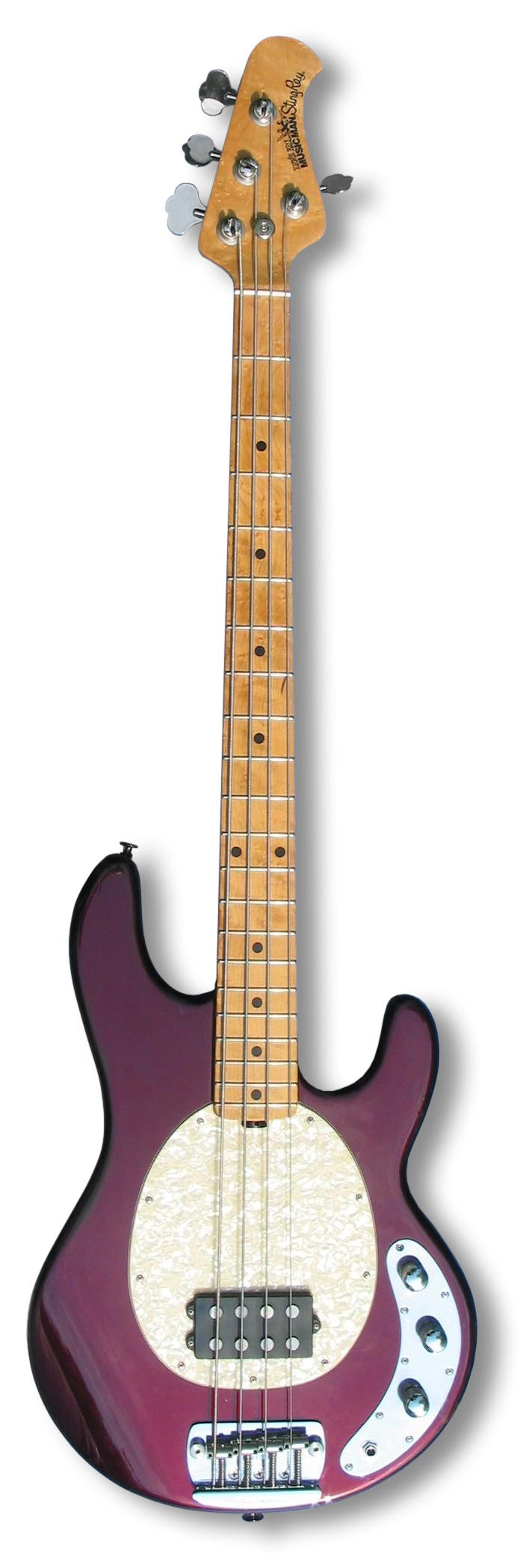
Photo: Th. Ott / Wikimedia Commons / CC BY-SA 3.0 Music Man
StingRay
1976
Leo Fender wanted a wide, bright bass. Louis Johnson hit it with his thumb, and funk had its sound.

Fender Jazz Bass from 1966 in Olympic white with the transition fingerboard (bindings and dot inlays). Photo by Th. Ott. Licensed under CC BY-SA 3.0. Via Wikimedia Commons. Fender
Jazz Bass
1960
Built for jazz players who mostly passed on it. Then bass players started using it to take the solo.
- Send a picture
Spector
NS-2
1979
It started with a man looking for a belt sander. Sting found his lying on the stage before soundcheck.