Fender
Jazz Bass
Built for jazz players who mostly passed on it. Then bass players started using it to take the solo.
Summer 1976. Jaco Pastorius tells an interviewer his debut album is fretless all the way through, except for two tracks. His fretless is a 1962 Jazz Bass that left the factory with frets on it, like every other Jazz Bass of the day.
- Introduced
- 1960
- Type
- Bass
- Class
- Production

The short version
1960
Fender’s second bass
A Jazzmaster-style offset body, two pickups, and a slimmer neck. The working name was “Deluxe Model.”
1961
Three knobs
The stacked knobs start giving way to volume, volume, tone. Or early 1962, depending who you ask.
1963
Mutes off
The felt string mutes under the bridge cover go away around mid-year.
1976
Jaco
A debut album played mostly on a Jazz Bass with no frets.
1977
Pawn shop, Kalamazoo
Geddy Lee finds a black 1972 Jazz Bass, around this year.
1981
Moving Pictures
Lee’s black Jazz is on “Tom Sawyer” and “Limelight.”
1986
Stolen
The rebuilt Bass of Doom disappears from a park bench in Manhattan.
2010
Home
On 31 May the Pastorius family gets it back, with Robert Trujillo’s help.
Side A
A1
Fender’s second bass
By 1960 Fender had one bass, the Precision, and it was doing its job: sit at the back and hold the floor up. Then Leo built a second one.
It borrowed the Jazzmaster’s offset body. It had two skinny pickups instead of one, and a narrower neck at the nut than the Precision, on the same 34-inch scale. Its working name was the “Deluxe Model.” It came out as the Jazz Bass, named for the jazz players Fender hoped would buy it. Mostly, they didn’t.
That’s fine. The Precision was built to stay at the back. The Jazz Bass turned out to be the one that walked to the front of the stage.
A2
Two pickups and a skinnier neck
The first thing you notice picking one up is the neck. How skinny? Depends on who’s measuring: somewhere around 1 7/16 to 1 1/2 inches at the nut on early ones. Either way, the Precision was 1 3/4, and your hand knows the difference right away.
The second thing is the pickups. Two of them, and no switch. You blend them with the volume knobs. Lean on the neck pickup for something round and warm, bring up the bridge for more bite. One bass, a lot of voices. That range is the whole appeal.
The first Jazz Basses had two stacked knobs, a volume and tone for each pickup. Then Fender changed to three knobs: volume, volume, master tone. The date depends who you ask, anywhere from August 1961 to early 1962, and leftover stacked plates kept going onto basses into 1962 anyway. The first ones also had a little felt mute for each string under the bridge cover. Those were gone by around mid-1963.
After that it changed around the edges: binding, block inlays, new finishes. The one change you can hear came in the early ’70s, when the bridge pickup moved a little closer to the bridge.
A3
The Bass of Doom
Jaco Pastorius played a 1962 Jazz Bass with no frets. It wasn’t born that way. Fender didn’t market a fretless until 1970, so somebody pulled them. Who, and how, is a story with two versions: one has a butter knife, and the other has a previous owner, Plastic Wood, and boat epoxy. Pick your favorite. Both end with the same bass.
In the summer of 1976 he told an interviewer his debut was fretless except “Come On, Come Over” and “Portrait Of Tracy.” Those two were fretted. He had a fretted 1960 blond Jazz as well.
Fender didn’t sell a fretless bass until 1970. Jaco didn’t wait.
The Bass of Doom got smashed. A luthier named Kaufman rebuilt it in 1986. Then, that same year, it was stolen off a park bench in Manhattan and vanished for twenty years.
Flip the record · By the numbers
2
Pickups, each with its own volume. On the first ones, each had its own tone knob too.
1 7/16"
Nut width on early ones, by one measure. Others say 1.5". The Precision was 1 3/4".
~18
Months, roughly, of the stacked-knob era. The collectors’ window.
2010
The year Jaco’s Bass of Doom went back to his family, after going missing in 1986.
Side B
B1
Pawn shops and Twitter
Around 1977, Geddy Lee walked into a pawn shop in Kalamazoo and came out with a black 1972 Jazz Bass. It was his main bass from 1979 to 1982 and again from 1989 to 2014. It’s on Moving Pictures, “Tom Sawyer” and “Limelight” included. (Plenty of early Rush is Rickenbacker, so don’t credit this one with all of it.) Lee also says John Paul Jones played a ’62 Jazz on early Led Zeppelin. That’s Lee’s word, not a session log.
Marcus Miller’s is a 1977 blond, not some pre-CBS treasure. He put a Sadowsky preamp in it in 1979 and a Bartolini after a DI surge in 1983. Flea found his 1961 Shell Pink through Twitter, and it’s been his main studio bass since Stadium Arcadium in 2006. Before that, the Chili Peppers records are other basses.
And before any of them, Joe Long of the Four Seasons played a left-handed, stacked-knob blond Jazz Bass on “Can’t Take My Eyes Off You.”
B2
Back to the front
The Bass of Doom resurfaced in 2006. On 31 May 2010, with Robert Trujillo’s help, the Pastorius family got it back.
It isn’t the untouched 1962 anymore. It’s the rebuild, smashed, stolen, fixed, and passed around. But put on “Donna Lee” and listen to what it’s doing. It’s not holding the floor up. It’s playing the melody, right up front, where the horn player usually stands.
Put this on
You’ve read about it. Now hear it. Here’s what this guitar sounds like, and what to listen for.
Donna Lee
From the debut, which Jaco said was fretless except two tracks, and this isn’t one of them. A bebop line played fretless, out front where the horn usually goes.
Find it on YouTube (opens in a new tab)Tom Sawyer
Geddy Lee’s black 1972 Jazz, the one from the Kalamazoo pawn shop. Hear how far forward the bass sits in the mix.
Find it on YouTube (opens in a new tab)Can’t Take My Eyes Off You
Joe Long’s left-handed, stacked-knob blond Jazz Bass, his main bass after 1965. A Jazz Bass hit from before Jaco.
Find it on YouTube (opens in a new tab)Stadium Arcadium
Where Flea’s 1961 Shell Pink Jazz Bass became his main studio bass. The earlier Chili Peppers records are other basses.
Find it on YouTube (opens in a new tab)
The cast
The people, and the specific guitars, that made the legend.
1976
Jaco Pastorius
“Bass of Doom,” a 1962 Jazz made fretless
Left the factory fretted. Also played a fretted 1960 blond. The recovered bass is a 1986 rebuild.
1977
Geddy Lee
Black 1972 Jazz Bass
Found in a Kalamazoo pawn shop. His main bass 1979–82, then again 1989–2014.
1979
Marcus Miller
1977 blond Jazz Bass
Not a pre-CBS relic. A Sadowsky preamp went in in 1979, a Bartolini after a DI surge in 1983.
2006
Flea
1961 Shell Pink Jazz Bass
Found through Twitter. His main studio bass since Stadium Arcadium.
1965
Joe Long
Left-handed stacked-knob blond Jazz
The Four Seasons’ bassist. A named Jazz Bass from well before the fretless era.
Liner notes
Specs, construction, rarity, value, and every source we used.
Fender’s second four-string: Jazzmaster offset, two skinny single-coils, a slimmer nut than the Precision — named for jazz players who mostly didn’t show.
- Body
- Alder; offset-waist contour
- Neck
- Bolt-on maple, Modern “C”
- Fingerboard
- Rosewood or maple, 9.5" radius, 20 medium-jumbo frets
- Scale
- 34" (864 mm)
- Pickups
- Two Player Series Alnico V Jazz Bass single-coils
- Hardware
- 4-saddle barrel-steel bridge; open-gear tuners
- Electronics
- Volume (neck), volume (bridge), master tone
- Finish
- Gloss polyester body; satin urethane neck
- Nut
- Synthetic bone, 1.5" (38.1 mm)
Open the full research fileConstruction details, the complete player record, production numbers, dated value estimates, and sources
Current Mexican Player II. Am Pro II: V-Mod II, HiMass, Posiflex, slim C, 20 narrow-tall, poly. AVII 1966 is nitro 1966 spec. Vintera III Early ’60s (April 2026) recreates stacked knobs. Vintage 1960 is stacked concentrics; three-knob from 1961/62. Not a Precision Bass.
Construction
Fender introduced the Jazz Bass in 1960 (GuitarHQ: summer 1960; Fender’s 60th essay: 1960). “Deluxe Model” is a well-attested early working name (Sweetwater citing Don Randall / Tony Bacon). Offset-waist Jazzmaster family, two 8-pole single-coils, narrower nut than a Precision, same 34" scale. Not a split-coil P-Bass. 1962 is a control-plate change, not a relaunch.
1960. GuitarHQ: contoured alder, 3-color sunburst; blond/natural ash. Slab rosewood, clay dots, unbound, 20 frets, 7.25" radius. Transition logo from day one — never spaghetti. Individual felt mutes, one per string (not the Jaguar flip-plate). Two stacked concentric knobs: Vintage Guitar puts volume on the upper/smaller knob, tone on the lower/larger; stack nearer the pickguard junction is neck, nearer the jack is bridge. Independent volume and tone per pickup.
Nut width is contested. GuitarHQ: 1.5". Vintage Guitar: 1 7/16" (1.4375") vs P-Bass 1 3/4". Current AVII 1966 and Player II: 1.5" (38.1 mm). Measured vintage necks often sit nearer 1.437". Do not flatten 1960 to “always 1.5".”
Electronics, 1961/62 — overlap, not overnight. GuitarHQ: three-knob (Vol neck, Vol bridge, master tone) August 1961. Vintage Guitar: early 1962. Wikipedia / Seymour Duncan / Guitar Center / Joe’s: late 1961 introduction, leftover stacked plates factory-correct into early 1962; mid-1962 Fullerton is three-knob. That blend — no selector — is the lasting passive spec. Stacked is 1960–early production plus the 2026 Vintera III Early ’60s recreation.
Later dated changes. Veneer rosewood August 1962 (GuitarHQ) vs Guitar Center 1963. Mutes off mid-1963 (GuitarHQ); Wikipedia: felt 1960–62, then foam under the cover. Pearloid dots late 1964; binding mid-to-late 1965; pearl blocks mid-1966 (GuitarHQ) vs Guitar Center 1967. 1968: polyester, black logo, F-tuners. 1971: maple/black blocks standard (GuitarHQ). Bridge pickup moved ~0.4" toward the bridge 1970–72 (Fender has said 1972; 4" examples from 1970). Ash typical by ~1974 (Wikipedia). 3-bolt micro-tilt: GuitarHQ late 1973 vs Wikipedia / Joe’s mid-to-late 1974. Four-bolt returns 1983 (Wikipedia). Jaguar Bass (2005/2006) is Jazz pickups in a Jaguar-shaped bass — not this body.
Players
The jazz pitch missed. Jamerson, Carol Kaye, and Duck Dunn are Precision stories. They do not belong here.
Jaco Pastorius — “Bass of Doom,” 1962 Jazz Bass converted to fretless; also a 1960 blond fretted Jazz Bass. Suchow: both left the factory fretted (Fender marketed fretless from 1970). Fret-removal stories conflict: butter knife vs previous owner plus Plastic Wood and boat epoxy (Milkowski, Guitar Player, August 1984). Kaufman rebuilt the smashed bass in 1986; stolen that year from a Manhattan park bench; resurfaced 2006; family reclaim 31 May 2010 (Trujillo-assisted). The recovered bass is that rebuild, not an untouched 1962. Bacon, summer 1976: debut album fretless except “Come On, Come Over” and “Portrait Of Tracy” — those two fretted.
Geddy Lee — black 1972 Jazz Bass (“Number One”). Pawn shop, Kalamazoo, about 1977. Rush.com: 1979–82 and 1989–2014. No Treble: Moving Pictures including “Tom Sawyer,” “Limelight,” “Vital Signs,” “Witch Hunt”; return on Counterparts (1993). Rickenbackers cover a large early stretch — not every Rush track is this bass.
Marcus Miller — 1977 blond Jazz Bass. Not a pre-CBS relic. Sadowsky preamp 1979; Bartolini TCT after a 1983 DI surge.
Flea — 1961 Shell Pink Jazz Bass. Twitter find; Tower Records trade for a Modulus; primary studio bass since 2006 (Stadium Arcadium). Pre-2006 Chili Peppers records are other makes. Do not stamp Give It Away or Californication on the pink ’61.
Joe Long (Four Seasons) — left-handed stack-knob, serial 57392, blond. Primary bass after 1965, including “Can’t Take My Eyes Off Of You” and Genuine Imitation Life Gazette (1968). Pre-Jaco named instrument, not the cultural centre.
Also known, without a canonical guitar: Larry Graham — Fender lists him; slap and the Sly titles are sourced, Jazz vs Precision is not. No Sly-era serial. John Paul Jones: Geddy Lee attributes a ’62 Jazz on early Zeppelin — Lee’s claim, not a session log. Noel Redding and Adam Clayton: manufacturer-acknowledged. Sting and Entwistle stay on the Precision page.
Rarity
AVII, Custom Shop, MIJ JB-62, and signatures are not vintage originals. Official shipping totals are unpublished. Serials were shared across models; they are not shipping counts. True Vintage’s 40000–58000 first-year window is a dating range, not a census.
Scarcity is the stack-knob window: 1960 through late 1961, leftover plates factory-correct into early 1962 — Joe’s: roughly eighteen months of a run still going. 1960 first-year (slab, clay dots, stacks, felt mutes) is the thinnest original supply; custom-color stacks thinner still. Later CBS and 1970s examples are abundant. Control-plate swaps fake stacks (Joe’s).
Value
Informal estimate, 25 August 2026. Not an appraisal.
Asking prices are not sold prices. Factory totals unpublished. Serials ≠ shipping. Stack-knob and pre-CBS three-knob solds are thin; most visible numbers are dealer asks. The only robust 2024–25 sold ladder is Reverb’s 1965–1969 bucket (165 orders). Artist-owned examples (Pastorius lots included) sit outside these ranges. 2011 Vintage Guitar guide dollars are stale.
New street. Mexico Player II about $850 (Fender $849.99). US American Professional II $1,849.99. AVII 1966 list $2,500; dealers commonly about $2,700.
Used modern / CBS. Clean 1970s original-finish commonly low-to-mid four figures; three-bolt 1975+ cheaper. No 2024–26 Reverb band captured for 1970–75 Jazz Bass.
Vintage / collectible. Reverb 1965–1969 Good–Mint sold estimate $3,961–$8,572, mixed originality. Dealer asks: sunburst often $8,000–$16,000; custom color $16,000–$19,000. 1962–64 three-knob pre-CBS original-finish sunburst roughly $10,000–$20,000 — thin; mostly asks. Edgewater: $15,000–$35,000 excellent stack-knob-era — dealer range, not sold. Stack-knob 1960–early 1962 sunburst: specialist asks mid-to-high five figures. Andy Baxter 1960 £26,995 ($34,000–$36,000 — ask); 1961 £23,995 ($30,000–$32,000 — ask). A $99,500 one-owner ask is an outlier, not a model comp. No 2024–26 public stack-knob solds located. Custom-color stacks sit above sunburst.
See also
- Precision Bass
- Stratocaster
- fender-mustang-bass — 30" student bass; not this 34" Jazz
Sources
- guitarhq.com Fender model notes — 1960 specs; August 1961 three-knob; August 1962 veneer; mid-1963 mutes; inlay/logo/poly/3-bolt chronology; 1.5" nut; 8-pole pickups.
- guitarhq.com pickups — Jazz Bass 42 Formvar ~9000 turns.
- guitarhq.com custom colors — matching headstocks ~1962; blond = ash.
- Vintage Guitar: Joe Long’s stack-knob Jazz Bass — stacked layout; 1 7/16" nut; three-knob early 1962; Long’s blond lefty 57392 (Moseley, May 2009).
- Vintage Guitar: Joe Long (alt. URL)
- Fender: 60th Anniversary Jazz Bass
- Fender: Precision Bass or Jazz Bass
- Seymour Duncan: The 1962 Fender Jazz Control
- American Vintage II 1966 Jazz Bass
- Player II Jazz Bass — $849.99 (August 2026).
- No Treble: Player II basses
- No Treble: Vintera III bass series
- Fender Vintera III launch
- Sweetwater: History of the Fender Jazz Bass
- Guitar Center: Jazz Bass buying guide
- American Professional II Jazz Bass — $1,849.99.
- American Professional II Jazz Bass V
- Joe’s Vintage Guitars: Jazz Bass Guide 1960–1975
- True Vintage Guitar serial charts
- Edgewater: Jazz Bass serial lookup
- Reverb Price Guide: Jazz Bass 1965–1969
- Reverb: Jazz Bass 1960–1961
- Andy Baxter: 1960 stack-knob sunburst
- Andy Baxter: 1961 stack-knob sunburst
- Vintage Guitar: 25 Most Valuable Basses — 2011 ranking (not 2026).
- Willcutt: AVII 1966 Jazz Bass
- Rick Suchow: Rebuilding The Bass Of Doom
- No Treble: Bass of Doom reclaim
- Tony Bacon: Jaco interview, summer 1976
- Fender: Jaco Pastorius Jazz Bass
- Rush.com: 1972 Fender Jazz
- No Treble: Geddy Lee 1972 Jazz Bass
- Premier Guitar: Geddy Lee’s Magnificent Obsession
- Rolling Stone: Geddy Lee on *Big Beautiful Book of Bass*
- Guitar World: Marcus Miller’s 1977 Jazz Bass
- Guitar World: Flea’s 1961 Shell Pink Jazz Bass
- Guitar World: Larry Graham on slap
Keep digging
Guitars this one gets compared to, confused with, or descended from.

Photo: Infrahertzz / Wikimedia Commons / CC BY-SA 3.0 Fender
Precision Bass
1951
Leo’s bass let the player at the back be heard. You know their lines by heart. You mostly don’t know their names.

Photo: Lightburst / Wikimedia Commons / CC BY-SA 4.0 Fender
Stratocaster
1954
The guitar most people mean when they say “electric guitar.” Designed by a man who didn’t play one.
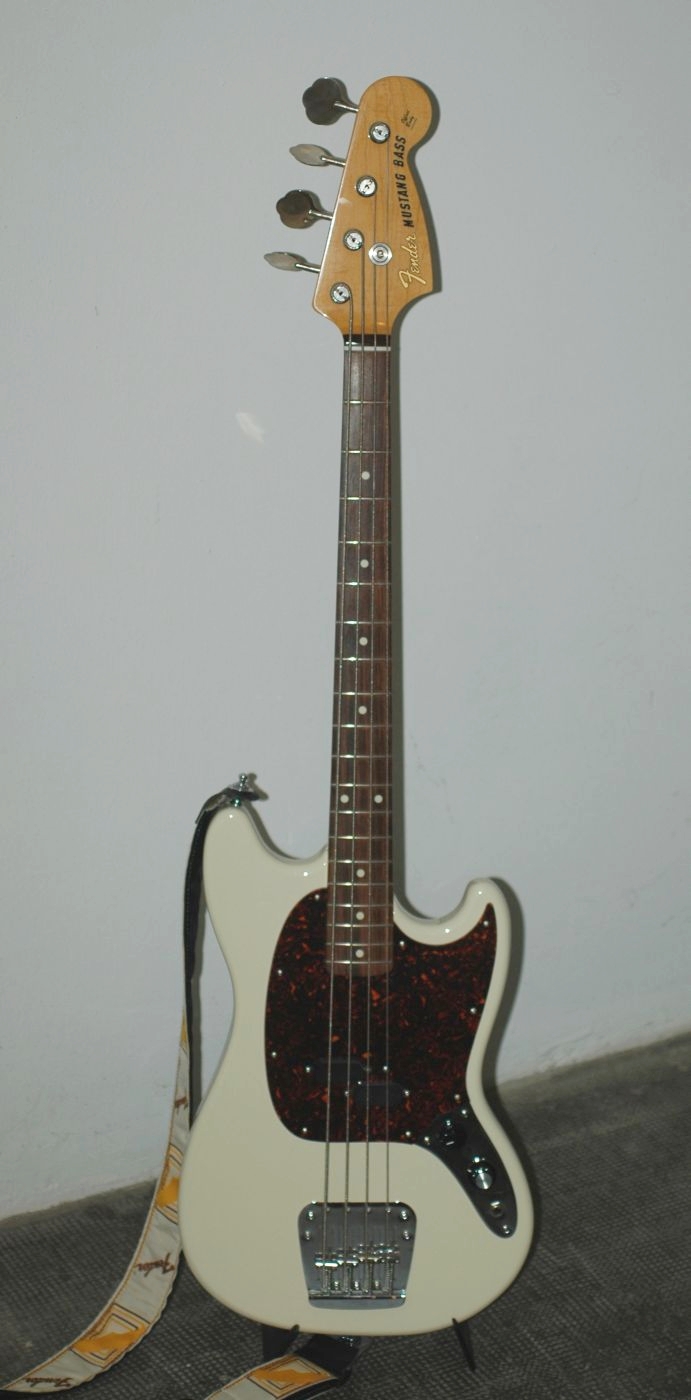
E-Bass Fender Mustang, shortscale 30". Photo by Joachim Hensel-Losch. Licensed under CC BY 2.5 (also offered as CC BY-SA 3.0). Via Wikimedia Commons. Fender
Mustang Bass
1966
Leo Fender’s last bass for Fender was a short, cheap student model. That was the whole idea.