Warwick
Corvette
Warwick’s first bolt-on was never shaped by hand. Then the players got their hands on it.
In 1992 a small German shop known for handmade through-neck basses screwed a neck onto a body and aimed at a wider floor. The Corvette was the bass built to leave the bench, and it ended up the one working bassists wear out.
- Introduced
- 1992
- Type
- Solidbody bass
- Class
- Production
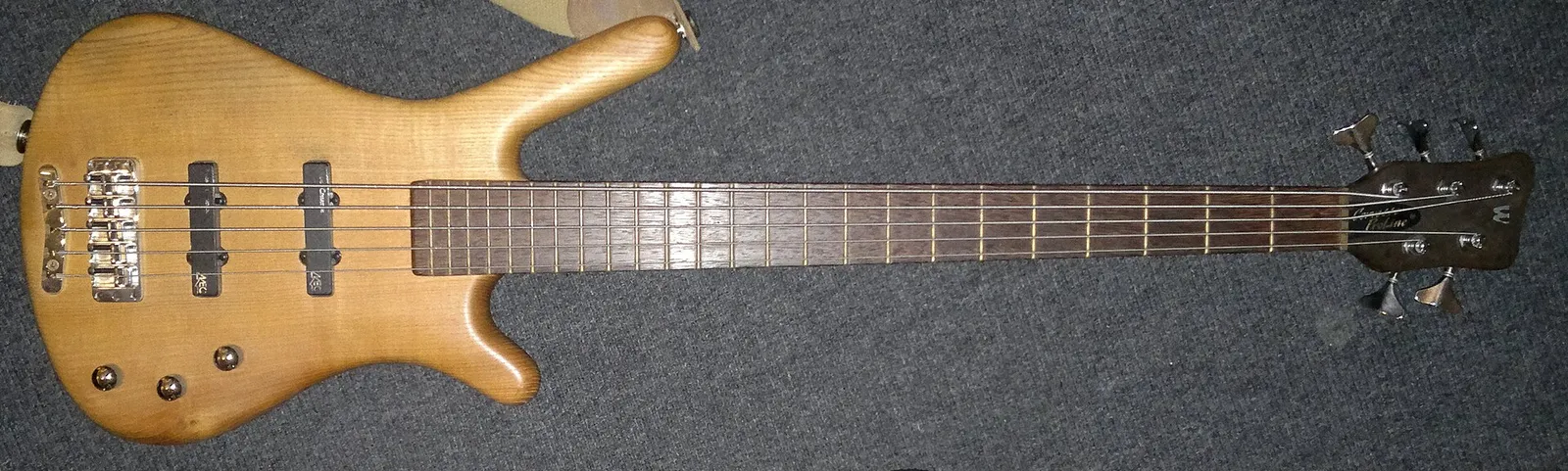
The short version
1991
The shape comes first
A neck-through with no catalog name, later nicknamed the Infinette, wears the outline the Corvette takes next year.
1992
The Proline
Warwick’s first bolt-on. Wenge neck, European ash, passive MEC Jazz pickups, satin. Some lists start it in 1994 or 1995.
1995
East, and the Standard
The shop moves to Markneukirchen, and the Standard replaces the Proline, at the end of 1994, in 1995, or in 1996.
1998
Formerly Named Altus
The FNA arrives with a StingRay-spot humbucker, because another builder already had the name it was meant to wear.
2005
Double buck
The $$ puts two humbuckers side by side. A 2007 price list adds a neck-through version.
2010
Korea, for a while
The Standards move to Korea under a Pro Series name, because Germany had become too expensive.
Side A
A1
Off the bench
In 1992, Warwick screwed a neck onto a bass.
That doesn’t sound like news until you know what came before. The Streamer and the Thumb had made the name, and both were neck-throughs, built slowly in a small shop for a niche. Lovely, expensive, and not the kind of thing you make a lot of.
The Corvette was the other plan. Bolt the neck on, aim at a wider floor, and build it like an industry instead of a bench. The through-necks stayed the top of the line and stayed handmade for a while. The new bolt-ons were never shaped by hand at all.
Hold that thought. Nobody told the players.
A2
Half Infinity, half Corvette
The body came a year early. In 1991 Warwick built a neck-through from a prototype by Stefen Manz: maple neck, etimoa wings, a bird’s-eye top, Dolphin electronics. It never had a catalog name. Owners later called it the Infinette, half Infinity and half Corvette, and some of their truss-rod covers say Streamer. About a hundred were numbered. One owner who bought one in 1992 remembers probably 220. Keep both.
That is not a Corvette. But the next year, its outline was.
The first one was the Proline: a three-piece wenge neck with a 24-fret wenge board, two-piece European ash, passive MEC Jazz pickups, and a satin finish, new for the company. Four screws. Five- and six-string versions from the start. A short body and a tubular upper horn.
When it started depends who you ask. This plate says 1992. Other lists say 1994, and one review says the Corvette was introduced in 1995, which is closer to when the Standard name stuck.
A3
East, and onto the machines
Late in 1994, in 1995, or in 1996, depending on the list, the Proline became the Standard. The body lifted a little, bubinga joined the ash, and a few came in cherry that’s hard to tell from ash. You could get it passive, or with an active MEC pair.
In 1995 the whole company left Franconia for Markneukirchen, in the former East Germany. Bigger shop. CNC. The bolt-ons were what was selling.
Then the wood ran short. Wenge for necks got protected and expensive, so around 1997 and 1998 the neck went to ovangkol, with the board still wenge, thinner and quartersawn. The brass nut you could notch string by string gave way to graphite.
The oddest Corvette came next. From 1998 to 2003 there was the FNA, with a flamed-maple top, a walnut line, and a big passive double-coil sitting where a StingRay keeps its pickup. It was supposed to be called the Altus. Another builder had the name. So: Formerly Named Altus.
Flip the record · By the numbers
1992
The year Warwick first bolted a neck on. Other lists say 1994 or 1995.
100 or 220
Infinettes, the 1991 neck-throughs that lent the Corvette its body. Depends who you ask.
$1,299
A passive German Standard four-string on the US list in January 2007.
24
Frets on a wenge board, on the 1992 Proline and on today’s German four-string.
Side B
B1
Double buck
The Corvette most players picture now has two humbuckers sitting next to each other, and that’s the whole joke of the name. Two bucks: $$. Warwick’s own demonstrator said as much. The pickups are a pair.
Each one has a three-way switch, series, parallel, or single-coil. In plain terms, every pickup can be fat, a bit brighter and tighter, or thin and snappy, and you can stack those choices across both pickups into an active two-band preamp. It’s the Corvette for players who want one bass to cover a whole set.
The dates are a little loose. One list puts the $$ at 2005, a German one survives from 2006, and the US price list in January 2007 already had it, with a neck-through $$ NT marked new for that September.
In 2010 Germany had become far too expensive for the entry Standard, so it moved to Korea with the same materials and parts and a Pro Series name. Today the German Teambuilt Corvette is built to order in Markneukirchen. Same short horn. Same screws.
The new bolt-ons were never shaped by hand at all.
B2
Worn in
Here is where the plan stopped mattering.
Jon Stockman of Karnivool ordered a custom Corvette in 2004, and in 2026 he still called it his main bass. Erlend Caspersen of Spawn of Possession plays a five-string $$ NT in bubinga as his main bass, into a SansAmp, with a fretless Thumb and an FNA Jazzman around it.
Paolo Gregoletto left B.C. Rich after Trivium’s 2015 record and showed up in the videos with a five-string Corvette, two humbuckers, and a flamed-maple top. By 2020 he’d narrowed it down. “It’s pretty much only the Corvette double buck these days,” he said. He wanted the bass in its own pocket between the guitars and the drums, and that’s where it sits.
Ivy Vujic of Kittie played an ash Corvette $$ at every live show for about a year and a half. The oil finish was wrecked in the first week of a tour.
Nobody shaped that bass by hand. A tour did it in a week.
Put this on
You’ve read about it. Now hear it. Here’s what this guitar sounds like, and what to listen for.
Silence in the Snow (video)
Paolo Gregoletto plays a five-string Corvette with two humbuckers and a flamed-maple top in the video. The record itself was finished on another bass, so watch it rather than reach for the album.
Watch it on YouTube (opens in a new tab)What the Dead Men Say
Gregoletto said this record is what he plays live, and live it’s the Corvette double buck. Listen for the low end sitting in its own pocket between the guitars and the drums.
Find it on YouTube (opens in a new tab)The Evangelist (playthrough)
Erlend Caspersen names two basses in this one, a $$ NT in bubinga and a Thumb. Watch for the Corvette; the Thumb is the other card.
Watch it on YouTube (opens in a new tab)
The cast
The people, and the specific guitars, that made the legend.
2020
Paolo Gregoletto
Five-string Corvette, then the Corvette $$
Of Trivium. Left B.C. Rich in 2015 and moved to a five-string Corvette. “It’s pretty much only the Corvette double buck these days,” he said in 2020. He took a Kiesel endorsement in 2021.
2009
Ivy Vujic
Corvette $$, ash, oil finish
Of Kittie. Her main bass from late 2009, used at every live show. The oil finish was wrecked in the first week of a tour. No studio take is pinned to it.
Erlend Caspersen
Five-string Corvette $$ NT, bubinga
Of Spawn of Possession. The $$ NT is his main bass. He also plays a fretless Thumb and an FNA Jazzman. Three basses, not one.
2004
Jon Stockman
Custom Corvette, ordered 2004
Of Karnivool. In his own words, that custom is his main bass. A Thumb from 2006 sits beside it. Which record is which bass isn’t on the record.
Liner notes
Specs, construction, rarity, value, and every source we used.
A short horn, two MEC Jazz pickups, and Warwick’s first bolt-on — the Corvette, not a Thumb, and not a Streamer.
- Body
- Bubinga; flat top and back; offset double-cut; bolt-on
- Neck
- Ovangkol, bolt-on
- Fingerboard
- Wenge. 20" radius (factory sheet also prints 502 mm), 24 jumbo extra-hard bronze frets, IFT, fluorescent side dots. Mix flagged.
- Scale
- 34" (864 mm)
- Pickups
- Active MEC J/J, “Dynamic Correction”
- Hardware
- Warwick 2-piece bridge; Warwick tuners; Warwick security locks; chrome
- Electronics
- Active MEC 2-way; volume with push/pull, balance, stacked treble/bass
- Finish
- Natural transparent satin. Oil is also on the factory color list.
- Nut
- Just-A-Nut III Tedur, 38.5 mm / 1.5". Mix flagged.
Open the full research fileConstruction details, the complete player record, production numbers, dated value estimates, and sources
Current typical = Teambuilt Pro Series Corvette Bubinga 4-string, active (Markneukirchen; shop.warwick.de, fetched 12 October 2026). Factory prints mixed inch/mm; no millimetres invented. The English sheet prints the radius as 20" / 502 mm; Thomann’s German page prints 508 mm for that 20". Do not average. Frets: that factory sheet prints extra-hard bronze; Thomann prints nickel silver; Sweetwater’s bullets print brass. Do not average. Factory cart €3,250 for the active 4-string natural (article GPS1244 90AA BUB FR), built to order. A second listing with the same name, GPS1244 90AABBUB FR, is €3,428.50. The sheet does not say what the difference is. Do not average. Passive 4-string €3,050. Ash is the other J/J body. $$ (“double buck”) is two MEC MM-style humbuckers, not this table. $$ NT is neck-through. 5- and 6-string, fretless, and a passive circuit exist. RockBass Corvette is China. Masterbuilt is Custom Shop. Proline is the 1990s name of this shape. Not a Thumb. Not a Streamer. No Gibson SKU.
Construction
The job was a Warwick that could leave the bench. Streamer and Thumb had made the name, and they were slow: neck-through, small shop, a niche. Bass Center’s translation of the megabass.it chronology (12 July 2016): 1992 is the year Warwick bolts a neck on and aims at a wider floor. The through-necks stay the top of the line and stay handmade for a while. The new bolt-ons are industrial. None of them, that chronology says, was ever shaped by hand. The bass that carries the change is the Corvette.
The outline is a year older than the screw-on. 1991, the Infinette: a neck-through from a Stefen Manz prototype, maple neck, etimoa wings, bird’s-eye top, pickups and electronics taken from the Dolphin. Bass Center: the body the Corvette takes the next year, and the woods and pickups that later sit in the Infinity. About 100 numbered. It had no catalog name. “Infinette” is a later nickname — Warwick Forum — half Infinity, half Corvette. Some truss-rod covers say Streamer. A Forum owner who bought one in 1992, citing a Dutch Gitarist review, remembers probably 220. Keep 100 and 220. That is a neck-through. It is not this plate.
When the Corvette itself starts is split. Bass Center heads the section Corvette Proline 1992–1994: first bolt-on Warwick produced, the Infinette’s shape, three-piece wenge neck, 24-fret wenge board, four screws, nut 38 mm on the four-string, optional maple neck, two-piece European ash, passive MEC Jazz pickups signed “Dynamic Correction,” satin — new for the company — and five- and six-strings from the start. Wikipedia’s Corvette page, which has no inline citations, prints the period 1992–present and a five-string Proline, serial G 000122 92, “according to Warwick”: wenge neck and board, two-piece ash, passive MEC, bronze frets, an adjustable brass nut, strap locks recessed into the body and two of them on the bridge side. A four-string 1992 Pro Line, serial L-000824-92, is the red one Ish Guitars listed. Blue Book’s Pro Line window is 1994–95, reintroduced 2001–06. guitar-list: Pro Line 1994–1995. MusicRadar (Roger Newell, 16 November 2010): “When Warwick introduced the Corvette bass in 1995.” Keep 1992, 1994, and 1995. This plate starts in 1992. Newell’s 1995 is the year the Standard name sticks, not the first screw-on.
Same years, not this bass. Dolphin Pro 2, 1992–94, is also a bolt-on, the first one taken off a through-neck, and Shadow in Japan built it (Bass Center). Ash, maple, wenge board, MEC J/J, about a thousand, and not sought. Fortress, 1993, is the bolt-on under the Corvette: ash, soon maple, P/J, passive or active, a wider nut (45 mm on the four). Not the Thumb (warwick-thumb): 1985, hidden neck, 26 frets, small body. Not the Streamer (warwick-streamer): 1984, Ned’s curve, reverse-P and J, through-neck. Not a Spector. No Gibson SKU.
Then the name changes. Bass Center: late 1994 the Proline is revised and the Standard arrives; the section header is 1995–1997. A slight lift of the body. Same first-series recipe. Bubinga joins the ash. A few in cherry, hard to tell from ash. Passive, and an active MEC pair with the two-band. Four, five, and six. Wikipedia: first Standard 1995. Blue Book: Standard 1996–2009. guitar-list: Standard introduced 1995, replacing the Proline. Keep the end of 1994, 1995, and 1996. A second Proline, 1995–97, is the flamed-maple body, usually passive pickups into active electronics, all-active ones too.
1995, the shop leaves Franconia for Markneukirchen. Bass Center’s translation spells the new town Marneukirchen; the address on a current bass is Markneukirchen. Bigger shop, former East Germany, CNC. The bolt-ons are what is selling. From that year, the same chronology says, the through-necks come off machines. Streamer, Thumb NT, and Dolphin still play, and the gap against the older small-shop ones is no longer something you can talk past. That sentence is about those basses. Not a new Corvette spec.
1997–98 the neck changes louder than the move. Wenge for the neck is short, protected, expensive. Ovangkol replaces it. The board stays wenge, thinner, cut on the quarter. Just-A-Nut II is graphite, not the brass nut you could notch per string. The neck thickens into a U. Bass Center: the profile comes back to the old C in 2009. Just-A-Nut III is the living nut. Wenge necks with a Just-A-Nut II exist in the overlap, 1998–99.
1998–2003, the FNA. It was going to be called Altus. Another builder had the name. Bass Center: FNA is read as Formerly Named Altus, or the version you don’t print on a truss-rod cover. Corvette outline, American ash, flamed-maple top, a walnut line between them. A passive double-coil with big Alnico poles, in the StingRay spot (music-man-stingray). Seymour Duncan three-band, a slap preset on the volume push/pull. Early necks still wenge, then ovangkol. Jazzman, 1999–2006, adds a neck J. Duncan on the early ones, MEC around 2002.
The $$ is the humbucker Corvette. guitar-list dates the double-buck to 2005. A German four-string, serial D-124852-06, is a 2006. The US price list effective 18 January 2007 already prices the bolt-on $$ and marks $$ NT new, available September 2007. MusicRadar (2 April 2008) reviews the NT bubinga and calls the double-buck the latest addition; swamp ash is the other wing wood. Two passive MEC MM-style humbuckers, each on a three-way — series, parallel, single-coil — into an active two-band. Andy Irvine, in Warwick’s 2013 demo: the name is the pair, sitting together. Not the J/J in the table. Not a neck-through unless the badge says NT.
Taranis is a tuning idea, twice. Bass Center, 2008: ash, passive MM plus a large-pole J, the four aimed at BEAD. No Treble (Kevin Johnson, 25 February 2018): RockBass Corvette Taranis at that NAMM, China, 35" scale, ash, maple neck, wenge board, active EMG DC35, retail $1,599.99. Same name. Not the same bass.
RockBass, 2002. China. Bass Center: cheap copies of Streamer Standard, Corvette, and Fortress, alder and maple and rosewood, none of the German wood recipe. German Wikipedia: a Shanghai office since 1996. That office is not this line. The line is the floor under this plate. It is not the table.
2010. Bass Center: Corvette Standards, the German entry, move to Korea. MusicRadar the same autumn: Germany had become far too expensive, so the same materials and parts, Korea, and a Pro Series name so the bass stays at a price. Wikipedia’s uncited page adds that each German Standard was losing money. Keep the cost story. Don’t invent a margin. Thomann has listed the German-made Teambuilt Bubinga 4 since August 2020, and the $$ 4 since July 2020. What sat between the Korean Standard and that German catalog line is unpublished here.
German Wikipedia, as on the Thumb and Streamer plates: Custom Shop is Masterbuilt, Germany; Pro Series is Teambuilt, also Germany; RockBass is China. Three prices, one horn. Thomann prints about 4.3 kg on the living four-string. Classic vs current: 1992 Proline — two-piece European ash, three-piece wenge neck and board, passive MEC Jazz, brass nut, 38 mm, satin, before the move east — against the Teambuilt Bubinga 4 in the table. Same short horn. Same screws. Same slug.
Players
Do not hang a Thumb, a Streamer, or a Fortress on this plate. Do not recruit Jack Bruce, P-Nut, John Norwood Fisher, Ryan Martinie, Mike Inez, or Robert Trujillo from the other Warwick cards. Bass Direct’s Corvette copy names Dirk Lance and Stuart Zender. Lance, on Scott’s Bass Lessons (30 September 2024), names a 1997 Streamer Stage II. Zender, in Guitar World, puts “Virtual Insanity” on a Streamer Stage I. Neither line is this horn. Paul Gray, in Total Guitar, said a Warwick “Corvette or some model,” from Ozzfest. Not a pin.
Paolo Gregoletto (Trivium). The player who says the model out loud. MusicRadar (29 May 2018): he left B.C. Rich at the end of recording Silence in the Snow (2015). That record is not this bass. The new one is a five-string Corvette, wenge neck, and he wants it in its own pocket between guitars and drums. Wikipedia: the videos for “Silence in the Snow” and “Until the World Goes Cold” show a five-string Corvette, two humbuckers, a flamed-maple top. Bass Player via Guitar World (1 September 2020): “It’s pretty much only the Corvette double buck these days.” Two newer ones, not yet toured, are neck-through with maple necks. For Bass Players Only (4 May 2020), on What the Dead Men Say: the record is what he plays live, and that bass is the Corvette double buck. Dunlop Super Bright .045–.130. An EBS compressor. Darkglass Duality on a few parts. Wikipedia: a Kiesel endorsement in 2021. Guitar World (22 June 2022): the main part of “Shadow of the Abattoir,” written in 2020, was chordal stuff “on my Warwick.” That is Warwick, in the Corvette years. It is not a pin for all of In the Court of the Dragon, and it is not a four-string J/J Bubinga.
Ivy Vujic (Kittie). V13 (17 March 2011): her main bass is a Corvette $$, ash, the double humbuckers, the oil finish wrecked the first week of a tour. She had had that one about a year and a half — so late 2009 — and used it at every live show. The piece points at “Cut Throat,” the In the Black single (September 2009). She does not say that take was this bass. I’ve Failed You (2011) credits her bass tracks, recorded in the United States. The instrument on those tracks is unpublished here.
Erlend Caspersen (Spawn of Possession). His own description on the “Evangelist” playthrough: a Warwick $$ NT bubinga, and a Thumb 6 NT with old strings, into a Darkglass. That is the video, not a studio log for Incurso (2012). Wikipedia’s equipment note — the page is thin on citations there — calls the five-string $$ NT bubinga the main bass, through a SansAmp, and also lists a fretless Thumb NT 6 and a five-string FNA Jazzman. A 2008 Warwick Forum thread, not him speaking, already had him on the FNA Jazzman. Keep the $$ NT and the FNA. Do not mash them into one bass, and do not borrow the Thumb.
Jon Stockman (Karnivool). Warwick’s own reel (9 May 2026), in his voice: the main bass is a custom Corvette he ordered in 2004. On the same bench, a Thumb he dates to 2006. Both are in the rundown. Which Karnivool record is which bass is unpublished here.
Also known stays empty on purpose. No one from the unsorted Warwick list.
Rarity
You can order a new Corvette from Markneukirchen. Teambuilt Bubinga, Ash, and $$ all sit on this horn, fretted and fretless, four through six. RockBass is the same outline from China. Masterbuilt is the limited current line. A Pro Series bass is not a 1992 Proline, and a RockBass is not either. The current German line is not vintage rare.
Warwick does not publish Corvette unit totals. None invented. Serials date a bass. They don’t count a model. Blue Book’s one named Corvette count: the Corvette Limited, a semi-hollow with f-holes, production limited to 100. That is one limited model, not a 1992 census. Bass Center’s shop figures — about 60–70 instruments a month in 1984, about 100–120 a month by 1990 — and German Wikipedia’s about 4,000 basses and guitars in 2009 are company-wide. Same caveat as on the Thumb and the Streamer. The Infinette’s 100, or 220, is the 1991 neck-through. Not a Corvette total.
What is actually thinner: 1992 Prolines with the recessed strap locks and a wenge neck; two-piece European ash before bubinga became the Standard’s other body; the cherry Standards Bass Center says are hard to separate from ash; FNA before the name ran out (2003); first $$ neck-throughs from 2007. Gregoletto’s double bucks, Vujic’s tour-scarred $$, Stockman’s 2004 custom, and Caspersen’s $$ NT bubinga are unique objects. They are not a vintage Corvette.
Value
Informal estimate, 12 October 2026. Not an appraisal.
Ask vs sold labeled. Celebrity instruments are not comps. No invented medians or factory counts. A 1992 Price Guide band did not print cleanly this pass. Flag: thin sold-comp access on the first-year Proline. The 2010s German Pro Series does have a band. Do not average it with 1992, with $$, or with RockBass.
New street. Factory Teambuilt Bubinga 4, active, €3,250 (GPS1244 90AA BUB FR), built to order, about 15 months; the same name on GPS1244 90AABBUB FR is €3,428.50; passive 4-string €3,050 (shop.warwick.de, fetched 12 October 2026). The sheet does not say what the extra is. Do not average the two active carts. Named EU dealer, in stock: Thomann.de €2,999. Named US cart: Sweetwater Pro Series Corvette Standard 4 natural $3,415. A heading on that page says two humbuckers; the bullets say stacked-coil MEC active J-style, and brass frets. The price is the price. Don’t launder the heading into the spec. $$, labeled adjacent, not this table: factory Nirvana Black €3,532.50; Thomann.de €2,899; Sweetwater natural $3,320, Nirvana Black $3,560. RockBass Corvette Basic 4, factory €949; Premium 4 €1,149. China. Do not average those with Teambuilt.
Used modern. Reverb Price Guide, German Pro Series Corvette Ash 4, 2010s natural, Good to Mint: $743–$1,294, from 175 orders. Named sold, not that band: Sweetwater Gear Exchange, 2013 Pro Series Standard 4 bubinga, serial WPS G-000006-13, $985, sold 21 December 2025. $$ 4, 2010s Burgundy, Good to Mint: $981–$1,936, from 17 orders. Named 2025 solds on that page: Very Good $1,500 (1 October), Excellent $1,450 (12 September), Excellent $1,400 (5 June). Do not average the Ash band with the $$ band.
Vintage / collectible. Named asks, not hammers: Ish Guitars, 1992 Pro Line red, serial L-000824-92, listed $1,399.99, sold out; a 1992 Pro Line natural on Reverb, €1,400, listing ended. Named older sold, not a series: 2004 German Standard $1,045 (the listing is about four years old). Named current ask: 2006 German bubinga Standard 4, $2,287.10. Do not average a 1992 ask with a 2006 bubinga. A 2023 Masterbuilt $$ in Ocean Blue, €5,635.28, listing ended, is Custom Shop. Not a comp. Gregoletto’s and Stockman’s basses are one object each.
Historical lists, not 2026 street. US retail sheet effective 18 January 2007: Standard 4 passive $1,299, active $1,599; $$ 4 $1,799; $$ NT 4 $2,999, marked new, available September 2007. MusicRadar, November 2010, on the Korean Standard Ash 4: £1,019 / $1,049. Guitar World (Jonathan Herrera, 8 January 2020), on one $$ review sample: street $3,700.
See also
- warwick-thumb — the 1985 hidden neck and 26 frets this bolt-on is not
- warwick-streamer — the 1984 through-neck on Ned’s curve, not this bolt-on horn
- music-man-stingray — the 1976 humbucker slab; FNA and $$ borrow the pickup, not the body
Sources
- Warwick, Teambuilt Corvette Bubinga — active 4-string natural €3,250 (GPS1244 90AA BUB FR) and €3,428.50 (GPS1244 90AABBUB FR), same title, difference unpublished; passive €3,050; built to order; ovangkol; wenge; 34" / 864 mm; nut 38.5 mm / 1.5"; radius 20" / 502 mm; 24 jumbo extra-hard bronze on the English sheet; MEC J/J; 2-way; 2-piece bridge; Just-A-Nut III
- Warwick, Teambuilt Corvette ($$ and family) — $$ 4 Nirvana Black, passive MEC humbuckers, active electronics, €3,532.50
- Warwick, RockBass Corvette — Basic 4 €949; Premium 4 €1,149; China, not the table
- Bass Center, L’histoire des Warwick (12 July 2016) — megabass.it chronology; Infinette 1991, ~100 numbered, Corvette shape the next year; Proline 1992–94, first Warwick-built bolt-on, 3-piece wenge, 38 mm nut, European ash, passive MEC J, satin, 5- and 6-string from the start; Dolphin Pro 2 Japan 1992–94; Fortress 1993; Standard late 1994 / 1995–97, bubinga and some cherry, active option; second Proline 1995–97 flamed maple; move east 1995 (that translation spells Marneukirchen); through-necks off machines from 1995; ovangkol and Just-A-Nut II 1997–98; FNA 1998–2003; Jazzman 1999–2006; RockBass 2002; Taranis 2008; C-profile 2009; Standards to Korea 2010; ~60–70/month 1984; ~100–120/month 1990
- Wikipedia, Warwick Corvette — period 1992–present, no inline citations; Proline serial G 000122 92 “according to Warwick”; Standard 1995; $$ and $$ NT ash/bubinga; Korea and the uncited “losing money” line
- Blue Book of Guitar Values, Warwick Corvette series — Pro Line mfg. 1994–95, reintroduced 2001–06; Standard mfg. 1996–2009; Limited semi-hollow, f-holes, 100 instruments
- guitar-list, Corvette series — Pro Line 1994–1995; Standard introduced 1995; $$ dated 2005
- MusicRadar, Roger Newell, Pro Series Corvette Standard Ash 4 (16 November 2010) — “introduced in 1995”; short body, tubular upper horn; Germany too expensive; Korea; Pro Series; £1,019 / $1,049; swamp ash, ovangkol, wenge, active MEC J
- MusicRadar, Corvette $$ NT Bubinga (2 April 2008) — double-buck the latest addition; neck-through; bubinga or swamp ash; passive MEC MM-style humbuckers; series/parallel/single; £1,399 / $3,800
- Warwick, Andy Irvine on the Pro Series Corvette $$ (13 May 2013) — “double buck” from the dual humbuckers; passive pickups, active preamp; series / single / parallel
- TalkBass, Warwick US price list effective 18 January 2007 — Standard 4 passive $1,299, active $1,599; $$ 4 $1,799, $$ 5 $2,049; $$ NT new, 4-string $2,999, available September 2007
- No Treble, Kevin Johnson, RockBass Corvette Taranis (25 February 2018) — NAMM; China; 35" scale; EMG DC35; retail $1,599.99
- No Treble, Kevin Johnson, Corvette $$ LTD 2019 (27 January 2019) — Masterbuilt neck-through and Teambuilt bolt-on; both Germany
- Guitar World, Jonathan Herrera, Corvette $$ and Star Bass II (8 January 2020) — $$ review sample street $3,700; bolt-on; ash; flame-maple top; 24 jumbo bronze; 9.5 lb
- Thomann, Pro Series Corvette Bubinga 4 — Germany; €2,999 in stock; radius 508 mm; 24 nickel-silver jumbo; nut 38.5 mm; active MEC 2-way; about 4.3 kg; in the catalog since August 2020; $$ 4 listed €2,899
- Sweetwater, Pro Series Corvette Standard 4 natural — $3,415; a heading says two humbuckers; bullets say stacked-coil MEC active J-style and brass frets
- Sweetwater, Pro Series Corvette $$ natural — $3,320; swamp ash; passive MEC humbuckers
- Sweetwater, Pro Series Corvette $$ Nirvana Black — $3,560
- Wikipedia (de), Warwick (Unternehmen) — Masterbuilt / Teambuilt / RockBass China; Shanghai office since 1996; about 4,000 basses and guitars in 2009
- MusicRadar, Paolo Gregoletto (29 May 2018) — left B.C. Rich at the end of Silence in the Snow; five-string Corvette; wenge neck
- Guitar World, Paolo Gregoletto (1 September 2020) — “only the Corvette double buck”; two new neck-throughs, maple necks
- For Bass Players Only, Paolo Gregoletto (4 May 2020) — What the Dead Men Say is the live rig; Corvette double buck; Dunlop Super Bright .045–.130; Darkglass Duality
- Wikipedia, Paolo Gregoletto — 2015 videos, 5-string Corvette, two humbuckers, flame maple; Kiesel endorsement 2021
- Guitar World, Paolo Gregoletto on In the Court of the Dragon (22 June 2022) — “Shadow of the Abattoir,” written 2020, chordal parts on “my Warwick”
- Bass Direct, GPS Corvette Ash 5 — dealer copy names Dirk Lance and Stuart Zender on the Corvette; not followed here
- Guitar World, Stuart Zender on Virtual Insanity (9 May 2024) — Streamer Stage I, MEC; not a Corvette
- Total Guitar / MusicRadar, Paul Gray (26 May 2010) — a Warwick “Corvette or some model,” from Ozzfest; not pinned
- V13, Ivy Vujic on her Corvette $$ (17 March 2011) — ash; double humbuckers; oil finish; about 18 months owned; every live show; points at “Cut Throat”
- Wikipedia, I've Failed You — “Cut Throat” is an In the Black single; Ivy’s bass tracks for the 2011 album recorded in the US
- Erlend Caspersen, Spawn of Possession — The Evangelist — his description: Warwick $$ NT bubinga; Thumb 6 NT
- Wikipedia, Erlend Caspersen — equipment note: 5-string $$ NT bubinga through a SansAmp; fretless Thumb NT 6; FNA Jazzman 5
- Warwick Forum, Erlend Caspersen (8 February 2008) — forum, not him: Corvette FNA Jazzman
- Warwick Basses, Jon Stockman reel (9 May 2026) — his voice: main bass a custom Corvette ordered 2004; a Thumb he dates to 2006
- Warwick Forum, “The Infinette” (12 October 2009) — nickname coined later; owner cites Gitarist, probably 220, bought 1992
- Ish Guitars, 1992 Pro Line Corvette red — serial L-000824-92; listed $1,399.99; sold out
- Reverb, 1992 Corvette Pro Line natural — ask €1,400; listing ended
- Reverb Price Guide, German Pro Series Corvette Ash 4 — 2010s natural, Good to Mint, $743–$1,294, 175 orders
- Reverb Price Guide, German Pro Series Corvette $$ 4 — 2010s Burgundy, Good to Mint, $981–$1,936, 17 orders; named 2025 solds
- Sweetwater Gear Exchange, 2013 Pro Series Standard 4 bubinga — serial WPS G-000006-13; sold $985, 21 December 2025
- Reverb, 2004 German Corvette Standard — sold $1,045; listing about four years old
- Reverb, 2006 German bubinga Standard 4 — ask $2,287.10
- BassBros, 2006 Corvette $$ 4 — serial D-124852-06; German; ash; ovangkol; wenge; MEC humbuckers
- Reverb, 2023 Masterbuilt Corvette $$ Ocean Blue — ask €5,635.28; listing ended; Custom Shop
- Scott’s Bass Lessons, Dirk Lance (30 September 2024) — 1997 Streamer Stage II, not a Corvette
Keep digging
Guitars this one gets compared to, confused with, or descended from.
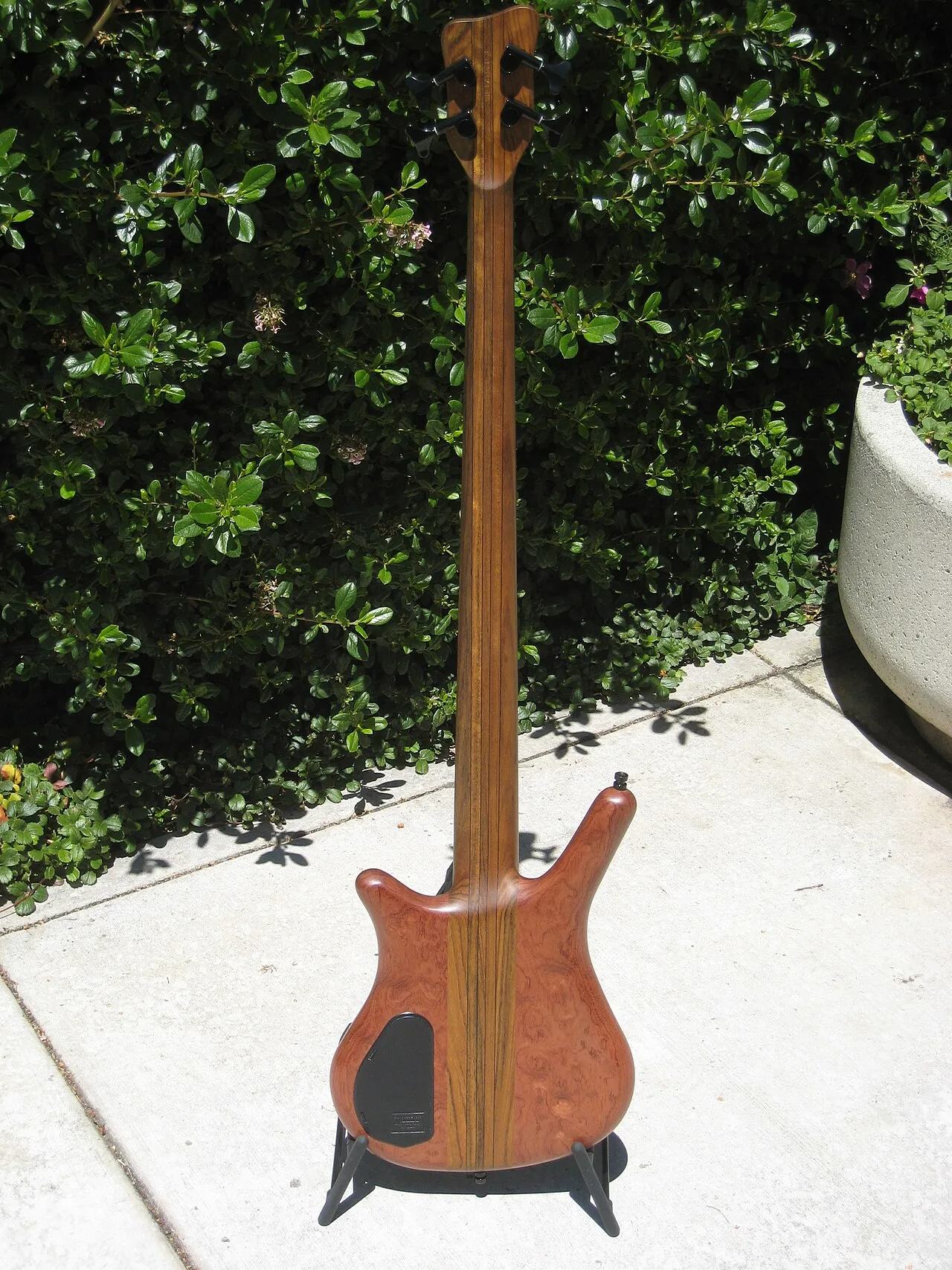
Photo: Ethan Prater from San Bruno, CA, USA / Wikimedia Commons / CC BY 2.0 Warwick
Thumb
1985
Named for one funk player’s thumb, fixed by Jack Bruce’s complaint, and the bass Bruce said he’d quit without.
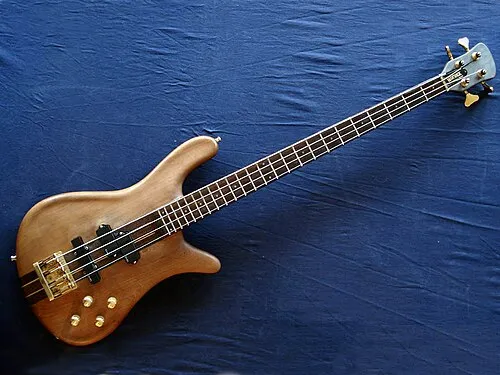
Photo: Jarlmos / Wikimedia Commons / CC BY-SA 3.0 Warwick
Streamer
1984
It started as a German copy of a bass Europe couldn’t get. By the time the lawyers came back, it wasn’t one.
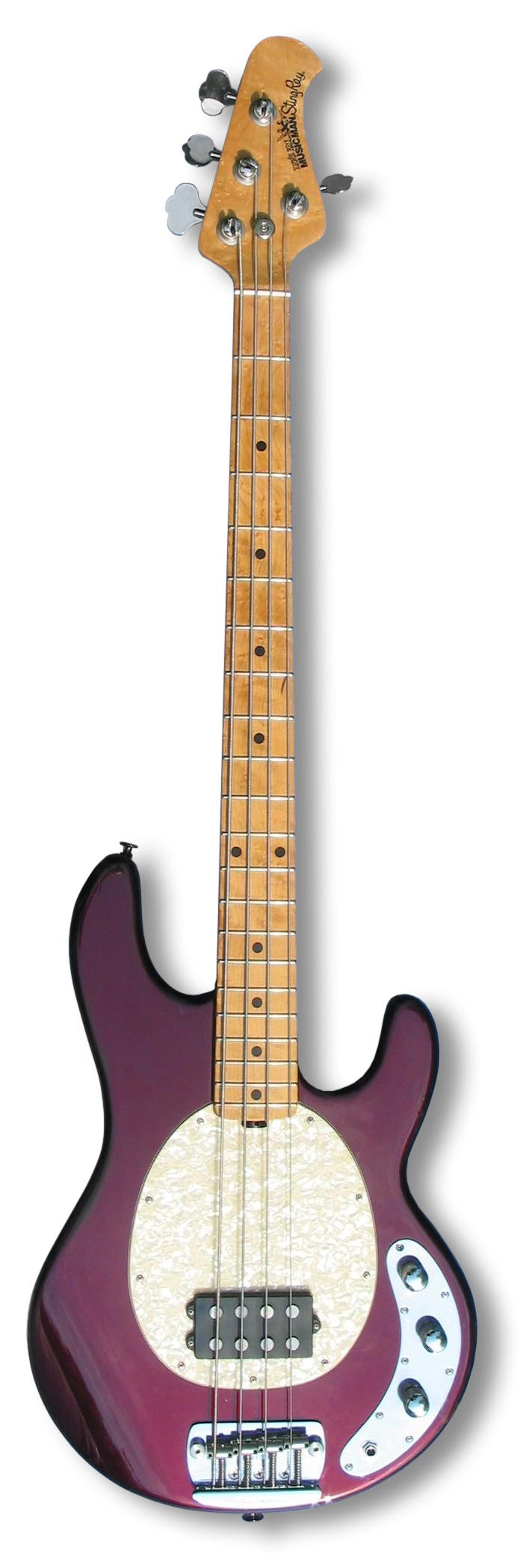
Photo: Th. Ott / Wikimedia Commons / CC BY-SA 3.0 Music Man
StingRay
1976
Leo Fender wanted a wide, bright bass. Louis Johnson hit it with his thumb, and funk had its sound.