Spector
NS-2
It started with a man looking for a belt sander. Sting found his lying on the stage before soundcheck.
Brooklyn, 1977. Stuart Spector is at a picnic table at the woodworkers’ co-op, talking to a furniture designer named Ned Steinberger. Stuart’s basses are flat and wide, and he wants a newer shape. Ned takes Stuart’s bass, shrinks it, and gives it a curve.
- Introduced
- 1979
- Type
- Solidbody bass
- Class
- Production
Have a photograph of this guitar? Send a picture
The short version
1976
Spector starts
Stuart Spector and Alan Charney open shop in Brooklyn, building flat, wide, neck-through instruments.
1977
The curve
Ned Steinberger reshapes Spector’s bass at a picnic table. The first one-pickup NS-1 is built in March.
1979
Two pickups
The NS-2 arrives, with a reversed P pickup and a J at the bridge.
1983
The Checkerdome
Sting picks up a white NS-2 at a Police soundcheck in St. Louis and keeps it.
1985
Sold to Kramer
The company goes to Kramer in New Jersey. Brooklyn keeps building into 1986.
1990
Production stops
Kramer goes bankrupt, and Spector basses stop with it.
1998
The name comes home
Stuart Spector buys his own name back and builds outside Woodstock, New York.
2019
Korg
Korg USA, the distributor since 2015, buys the company.
Side A
A1
He came in for a belt sander
A lot of the best things in the guitar world happen because somebody was in the right room at the right time. The Spector NS-2 is practically made of those moments.
Stuart Spector and Alan Charney started Spector in Brooklyn in 1976. Their first instruments were flat, wide, and built neck-through, a single piece of wood running the length of the instrument. They sounded good. They also sat on you like a plank.
Ned Steinberger was a furniture designer at the Brooklyn Woodworkers Co-op. As the story goes, Stuart stopped by looking for a belt sander and found Ned instead.
A2
A bass that sits against you
One day in 1977, at the co-op’s picnic table, Stuart asked Ned for a newer shape. Ned took Spector’s bass, shrank it down, and curved the wings so the body nested against the player instead of sitting flat in front of them.
Stuart did the rest by feel. He moved the strap pin and fiddled with the upper horn until the bass hung level and the neck stopped diving toward the floor. They called it the NS, for Ned Steinberger. The first one, the NS-1, was built that March with a single pickup.
Keith Jones, one of the early NS-1 players, sat in with Bob Marley on “Jamming.” Good record, wrong bass for this story.
Stuart went looking for a belt sander and came back with a new bass.
A3
Two pickups and a battery
The NS-2 came in 1979. It kept the curve and added a second pickup, and the way they did it is clever. The P-style pickup near the neck was flipped around and moved so every string came out at an even level. A J pickup went in near the bridge. The P gives you the weight. The J gives you the snarl.
Then there’s the 9-volt battery. Stuart had designed an active circuit a year earlier, so you could boost or cut the bass and the treble right on the instrument instead of reaching for the amp. The first NS-2s wore DiMarzio pickups; EMG’s active pickups show up that same year. EMGs and that circuit became the Spector sound people know.
Over the years it picked up the crown inlays on the board, a brass locking bridge, and eventually graphite rods in the neck. The curve didn’t change.
Flip the record · By the numbers
2
Pickups. A reversed P near the neck for weight, a J at the bridge for bite.
9V
The battery behind the active circuit Stuart designed with H.A.Z. Labs in 1978, a year before the NS-2.
14
Basses in the batch that Sting’s came from. His was the last one built.
100
Instruments a month at the Kramer-era peak, all models. Not an NS-2 count.
Side B
B1
Left on the stage in St. Louis
24 July 1983, the Checkerdome in St. Louis. The Police are on the Synchronicity tour. A dealer named Dan Martin sets a white NS-2 on the front of the stage before soundcheck.
Sting picked it up. He played it that night. Then he pointed at Martin and told his people to write the man a check. It was the last of a batch of fourteen, built that May, and Sting played it for the rest of the tour. A picture of it ended up in Time. That white bass is now in the Rock & Roll Hall of Fame in Cleveland, and it’s where a lot of people first saw that curve.
B2
Sold, broke, and bought back
Late in 1985, Spector sold to Kramer, the New Jersey guitar company. Brooklyn kept building until the summer of 1986, and after that the NS-2 was a Kramer product, with cheaper copies coming out of Korea. Kramer went bankrupt in 1990, and Spector basses stopped.
Stuart started over near Woodstock, New York, under a different name. In 1998 he bought his own name back. Korg USA took over distribution in 2015 and bought the company in 2019. The custom shop is still outside Woodstock.
Doug Wimbish had seen a Brooklyn Spector on the road with the Sugar Hill Gang back in 1979. By the time he got one, Kramer owned the company. He had the neck shaved down to feel more like a Jazz Bass and has been recording with that 1987 NS-2 ever since.
B3
Keep that one
In 1989 Guy Pratt played an NS-2 on Madonna’s “Like a Prayer.” On the fade, she kept asking for more until he ran out of licks. He thought he was just messing around. They kept it.
Ian Hill of Judas Priest found a Spector sitting in a Miami studio around 1984. The company sent him two. Years later, after he had a signature model for the stage, he was still using the original NS-2s in the studio.
A belt sander. A picnic table. A bass left on the front of a stage in St. Louis. A bass in the corner of a studio in Miami. The shop outside Woodstock is still carving the same curve, and one of them is sitting somewhere right now, waiting for the right person to walk by.
Put this on
You’ve read about it. Now hear it. Here’s what this guitar sounds like, and what to listen for.
Like a Prayer
Guy Pratt on an NS-2, with a Minimoog doubling the line. Wait for the fade, where Madonna kept asking for more until he ran out of ideas. He thought he was messing around. They kept it.
Find it on YouTube (opens in a new tab)
The cast
The people, and the specific guitars, that made the legend.
1983
Sting
White NS-2
Played it the night a dealer left it on the stage in St. Louis, then for the rest of the Synchronicity tour. It’s in the Rock & Roll Hall of Fame.
1987
Doug Wimbish
1987 NS-2
Saw a Brooklyn Spector on the road in 1979 and finally got his in the Kramer years. Neck shaved down, and on his records ever since.
1989
Guy Pratt
NS-2
The bass line on Madonna’s “Like a Prayer,” including the fade he thought was just messing around.
1984
Ian Hill
NS-2
Judas Priest’s bassist found one in a Miami studio; Spector sent two. He kept using the originals in the studio for years.
1977
Ned Steinberger
Designer
The furniture designer who curved the body. NS stands for his initials.
1976
Stuart Spector
Founder
Asked for the new shape, then fixed the balance himself. Lost his company’s name, then bought it back.
Liner notes
Specs, construction, rarity, value, and every source we used.
Ned Steinberger’s curved NS body, a reverse-P and a J, and a 9-volt HAZ — Spector’s two-pickup bass, not the one-pickup NS-1, and not a Czech Euro.
- Body
- Solid maple wings on the Ned Steinberger NS curve; neck-through
- Neck
- 3-piece maple through-neck with graphite rods
- Fingerboard
- Pau ferro, 24 frets, mother-of-pearl crown inlays
- Scale
- 34"
- Pickups
- EMG P (neck, reverse-P) and EMG J (bridge)
- Hardware
- Aluminum locking bridge with brass saddles; Spector Gotoh tuners; gold
- Electronics
- HAZ 9V; master volume, pickup balance, bass boost/cut, treble boost/cut
- Finish
- High gloss
- Nut
- Brass, 1.64"
Open the full research fileConstruction details, the complete player record, production numbers, dated value estimates, and sources
Current typical = USA Custom Shop NS-2 (Woodstock, NY). Table follows the factory Woodstock Select NS-2 recipe (fetched 4 September 2026): maple wings, EMG P/J, HAZ 9V, 34", 1.64" brass nut. Custom Shop one-offs vary woods, nut width (1.5" narrow exists), and pickups. Factory inches. Dealer tables sometimes print 41.5 mm for that nut. Mix flagged. No millimetres invented for scale. NS-1 is one pickup. NS-2A is the Korean Kramer-era copy. Euro LX is the Czech production version of this silhouette. Icon NS-2 Bolt-On is bolt-on alder. Doug Wimbish and Ian Hill signatures are adjacent SKUs, not this table.
Construction
The job was a bass that sat on you. Fender slabs were wide. The headstock pulled the neck down. Ned Steinberger was a furniture designer in the Brooklyn Woodworkers Co-op. MusicRadar: Stuart Spector stopped by looking for a belt sander and got Ned.
Stuart Spector and Alan Charney started Spector in Brooklyn in 1976 (Wikipedia; factory NS body history). First line: Stuart’s own G-1 guitar and SB-1 bass — flat, wide, neck-through. Factory: one day in 1977, at the co-op picnic table, Stuart asked for a newer shape. Ned took the SB-1, reduced it, and curved the wings so the body nested against the player. Stuart fine-tuned the balance. MusicRadar: he moved the strap pin and played with the upper horn until the center of gravity stopped diving. NS is Ned Steinberger.
The first NS-1 was built in March 1977 (factory; Vintage Spector holds the prototype). One P-style pickup. Parkash John, Pete Briquette, Loverboy’s Scott Smith, Keith Jones — MusicRadar names those on the one-pickup. Jones sat in with Bob Marley on “Jamming.” That is the NS-1. This plate is the two-pickup.
1979. Factory NS body history: first NS-2 introduced. MusicRadar, Wikipedia, and Guitar World (Joe Daly, 25 May 2022) the same year. Vintage Spector: the P was reversed and moved for even string-to-string output; a J went at the bridge. DiMarzio P/J on first-year examples (Vintage Spector NS-2 #398, 1979). Factory also dates EMG active low-impedance pickups to 1979. Keep both. The 9-volt circuit is older than the two-pickup: factory, Spector USA 9V designed by Stuart with H.A.Z. Labs, 1978. Factory later calls EMG plus HAZ the Spector recipe.
Then the running changes. Factory: crown inlays on NS-2 boards, 1982. Solid brass locking bridge, 1984. Graphite rods in the neck as a standard spec, 1993. Pocketed frets, 2012. Early Brooklyn boards were often rosewood with dots; pau ferro and crowns became the later house look. Walnut wings were common in Brooklyn; maple in the Kramer years and after. Oil-and-wax, then gloss.
24 July 1983, Checkerdome, St. Louis. Stuart Spector, via TalkBass (Patrick Stern, 25 July 2013): dealer Dan Martin put a white NS-2 on the apron before a Police soundcheck. Sting played it that night, pointed at Martin, said write the man a check. Serial #669, built 10 May 1983, last of a batch of fourteen (656–669). He played it for the rest of the Synchronicity tour. A Time picture followed. The bass is at the Rock & Roll Hall of Fame, Cleveland (Wikipedia; Stern). That is one object. It is why a lot of players first saw this curve.
Late 1985, the company sold to Kramer in Neptune, New Jersey. Vintage Spector: December 1985; Wikipedia: late 1985. Production stayed in Brooklyn through the move; last Brooklyn serial #1187, 1 July 1986 (Vintage Spector). Kramer serials for NS-2 / NS-2o: 1188–2719. Serialized at the start of the build, completed out of order. Wikipedia: production reached a maximum of 100 guitars a month, company-wide — not an NS-2 census. Korean NS-2A / NS-2B / NS-2C: factory 1986; FAQ dates NS-2A 1987–1990. Keep both. Czech NS bodies, 1993, “true production versions of our USA handmade NS basses” (factory). Kramer went bankrupt in 1990. Spector production stopped.
Stuart started Stuart Spector Designs near Woodstock. Wikipedia: SD bass at NAMM, Atlantic City, after a two-year gap. He bought the Spector name back in 1998. Korg USA took US and Canadian distribution in 2015 and bought the company in 2019 (No Treble, 17 January 2019). USA Custom Shop still sits outside Woodstock. Bass Magazine (Chris Jisi, 3 August 2021): a new team, same curve, woods Stuart had not used as house stock — reclaimed NYC water-tank redwood, buckeye, swamp ash.
Not an NS-1. Not an NS-2A. Not a Euro LX, even though factory calls Euro4LX a production version of the USA NS-2. Not the Icon bolt-on. Not Ned’s later Steinberger L2, and not the GL guitar. No Gibson SKU.
Classic vs current: 1979 Brooklyn NS-2 — walnut or maple wings, often DiMarzio, HAZ 9V, dots — against a living Woodstock Custom Shop NS-2: maple wings, EMG P/J, HAZ 9V, crowns, $4,999 on the Woodstock Select cart. Same reverse-P idea. Same curve. Same slug.
Players
Do not hang the NS-1 on this plate. Do not recruit Euro signatures as if they were a 1979 Brooklyn bass. Do not flatten every Spector artist onto this four-string.
Sting (The Police). The public object. White NS-2 #669, 24 July 1983, Checkerdome, Synchronicity tour (Stuart Spector via Stern). Rock Hall. Time ran the picture. That tour, not every Police record.
Doug Wimbish (Living Colour / Sugar Hill). Official Spector player profile and Premier Guitar Rig Rundown: 1987 NS-2, neck shaved toward a Jazz profile, EMG P/J into a Spector preamp. He had seen Aaron Mills’s Brooklyn Spector on the road with the Sugar Hill Gang in 1979; Kramer had the company when he finally got one. He has used that bass on records from 1987 on. Signature Euro and USA DW models copy it. They are other SKUs.
Guy Pratt. Official Spector On Record: Pratt and an NS-2 on Madonna’s “Like a Prayer” (1989); a Minimoog doubles the line. The Guardian (30 March 2019): Madonna calling for more until he ran out of licks on the fade. Pratt later told Ultimate Guitar he thought he was mucking about and they kept it. That is the song. Do not hang every Pink Floyd live date on this bass.
Ian Hill (Judas Priest). Guitar World (Joel McIver, 5 May 2022): around 1984, Defenders of the Faith era; he found a Spector in a Miami studio and they sent two. PopMatters (1 June 2015): he still used the original NS-2s in the studio after the Czech signature became the stage bass. The signature is adjacent.
Also known to play (Bass Magazine factory tour, last, short): Graham Maby; Rudy Sarzo; Alex Webster. No named records invented for that list.
Rarity
You can order a new USA NS-2 from the Woodstock Custom Shop. Woodstock Select was a limited factory batch of the classic maple / EMG / HAZ recipe. Euro, Legend, Pulse, and Icon are other factories on this silhouette. They are not a 1979 Brooklyn NS-2.
Spector does not publish NS-2 unit totals. None invented. Serials date a bass, they don’t count a model. Brooklyn numbers were shared across models; they moved to the back of the headstock in the late 100s, just before #200 (Vintage Spector). Last Brooklyn: #1187, 1 July 1986. Kramer NS-2 / NS-2o serials 1188–2719 are a range, not a census. Wikipedia’s Kramer 100-a-month ceiling is company-wide. Factory FAQ: fewer than thirty USA instruments a month — dated shop language, not a 2026 NS-2 count.
What is actually thinner: first-year 1979 DiMarzio examples; oil-finish Brooklyn; complete pre-Kramer instruments before #1187. Sting’s #669 and Wimbish’s 1987 are unique objects. They are not a vintage NS-2.
Value
Informal estimate, 4 September 2026. Not an appraisal.
Ask vs sold labeled. Celebrity lots are not-comps. No invented medians or factory counts. US Reverb Price Guide dollar widget did not print a clean band this pass. Flag: thin sold-comp access.
New street. Factory Woodstock Select NS-2 $4,999.00 (spectorbass.com, fetched 4 September 2026; sold out this pass). Named dealer carts, not a midpoint: Drum City NAMM 2024 Custom Shop $5,999 (was $6,890); Bahama Blue gloss $7,099; master-grade quilt Custom Shop $11,575.83. Exotic tops are extra. Icon NS-2 Bolt-On factory $1,199.99 — bolt-on, labeled adjacent. Euro CST 4-string factory $3,699.99 — Czech, labeled adjacent.
Used modern. Named asks this pass, not hammers: 2020 Woodstock NS-2/BO Excellent $4,499.99; Super Faded Blue Excellent $4,999.99; Transparent Grey Excellent $5,609.99. Spain Reverb Price Guide for USA NS-2: €5,209–€8,785 based on orders Good to Mint — labeled estimate, not a 2026 USD sold median computed here.
Vintage / collectible. Named asks, not hammers: 1989 Kramer USA NS-2 Very Good $6,709.92 (was $7,319.91); 1979 Natural SN 379 $9,085.66 (listing ended). Do not average those asks. Sting’s #669 is one object at the Rock Hall. Not a comp.
See also
- alembic-series-i — 1972 through-neck active; not the NS curve
- music-man-stingray — 1976 active four-string, bolt-on slab; not neck-through
- steinberger-gl — Ned after this bass; graphite paddle guitar, not the wood NS
Sources
- Spector, NS Body History — March 1977 NS-1; 1978 HAZ 9V; 1979 first NS-2; 1979 EMG; 1980 NS-5; 1982 crowns; 1984 brass locking bridge; 1986 Korean NS-2A; 1993 Czech NS; 1993 graphite rods
- Spector, Woodstock Select NS-2 Natural — maple wings; 3-piece maple with graphite rods; pau ferro 24; 1.64" brass nut; 34"; EMG P/J; HAZ 9V; $4,999
- Spector, FAQs — NS-2A Korea 1987–1990; Euro4LX as production version of USA NS-2; <30 USA instruments/month; 1.64" standard nut; Wimbish 1.50"
- Spector, Spec Your Dream Bass — Woodstock Custom Shop; EMG + HAZ as house electronics
- Wikipedia, Spector (company) — 1976 Brooklyn; NS-1 March 1977; NS-2 1979; Sting 1983 white NS-2 / Rock Hall; Kramer late 1985, 100/month max, Korea, 1990 bankruptcy; SSD; name back 1998; Korg 2015 / 2019
- Vintage Spector, Brooklyn Era — SB-1 / G-1; NS-1 prototype March 1977; NS-2 #398 1979 DiMarzio reverse-P + J; last Brooklyn #1187 1 July 1986; sale to Kramer Dec 1985
- Vintage Spector, Kramer Era — NS-2 / NS-2o serials 1188–2719; serialized at start, completed out of order
- MusicRadar, How Ned Steinberger redesigned the bass world — Jim Reilly; 1976 co-op; NS-1 1977; NS-2 1979 P/J; strap-pin / horn balance; Jones on Marley “Jamming”
- Bass Magazine, Spector Factory Tour — Chris Jisi, 3 August 2021; 1979 NS-2; Woodstock Custom Shop; Sting, Wimbish, Maby, Hill, Pratt, Sarzo, Webster
- Guitar World, Spector NS Pulse II review — Joe Daly, 25 May 2022; NS-1 March 1977; NS-2 two years later
- No Treble, Korg USA Acquires Spector Basses — Kevin Johnson, 17 January 2019; distribution 2015; purchase 2019
- TalkBass, Sting’s NS-2 — Patrick Stern, 25 July 2013; Stuart Spector on Dan Martin / Checkerdome; #669; 24 July 1983; Rock Hall
- Spector, Doug Wimbish Euro 4 Signature — 1987 NS-2 as the template; 1.5" nut; slim carve
- Premier Guitar, Why Doug Wimbish Started Playing Spector — 1987 NS-2; EMG P/J; Sugar Hill / Aaron Mills 1979; Kramer-era acquisition
- Official Spector, Like a Prayer (On Record) — Guy Pratt NS-2 on Madonna “Like a Prayer”
- The Guardian, Madonna’s ‘divorce album’ — 30 March 2019; Pratt on the “Like a Prayer” fade
- Ultimate Guitar, Guy Pratt on Madonna — 21 July 2023; Pratt on “Like a Prayer” as a go-nuts take they kept
- Guitar World, Ian Hill reflects on 50 years of Judas Priest — Joel McIver, 5 May 2022; Spector around 1984 / Defenders of the Faith
- PopMatters, Ian Hill — 1 June 2015; original NS-2s in studio; Czech signature on stage
- Reverb, Spector USA NS-2 — US Price Guide widget thin this pass
- Reverb España, Spector USA NS-2 — Price Guide €5,209–€8,785 Good to Mint
- Blue Book of Guitar Values, Spector NS 2 — current mfg.; 34"; pau ferro; EMG P/J; 9V; pearl crowns
Keep digging
Guitars this one gets compared to, confused with, or descended from.
- Send a picture
Alembic
Series I
1972
The sound wizards behind the Grateful Dead got tired of noisy pickups, so they built bass players a better one.
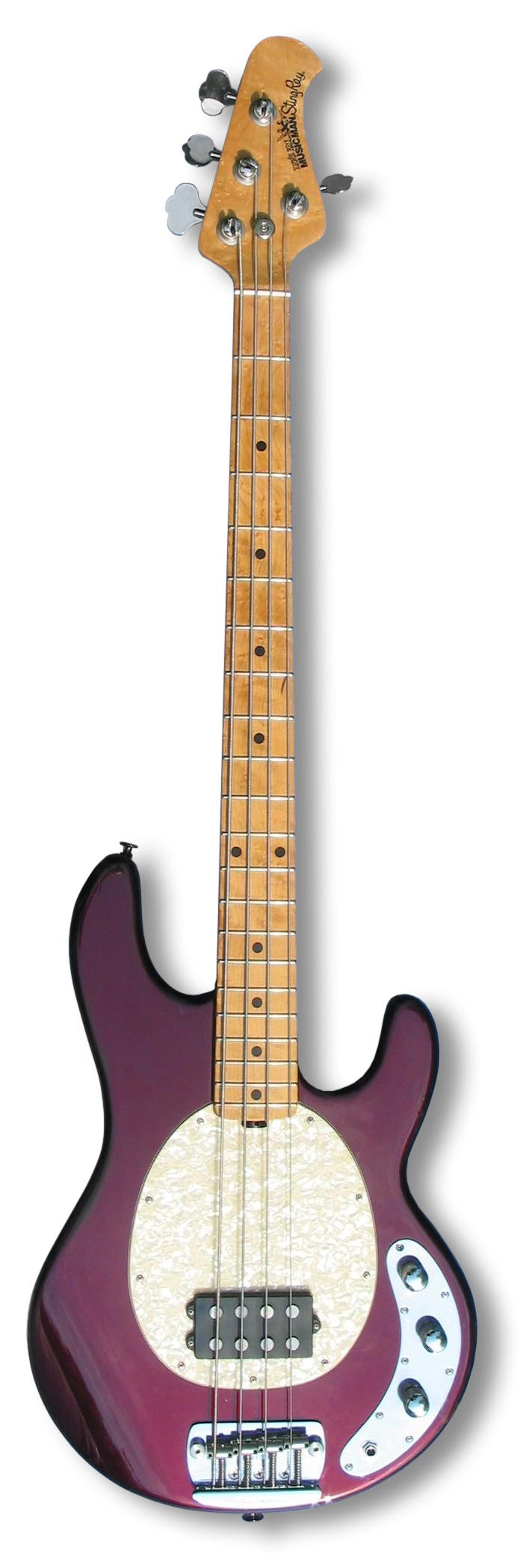
Photo: Th. Ott / Wikimedia Commons / CC BY-SA 3.0 Music Man
StingRay
1976
Leo Fender wanted a wide, bright bass. Louis Johnson hit it with his thumb, and funk had its sound.
- Send a picture
Steinberger
GL
1984
No headstock, no wood, and designed by a man who didn’t play. Eddie Van Halen wrote two songs on it in days.