Music Man
StingRay
Leo Fender wanted a wide, bright bass. Louis Johnson hit it with his thumb, and funk had its sound.
Fullerton, California, 1976. Leo Fender has spent ten years barred from competing with the company that still carries his name. Now he’s president of a new outfit called Music Man, his own shop is building its instruments, and one of the first things out the door is a bass with a battery in it.
- Introduced
- 1976
- Type
- Bass
- Class
- Production
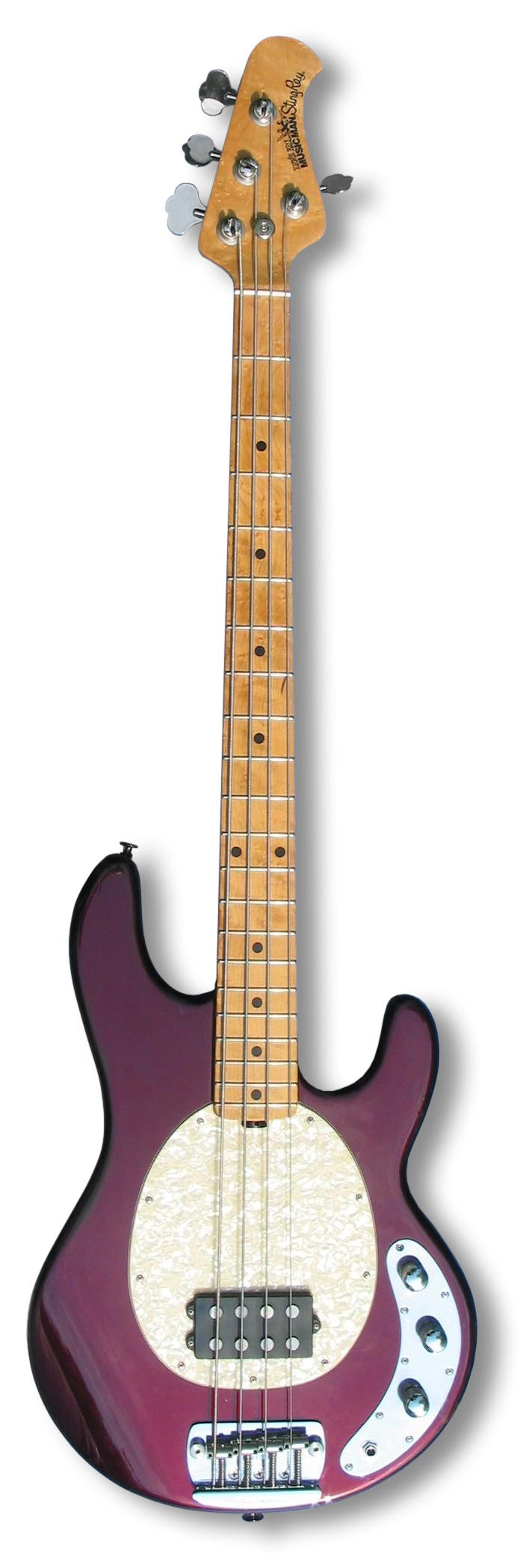
The short version
1965
Leo sells Fender
CBS buys the company. Leo sits out a ten-year non-compete.
1975
Music Man
Forrest White and Tom Walker’s new company makes Leo its president.
1976
The StingRay
One big humbucker, a 9-volt preamp, and a three-bolt neck on a slab of ash.
1978
“Le Freak”
Bernard Edwards and Chic put the StingRay thump on the radio.
1984
Ernie Ball buys it
On 7 March, the string company buys the trademarks and the StingRay design.
1985
First again
The first instrument Ernie Ball’s Music Man builds is the StingRay bass.
1987
Three bands, five strings
A three-band preamp goes into production. The five-string arrives this year or next.
2018
The Special
An updated StingRay with an 18-volt preamp becomes the flagship.
Side A
A1
Ten years on the bench
Leo Fender sold Fender to CBS in 1965. Part of the deal was a ten-year non-compete, and for ten years the man behind the Precision Bass had to sit on the bench.
When the ten years were up, Forrest White and Tom Walker had a company called Music Man, and in 1975 they made Leo its president. His own shop, CLF Research, built the instruments.
The bass they came up with was a group effort: Leo, Walker, White, and a player named Sterling Ball trying out the prototypes. Walker designed the electronics. Leo knew what he wanted from it: width and brightness.
He wasn’t thinking about thumbs. Nobody was, yet.
A2
A bass with a battery in it
In 1976 Music Man put out the StingRay. Music Man still calls it “the first production four string bass to feature on-board active equalization,” and that’s the part that mattered.
Here’s what that means in plain English. There’s a 9-volt battery in the back running a little preamp, and the treble and bass knobs don’t just cut, they boost. You can add low end or add sparkle right at the bass, before the amp ever hears it.
The pickup is one big humbucker near the bridge with eight pole pieces, wired so both coils work side by side. It’s punchy, bright, and quiet. Add a string-through bridge with little built-in mutes, a three-on-one-side headstock, and a slab of ash with no contours, and you have a bass that looks like nothing Leo had made before and sounds even less like it.
Leo asked for width and brightness. He had no idea it was about to be slapped.
A3
The thumb
Louis Johnson of the Brothers Johnson picked up a StingRay from the start, and started hitting it with his thumb and popping the strings with his fingers. On a bright active bass with a big pickup near the bridge, that sound jumped out of the speakers. You can hear it all over “Stomp!” He took it onto Michael Jackson’s Off the Wall and Thriller too.
Sterling Ball calls it a “happy accident.” Leo built a bright bass, and it showed up just as slap and funk needed one.
Bernard Edwards played one on Chic’s “Le Freak,” and that thump got around. It’s said to have influenced John Deacon of Queen, and the magazines agree that “Another One Bites the Dust” is a StingRay. Deacon himself told an interviewer in 1979 that he’d used a StingRay in the studio but still preferred his Precision. So file the song under StingRay, on the magazines’ word. Deacon stayed a Precision man.
Flip the record · By the numbers
10
Years Leo Fender sat out after selling Fender, before Music Man.
9V
The battery that runs the preamp. The pickup itself is passive.
2
Bands of EQ on the original, bass and treble. The three-band came in 1987.
3
Bolts holding the neck on the originals. Four arrived in 1982, six later.
Side B
B1
Not only funk
Tony Levin made it his main bass in 1979. He’s on Double Fantasy, and on Peter Gabriel’s “Sledgehammer.” Chuck Wright played one on Quiet Riot’s “Metal Health.” Tim Commerford used one on the first Rage Against the Machine record.
Flea is where people get it wrong. He played StingRays live in the mid-’90s, but almost all of Blood Sugar Sex Magik was cut on a Wal. The StingRay on that album is a five-string, on “Funky Monks” and “The Righteous and the Wicked.”
B2
The string company buys the bass
Music Man didn’t last in its first form. On 7 March 1984, Ernie Ball, the string company, bought the trademarks and the StingRay design, and moved it to San Luis Obispo. The first instrument the new company built, in 1985, was the StingRay bass. Contours came in. A three-band preamp followed in 1987, and the five-string was unveiled that year or the next, depending who you ask.
These days the flagship is the StingRay Special from 2018, with more bolts, more frets, and an 18-volt preamp. There’s also a Retro ’70s model for people who want the three-bolt, two-band version back. People still ask for the original sound, fifty years on.
Leo drew the StingRay to be wide and bright, and it was. What he didn’t draw was Louis Johnson’s thumb, or Bernard Edwards, or a radio that wanted exactly that thump in 1978. The sound people still buy a StingRay for is the one nobody planned. It just turned up at the right time, in the right hands.
Put this on
You’ve read about it. Now hear it. Here’s what this guitar sounds like, and what to listen for.
Stomp!
Louis Johnson, thumb on a StingRay. That snap on the low notes is what the bass did that nobody had planned.
Find it on YouTube (opens in a new tab)Le Freak
Bernard Edwards’s StingRay. Listen to how round and tight the bass line is, sitting right on the drums.
Find it on YouTube (opens in a new tab)Another One Bites the Dust
The magazines agree this one is a StingRay. John Deacon’s main bass was still a Precision, so file the song, not the career.
Find it on YouTube (opens in a new tab)Metal Health (Bang Your Head)
Chuck Wright on a StingRay, proof it wasn’t only a funk bass.
Find it on YouTube (opens in a new tab)
The cast
The people, and the specific guitars, that made the legend.
1976
Louis Johnson
StingRay
On it from the start. “Stomp!”, and Michael Jackson’s Off the Wall and Thriller.
1978
Bernard Edwards
StingRay
“Le Freak.” That thump is said to have influenced John Deacon.
1980
John Deacon
StingRay, in the studio
“Another One Bites the Dust,” by magazine consensus. In 1979 he said he still preferred his Precision.
1979
Tony Levin
StingRay
His main bass from 1979 on. Double Fantasy, and Peter Gabriel’s “Sledgehammer.”
1976
Sterling Ball
Beta-tester
Tried out the prototypes. His family’s string company bought Music Man in 1984.
Liner notes
Specs, construction, rarity, value, and every source we used.
Leo Fender’s first post-CBS four-string: 34-inch slab, 3-bolt, one parallel Alnico humbucker and a 2-band 9V preamp — not a guitar, not a StingRay 5, not a Sterling, and not the current Special.
- Body
- Solid double-cut slab, non-contoured ash
- Neck
- Bolt-on maple; 3-bolt Micro-Tilt
- Fingerboard
- Maple; 21 frets; black dots
- Scale
- 34" (863 mm)
- Pickups
- One large Alnico humbucker at the bridge; 8 poles; coils in parallel. Pickup itself passive.
- Hardware
- String-through hardened-steel bridge, barrel saddles, per-string mutes; 3+1 tuners; oval/teardrop pickguard
- Electronics
- 2-band active preamp (bass + treble), 9V, epoxy-potted
- Finish
- High-gloss polyester on documented examples; natural, sunburst, opaque colors
Open the full research fileConstruction details, the complete player record, production numbers, dated value estimates, and sources
Vintage pre-EB 1976–83 (CLF / Fullerton): 3-bolt, 2-band, slab ash. Current flagship is StingRay Special, not this table. Classic StingRay 4 catalog status 2026 uncertain (hosted spec vs dealer discontinue). Special + Retro ’70s are the live new pair.
Construction
1976. Official Music Man: “the first production four string bass to feature on-board active equalization” (maker; Seymour Duncan). Guitar World (Chris Gill, 10 August 2018): “arguably Leo Fender’s last great achievement.” This is a bass — the StingRay 1 guitar died, out of scope.
Leo sold Fender to CBS in 1965 and sat out a ten-year non-compete. Walker and White’s Music Man (from Tri-Sonix) made him president in 1975; CLF Research built the instruments. Premier Guitar: designed by Fender, Walker, and White, with Sterling Ball as beta-tester. Walker designed the preamp. Fender wanted width and brightness; Ball’s “happy accident” is that a bright bass arrived as slap and funk needed one. Louis Johnson picked it up; Leo had not designed it for slap.
Pre-EB vs Ernie Ball Music Man is a construction split, not a nickname. Pre-EB: June 1976–Dec 1983 (CLF / Fullerton; musicmanbass.global). Slab non-contoured ash, 3-bolt Micro-Tilt, string-through + mutes, 2-band 9V epoxy preamp, Alnico parallel humbucker, 3+1, oval guard. Wikipedia’s “six-bolt neck plate” as original is wrong for 1976. 4-bolt arrives 2nd half 1982; 3-bolt still used through 1983. Serial B + 6 digits on the plate 1976–late 1978, then on the bridge. CRAVE’s “pre-EB 1976–c.1981” under-runs Dec 1983 — attribute. Do not apply alder/basswood to 1976 without a dated example.
Scale 34". Vintage 21 frets. Nut: CRAVE 1978 1 5/8" (41.5 mm) vs Andy Baxter 1976 43 mm — two measured examples; do not flatten. Radius 7.5" is Classic reissue, not a 1976 catalog figure.
Pickup itself passive; battery feeds the preamp. Long 1" poles through first half 1977; shorter 5/8" from second half 1977. Earliest covers white, then black. Knobs: radio/barrel, then Tele-style. 3-band is not 1976. Sterling Ball: prototyped 1986, production 1987.
7 March 1984: Ernie Ball bought trademarks and the StingRay design. First Ernie Ball Music Man instrument, 1985, was the StingRay bass (San Luis Obispo). Contours vs pre-EB slab. 4-bolt, then 6-bolt 2H 1990 on SR4. StingRay 5 unveiled 1987 (official); Wikipedia 1988 — attribute.
Special, 2018: 5-bolt, 22 stainless, 18V 3-band, neodymium, “select hardwoods,” top-load — not 1976. Retro ’70s is the current vintage-leaning new SKU (3-bolt, 2-band, Alnico, mutes) and still not 1976 CLF. Sterling (EBMM ceramic, 1993), Cutlass (passive, or 1983 I/II), DarkRay, Short Scale, Sabre, and RAY34/24 imports are adjacent, not this bass.
Players
Louis Johnson — from the beginning. “Stomp!” (Light Up the Night); Off the Wall / Thriller / “Billie Jean.” Guitar World (Jisi) “helped design” is Johnson-side wording. Conservative claim: adopted from the start. Design room is Fender / Walker / White / Ball.
Bernard Edwards — “Le Freak.” Gill: that thump influenced Deacon.
John Deacon — magazine consensus “Another One Bites the Dust” is a StingRay. Identity bass is still a Precision. Deacon to International Musician, September 1979: used a StingRay in the studio, still prefers the Precision. File the song, not a career wipe.
Tony Levin — from 1979. Double Fantasy; “Sledgehammer.” Main bass since; later StingRay 5 is ~70% — labeled adjacent.
Chuck Wright — Quiet Riot, “Metal Health (Bang Your Head).”
Flea — live StingRays mid-1990s; not a career label. Mixdown: Wal Mach II for almost every Blood Sugar Sex Magik track; StingRay 5 on “Funky Monks” and “The Righteous and the Wicked.” Do not repeat Premier Guitar “first six albums.” Later identity = Modulus / ’61 Jazz.
Tim Commerford — Rage Against the Machine debut, list-level. Also known-to-play: Cliff Williams, Tom Hamilton, Boz Burrell, John Taylor, Mark King, Joe Dart, Stefan Lessard (from 2016).
Rarity
Official lifetime totals are unknown. B-prefix serials date era, not shipping. Dealer “3,500 in 1977” / “first 2,500” is unsourced shop language. Andy’s “~1,500 natural ones in 1977” is unsourced — do not repeat.
Pre-EB 3-bolt slabs are the collector object — not 1951 Precision scarce, but scarce relative to 40+ years of EBMM. Original epoxy 2-band + original pickup moves money. 1976 first-year (radio knobs, long poles, earliest white covers) is the thinner window. Reissues ≠ 1976 CLF. Sourced limited runs, not a census: 50th Liquid Gold 50 / Molten Gold 300.
Value
Informal estimate, 25 August 2026. Not an appraisal.
Ask ≠ sold. Do not average. Pre-EB 2024–26 US solds are thin. Live Reverb US captcha-blocked; UK Reverb 2 orders — too thin. Do not invent a pre-EB Reverb median. Artist lots (Johnson / Edwards / Deacon / Levin / Flea) sit outside these ranges.
New / adjacent. Special 4H street $2,500–$2,650. 4HH $2,600–$2,750. Retro ’70s new $3,300–$3,500 (not vintage). 50th $3,400. Classic used ~$1,500–$2,400 (Reverb Canada ~0.73; not pre-EB). RAY34 $880–$900 import, labeled adjacent only.
Vintage. Only named 2024–26 sold: Basschat September 2025 1977/78 Natural £3,395 (~$4,400) sold. Working 1977–79 original-electronics ask ~$5,000–$8,500. Clean 1977–78 dealer asks ~$6,000–$9,000; named sold sits below — do not average. 1976 first-year Andy Baxter B002654 £7,995 (~$10,400) ask is the visible ceiling and not mint. Equipboard 1979 used average $2,890 is a marketplace average, not a sold median. A clean pre-EB should clear new Retro ’70s $3,300, not sit under it.
See also
- fender-precision-bass — Leo’s first bass; Deacon’s identity instrument
- fender-jazz-bass — Flea’s later identity; two skinny single-coils
- rickenbacker-4003 — 33.25" neck-through, not a 34" CLF bolt-on
- music-man-silhouette — EBMM’s first guitar; not this bass
Sources
- Ernie Ball Music Man: StingRay — 1976 intro; first production four-string with onboard active EQ; hosted regular-SR4 table.
- Ernie Ball Music Man: StingRay Special — current flagship: select hardwoods, 5-bolt, 22 SS, 18V 3-band, neodymium, top-load.
- Ernie Ball Music Man: Classic StingRay 4 — 2-band, Alnico, 7.5", 21, 6-bolt, string-through; ash vs “Select Hardwood” conflict.
- Ernie Ball Music Man: Retro ’70s StingRay — current vintage-leaning SKU: 3-bolt, mutes, Alnico, 2-band — not 1976 CLF.
- Ernie Ball Music Man: StingRay 50th Anniversary — Liquid Gold 50 / Molten Gold 300.
- Ernie Ball Music Man: NAMM 2026 — 50th limits; Special still 4/5 H or HH.
- Ernie Ball Music Man: StingRay 5 — unveiled 1987.
- Ernie Ball Music Man: bass buying guide — Classic vs modern language; player list.
- Seymour Duncan: History of the Music Man StingRay pickup, 1976–2021 — first production active bass; parallel Alnico HB; pickup passive / preamp active; 2-band then 3-band.
- musicmanbass.global: neck plates — 3-bolt June 1976–1983; serial on plate then bridge; 4-bolt 2H 1982; SR4 6-bolt 2H 1990; Special 5-bolt 2018; regular SR cease 2018.
- musicmanbass.global: pickups and preamps — pre-EB parallel Alnico; 1" poles then 5/8" 2H 1977; pickup passive / preamp active.
- CRAVE: 1978 Music Man StingRay — slab ash, 3-bolt, 34", 21, 1 5/8" nut, 8-pole HB, 2-band 9V epoxy, string-through + mutes, 3+1.
- Andy Baxter: 1976 StingRay sunburst — B002654; 43 mm nut; radio knobs; long poles; £7,995 ask.
- Sterling Ball, Ernie Ball forum: 3-band year — prototyped 1986, production 1987.
- Freddy Villano / Sterling Ball, Premier Guitar — 1976 design room; first active EQ; Johnson, Edwards, Deacon, Levin, Wright; Flea photo 1992; “first six albums” compression; Commerford; Dart.
- Chris Gill, Guitar World, 10 August 2018 — Leo’s last great design; Johnson; Edwards “Le Freak” → Deacon AOBTD; Levin from 1979; 1984 Ernie Ball.
- Phil Weller, Guitar World, 27 February 2026 — 1976; Ball on buying “Leo Fender’s guitar company”; first EBMM instrument 1985 was the StingRay bass.
- Chris Jisi, Guitar World, 1 December 2023 — named StingRay on “Stomp!”; “helped design.”
- Guitar World: Louis Johnson gloves / slap — custom Music Man StingRay; Billie Jean / Off the Wall / Thriller.
- Mixdown: Blood Sugar Sex Magik gear — Wal Mach II for almost every track; StingRay 5 on “Funky Monks” and “The Righteous and the Wicked”; live StingRays.
- John Deacon, International Musician, September 1979 — used StingRay in studio; still prefers Precision.
- Wikipedia: Music Man StingRay — lead only; 6-bolt-as-original and SR5-as-1988 attributed, not followed.
- Wikipedia: Louis Johnson — lead only; StingRay as signature sound; Billie Jean.
- Wikipedia: Music Man (company) — StingRay guitar quietly dropped; 7 March 1984 sale.
- Guitar Center Riffs: StingRay buying guide — March 2026 street: 50th $3,399.99; Retro $3,299.
- Sweetwater: StingRay Special 4H Burnt Ends — $2,499 street.
- Musician’s Friend: Retro ’70s StingRay — $3,299.
- Sterling by Music Man: RAY34 — $879.99–$899.99 import, labeled adjacent.
- Basschat: 1977/78 Natural sold — Sept 2025 £3,395 sold.
- Equipboard: 1979 StingRay — used average $2,890 (11 June 2026); marketplace average, not sold median.
- Reverb Canada: Classic StingRay 4 — 299 orders; C$1,807–C$2,881 (~$1,320–$2,100 at ~0.73); not pre-EB.
Keep digging
Guitars this one gets compared to, confused with, or descended from.

Photo: Infrahertzz / Wikimedia Commons / CC BY-SA 3.0 Fender
Precision Bass
1951
Leo’s bass let the player at the back be heard. You know their lines by heart. You mostly don’t know their names.

Fender Jazz Bass from 1966 in Olympic white with the transition fingerboard (bindings and dot inlays). Photo by Th. Ott. Licensed under CC BY-SA 3.0. Via Wikimedia Commons. Fender
Jazz Bass
1960
Built for jazz players who mostly passed on it. Then bass players started using it to take the solo.
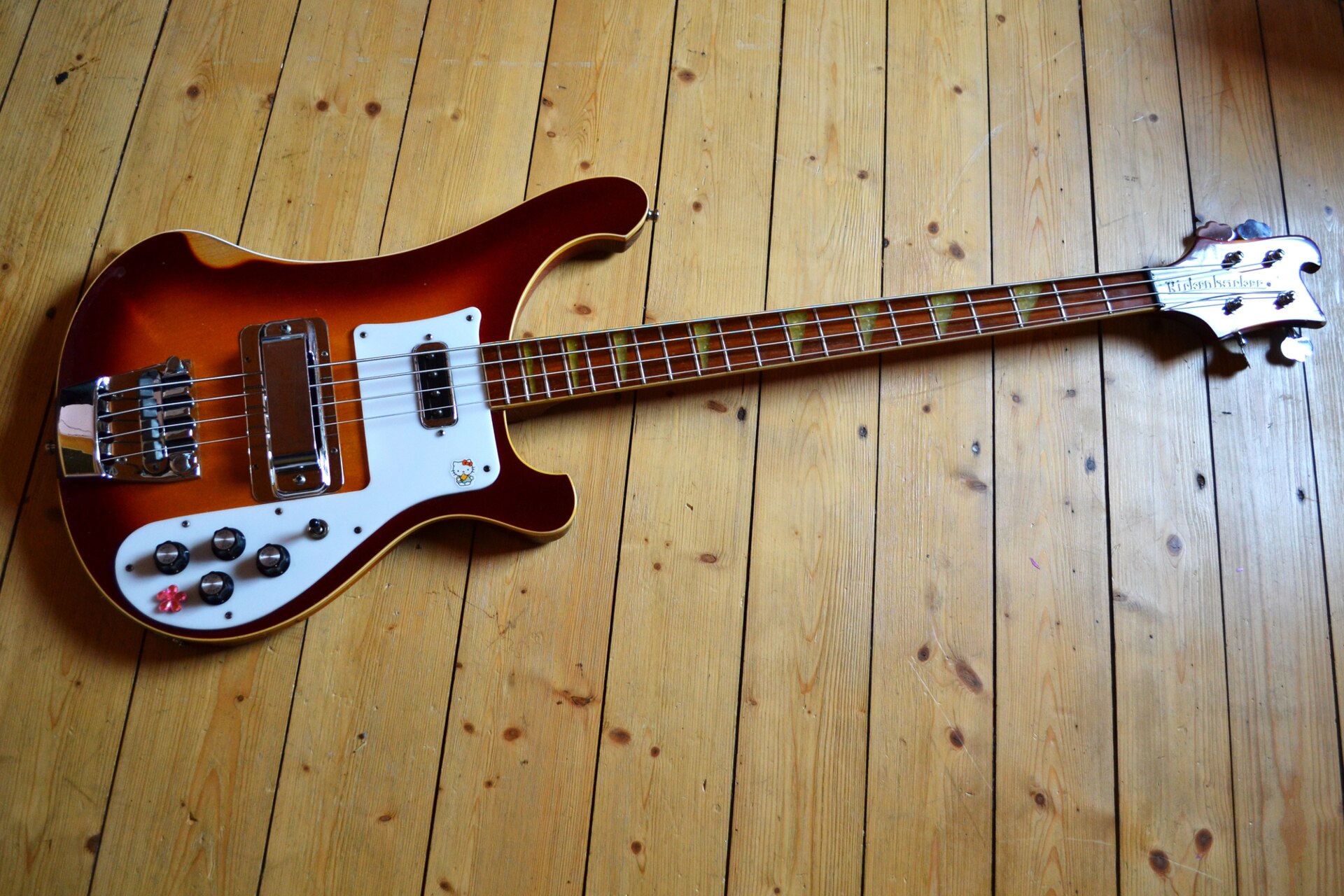
Rickenbacker 4003 (33 1/4" scale). Photo by DeLerkim. Licensed under CC BY-SA 2.0. Via Wikimedia Commons. Rickenbacker
4003
1980
Rickenbacker’s first answer to players’ new strings was to void the warranty. The 4003 was the better answer.