Tobias
Classic
You didn’t take a Tobias Classic off a wall. You ordered one from a Hollywood shop, and you waited.
Hollywood, the 1980s. Michael Tobias and Bob Lee are building neck-through basses on Cahuenga, and the orders keep coming faster than the benches can clear them. The Classic is the middle of three ways to order one: a step up from the Basic, a step short of the Signature.
- Introduced
- 1986
- Type
- Solidbody bass
- Class
- Production
Have a photograph of this guitar? Send a picture
The short version
1977
Orlando
Michael Tobias opens Tobias Guitars in Florida in April.
1982
A stranger at NAMM
January. Bob Lee meets Tobias at the show and stays.
1986
On paper
A Hollywood dealer packet with a Classics page, the earliest dated print of the model. The first Classic may be older.
1990
Sold
On 1 January, Tobias sells the company to Gibson. The crew moves to a bigger shop in Burbank.
1992
Nashville
Late in the year the company moves east. Nobody from the original bench goes.
1997
The Dance
John McVie plays a Classic 4 at the Fleetwood Mac taping in Burbank.
2008
Production stops
After California, Nashville, and Arkansas, Gibson stops making Tobias basses.
2025
The name returns
March. An Indonesian-made Classic IV and V arrive from Gibson.
Side A
A1
Twenty-four frets and a stranger
January 1982, the NAMM show. Bob Lee walks up to Michael Tobias’s booth. The basses on it have 24 frets, all of them clear of the body, so you can get your hand all the way up the neck. Lee stays. In his first year at the shop, they sell 17 basses.
Seventeen basses in a year is not a factory. That’s the world the Classic came out of. You didn’t walk into a store and take one off a wall. You picked the woods, you ordered, and you waited while a handful of people in Hollywood built it. The name on the headstock was Michael’s. The bass was the bench.
A2
How they got to Cahuenga
Michael had been building since 1974. He opened Tobias Guitars in Orlando in April 1977, sold The Guitar Shop in 1980, built about 50 instruments at Sierra Guitars in San Francisco, and left in May 1981. After a stop in Costa Mesa he landed in Hollywood, on Cahuenga. Repair work paid the early rent.
The Tobias catalog of 1982 opens with “MultiLam construction, the heart of every Tobias Guitar.” It doesn’t mention a Classic yet. Word got around anyway. By 1985–86 there were 500 instruments on back order. From June 1988 the order book closed, and it stayed closed until the January 1990 NAMM.
A3
Three ways to spend the money
Before the Gibson sale, you ordered one of three tiers. The Basic had solid wings and could come in colors. The Signature had the dark woods, wenge, walnut, and purpleheart, in the neck as well as the wings, and a laminated top and back.
The Classic sat in between. It had a laminated top with a contrasting veneer, a pau ferro fingerboard more often than not, a pearl logo, cover plates in matching wood, and a natural finish only. You picked the wings: walnut, alder, bubinga, koa, maple. The counts of neck pieces don’t agree, five or seven depending on who you ask, and real basses break the rules. There’s a 1987 Classic 5 out there with a rosewood board and koa and alder wings.
The part players still talk about is the neck. It’s asymmetric, shaped differently on the bass side than on the treble side. Lee says that when he started, his was the only shop he knew of making one. Descriptions of which side is thinner don’t agree. Two truss rods let the shop fix a twist one side at a time.
The electronics are active. Lee sat down with Bill Bartolini and worked out a preamp to go inside the bass, and early Classics wear Bartolini soapbars. One player who knows them says the first version of that preamp had no switches at all.
Flip the record · By the numbers
17
Basses sold in Bob Lee’s first year at the shop.
500
Instruments on back order in 1985–86.
2
Truss rods, so the shop could chase a twist one side of the neck at a time.
0
Members of the California crew who went to Nashville.
Side B
B1
The first six
Nobody can tell you the day the first Classic was built. What Lee does say is about Tim Bogert, who was moving from four strings to five, and then to six:
I believe we made the first Classic model 6 string for Tim.
He believes it. There’s no date and no serial, so it stays a belief. A forum post says the Classic 5 was made from 1985. The earliest dated print is a 1986 dealer packet with a Classics page. The dated basses start in 1987.
The Tobias five-string got its big moment around 1983–84, in a Guitar Player giveaway. A full-page ad cost about as much as the bass, and a preacher from Wisconsin won it. That was a Signature, though, not a Classic.
Robert Trujillo spent most of his pre-Metallica years on five-strings: Tobias, ESP, and Music Man. After a rebuilt Ibanez was stolen on tour with Suicidal Tendencies, Steve McGrath told him they’d get him a custom five. A 1994 rig rundown lists a Classic 5 of bubinga, wenge, and alder, and a tobacco-burst Classic 5 turns up in the “Love vs. Loneliness” clip. He retired the Tobiases when he joined Metallica.
B2
The name went to Nashville
On 1 January 1990, Michael sold the company to Gibson. The crew moved to a bigger shop in Burbank, with a spray booth, dust collection, and about ten people. The orders still outran the benches. Rather than speed up the shop, they sent work out: 110 “Model T” basses from a builder in New England, and about 400 “Standard” basses from Terada in Nagoya.
Lee was off the job in April 1992. Late that year the company went to Nashville, and nobody from the original bench went with it. Michael sat out a non-compete and started MTD in 1994. Gibson kept the Classic, the Basic, and the Signature, added bolt-ons, and moved production on to Arkansas. It stopped making them in 2008.
John McVie’s Classic 4 comes from those later years, after the California crew. He played it at Warner Bros. Studios in Burbank on 23 May 1997, at the show that became The Dance, in the same town where the old crew’s last shop had been.
In March 2025 the name came back on Gibson’s site, built in Indonesia. Epiphone’s brand manager called Tobias “the ace up the sleeve of bass players around the globe since 1978.” One reviewer said the new Classic IV “most closely resembles an original Tobias,” and called the neck construction “very different.” You can click and buy one.
You can’t order the one from Cahuenga. The name has been to Nashville, Arkansas, and Indonesia. The man whose name it is builds basses in Woodstock now, under his initials.
Put this on
You’ve read about it. Now hear it. Here’s what this guitar sounds like, and what to listen for.
The Dance
Taped at Warner Bros. Studios in Burbank on 23 May 1997, with John McVie on a Classic 4. Other basses turn up on the tour that followed, so this is the Burbank show, not every clip.
Watch it on YouTube (opens in a new tab)Love vs. Loneliness
Robert Trujillo on a tobacco-burst Classic 5 in the clip. That’s a five-string, played by the guy who had these basses under him for years before Metallica.
Watch it on YouTube (opens in a new tab)
The cast
The people, and the specific guitars, that made the legend.
Tim Bogert
Classic 6
Moving from four strings to five to six. Bob Lee believes the first Classic six was built for him.
1994
Robert Trujillo
Classic 5s
Mostly on five-string Tobiases before Metallica. Retired them when he joined the band.
1997
John McVie
Classic 4, c. 1997
A bubinga-winged four-string with a seven-piece neck. Played on The Dance, and at the Rock and Roll Hall of Fame and the Brits in 1998.
1982
Bob Lee
Builder
Joined at the 1982 NAMM, worked out the preamp with Bill Bartolini, and left in April 1992.
1977
Michael Tobias
Founder
Sold the company, and his name, to Gibson in 1990. Builds basses as MTD now.
1987
Jimmy Haslip
Not a Classic
His important Tobias was a red, fretless Basic 5. Don’t hang the Yellowjackets on this model.
Liner notes
Specs, construction, rarity, value, and every source we used.
A laminated top on a neck-through stick — Hollywood’s Classic, not a Pedulla Buzzard, not a Music Man Bongo, and not the Indonesian bass now wearing the name.
- Body
- Neck-through. Pre-Gibson tier, as TalkBass draws it: laminated top, contrasting veneer; a wenge “tone-plate” instead of veneer on some Burbank basses. Natural only. Wings to the order — walnut, alder, bubinga, koa, maple, a gonçalo alves top. Not the Basic’s solid wings.
- Neck
- Five-piece neck-through in that same split, figured if maple. Another TalkBass post says seven pieces on a Classic and nine on a Signature. Keep both. Asymmetric. Bob Lee: dual rods were the shop’s trick when he started.
- Fingerboard
- Pau ferro in the tier split. Jason Bonilla’s 1987 Classic 5, serial 526, is rosewood. Julien’s 1997 Classic 4 is unmarked wenge. Do not average.
- Scale
- 34" on named pre-Gibson Classics (a c. 1990 Classic 6; Classic 6 #462). Not a catalog line I could read.
- Pickups
- Bartolini. Early examples: soapbars into the TCT preamp Bob Lee worked out with Bill Bartolini. Julien’s #2569: active, J-spaced.
- Hardware
- To the bass. #526: Schaller, bone nut. #2569: Tobias bridge, Grover tuners.
- Electronics
- Active. A Basschat note: the original TCT had no switches. #526 wears a blend and stacked knobs the seller treats as installed. #2569: five knobs, one mini-toggle.
- Finish
- Natural, on the pre-Gibson Classic. Color was the Basic’s column.
- Nut
- No Hollywood width in hand. 2025 IV: Gibson 41.0 mm / 1.61 in; Musician’s Friend and Gibson Japan 1.614 in. 2025 V: Gibson Japan 47.63 mm / 1.875 in; Motor City 1.874 in. Mix flagged.
Open the full research fileConstruction details, the complete player record, production numbers, dated value estimates, and sources
Classic living example = pre-Gibson Hollywood / Burbank Tobias Classic, 4, 5, or 6. The living catalog object is not that bass. 2025 Classic IV / V (Indonesia, Gibson’s Original Collection): walnut wings, wenge veneer, quilted-maple top, five-piece maple/purpleheart stringer neck-through, wenge, 24 jumbo, no inlays, bone nut, Bartolini, 18-volt, Babicz, Gotoh. Mix flagged on that sheet too — inch/mm pairs Gibson prints together; V body walnut (Gibson Japan) against mahogany (zZounds, Motor City) against a paulownia blurb (Bass Magazine, Alto’s prose; their spec tables say walnut and five pieces); pickup codes MT4C-1 both positions (Gibson, Bass Gear) against Sweetwater’s MT4C-B1 / MT4C-T1. Do not average. Basic is the solid-wing tier. Signature is the dark-wood tier above. Killer B and Growler are bolt-ons. MTD is Michael’s later shop. Not a Pedulla Buzzard. Not a Music Man Bongo. No millimetres invented for the California nut or scale.
Construction
The job was a bass you ordered, not a bass you took off a wall. The Classic was the middle of three ways to spend the money, once the Hollywood shop had more orders than benches.
Michael Tobias’s own account: building since 1974, Washington, D.C. Tobias Guitars, Orlando, April 1977. First serial 0178, January 1978 — the month, not a count from 0001. After 578 he went back to 179. Sold The Guitar Shop in 1980. Sierra Guitars in San Francisco, about 50 instruments. Left in May 1981. Costa Mesa, then Hollywood. First California serial 240, a mahogany six-string guitar. First Southern California number 250, one of four mahogany neck-throughs in a Les Paul Junior outline. 1623 Cahuenga. Repair paid the early rent. After a year there, they quit it. Lee puts a later crew of seven at 1614.
Bob Lee met him at the January 1982 NAMM and stayed. The basses on that booth already had 24 frets clear of the body. Lee’s “Mamma” was a koa body, koa and wenge neck, medium scale. The line. Not yet a model called Classic. The 1982 catalog VintAxe indexes leads with “MultiLam construction, the heart of every Tobias Guitar.” The cover does not say Classic.
The name shows up in his memoir without a shop date. A Guitar Player giveaway in 1983/84 — a full-page ad that cost as much as the bass — was a zebra-and-wenge Signature with a wenge neck, omega cut at the butt, won by a Wisconsin preacher. Lee: it “marks the beginning of the modern Tobias 5 string basses,” and Michael had made a few fives in Florida. The omega cut was later dropped. Then Tim Bogert, moving from four to five to six. Lee: “I believe we made the first Classic model 6 string for Tim.” Belief. No serial, no date. A TalkBass note says the Classic 5 “was made from 1985.” Forum, not a price list. Dated basses come in behind it: Bonilla’s 1987 Classic 5, #526; a Basschat seller’s 1988 Classic 5, #690. VintAxe indexes a 1986 Hollywood dealer packet, seven pages, with a price list. One thumbnail reads as the Classics sheet. The type under the heading did not resolve, and the full scans sit behind a login. No 1986 dollar from that packet is in this plate. This page’s year is 1986 because that packet is the earliest dated print object on the shelf. It is not a claim that the first Classic left the bench that year. Lee’s six for Bogert may be earlier. Keep it open.
The tier, as one long TalkBass post draws the pre-Gibson shop: Basic is five-piece neck-through, rosewood (pau ferro on a six), solid wings, a decal logo, black plastic covers, and color — natural, opaque black, red, white, or candy red, orange, blue, purple. Classic is five-piece, pau ferro, figured laminations if the neck is maple, a laminated top with a contrasting veneer, pearl logo, matching-wood covers, natural only. Signature is seven or nine pieces, pau ferro, laminated top and back, and the dark woods — wenge, walnut, purpleheart — in the neck as well as the wings. A second post says nine pieces on a Signature and seven on a Classic. #526 is a Classic with a rosewood board and koa/alder wings. The rule and the bass both stay.
The neck is the part players still mean. Lee, on TalkBass, years later: when he started they were the only shop he knew making an asymmetric neck. Wikipedia, citing Gibson’s old about page, says thinner on the lower side than the upper. Andertons on the 2025 neck says thicker on the bass side, thinner on the treble. Same idea or two ideas. Not averaged. Two truss rods let the shop chase a twist one side at a time. The 2025 sheet says “dual action,” which is one rod. Don’t merge them.
Electronics were Bartolini because Lee sat with Bill Bartolini and built the package in the bass. The TCT is that circuit. A Basschat reader: the original TCT had no switches. The seller of #690 says that bass later gained an active/passive switch and a mid boost. Named early Classics wear Bartolini soapbars. “Tobias Radiused Top” is the 2025 badge, not an 1980s spec. McVie’s 1997 is a J configuration — placement, not a measured spacing.
1 January 1990, Michael’s date, he sold the company to Gibson. Lee says the buyer was CMI, Gibson’s parent. Gibson’s first serial 1094. They moved the crew to a bigger shop in Burbank, spray booth, dust collection, ten people. Orders still outran the benches. Rather than speed the shop up, they sent work out: 110 “Model T” basses from “a very fine builder in New England,” and about 400 “Standard” basses from Terada in Nagoya. The yen killed the Standard. He does not name the New England shop. A forum does. Omitted. Final Los Angeles serial 2044. Up to that number, his crew. Late 1992 the company went to Nashville. Nobody from the original bench went. The first Nashville run was about 60 basses that crew neither numbered nor finished.
Lee was off the job in April 1992. Wikipedia has him founding Michael Tobias Design that year. His 2023 NAMM interview: a non-compete, then MTD in 1994. Wikipedia’s MTD page puts an Eclipse name in between, Kingston, New York, and a 35" scale on the handmade basses. About ten a month in Woodstock, with two part-timers; Kingston-line basses in China. That is his shop. This plate is the name he sold.
Gibson kept Classic, Basic, and Signature, and added bolt-ons. Wikipedia: the Killer B’s B means bolt-on. The Growler is the other bolt-on. Production, Gibson’s 2025 Gazette: California, then Nashville, then Arkansas, and manufacturing stopped in 2008.
March 2025 the name came back on gibson.com, Epiphone’s side of the company. Andrew Ladner, brand manager for Epiphone and Kramer: “the ace up the sleeve of bass players around the globe since 1978.” That date is the brand. Not a Classic debut. Vintage Guitar (Ward Meeker): six Indonesian models, and the Classic IV “most closely resembles an original Tobias” — same dimensions, measurements, pickup spacing, and weight, on their say, same neck shape and materials, and “very different” in the stringer, a quilted top that stops just shy of the lower bout. Gold hardware where the Killer B is black. Bartolini, 18 volts, a blend the spec lines sometimes omit and the body copy keeps. No passive mode, Bonedo’s note on the five. List $2,199 IV, $2,299 V, gig bag in the carton. Left-handed satin natural only, on No Treble’s sheet. Bass Gear dates the unveil to 2024. The Gazette is 18 March 2025. Thomann: available since March 2025. Keep the reviewer’s year.
Classic vs current: a Hollywood order — natural, veneered top, pau ferro more often than not, TCT — against a 2025 Indonesian recipe you can click. Same name. Not the same stick. Killer B is sapele, bolt-on, $1,499. Growler is paulownia, bolt-on. Not this table.
Players
Do not hang a Yellowjackets record on this plate. Bob Lee’s important 1987 bass for Jimmy Haslip is a red Basic 5, fretless. The Jazz he fixed for Jeff Berlin is a Fender. MTD, a Killer B, a Growler, a Toby, and a Bongo do not belong in this list. Neither does a Pedulla Buzzard.
Tim Bogert. The only “first Classic” the shop memoir names. Lee believes the first Classic 6 was his, as Bogert moved off four strings. No album, no serial. A belief stays a belief.
Robert Trujillo. Wikipedia: before Metallica he was most often on Tobias, ESP, and Music Man, all fives. Which Bass has him, in his own words, starting a Tobias when he toured with Suicidal Tendencies, after a rebuilt Ibanez was stolen and Steve McGrath told him they’d get a custom five. The model on that first one is not named. Which Bass, reading Bass Player, August 1994: a Classic 5 of bubinga, wenge, and alder — “presumably” the red one — and a tobacco-burst Classic 5 on the “Love vs. Loneliness” clip from Suicidal for Life. Presume with them. Don’t pin the whole Suicidal catalog. Bass Guitar Magazine, 2003, via Which Bass: the Tobiases had given him years, and he was retiring them for Metallica. MusicRadar: the Fernandes basses on the album before Hardwired were built by Tobias luthiers who left after the Gibson sale. Not this name. The Warwick he plays in the band is a Streamer (warwick-streamer).
John McVie. One bass, papered. Julien’s Auctions, Music Icons, 19 May 2023, lot 673: c. 1997 Tobias Classic 4, serial 2569, seven-piece maple-and-walnut neck-through, bubinga wings, unmarked wenge board, Bartolini actives in a J layout, Tobias bridge, Grover tuners. Played at Warner Bros. Studios in Burbank, 23 May 1997, the set released as The Dance (Reprise, 1997). Also the 1998 Rock & Roll Hall of Fame induction and the 1998 Brit Awards. Original hard case. #2569 sits after 2044, so Nashville, not the California crew. Equipboard also files a Rick Turner Electroline on the Dance tours, and an Alembic on another clip. Other basses. The Dance is not “the Tobias record” and nothing else.
Also known to play stays short. Lee’s California endorsees — Gary Willis, Chris Squire, Jerry Watts Jr., Max Bennett, Keith Jones, Freddy Flewellen, Andrew Gouche — are Tobias players in his memoir. He does not say Classic.
Rarity
You can buy a new Classic. Indonesian, stringer-built, satin. You cannot order the Hollywood one. Michael builds MTD. Gibson’s Gazette dates the stop at 2008.
No Classic total was published. None invented. The counts in Construction are the whole shop: 17 basses Lee’s first year, 500 instruments on back order in 1985–86, a closed book from June 1988 to the January 1990 NAMM, 110 Model Ts, about 400 Japanese Standards, serials through 2044 for the California crew. The restart after 578 is why those serials will not count a year, and will not count a Classic. The 60 unnumbered Nashville basses are a different hole. Still not this model.
What is actually thinner: a pre-Gibson natural Classic with the veneered top and the pau ferro still the board; a Burbank bass with the wenge tone-plate instead of a veneer; Bogert’s six, if it is the one Lee means. #526, #690, and McVie’s #2569 are single objects. They are not “a vintage Classic.” A 2025 IV is a current import. It does not make the Hollywood ones common.
Value
Informal estimate, 24 September 2026. Not an appraisal.
Ask vs sold labeled. Celebrity lots are not-comps. No invented medians or factory counts. The 1986 packet’s prices were not readable this pass. A TalkBass memory of 1990 list prices is not a price list in hand. Omitted.
New street. Gibson’s tags: Classic IV $2,199, Classic V $2,299, gig bag included. Vintage Guitar reviews the IV at $2,199. Thomann’s U.S. page has a new IV at $1,869 — a dealer dollar, not the Gibson tag. Ireland, VAT in the price: a left-handed IV at €1,999, a V at €2,099. Don’t average any of that into one “street.” Killer B and Growler tags are other models.
Used modern. The 2025 imports, asks this pass, not hammers. Reverb: a Good Classic IV at $1,196.26, cut from $1,407.36; a Trans Black Satin IV at $1,499.99, from $1,570; a Good Classic V at $1,324.22, from $1,471.36. A Mint V still sitting at $2,299, which is the new tag. No clean Reverb Price Guide band isolated this pass. Flag: thin sold-comp access.
Vintage / collectible. Same market, older wood, wider asks. Named asks, not a series: Reverb, a 1988 Classic 6 at $6,813.87; Classic 6 #1992, fretless, at $5,999. Named older sold listings, not 2026 hammers: pre-Gibson Classic 5 serial 1030, $3,500, listed nine years ago; Classic 5 #567, $4,500, listed three years ago. Bonilla’s #526 was up at $4,000 and marked sold; the hammer isn’t on the ad. A UK ask on serial 1784 — between 1094 and 2044, so the California crew after the sale — ran £3,200 / £3,100 / £3,000 depending on which preamp went with it. Pounds. Not converted. Don’t average any of these into a Hollywood price. McVie’s #2569 brought US$16,000 at Julien’s (14 bids; estimate $10,000–$20,000). The house Facebook post says $15,875. Same lot. Not a comp either way.
See also
- pedulla-buzzard — the other 1980s boutique bird; a fretless, and not this neck-through
- music-man-bongo — a 2003 bolt-on; do not nest a Classic under it
- spector-ns-2 — the curved neck-through Bob Lee was playing before he joined the Hollywood shop
Sources
- Michael Tobias, MTD history — Orlando April 1977; serial 0178, January 1978; after 578 back to 179; Guitar Shop sold 1980; Sierra, about 50; left San Francisco May 1981; Costa Mesa, then Hollywood; first California serial 240; first Southern California number 250; 1623 Cahuenga; June 1988 back orders until January 1990 NAMM; sold to Gibson 1 January 1990. Same account on the 2010 archive: first Gibson serial 1094; 1990–92 crew; 10-man shop; 110 Model T from a New England builder; about 400 Standards, Terada, Nagoya; final LA serial 2044; about 60 unnumbered Nashville basses; no original crew to Nashville; move decided late 1992
- Bob Lee, Tobias Guitars, the California years 1983–1992 — January 1982 NAMM; 24 frets clear of the body on those basses; 17 sold his first year; 1983/84 Signature five and the Guitar Player giveaway; “I believe we made the first Classic model 6 string for Tim”; 1985–86 back orders of 500; Haslip about 1986, and a 1987 red Basic 5; endorsees; sale to CMI, 1990; off the job April 1992; 1614 and 1623 Cahuenga
- TalkBass, Bob Lee on the asymmetric neck — when he started, the only shop he knew making that neck
- Wikipedia, Tobias — neck-through as the rule; Killer B’s B means bolt-on; Growler bolt-on; asymmetric, “thinner on the lower side than the upper”; serials 1094 and 2044; left 1992; parent Epiphone; Basic / Classic / Signature on the product list
- Wikipedia, Michael Tobias Design — MTD 1994; Eclipse name in between; Kingston; about 10 a month in Woodstock; handmade 35" scale; Kingston line in China
- American Musical Supply, NAMM 2023 interview — non-compete, then MTD in 1994
- VintAxe, Tobias catalogs — 1982 catalog, five pages; 1986 dealer packet with price list, seven pages. Thumbnail of the 1986 Classics page did not yield readable prices. Full scans returned 401. No dollars taken from it
- TalkBass, value of a pre-Gibson Tobias — Basic / Classic / Signature tier split: five-piece, pau ferro, veneered top, natural only, on the Classic. A reply on the thread: Classic 5 “made from 1985.” Forum, not a catalog
- TalkBass, Basic, Classic, or Signature? — a counter-count: seven-piece Classic, nine-piece Signature
- Jason Bonilla, TalkBass classified, 1987 Classic 5 #526 — koa and alder wings; flamed maple and wenge neck; rosewood; bone nut; Schaller; Bartolini soapbars and TCT; 8.8 lb; 17 mm spacing; ask $4,000, marked sold, hammer unpublished
- Basschat, 1988 Classic 5, serial 690 — seller date; maple body; pau ferro; Bartolini soapbars; TCT. A reply: the original TCT had no switches
- Basschat, Classic 6 #462 — pre-Gibson; alder wings; flame maple and purpleheart; pau ferro; dual truss; asymmetric; 34"; 16.5–17 mm on that bass; seller says Michael called it a thicker custom for Tim Emmons
- Gibson Gazette, Tobias basses return, 18 March 2025 — ceased 2008 after California, Nashville, and Arkansas; Classic, Killer B, Growler; Ladner, “ace up the sleeve… since 1978”
- No Treble, Kevin Johnson, 22 March 2025 — IV/V neck-through stringer; walnut, wenge veneer, quilted maple; 34"; 24 jumbo; Bartolini; 18V; Babicz FCHZ4GD; Gotoh; satin natural and trans black; left-handed satin natural only
- Gibson, Classic IV — $2,199; 863.6 mm / 34.0 in; radius 304.8 mm / 12.0 in; nut 41.0 mm / 1.61 in; five-piece maple/purpleheart; Bartolini MT4C-1; bone; blend in the body copy
- Gibson Japan, Classic IV — nut 41.0 mm / 1.614 in; Babicz FCHZ4GD
- Gibson Japan, Classic V — nut 47.63 mm / 1.875 in; walnut wings with 6 mm wenge veneer; bridge FCHZ5NGD; five-piece stringer
- Musician’s Friend, Classic IV — $2,199; nut 1.614"
- Sweetwater, Classic IV — neck MT4C-B1, bridge MT4C-T1
- Bass Gear Magazine, Lily Mitchell, 22 April 2026 — Indonesia; $2,199; both pickups MT4C-1; blend; .045–.105; abalone T-and-vine headstock; the review dates the unveil to 2024
- Vintage Guitar, Ward Meeker, Tobias Killer B and Classic IV — Indonesian Original Collection; IV $2,199; Killer B IV $1,499; stringer called very different; dimensions, spacing, and weight called the same as an original
- Bonedo, Rainer Wind, 22 April 2025 — production stopped 2008; Michael consulting through 1992; 2025 line built in Indonesia; no passive mode on the V
- Andertons, 20 March 2026 — Asym described thicker on the bass side, thinner on the treble; Classic neck-through against Killer B and Growler bolt-ons
- zZounds, Classic V — feature line “mahogany with 6 mm wenge veneer”; nut 47.63 mm
- Motor City Guitar, Classic V — $2,299; prose says paulownia and a 3-piece neck, spec lines say mahogany with 6 mm wenge and a 5-piece neck; nut 1.874"
- Alto Music, Classic V — $2,299; same paulownia / 3-piece prose against a walnut, 5-piece spec table
- Thomann, Classic IV — U.S. page $1,869; available since March 2025
- Julien’s Auctions, lot 673, 19 May 2023 — McVie Classic 4, c. 1997, serial 2569; The Dance, 23 May 1997; Rock Hall and Brits, 1998; sold US$16,000, estimate $10,000–$20,000
- Julien’s Auctions, Facebook, 20 May 2023 — same lot, “sold for $15,875”
- Wikipedia, Robert Trujillo — before Metallica, Tobias, ESP, and Music Man, all 5-strings
- Equipboard, John McVie’s basses — a Rick Turner Electroline filed on the Dance tours; an Alembic on a separate clip. Not this Classic
- Which Bass, Trujillo with Suicidal Tendencies — first Tobias on the ST tour, model unstated; Bass Player, August 1994, Classic 5 of bubinga, wenge, and alder, “presumably” the red one; tobacco-burst Classic 5 on “Love vs. Loneliness”; 2003, retiring the Tobiases
- MusicRadar, Trujillo, 30 March 2017 — Fernandes basses on the album before Hardwired, built by Tobias luthiers who left after the Gibson sale; not a Classic
- Reverb, used Tobias basses — asks this pass, not hammers: 1988 Classic 6 $6,813.87; Classic 6 #1992 fretless $5,999; 2025 IV $1,196.26 from $1,407.36; trans-black IV $1,499.99 from $1,570; 2025 V $1,324.22 from $1,471.36; a Mint V at $2,299
- Reverb, pre-Gibson Classic 5, serial 1030 — sold at $3,500; listed nine years ago; gonçalo alves on walnut; pau ferro
- Reverb, Classic 5 #567 — sold at $4,500; listed three years ago
- Reverb, c. 1990 Classic 6 — 34" on the spec; walnut, gonçalo alves top, pau ferro, Bartolini. Seller’s Curves Ahead claim is not treated as a credit
- Basschat, Classic 6 serial 1784 — asks £3,200 / £3,100 / £3,000 by preamp; walnut and a wenge tone block
Keep digging
Guitars this one gets compared to, confused with, or descended from.
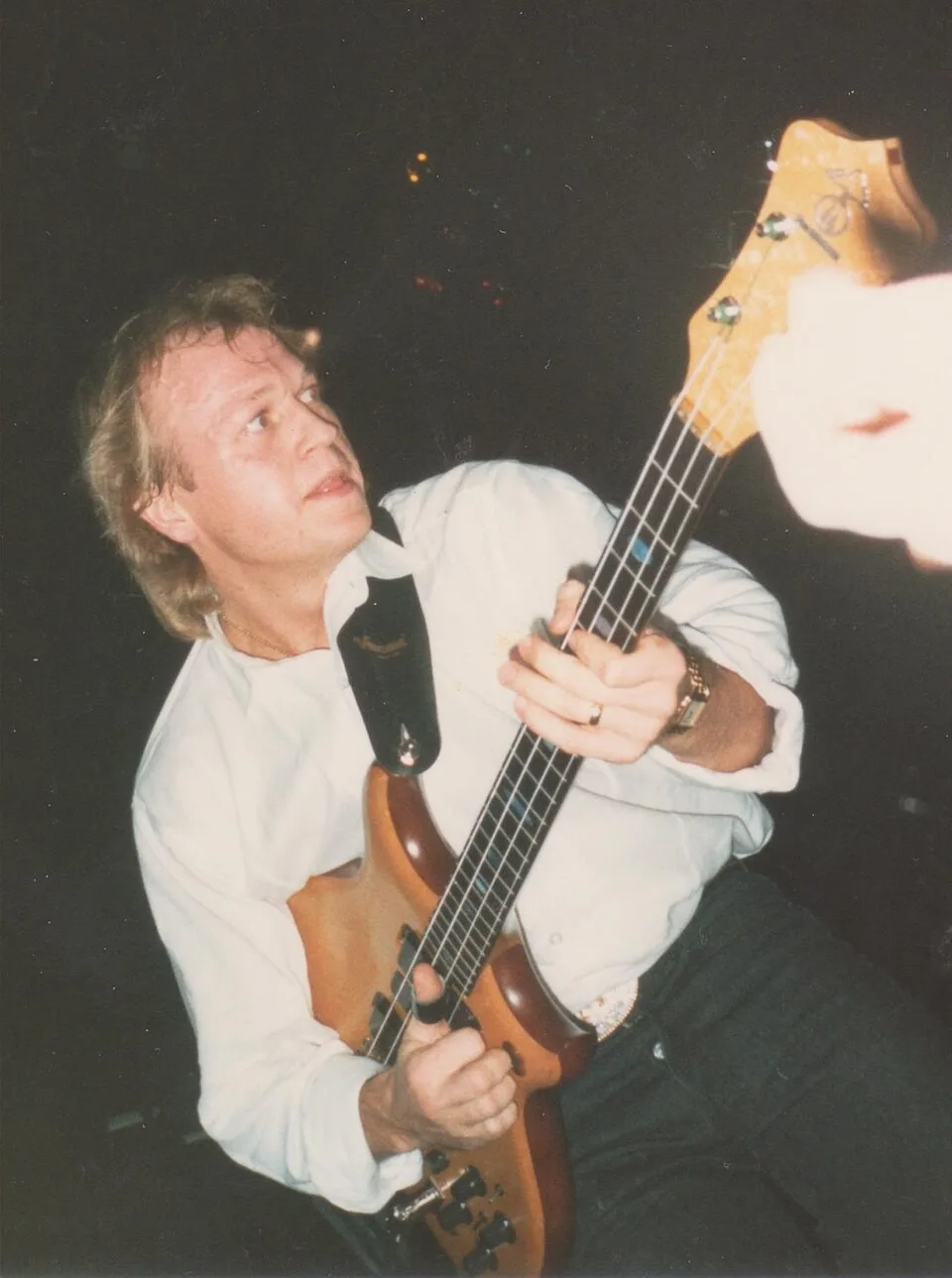
Photo: אהוד אמיר / Wikimedia Commons / CC BY-SA 4.0 Pedulla
Buzzard
1980
A fusion bassist botched his homemade fretless. The builder who fixed it went on to build him a better one.
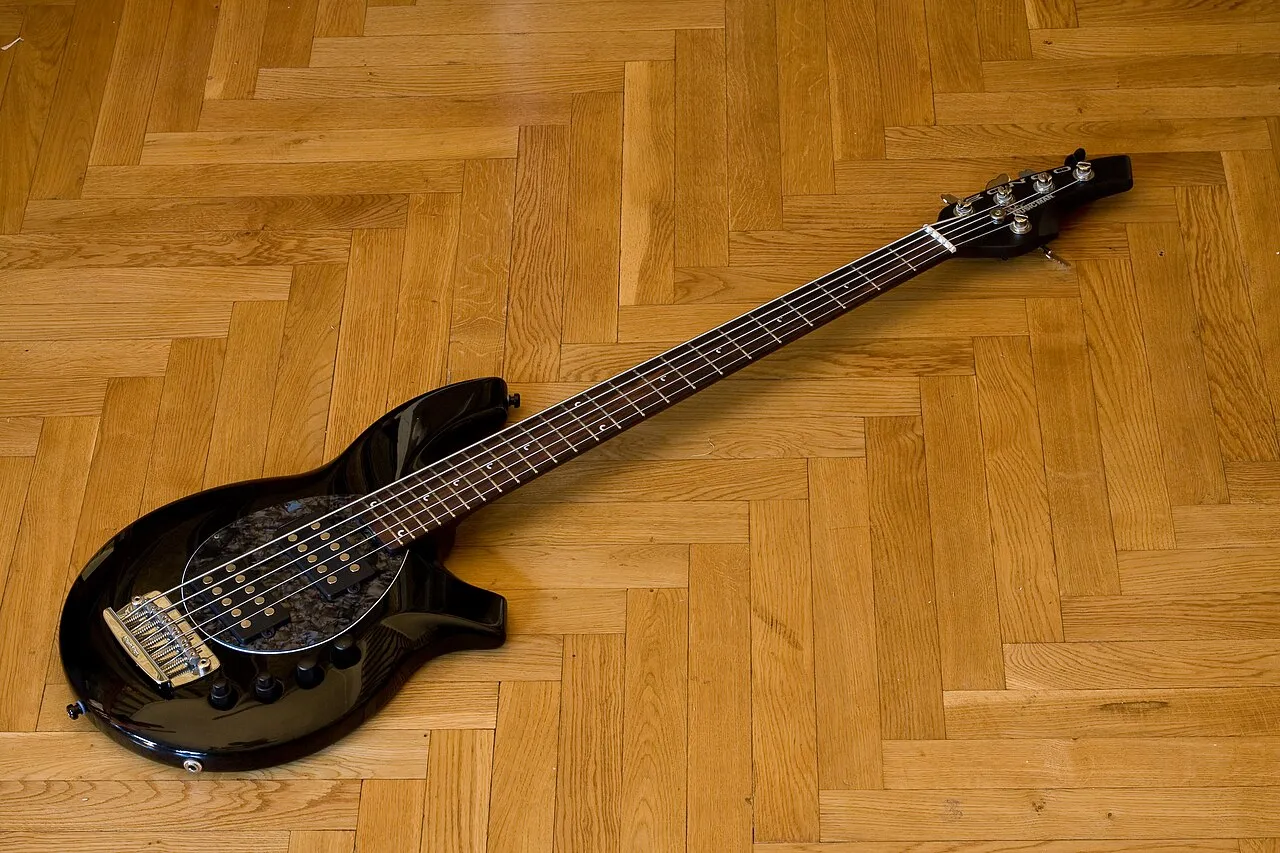
Photo: Serguei Trouchelle / Wikimedia Commons / CC BY-SA 3.0 Music Man
Bongo
2003
Sterling Ball asked BMW’s design studio for a bass. People thought he’d lost his mind. It’s still in production.
- Send a picture
Spector
NS-2
1979
It started with a man looking for a belt sander. Sting found his lying on the stage before soundcheck.