Duesenberg
Starplayer
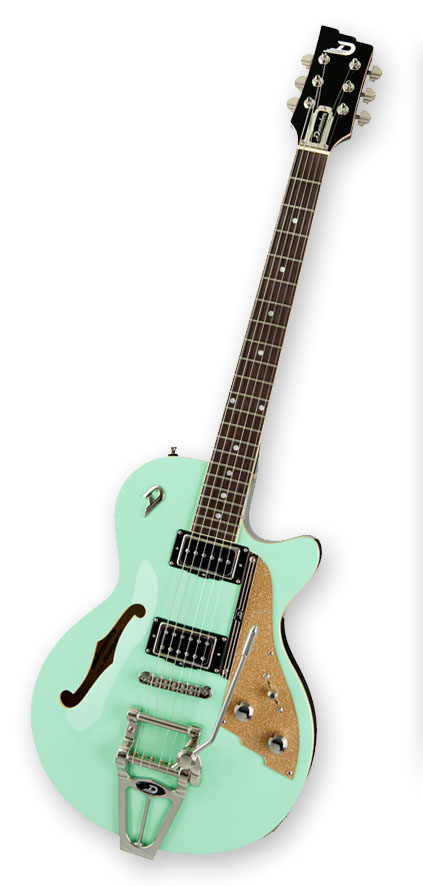
It looks like a 1950s guitar. There is no 1950s Starplayer. It had to make its own past, starting in 1995.
Hannover, Germany, 1995. Dieter Gölsdorf has been building guitars for years, and he wants a smaller jazz guitar that won’t weigh like one, dressed in Art Deco steps like a 1930s radio. What he comes up with looks like it’s been around since Eisenhower. It’s brand new.
- Introduced
- 1995
- Type
- Semi-hollow electric
- Class
- Production
The short version
1978
Rockinger
Dieter Gölsdorf’s earlier guitar business, in Germany.
1986
The Duesenberg name
It first goes on a run of futuristic metal guitars, which last until 1989.
1995
The Starplayer
A small single-cut from Hannover, built to look like the ’40s or ’50s.
1999–2000
The TV
A P-90 at the neck, a humbucker at the bridge. It becomes the flagship.
2002
A guitar for a Stone
Chris Jagger takes a pearl-top prototype to Ron Wood. Wood loves the tremolo.
2008
Halftime
Mike Campbell plays a blue Starplayer TV at the Super Bowl with Tom Petty and the Heartbreakers.
2025
Back to the start
Duesenberg revives what the owners call the original formula, chambered mahogany, as the Starplayer CBR.
Side A
A1
Built to look like it had always been there
Most guitars that look old are old, or they’re copies of something old. The Duesenberg Starplayer is neither. It looks like it walked out of a 1950s catalog, and there has never been a 1950s Starplayer. Everything you think you remember about it, it made up.
Dieter Gölsdorf had been at this a long time. He started a company called Rockinger in 1978, and the Duesenberg name first went on some futuristic metal guitars in the late ’80s. In 1995, in Hannover, he went the other way. He wanted a smaller jazz guitar that wouldn’t weigh what jazz guitars weigh, something “in the style of the ’40s or ’50s,” with “light weight and lively sound.” And he wanted Art Deco on the metalwork.
A2
The Art Deco three-step idea
That’s Gölsdorf’s phrase, and you can see it on the three-step headstock and in the metalwork. It’s all a little bit Chrysler Building.
The first Starplayers, the I and the II, had two humbuckers. The TV came along in late 1999 or 2000, depending who you ask, and it became the flagship.
The sound is where it earns its keep. The TV has a P-90 at the neck and a humbucker at the bridge, which is an odd couple that works. The P-90 is round and a bit raw, the humbucker is thick and loud, and the middle position trims the humbucker’s low end so the two sit together instead of fighting. There’s a block of wood down the middle of the body, so it will take some volume before it starts to howl. And the Duesenberg vibrato, the Tremola, is a big part of the appeal. More on that in a minute.
A3
Not a Gretsch
From across a shop it looks like a Gretsch 6120. It isn’t one. It isn’t a Gibson 335 either. It’s a German single-cutaway with a 25.5-inch scale, a sustain block, one of each kind of pickup, and a headstock you won’t confuse with anything once you’ve seen it. Today the wood is done in Croatia and the final assembly and setup happen in Germany, where since around 2010 the frets have been dressed on a Plek machine.
How many do they make? Nobody’s saying. Asked for a number, the owners gave the best non-answer in the business:
Not enough to get one in the hands of everybody who wants one!
Flip the record · By the numbers
1995
The year the Starplayer arrived. Everything that looks older about it is on purpose.
25.5″
Scale length. Fender length, on a guitar that looks like a Gretsch.
100
Production Ron Wood pearl-top signatures.
30
The Starplayer’s age in 2025, the year the chambered CBR came back.
Side B
B1
A tremolo that stays in tune
The first people to pick it up were German players, Peter Maffay and Carl Carlton, and in 2000 Carlton got the first Duesenberg signature, basically a bigger Starplayer TV. In Japan, Sheena Ringo became the face of a surf-green TV around the same time, and sales there went up with her.
Then, in 2002, Chris Jagger carried a pearl-top prototype to Ron Wood. Wood’s verdict was the kind of review every guitar maker dreams about:
Dieter made a tremolo that really stays in tune!
Duesenberg made a hundred production Ron Wood models. He’s still playing his, most recently with the Hollywood Vampires in London.
B2
Halftime
On 3 February 2008 Tom Petty and the Heartbreakers played the Super Bowl halftime show, and Mike Campbell did it on a blue metallic Starplayer TV with white racing stripes. That’s a lot of living rooms for a small company from Hannover to walk into at once. Campbell’s signature model went on to become Duesenberg’s best-selling artist model. He gave one to Dave Stewart, who played it on Jay Leno and on records for himself and Joss Stone.
B3
Old enough for a reissue
Here’s the funny part. Nobody quite agrees on what the 1995 Starplayer was. The owners say the original was chambered mahogany with a flat maple top, and that it grew into the spruce-topped semi-hollow with a center block over the years. Other accounts describe even the first one as a spruce-top semi. Either way, the guitar you buy today isn’t exactly the one that started it.
So in 2025, when the Starplayer turned 30, Duesenberg brought back the chambered-mahogany version and called it the CBR. A guitar that was built to look vintage finally has a vintage of its own. The Super Bowl, Ron Wood’s tremolo, a green guitar in Japan: that’s real history now, thirty years of it, and nobody had to make any of it up.
Put this on
You’ve read about it. Now hear it. Here’s what this guitar sounds like, and what to listen for.
Super Bowl XLII halftime show
Mike Campbell on a blue metallic Starplayer TV with white racing stripes, in front of about as many people as a guitar ever gets.
Watch it on YouTube (opens in a new tab)
The cast
The people, and the specific guitars, that made the legend.
1995
Dieter Gölsdorf
Designer
Drew the Starplayer “in the style of the ’40s or ’50s,” and put an Art Deco three-step on the metalwork.
2008
Mike Campbell
Blue Starplayer TV with racing stripes
Played it at the Super Bowl with Tom Petty. His signature model became Duesenberg’s best-selling artist model.
2002
Ron Wood
Pearl-top Starplayer TV
Got a prototype through Chris Jagger. Still playing his signature in 2026, with the Hollywood Vampires in London.
2000
Sheena Ringo
Surf-green Starplayer TV
One of the first big names on it outside Germany. Sales in Japan went up around her.
2000
Carl Carlton
The CC
One of the first German players, with Peter Maffay. His signature was a sized-up Starplayer TV, and Duesenberg’s first.
Dave Stewart
Mike Campbell Special Edition
A gift from Campbell. Stewart played it on Jay Leno and on records for himself and Joss Stone.
Liner notes
Specs, construction, rarity, value, and every source we used.
Spruce over maple, a sustain block, P-90 and humbucker — Hannover’s flagship semi, not a Gretsch, not a 335, and not the chambered mahogany guitar it started as.
- Body
- Semi-hollow with sustain block, bent sides, one f-hole. Laminated spruce top; laminated flamed maple back and sides. 46 × 34 cm / 18.11" × 13.38"; sides 4.5 cm / 1.8". Cream bind typical. Mix flagged.
- Neck
- Set, 1-piece maple; Medium D. 21 mm / 0.8" at 1st, 24 mm / 0.95" at 12th. Dual-action steel truss. Mix flagged.
- Fingerboard
- Indian rosewood; 305 mm / 12" radius; 22 jumbo 2.8 × 1.0 mm; cream dots. Mix flagged.
- Scale
- 648 mm / 25.5"
- Pickups
- Duesenberg Domino P90 (neck); GrandVintage humbucker (bridge)
- Hardware
- Duesenberg Z-Tuners; steel-saddle bridge; Sapphire Deluxe Tremola on 2026 Standard (Diamond Deluxe on earlier TV). Nickel. Custom Line case included.
- Electronics
- 1 volume, 1 tone, 3-way. Middle position filters the humbucker’s low end.
- Finish
- PUR lacquer typical (polyester on sparkle, pearl, pearloid tops). Deep Black and Everest White are 2026 standards. Back and sides Trans-Black except specials.
- Nut
- 42.5 mm / 1.67" at nut; 52 mm / 2.05" at 12th. Mix flagged. Material unpublished on the live TV table.
Open the full research fileConstruction details, the complete player record, production numbers, dated value estimates, and sources
Current typical = Starplayer TV Standard (duesenberg.de, fetched 8 September 2026). Factory mixed mm/inch flagged; do not average Sweetwater’s 12–14" compound against factory 12" / 305 mm, or German Wikipedia’s 650 mm / 25.6" against 648 mm / 25.5". CBR is chambered mahogany, flat maple — sister, not this table. TV+ adds piezo. Custom, Deluxe, Phonic, Velvet stay on this name. Starplayer Bass is a bass. No Gibson SKU.
Construction
The job was a smaller jazz guitar that would not weigh like one. Dieter Gölsdorf, to Guitar World (Dave Burrluck, 20 April 2026): a design “in the style of the ’40s or ’50s,” chambered for “light weight and lively sound,” plus “the Art Deco three-step idea” on the metal. That became the Starplayer. Hannover. 1995. Factory 25th-anniversary copy: “In 1995 the world was introduced to the original Duesenberg Starplayer.” Burrluck’s CBR review: it “turned 30 in 2025.” This plate starts in 1995.
It is not a Gretsch (gretsch-6120). Not a Gibson ES-335 (gibson-es-335). Not a Casino (epiphone-casino). The 335 is Kalamazoo, 24.75", maple stick, two humbuckers. The Casino is fully hollow, dog-ear P-90s, no block. This is a German single-cut: 25.5" scale, sustain block, P-90 and humbucker, three-step head. From across a shop it reads 6120. It is not one.
Gölsdorf’s earlier shop is Rockinger, 1978. The Duesenberg name sat on futuristic metal guitars 1986–89. Göldo Music GmbH, 1991, Hannover. The Starplayer is the brand’s second life.
What 1995 actually was is split. Gölsdorf and Ingo Renner, to Burrluck: originally chambered mahogany with a flat maple top and neck — “more in line with what we re-released last year with the Starplayer CBR” — and it “developed into the more traditional spruce semi-acoustic with centre-block construction over the years.” German Wikipedia: a semi-acoustic with a flat spruce top, two pickups, maple neck; predecessor of the TV. Keep both. Do not back-copy the current spruce arch onto every 1995 original.
Starplayer I and II came first. MusicMart (2007, Duesenberg archive): twin humbuckers. The TV arrived late 1999 in that piece, P-90 plus humbucker. Accordo.it dates the TV as a 2000 semi-hollow revision. Keep both years. The living flagship is the TV. Gitarre & Bass (NAMM 2020) collapses the span onto “the first Starplayer TVs.” Flag the mash.
Current TV (factory): laminated spruce top, laminated flamed maple back and sides, bent sides, one f-hole, sustain block. Burrluck, TV versus CBR: arched spruce/maple and a spruce centre block — his sentence, not a factory wood call on the live TV table. Set maple, Medium D, Indian rosewood, 22 jumbo, 648 mm / 25.5". Domino P90 neck, GrandVintage bridge. Middle position trims the humbucker’s low end. 2026 Tobacco Burst is the finish that gets a flamed maple top.
Long-running tremola: Diamond Deluxe. 2026 Standard: Sapphire Deluxe, metal D, new guards and rings. Deep Black and Everest White are the new standards; Everest White is the first Duesenberg with black binding. Do not write Diamond Deluxe as the current Standard default.
Plek from 2010. Production split: Croatia woodwork, paint, CNC; Germany Plek, assembly, setup. Fullerton branch 2004. Hannover outskirts 2011. Yearly totals unpublished. Asked for a figure, the owners: “Not enough to get one in the hands of everybody who wants one!”
Not the CBR — chambered mahogany, flat maple, the 2025 return of the first formula. Not TV+ (piezo). Not Custom (three D-Trons). Not Deluxe (twin f-holes). Alliance Campbell / Wood / Walsh signatures sit on this silhouette; they are not this table. Classic vs current: 1995 Starplayer — chambered mahogany/maple in the owners’ telling, spruce semi in the German wiki — against the 2026 TV Standard: spruce/maple laminate, sustain block, Sapphire Deluxe.
Players
Do not hang a 6120 or a 335 here. Do not recruit the CC, the CBR, or the bass. Manufacturer quote-walls are not named instruments.
Mike Campbell. Blue metallic Starplayer TV, white racing stripes, Super Bowl XLII halftime, 3 February 2008, Tom Petty and the Heartbreakers (factory Alliance page; Guitar World). Gölsdorf/Renner: that Alliance model “has been the best-selling Alliance model for us.” Premier Guitar (9 January 2008) reviewed the Heartbreakers 30th-anniversary signature as a Starplayer — semi-hollow, smaller and heavier than a 17" Gretsch. Vintage Guitar’s 2021 Campbell interview is his ’59 ES-335 and a bender Tele. Those are other guitars.
Ron Wood. Gölsdorf: 2002, Chris Jagger took a pearl-top prototype to Wood; Wood’s note: “Dieter made a tremolo that really stays in tune!” German Wikipedia: TV Ron Wood, yellow pearl mosaic, limited 100. Gardiner Houlgate, 4 December 2024: a 2003 TV-RW, “one of only 100 production models.” Guitar World (Phil Weller, 14 August 2026): still the signature, Hollywood Vampires, London.
Sheena Ringo. Guitar World: among the first after the German players. German Wikipedia: surf-green Starplayer TV, sales lift around 2000. Japanese dealer cards put her first on a Starplayer II. The green TV is the image. A named studio-album credit is unpublished here.
Peter Maffay and Carl Carlton were the first German users (Guitar World). Carlton’s 2000 CC is the first signature — “technically a sized-up version of the Starplayer TV.” Bigger body. Not this table.
Dave Stewart. Vintage Guitar: a Mike Campbell Special Edition, gift from Campbell, Jay Leno (11 July), “some of my new album as well as Joss Stone’s new album.” The later Blackbird Artist Series is a Starplayer III, limited 52 (German Wikipedia). III, not TV.
Also known to play stays short. Factory TV page quotes Robbie McIntosh (“I play it every night”), Joe Walsh, Glenn Frey, Chris Cornell. Named serials and songs for those four are unpublished here. Do not dump Bob Dylan or John Mayer from a 25th-anniversary brochure.
Rarity
Current TV Standard, Deluxe, Phonic, Velvet, Custom, TV+, and the CBR are regular production. Duesenberg does not publish Starplayer unit totals. None invented. Serials date a guitar. They don’t count a year.
What is actually thinner: 1995 Starplayer I/II; late-1999/2000 first TVs; the Ron Wood pearl 100; factory 25th-anniversary Gold Leaf, 25 worldwide (NAMM 2020 / factory page). The CBR 30th Checkerboard is sold out — a CBR, not a TV census. Campbell’s Super Bowl guitar and Wood’s own pearl are unique objects. They are not a street TV. Japan’s 2000 bump is a market story, not a ledger.
Value
Informal estimate, 8 September 2026. Not an appraisal.
Ask vs sold labeled. Celebrity lots are not-comps. No invented medians or factory counts. A CBR is not a TV comparable. A Ron Wood pearl is not a Standard.
New street. Sweetwater 2026 TV: Everest White $3,899; Balboa Pearl Blue $3,999; Galaxy Burst Purple $4,299. Velvet Black $4,399. Custom Black $4,599. Musician’s Friend Catalina Sunset Rose $3,644; Blue Sparkle $4,199. guitarguitar Surf Green £2,249 (inc. case). Guitar World / Guitarist CBR review prints TV from £2,249, TV+ £2,549 — UK, not a US MAP. CBR Sweetwater $3,699 is the chambered sister.
Used modern. Named asks this pass, not hammers: 2010s Black Sparkle $2,700; 2022 Vintage Burst $2,584; Velvet Black $3,100. Flag: thin public sold-comp access. Do not average those asks.
Vintage / collectible. There is no 1950s Starplayer. Early 1995–early-2000s examples are used modern with age. Named hammer, not a series: Gardiner Houlgate, 4 December 2024, 2003 Ron Wood TV-RW £2,000 (estimate £2,000–£4,000). A Reverb listing for another Wood limited printed sold $5,193.70 three years ago — one guitar, old sold, not 2026. Gold Leaf 25 is a limited object. Campbell and Wood artist pieces are a separate market.
See also
- gretsch-6120 — the 16" Chet hollow this silhouette gets mashed onto
- gibson-es-335 — the 1958 Kalamazoo center-block this Hannover semi is not
- epiphone-casino — fully hollow P-90s, no sustain block
Sources
- Duesenberg, Starplayer TV Standard — current typical spec, fetched 8 September 2026; spruce/maple laminate; sustain block; 648 mm / 25.5"; 42.5 mm nut; Domino P90 / GrandVintage; Diamond Deluxe still printed on the English table
- Duesenberg, Starplayer TV Standard (DE) — 2026 Standard: Sapphire Deluxe Tremola
- Duesenberg 2026 news — Sapphire Deluxe; metal D; Deep Black / Everest White; Tobacco Burst flamed maple top; TV+ as sister
- Duesenberg, Starplayer TV 25th Anniversary Gold Leaf — “In 1995 the world was introduced to the original Duesenberg Starplayer”; Gold Leaf limited 25
- Duesenberg, Alliance Series Mike Campbell — Super Bowl 2008 blue/white TV
- Duesenberg, Starplayer CBR — chambered mahogany, flat maple; sister construction
- Guitar World / Guitarist, Dave Burrluck, 20 April 2026 — 30 years of Starplayer; original chambered mahogany / flat maple; CBR as that formula; first players Maffay, Carlton, Keb’ Mo’, Sheena Ringo; Carlton CC 2000; Campbell Alliance best-seller; Plek ~2010; Croatia/Germany split; no yearly total
- Guitar World / Guitarist, Dave Burrluck, Starplayer CBR review — Starplayer turned 30 in 2025; TV = arched spruce/maple + spruce centre block vs CBR chambered mahogany; 648 mm; TV from £2,249; TV+ £2,549; CBR $3,699
- Premier Guitar, Mike Campbell 30th-anniversary Starplayer, 9 January 2008
- Vintage Guitar, Dave Stewart — Campbell Special Edition gift; Jay Leno 11 July; Blackbird Diaries / Joss Stone
- Guitar World, Phil Weller, 14 August 2026 — Wood on the Starplayer TV Ronnie Wood with Hollywood Vampires, London
- Dieter Gölsdorf, 2002–2004 — 2002 Jagger/Wood pearl prototype; Wood on the tremola
- Gardiner Houlgate, 4 December 2024, lot 925 — 2003 TV-RW; 100 production; hammer £2,000
- Gitarre & Bass, NAMM 2020 — 25 years; Gold Leaf 25; Catalina colors
- MusicMart 2007 (Duesenberg archive PDF) — 1995 redesign; Starplayer I/II twin humbuckers; TV late 1999
- Accordo.it, Starplayer 2002 vs 2009 — 1995 Starplayer; TV as 2000 semi-hollow revision
- Vintage Guitar, Mike Campbell — 2021 interview: ’59 ES-335 and bender Tele, not the Super Bowl TV
- Wikipedia, Duesenberg Guitars — brand 1986; Göldo 1991; Starplayer 1995 as TV predecessor; Fullerton 2004; Hannover move 2011
- German Wikipedia, Duesenberg Guitars — Rockinger 1978; 1995 spruce-top semi as TV predecessor; Sheena Ringo ~2000; Ron Wood pearl limited 100; scale 25.6" / 650 mm (mix vs factory 648 mm); Blackbird limited 52
- Sweetwater, Starplayer TV Everest White — $3,899
- Sweetwater, Starplayer TV Balboa Pearl Blue — $3,999
- Sweetwater, Duesenberg manufacturer — Galaxy Burst $4,299; Velvet $4,399
- Sweetwater, Starplayer TV Custom Black — $4,599
- Musician’s Friend, Starplayer TV Catalina Sunset Rose — $3,644; Blue Sparkle $4,199
- guitarguitar, Starplayer TV Surf Green — £2,249; 12" radius; 1.67" nut
Keep digging
Guitars this one gets compared to, confused with, or descended from.
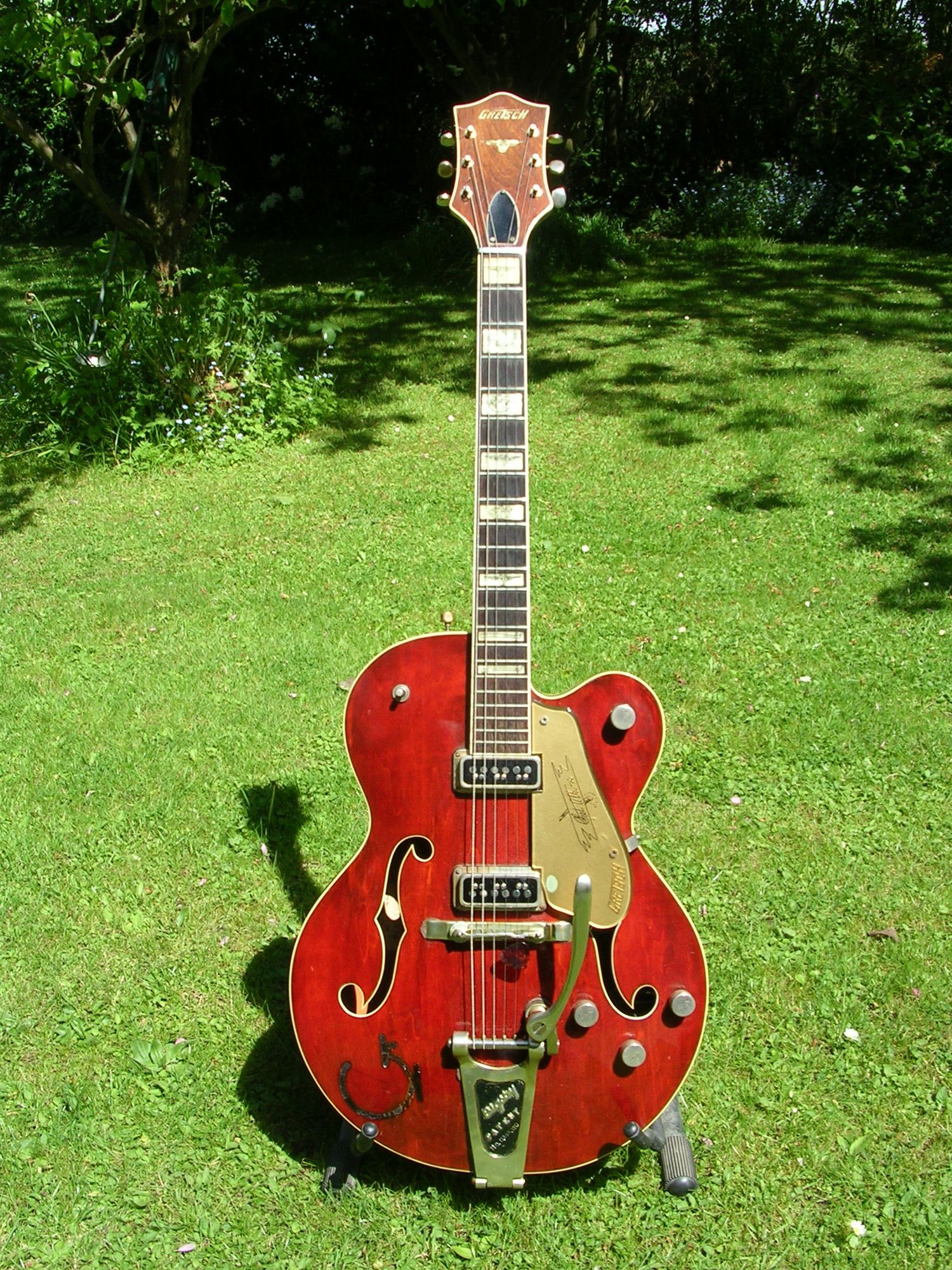
Gretsch 6120 G-Brand 1955. Photo by Francis pullen. Public domain (PD-self). Via Wikimedia Commons. Gretsch
6120
1955
Joe Walsh gave Pete Townshend one. Steve Miller gave Brian Setzer one. Chet Atkins just lent it his name.

Photograph of a vintage 1960 Gibson ES-335TD. Photo by Lightburst. Licensed under CC BY-SA 4.0. Via Wikimedia Commons. Gibson
ES-335
1958
Larry Carlton played three 335s off a shop wall, unplugged, paid $850 for one, and became Mr. 335.
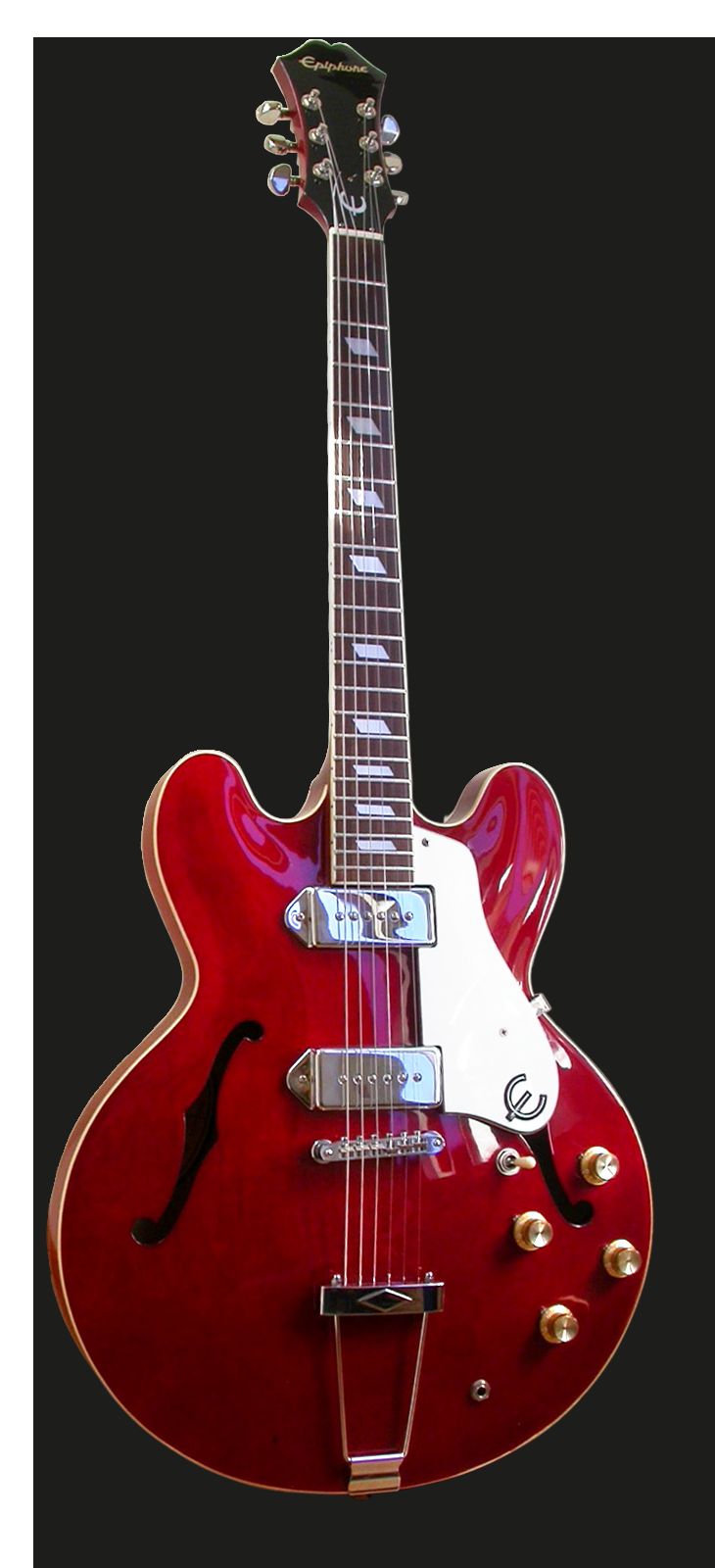
Epiphone Casino Cherry. Photo by Maxo; background removed by Auge=mit. Licensed under CC BY-SA 4.0. Via Wikimedia Commons. Epiphone
Casino
1961
Of all the Beatles’ famous guitars, the only one John, Paul, and George all had. Two sanded theirs bare.