Yamaha
SA2200
It borrowed someone else’s outline in 1991, and it has been quietly refusing to change ever since.
January 2019, in front of a guitar shop’s camera. Jeff Schroeder of the Smashing Pumpkins holds a Yamaha SA2200 and explains what it’s for: the quiet songs, the small space in the band. The model was nearly thirty years old by then, and it had barely moved.
- Introduced
- 1991
- Type
- Semi-hollow electric
- Class
- Production
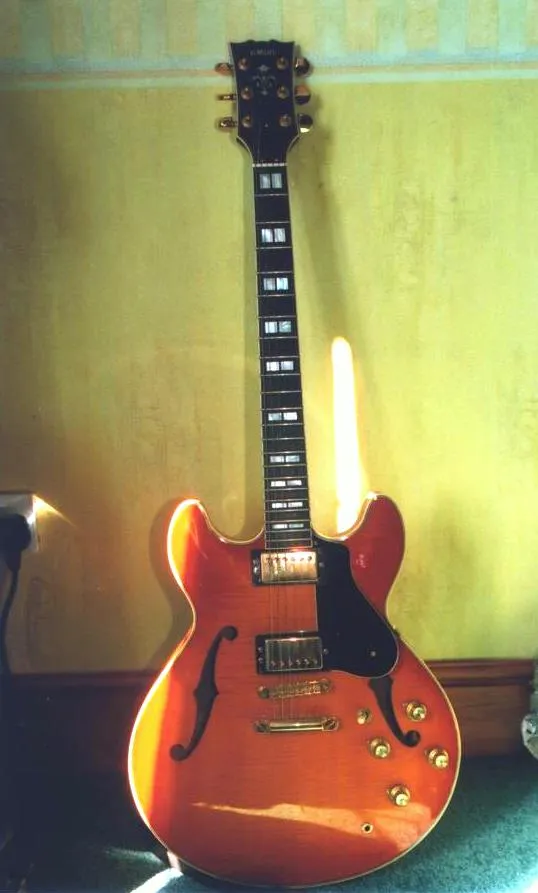
The short version
1968
The first Yamaha hollows
The SA-50 and SA-15. Yamaha also dates its hollow line to 1966. Keep both.
1977
A block in the middle
The asymmetric SA-2000 is Yamaha’s first center-block semi. A relative, not this guitar.
1991
The SA2200 arrives
Late in the year, by one account. The catalogs can place it from 1992.
1994
On the Japanese price list
¥150,000 in that year’s catalogue.
2019
Schroeder on camera
He demos an SA2200 and says he started using them on the In Plainsong tour.
2020
Virtually unchanged
A guitar built in May 2020 is virtually the same as the one introduced in 1991.
2022
Stripped and reloaded
On tour, Schroeder’s semi is an SA2200 that’s been repainted, fitted with a trapeze, and loaded with Lollars.
2026
“Updated”
A February headline calls it updated. The spec underneath is the same guitar.
Side A
A1
The small space in the band
January 2019. Jeff Schroeder, a Smashing Pumpkins guitarist since 2007, is on camera at The Music Zoo with a Yamaha SA2200. He has taken them out on a few Pumpkins tours, he says, starting with In Plainsong, the band’s acoustic-leaning shows.
What does he use it for? The mellower songs. He plays it against the acoustics, because it sits in a small space in the band. It isn’t there to be the loudest thing on stage. It’s there to fit.
He doesn’t name a song. He does toss off an aside: “A lot of jazz guys like to use these.” He doesn’t name them either, and nobody else has been pinned to one. For a guitar that has spent its whole life being the quiet one in the room, that seems about right.
A2
Two birthdays for the hollow line
Yamaha can’t quite agree with itself about when its hollow guitars began. One page says the line has been changing since 1966. The company’s own chronology says 1966 was the year of the first electrics, the solid SG-2 and SG-3, and that the first hollows, the SA-50 and SA-15, came in 1968. Keep both. Neither one is this guitar.
The SA-50 had no block in the middle. The block showed up in 1977, on the SA-2000: an asymmetric semi-hollow with a covered humbucker on a three-point mount. Some owners call the SA2200 a facelift of it. Yamaha’s chronology doesn’t. Treat the SA-2000 as family, not as the same guitar with a new badge.
A3
Someone else’s outline
The SA2200 turned up late in 1991, by one long-time reviewer’s account. The catalogs can place it from at least 1992, often as the only SA on the page. Both hold. In 1994 the Japanese catalogue listed it at ¥150,000.
You know the shape. It’s the double-cut thinline Gibson put out in 1958 as the ES-335. Someone else’s design, and reviewers say so. Up close it has its own accent. The body is a straight 16 inches across, the horns are thinned, and the rise is gentler than the Gibson it imitates.
The block down the middle is there to fight feedback, and it mostly wins. Lean into a cranked amp and you’ll still get some, the musical kind. It holds. It isn’t a solid.
The rest is dressed for the evening: a set mahogany neck, a bound ebony board with split-block pearl inlays, gold Gotoh hardware, and two gold-covered Alnico V humbuckers. It’s made in Japan, by hand, in small numbers, at a small workshop that also builds Yamaha’s high-end electrics, acoustics, and basses. At one point a rumor said production had moved to Taiwan. One player who had to order his from Japan heard it, and the label on the guitar that finally arrived still read Made in Japan.
Flip the record · By the numbers
¥150,000
The SA2200 in the 1994 Japanese catalogue.
1991–92
Introduced late in 1991 by one account; in the catalogs from at least 1992.
8
Sounds, by Yamaha’s count, once you split both humbuckers with the tone knobs.
16"
Straight across the body, with the horns thinned down.
Side B
B1
Pull the knob, find the quack
The part that’s Yamaha’s own is in the wiring. They call it Bi-Sound. Pull a tone knob up and that humbucker turns into a single coil. Do it on both and Yamaha counts eight sounds.
On a 2020 example, the split leaves the inner coils doing the talking, and that’s where the quack lives. Earlier Yamahas were push-push, and at least one catalog note says this one is too. The hands-on review and Yamaha’s own page say you pull. Try pulling first.
Pull a knob and the borrowed shape starts sounding like somebody else.
Then there’s I.R.A. Yamaha vibrates each finished guitar to ease the stress between wood and finish, neck and fingerboard, body and hardware, so a new one feels played-in. Where the idea came from depends who you ask: wind instruments, or high-end violins. Either way, the certificate comes with the guitar.
And what is it made of? Laminated sycamore with a soft maple block, says Yamaha’s spec table. Plenty of people say maple. Some count three plies, some count five. Nobody agrees, so don’t go picking a tree.
B2
Stripped, repainted, still an SA
A few months before that 2019 video, Schroeder had been in Nashville while Billy Corgan worked on a solo album that wasn’t out yet. He played a lot of solos on the SA2200.
By the Spirits on Fire tour in 2022 his main electric was a Yamaha Revstar, with a scalloped Pacifica beside it. But for a semi-hollow he still went to the SA2200. One of them had come from Yamaha’s custom shop completely stock. He had it stripped and repainted, swapped the stop tailpiece for a trapeze, and put in Lollar Imperial low-wind humbuckers.
There’s a 335 on that same tour, a 1972 Gibson. It’s Corgan’s, not Schroeder’s. Don’t mix them up.
B3
Virtually unchanged
Pick up one built in May 2020 and it’s virtually the guitar Yamaha introduced in 1991. In February 2026 a French headline announced an “updated” SA2200. The spec underneath was the same: no new pickups, no new scale, no new neck joint.
Even the colors held on. One account has the brown sunburst dropping out around 2005. Today you can still order it in Brown or Violin Sunburst. If there was a gap, it didn’t last.
Schroeder took his apart and made it his own: new paint, new tailpiece, new pickups. Yamaha kept building the other one exactly the way it always had. Both still go to the same place in the song, back by the acoustics, and they still fit.
Put this on
You’ve read about it. Now hear it. Here’s what this guitar sounds like, and what to listen for.
Smashing Pumpkins demo the SA2200
The Music Zoo, January 2019. Schroeder plays an SA2200 and talks through why he uses it on the mellower songs, against the acoustics.
Watch it on YouTube (opens in a new tab)
The cast
The people, and the specific guitars, that made the legend.
2019
Jeff Schroeder
SA2200s
Smashing Pumpkins guitarist, 2007–2023. Took them on a few tours starting with In Plainsong. In Nashville, while Billy Corgan worked on a solo album, he played a lot of solos on one.
2022
Jeff Schroeder
Custom-shop SA2200, stripped and repainted
Bought stock, then refinished, with a trapeze tailpiece and Lollar Imperial low-wind humbuckers. His semi on the Spirits on Fire tour; his main electric was a Revstar.
Liner notes
Specs, construction, rarity, value, and every source we used.
A center-block thinline with coil-splits on both tones — Yamaha’s Japan SA2200, not a Gibson ES-335 and not an SG-2000.
- Body
- Double-cut thinline semi-hollow. Yamaha’s current table: laminated sycamore, soft maple center block, gloss polyurethane. Burrluck, on a May 2020 guitar: 16" wide, five-ply maple-faced laminate, thinned horns. Two f-holes (Bax; an owner review). Mix flagged.
- Neck
- Set mahogany. Gloss polyurethane. Not a through-neck.
- Fingerboard
- Bound ebony, 22 medium jumbo, split-block mother-of-pearl (Burrluck). Radius 13-3/4" (350 mm).
- Scale
- 24-3/4" (628.6 mm), Yamaha. Burrluck’s spec box: 629 mm (24.75"). Thomann: 628 mm. Bax: 24.75" (628.7 mm). Mix flagged.
- Pickups
- Two Yamaha Alnico V humbuckers, gold covers. Three-point mount (Burrluck: an extra screw on the bass side so the pickup can tilt)
- Hardware
- Gold Gotoh. GE103B Nashville-style bridge, GE101Z stop tail, SG30 tuners. Yamaha string spacing 10.4 mm; Burrluck’s bridge spread 52 mm (five gaps). No tremolo. 2-ply black guard.
- Electronics
- Volume and tone per pickup; 3-way toggle. Bi-Sound coil-split on both tones. Current Japanese features page and Burrluck’s 2020 guitar: pull the tone knobs up. Alston’s catalog note: push-push.
- Finish
- Gloss polyurethane. Violin Sunburst and Brown Sunburst.
- Nut
- Bone. Yamaha: 43 mm at the zero fret, 53.5 mm at the 12th. Burrluck measured 43.3 mm. Neck thickness on the Yamaha table: 20.5 / 22.2 mm at the 1st / 12th. Burrluck: 23.5 mm by the 12th. Alston: synthetic bone, 43 mm. Mix flagged.
Open the full research fileConstruction details, the complete player record, production numbers, dated value estimates, and sources
Classic living example = current Japan SA2200. Burrluck (Guitar World, 2 February 2021; Guitarist, January 2021): virtually unchanged since it was introduced late in 1991. Bill Alston’s SA file can document it in catalogs from at least 1992. Same silhouette. SA-50 / SA-15 (1968) are the first Yamaha hollows; the SA-50 has no center block. SA-2000 (1977) is the asymmetric center-block predecessor. AE-2000 (1978) is the full hollow. SG-2000 is the 1976 through-neck solid. Pacifica is the bolt-on Strat-layout. BB and TRB are basses. FG is the folk acoustic. No Gibson SKU. Mixed inch/mm flagged. Do not average 628.6 mm with 629 mm or 628.7 mm, or 43 mm with 43.3 mm, or 22.2 mm with 23.5 mm. Yamaha’s 10.4 mm spacing and Burrluck’s 52 mm spread are the same bridge stated two ways (5 × 10.4 = 52), not two nuts to split.
Construction
The job was a semi Yamaha could stand next to a 335 and still sign. Laminate. A block through the middle. Two humbuckers you can split. Japan.
Yamaha’s own dates for “hollow” do not agree. The Hollow Series overview says the line has been changing since 1966. The chronology puts that year’s first electrics as SG-2 and SG-3, and the first hollows as SA-50 and SA-15 in 1968. The SA-50 looks semi-solid and has no center block. The SA-15 has the SG-7’s long horn and two single-coils. Keep 1966 and 1968. Neither is this guitar.
The center-block semi that came first is the 1977 SA-2000: asymmetric, a block, a covered humbucker on a three-point mount, over-binding frets. 1978 AE-2000 is the full-hollow flagship, not a thinline. A Yamaha Musicians review (4 March 2023) calls the SA2200 a facelift of the SA-2000. The chronology does not. The 1977 guitar stays the other object.
This plate starts in 1991. Burrluck: introduced late that year; the May 2020 guitar he played was virtually the same. Alston can document it in catalogs from at least 1992, often the only SA on the page. 1994 Japanese catalogue, via Alston: ¥150,000. Reverb’s year field: 1992–2026. Thomann’s “available since August 2001” is that shop’s listing date, not a birth. Late 1991 and a 1992 catalog floor both stand. 1991 is the introduction claim. 1992 is not buried.
The body is a double-cut thinline, arched top and back, block in the center. Japanese features page: figured sycamore on the top; gold-covered Alnico Vs wound for the SA. The block is the feedback control. Burrluck still got musical feedback when he leaned into a cranked amp. It holds. It is not a solid. His May 2020 guitar: a straight 16-inch width, horns thinned, body rise slighter than the ES it imitates, kerfed mahogany linings, purfling inside the binding, headstock about 180 × 85 mm. Two f-holes (Bax’s spec; the 2023 review puts the toggle by one). Set mahogany. Not a through-neck. The rest of the living spec is the table. Hardshell case on Yamaha’s spec and on Thomann. Musician’s Friend says the case is sold separately. Keep both. Weight is not on the table. That one review guitar: 3.79 kg / 8.34 lb. Not a factory average.
Not an ES-335 (gibson-es-335). Burrluck: this is someone else’s design. Kalamazoo, then Nashville, 1958, maple stick, PAFs then T-Types. This is Japan, thinned horns, Yamaha Alnicos, splits on the tones. No Gibson SKU. Not an SG-2000 (yamaha-sg-2000): thick 1976 through-neck, T-Cross, brass under the bridge. Not a Pacifica. Not a BB, a TRB, or an FG.
The wood name is a fight. Do not pick a tree. Current Yamaha table (USA shop, Australia specs, China): laminated sycamore, soft maple center block. Japanese features page: figured sycamore on the top. Burrluck’s hands: five-ply maple-faced laminate, and he flags the USA site’s sycamore. His spec box then prints “laminated 5-ply figured sycamore with soft maple centre block.” Alston, quoting the March 2023 review: a brochure says figured maple; a service manual, so that review says, says maple and spruce; one Japanese catalogue splits maple and sycamore on the top, birch and sycamore on the sides, and a spruce block. That review counts three plies, a sycamore-maple sandwich “like pre-1960 335s,” and reads sycamore as Acer pseudoplatanus, not American plane. Five-ply and three-ply both stay. Thomann prints maple (Ahorn). Bax prints flamed maple. Dealer shorthand. Not a winner.
Bi-Sound is the Yamaha part of the wiring. Japanese features page: pull both tone knobs up, humbucker to single, eight sounds. Burrluck’s 2020 guitar: pull-push, not the push-push on earlier Yamahas, and the splits voice the inner slug coils. That is where he heard the quack. Alston’s catalog note says push-push. A 2001 listing and Musician’s Friend say push/pull. The hands-on review and the current Japanese page agree you pull up. No published DCR. He only says they metered slightly hotter than the Duncan ’59s in the SG1820 beside them.
I.R.A. is Initial Response Acceleration. Yamaha’s electric-guitar page: specific vibrations, each instrument, releasing stress between wood and finish, neck and fingerboard, body and hardware, so a new guitar feels played-in. Origin is split. The Europe 60th page says wind instruments. Burrluck’s Guitarist box, first on the 2007 Music Craft SGs, says high-end violins: that guitar’s resonant frequency, 15 minutes, smoother sustain, a more linear decay. Keep both. The USA hollow spec lists I.R.A. on the SA2200. In 2021 his sheet named it on the SG1820, and the SA still came with the certificate. A.R.E. is the acoustic torrefaction, a different process. The 2023 owner misread his card as A.R.E., then corrected it: the card says I.R.A.
Burrluck in 2021: barely moved since 1991. Audiofanzine, 6 February 2026, headlines an “updated” SA2200, cites Yamaha France, and prints the same spec, at €3,140. A comment under it: no big change beyond sycamore versus maple. No new pickup, scale, or joint in that piece. Alston: brown sunburst dropped around 2005. Burrluck’s 2021 finishes, and that 2026 price, still list Brown and Violin. If the gap was real, it did not last.
Players
Do not hang a Gibson ES-335 on this plate. Larry Carlton’s 1969, Alvin Lee’s Big Red, and Clapton’s 1964 stay on gibson-es-335. Do not hang Billy Corgan’s 1972 ES-335 on it either. Premier Guitar’s 2022 rig rundown puts that Gibson in Corgan’s hands, on the same tour where the Yamaha semi is someone else’s. Do not file Jeff Schroeder’s Revstars, or his custom Pacifica, as this guitar. He plays all three. They are not the same object.
Jeff Schroeder. The Smashing Pumpkins guitarist, 2007–2023, and the one named player this plate can pin. The Music Zoo, 17 January 2019, camera on an SA2200 (the title and the description name it; the auto-transcript hears “SI 2200”). He said he had used them on a few Pumpkins tours, and that he started on the In Plainsong tour. Two runs used that name. Pitchfork, 21 April 2015: an acoustic In Plainsong. Rolling Stone, 1 February 2016: the later acoustic-electro In Plainsong, March–April 2016, Schroeder in the lineup. He said “the last” one. He also said that a few months before that January 2019 video he had been in Nashville, Billy Corgan working on a solo album not yet out, and that he played a lot of solos on this guitar. He uses it on the mellower songs, against acoustics, because it sits in a small space in the band. No song title from him. “A lot of jazz guys like to use these” is his aside, not a roster.
The 2022 guitar is not the stock gold stop-tail in the table. Premier Guitar’s written rundown (23 November 2022): for a semi-hollow he goes to his Yamaha SA2200s, with Lollar Low Wind Imperial humbuckers. The video the same week, his own mouth: a custom-shop SA2200 that was stock, then stripped, repainted, a trapeze in place of the stop, Lollar Imperial low-winds. One object, modified. His number-one on that Spirits on Fire tour is a Revstar. The Pacifica beside it is a scalloped Super Strat with a Floyd. The SA is the semi. Not every Pumpkins guitar from Oceania through Atum.
Also known to play stays empty on purpose. No second named player with a pinned SA2200 turned up in a magazine, a maker page, or an interview this pass. Dealer reviews are not a cast.
Rarity
You can still order one. Yamaha’s USA shop lists the SA2200. Thomann still sells the VS and the BS. Alston’s file, July 2025: still in production, and an earlier halt, if it happened, did not stick. Audiofanzine, February 2026, has it as a current French guitar. Reverb’s year field runs the model through 2026.
Yamaha does not publish SA2200 unit totals. None invented. Burrluck, on the high-end shop that also built the SG1820 he reviewed: handmade, in small numbers, at a relatively small workshop in Japan — Yamaha Music Manufacturing Japan — which also builds the high-end electrics, acoustics, and basses, and which he was told cannot make enough guitars for worldwide demand. The “one of only 100, exclusive to the UK” line in that review is the SG1820, not this semi. Do not borrow it. A 2016 note Alston saves, from a player who had to order out of Japan: not on a regular schedule, months to arrive, and a Taiwan rumor that died when the label still read Made in Japan. Serial letters date a guitar. They do not count a year. That is why a first-year census is unknown.
What is actually thinner: a late-1991 or early-1992 example, if you can prove the year without a factory ledger; a brown-sunburst from the stretch Alston thinks skipped the color. Schroeder’s repainted, trapeze, Lollar guitar is one object. It is not a stock SA2200, and it is not a vintage tax on the model.
Value
Informal estimate, 29 September 2026. Not an appraisal.
Ask versus sold, labeled. No celebrity hammer on this model turned up. No invented medians or factory counts. Period ¥150,000 (1994 Japanese catalogue, via Alston) and ¥231,000 MRRP, about £1,300 (2012, Alston) are old list prices, not 2026 street. Burrluck’s on-sale figure in the January 2021 issue, $1,999 / £1,699 including case, is 2021 money. He says Yamaha’s official SRP sat about 35 percent higher than the UK price he printed. He does not print the SRP. None invented here.
New street. Yamaha USA’s shop, this pass: $3,099.99, out of stock. A Reverb dealer listing of a new 2025 brown burst, case included, asks the same $3,099.99. Reverb’s product page prints a typical new of $3,099. Europe is a different sticker, and the stickers do not agree with each other. Thomann Germany, fetched 29 September 2026, prices in euros and including VAT: SA2200VS €2,279, five to seven weeks; SA2200BS €2,389. Thomann Belgium: SA2200VS €2,499, in stock. Audiofanzine, 6 February 2026, citing Yamaha France: €3,140 in either sunburst, and a shop button “from €2,499.” Yamaha China’s page lists a suggested retail of 22,400 yuan. Do not average dollars, euros, and yuan. Do not convert them. A March 2023 owner had German retail at €2,150 including case and tax. That is 2023, not this pass.
Used. Reverb’s Price Guide, on the Old Violin Sunburst SA2200 page, which says the band covers all models: $1,144–$1,762, based on 179 orders, Good to Mint. Labeled estimate, not a median computed here. Named solds on that same tape, which do not all sit inside the band: 23 November 2025 Mint $2,199 and Excellent $1,415; 12 November 2025 Excellent $1,540; 3 November 2025 Very Good $1,699; 28 October 2025 Excellent $1,511.20; 7 October 2025 Excellent $1,350; 18 September 2025 Excellent $1,913.13. Report the band and the hammers. Do not average them.
Vintage / collectible. No separate early-1990s sold series isolated this pass. A 1992 SA2200 is not a 1958 ES-335, and the guitar is still a current SKU, so the used guide above is the market. Schroeder’s refinished Lollar guitar is one modified object. Not a comp.
See also
- gibson-es-335 — the 1958 center-block thinline this outline imitates and is not
- yamaha-sg-2000 — 1976 through-neck solid; the other Yamaha flagship, not this semi
- ibanez-as200 — 1979 Japanese semi players cross-shop; Super 58 and a Tri-sound, not these Alnicos
Sources
- Guitar World, Dave Burrluck, Yamaha SG1820 & SA2200 (2 February 2021) — Guitarist, January 2021. Late 1991, virtually unchanged. May 2020 sample. 16" wide; five-ply maple-faced laminate; USA site says sycamore; spec box: 5-ply figured sycamore, soft maple center block. 629 mm (24.75"); bone nut 43.3 mm; ebony, split-rectangle mother-of-pearl, 350 mm (13.75") radius; 22 medium jumbo. Gotoh GE103B Nashville bridge, GE101Z stop, SG30; bridge spread 52 mm. Pull-push Bi-Sound; inner slug coils. Weight of that guitar 3.79 kg / 8.34 lb. Violin Sunburst and Brown Sunburst, gloss polyurethane. Kerfed mahogany linings; thinned horns; headstock about 180 × 85 mm; three-point mount. Small Japan workshop (YMMJ); the UK-only 100 is the SG1820. On-sale $1,999 / £1,699 including case. IRA certificate; 2007 violin account, 15 minutes at resonance.
- Yamaha USA shop, SA2200 — $3,099.99, out of stock this pass. Laminated sycamore / soft maple center block. Made in Japan. Gotoh SG30, GE103B, GE101Z. Alnico V humbuckers. Mahogany neck, ebony board.
- Yamaha USA, Hollow specs — set-in; 24-3/4" (628.6 mm); laminated sycamore / soft maple center block; gloss polyurethane; mahogany; ebony; 13-3/4" (350 mm); medium jumbo; 22 frets; bone; 43 / 53.5 mm at 0 and 12; 20.5 / 22.2 mm at 1st and 12th; Yamaha Alnico V humbuckers; two volumes, two tones; 3-way; Gotoh GE103B; 10.4 mm; GE101Z; SG30; 2-ply black guard; D’Addario EXL110 .010–.046; hardshell case; I.R.A.
- Yamaha Australia, Hollow Body specs — same construction table as the USA spec, including 628.6 mm and 43.0 / 53.5 mm
- Yamaha Japan, Hollow features — arched top and back; wood block in the center; figured sycamore on the top; gold-covered custom Alnico V; Bi-Sound, pull the tone knobs up, eight sounds; I.R.A. explained as vibration of the finished guitar
- Yamaha USA, Hollow overview — Hollow Series changing since 1966; SA2200 as the current double-cut semi-hollow, Made in Japan, I.R.A.
- Yamaha, guitar chronology (Europe / Asia mirrors of the 60th) — 1966 SG-2/3; 1968 SA-50 and SA-15, SA-50 with no center block; 1976 SG-2000/1000; 1977 SA-2000 asymmetric semi-hollow with a center block; 1978 AE-2000 full hollow
- Yamaha USA, electric guitar technologies — I.R.A.: specific vibrations; stress between wood and finish, neck and fingerboard, body and hardware; played-in feel
- Yamaha Europe, guitar 60th, I.R.A. — I.R.A. described as begun on wind instruments, then adapted to guitars
- Bill Alston, SA 2200 — catalogs from at least 1992; 1994 Japanese retail ¥150,000; 2012 MRRP ¥231,000 (£1,300); push-push in his spec note; synthetic bone 43 mm; brown dropped around 2005; wood-name note, including the catalogue split and the quoted service-manual line; July 2025 still in production; Taiwan rumor contradicted by a Made in Japan label
- Yamaha Musicians, SA2200 review (4 March 2023) — owner’s service-manual and ply-count claims; f-hole; sycamore-maple argument; German retail then €2,150 including case and tax
- The Music Zoo, Smashing Pumpkins demo the SA2200 (17 January 2019) — Schroeder: a few Pumpkins tours; started on the In Plainsong tour; Nashville solos on Corgan’s then-upcoming solo album; mellower songs against acoustics
- Rolling Stone, In Plainsong tour (1 February 2016) — March–April 2016 acoustic-electro run; Schroeder named in the lineup
- Pitchfork, In Plainsong announced (21 April 2015) — earlier acoustic tour under the same name
- Premier Guitar, Rig Rundown: The Smashing Pumpkins (23 November 2022) — Schroeder’s SA2200s with Lollar Low Wind Imperial humbuckers; Revstars are the main electrics; Pacifica is separate; Corgan’s 1972 ES-335 is Corgan’s
- Premier Guitar, Rig Rundown video (30 November 2022) — Schroeder: the SA2200 was stock, then stripped, repainted, trapeze, Lollar Imperial low-winds
- Reverb, Yamaha SA2200 (Old Violin Sunburst) — Price Guide $1,144–$1,762, 179 orders, Good to Mint, all models; typical new $3,099; named 2025 solds listed in Value
- Reverb, new 2025 SA2200 brown burst — dealer ask $3,099.99; repeats Yamaha’s spec table, including 628.6 mm and 10.4 mm
- Thomann Germany, SA2200VS — €2,279 incl. VAT, 5–7 weeks, this pass; scale printed 628 mm; body “Ahorn”; case included; “available since August 2001” is Thomann’s listing date. BS sibling on the same page €2,389
- Thomann Belgium, SA2200VS — €2,499 incl. VAT, in stock this pass
- Audiofanzine, Yamaha a actualisé sa SA2200 (6 February 2026) — cites Yamaha France; €3,140 either sunburst; spec matches the living guitar; no separate construction change named in the piece
- Bax Music, SA2200 — two f-holes; scale printed 24.75" (628.7 mm); dealer calls the laminate maple
- Musician’s Friend, SA2200 — laminated sycamore and a soft maple block; push/pull splits; this page says the case is sold separately
- Reverb listing, 2001 SA2200 brown sunburst — seller copy says push/pull; not used here for factory city or for a production-start year
- Yamaha China, SA2200 — laminated sycamore / soft maple center block; suggested retail 22,400 yuan on that page; 2025 electric catalog linked from the same section
Keep digging
Guitars this one gets compared to, confused with, or descended from.

Photograph of a vintage 1960 Gibson ES-335TD. Photo by Lightburst. Licensed under CC BY-SA 4.0. Via Wikimedia Commons. Gibson
ES-335
1958
Larry Carlton played three 335s off a shop wall, unplugged, paid $850 for one, and became Mr. 335.
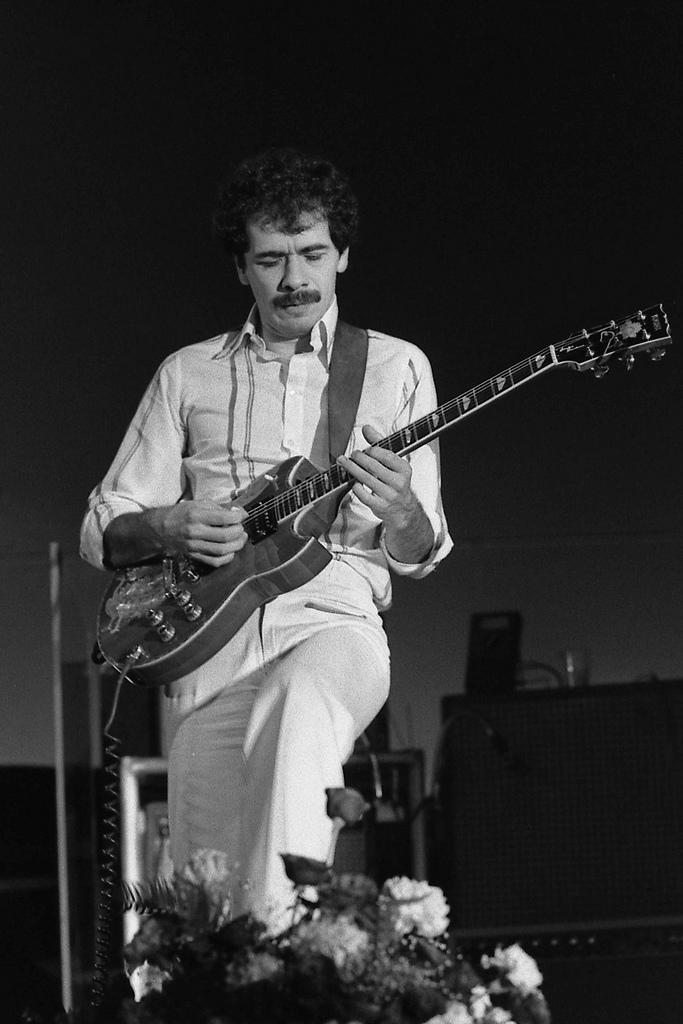
Photo: Chris Hakkens / Wikimedia Commons / CC BY-SA 2.0 Yamaha
SG-2000
1976
Santana told Yamaha to put a chunk of metal under the strings. They listened, and the notes stopped dying.
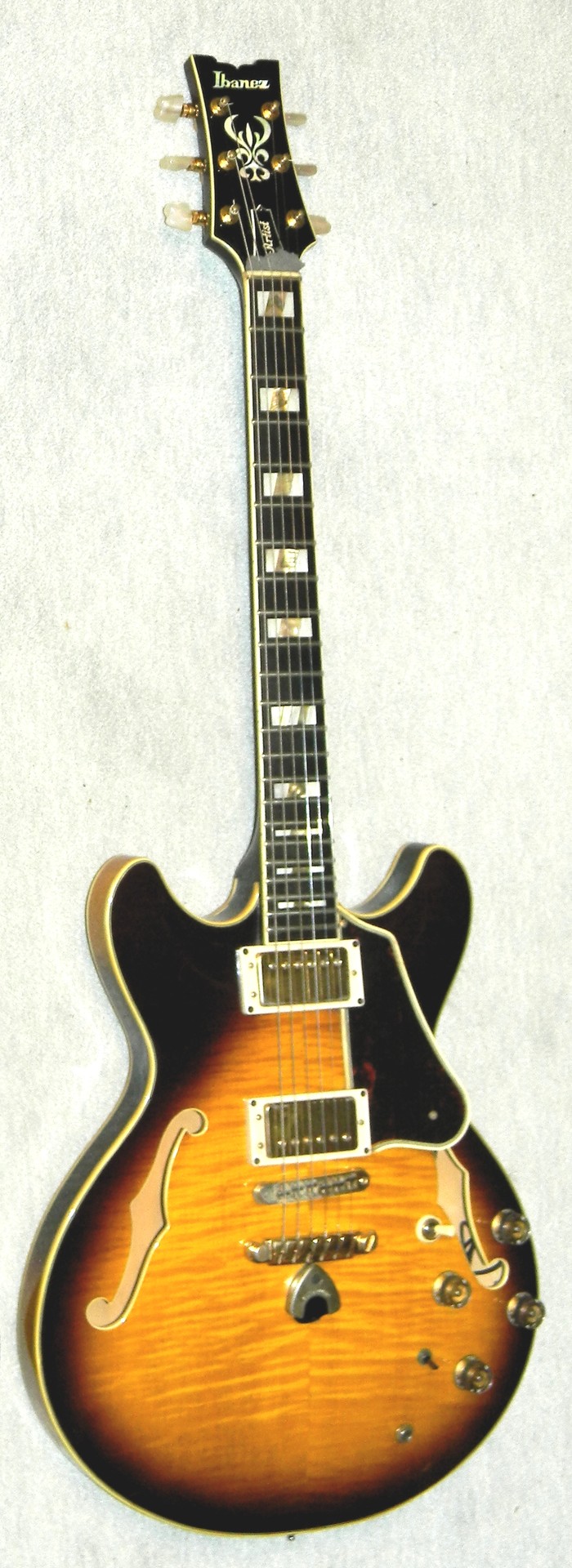
Photo: NSX-Racer / Wikimedia Commons / CC BY 3.0 Ibanez
AS200
1979
Ibanez handed John Scofield one in 1981. Twenty years later, they had to scan his to remember how it was made.